Climate change may be accelerating – Antarctic study reveals Earth’s lessened ability to absorb CO2
 Earth’s ability to absorb CO2 reduced by global warming, Antarctic study finds http://www.abc.net.au/news/2016-07-29/global-warming-reduces-earth-co2-absorption-arctic-study/7673032 By Stephanie Smail Global warming reduces the amount of carbon dioxide the earth can absorb, which could amplify climate change, landmark research in Antarctica has revealed.
CSIRO researchers extracted ice bubbles in pre-industrial polar ice to measure the planet’s sensitivity to changes in temperature.
They found that for every degree Celsius of global temperature rise, the equivalent of 20 parts per million less CO2 is stored by the land biosphere.
CSIRO principle research scientist Dr David Etheridge said the research confirmed the relationship for the first time and revealed how it impacted the cycles of carbon between land, ocean, and the atmosphere.
“That’s useful to know. It’s a bit concerning because it’s going to amplify the climate change, but it’s good news in a way because it can be used in modelling.”
The research team used ice core samples from the Australian Antarctic Program’s unique Law Dome site, together with ice cores from the British Antarctic Survey.
The study focused on CO2 changes preserved in ice before, during, and after a naturally-cool period known as the Little Ice Age (1500 to 1750 AD).
“It gives global planners something to work with, to help estimate what CO2 emissions are allowable to limit global warming to one and a half or two degrees Celsius,” Dr Etheridge said.
The finding is a result of a collaboration between CSIRO, the Seconda Universita di Napoli, University of Melbourne, British Antarctic Survey, University of East Anglia, Australian Antarctic Division, University of Tasmania, and the Australian Nuclear Science and Technology Organisation.
Accuracy of climate modelling in predicting ocean and atmospheric warming
since 1992, the models have been within 3 % of the measurements. In my mind, this agreement is the strongest vindication of the models ever found, and in fact, in our study we suggest that matches between climate models and ocean warming should be a major test of the models
Climate models are accurately predicting ocean and global warming, Skeptical Science 27 July 2016 by John Abraham
For those of us who are concerned about global warming, two of the most critical questions we ask are, “how fast is the Earth warming?” and “how much will it warm in the future?
The first question can be answered in a number of ways. For instance, we can actually measure the rate of energy increase in the Earth’s system (primarily through measuring changing ocean temperatures). Alternatively, we can measure changes in the net inflow ofheat at the top of the atmosphere using satellites. We can also measure the rate of sea-level rise to get an estimate of the warming rate.
Since much of sea-level rise is caused by thermal expansion of water, knowledge of the water-level rise allows us to deduce the warming rate. We can also use climate models (which are sophisticated computer calculations of the Earth’s climate) or our knowledge from Earth’s past (paleoclimatology).
Many studies use combinations of these study methods to attain estimates and typically the estimates are that the planet is warming at a rate of perhaps 0.5 to 1 Watt per square meter of Earth’s surface area. However, there is some discrepancy among the actual numbers.
So assuming we know how much heat is being accumulated by the Earth, how can we predict what the future climate will be? The main tool for this is climate models (although there are other independent ways we can study the future). With climate models, we can play “what-if scenarios” and input either current conditions or hypothetical conditions and watch the Earth’s climate evolve within the simulation.
Two incorrect but nevertheless consistent denial arguments are that the Earth isn’t warming and that climate models are inaccurate. A new study, published by Kevin Trenberth, Lijing Cheng, and others (I was also an author) answers these questions.
The study was just published in the journal Ocean Sciences; a draft of it is available here. In this study, we did a few new things. First, we presented a new estimate of oceanheating throughout its full depth (most studies only consider the top portion of the ocean). Second, we used a new technique to learn about ocean temperature changes in areas where there are very few measurements. Finally, we used a large group of computer models to predict warming rates, and we found excellent agreement between the predictions and the measurements.
According to the measurements, the Earth has gained 0.46 Watts per square meter between 1970 and 2005. Since, 1992 the rate is higher (0.75 Watts per square meter) and therefore shows an acceleration of the warming. To put this in perspective, this is the equivalent of 5,400,000,000,000 (or 5,400 billion) 60-watt light bulbs running continuously day and night. In my view, these numbers are the most accurate measurements of the rate at which the Earth is warming.
What about the next question – how did the models do? Amazingly well. From 1970 through 2005, the models on average showed a warming of 0.41 Watts per square meter and from 1992-2005 the models gave 0.77 Watts per meter squared. This means that since 1992, the models have been within 3 % of the measurements. In my mind, this agreement is the strongest vindication of the models ever found, and in fact, in our study we suggest that matches between climate models and ocean warming should be a major test of the models……..http://www.skepticalscience.com/climate-models-accurately-predicting-ocean-global-warming.html
Hottest year on record – 2016 shaping up to be that
2016 set to be world’s hottest year on record, says UN, Guardian, 26 July 16
June marked 14th month of record heat for land and oceans with average global temperature reaching 1.3C above the pre-industrial era The world is on track for its hottest year on record and levels of carbon dioxide in the atmosphere have reached new highs, further fuelling global warming, the World Meteorological Organisation (WMO) has said.
June marked the 14th consecutive month of record heat for land and oceans, the United Nations agency said on Thursday. It called for the speedy implementation of a pact reached last December to limit climate change by shifting from fossil fuels to green energy by 2100.
The average temperature in the first six months of 2016 was 1.3C warmer than the pre-industrial era in the late 19th century, according to Nasa.
“This underlines more starkly than ever the need to approve and implement the Paris climate change agreement, and to speed up the shift to low carbon economies and renewable energy,” said the WMO secretary general, Petteri Taalas…….https://www.theguardian.com/environment/2016/jul/21/2016-worlds-hottest-year-on-record-un-wmo
USA’s African Methodist Episcopal church speaks out on climate change
 World can’t afford to silence us’: black church leaders address climate
change
One of the largest and oldest black churches in the US warns that black people are disproportionally harmed by global warming and fossil fuel pollution, Guardian, Oliver Milman, 24 July 16, African American religious leaders have added their weight to calls for action on climate change, with one of the largest and oldest black churches in the US warning that black people are disproportionally harmed by global warming and fossil fuel pollution.
The African Methodist Episcopal church has passed its first resolution in its 200-year history devoted to climate change, calling for a swift transition to renewable energy.
“We can move away from the dirty fuels that make us sick and shift toward safe, clean energy like wind and solar that help make every breath our neighbors and families take a healthy one,” states the resolution, which also points to research showing that black children are four times as likely as white children to die from asthma.
“Damage to our climate puts the health of children, elderly, and those with chronic illnesses at greater risk and disproportionately impacts African Americans. We believe it is our duty to commit to taking action and promoting solutions that will help make our families and communities healthier and stronger,” stated Bishop John White, president of the council of bishops of the AME church.
The resolution follows an open letter sent by African American clergy last year that called for political leaders to take “bold action to address climate change”……..
Dupont-Walker said that the church’s voter mobilization campaign will work throughout the 2016 election cycle to question candidates on climate change. Local officials and landlords will also be put under pressure over inadequate housing and infrastructure that helps spread pollution to black communities.
According to the NAACP, African Americans emit far less carbon dioxide per person compared with white people and yet will bear the brunt of heat-related deaths, due to the concentration of black people in cities…….https://www.theguardian.com/environment/2016/jul/24/african-methodist-episcopal-church-climate-change-letter
Heatwave deaths linked to climate change
 Study links heatwave deaths in London and Paris to climate change, Skeptical Science 23 July 16 [good charts etc] This is a re-post from Carbon Brief by Robert McSweeney In 2003, more than 70,000 people across Europe died in a sweltering heatwave that spanned much of the summer. France was among the worst-affected countries, with 15,000 deaths in August alone. In the UK, the summer saw more than 2,000 heat-related fatalities.
A new first-of-a-kind study works out how many of the deaths in Paris and London are down to the heatwave being intensified by human-caused climate change. The findings suggest that 506 of the 735 summer fatalities in Paris in 2003, and 64 of the 315 in London, were a result of human influence on the climate.
Human influence The European summer heatwave of 2003 has been something of a focal point for scientists looking at if and how human-caused climate change influences extreme weather events.
In 2004, the heatwave was the subject of the first ever attribution study, which found thatclimate warming from human activity had at least doubled the likelihood of such an event. In 2014, another study found that a similar “extremely hot” summer in Europe has become 10 times more likely over the last 10-15 years because of climate change.
Taking this a step further, the new study, published in Environmental Research Letters, attributes the number of deaths during the 2003 heatwave to our warming climate.
The study makes use of the weather@home project, where members of the public offer spare capacity on their home computers for scientists to run model simulations.
The researchers ran thousands of simulations of European weather in 2003. One set of model runs simulated the weather according to the climate as it was – i.e. in a world warmed by past greenhouse gas emissions. The second set simulated the weather in a hypothetical world with no human influences on climate.
The researchers then compared the heat and humidity between the hypothetical world and the one better matched to reality to see how they affect the number of premature deaths in the summer of the same year. Lead author Dr Daniel Mitchell, a researcher in the Department of Physics at the University of Oxford, explains to Carbon Brief:
“We have a statistical relationship between the number of additional deaths per degree of warming. This is specific to a certain city, and changes a lot between cities. We use climate simulations to calculate the heat in 2003, and in 2003 without human influences. Then we compare the simulations, along with the observations.”
The authors’ comparison shows that human-induced climate change was responsible for 70% of heat-related deaths in central Paris, and 20% in Greater London.
This means, of the 735 heat-related deaths in Paris during the summer of 2003, 506 were due to human-caused climate change. For London, it was 64 out of 315.
Heat-related deaths …….Between June and August 2003, the total rate of heat-related deaths was 4.5 per 100,000 people for London and 34 per 100,000 for Paris, the paper says. Note, these figures differ from those in the charts below [on original] because they’re totals for the whole summer, rather than the heat-deaths per day, which the charts show.
As the study looked at just two affected cities, the total number of deaths due to the influence of climate change on the heatwave will be much higher, the paper notes:
“London and Paris are just two of a large number of cities that were impacted by the 2003 heatwave, therefore the total European-wide mortality count attributable to anthropogenic climate change is likely to be orders of magnitude larger than this.”
Future heatwaves The study is the first to apply a standard attribution methodology to look at mortality during a specific extreme weather event, says Dr Nikos Christidis from the Met Office, who wasn’t involved in this study, but authored another about European heatwaves. He tells Carbon Brief about the benefits of using this approach:
“An obvious one is that the study analyses mortality – i.e. a direct impact measure – rather than temperature – an indirect impact measure, which might be more useful to some decision makers.”……..http://www.skepticalscience.com/study-links-heatwave-deaths-london-paris-climate-change.html
|

Links between global warming and massive heat waves
What science can tell us about the links between global warming and massive heat waves, WP, By Chris Mooney July 21 The United States is witnessing a massive, dangerous heat wave, as a huge system of high pressure covers the central part of the country. It’s a big enough deal that yesterday President Obama even tweeted about it, including a map showing the maximum heat index in some parts of the Midwest and Southeast reaching 110 or 115 degrees on Saturday.
Here in Washington, temperatures could break 100 degrees Friday or over the weekend.
[D.C.’s summer heat is rapidly becoming more oppressive, analysis finds]
This will, inevitably, lead to much talk of climate change in the coming days. So it’s important to separate the scientific wheat from the chaff and figure out what science can, and can’t, reliably say about the link between an event like this and a warming planet — especially in a year that, on a global scale, has shattered past temperature records for six out of the last six months.
[June sets another global temperature record, extending a blazingly hot year]
And the gist is that when it comes to extreme heat waves in general — heat waves that appear out of the norm in some way, for instance in their intensity, frequency, or duration — while scientists never say individual events are “caused” by climate change, they are getting less and less circumspect about making some connection….
[It’s official: We can now say global warming made some weather events worse]……we’ve definitely already had changes in not only “long-term mean conditions,” but in heat waves themselves. The U.S. National Climate Assessment found that U.S. heat waves have already “become more frequent and intense,” that the U.S. is shattering high temperature records far more frequently than it is shattering low temperature records (just as you’d expect), and that it is seeing correspondingly fewer cold spells.
As for future projections, meanwhile, the assessment added that “Climate models project that the same summertime temperatures that ranked among the hottest 5% in 1950-1979 will occur at least 70% of the time by 2035-2064 in the U.S. if global emissions of heat-trapping gases continue to grow.”…..
“With every heat wave, probably the number one question is, is it climate change, or is it not? Well the answer is, it’s both,” said Texas Tech University climate scientist Katharine Hayhoe on a press call Thursday. “We get heat waves naturally, but climate change is amping them up, it’s giving them that extra energy, to make them even more serious, and have even greater impacts.” https://www.washingtonpost.com/news/energy-environment/wp/2016/07/21/what-science-can-tell-us-about-the-links-between-global-warming-and-massive-heat-waves/?wpisrc=nl_green&wpmm=1
World’s climate endangered by Russia’s wildfires
Russian wildfires put key climate change resource at risk, Japan Times, 22 July 16 AFP-JIJI, REUTERS JUL 22, 2016 MOSCOW – Russia’s practice of leaving massive wildfires to burn out of control in sprawling stretches of Siberia puts at risk a key global resource for absorbing climate-warming emissions: its trees.
The blazes are consuming millions of hectares of pristine Boreal forests in Russia, which are second only to the world’s tropical jungles in capturing planet-warming carbon emissions.
At the same time, the drier and harsher conditions associated with a warmer climate — June was the hottest ever recorded — are contributing to the fires becoming ever bigger and more common.
The World Meteorological Organization said Thursday that not only is the Earth on track for its hottest year on record, it is warming at a faster rate than expected.
Temperatures for the first six months of the year, coupled with an early and fast Arctic sea ice melt and “new highs” in heat-trapping carbon dioxide levels, point to quickening climate change, it said.
Russia’s forests annually absorb a net 500 million tons of carbon from the atmosphere, said Anatoly Shvidenko, who spent decades in the Soviet forestry system and served as an expert for the U.N.’s Intergovernmental Panel for Climate Change (IPCC).
That figure is the equivalent to the emissions put off over a year by 534 coal-burning power plants.
With expected climate change and current levels of forest protection in Russia, “forest fire danger and carbon emissions will double or triple by the end of the century,” added Shvidenko, saying authorities pay less attention to the problem now than in the 1990s or the Soviet era.
The thinning forests are most evident in northern Siberia, where fires can ravage plant life and shallow roots, making it impossible for trees to regrow for centuries.
Russian forest scientists call the process “green desertification,” said Shvidenko……
Scientists have been sounding the alarm over the fate of the planet’s boreal forests, also called taiga, which wrap around the northern hemisphere covering vast areas mainly in Canada and Russia, where they constitute 90 percent of all forest cover.
Wildfires in Canada this year have already amounted to the costliest disaster in the country’s history by causing $2.75 billion in damage, displacing about 100,000 people and sweeping through more than a million acres (405,000 hectares) of forest.
In Russia, 43 million hectares of forest managed by the national forest agency was lost between 2000 and 2011, mostly in the Far North, Shvidenko said, an area almost the size of Iraq.
This, combined with growing wildfires, could alter the role of Russia’s forests as a carbon sink, currently second only to the world’s tropical forests…….http://www.japantimes.co.jp/news/2016/07/22/world/science-health-world/russian-wildfires-put-key-climate-change-resource-risk/#.V5LjXdJ97Gi
Climate change threatens economies, as workers hampered by increasing heat
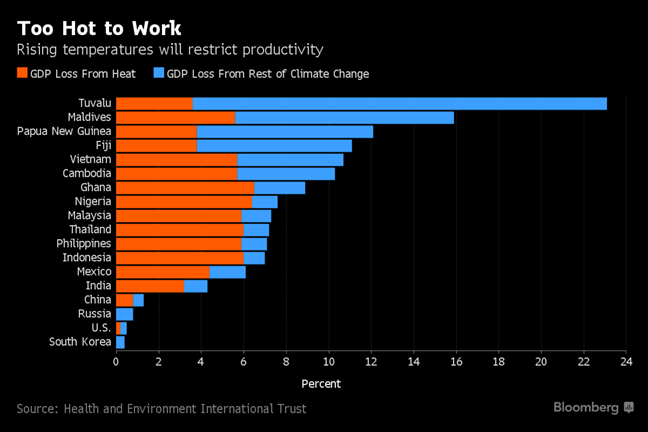
Hotter Temperatures Threaten Southeast Asian Economies: Chart http://www.bloomberg.com/news/articles/2016-07-19/too-hot-to-work, Jessica Shankleman July 19, 2016 Rising global temperatures may cost global economies more than $2 trillion by 2030, restricting working hours in some of the poorest parts of the world, according to United Nations research published Tuesday. As many as 43 countries, especially those in Southeast Asia, will experience declines in their economies because of heat stress, says Tord Kjellstrom, a director at the Health and Environment International Trust, based in Nelson, New Zealand.“With heat stress, you cannot keep up the same intensity of work, and we’ll see reduced speed of work and more rest in labor-intensive industries,” he said.
As with tobacco, the climate wars are going to court

Déjà vu: as with tobacco, the climate wars are going to court Skeptical Science
18 July 2016 by dana1981, JohnMashey Investigative journalism has uncovered a “web of denial” in which polluting industries pay “independent” groups to disseminate misinformation to the public and policymakers. The same groups and tactics were employed first by the tobacco industry, then fossil fuel companies. Big Tobacco has been to court and lost; now it’s Big Oil’s turn. Political leaders are choosing sides in this war.
Elizabeth Warren Rips Think Tanks & Policy Groups For Fake Climate Change Research
Research by Inside Climate News revealed that Exxon did top notch climate science research in the late 1970s and early 1980s, which revealed the dangers its products posed via climate change. Soon thereafter, Exxon launched misinformation campaigns by funding “think tanks” and front groups to manufacture doubt about climate science and the expert consensus on human-caused global warming.Exxon wasn’t alone. Koch Industries, Peabody Energy, and other fossil companies have similarly funneled vast sums of money to these groups. Last week, Senate Democrats, including presidential candidate Bernie Sanders and vice presidential contenders Elizabeth Warren and Al Franken signed a Resolution expressing congressional disapproval of the fossil fuel industry’s misinformation campaign.19 Senate Democrats also took to the floor of the Senate to speak out against the web of denial, with repeated references to the tobacco/fossil connections.
Senator Elizabeth Warren speaking about the web of denial on the Senate floor.
The climate battle goes to court
The fossil fuel industry has already put forth its best scientific argument in court,and lost. Now 17 state attorneys general, led by New York Attorney General Eric Schneiderman, have formed a coalition to investigate ExxonMobil’s activities. As Schneiderman put it:
The First Amendment, ladies and gentlemen, does not give you the right to commit fraud
However, Lamar Smith (R-TX), chairman of the House Science Committee, along with his Republican colleagues last week issued subpoenas to Schneiderman and Massachusetts Attorney General Maura Healey, accusing them of violating Exxon’s First Amendment rights. As Smith claimed:
The Committee has a responsibility to protect First Amendment rights of companies, academic institutions, scientists, and nonprofit organizations. That is why the Committee is obligated to ask for information from the attorneys general and others.
In this battle of First Amendment claims, Big Oil & Coal use the same argument as Big Tobacco, who lost.
The fossil fuel industry copied the tobacco playbook
Last century, we saw a similar battle with tobacco. By the 1950s, the tobacco industry knew that its products caused cancer and other diseases. They still marketed their harmful products to children, and soon created pseudo-academic institutes like the Council for Tobacco Research to cast doubt on smoking’s damage. However, the institutes’ connections to the tobacco industry were too obvious; they wanted “independent” voices.In the 1980s the Koch brothers started creating a vast web of “think tanks” that could simulate credible independence, funded via dark money, often tax-exempt. Big Tobacco eagerly joined, to “quarterback behind the scenes.” They contributed great marketing talent, some later hired by Kochs.As extensively documented at DeSmogBlog, Big Tobacco has long funded science-denying think tanks, such as the Heartland Institute, Heritage Foundation, Cato Institute, George Marshall Institute, American Legislative Exchange Council (ALEC), and Manhattan Institute, to name a few. ExxonMobil later funded these same groups.The fossil fuel industry has adopted the tobacco industry’s playbook, and shared the same web of denial. The Senate Resolution made this point, calling out both the tobacco and fossil fuel industries for having:
(A) developed a sophisticated and deceitful campaign that funded think tanks and front groups, and paid public relations firms to deny, counter, andobfuscate peer-reviewed science; and(B) used that misinformation campaign to mislead the public and cast doubt in order to protect their financial interest
Their tactics have grown more sophisticated, for example using money anonymizers like Donors Trust to ensure their “dark money” becomes even harder to trace.
The tobacco industry lost in court
In 1999, the US Justice Department filed a civil Racketeer Influenced and Corrupt Organizations Act (RICO) lawsuit against the major tobacco companies and their associated industry groups. In 2006, US District Court Judge Gladys Kessler ruledthat the tobacco industry’s campaign to “maximize industry profits by preserving and expanding the market for cigarettes through a scheme to deceive the public” about the health hazards of smoking amounted to a racketeering enterprise. She wrote a clear statement, appealed fruitlessly by tobacco companies:
The First Amendment Does Not Protect Defendants’ False and Misleading Public Statements
The attorneys general investigating Exxon have a strong case that the fossil fuel industry is similarly guilty of racketeering by deceiving the public in order to maximize profits. Exxon and other fossil fuel companies knew of the dangers of carbon pollution more than three decades ago, and yet funneled tens of millions of dollars to think tanks that disseminate misinformation to try to convince the public and policymakers otherwise.Sharon Eubanks led the Justice Department trial team, as documented in the book Bad Acts: The Racketeering Case Against the Tobacco Industry and was a key contributor to the report Establishing Accountability for Climate Change Damages. Of the Exxon case, she said:
I think a RICO action is plausible and should be consideredThe First Amendment defense of the fossil fuel industry by House Republicans simply doesn’t hold water. Defending the fossil fuel industry today is no different than defending the tobacco industry in the 1990s, as did Lamar Smith’s colleague“Smokey Joe” Barton (R-TX).Unsurprisingly, oil & gas is the top industry donor to Lamar Smith. History books will reflect poorly on those who sold out millions of peoples’ health for personal gain or industry profits, and on those who worked to destabilize the climate on which future generations will rely for the sake of their own political power orExxonMobil’s record profits. http://www.skepticalscience.com/deja-vu-climate-wars-going-to-court-like-tobacco.html
The $US2 trillions cost of climate change, as places too hot to work in
 Many places ‘too hot to work’ by 2030
 http://www.heraldsun.com.au/news/breaking-news/many-places-too-hot-to-work-by-2030/news-story/67761e405a9405d45d94279104016f7c Beh Lih Yi, AAP
It showed that in Southeast Asia alone, up to 20 per cent of annual work hours may already be lost in jobs with exposure to extreme heat with the figures set to double by 2050 as the effects of climate change deepen.
Across the globe, 43 countries will see a fall in their gross domestic product (GDP) due to reduced productivity, the majority of them in Asia including Indonesia, Malaysia, China, India and Bangladesh, Tord Kjellstrom, a director at the New Zealand-based Health and Environment International Trust, said. Indonesia and Thailand could see their GDP reduced by six per cent in 2030, while in China GDP could be reduced by 0.8 per cent and in India by 3.2 per cent.
Kjellstrom authored one of six papers on the impact of climate change on health that were put together by the United Nations University’s International Institute for Global Health in Kuala Lumpur and published in the Asia Pacific Journal of Public Health.
Kjellstrom warned that the lowest-paid workers – those in heavy labour, agricultural and manufacturing – were most at risk of exposure to extreme heat.
The other papers in the series showed around 2.1 million people worldwide died between 1980 and 2012 due to nearly 21,000 natural catastrophes such as floods, mudslides, extreme heat, drought, high winds or fires.
In Asia Pacific, 1.2 billon people have been affected by 1215 disasters – mostly floods, cyclones and landslides – since 2000.
The first three months of 2016 have broken temperature records and 2015 was the planet’s warmest year since records began in the 19th century.
UK and Germany of backtracking on the spirit of the Paris climate deal, funding fossil fuels


 UN criticises UK and Germany for betraying Paris climate deal
Climate change envoy singles out both countries for subsidising the fossil fuel industry and says the UK has lost its position as a climate leader, Guardian, Adam Vaughan, 18 July 16, Ban Ki-moon’s climate change envoy has accused the UK and Germany of backtracking on the spirit of the Paris climate deal by financing the fossil fuel industry through subsidies.
Mary Robinson, the former president of Ireland and UN special envoy on climate change and El Niño, said she had to speak out after Germany promised compensation for coal power and the UK provided tax breaks for oil and gas.
Governments in Paris last year not only pledged to phase out fossil fuels in the long term but to make flows of finance consistent with the reduction of greenhouse gas emissions.
“They’ve [the British government] introduced new tax breaks for oil and gas in 2015 that will cost the UK taxpayer billions between 2015 and 2020, and at the same time they’ve cut support for renewables and for energy efficiency,” she told the Guardian…..
The criticism comes as Theresa May’s government has come under fire at home and abroad for its leadership on climate change after it abolished the Department of Energy and Climate Change. Senior figures such as the outgoing UN climate change chief have urged the UK not to abandon its climate commitments as it leaves the EU. “Let us remember that the Brexit vote was not about climate change,” said Christiana Figueres.
Natalie Bennett, the leader of the Green party, said: “This damning indictment of the UK’s energy policy comes just days after our new prime minister scrapped the Department of Energy and Climate Change and appointed an environment secretary who has consistently voted against measures to tackle climate change.
“I urge Theresa May to listen carefully to Robinson’s remarks and start reversing the damaging policies put in place by her predecessor – like giving tax breaks to fossil fuel companies while cutting subsidies for renewables.”
Robinson said that while Germany had made some positive steps such as aiding developing countries on climate change, it was sending mixed messages.
Germany says its on track to end coal subsidies by 2018 but the German government is also introducing new mechanisms that provide payment to power companies for their ability to provide a constant supply of electricity, even if they are polluting forms, such as diesel and coal,” she said. She called on Germany to make a real commitment to get out of coal.
But she said her criticism was far from limited to the two countries. “We want all countries to end [fossil fuel] subsidies,” she said…..
The likely US Republican presidential nominee, Donald Trump, has said he would try to unpick the deal, but Robinson said if it was ratified by the US this year “unwinding it would be very prolonged and difficult. I sincerely hope we won’t be facing that problem.”
However Hillary Clinton would be good on climate because she had been pushed by Bernie Sanders to adopt an ambitious climate change platform, she said.
Robinson said she been to Ethiopia recently and seen firsthand the way manmade climate change was exacerbating natural climate phenomenons such as El Niño, which brings drought to some parts of the world, and flooding to others. “I saw so many malnourished children, and it’s not tolerable.”…….https://www.theguardian.com/environment/2016/jul/18/un-criticises-uk-and-german-for-betraying-the-spirit-of-the-paris-climate-deal
Montreal Protocol to be amended to phase out climate damaging hydrofluorocarbons
The world is poised to take the strongest action of this year against climate change, WP, By Chris Mooney July 18 When the world moved to phase out ozone-destroying chlorofluorcarbons, or CFCs, it solved one enormous and urgent environmental problem — but it left behind another. CFCs were bad for the ozone layer and also caused a great deal of global warming to boot. But a key substitute — hydrofluorocarbons, or HFCs — spare the ozone layer but are still powerful greenhouse warming agents.
That’s why diplomats and leading national ministers have assembled in Vienna this week for negotiations under the Montreal Protocol, the treaty that led to the phaseout of CFCs and is now aiming its sights at HFCs. If an amendment to the treaty can be adopted this year, advocates say, it could represent the single largest tangible piece of climate progress in all of 2016.
[The Antarctic ozone hole has finally started to ‘heal,’ scientists report]
HFCs are used in refrigerants in car and home air conditioners, as well as in foams, solvents and other products. They are being used more and more — in large part because they are the heirs to the CFC phaseout — and when they get into the atmosphere, they are far more powerful than carbon dioxide at warming the planet.
According to the Institute for Governance and Sustainable Development, which focuses on the issue, the “most abundant and fastest growing” of these gases, HFC-134a, remains in the atmosphere for 13.4 years (not nearly as long as carbon dioxide) but causes 1,300 times as much warming as carbon dioxide does over a span of 100 years. One recent study noted that by 2050, if nothing is done, HFC-134a could add 9 to 19 percent to the warming caused by carbon dioxide.
For the broader group of HFCs, one recent study found that HFC emissions as a whole grew from 198 million tons (as measured in carbon-dioxide equivalents) in 2007, to 275 million tons by 2012.
“The HFCs effect now is very small. The problem with the HFCs is it’s the fastest-growing greenhouse gas,” said Veerabhadran Ramanathan, a climate scientist at the Scripps Institution of Oceanography. “So by banning HFCs, you prevent another disaster downstream. It could be as high as half to one degree [Celsius] by the end of the century.”
Data like these explain why diplomats and leading national ministers have assembled in Vienna this week for negotiations under the Montreal Protocol, the treaty that led to the phaseout of CFCs and is now aiming its sights at HFCs. And signs look positive that a phase-down amendment could happen this year, giving a key boost to climate-change momentum, said Durwood Zaelke, head of the Institute for Governance and Sustainable Development……….
Granted, an amendment to phase out HFCs is not expected to be formally adopted this month in Vienna. Rather, that is more likely to occur at a second meeting, in October, in Kigali, Rwanda, meeting observers say.
If it is successful, then when the parties to the U.N. Framework Convention on Climate Change meet in Marrakesh, Morocco, in November to start the process of putting the Paris agreement into action, they will be riding a wave of accomplishment and be able to think rather optimistically about the work before them. Doniger wrote recently that achieving an HFC phaseout would represent “the biggest climate protection achievement of 2016.”
“The ozone treaty has been effectively a climate treaty also,” he said in an interview. “So it can be another win for the climate from the treaty that saved the ozone layer.”
Read more at Energy & Environment:
The world’s clouds are in different places than they were 30 years ago
Scientists think they’ve just pinpointed the key driver of ice loss in Antarctica
The diversity of life across much of Earth has plunged below ‘safe’ levels https://www.washingtonpost.com/news/energy-environment/wp/2016/07/18/this-could-do-more-to-save-the-planet-this-year-than-any-other-action/
Teresa May’s backward step in abolishing Climate Change Department
Climate change department closed by Theresa May in ‘plain stupid’ and ‘deeply worrying’
move Campaigners called for ‘urgent reassurance from the new government’ that the fight against climate change and pollution will not be ‘abandoned’ Independent Ian Johnston Environment Correspondent , 15 July 16 The decision to abolish the Department for Energy and Climate Change has been variously condemned as “plain stupid”, “deeply worrying” and “terrible” by politicians, campaigners and experts.
One of Theresa May’s first acts as Prime Minister was to move responsibility for climate change to a new Department for Business, Energy & Industrial Strategy.
Only on Monday, Government advisers had warned of the need to take urgent action to prepare the UK for floods, droughts, heatwaves and food shortages caused by climate change.
The news came after the appointment of Andrea Leadsom – who revealed her first question to officials when she became Energy Minister last year was “Is climate change real? – was appointed as the new Environment Secretary……..
Green Party MP Caroline Lucas described the decision as “deeply worrying”.
“Climate change is the biggest challenge we face, and it must not be an afterthought for the Government,” she said.
“Dealing with climate change requires a dedicated Minister at the Cabinet table. To throw it into the basement of another Whitehall department, looks like a serious backwards step.”
She said she would work with any Minister “willing to take climate change seriously”, but added she would seek to hold Government to account for “any backpeddling on our climate change commitments”.
Craig Bennett, chief executive of Friends of the Earth, pointed out that a major report into the effects of climate change on Britain had made clear that it was already happening.
“This is shocking news. Less than a day into the job and it appears that the new Prime Minister has already downgraded action to tackle climate change, one of the biggest threats we face,” he said…….
A letter by DECC’s permanent secretary, Alex Chisholm, to staff in his department, which was leaked to Civil Service World, confirmed that its responsibilities were being transferred to the new Department for Business, Energy and Industrial Strategy, under its new Secretary, Greg Clark…….http://www.independent.co.uk/environment/climate-change-department-killed-off-by-theresa-may-in-plain-stupid-and-deeply-worrying-move-a7137166.html
New Zealand set to get stream of refugees: Pacific atolls ‘could be underwater by 2050
Pacific atolls ‘could be underwater by 2050 Radio New Zealand Chris Bramwell, Deputy Political Editor – @chrisbramwell, 15 July 16 The government is being warned to prepare for an impending stream of refugees from the Pacific as low-lying atolls are swamped by sea-level rise over the coming decades.

Labour is also calling for the government to take a humanitarian approach to people from the region
who are overstayers in New Zealand.
United Nations warns if sea level rise continues at the current rate, the Pacific atolls of Kiribati and Tuvalu could be completely submerged within decades……
Labour’s Su’a William Sio said the people of the Pacific were fighting a losing battle. The government could take a more sympathetic approach to overstayers from Kiribati and Tuvalu and not send them back to islands already under pressure, he said.
“The main islands they’ve got issues not just with climate change, but with population growth and waste on both Tuvalu and Kiribati, so I think we’ve got to seriously look at what we do with that, and my view is that we need to adopt a humanitarian stance with the overstayers that are here.”
Climate change refugees might not be a serious issue now, but they would become one, he said.
“The overwhelming scientific evidence is telling us these islands will be underwater by 2050 or 2070, so we actually do need to have a strategic long term plan in preparation to help these islanders because we can’t just sit around once those islands are underwater.”…..http://www.radionz.co.nz/news/political/308703/pacific-atolls-could-be-underwater-by-2050
Britain’s new Government axes climate department
 Government axes climate department By Paul RinconScience editor, BBC News website, 14 July 16, The government has axed the Department of Energy and Climate Change (Decc) in a major departmental shake-up.
The brief will be folded into an expanded Department of Business, Energy and Industrial Strategy under Greg Clark.
Ed Miliband, the former energy and climate secretary under Labour, called the move “plain stupid”.
It comes at a time when campaigners are urging the government to ratify the Paris climate change deal…….One of the most pressing items on the environment agenda is the ratification of the Paris climate deal, which was inked last year.
The climate “sceptic” group Global Warming Policy Forum has long demanded the demise of Decc, so alarm bells are ringing loudly for some green groups……
The Green Party and Friends of the Earth, for instance, see the move as potentially a major downgrade for climate as a government priority.
Decc has made the UK a world leader in climate policy, and scrapping the department removes the words “climate change” from the title of any department. Out of sight, out of mind, in the basement, perhaps…….http://www.bbc.com/news/science-environment-36788162
1 This Month





PLEASE OPPOSE HR 8255 AND S.3639 – bills would accelerate satellite deployment, with no environmental review or safeguards – https://ncstd5li.quorum.us/campaign/169331/
To see nuclear-related stories in greater depth and intensity – go to https://nuclearinformation.wordpress.com
-
Archives
- October 2026 (10)
- September 2026 (339)
- August 2026 (330)
- July 2026 (355)
- June 2026 (287)
- May 2026 (306)
- April 2026 (356)
- March 2026 (251)
- February 2026 (267)
- January 2026 (308)
- December 2025 (358)
- November 2025 (359)
-
Categories
- 1
- 1 NUCLEAR ISSUES
- business and costs
- climate change
- culture and arts
- ENERGY
- environment
- health
- history
- indigenous issues
- Legal
- marketing of nuclear
- media
- opposition to nuclear
- PERSONAL STORIES
- politics
- politics international
- Religion and ethics
- safety
- secrets,lies and civil liberties
- spinbuster
- technology
- Uranium
- wastes
- weapons and war
- Women
- 2 WORLD
- ACTION
- AFRICA
- Atrocities
- AUSTRALIA
- Christina's notes
- Christina's themes
- culture and arts
- Events
- Fuk 2022
- Fuk 2023
- Fukushima 2017
- Fukushima 2018
- fukushima 2019
- Fukushima 2020
- Fukushima 2021
- general
- global warming
- Humour (God we need it)
- Nuclear
- RARE EARTHS
- Reference
- resources – print
- Resources -audiovicual
- Weekly Newsletter
- World
- World Nuclear
- YouTube
-
RSS
Entries RSS
Comments RSS

