N.Y. Public Service Commission OKs multi-billion dollar nuclear industry bailout funded by ratepayers statewide, Riverhead Local, by Karl Grossman Aug 12, 2016 Riverhead and Southold Town residents, indeed people throughout Suffolk County and New York State, will be getting higher utility bills because the State Public Service Commission this month approved — despite strong opposition — a $7.6 billion bailout of aging nuclear power plants in upstate New York. Their owners have said are uneconomic to run without government support.
As a result, there will be a surcharge for 12 years on electric bills paid by residential and industrial customers through the state.
Governor Andrew Cuomo — who appoints the members of the PSC — has called for the continued operation of the nuclear plants in order to, he says, save jobs at them.
The bailout would be part of a “Clean Energy Standard” advanced by Mr. Cuomo. Under it, 50 percent of electricity used in New York by 2030 would come from “clean and renewable energy sources” — with nuclear power considered clean and renewable.
A North Fork resident, PSC member Patricia Acampora of Mattituck, joined the other three members of the commission in voting Aug. 1 for the bailout and “Clean Energy Standard.” She is a former New York State assemblywoman representing a district including Riverhead and Southold Towns. She is also ex-chairwoman of the Suffolk County Republican Party.
“Nuclear energy is neither clean nor renewable,” testified Pauline Salotti, vice chair of the Green Party of Suffolk County, at a recent hearing in Riverhead on the plan.
“Without these subsidies, nuclear plants cannot compete with renewable energy and will close. But under the guise of ‘clean energy,’ the nuclear industry is about to get its hands on our money in order to save its own profits, at the expense of public health and safety,” Jessica Azulay, program director of the Syracuse-based Alliance for a Green Economy, declared. Moreover, she emphasized, “Every dollar spent on nuclear subsidies is a dollar out of the pocket of New York’s electricity consumers—residents, businesses and municipalities” that should “instead” go towards backing “energy efficiency, renewable energy and a transition to a clean energy economy.”
The “Clean Energy Standard” earmarks twice as much money for the nuclear power subsidy than it does for renewable energy sources such as solar and wind. Its claim is that nuclear power is comparable because nuclear plants don’t emit carbon or greenhouse gasses—the key nuclear industry argument for nuclear plants nationally and worldwide these days because of climate change. What the industry does not mention, however, is that the “nuclear cycle” or “nuclear chain”—the full nuclear system—is a major contributor to carbon emissions. Numerous statements sent to the New York PSC on the plan pointed to this.
“Nuclear is NOT emission-free!” Manna Jo Greene, environmental director of the Hudson River Sloop Clearwater, wrote the PSC. The claim of nuclear power having ‘zero-emission attributes’ ignores emissions generated in mining, milling, enriching, transporting and storing nuclear fuel.” Further, “New York no longer needs nuclear power in its energy portfolio, now or in the future.
“Nuclear power is not carbon-free,” wrote Michel Lee, head of the Council on Intelligent Energy and Conservation Policy. “If one stage,” reactor operation itself, “produces minimal carbon…every other stage produces prodigious amounts.” Thus the nuclear “industry is a big climate change polluter…Nuclear power is actually a chain of highly energy-intensive industrial processes which—combined—consume large amounts of fossil fuels and generate potent warming gasses. These include: uranium mining, milling enrichment, fuel fabrication, transport” and her list went on. Further, “New York no longer needs nuclear power in its energy portfolio, now or in the future. Ten years ago the transition to a renewable energy economy was still a future possibility. Today it is well underway.”

In opposing the New York nuclear subsidy, Dr. Mark Z. Jacobson, professor of civil and environmental engineering and director of the Atmosphere/Energy Program at Stanford University, wrote in an op-ed in Albany Times Union, the newspaper in the state’s capitol, that he was “shocked” by the PSC’s “proposal that the lion’s share of the Clean Energy Standard funding would be a nuclear bailout.” He said “allowing the upstate nuclear plants to close now and replace them with equal energy output” from offshore wind and solar power “would be cheaper and would create more jobs.” The closure of the upstate plants “would jeopardize fewer than 2,000 jobs” while a “peer-reviewed study” he has done “about converting New York State to 100 percent clean, renewable energy – which is entirely possible now — would create a net of approximately 82,000 good, long-term jobs.”
The upstate nuclear power plants to be bailed out under the plan would be FitzPatrick, Nine Mile Point 1 and 2 and Ginna.
Reported Tim Knauss of the Post-Standard of Syracuse: “Industry watchers say New York would be the first state to establish nuclear subsidies based on environmental attributes, a benefit typically reserved for renewable energy sources such as wind and solar.” The ‘zero emission credits’ would be paid to nuclear plants based on a calculation of the economic value of avoiding greenhouse gas emissions that contribute to climate change.” Cuomo “directed the PSC to create subsidies for upstate reactors,” he wrote.
Reuters has reported that the nuclear “industry hopes that if New York succeeds, it could pressure other states to adopt similar subsidies” for nuclear plants. The headline of the Reuters story: “New York could show the way to rescue U.S. nuclear plants.”
The two Indian Point nuclear power plants 26 miles north of New York City are not now included in the plan but it “leaves the door open to subsidies” for them, Azulay says.
This would mean “the costs [of the bailout] will rise to over $10 billion.”…….http://riverheadlocal.com/2016/08/12/n-y-public-service-commission-oks-multi-billion-dollar-nuclear-industry-bailout-funded-by-ratepayers-statewide/
August 13, 2016
Posted by Christina Macpherson |
business and costs, climate change, politics |
Leave a comment
 And for 2020 Olympic Games, what about the nuclear radiation risk, too – close to Fukushima’s continuing disaster?
Climate change puts heat on future Games venues http://www.nzherald.co.nz/climate-change/news/article.cfm?c_id=26&objectid=11692866 Ben Hill 13 Aug 16 Climate change is set to make it too hot to host the Olympics in the world’s biggest cities, according to a university study.
University of Auckland collaborative research found about 90 per cent of the Northern Hemisphere’s most populous cities will become too hot and humid over the next 70 years to safely hold the Games.
Professor Alistair Woodward said the study focused on whether cities in the Northern Hemisphere would be able to stage the marathon without posing a significant risk to athletes.
“Only three cities in North America, two in Asia and none in Africa will fall in the low risk category,” he said.“Projections suggest the last cities with low-risk summer conditions will be Belfast, Dublin, Edinburgh and Glasgow.
“Increasing restrictions on when, where, and how the Games can be held owing to extreme heat are a sign of a much bigger problem,” Woodward said.
“If the world’s most elite athletes need to be protected from climate change, what about the rest of us?”
The study has been published in British medical journal the Lancet.
August 13, 2016
Posted by Christina Macpherson |
2 WORLD, climate change |
Leave a comment
 An epic Middle East heat wave could be global warming’s hellish curtain-raiser WP, By Hugh Naylor August 10 BAGHDAD — Record-shattering temperatures this summer have scorched countries from Morocco to Saudi Arabia and beyond, as climate experts warn that the severe weather could be a harbinger of worse to come.
In coming decades, U.N. officials and climate scientists predict that the mushrooming populations of the Middle East and North Africa will face extreme water scarcity, temperatures almost too hot for human survival and other consequences of global warming.If that happens, conflicts and refugee crises far greater than those now underway are probable, said Adel Abdellatif, a senior adviser at the U.N. Development Program’s Regional Bureau for Arab States who has worked on studies about the effect of climate change on the region.
“This incredible weather shows that climate change is already taking a toll now and that it is — by far — one of the biggest challenges ever faced by this region,” he said.
These countries have grappled with remarkably warm summers in recent years, but this year has been particularly brutal. Parts of the United Arab Emirates and Iran experienced a heat index — a measurement that factors in humidity as well as temperature — that soared to 140 degrees in July, and Jiddah, Saudi Arabia, recorded an all-time high temperature of nearly 126 degrees. Southern Morocco’s relatively cooler climate suddenly sizzled last month, with temperatures surging to highs between 109 and 116 degrees. In May, record-breaking temperatures in Israel led to a surge in heat-related illnesses.
Temperatures in Kuwait and Iraq startled observers. On July 22, the mercury climbed to 129 degrees in the southern Iraqi city of Basra. A day earlier, it reached 129.2 in Mitribah, Kuwait. If confirmed by the World Meteorological Organization, the two temperatures would be the hottest ever recorded in the Eastern Hemisphere.
[Two Middle East locations hit 129 degrees]
The bad news isn’t over, either. Iraq’s heat wave is expected to continue this week……..https://www.washingtonpost.com/world/middle_east/an-epic-middle-east-heat-wave-could-be-global-warmings-hellish-curtain-raiser/2016/08/09/c8c717d4-5992-11e6-8b48-0cb344221131_story.html
August 12, 2016
Posted by Christina Macpherson |
climate change, MIDDLE EAST |
1 Comment
The three ways we know sea levels are rising are from physical tide gauges, from satellites that measure the water height, and from satellites that measure where ice is stored across the globe.

Climate scientists make a bold prediction about sea level rise http://www.skepticalscience.com/climate-scientists-bold-prediction-slr.html 10 August 2016 by John Abraham
One of the great things about science is that it allows you to make predictions. Three topclimate scientists just made a very bold prediction regarding sea level rise; we should know in a few years if they are correct.
As humans emit greenhouse gases, it’s causing the Earth to warm. That’s indisputable and proven. We can actually measure the amount of extra heat. Since most of it ends up in the oceans, we can also measure other changes in the oceans.
For instance, the oceans are rising. We know that’s indisputable. Measurements taken from physical gauges and from satellites confirm sea level rise. The cause of the rise is more complex.
Part of the rise is from ocean warming – warm water is less dense so the sea level rises as temperatures increase. Another part of the rise is from melting ice, especially ice that is currently on land (like glaciers and ice sheets). As this ice melts and flows into the oceans, the water levels rise. A third reason for sea level changes is from alterations of where water is stored on the planet. For instance, changing rainfall patterns and storage of water underground, in lakes, or in the atmosphere can affect sea levels.
The three ways we know sea levels are rising are from physical tide gauges, from satellites that measure the water height, and from satellites that measure where ice is stored across the globe. While tide gauge measurements go back many years, they only measure water levels at their location. Many tide gauges have to be in place to get an accurate sense of what is happening globally.
Satellites, on the other hand, are much more capable of taking global measurements. The problem with satellites is they have only been taking measurements since approximately 1993 (not nearly as long as tide gauges). So scientists try to combine these two measurements to get a long-term and global picture of what is really happening.
A very recent paper published in Nature has evaluated the history of sea level rise, and what they find is really interesting. The lead author (John Fasullo from the National Center for Atmospheric Research) and his colleagues tried to determine if the rate of sea level rise is changing. That is, are the water levels rising linearly, the same amount each year? Or, is the rate increasing (faster and faster each year)?
Using satellite data, the authors found little evidence of an acceleration. However, they show that this is because the satellites began measuring in 1993, right after a large volcanic eruption (Mount Pinatubo). This eruption temporarily reduced global warming because particles from the eruption blocked sunlight. Just by coincidence, the timing of the satellites and the eruption has affected the water rise so that it appears to be linear. Had the eruption not occurred, the rate would have increased.
This allows the scientists to make a prediction:
Click here to read the rest
August 12, 2016
Posted by Christina Macpherson |
2 WORLD, climate change |
Leave a comment
 In 2007, the US Supreme Court ruled that the State of Massachusetts had legal standing to sue the EPA for its refusal to regulate greenhouse gases, specifically because Massachusetts showed that it was being harmed by global warming via sea level rise encroaching on its shores. In that case, the Supreme Court ruled that carbon dioxide is a pollutant.
In response to the Supreme Court decision, the EPA issued an endangerment finding concluding that, based on the available scientific evidence, carbon dioxide endangers public health and welfare, and must therefore be regulated as a pollutant.
The Clexiters deny that vast body of scientific evidence.
Rejection of experts spreads from Brexit to climate change with ‘Clexit’ http://www.skepticalscience.com/rejection-experts-from-brexit-to-clexit.html August 2016 by dana1981
Brexit support and climate denial have many similarities. Many Brexit Leave campaignleaders also deny the dangers of human-caused climate change. Older generations were more likely to vote for the UK to leave the EU and are more likely to oppose taking action on climate change; younger generations disagree, and will be forced to live with the consequences of those decisions. On both issues there’s also a dangerous strain of anti-intellectualism, in which campaigners mock experts and dismiss their evidence and conclusions.
With Brexit, the Leave campaign won the vote, and the UK economy is already feeling the consequences. As Graham Readfearn reported, a new group called “Clexit” (Climate Exit) has formed in an effort to similarly withdraw countries from the successful internationalclimate treaty forged last year in Paris. As
As the group describes itself:
Brexit was Britain’s answer to the growing over-reach of EU bureaucracies. Clexit is our answer to the push for global control through climate hysteria.
Clexit leaders are heavily involved in tobacco and fossil fuel-funded organizations, in what’s become known as “the web of denial.” The group’s president is Christopher Monckton, whose extensive misunderstanding of basic climate science was revealed in a thorough debunking by John Abraham, and who insists that President Obama was born in Kenya, among his many controversial and conspiratorial public statements. Its vice president is Marc Morano, who began his career working for Rush Limbaugh and is essentially the real-life version of the character Nick Naylor from the film Thank You for Smoking. Its secretary is Viv Forbes, who has been involved with coal industry for over 40 years and is associated with many fossil fuel-funded groups.
With feedback from the rest of the group’s members, Forbes prepared Clexit’s summary statement, which is full of myths and misinformation about economics, energy, laws, andclimate science. It includes this expression of compassionate concern over the plight of low-lying island nations that are being engulfed by rising seas:
Some of the biggest supporters of the Paris accord are small oceanic nations seeking welfare through handouts to save them from baseless predictions of rising sea levels, even though actual changes in sea levels are tiny and not unusual.
The fact is that sea level rise in Tuvalu has been effectively zero since accuratemeasurements commenced in 1993, on tide gauges set up by the Australiangovernment
This purported fact is actually a fiction: the tide gauge data show the rate of sea level rise in Tuvalu since 1993 is 4.3 mm per year, which is faster than the global average of 3.4 mm per year. And Tuvalu is only one among the many small island nations facing the loss of their homelands at the hands of global warming-caused sea level rise.
However, when it comes to energy use, Clexit’s compassion for developing countries becomes even clearer yet:
For developing countries, the Paris Treaty would deny them the benefits of reliable low-cost hydrocarbon energy, compelling them to rely on biomassheating and costly weather-dependent and unreliable power supplies, thus prolonging and increasing their dependency on international handouts. They will soon resent being told to remain forever in an energy-deprived wind/solar/wood/bicycle economy.
The problem with energy from burning fossil fuels is that it’s only “low-cost” if we ignore the tremendous costs of the damages its carbon pollution causes via climate change. Poorer countries are particularly vulnerable to those costs, both because they lack the wealth and resources to adapt to them, and because they tend to be located in already-hot geographic regions near the equator.
There’s a reason why 95% of expert economists agree that we should cut carbon pollution. Of course, the Clexiters deny that carbon dioxide is a pollutant:
Carbon dioxide is NOT a dangerous pollutant – it is a natural, non-toxic and beneficial gas which feeds all life on earth.
However, this was long ago decided in the courts. In 2007, the US Supreme Court ruled that the State of Massachusetts had legal standing to sue the EPA for its refusal to regulate greenhouse gases, specifically because Massachusetts showed that it was being harmed by global warming via sea level rise encroaching on its shores. In that case, the Supreme Court ruled that carbon dioxide is a pollutant.
In response to the Supreme Court decision, the EPA issued an endangerment finding concluding that, based on the available scientific evidence, carbon dioxide endangers public health and welfare, and must therefore be regulated as a pollutant.
The Clexiters deny that vast body of scientific evidence.
August 10, 2016
Posted by Christina Macpherson |
2 WORLD, climate change |
Leave a comment
Carteret climate refugees seek home A grassroots group in Bougainville is scrambling to relocate the Carteret Islanders before rising sea levels swallow their land forever. ABC News 7 Aug 16 By Lauren Beldi for Pacific Beat At only 1.5 metres above sea level at their highest point, the Carteret Islands are some of the first to succumb to the rising ocean tides.
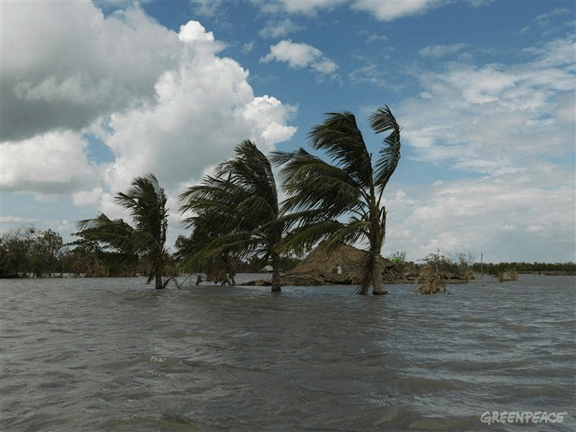
The grassroots Tulele Peisa group, which means “sailing the waves on our own” in the local Halia language, is hoping to relocate more than half of the population by 2020. They have secured land for new homes on the main island of the Autonomous Region of Bougainville, to the east of mainland Papua New Guinea.Tulele Peisa formed in late 2006 after the Council of Elders on the islands decided to establish their own relocation program. The group’s chief executive, Ursula Rakova, says the encroaching tides on the islands have a major impact on people’s health. “We’re beginning to get more requests for people wanting to move because of the situation and the dire need for food,” she says.
The storm surges not only wash away houses, but also vegetable gardens, which are critical for the islanders’ survival.
With no cash economy on the Carterets, the only source of food is what people are able to grow for themselves……
Tulele Peisa has also provided thousands of mangrove seedlings to prevent the erosion of the coastline, and helped to build raised garden beds. But this will only stave off the inevitable for so long.
“Those are adaptation strategies, they aren’t really long-term solutions to containing the islands, because we know the islands are going, but we are looking at supporting our families,” Ms Rakova says.
She says the islanders want to maintain their independent way of living but that the international community should provide more support.
“The islanders on the Carterets are victims of what other people have caused and the international community needs to aid and support the work that we are doing,” she says.
“We have found our way forward [and] we would like to share the way forward with other people, but we need this process to be funded financially so that we can continue to sustain ourselves.” http://www.abc.net.au/news/2016-08-07/carteret-climate-refugees-new-home/7693950?section=environment
August 8, 2016
Posted by Christina Macpherson |
climate change, OCEANIA, oceans |
Leave a comment
 Cities rush to measure climate footprint after Paris deal http://www.reuters.com/article/us-global-climatechange-cities-data-idUSKCN10F0D0 BARCELONA (Thomson Reuters Foundation) , 5 Aug 16 – The number of cities reporting on their efforts to tackle global warming has risen 70 percent to 533 around the world since the adoption of the Paris climate change agreement in 2015, the group collecting the data said.
The cities – which provide annual information on their planet-warming emissions, the climate hazards they face, renewable energy targets, risks to their water supply and other environmental aspects – now represent 621 million citizens globally, CDP said on Thursday.
“When cities measure their climate footprint and seek a sustainable path to green growth powered by clean energy, they take us all further towards the global transition to low emissions and resilient development,” said Patricia Espinosa, the new head of the U.N. climate change secretariat.
In December, 195 nations reached a deal to limit climate change by shifting from fossil fuels to green energies by 2100.
CDP, a UK-based non-profit formerly called the Carbon Disclosure Project, said more cities are doing an inventory of their greenhouse gas emissions, as a first step to managing their climate impact, amid growing awareness of climate risks.
Today four in 10 cities are measuring their emissions, compared with one in 10 cities in 2011, when CDP launched a program to help them reduce their emissions and adapt to climate change.CDP highlighted a nearly four-fold increase since last year in the number of African cities disclosing climate information, to 46 from 12.
Newcomers include Accra in Ghana, Kisumu in Kenya, Kinshasa in Democratic Republic of Congo and Antananarivo in Madagascar.
August 6, 2016
Posted by Christina Macpherson |
2 WORLD, climate change |
Leave a comment
“Very Serious”: Wildfires burn close to US nuclear site — ‘Red Flag Warning’ issued —
 FEMA: “Fire threatened such destruction as would constitute a major disaster” — Largest wildfire in country (VIDEO) http://enenews.com/very-serious-wildfires-burn-close-nuclear-site-red-flag-warning-issued-fema-fire-threatened-destruction-constitute-major-disaster-largest-wildfire-country-video?utm_source=feedburner&utm_medium=email&utm_campaign=Feed%3A+ENENews+%28Energy+News%29
NPR, Aug 3, 2016 (emphasis added): Washington Fire Crews Fight To Keep Buffer Between Wildfire, Nuclear Reactor — Officials from the Hanford nuclear reservation and Energy Northwest have been meeting with fire managers in southeast Washington state Tuesday. The nearby Range 12 Fire has grown to more than 177,000 acres and high winds are predicted this evening. Fire managers are very serious about keeping the Range 12 Fire off the central portion of the Hanford nuclear site and away from the Northwest’s only nuclear reactor… Energy Northwest spokesman John Dobken called the fire’s distance from the reactor a “non-issue,”… However, fire crews were still active on Rattlesnake Tuesday. Helicopters won’t be able to fly if gusts reach 20-30 miles per hour as predicted.
KEPR, Aug 2, 2016: The fire that began on the Yakima Training Center Saturday night and burned into Benton and Grant Counties over the weekend has ballooned to over 175,000 acres according to fire crews… The Range 12 fire [is] burning close to Hanford… The Northwest Incident Command team managing the firefighting efforts said [the blaze] is getting dangerously close to West Richland… A red flag warning is in place until 8 p.m. Tuesday night… Fire officials said the Red Flag Warning is causing concern for controlling containment lines around the blaze… As of Tuesday the Range 12 blaze stretched… from the Yakima Training Center toward the Hanford Reservation… Randall Rishe with BLM [Bureau of Land Management] said at this time they do not have a clear estimate of when the fire will be fully contained.
NPR, Aug 2, 2016: The Country’s Largest Wildfire Is Burning In Washington State… About 400 firefighters, three helicopters and 34 engines are fighting it. Some firefighters and land managers say they’re on edge because of predicted gusty winds and a red flag warning. The breeze is already kicking up, and firefighters worry that burned areas could pop up and jump the established fire lines. Crews set a backfire Sunday night on Rattlesnake Mountain to keep the Range 12 fire from burning contaminated areas of the Hanford Nuclear Reservation… [This] is the largest wildfire on a list of fires managed by government agencies.
KIRO, Aug 1, 2016: FEMA funds to help fight Benton County wildfire — A wildfire burning toward the Hanford nuclear reservation scorched about 110 square miles of brush and grass Monday as it spread… [FEMA] has authorized the use of federal funds to help with firefighting costs for the South Ward Gap Fire burning in Benton County, Washington. FEMA Region X Regional Administrator Kenneth D. Murphy determined that the fire threatened such destruction as would constitute a major disaster…
Seattle Times, Aug 2, 2016: Winds whip up wildfires; one blaze bearing down on Hanford site… winds pushed the Range 12 fire toward the Hanford Nuclear Reservation… Rishe said the fire Sunday ripped through grass, sagebrush and cheatgrass with ferocity… Crews are racing to put the fire down before winds make the situation more dangerous.
Seattle Times, Aug 2, 2016: Wildfire near Hanford site larger than first thought; high winds a concern — The Range 12 fire, near the Hanford nuclear site, is now 175,000 acres — much bigger than crews first realized… More than 400 firefighters are working the Range 12 fire, which is west of the Hanford nuclear site. Rishe said “there’s very low concern along Highway 240,” the barrier to the nuclear site. But, “it’s all contingent on this wind event.”
Tri-City Herald, Aug 2, 2016: Fire near Hanford much larger than thought… The estimated size of the fire that burned… toward the Hanford nuclear reservation has more than doubled to 273 square miles… A red flag fire warning was issued for the Mid-Columbia on Tuesday… The incident command team was concerned that established fire perimeter lines could be threatened… Crews have come from as far away as Medford, Ore., to help fight the fire.
Watch KEPR’s broadcast here
August 5, 2016
Posted by Christina Macpherson |
climate change, safety, USA |
Leave a comment
“Looking at a range of climate measurements, 2015 was yet another highly significant year,” she said. “Not only was 2015 the warmest year on record by a large margin, it was also another year when the levels of dominant greenhouse gases reached new peaks.”
The state of the climate report is now in its 26th year. The peer-reviewed series is published annually by the American Meteorological Society.
Environmental records shattered as climate change ‘plays out before us’ https://www.theguardian.com/environment/2016/aug/02/environment-climate-change-records-broken-international-report
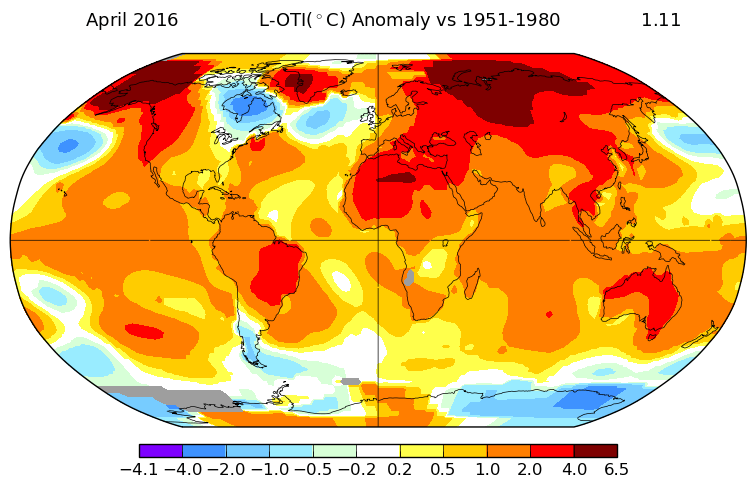
Temperatures, sea levels and carbon dioxide all hit milestones amid extreme weather in 2015, major international ‘state of the climate’ report finds, Oliver Milman , 3 Aug 16, The world is careening towards an environment never experienced before by humans, with the temperature of the air and oceans breaking records, sea levels reaching historic highs and carbon dioxide surpassing a key milestone, a major international report has found.
The “state of the climate” report, led by the National Oceanic and Atmospheric Administration (Noaa) with input from hundreds of scientists from 62 countries, confirmed there was a “toppling of several symbolic mileposts” in heat, sea level rise and extreme weather in 2015.
“The impacts of climate change are no longer subtle,” Michael Mann, a leading climatologist at Penn State, told the Guardian. “They are playing out before us, in real time. The 2015 numbers drive that home.”
Last year was the warmest on record, with the annual surface temperature beating the previous mark set in 2014 by 0.1C. This means that the world is now 1C warmer than it was in pre-industrial times, largely due to a huge escalation in the production of greenhouse gases. The UN has already said that 2016 is highly likely to break the annual record again, after 14 straight months of extreme heat aided by a hefty El Niño climatic event, a weather event that typically raises temperatures around the world.
The oceans, which absorb more than 90% of the extra CO2 pumped into the atmosphere, also reached a new record temperature, with sharp spikes in the El Niño-dominated eastern Pacific, which was 2C warmer than the long-term average, and the Arctic, where the temperature in August hit a dizzying 8C above average.
The thermal expansion of the oceans, compounded by melting glaciers, resulted in the highest global sea level on record in 2015. The oceans are around 70mm higher than the 1993 average, which is when comprehensive satellite measurements of sea levels began. The seas are rising at an average rate of 3.3mm a year, with the western Pacific and Indian Oceans experiencing the fastest increases.
These changes are being driven by a CO2 concentration that surpassed the symbolic 400 parts per million mark at the Mauna Loa research station in Hawaii last year. The Noaa report states that the global CO2 level was a touch under this, at 399.4ppm, an increase of 2.2ppm compared to 2014.
Noaa said other “remarkable” changes in 2015 include the Arctic’s lowest maximum sea ice extent in the 37-year satellite record, recorded in February 2015. The world’s alpine glaciers recorded a net annual loss of ice for the 36th consecutive year and the Greenland ice sheet, which would balloon sea levels by around 7m should it disintegrate, experienced melting over more than 50% of its surface.
The rapid changes in the climate may have profound consequences for humans and other species. In June last year, a severe heatwave claimed over 1,000 lives in Karachi, Pakistan. Severe drought caused food shortages for millions of people in Ethiopia, with a lack of rainfall resulting in “intense and widespread” forest fires in Indonesia that belched out a vast quantity of greenhouse gas.
Diminishing sea ice is causing major walrus herds to haul themselves out on to land. Arctic marine species, such as snailfish and polar cod, are being pushed out of the region by species coming from further south, attracted to the warming waters. A huge algal bloom off the west coast of North America harmed marine life and fisheries.
Scientists have said there were underlying climate change trends at play but last year was also influenced by the strong El Niño event, which is when equatorial Pacific waters warm, leading to an array of weather effects around the world. El Niño has also helped spur searing heat in 2016 but has now petered out.
Thomas Karl, director of Noaa national centers for environmental information, said that last year’s climate “was shaped both by long-term change and an El Niño event. When we think about being climate resilient, both of these time scales are important to consider.
“Last year’s El Niño was a clear reminder of how short-term events can amplify the relative influence and impacts stemming from longer-term warming trends.”
Kate Willett, a senior scientist at Britain’s Met Office, said that there was a 75% annual increase in the amount of land that experienced severe drought last year.
“Looking at a range of climate measurements, 2015 was yet another highly significant year,” she said. “Not only was 2015 the warmest year on record by a large margin, it was also another year when the levels of dominant greenhouse gases reached new peaks.”
The state of the climate report is now in its 26th year. The peer-reviewed series is published annually by the American Meteorological Society.
August 5, 2016
Posted by Christina Macpherson |
climate change, Reference |
Leave a comment
Washington Fire Crews Fight To Keep Buffer Between Wildfire, Nuclear Reactor, nw News Network, By ANNA KING • AUG 2, 2016 Officials from the Hanford nuclear reservation and Energy Northwest have been meeting with fire managers in southeast Washington state Tuesday. The nearby Range 12 Fire has grown to more than 177,000 acres and high winds are predicted this evening.
Fire managers are very serious about keeping the Range 12 Fire off the central portion of the Hanford nuclear site and away from the Northwest’s only nuclear reactor.
“We have firefighters and engines stationed around the entire perimeter of the fire and the entire flank of the eastern side where the Hanford site is,” Bureau of Land Management spokesman Randall Rishe said Tuesday. “So if there is a slop over, if there is a spot, they can get it immediately.”…….
The Range 12 Fire is currently the largest wildfire on a list of active wildfires across the U.S. being managed by government agencies. http://nwnewsnetwork.org/post/washington-fire-crews-fight-keep-buffer-between-wildfire-nuclear-reactor
August 5, 2016
Posted by Christina Macpherson |
climate change, safety, USA |
Leave a comment
Melting ice sheet could expose frozen Cold War-era hazardous waste, Eureka Alert, YORK UNIVERSITY TORONTO, AUG. 4, 2016 –Climate change is threatening to expose hazardous waste at an abandoned camp thought to be buried forever in the Greenland Ice Sheet, new research out of York University has found.Camp Century, a United States military base built within the Greenland ice sheet in 1959, doubled as a top-secret site for testing the feasibility of deploying nuclear missiles from the Arctic during the Cold War. When the camp was decommissioned in 1967, its infrastructure and waste were abandoned under the assumption they would be entombed forever by perpetual snowfall.
“Two generations ago, people were interring waste in different areas of the world, and now climate change is modifying those sites,” said William Colgan, a climate and glacier scientist at York U and lead author of the new study. “It’s a new breed of climate change challenge we have to think about.”
The study was published today in Geophysical Research Letters, a journal of the American Geophysical Union.
Climate change has warmed the Arctic more than any other region on Earth and the new research has found that the portion of the ice sheet covering Camp Century could start to melt by the end of the century. If the ice melts, the camp’s infrastructure, as well as any remaining biological, chemical and radioactive waste, could re-enter the environment and potentially disrupt nearby ecosystems, say the study’s authors. The wastes would not remain encased in ice forever, as was assumed by both the US and Denmark when the camp was abandoned. Determining who is responsible for cleaning up the waste could also lead to political disputes not considered before, said Colgan.
The study’s team took an inventory of the wastes at Camp Century and ran climate model simulations. The researchers also analyzed historical US army engineering documents to determine where and how deep the wastes were buried and how much that part of the ice cap had moved since the 1960s. They found the waste at Camp Century covers 55 hectares, roughly the size of 100 football fields…….
International law is clear about responsibility for preventing future hazardous waste, but ambiguous about who is liable for waste already discarded, said Jessica Green, a political scientist specializing in international environmental law at New York University who was not connected to the study. Although Camp Century was a US base, it is on Danish soil, and although Greenland is a Danish territory, it is now self-governing, she said…….
Although the camp was built with Denmark’s approval, the missile launch program, known as Project Iceworm, was kept secret from the Danish government. Several years after the camp became operational, Project Iceworm was rejected by the Joint Chiefs of Staff and the camp was decommissioned. The Army Corps of Engineers removed the nuclear reaction chamber but left the camp’s infrastructure and all other waste behind, assuming the ice sheet would secure them forever. In the decades since, falling snow has buried the camp roughly 35 meters further underneath the ice. http://www.eurekalert.org/pub_releases/2016-08/yu-mis080416.php
August 5, 2016
Posted by Christina Macpherson |
ARCTIC, climate change |
Leave a comment
 These two huge states are both going green. But only one is sticking with nuclear, WP
By Chris Mooney August 1 In June, the state of California — which has led the U.S. in putting electric cars on the road and switching to so-called clean electricity — took a
decisive turn in its quest to move away from carbon
–emitting fuels. An agreement between the large utility Pacific Gas and Electric and environmental and labor groups set a path for retiring the Diablo Canyon nuclear plant, and thus, for a state in which “carbon free” will not include energy generated through the splitting of atoms.
On Monday, though, New York — also a leader when it comes to greening power supplies — announced a very different route. The state’s Public Service Commission approved a Clean Energy Standard backed by Gov. Andrew Cuomo’s backed Clean Energy Standard. It seeks to get New York to 50 percent renewable electricity by the year 2030 — while also retaining the six nuclear reactors that currently provide more 30 percent of the state’s electricity. (These reactors would not count as part of the renewable 50 percent.)……….
many critics of nuclear energy persist, in the environmental community and elsewhere, and not all observers think New York necessarily made the right move.
“By not making them compete for a place in the low carbon portfolio, the state is almost assuring that the customers are going to pay more than they have to, and that some desirable alternative sources won’t get developed, because nuclear’s place in the picture is locked in,” said Peter Bradford, a former chair of the New York Public Service Commission and an adjunct professor at the Vermont Law School………
All sides will now watch how these two experiments — in New York, and California — play out. Nuclear provides a major stream of what is often termed “baseload” electricity, which is continuous and thus very different from wind and solar, which are much stronger at key times (solar, for instance, in the afternoon) and less available at others. Thus, integrating more wind and solar with less baseload, as California aims to do, presumably puts a greater emphasis on the use of energy efficiency measures (less electricity use over all), or energy storage (using electricity at a different time from when it is generated), to deal with these sources’ intermittency………https://www.washingtonpost.com/news/energy-environment/wp/2016/08/01/why-new-york-state-just-delivered-extremely-good-news-to-the-nuclear-industry/?utm_term=.20097475af56
August 5, 2016
Posted by Christina Macpherson |
climate change, ENERGY, politics, USA |
Leave a comment
Large fire burning toward Hanford nuclear reservation A fire burning on the Yakima Training Center near Moxee, shown here, has spread into Benton County near the Hanford nuclear reservation. Ronnie Butler Yakima Herald Republic Tri-City Herald,Yakima Herald-Republic and Walla Walla Union-Bulletin, 1 August 16 A large wildfire was burning toward the Hanford nuclear reservation Sunday after spreading from Grant and Yakima counties into Benton County overnight Saturday.
It was one of at least five wildfires burning Sunday in eastern Washington and Oregon, including a 1,000-acre fire that had residents evacuating a rural area near Prosser Sunday evening.
The larger Benton County fire burning toward Hanford, called the Range 12 Fire, was estimated to have burned 60,000 acres or about 94 square miles by early Sunday evening.
Sunday afternoon it was spreading across an unpopulated area between Highways 240 and 241, according to Benton County Emergency Services.
Firefighters were working to stop the fire before it reached the large wildland security zone maintained around the contaminated portion of the nuclear reservation. The security zone, which includes the peak of Rattlesnake Mountain, is part of the Hanford Reach National Monument………http://www.tri-cityherald.com/news/local/hanford/article92931342.html
August 1, 2016
Posted by Christina Macpherson |
climate change, safety, USA |
Leave a comment
 Sizzling Midwest Previews a Hotter Future Climate, Skeptical Science, 29 July 16 Extreme heat waves like the current string of scorching days in the Midwest have become more frequent worldwide in the last 60 years, and climate scientists expect that human-caused global warming will exacerbate the dangerous trend in coming decades. It comes with potentially life-threatening consequences for millions of people.
Research has shown that overall mortality increases by 4 percent during heat waves compared to normal days in the U.S. A study in the journal Environmental Health Perspectives in 2011 suggested that rising summer temperatures could kill up to 2,200 more people per year in Chicago alone during the last two decades of the 21st century.
“The climate is changing faster than we’ve ever seen during the history of human civilization on this planet, and climate change is putting heat waves on steroids,” Katharine Hayhoe, director of the Climate Science Center at Texas Tech University, said during a news conference on Thursday. “Heat waves are getting more frequent and stronger.”
Temperatures this week soared into the 90s from Minnesota to Iowa, combining with high humidity to send heat indices well above the 100-degree Fahrenheit mark, considered a threshold for conditions dangerous to human health.
Current temperatures in large parts of the Midwest have been rising steadily for more than 100 years, with accelerated warming in the past few decades. According to the 2014 National Climate Assessment, the average temperature in the region increased by more than 1.5 degrees Fahrenheit between 1900 and 2010. Between 1950 and 2010, the rate of increase doubled, and since 1980, the pace of warming is three times faster than between 1900 and 2010…….
“And when nighttime temperatures don’t cool off enough to give us a respite, that’s when we start to see an impact on health. Especially the elderly and people with respiratory problems start flooding emergency rooms.”
“The bottom line is we face a new normal and we’re adapting to it on the city and regional level,” said Christopher B. Coleman, mayor of St. Paul, Minn., and co-chair of the Mississippi River Cities & Towns Initiative. Also speaking during the press conference, he called the Mississippi River Valley an “acute climate impact zone,” and said some of the less obvious impacts of extreme heat includes urban stormwater runoff that creates thermal pollution when it hits hot pavement……
“The health consequences of climate change run an entire gamut, from worsening chronic disease, to an increase in vector and waterborne illnesses and disruption to food safety,” said Rev. Miriam Burnett, president of Resource and Promotion of Health Alliance, Inc, a faith-based nonprofit focusing on public health in African-American communities. Extremeheat events even have social consequences, including putting strain on human interactions and generating anger and hostility, she said.
Scientists say there’s little doubt that the buildup of heat trapping greenhouse gases is already causing more deadly heat waves worldwide. The increase has been widely documented and summarized in the latest Intergovernmental Panel on Climate Changeassessment…http://www.skepticalscience.com/sizzling-midwest-previews-hotter-climate.html
August 1, 2016
Posted by Christina Macpherson |
climate change, USA |
Leave a comment

 Over 10,000 Climate Protesters March in Philadelphia on Day Before Democratic National Convention DeSmog Blog By Sharon Kelly • Monday, July 25, 2016 Thousands of climate activists, public health advocates and others arrived in the streets before the first day of the Democratic National Convention, despite blazing heat that was just one degree shy of the hottest July 24 on record in Philadelphia. With temperatures in the mid-90s, a crowd that organizers estimated included over 10,000 marchers converged on Independence Mall near the home of the Liberty Bell.
“We’ve just wrapped up a Republican National Convention filled with climate denial and extreme energy talking points. Tomorrow we start the Democratic Convention, and the question to all these leaders and politicians is: Are you willing to take the action that science demands, or are you just another kind of climate denier?” said Drew Hudson, Director of Environmental Action. “Science tells us we need to keep 80% or more of fossil fuels in the ground: that means a ban on fracking, a halt to dirty trade deals like the TPP, and no more use of eminent domain for polluter gain. I’m marching today to tell all elected officials, if you’re not down to #KeepItInTheGround, you’re just another climate denier.”
Many of the protesters were local — noteworthy in a city long regarded as a Democratic stronghold. ……..
The protests in Philadelphia were already larger than those that confronted Trump and the Republican party in Ohio, according to those who attended both events. No arrests were reported on Sunday in Philadelphia, though one person was transported by ambulance to receive medical care for heat exhaustion.
At one point, the crowd of marchers nearly stretched the full length of the route between City Hall and Independence Mall.
“Our elected leaders must listen to the people,” said Wenonah Hauter, Executive Director of Food & Water Watch, one of the main organizers of the protest, “which is why over a thousand groups from all 50 states endorsed the March for a Clean Energy Revolution and called for the need to keep fossil fuels in the ground and focus on renewable energy options that will create jobs, not destroy lives.” http://www.desmogblog.com/2016/07/25/over-10-000-climate-protesters-march-philadelphia-day-democratic-national-convention
July 30, 2016
Posted by Christina Macpherson |
climate change, USA elections 2016 |
Leave a comment