Trump: U.S. will withdraw from Paris climate accord
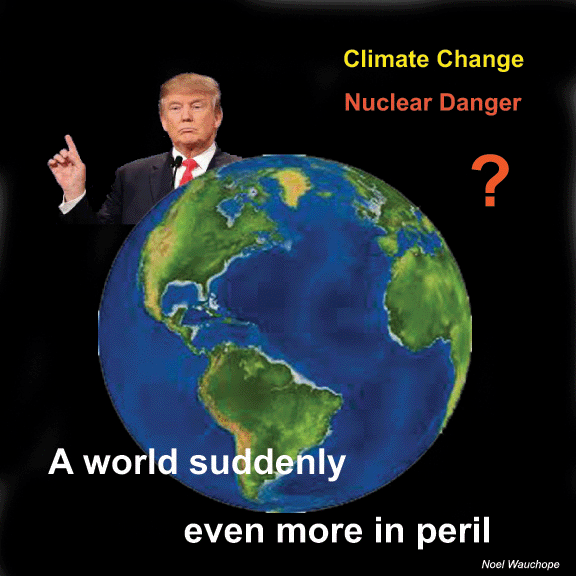
Paris climate deal: Donald Trump withdraws US from the accord, SMH, 2 June 17 Valerie Volcovici and Jeff Mason Washington: President Donald Trump on Thursday said he will withdraw the United States from the landmark 2015 global agreement to fight climate change, spurning pleas from US allies and corporate leaders in an action that fulfilled a major campaign pledge.
“We’re getting out,” Trump said at a ceremony in the White House Rose Garden in which he decried the Paris accord’s “draconian” financial and economic burdens.
“In order to fulfil my solemn duty to protect America and its citizens, the United States will withdraw from the Paris climate accord,” Trump said. But he added that the United States would begin negotiations to re-enter either the Paris accord or “a new transaction on terms that are fair to the United States, its businesses, its workers, its people, its taxpayers.”
With Trump’s action, the United States will walk away from nearly every nation in the world on one of the pressing global issues of the 21st century. The pullout will align the United States with Syria and Nicaragua as the world’s only non-participants in the accord.
The United States was one of 195 nations that agreed to the accord in Paris in December 2015, a deal that former US President Barack Obama was instrumental in brokering.
Supporters of the accord condemned Trump’s move as an abdication of American leadership and an international disgrace.
“At this moment, when climate change is already causing devastating harm around the world, we do not have the moral right to turn our backs on efforts to preserve this planet for future generations,” said US Senator Bernie Sanders, who sought the Democratic presidential nomination last year.
“Ignoring reality and leaving the Paris agreement could go down as one of the worst foreign policy blunders in our nation’s history, isolating the US further after Trump’s shockingly bad European trip,” Democratic Senator Sheldon Whitehouse added.
Former US president Barack Obama, who signed on to the accord, wasted no time in criticising Trump’s move. In a statement, Obama said the Trump administration was rejecting the future by pulling out of the climate pact……..
Under the pact, which was years in the making, nations both rich and poor committed to reducing emissions of so-called greenhouse gases generated by burning fossils fuels and blamed by scientists for warming the planet.
The United States had committed to reduce its emissions by 26 per cent to 28 per cent from 2005 levels by 2025. The United States, exceeded only by China in greenhouse gas emissions, accounts for more than 15 per cent of the worldwide total.
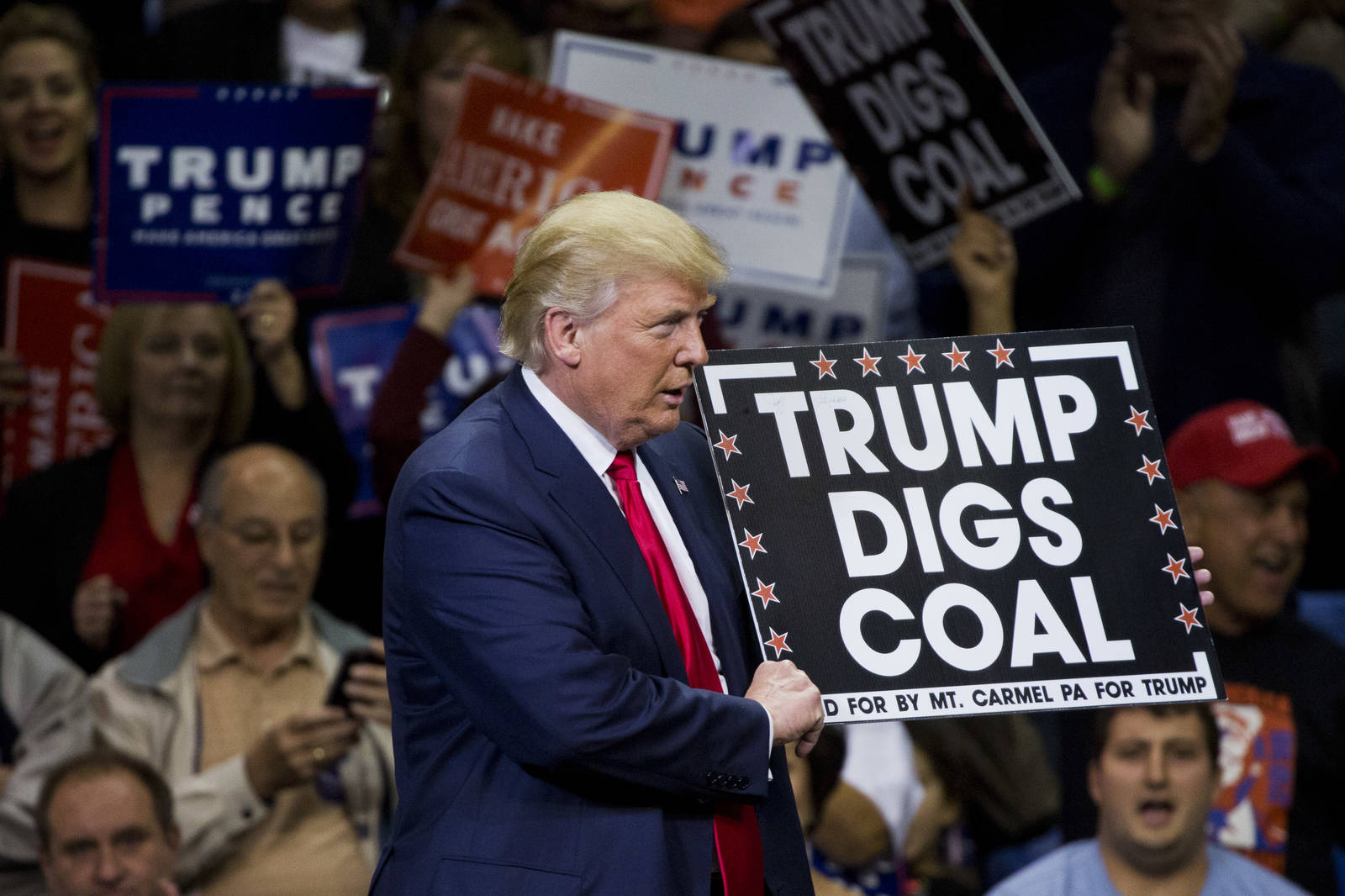
Trump, who campaigned for president last year with an “America First” message, promised voters an American withdrawal.
US supporters of the pact said any pullout by Trump would show that the United States can no longer be trusted to follow through on international commitments……..
In a statement backed by all 28 EU states, the EU and China were poised to commit to full implementation of the agreement, officials said.
Trump has already moved to dismantle Obama-era climate change regulations, including the US Clean Power Plan aimed at reducing emissions from main coal-fired power plants.
Some US states, including California, Washington and New York, have vowed to continue to reduce greenhouse gas emissions and continue engaging in the international climate agreement process.
Oil majors Shell and ExxonMobil Corp supported the Paris pact. Several big coal companies, including Cloud Peak Energy, had publicly urged Trump to stay in the deal as a way to help protect the industry’s mining interests overseas, though others asked Trump to exit the accord to help ease regulatory pressures on domestic miners. Reuters http://www.smh.com.au/world/paris-climate-deal-donald-trump-withdraws-us-from-the-accord-20170601-gwiord.html
While it fulfils Mr Trump’s election promise to pull out of the pact — which he has labelled a job killer — the announcement has caused widespread shock and outrage.
European leaders have condemned the decision and even big business is angry.
Former president Obama called the decision a “rejection of the future”, while former US vice president and ardent climate change campaigner Al Gore blasted Mr Trump’s move as “indefensible”.
“The worst part: There is absolutely no reason for it. Aside, perhaps, from bravado and arrogance,” he writes. Sutter said, in walking away from the agreement, Mr Trump was turning his back on the entire world and on the consensus of climate science. Continue reading →
Paris climate deal: Donald Trump to lose Elon Musk, Disney boss from advisory council, ABC News, 2 June 17 Billionaire entrepreneur Elon Musk and Disney chief executive Bob Iger say they will leave President Donald Trump’s advisory councils after he confirmed the United States would withdraw from the Paris climate accord…..
While the move was welcomed by conservative groups and Republicans, several business leaders — including Mr Musk and Mr Iger, and the heads of companies including Google, Facebook Shell and Amazon — have spoken out against the decision.
“Climate change is real. Leaving Paris is not good for America or the world,” Mr Musk said in a Twitter post. Mr Musk, who founded SpaceX and Tesla among other companies, had been a member of Mr Trump’s infrastructure council, manufacturing jobs council and his strategic and policy forum……
A couple of hours after Mr Musk’s announcement, Mr Iger also said he will be stepping down from the advisory council “as a matter of principle”. Other business leaders, such as Google chief executive Sundar Pichai, Microsoft president Brad Smith and General Electric CEO Jeff Immelt have tweeted that they were “disappointed” with the decision.
Facebook founder Mark Zuckerberg said stopping climate change is “something we can only do as a global community”.
Withdrawing from the Paris climate agreement is bad for the environment, bad for the economy, and it puts our children’s future at risk,” he wrote on Facebook.
Other global companies, including Intel, HP, Dell, Amazon and oil giant Shell have released statements expressing support for the Paris agreement.
“We believe that robust clean energy and climate policies can support American competitiveness, innovation, and job growth,” Amazon wrote on Twitter.
Meanwhile, the governors of three US states — New York, California and Washington — announced they would form a “United States Climate Alliance” to convene states “committed to upholding the Paris climate agreement”.
By Graham Readfearn • Wednesday, May 31, 2017, On the face of it, the climate science conference scheduled for the romantic Italian city of Rome looks like any other.
The organizers, India-based ConferenceSeries, promise their “4th World Conference on Climate Change” will attract “world class experts” from across the planet.
Anticipating “more than 500 participants,” the event claimed to have an organizing committee with representatives from the UN’s World Meteorological Organization (WMO), the European Space Agency, and the European Environment Agency (EEA).
But a DeSmog investigation reveals the event is being hijacked by a group of climate science deniers who have previously claimed they want to investigate climate scientists for fraud and have dismissed human-caused climate change as a hoax.
Since being contacted by DeSmog, both the WMO and the EEA have issued statements distancing themselves from the three-day conference, scheduled to start on October 19.
ConferenceSeries, also known as OMICS, promotes hundreds of meetings around the world and is behind the logistics and promotion for the Italy conference. In August 2016 the U.S. government’s Federal Trade Commission launched court action against the company, alleging deceptive marketing practices. The case is ongoing.
Seven presenters, including Monckton and Mörner, and one organizer of that London meeting, Maranzana, are also scheduled to speak at the Rome event. Continue reading →
The president’s decision not only harms the planet but goes against the wishes of the American public. President Trump’s decision to pull out of the Paris climate agreement is the latest demonstration of his administration’s complete disregard for the health and safety of the American people, the economy on which those families rely, and the future of the planet we all share.
The landmark 2015 climate agreement was negotiated by 197 countries and has been approved by 147 nations, including the United States. It is our best attempt yet to deal with the increasingly negative impacts of climate change.
China suspends permits for new coal plants as overcapacity policy bites, Energy Desk, May 16, 2017 by Zachary Davies Boren @zdboren The Chinese government has ordered the vast majority of its provinces to stop permitting new coal power projects.
This represents an update to the government’s ‘traffic light’ system, designed to tackle the country’s coal overcapacity crisis — that we reported on last year.
Last year the National Energy Administration kicked off a new scheme to determine whether provinces should build new coal- fired power stations.
The system, created so that the country would stop adding to its overcapacity crisis, assigns each province a colour to signify the viability of its coal pipeline — based on profitability, existing capacity and ‘resource constraints’ such as air pollution and water.
Red means no new coal projects should be permitted. Orange indicates local governments and coal companies should tread carefully. And green says that there is plenty space for new coal power.
24 provinces were issued red lights, 4 earned the orange light (which recommends not adding coal in much stronger language than last year) while only two were given the green light……..
We reported earlier this year that the permits for new coal plants in 2016 have declined 85% compared to 2015, but that the new permits are concentrated in areas of high water stress.
Data from the last two quarters (the end of 2016 and beginning of 2017) show this trend continues.
FT 1st June 2017US companies in industries from manufacturing and energy to information technology have reacted with dismay to the prospect of President Donald Trump withdrawing from the Paris climate agreement, warning that pulling out of the accord would hit jobs and investment.
Businesses have raised concerns about the impact on markets for products that can help cut greenhouse gas emissions, and warned that countries remaining in the accord could impose retaliatory tariffs on American goods.
However, some groups have said they will press ahead with investments in emissions-reducing technologies, saying they expect continued long-term growth in demand despite the lack of support from the US administration. Leading US
companies including Apple, Facebook, Google, Intel and Microsoft have taken out an advertisement in US newspapers on Thursday with an open letter to Mr Trump arguing that the Paris agreement generates jobs and economic growth
by expanding the markets for innovative environmentally friendly technologies. It warns that withdrawal would limit US access to those markets. https://www.ft.com/content/5f2b6e06-4663-11e7-8519-9f94ee97d996
Energydesk 28th May 2017 On the very day Theresa May triggered Article 50, her government quietly issued another bold statement to Brussels. Documents obtained by Energydesk reveal UK government attempts to significantly weaken draft EU climate and energy rules, even as Brexit is underway.
Key renewable energy and energy efficiency targets proposed by the European Commission should be reduced, made non-binding, or even scrapped altogether, the UK said, despite the fact that they would not take effect until after the UK had left the EU.
“This smells of obstructionism,” Jonathan Gaventa, director of environmental think-tank E3G, told Energydesk. “The UK is pissing off countries it needs as allies.” The news comes as the future of the Paris climate agreement hangs in the balance, with the United States refusing to commit to the deal at the G7 meeting.
President Trump has privately told multiple people, including EPA Administrator Scott Pruitt, that he plans to leave the Paris agreement on climate change, according to three sources with direct knowledge.
Publicly, Trump’s position is that he has not made up his mind and when we asked the White House about these private comments, Director of Strategic Communications Hope Hicks said, “I think his tweet was clear. He will make a decision this week.”
Why this matters: Pulling out of Paris is the biggest thing Trump could to do unravel Obama’s climate policies. It also sends a stark and combative signal to the rest of the world that working with other nations on climate change isn’t a priority to the Trump administration. And pulling out threatens to unravel the ambition of the entire deal, given how integral former President Obama was in making it come together in the first place.
Caveat: Although Trump made it clear during the campaign and in multiple conversations before his overseas trip that he favored withdrawal, he has been known to abruptly change his mind — and often floats notions to gauge the reaction of friends and aides. On the trip, he spent many hours with Ivanka Trump and Jared Kushner, powerful advisers who back the deal.
Behind-the-scenes: The mood inside the EPA this week has been one of nervous optimism. In a senior staff meeting earlier this week, Pruitt told aides he wanted them to pump the brakes on publicly lobbying for withdrawal from Paris.
Instead, the EPA staff are quietly working with outside supporters to place op eds favoring withdrawal from Paris.
The White House has told Pruitt to lay off doing TV appearances until Trump announces his decision on Paris. (In past weeks, the EPA Administrator has gone on TV to say the U.S. needs to quit Paris, but Pruitt told aides he’ll be keeping a lower profile. He doesn’t want a Paris withdrawal to be seen as his victory. “It needs to be the President’s victory,” one source said, paraphrasing what Pruitt has told aides.)
Pruitt’s aides have told associates in recent days that they remain confident the President will withdraw from Paris but they’ve been worried about him being overseas and exposed to pressure from European leaders and the environmentalist views of his top aides like Ivanka and economic adviser Gary Cohn. Top EPA staff were relieved when Trump refused to join the other six nations of the G7 in reaffirming “strong commitment” to the Paris agreement.
One level deeper: If Trump follows through and announces publicly he plans to withdraw from the Paris deal, an administration official laid out three ways he could do that:
Trump could announce he is pulling the U.S. from the deal, which would trigger a withdrawal process that wouldn’t conclude until November 2020 at the earliest. Under the deal’s terms, any country can’t send notice of its intent to withdraw until three years after the deal entered into force, which was Nov. 4, 2016. The actual process of withdrawal would then take one year. In this time, it’s feasible Trump could change his mind, the administration source said.
Trump could declare that the Paris deal is actually a legal treaty that requires Senate approval. Such a vote would fail, and then Trump would have Senate backing to not abide by the deal, which he deems a treaty. A letter that 22 Senate Republicans, including Senate Majority Leader Mitch McConnell, sent to Trump this week urging him to withdraw from the deal, increases the odds of this happening, the source said. Trump could also call for a Senate vote in combination with either the first or third option.
Trump could withdraw the U.S. from the treaty that underpins the Paris deal, which is called the United Nations Framework Convention on Climate Change. This would be the most extreme option because it would take the U.S. out of all global climate diplomacy. This process would take just one year.
Will we always have Paris? All of these scenarios take more time and maneuvering than a simple announcement, which ensures the debate about what to do with the climate deal won’t be over with any time soon.
G7 summit ends with split between Donald Trump, other leaders on climate change, ABC News, 28 May 17Under pressure from allies, US President Donald Trump has backed a pledge to fight protectionism, but refused to endorse a global climate change accord, saying he needed more time to decide.
Key points:
German Chancellor says climate talks were “difficult”
Donald Trump says he will decide on Paris Agreement next week
Final communique just six pages, compared to 32 last year
The summit of Group of Seven wealthy nations pitted Mr Trump against the leaders of Germany, France, Britain, Italy, Canada and Japan on several issues, with European diplomats frustrated at having to revisit questions they hoped were long settled.
Mr Trump, who has previously called global warming a hoax, tweeted that he would make a decision next week on whether to back the 2015 Paris Agreement on curbing carbon emissions following lengthy discussions with G7 partners.
“The entire discussion about climate was very difficult, if not to say very dissatisfying,” German Chancellor Angela Merkel told reporters.
“There are no indications whether the United States will stay in the Paris Agreement or not.”………
Security questions dominated initial G7 discussion on Friday and the leaders called on internet service providers and social media firms to “substantially increase” their efforts to rein in extremist content.
US officials said Mr Trump had enjoyed “robust” conversations with his allies in Sicily and had also learnt a lot — especially in the debate on climate change.
Critics have pointed to the rising seas from climate change, risks of storm surge, radioactive waste and threats to drinking water and wildlife at the site, nestled near Everglades National Park, as reasons to stop nuclear expansion.
Complaints have also centered on the difficulty of evacuating the densely populated area around the plant in case of emergency. Miami-Dade County is home to 2.6 million people.
“Investing tens of billions of dollars on a power plant that will be underwater one day, along with the highly radioactive waste it will produce, makes no sense,”
Why nuclear could become the next ‘fossil’ fuel, Afp, Homestead, United States, Daily Star 29 May 17 A gray dinosaur statue outside south Florida’s largest power plant is meant to symbolize two decommissioned fossil fuel reactors, but it also could be seen to represent a nuclear industry crumpling under mounting costs.
Almost a decade ago, Turkey Point was aiming to become one of the country’s largest nuclear plants.Florida Power and Light had argued that such expansion was needed to maintain diverse energy sources and to supply Florida’s booming population for years to come, while touting nuclear as a clean form of energy.
But now, just three reactors are in operation – one natural gas and two nuclear reactors, built in the 1970s. And plans to build two more nuclear reactors — first announced in 2009 — are essentially on hold for at least four years, according to filings with the state’s Public Service Commission……
The project has been controversial from the start, and casts the spotlight on wider concerns about nuclear power.
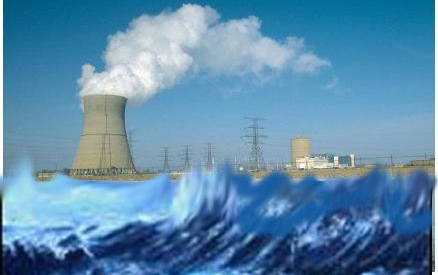
Critics have pointed to the rising seas from climate change, risks of storm surge, radioactive waste and threats to drinking water and wildlife at the site, nestled near Everglades National Park, as reasons to stop nuclear expansion.
Complaints have also centered on the difficulty of evacuating the densely populated area around the plant in case of emergency. Miami-Dade County is home to 2.6 million people.
“Investing tens of billions of dollars on a power plant that will be underwater one day, along with the highly radioactive waste it will produce, makes no sense,” said fishing captain Dan Kipnis, one of the activists who is fighting to stop the project.
Legal challenges to the plant’s planned expansion began in 2010, and continued this month with a hearing before the Atomic Safety Board.
Over the course of the two-day hearing, environmental scientists and lawyers wrangled over whether the porous limestone in Florida could really contain wastewater injected underground, without allowing toxic chemicals to seep upward into drinking water.
Currently, Turkey’s Point’s two nuclear reactors use a series of cooling canals to treat wastewater.
These canals were confirmed last year to be leaking into a nearby national park, after a radioactive isotope, tritium, was found at up to 215 times the normal levels in the waters of Biscayne Bay.
The three-judge safety board panel is expected to rule by year’s end on whether an operating license should be granted by the Nuclear Regulatory Commission (NRC).
Throughout Florida, FPL is expanding its solar installations, and is shuttering coal plants.
Its energy mix is 70 percent natural gas, 17 percent nuclear, with the rest divided between solar, oil and coal.
Meanwhile, the ever-dropping cost of natural gas is making nuclear less attractive every day, analysts say.
“Most people think Turkey Point will never get built,” said Mark Cooper, senior research fellow at the Institute for Energy and the Environment, Vermont Law School, referring to FPL’s proposed two new nuclear reactors. “It turns out it was not the environmentalists, it was not the lawsuits,” Cooper told AFP.
“They could not deliver a safe, economically viable product. They couldn’t do it in the ’80s and they can’t do it today,” said Cooper.
William D. Ruckelshaus was administrator of the Environmental Protection Agency from 1970 to 1973 and 1983 to 1985. Lee M. Thomas was EPA administrator from 1985 to 1989, and William K. Reilly was EPA administrator from 1989 to 1993.
More than 30 years ago, the world was faced with a serious environmental threat, one that respected no boundaries. A hole in the ozone layer was linked to potential increases in skin cancer and blindness from cataracts. The ozone layer is a thin band of gas in the stratosphere that protects the Earth and humans from dangerous ultraviolet radiation from the sun, and it was slowly being destroyed by chlorofluorocarbons, or CFCs, which are man-made gases used as aerosol propellants and in refrigeration and cooling.
Despite early skepticism, the risk of a thinning ozone layer was such that an international U.N. conference was convened in Vienna to address this problem. The participating countries and international bodies, including the United States, the European Union and other major producers and users of CFCs, afterward met in Montreal to negotiate an agreement setting out a specific program to reduce the production and use of CFCs.
The Environmental Protection Agency, with strong support from President Ronald Reagan, led the international effort that resulted in a treaty that contained an aggressive schedule of reductions known as the Montreal Protocol. It remains in effect today and has resulted in significant improvement in the ozone layer and greatly reduced the threat to human health. An element critical to the success of the effort was strong reliance on the shared science of the impact of CFCs and a willingness of the countries of the world to work together. They accepted that the risk of not acting was simply not acceptable.
Today, presented with the undeniable warming of the planet, we are faced with a global environmental threat whose potential harm to people and other living things exceeds any we have seen before. The Paris climate agreement is the international response to that threat.
In his April 22 Earth Day message, President Trump stated, “My administration is committed to advancing scientific research that leads to a better understanding of our environment and of environmental risks.”
Yet when confronted with broad-based evidence of planetary warming and the almost daily emerging evidence of the impacts of climate change, Trump’s March “skinny” budget and this week’s final 2018 budget plansay we should look the other way; he has chosen ignorance over knowledge. The need for extensive and accelerated scientific research about the nature of the problem and its possible policy solutions should be beyond question. Not to get more information is inexcusable.
Trump’s budget proposals have scrubbed every agency and department of expenditures that would provide us with vital information about the pace and impacts of climate change. Among those severely cut or eliminated altogether are programs in the departments of Energy, State, Interior and Homeland Security, and at the National Science Foundation, National Oceanic and Atmospheric Administration, NASA, and EPA.
The EPA budget released this week cuts science and technology spending by more than $282 million , almost a 40 percent reduction. The Greenhouse Gas Reporting Program is zeroed out; air and energy research are cut by 66 percent. Programs targeted at specific areas with significant climate vulnerabilities, such as the Chesapeake Bay, the Great Lakes and Puget Sound, have been eliminated.
The destruction of irreplaceable research would be staggering. It would put us and the rest of the world on a dangerous path. If our president is wrong about the reality of climate change, we will have lost vital time to take steps to avoid the worst impacts of a warming planet. If those urging collective worldwide accelerated action are wrong, we will have developed alternative sources of clean energy that will enhance our green energy choices for the foreseeable future.
We can see already, in many places here and around the world, concrete evidence of what climate change means. Sea-level rise along the Eastern Seaboard of the United States has increased, and with it have come significant increases in coastal erosion and flooding. Glacier ice melt in the Antarctic and Greenland is increasing. Arctic sea ice is at its lowest level since measurements began. The past three years have been the hottest on record; the 10 hottest years all occurred since 1998. When Glacier National Park in Montana was established in 1910, it contained 150 active glaciers; today there are 26.
With no seeming clue as to what’s going on, the president seems to have cast our lot with a small coterie of climate skeptics and their industry allies rather than trying to better understand the impact of increased greenhouse-gas emissions into the atmosphere. His policy of willful ignorance is a bet-the-house approach that is destructive of responsible government.
The consequences of the president’s being wrong are hard to imagine. All the more reason to respect science and continue the work that better defines the problem and the diminishing options for coping with it.
DONALD TRUMP’S PICK FOR EPA ENFORCEMENT OFFICE WAS A LOBBYIST FOR SUPERFUND POLLUTERS https://theintercept.com/2017/05/24/donald-trumps-pick-for-epa-enforcement-office-was-a-lobbyist-for-superfund-polluters/Sharon LernerMay 24 2017,RESIDENTS OF HOOSICK FALLS, New York, recently took comfort in EPA administrator Scott Pruitt’s announcements that the agency will be prioritizing the Superfund program. This small village northeast of Albany is one of eight sites the EPA last year proposed adding to the National Priorities List, as the list of polluted sites covered by the Superfund is known, because the community’s drinking water had elevated levels of PFOA, which has been associated with kidney cancer, testicular cancer, and thyroid disease, among other health problems.
Since the contamination was discovered in 2014, “there’s been a lot of fear,” said Rob Allen, the mayor of Hoosick Falls. Testing has shown many people in Hoosick Falls, including Allen’s four children, have elevated levels of PFOA in their blood. Allen and others in the town are still awaiting the official Superfund designation, which they hope will help speed the process of cleaning up the pollution and securing a new water source. “We need all the help we can get,” he explained.
Since 1980, Superfund has been the federal government’s answer to the worst cases of toxic pollution. The program assesses giant environmental messes, ranks them according to the hazard they pose to the environment or human health, and if they’re dangerous enough, adds them to the list and arranges to clean them up. At its best, Superfund removes environmental pollution so sites can be used again and measurably alleviates health dangers. According to one 2011 study published in the American Economic Review, babies living near Superfund sites that had yet to be remediated had a 20 to 25 percent increased rate of birth defects. After the cleanups, the rates of birth defects dropped.
But Superfund’s progress has slowed to a near halt in recent years, in part due to a lack of funding. A tax on polluting industries originally paid into a fund for the cleanups (hence the name Superfund) expired in 1995, leaving regular taxpayers to pick up the tab when the government can’t identify a polluter — or when a polluter doesn’t have enough money to pay.
Since then, as fewer cleanups have been completed, the number of people exposed to dangerous pollution has climbed. In 2010, there were 75 Superfund sites where the government had yet to bring toxic exposure to humans under control. By last year, that number was up to 121, according to the most recent EPA data.
Pruitt announced his plans to emphasize Superfund on a visit to a lead-contaminated public housing site in Indiana in April. On May 22, he reiterated his commitment to the program by announcing a new Superfund Task Force, which will “provide recommendations on how the EPA can streamline and improve the Superfund program.” In an accompanying memo, the EPA administrator once again promised to restore Superfund and the EPA’s land and water cleanup efforts “to their rightful place at the center of the agency’s core mission.”
But Pruitt’s pledges to protect human health and the environment by focusing on Superfund are belied by his own priorities and personnel choices for the program…..Albert Kelly, whom Pruitt announced May 22 as his choice to chair the Superfund Task Force, is an Oklahoma banker who has no prior experience with the program or with environmental issues at all, according to his résumé. Kelly, who has donated twice to Pruitt’s campaigns in Oklahoma, has spent the past 33 years working at Spiritbank, which is headquartered in Tulsa, and most recently served as its chairman. The “core competencies” listed on his résumé, which The Intercept obtained by FOIA, include motivational speaking, business development, and “political activity.”
Meanwhile, Susan Bodine, whom Trump nominated on May 12 to be assistant administrator for the EPA’s Office of Enforcement and Compliance Assurance, does have plenty of experience with environmental issues — though most of it representing polluting industries. According to her LinkedIn account, from 2009 until 2015, Bodine was a partner at Barnes & Thornburg LLP, the same firm that is representing FRRC, the group of industries directly affected by EPA cleanup rules. While at Barnes & Thornburg, Bodine represented the American Forest and Paper Association from 2011 to 2014. Member companies in that industry group have hundreds of EPA enforcement actions against them, including violations of the Clean Water Act and Clean Air Act.
Bodine’s close ties to these companies make her a poor choice to lead the enforcement office, according to Frank O’Donnell, president of Clean Air Watch. “She is the classic revolving door appointment,” said O’Donnell.“The office of enforcement is responsible for everything — clean air, clean water, toxic waste — the core of our environmental protections. Companies will cut corners if they think they won’t get caught.” Bodine’s nomination comes while the Trump administration is blocking efforts to disclose waivers granted to former lobbyists working in federal agencies and the White House.
Because the enforcement office handles negotiations between the companies responsible for the pollution and the EPA, Bodine would be in a position to decide how extensive some cleanups are — and how much polluters have to spend cleaning them.
Bodine’s past lobbying could also compromise her role with the Superfund program. Seven of the companies that belong to the American Forest and Paper Association are named as responsible parties in dozens of Superfund sites, according to the EPA website. International Paper, one member of the group Bodine represented — whose CEO met with Pruitt last week to discuss jobs, according to a tweet from Pruitt — is a responsible party in 12 Superfund sites
If you can’t beat them, sue them. Citizens are increasingly taking governments to court over climate change inaction, with financial lenders – and possibly big firms – next in the firing line.
Some 894 climate change cases have now been filed in 24 countries, according to a report published last week by the United Nations Environment Programme and Columbia Law School’s Sabin Center for Climate Change Law in New York.
By some distance, most – 654 – have been in the US. Australia sits in second place, with 80 cases, and the UK third, with 49. The number of countries with climate cases has tripled since 2014.
Citizens have filed the vast majority of these cases against governments, with a handful lodged against fossil fuel companies.
Separately, campaign group ClientEarth has written to energy giants BP and Glencore warning them of the risk of investor lawsuits based on over-optimistic statements about future fossil fuel demand in their reporting.
Wins and losses
Recent years have seen significant wins for climate change cases. Environmental group Urgenda, for example, won a landmark case in 2015 that forced the Dutch government to commit to bigger emissions cuts. And in 2015, a Pakistani farmer successfully sued his government for failing to implement adequate climate change action.
Others have not had the same success. Last year, the Australian Conservation Foundation lost a legal battle over the Australian government’s approval of the Adani Carmichael coal megamine. And in the UK, fracking activists recently lost a case against a shale gas operation.
However, the success rate of climate cases is likely to grow following the Paris agreement, says the report. Under the accord, which was ratified late last year, each country is committed to specific emissions targets.
Although these commitments are not legally binding, they make it “possible for constituents to articulate more precisely and forcefully concerns about the gaps between current policy and the policy needed to achieve mitigation and adaptation objectives”, say the authors.
This is already starting to take effect. In March, EarthLife Africa successfully challenged the South African government’s approval of a new coal-fired power station. The high court decision was based partly on the country’s commitment to the Paris agreement.
Getting creative
Legal teams are also finding innovative ways to hold governments to account over climate change, says Brendan Sydes at Environmental Justice Australia. “There’s a whole international effort – a lot of energy and intellect is being poured into developing new legal remedies,” he says.
One example is in the US, where 21 youths have filed a case against the government for failing to safeguard their futures from dangerous climate change. Instead of appealing to environmental laws, the youths have invoked the “public trust doctrine” – an ancient principle holding that certain natural resources belong to everyone and must be protected by the state.
Banks and other financial institutions that lend money to fossil fuel projects may also find themselves the subject of legal action, Sydes says. There is an increasing recognition that directors who fail to consider climate risks could be liable for breaching their duty of due care and diligence, he says.
This is already causing some businesses to distance themselves from carbon-heavy investments, he adds. For example, Australia’s four major banks have all recently ruled out providing loans for construction of the Adani Carmichael mine. And worldwide, almost 700 institutions in 76 countries have committed to ending their investment in fossil fuel companies.
The growth of such litigation worldwide shows that many citizens hope courts can force governments and corporations to act on climate change, says Sydes. “People are increasingly turning to the courts to find duties and obligations of governments and corporations who are currently not acting sufficiently on climate change,” he says. “This trend is likely to continue.”
Climate Change Could Uncover An Abandoned Arctic Nuclear Base, HuffPost Canada | By Sarah Rieger, 05/25/2017
Climate change is causing record levels of ice to disappear from the Arctic, and the melt is unearthing something that was supposed to stay buried for centuries — an abandoned U.S. nuclear base.
The US army’s top secret arctic city Under the Ice! “Camp Century” Restored Classified Film
Camp Century was built in Greenland in 1959 during the peak of the Cold War. The subterranean base held between 85 and 200 soldiers year-round. The base was built under the pretense that it would be a centre for scientific experiments on the icecap and a space to test construction techniques in Arctic conditions.
The base was really part of “Project Iceworm,” a top secret U.S. army program that intended to build a network of missile launch sites under the ice sheet.
The camp was essentially a small town under the ice. When abandoned in 1967, the trenches and buildings — including houses, a town store and even a hospital — were left behind, too.
The engineers stationed there also abandoned a nuclear generator that was “minimally” decommissioned, as they assumed it would be “‘preserved for eternity‘ by perpetual snowfall,” according to a 2016 study by Geophysical Research Letters. Other than the nuclear reaction chamber, all of the infrastructure and nuclear waste at the site was left intact.
The researchers weren’t totally off-base with their belief that the site wouldn’t melt. The camp was established on what’s known as the “dry snow zone” of the Greenland ice sheet, where almost no surface melting was known to occur at the time.
According to NASA’s Earth Science Communications Team, geoscientists in the ’60s believed that the climate could only change on a large timescale, over thousands of years. It wasn’t until 1979 that it was proven that increased carbon dioxide in the atmosphere would result in significant negative changes to the earth’s climate.
Climate change is hitting the Arctic hard. Surface ice melt in Northern Canada grew by 900 per cent between 2005 and 2015, a recent study found, and melting glaciers have begun to release pollutants like DDT and PCBs into the environment.