Climate change brings risks of more devastating tsunamis

Climate change sea level rises could increase risk for more devastating tsunamis worldwide https://www.eurekalert.org/pub_releases/2018-08/vt-ccs081418.php, Even minor sea-level rise, by as much as a foot, poses greater risks VIRGINIA TECH 16 Aug 18
As sea levels rise due to climate change, so do the global hazards and potential devastating damages from tsunamis, according to a new study by a partnership that included Virginia Tech.
Even minor sea-level rise, by as much as a foot, poses greater risks of tsunamis for coastal communities worldwide.
The threat of rising sea levels to coastal cities and communities throughout the world is well known, but new findings show the likely increase of flooding farther inland from tsunamis following earthquakes. Think of the tsunami that devasted a portion of northern Japan after the 2011 Tohoku-Oki earthquake, causing a nuclear plant to melt down and spread radioactive contamination.
These findings are at the center of a new Science Advances study, headed by a multi-university team of scientists from the Earth Observatory of Singapore, the Asian School of the Environment at Nanyang Technological University, and National Taiwan University, with critical support from Virginia Tech’s Robert Weiss, an associate professor in the Department of Geosciences, part of the College of Science.
“Our research shows that sea-level rise can significantly increase the tsunami hazard, which means that smaller tsunamis in the future can have the same adverse impacts as big tsunamis would today,” Weiss said, adding that smaller tsunamis generated by earthquakes with smaller magnitudes occur frequently and regularly around the world. For the study, Weiss was critical in helping create computational models and data analytics frameworks.
At Virginia Tech, Weiss serves as director of the National Science Foundation-funded Disaster Resilience and Risk Management graduate education program and is co-lead of Coastal@VT, comprised of 45 Virginia Tech faculty from 13 departments focusing on contemporary and emerging coastal zone issues, such as disaster resilience, migration, sensitive ecosystems, hazard assessment, and natural infrastructure.
For the study, Weiss and his partners, including Lin Lin Li, a senior research fellow, and Adam Switzer, an associate professor, at the Earth Observatory of Singapore, created computer-simulated tsunamis at current sea level and with sea-level increases of 1.5 feet and 3 feet in the Chinese territory of Macau. Macau is a densely populated coastal region located in South China that is generally safe from current tsunami risks.
At current sea level, an earthquake would need to tip past a magnitude of 8.8 to cause widespread tsunami inundation in Macau. But with the simulated sea-level rises, the results surprised the team.
The sea-level rise dramatically increased the frequency of tsunami-induced flooding by 1.2 to 2.4 times for the 1.5-foot increase and from 1.5 to 4.7 times for the 3-foot increase. “We found that the increased inundation frequency was contributed by earthquakes of smaller magnitudes, which posed no threat at current sea level, but could cause significant inundation at higher sea-level conditions,” Li said.
n the simulated study of Macau – population 613,000 – Switzer said, “We produced a series of tsunami inundation maps for Macau using more than 5,000 tsunami simulations generated from synthetic earthquakes prepared for the Manila Trench.” It is estimated that sea levels in the Macau region will increase by 1.5 feet by 2060 and 3 feet by 2100, according to the team of U.S.-Chinese scientists.
The hazard of large tsunamis in the South China Sea region primarily comes from the Manila Trench, a megathrust system that stretches from offshore Luzon in the Philippines to southern Taiwan. The Manila Trench megathrust has not experienced an earthquake larger than a magnitude 7.8 since the 1560s. Yet, study co-author Wang Yu, from the National Taiwan University, cautioned that the region shares many of the characteristics of the source areas that resulted in the 2004 Sumatra-Andaman earthquake, as well as the 2011 earthquake in northern Japan, both causing massive loss of life.
These increased dangers from tsunamis build on already known difficulties facing coastal communities worldwide: The gradual loss of land directly near coasts and increased chances of flooding even during high tides, as sea levels increase as the Earth warms.
“The South China Sea is an excellent starting point for such a study because it is an ocean with rapid sea-level rise and also the location of many mega cities with significant worldwide consequences if impacted. The study is the first if its kind on the level of detail, and many will follow our example,” Weiss said.
Policymakers, town planners, emergency services, and insurance firms must work together to create or insure safer coastlines, Weiss added.
“Sea-level rise needs to be taken into account for planning purposes, for example for reclamation efforts but also for designing protective measures, such as seawalls or green infrastructure.”
He added, “What we assumed to be the absolute worst case a few years ago now appears to be modest for what is predicted in some locations. We need to study local sea-level change more comprehensively in order to create better predictive models that help to make investments in infrastructure that are or near sustainable.”
Questions about viability of nuclear power in a warming world
 Europe’s Nuclear Reactors Fall Victim to the Heat http://www.earthisland.org/journal/index.php/elist/eListRead/europes_nuclear_reactors_fall_victim_to_the_heat/,BY ANDY
  ROWELL – AUGUST 10, 2018
Closures raise questions about viability of nuclear power in a warming world
This story originally appeared in Oil Change International.
As many parts of the Northern hemisphere continue to experience an unprecedented heat-wave, with near-record temperatures in Spain and Greece this weekend, the heat-wave is having an effect on the continent’s nuclear reactors.
But first let’s keep joining the dots. What we are witnessing this summer is climate change in action.
For many people trying to understand why we are having record temperatures this year, there is further evidence contained in the annual “Bulletin of the American Meteorological Society,” which is for actually for last year but gives us further evidence of our warming world.
The “State of the Climate 2017” report, as it is known, is compiled by over 500 scientists from sixty five countries. It states:
“In 2017, the dominant greenhouse gases released into Earth’s atmosphere — carbon dioxide, methane, and nitrous oxide — reached new record highs. The annual global average carbon dioxide concentration at Earth’s surface for 2017 was 405.0 ± 0.1 ppm, 2.2 ppm greater than for 2016 and the highest in the modern atmospheric measurement record and in ice core records dating back as far as 800 000 years. The global growth rate of CO2 has nearly quadrupled since the early 1960s.”
The report adds: “Notably, it was the warmest non-El Niño year in the instrumental record.”
My hunch is that 2018 will be warmer that 2017, but we will have to wait to see. And this year it is not just people dying in wild-fires or mountains in Sweden literally melting in the heat, but now the excessive temperatures have forced the closure of over half a dozen nuclear reactors.
The French energy company, EDF has halted four nuclear reactors at three different power plants in France due to the heat, a spokesman confirmed yesterday.
The force of the closure was the high temperatures registered in the Rhone and Rhine rivers, which are used to cool the nuclear reactors, according to Reuters.
But these are not the only nuclear reactors suffering in the heat. Due to increased sea temperatures in Nordic region, Reuters is also reporting that the heat “has forced some nuclear reactors to curb power output or shut down altogether, with more expected to follow suit.”
One of those plants struggling is Vattenfall’s Ringhal’s plant in Sweden. The company, which operates seven reactors in Sweden, shut a 900 megawatt PWR unit — one of the four located at its Ringhals plant — earlier this month, as water temperatures exceeded 25 degrees Celsius, according to Reuters.
The short-term nuclear shut downs raise numerous issues.
Vegard Willumsen, section manager at Norway’s energy regulator NVE, told Reuters. “If nuclear reactors in the Nordics shut down or reduce power due to the heatwave, it could also put pressure on the supply and consequently on the Nordic power prices.”
But more importantly, there is an obvious question that needs answering. For the last decade the nuclear industry has been telling us it is the solution to climate change. But if their reactors can’t work in our rapidly warming world, are we just building a whole new generation of expensive white elephants?
Nuclear industry too late to ward off the impacts of climate change upon it
How nuclear is preparing for climate change http://www.corporateknights.com/channels/utilities-energy/nuclear-preparing-climate-change-15339111/, BY JOHN VIDAL – AUGUST 10, 2018
Plans to weather erosion and storm surges for new nuclear power plants may not be up to date, some experts say.The outer defensive wall of what is expected to be the world’s most expensive nuclear power station is taking shape on the shoreline of the choppy gray waters of the Bristol Channel in western England.
 By the time the US$25 billion Hinkley Point C nuclear station is finished, possibly in 2028, the concrete seawall will be 12.5 meters (41 feet) high, 900 meters (3,000 feet) long and durable enough, the UK regulator and French engineers say, to withstand the strongest storm surge, the greatest tsunami and the highest sea-level rise.
But will it? Independent nuclear consultant Pete Roche, a former adviser to the UK government and Greenpeace, points out that the tidal range along this stretch of coast is one of the highest in the world, and that erosion is heavy. Indeed, observers reported serious flooding on the site in 1981 when an earlier nuclear power station had to be shut down for a week. following a spring tide and a storm surge. However well built, says Roche, the new seawall does not adequately take into account sea-level rise due to climate change.
“The wall is strong, but the plans were drawn up in 2012, before the increasing volume of melting of the Greenland ice cap was properly understood and when most experts thought there was no net melting in the Antarctic,” he says. “Now estimates of sea level rise in the next 50 years have gone up from less than 30 centimeters to more than a meter, well within the operating lifespan of Hinkley Point C — let alone in 100 years time when the reactors are finally decommissioned or the even longer period when spent nuclear fuel is likely to be stored on site.”
In fact, research by Ensia suggests that at least 100 U.S., European and Asian nuclear power stations built just a few meters above sea level could be threatened by serious flooding caused by accelerating sea-level rise and more frequent storm surges.
Some efforts are underway to prepare for increased flooding risk in the future. But a number of scientific papers published in 2018 suggest that climate change will impact coastal nuclear plants earlier and harder than the industry, governments or regulatory bodies have expected, and that the safety standards set by national nuclear regulators and the United Nations’ nuclear watchdog, the International Atomic Energy Agency (IAEA), are out of date and take insufficient account of the effects of climate change on nuclear power.
The Problem With Flooding
Flooding can be catastrophic to a nuclear power plant because it can knock out its electrical systems, disabling its cooling mechanisms and leading to overheating and possible meltdown and a dangerous release of radioactivity. Flooding at the Fukushima Daiichi plant in Japan as a result of the March 2011 tsunami caused severe damage to several of the plant’s reactors and only narrowly avoided a catastrophic release of radioactivity that could have forced the evacuation of 50 million people.
According to maps prepared by the World Association of Nuclear Operators (WANO), around one in four of the world’s 460 working commercial nuclear reactors are situated on coastlines. Many were built only 10–20 meters (30–70 feet) above sea level at a time when climate change was barely considered a threat.
 (At left flooded Fort Calhoun nuclear plant, USA) In the U.S., where nine nuclear plants are within 2 miles (3 kilometers) of the ocean and four reactors have been identified by Stanford academics as vulnerable to storm surges and sea-level rise, flooding is common, says David Lochbaum, a former nuclear engineer and director of the nuclear safety project at the Union of Concerned Scientists (UCS).
Lochbaum says over 20 flooding incidents have been recorded at U.S. nuclear plants since the early 1980s. “The most likely [cause of flooding] is the increasing frequency of extreme events,” he says.
“There was no consideration of climate change when most U.S. plants were built,” says Natalie Kopytko, a University of Leeds researcher who has studied nuclear power plant adaptations to climate change. “They used conservative models of historical reference. Also, they were largely built at a calm period, when there were not many major storms.”
“While an accident has never yet happened due solely to sea-level rise and storms, the flooding experienced at Fukushima resembles what could occur in the future from sea-level rise,” says Kopytko.
Considering Climate Change
IAEA’s current global safety standards were published in 2011. These state that operators should only “take into account” the 18- to 59-centimeter (7- to 23-inch) sea-level rise projected by 2100 in the Intergovernmental Panel on Climate Change (IPCC)’s fourth assessment report, published in 2007.
But those safety standards don’t factor in the most recent assessment of the IPCC, published in 2013–14. This scientific consensus report has seas rising 26 centimeters (10 inches) to 1 meter (39 inches) by 2100, depending on how far temperature continue to rise and the speed at which the polar ice caps melt.
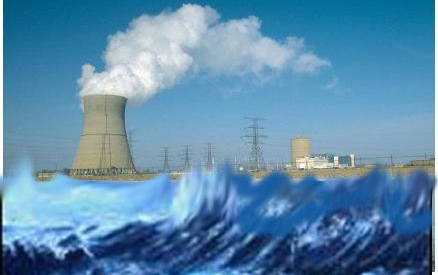 A 1-meter (39-inch) increase, combined with high tides and a storm surge, significantly increases the risk of coasts and nuclear stations being swamped, says Michael Mann, director of the Earth System Science Center at Pennsylvania State University.
“Nuclear stations are on the front line of climate change impacts both figuratively and quite literally,” Mann says. “We are likely profoundly underestimating climate change risk and damages in coastal areas.”
A recent study from NASA’s Goddard Space Flight Center expects the mean average rise to be a minimum of 65 centimeters (26 inches) by 2100.
“This 65-centimeter [rise] is almost certainly a conservative estimate,” says NASA lead author Steve Nerem, a professor of aerospace engineering sciences at the University of Colorado Boulder. “Our [study] assumes that sea level continues to change in the future as it has over the last 25 years. Given the large changes we are seeing in the ice sheets today, that’s not likely.”
A Matter of Timing Continue reading
Wildfires in USA increased due to climate change
 Factcheck: How global warming has increased US wildfires , Carbon Brief , 9 Aug 18
In the midst of record or near-record heatwaves across the northern hemisphere this summer, deadly wildfires have swept through many regions, such as the western US, Europe and Siberia. This has focused a great deal of public attention on the role that climate change plays in wildfires.
Recently, some commentators have tried to dismiss recent increases in the areas burnt by fires in the US, claiming that fires were much worse in the early part of the century. To do this, they are ignoring clear guidance by scientists that the data should not be used to make comparisons with earlier periods.
The US National Interagency Fire Center (NIFC), which maintains the database in question, tells Carbon Brief that people should not “put any stock” in numbers prior to 1960 and that comparing the modern fire area to earlier estimates is “not accurate or appropriate”.
Here, Carbon Brief takes a look at the links between climate change and wildfires, both in the US and across the globe. As with any environmental issue, there are many different contributing factors, but it is clear that in the western US climate change has made – and will continue to make – fires larger and more destructive.
As one scientist tells Carbon Brief: “There is no question whatsoever that climate plays a role in the increase in fires.”
More area burned………
US wildfires and climate change
The recent period of large wildfires in forested areas of the western US has coincided with near-record warm temperatures……… https://www.carbonbrief.org/factcheck-how-global-warming-has-increased-us-wildfires
Climate change threats to coastal nuclear power plants
What are coastal nuclear power plants doing to address climate threats ? As shorelines creep inland and storms worsen, nuclear reactors around the world face new challenges. ENSIA, John Vidal @john_vidal, Environment editor August 8, 2018 — The outer defensive wall of what is expected to be the world’s most expensive nuclear power station is taking shape on the shoreline of the choppy gray waters of the Bristol Channel in western England.
By the time the US$25 billion Hinkley Point C nuclear station is finished, possibly in 2028, the concrete seawall will be 12.5 meters (41 feet) high, 900 meters (3,000 feet) long and durable enough, the UK regulator and French engineers say, to withstand the strongest storm surge, the greatest tsunami and the highest sea-level rise.
But will it? Independent nuclear consultant Pete Roche, a former adviser to the UK government and Greenpeace, points out that the tidal range along this stretch of coast is one of the highest in the world, and that erosion is heavy. Indeed, observers reported serious flooding on the site in 1981 when an earlier nuclear power station had to be shut down for a week. following a spring tide and a storm surge. However well built, says Roche, the new seawall does not adequately take into account sea-level rise due to climate change.
“The wall is strong, but the plans were drawn up in 2012, before the increasing volume of melting of the Greenland ice cap was properly understood and when most experts thought there was no net melting in the Antarctic,” he says. “Now estimates of sea level rise in the next 50 years have gone up from less than 30 centimeters to more than a meter, well within the operating lifespan of Hinkley Point C — let alone in 100 years time when the reactors are finally decommissioned or the even longer period when spent nuclear fuel is likely to be stored on site.”
In fact, research by Ensia suggests that at least 100 U.S., European and Asian nuclear power stations built just a few meters above sea level could be threatened by serious flooding caused by accelerating sea-level rise and more frequent storm surges.
Some efforts are underway to prepare for increased flooding risk in the future. But a number of scientific papers published in 2018 suggest that climate change will impact coastal nuclear plants earlier and harder than the industry, governments or regulatory bodies have expected, and that the safety standards set by national nuclear regulators and the United Nations’ nuclear watchdog, the International Atomic Energy Agency (IAEA), are out of date and take insufficient account of the effects of climate change on nuclear power.
The Problem With Flooding
Flooding can be catastrophic to a nuclear power plant because it can knock out its electrical systems, disabling its cooling mechanisms and leading to overheating and possible meltdown and a dangerous release of radioactivity. Flooding at the Fukushima Daiichi plant in Japan as a result of the March 2011 tsunami caused severe damage to several of the plant’s reactors and only narrowly avoided a catastrophic release of radioactivity that could have forced the evacuation of 50 million people.
The interactive map above from Carbon Brief shows the location of nuclear power plants around the world. According to mapsprepared by the World Association of Nuclear Operators(WANO), around one in four of the world’s 460 working commercial nuclear reactors are situated on coastlines. Many were built only 10–20 meters (30–70 feet) above sea level at a time when climate change was barely considered a threat.
In the U.S., where nine nuclear plants are within 2 miles (3 kilometers) of the ocean and four reactors have been identified by Stanford academics as vulnerable to storm surges and sea-level rise, flooding is common, says David Lochbaum, a former nuclear engineer and director of the nuclear safety project at the Union of Concerned Scientists (UCS).
Lochbaum says over 20 flooding incidents have been recorded at U.S. nuclear plants since the early 1980s. “The most likely [cause of flooding] is the increasing frequency of extreme events,” he says.
………. The most comprehensive research yet conducted also shows sea-level rises are accelerating as ice caps melt. Such is the speed of ice melt observed since 2007 that even the 2013 IPCC estimates of sea-level rise are thought to be outdated.
…….. Threats From Storms
On top of sea-level rise, the added impact of flooding from storm surges must be considered as well, scientists say. Since 1970, the magnitude and frequency of extreme sea levels (ESLs, a factor of mean sea level, tide and storm-induced increases), which can cause catastrophic flooding, have increased throughout the world, according to the Global Extreme Sea Level Analysisproject. New satellite studies by the U.S. government’s National Oceanic and Atmospheric Administration (NOAA), NASA, and other leading scientific institutions all show mean sea level rising and magnifying the frequency and severity of ESLs………. https://ensia.com/features/coastal-nuclear/
Young children will suffer the most from health risks of a changing climate
 Children are highly vulnerable to health risks of a changing climate https://www.eurekalert.org/pub_releases/2018-08/cums-noc080618.php, COLUMBIA UNIVERSITY’S MAILMAN SCHOOL OF PUBLIC HEALTH , August 6, 2018 —
Young children are far more vulnerable to climate-related disasters and the onus is on adults to provide the protection and care that children need, according to research by Columbia University’s Mailman School of Public Health and Columbia University Irving Medical Center. In a paper published in PLoS Medicine, researchers set out some specific challenges associated with the impacts of climate change on the world’s 2.3 billion children and suggest ways to address their underprioritized needs.
“Because of their anatomic, cognitive, immunologic, and psychologic differences, children and adolescents are more vulnerable to climate change-related events like floods, droughts, and heatwaves than adults,” says Madeleine Thomson, PhD, a research scholar in the Department of Environmental Health Sciences, faculty member at Columbia’s Earth Institute, a guest editor in PLOS One Medicine’s Special Issue on Climate Change and Health in the International Research Institute for Climate and Society.
Because of their small surface-to-body ratio, infants and children are particularly vulnerable to dehydration and heat stress. During heat waves, children are more likely to be affected by respiratory disease, kidney disease, electrolyte imbalance, and fever. Heat waves have also been shown to exacerbate allergens and air pollution which impact children more severely than adults because of their underdeveloped respiratory and immune systems and because they breathe at a faster rate than adults.
The authors write that hotter temperatures may also expand the range of vector-borne diseases, including the Zika virus which, following the 2015 epidemic, has profoundly affected the lives of children and their families across Latin America and the Caribbean. Even children who were asymptomatic at birth may develop problems later in life.
After Hurricane Maria made landfall in Puerto Rico in September 2017 medical responders encountered increases in gastroenteritis, asthma exacerbations and skin infections. Children were also at increased risk for mosquito-borne diseases such as Chikungunya and Dengue, as well as leptospirosis through the drinking of contaminated water. Flood waters from Hurricane Harvey a few weeks earlier dropped record breaking rain. Most of the Harvey-related toxic releases were never publicized and the long-term implications for children’s health is unknown. Studies suggest that climate change is increasing the intensity of North Atlantic hurricanes and the likelihood that the severe consequences for children’s health will grow.
In rural households droughts can have significant impacts on child development through increased food insecurity and dietary changes [17]. Droughts may also contribute to conflict and forced migration in resource poor settings, thereby increasing children’s vulnerability to a wide range of health issues.
To begin to address the specific needs of children confronted with climate-change related health disasters, Thomson and colleagues are proposing the following:
- Establish an international consortium of experts to develop adoptable medical and behavioral protocols and to set research agendas to address the unmet child specific needs that arise from climate-related natural disasters.
- Develop best practice guidelines for climate-change related event planning that incorporates strategies for addressing the health-related needs of children.
- Fund mechanisms designed to help the most vulnerable nations prepare for and respond to climate related disasters must consider funding the development of responses that specifically address the unmet needs of children’s health.
Europe’s heatwave -land and water – is crippling nuclear power
Europe’s heatwave is forcing nuclear power plants to shut down, Quartz, By Akshat Rathi,
Future heatwaves will knock nuclear, gas and coal power plants offline
 New Scientist. By
As large parts of the northern hemisphere swelter in record heat, yet another consequence of global warming is becoming apparent. Across Europe, several nuclear reactors and at least one coal-fired plant have had to be temporarily shut down, and others have reduced their output.
The world gets 80 per cent of its electricity from power plants that needs lots of cool water, which is a major problem in a warming and drier world. If nothing is done, there could be major …(subscribers only) https://www.newscientist.com/article/2176187-future-heatwaves-will-knock-nuclear-gas-and-coal-power-plants-offline/
With more hot weather coming,, France forced to more cuts to nuclear power production
French nuclear power supply cuts extended as hot weather lingers https://www.spglobal.com/platts/en/market-insights/latest-news/electric-power/080318-french-nuclear-power-supply-cuts-extended-as-hot-weather-lingers, AuthorAnuradha Ramanathan, EditorJeremy Lovell
HIGHLIGHTS
1,335 MW St Alban-1, 910 MW Bugey-2 offline until next Saturday
Reduced available capacity at St Alban-2, Bugey-3, Fessenheim-2
Prompt power price rally continues due to supply pressures
London — With France bracing for more hot to very hot weather in the coming week, nuclear power plant operator EDF said Friday it plans to halt production completely at two of its reactors near the river Rhone, water from which is used for cool them, and reduce available capacity at other units next week.
In its latest update on Friday, EDF said production capacity at the 1,335 MW St Alban-1 and 910 MW Bugey-2 reactors would drop to zero until Saturday next week, reducing capacity from Friday afternoon. The 910 MW Bugey-3 will also remain unavailable for power generation from late Friday but with an expected restart on Wednesday.
Out of the 1,335 MW St Alban-2 installed capacity, 950 MW will remain available to the market over the weekend, EDF said, while 600 MW will be available from its 880 MW Fessenheim-2 nuclear reactor over the weekend and until Monday midnight.
EDF, however, warned that the planning and duration of the unavailability due to environmental issues will be reassessed according to the weather forecast. These supply restriction warnings due to hot weather began late July at the onset of the heatwave which is currently covering Europe.
Furthermore, forecasters predict temperatures in France, Germany, Italy and Spain to stay above seasonal averages next week, with forecaster MeteoFrance expecting Portugal temperatures to hit 48 degrees Celsius over this weekend.
The hot weather and the resulting nuclear supply restrictions sent the prompt power prices in the wholesale market to winter levels as countries are ramping up the more expensive fossil fuel power plants, analysis shows.
French day-ahead baseload for Monday delivery was last heard trading at Eur66.50/MWh on the over-the-counter market, reaching a new summer high and the highest in more than five months, data showed.
–Anuradha Ramanathan, anuradha.ramanathan@spglobal.com Jeremy Lovell, jeremy.lovell@spglobal.com
Climate change fears add urgency to environmental fight over Florida nuclear power plant
 Environmentalists Fight FPL Plan to Keep Nuclear Plant Open Until 2053, Miami New Times | AUGUST 2, 2018
Compared to wind farms and solar parks, nuclear power plants are, in general, extremely expensive to operate and terrible for their surrounding environments. Florida Power & Light’s Turkey Point Nuclear Generating Station in Homestead certainly has not done good things for the local water supply. The power plant’s infamous canal system, a nuclear-fluid cooling setup used nowhere else on Earth, has leaked salt water into Miami’s major drinking-water aquifer and spilled trace amounts of radioactive materials into Biscayne Bay.
So after FPL filed a motion at the beginning of 2018 to renew Turkey Point’s operating license for 20 years, potentially keeping the nuclear plant open until 2053, the environmental nonprofit Southern Alliance for Clean Energy (SACE) has filed a legal petition in yet another attempt to finally get rid of the cooling-canal system. The legal filing notes that environmentalists worry about the impact the cooling canals will have in an “increasingly warm climate.”
SACE now says the Nuclear Regulatory Commission (NRC), the federal body tasked with renewing Turkey Point’s license, should deny FPL another 20-year extension until the company puts a hard plan in place to get rid of the canal system once and for all. Instead, SACE simply wants FPL to build some normal nuclear cooling towers so the site can at least function like every other nuclear power plant in America.
“FPL should not be allowed another twenty years of operation before analyzing the reasons for the failures of its efforts over the past decades to stem those impacts,” the 34-page legal petition reads. “Nor should FPL be allowed to go forward with a second license renewal term before reckoning with the fact that new measures it proposes for mitigation of the CCS’ impacts in the future are mutually inconsistent and counter-productive. Finally, FPL should be required to address an alternative cooling system, already approved and used by FPL for other plants on the Turkey Point site, which would eliminate the need for the CCS and thereby avoid its adverse environmental impacts: mechanical draft cooling towers.”
In short, SACE’s scientists contend FPL hasn’t done the basic scientific work necessary to ensure the cooling-canal system won’t continue polluting Miami’s waterways. SACE says FPL has underestimated the power plant’s environmental impact on the surrounding environment. The nonprofit also says the cooling canals are leaking chemicals such as tritium, nitrogen, phosphorous, and chlorophyll into Biscayne Bay, as well as wiping out seagrass habitats that are crucial for alligator nests, among other animals.
“FPL claims to have studied the groundwater interface with Biscayne Bay and found that ‘the groundwater pathway is having no discernible influence on Biscayne Bay,'” the legal filing states. “But FPL’s assertion is contradicted by ample evidence that wastewater from the CCS is reaching Biscayne Bay and that it has a significant adverse environmental impact.”
SACE’s latest legal filing merely requests a hearing with the NRC, an agency that tends to rule in favor of major power companies in these kinds of cases. SACE says it expects the NRC to respond to the hearing request sometime this fall.
“Federal environmental law prohibits FPL from continuing to pollute Biscayne Bay and the drinking water supply for another 20 years when a feasible and cost-effective alternative is available to avoid those impacts,” SACE attorney Diane Curran said today in a news release. “SACE intends to use that federal law to push for a solution that will protect public drinking water and the environment.”
- CONTACT: Jerry Iannelli Twitter: @jerryiannelli
France’s EDF may have to shut down 4 nuclear reactors because of the heatwave
 France’s EDF may halt four nuclear reactors due to heatwave, Reuters Staff, 2 Aug 18 PARIS (Reuters) – French utility EDF on Wednesday said that forecasts of high temperatures in the Rhone River could lead to the shutdown from Aug. 3 of four nuclear reactors which depend on its waters for cooling. EDF said it could be forced to halt electricity production at two reactors at St. Alban with an installed capacity of 2,300 megawatts (MW), and at the 900 MW Bugey 2 and 3 reactors.
EDF’s nuclear plants along the Rhone use the river’s waters to regulate the temperature of their reactors, discharging warm water back into the waterway. Curbs are placed on the volume of water its plants can use as the river’s temperature rises.
The utility did not say if the four reactors at its Tricastin nuclear plant, further downriver, might also be affected. Three reactors at Tricastin are on planned maintenance outages….. https://uk.reuters.com/article/us-france-nuclearpower-weather/frances-edf-may-halt-four-nuclear-reactors-due-to-heatwave-idUKKBN1KM56C
Nordic nuclear power plants hit by unprecedented heat wave
 HOW SUMMER HEAT HAS HIT NORDIC NUCLEAR PLANTS http://ewn.co.za/2018/08/02/how-summer-heat-has-hit-nordic-nuclear-plants Reuters 2 Aug 18
OSLO – This year’s unusually warm summer in the Nordic region has increased sea water temperatures and forced some nuclear reactors to curb power output or shut down altogether, with more expected to follow suit.
The summer has been 6-10 degrees Celsius above the seasonal average so far and has depleted the region’s hydropower reservoirs, driving power prices to record highs, boosting energy imports from continental Europe and driving up consumer energy bills.
Nuclear plants in Sweden and Finland are the region’s second largest power source after hydropower dams and have a combined capacity of 11.4 gigawatts (GW).
Reactors need cold sea water for cooling but when the temperature gets too high it can make the water too warm for safe operations, although the threshold varies depending on the reactor type and age.
Unscheduled power output cuts in Swedish and Finnish reactors could push prices even higher, said Vegard Willumsen, section manager at Norway’s energy regulator NVE.
“If nuclear reactors in the Nordics shut down or reduce power due to the heatwave, it could also put pressure on the supply and consequently on the Nordic power prices,” he added.
WHY IS WATER TEMPERATURE AN ISSUE?
The Nordic region’s nuclear plants comprise either pressurised water reactors (PWR) or boiling water reactors (BWR) – and both can be affected by warm sea water.
Typically, power would be reduced at the 12 reactors after a certain temperature threshold has been reached and then fully shut down at a higher threshold.
BWRs can keep operating for longer and would only shut down after a several-degree rise in water temperatures from the moment power reductions are triggered.
However, PWRs require a shorter time to shut down after they start reducing power.
Utility Vattenfall, which operates seven reactors in Sweden, shut a 900-megawatt (MW) PWR unit – one of the four located at its Ringhals plant – this week as water temperatures exceeded 25 degrees Celsius.
The firm’s second plant at Forsmark consists of three BWRs and Vattenfall had to reduce output by 30-40 megawatt per reactor earlier in July as the sea water in the area exceeded 23 degrees Celsius.
Finland’s Fortum reduced power at its Loviisa plant last week when water temperatures reached 32 degrees C, close to a threshold of 34 degrees.
The extent to which water temperature affects nuclear plants also depends on the depth that they receive water from. Colder water is deeper.
It also depends on how warm the water is after being used in the reactors and released back into the sea. If used water exceeds 34 degrees Celsius, it can cause major output reductions or shutdowns for certain plants due to safety regulations.
Sweden’s biggest reactor – 1.4 GW Oskarshamn 3 – should be less vulnerable to very hot summers due to the depth of water, said a spokesperson for operator OKG, a unit of Uniper Energy.
“Water intake (is) at a depth of 18 metres where the water naturally is cooler than on the surface … should it be too hot, we would, of course, reduce the capacity accordingly,” he said.
Oskarshamn 3 will reduce power if sea water reaches 25 degrees but it was below 20 degrees on Tuesday.
Similarly, Teollisuuden Voima’s Olkiluoto plant in Finland has deeper water which is colder than a 27-degree threshold.
TVO has also built an additional safety mechanism – a canal – which it can use under certain conditions to release used warm water on the other side of the Olkiluoto island.
Climate change will bring sea level rise – bringing danger to Hinkley Point C nuclear site.
Burnham-on-sea.com 1st Aug 2018 , EDF reject fears Hinkley C will be vulnerable to sea level rise. T
 The Stop
Hinkley Campaign has written to the Office for Nuclear Regulation to
express concern about recent reports that we could be heading for a
sea-level rise of as much as 6 metres during the lifetime of the Hinkley
Point C site.
Some researchers say sea levels could rise by six metres or
more even if the 2 degree target of the Paris accord is met.
Sustained warming of one to two degrees in the past has been accompanied by
substantial reductions of the Greenland and Antarctic ice sheets and sea
level rises of at least six metres – several metres higher than what
current climate models predict could occur by 2100.
http://www.burnham-on-sea.com/news/2018/hinkley-c-rising-sea-levels-01-08-18.php
Europe’s nuclear reactors affected by heat waves
The heatwave across Europe in late July required some nuclear plants to
reduce electricity after cooling water was affected by high temperatures.
Plants in Finland, Sweden, Germany, France and Switzerland have been
affected.
While air temperatures have been above 90 degrees Fahrenheit (32
degrees Celsius) in many parts, water temperatures have reached 75 degrees
Fahrenheit (23.8 degrees Celsius) or more. The Loviisa nuclear plant, which
produced 10% of Finland’s power in 2017, began reducing its output on 25
July, according to chief of operations, Timo Eurasto. He said customers
were not affected, because other power plants were satisfying electricity
demand. Loviisa previously reduced output in 2010 and 2011, due to warm
water, but Eurasto said the current heatwave has been more severe.
Reactorsin Sweden and Germany also reduced production because of cooling problems,Reuters reported. A spokesperson for Sweden’s nuclear energy regulator saidthe Forsmark had cut energy production “by a few percentage points”.
http://www.neimagazine.com/news/newseuropes-heatwave-affects-npps-6271432
Swedish nuclear reactor cuts output, due to sea water being too warm
 Warm sea water limits capacity at Vattenfall’s Ringhals 2 reactor https://www.reuters.com/article/sweden-nuclear-ringhals/warm-sea-water-limits-capacity-at-vattenfalls-ringhals-2-reactor-idUSL5N1UR376. Reuters Staff, STOCKHOLM, July 31 (Reuters) – Swedish utility Vattenfall said its Ringhals 2 nuclear reactor was running at 49 percent capacity on Tuesday as the sea water used to cool it nears an upper temperature limit.
Water from the Baltic Sea is used to cool several nuclear reactors along Sweden’s coastline, but temperatures are unusually warm following a prolonged period of hot weather.
Vattenfall on Monday posted plans to take Ringhals 2 out of operation after water reached that reactor’s 25 degree Celsius limit
However Vattenfall spokesman Peter Stedt said on Tuesday it had opted to keep capacity at 49 percent after the sea water cooled to 24 degrees, while closely monitoring water temperatures as the warm weather continued.
The 865-megawatt (MW) pressurized water Ringhals 2 reactor is one of four reactors, which produce around 20 percent of Sweden’s electricity. While Ringhals 3 and 4 are still online, Ringhals 1 is shut for annual planned maintenance. (Reporting by Anna Ringstrom Editing by Alexander Smith)
1 This Month
26 September – International Day for the Total Elimination of Nuclear Weapons





PLEASE OPPOSE HR 8255 AND S.3639 – bills would accelerate satellite deployment, with no environmental review or safeguards – https://ncstd5li.quorum.us/campaign/169331/
To see nuclear-related stories in greater depth and intensity – go to https://nuclearinformation.wordpress.com
-
Archives
- September 2026 (323)
- August 2026 (330)
- July 2026 (355)
- June 2026 (287)
- May 2026 (306)
- April 2026 (356)
- March 2026 (251)
- February 2026 (267)
- January 2026 (308)
- December 2025 (358)
- November 2025 (359)
- October 2025 (375)
-
Categories
- 1
- 1 NUCLEAR ISSUES
- business and costs
- climate change
- culture and arts
- ENERGY
- environment
- health
- history
- indigenous issues
- Legal
- marketing of nuclear
- media
- opposition to nuclear
- PERSONAL STORIES
- politics
- politics international
- Religion and ethics
- safety
- secrets,lies and civil liberties
- spinbuster
- technology
- Uranium
- wastes
- weapons and war
- Women
- 2 WORLD
- ACTION
- AFRICA
- Atrocities
- AUSTRALIA
- Christina's notes
- Christina's themes
- culture and arts
- Events
- Fuk 2022
- Fuk 2023
- Fukushima 2017
- Fukushima 2018
- fukushima 2019
- Fukushima 2020
- Fukushima 2021
- general
- global warming
- Humour (God we need it)
- Nuclear
- RARE EARTHS
- Reference
- resources – print
- Resources -audiovicual
- Weekly Newsletter
- World
- World Nuclear
- YouTube
-
RSS
Entries RSS
Comments RSS

