10 reasons why Donald Trump can’t derail global climate action, especially in Australia
Wesley Morgan & Ben Newell, Nov 8, 2024, https://reneweconomy.com.au/10-reasons-why-donald-trump-cant-derail-global-climate-action/
If you care about saving Earth from catastrophe, you might be feeling a little down about the re-election of Donald Trump as United States president. Undeniably, his return to the White House is a real setback for climate action.
Trump is a climate change denier who has promised to increase fossil fuel production and withdraw the US from the Paris climate deal, among other worrying pledges.
But beyond Trump and his circle, there remains deep concern about climate change, especially among younger people. Support for climate policy remains high in the US and around the world. And studies based on data from 60,000 people in more than 60 countries suggest individuals’ concern about climate change is widely underestimated.
So now is a good time to remember that efforts to tackle the climate crisis – both in Australia and globally – are much bigger than one man. Here are ten reasons to remain hopeful.
1. The global clean energy transition can’t be halted
The global shift to clean energy is accelerating, and Trump can’t stop it. Investment in clean energy has overtaken fossil fuels, and will be nearly double investment in coal, oil and gas in 2024. This is a historic mega-trend and will continue with or without American leadership.
2. Clean energy momentum is likely to continue in the US
Much of the Biden-era spending on clean energy industries went to Republican states and Congressional districts. New factories for batteries and electric vehicles will still go ahead under the Trump administration. After all, entrepreneur Elon Musk – who is expected to join the Trump administration – makes electric vehicles.
Some of Trump’s financial backers are receiving subsidies for clean energy manufacturing and 18 Republican Congress members have gone on record to oppose cuts to clean energy tax credits.
3. The US still wants to beat China
There is bipartisan concern in Washington about the US losing a technological edge to Beijing. China currently dominates global production of electric vehicles, batteries, wind turbines and solar panels. So internal pressure in the US to counter China’s manufacturing might will continue.
4. The federal government is not everything in the US
When Trump was last in power, he withdrew the US from some climate commitments, such as the Paris Agreement. But many state and local governments powered ahead with climate policy, and that will happen this time around, too. For example, California – the world’s fifth largest economy – plans to eliminate its greenhouse gas footprint by 2045. Even Texas, a Republican heartland, is leading a shift toward wind and solar power.
5. The US climate movement will be more energised than ever
During Trump’s first presidency, the US climate movement developed policy proposals for a “Green New Deal”. Many of these proposals were later implemented by the Biden administration. Initial reactions to Trump’s re-election suggest we can expect similar policy advocacy this time around.
6. Global climate cooperation is bigger than Trump
If Trump makes good on his promise to leave the Paris Agreement (again), he will only be leaving the room where the world’s future is being shaped. The US has walked away from global climate agreements before – for example, refusing to join the Kyoto Protocol in 2001. But other nations rallied for global action, and will do so again.
7. The rules-based global order will remain
When a nation walks away from rules that have been agreed after decades of negotiation, responsible countries must work together to bolster global cooperation. This applies to trade and security – and climate is no different.
As our Foreign Minister Penny Wong recently explained, Australia, as a middle power on the world stage, wants:
a world where disputes are resolved by engagement, negotiation and by reference to rules [and] norms […] We don’t want a world in which disputes are resolved by power alone.
8. Australian diplomacy matters
Australia is seeking to co-host the United Nations climate talks with Pacific island countries in 2026, and is emerging as the favourite. Hosting the conference, known as COP31, would be a chance for Australia to help broker a new era of international climate action, even if the US opts out under Trump.
Hosting the talks would also help cement Australia’s place in the Pacific and assist our Pacific neighbours to deal with the climate threat.
9. Australia’s clean energy shift is accelerating
About 40% of Australia’s main national electricity grid is powered by renewables and this is set to rise to 80% by 2030. Some states are surging ahead – for example, South Australia is aiming for 100% renewables by 2027.
Australians love clean energy at home, too. One in three households have rooftop solar installed, making us a world-leader in the technology’s uptake. Trump’s occupation of the Oval Office cannot stop this momentum.
10. Trump cannot change the science of climate change
The science is clear – burning coal, oil and gas fuels climate change and increases the risk of disasters that are harming communities right now. In Australia, we need look no further than the Black Summer bushfires in 2019-20 and unprecedented Lismore floods in 2022.
And the damage is happening across the globe. In October, twin hurricanes in the US – made stronger by the warming ocean – left a damage bill of more than US$100 billion. And hundreds of people died when a year’s worth of rain fell in one day in Spain last month.
On gloomy days – like, say, the election of a climate denier to the White House – it might feel humanity won’t rise to Earth’s biggest existential challenge. But there are many reasons for hope. The vast majority of us support policies to tackle climate change, and in many cases, the momentum is virtually unstoppable.
Wesley Morgan, Research Associate, Institute for Climate Risk and Response, UNSW Sydney and Ben Newell, Professor of Cognitive Psychology and Director of the UNSW Institute for Climate Risk and Response, UNSW Sydney
TODAY . COP 29 global climate summit – already a dead duck.
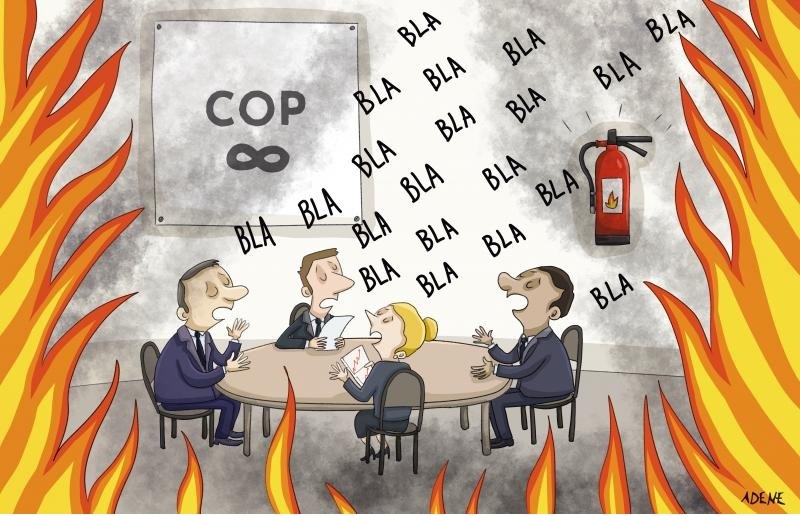
In the midst of all the brouhaha about the election of a deranged narcissist to be in charge of America, we must remember what is really the biggest danger to our Earth – climate change – global heating
The 29th Conference of the Parties to the UN Framework Convention on Climate Change (COP29), will take place from November 11 to 22 in 2024 at Baku Stadium, Azerbaijan, from 11 to 22 November 2024.
There will be good people there, and I’m not rubbishing their work.
Still, at the top level, corporate greed will be running the show.
FIRST. to start with, the host, Azerbaijan- is a massive exporter of oil and gas, – global fossil fuel lobbyists will be welcome there and money will be splurged on an attractive greenwash of the dirtiest industries

SECOND. As if having the fossil fuel industries in control was not bad enough, we have their close mate, the nuclear industry, jumping on the bandwagon, with its lucrative claims about “solving” the climate crisis .
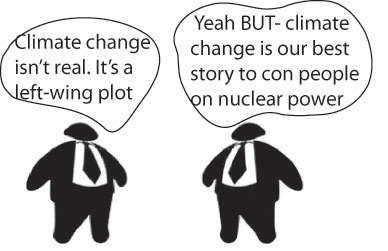
THIRD. Politics international. Ursula von der Leyen, the big cheese of the European Commission, will not be attending. Nor will France’s Emmanuel Macron, the current US president, Joe Biden, and the Brazilian president, Luiz Inácio Lula da Silva, . The leaders of China, South Africa, Japan and Australia are expected to miss the talks as well. This sends a clear message that climate change is not a concern for top world leaders

THIRD. American politics now. I’m not a fan of Joe Biden, but the Biden administration deserves credit . The U.S. Inflation Reduction Act has been successful in promoting truly clean energy (even though it does contain sops to the nuclear industry). Many Americans have now become painfully aware of the extreme effects of global heating, and the USA’s clean energy success will be hard for the climate deniers to unravel. But still, in January, Trump’s climate denial administration will take over, and this fact does cast a damper on COP29.

We know that there are millions of people who are dedicated to the cause of a clean world, and of stopping global heating. We are up against the globally amoral corporateaucracy .
Von der Leyen’s Cop29 absence sends ‘fatal signal’, say watchers
MEPs express concern for EU climate leadership as commission head confirms she will miss Baku summit
Jennifer Rankin in Brussels, Guardian 6th Nov 2024 https://www.theguardian.com/environment/2024/nov/06/von-der-leyens-cop29-absence-sends-fatal-signal-say-watchers
Ursula von der Leyen’s decision to miss the Cop29 climate summit is “a fatal signal” and raises questions about Europe’s commitment to the climate crisis, observers have said.
The European Commission confirmed on Tuesday that its president would not attend the UN climate talks in Baku, which start on Monday. “The commission is in a transition phase and the president will therefore focus on her institutional duties,” a spokesperson said.
Also skipping the “world leaders’ climate action summit” on Tuesday and Wednesday are France’s Emmanuel Macron and the outgoing US president, Joe Biden. The Brazilian president, Luiz Inácio Lula da Silva, cancelled his participation due to a head injury, Reuters reported. The leaders of China, South Africa, Japan and Australia are expected to miss the talks as well.
Mohammed Chahim, a Dutch socialist and the vice-chair of the European parliament’s delegation to the Baku talks, described von der Leyen’s absence as “regrettable”, but said it did not imply a lack of EU commitment.
He said: “The climate crisis does not wait for ideal conditions to act, and neither can we. After the re-election of [Donald] Trump, the EU must now take a stronger leadership role, both to sustain momentum and to counterbalance the US stance.”
Michael Bloss, a German Green MEP, also in the delegation, said it was “a fatal signal” that Europe’s most powerful woman, along with other leaders, had chosen not to attend.
Referring to Azerbaijan’s strongman president, Ilham Aliyev, Bloss said: “By leaving the stage to autocrats like Aliyev, we risk turning the conference more and more into a greenwashing spectacle for self-promotion rather than genuine climate action.”
Von der Leyen is preparing for her second term in office, expected to begin on 1 December after European parliament hearings with her top team conclude.
The commission will be represented at Cop29 by its climate commissioner, Wopke Hoekstra, and the energy commissioner, Kadri Simson, and a team of negotiators.
WWF said von der Leyen’s non-attendance was disappointing. Shirley Matheson, a climate specialist at the charity, said her absence, along with other world leaders, raised “serious questions” about European and international commitment to fighting the climate crisis. “We cannot afford for climate action to move down on Europe’s agenda,” she added.
Von der Leyen has attended every high-level Cop meeting since she became commission president in 2019. In her successful pitch for re-election by MEPs, she highlighted the importance of Europe’s role in international climate talks: “I want Europe to remain a leader in international climate negotiations.”
The head of the UN environment programme said last month that “huge cuts” in carbon emissions were needed to steer the world off a path of catastrophic temperature rise, in a report urging countries to act at the climate summit in Baku.
Sven Harmeling, head of climate at the Climate Action Network Europe, said he did not see von der Leyen’s non-attendance as “not showing interest”, but added it was important she ensured the EU “is able to speak up and convey its ambition for climate leadership”.
“Stronger EU participation is always important to signal leadership, but for me it really comes down to how they use diplomatic channels,” he said, highlighting the bloc’s role at the G20 summit in Brazil on 18-19 November, where leaders of the world’s largest economies will discuss financing the climate transition.
On Wednesday, the commission said: “Our leadership is demonstrated by our consistent actions domestically and internationally. We are always a leading voice for ambition at Cops and that will not change this year.”
‘A wrecking ball’: experts warn Trump’s win sets back global climate action
Election of a ‘climate denier’ to US presidency poses ‘major threat to the planet’, environmentalists say. Donald Trump has called climate change ‘a big hoax’ and vowed to gut environmental rules ahead of his election victory
Guardian 6th Nov 2024 Oliver Milman and Ajit Niranjan,
https://www.theguardian.com/us-news/2024/nov/06/trump-climate-change-environment-threat
Donald Trump’s new term as US president poses a grave threat to the planet if it blows up the international effort to curb dangerous global heating, stunned climate experts have warned in the wake of his decisive election victory.
Trump’s return to the White House is widely expected to result in the US, yet again, exiting the Paris climate agreement and may even remove American involvement in the underpinning United Nations framework to deal with the climate crisis.
While campaigning for president, Trump has called climate change “a big hoax”, scorned wind energy and electric cars and vowed to gut environmental rules and the “green new scam” of the Inflation Reduction Act, a major bill passed by Democrats to support clean energy projects.
Trump’s agenda, analysts have found, risks adding several billion tonnes of extra heat-trapping gases to the atmosphere, further imperiling goals to stave off disastrous global heating that governments are already failing to meet. Michael Mann, a climate scientist at the University of Pennsylvania, said that the US is now a “failed democracy” and that “we now pose a major threat to the planet.”
The election result will send shockwaves through annual UN climate talks that start in Azerbaijan on Monday. “The election of a climate denier to the US presidency is extremely dangerous for the world,” said Bill Hare, a senior scientist at Climate Analytics, who warned a Trump administration would likely “damage efforts” to keep the world from heating by more than 1.5C above pre-industrial levels, a Paris target that now appears even further out of reach.
While Joe Biden’s administration will send a delegation to the Cop29 summit next week, this will be overshadowed by an incoming Trump government that threatens to disengage with other major carbon emitters, such as China, to address the climate crisis. “The nation and world can expect the incoming Trump administration to take a wrecking ball to global climate diplomacy,” said Rachel Cleetus, policy director at the Union of Concerned Scientists.
Across Europe, climate activists and politicians who support stronger action to cut pollution reacted with despair to the news of Trump’s win. “This is a dark day in the US and globally,” said Thomas Waitz, an Austrian MEP and co-chair of the European Green party.
Luisa Neubauer, a German climate activist from the Fridays for Future movement, who went door-knocking for Harris, compared the feeling to a bad breakup. “A decision over parts of the near future has been made and most of us didn’t have a say in it,” she said. “And for a moment it feels like the world is going to end. It’s not. But the heartbreak is real.”
But they also urged supporters of climate action to not give up.
Areeba Hamid, joint executive director of Greenpeace UK, said it was “an election won with corporate cash, big polluter backers and disinformation” but that a global movement was already fighting to rein in the damage.
“We simply don’t have any more time to waste,” she added. “Whatever a Trump presidency chooses to do on global climate action, we know that damage can be contained if the grown-ups in the room speak up.”
When he was last president, Trump took several months to decide to remove the US from the Paris deal, raising fears the agreement would collapse. Countries did manage to avoid such a fate prior to Biden re-entering the pact and there is some optimism that the transition to cleaner energy isn’t something that Trump, despite his demands that the US “drill, baby drill” for oil and gas, can reverse.
“The US election result is a setback for global climate action, but the Paris agreement has proven resilient and is stronger than any single country’s policies,” said Laurence Tubiana, chief executive of the European Climate Foundation and a key architect of the Paris deal.
“The context today is very different to 2016,” she said. “There is powerful economic momentum behind the global transition, which the US has led and gained from, but now risks forfeiting. The devastating toll of recent hurricanes was a grim reminder that all Americans are affected by worsening climate change.”
Much like after the previous withdrawal, cities and state within the US committed to climate action will try to fill the void of federal indifference, acting as de facto representatives at global summits and even engaging with other countries on how to cut emissions.
“No matter what Trump may say, the shift to clean energy is unstoppable and our country is not turning back,” said Gina McCarthy, former climate adviser to Biden and co-chair of the America Is All In coalition of climate-concerned states and cities.
“Our coalition is bigger, more bipartisan, better organized, and fully prepared to deliver climate solutions, boost local economies and drive climate ambition,” she said. “We cannot and will not let Trump stand in the way of giving our kids and grandkids the freedom to grow up in safer and healthier communities.”
Domestically, environmental groups have said they will attempt to rally Democrats, as well as some Republicans, to oppose Trump’s tearing down of climate policies, which is anticipated to include major cuts to the Environmental Protection Agency and weakened pollution rules for coal plants, cars and fossil fuel drilling. “President Trump will face a bipartisan wall of opposition if he attempts to rip away clean energy incentives now,” said Dan Lashof, director of the World Resources Institute.
“No matter what Trump may say, the shift to clean energy is unstoppable and our country is not turning back,” said Gina McCarthy, former climate adviser to Biden and co-chair of the America Is All In coalition of climate-concerned states and cities.
“Our coalition is bigger, more bipartisan, better organized, and fully prepared to deliver climate solutions, boost local economies and drive climate ambition,” she said. “We cannot and will not let Trump stand in the way of giving our kids and grandkids the freedom to grow up in safer and healthier communities.”
Domestically, environmental groups have said they will attempt to rally Democrats, as well as some Republicans, to oppose Trump’s tearing down of climate policies, which is anticipated to include major cuts to the Environmental Protection Agency and weakened pollution rules for coal plants, cars and fossil fuel drilling. “President Trump will face a bipartisan wall of opposition if he attempts to rip away clean energy incentives now,” said Dan Lashof, director of the World Resources Institute.
COP 29 chief exec filmed promoting fossil fuel deals

BBC 8th Nov 2024, Justin Rowlatt, BBC climate editor, https://www.bbc.co.uk/news/articles/crmzvdn9e18o
A senior official at COP29 climate change conference in Azerbaijan appears to have used his role to arrange a meeting to discuss potential fossil fuel deals, the BBC can report.
A secret recording shows the chief executive of Azerbaijan’s COP29 team, Elnur Soltanov, discussing “investment opportunities” in the state oil and gas company with a man posing as a potential investor.
“We have a lot of gas fields that are to be developed,” he says.
A former head of the UN body responsible for the climate talks told the BBC that Soltanov’s actions were “completely unacceptable” and a “betrayal” of the COP process.
As well as being the chief executive of COP29, Soltanov is also the deputy energy minister of Azerbaijan and is on the board of Socar.
Azerbaijan’s COP29 team has not responded to a request for comment.
Oil and gas accounts for about half of Azerbaijan’s total economy and more than 90% of its exports, according to US figures.
COP29 will open in Baku on Monday and is the 29th annual UN climate summit, where governments discuss how to limit and prepare for climate change, and raise global ambition to tackle the issue.
However, this is the second year in a row the BBC has revealed alleged wrongdoing by the host government.
The BBC has been shown documents and secret video recordings made by the human rights organisation, Global Witness.
It is understood that one of its representatives approached the COP29 team posing as the head of a fictitious Hong Kong investment firm specialising in energy.
He said this company was interested in sponsoring the COP29 summit but wanted to discuss investment opportunities in Azerbaijan’s state energy firm, Socar, in return. An online meeting with Soltanov was arranged.
During the meeting, Soltanov told the potential sponsor that the aim of the conference was “solving the climate crisis” and “transitioning away from hydrocarbons in a just, orderly and equitable manner”.
Anyone, he said, including oil and gas companies, “could come with solutions” because Azerbaijan’s “doors are open”.
However, he said he was open to discussions about deals too – including on oil and gas……………
“There are a lot of joint ventures that could be established,” Soltanov says on the recording. “Socar is trading oil and gas all over the world, including in Asia.
….. The UN climate science body, the Intergovernmental Panel on Climate Change, acknowledges there will be a role for some oil and gas up to 2050 and beyond. However, it has been very clear that “developing… new oil and gas fields is incompatible with limiting warming to 1.5C”.
It also goes against the agreement the world made at the last global climate summit to transition away from fossil fuels.
Soltanov appeared eager to help get discussions going, telling the potential sponsor: “I would be happy to create a contact between your team and their team [Socar] so that they can start discussions.”
A couple of weeks later the fake Hong Kong investment company received an email – Socar wanted to follow up on the lead.
Attempting to do business deals as part of the COP process appears to be a serious breach of the standards of conduct expected of a COP official.
These events are supposed to be about reducing the world’s use of fossil fuels – the main driver of climate change – not selling more.
…………………………………… Christiana Figueres, who oversaw the signing of the 2015 Paris agreement to limit global temperature rises to well below 2C, told the BBC that she was shocked anyone in the COP process would use their position to strike oil and gas deals.
She said such behaviour was “contrary and egregious” to the the purpose of COP and “a treason” to the process.
The BBC has also seen emails between the COP29 team and the fake investors.
In one chain, the team discusses a $600,000 (£462,000) sponsorship deal with a fake company in return for the Socar introduction and involvement in an event about “sustainable oil and gas investing” during COP29.
………………… The findings come a year after the BBC obtained leaked documents that revealed plans by the UAE to use its role as host of COP28 to strike oil and gas deals.
COP28 was the first time agreement was reached on the need to transition away from fossil fuels.
UK lobbyists accused of ‘greenwashing’ oil-rich Azerbaijan before Baku COP summit
Azerbaijan’s authoritarian regime has been accused of human rights abuses, including jailing climate activists on ‘bogus’ charges
By Ben Gartside, November 3, 2024
A lobbying firm with close links to a former Cabinet minister and the fossil fuels industry is being paid $4.7m to help oil-rich Azerbaijan enhance its image ahead of the crucial UN COP climate summit next month, the i Paper can reveal.
The lobbying giant Teneo, which employs Labour’s former Culture Secretary Ben Bradshaw as well as Boris Johnson’s former business chief Alex Hickman, has been awarded a seven-month contract which campaigners claim will help the state “greenwash” its reputation.
On 11 November, the UN will host its COP 29 climate change summit in Baku, the Azerbaijan capital. It will be the first major global climate meeting after the US presidential election and will set the tone for discussions for tackling global warming. The talks will involve world leaders, ministers and negotiators and have a particular focus on how to make finance available to developing countries for climate action.
The choice of Azerbaijan as a host for the summit has been controversial. Its economy is highly dependent on fossil fuels and campaigners have criticised the regime’s human rights record, including the imprisonment of climate activists
An investigation by the i, in conjunction with the newsletter Democracy for Sale and SourceMaterial, reveals that as part of the Teneo contract, one of its British consultants will be paid “a monthly fee of $25,000, plus bonuses totalling $50,000” while only working on a “part-time basis”.
According to US documents Teneo will provide “media training” and advise on “narrative development” for the hosts of the COP summit.
The lobbying firm’s work will be led by its Global Strategy President Geoff Morrell who is a former executive at oil giant BP, which is Azerbaijan’s biggest foreign investor.
While working for BP, Morrell chided “opportunistic” environmentalists for exaggerating the impact of the company’s Deepwater Horizon explosion, an oil rig explosion in the Gulf of Mexico that killed 11 people and discharged four million barrels of oil into the ocean.
Despite hosting the environmental summit, Azerbaijan is planning to ramp up oil and gas production over the next decade, according to a report from a German NGO.
The country, which earns 60% of its entire revenue from oil and gas, has also massively increased its gas exports to Europe since the Russian invasion of Ukraine.
Climate campaign groups have accused Teneo of helping Azerbaijan to “greenwash” its image.
Lela Stanley, senior investigator at Global Witness said: “Firms helping petrostates like Azerbaijan … are complicit in greenwashing.
“Instead of focusing on glossing up their image, Azerbaijan and its partners should be making fossil fuel companies pay in to the UN’s Loss and Damage Fund. Planet-wrecking polluters should pay for the devastation they’ve caused.”
In addition to its work for the Azerbajian regime, Teneo has also signed lucrative deals to work with major fossil fuel producers Saudi Arabia and the UAE on other contracts, according to i‘s analysis of US government filings. It also works for some of the world’s leading fossil fuel firms including British Gas owner Centrica and mining giant BHP.
Kathy Mulvey, campaigner at the Union of Concerned Scientists, said: “It’s a clear conflict of interest for a PR firm to be paid to serve both oil and gas company clients that are driving the climate crisis and the host country government charged with shepherding the upcoming international climate talks.”
According to the US documents, Teneo’s lobbying teamworking on the Azerbajian contract includes Boris Johnson’s former chief business adviser Alex Hickman.
Shortly after the general election, the firm sought to bolster their links to the Labour government by appointing former Labour Cabinet minister Ben Bradshaw as a senior advisor.
Although the US documents do not list Bradshaw as one of the individuals working on the Azerbajian COP contract, when he was hired by Teneo, the firm’s UK chief executive Nick Claydon said: “Ben’s deep insights and experience in helping to understand the priorities and approach of the new Labour administration will be of tremendous benefit to Teneo’s clients around the world.”
Teneo’s senior managing director is Patrick Loughlan, one of Tony’s Blair’s former Downing Street special advisors and Labour’s former director of policy and head of research.
The firm’s managing director Robert Fuller also spent six weeks volunteering to help Labour during the recent election campaign.
Azerbaijan’s fossil fuel expansion plans
Azerbaijan’s state-owned oil and gas company, Socar, and its partners are set to raise the country’s annual gas production by 2033, according to a report produced by Urgewald and CEE Bankwatch last month………………………………………………………………………
https://inews.co.uk/news/politics/uk-lobbyists-greenwashing-cop-3354835
‘Two sides of the same coin’: governments stress links between climate and nature collapse

Representatives at the Cop16 summit in Colombia negotiated against a backdrop of extreme weather and ecosystem collapse
Patrick Greenfield and Phoebe Weston in Cali, Guardian 4th Nov 2024
As world leaders gathered in Colombia this week, they also watched for news from home, where many of the headlines carried the catastrophic consequences of ecological breakdown. Across the Amazon rainforest and Brazil’s enormous wetlands, relentless fires had burned more than 22m hectares (55m acres). In Spain, the death toll in communities devastated by flooding passed 200. In the boreal forests that span Siberia, Scandinavia, Alaska and Canada, countries were recording alarming signs that their carbon sinks were collapsing under a combined weight of drought, tree death and logging. As Canada’s wildfire season crept to a close, scientists calculated it was the second worst in two decades – behind only last year’s burn, which released more carbon than some of the world’s largest emitting countries.
In global negotiations, climate and nature move along two independent tracks, and for years were broadly treated as distinct challenges. But as negotiations closed at the Cop16 biodiversity summit in Cali on Saturday, ministers from around the world underscored the crucial importance of nature to limiting damage from global heating, and vice versa – emphasising that climate and biodiversity could no longer be treated as independent issues if either crisis was to be resolved. Countries agreed a text on links between the climate and nature, but failed to include language on a phase out of fossil fuels.
The UK environment secretary, Steve Reed, said that attending the summit in Colombia had brought home the links between climate and biodiversity. “One of the other things that’s really struck me coming here and speaking to the Colombians in particular is how for them the nature crisis and the climate crisis are exactly the same thing. In the UK, perhaps more widely in the global north, we tend to talk a lot about climate and particularly net zero, and much less about nature – perhaps because we’re already more nature-depleted. But those two things connect entirely,” he said.
The Cop16 president, Susana Muhamad, Colombia’s environment minister, has sought to put nature on a level with global efforts to decarbonise the world economy during the summit, warning that slashes to greenhouse gas emissions must be accompanied by the protection and restoration of the natural world if they are to be effective. Her presidency has repeatedly described nature and climate as “two sides of the same coin”.
“There is a double movement humanity must make. The first one is to decarbonise and have a just energy transition. The other side of the coin is to restore nature and allow nature to take again its power over planet Earth so that we can really stabilise the climate,” she has said throughout Cop16 and during the buildup……………………………………………………………………………. https://www.theguardian.com/environment/2024/nov/04/two-sides-of-the-same-coin-governments-stress-links-between-climate-and-nature-collapse
Climate Researchers Warn: Warmer Climate Could Lead To “Cold Waves Across Northern Europe”!
By P Gosselin on 2. November 2024, https://notrickszone.com/2024/11/02/climate-researchers-warn-warmer-climate-could-lead-to-cold-waves-across-northern-europe/
In a recent open letter, researchers warned that a warmer Arctic could lead to cold waves across Northern Europe – due to “complex feedback mechanisms”.
According to Forschung & Wissen here, an international group of renowned scientists recently published an open letter (PDF) stating that the melting of ice in the Arctic could disrupt ocean currents in the Atlantic, and thus have “devastating and irreversible impacts especially for Nordic countries, but also for other parts of the world.”
According to their publication in the journal Nature Communications, October 2024, doi: 10.1038/s41467-024-53401-3, melting of sea ice during the last interglacial significantly impacted the density and salinity of seawater, and thus led to significant changes in ocean currents and heat distribution in the oceans.
The researchers looked at sediment cores collected in the North Sea and reconstructed surface temperatures and salinity and found that these processes have led to a significant drop in temperature in northern Europe.
According to Mohamed Ezat: “Our discovery that the increased melting of Arctic sea ice in the Earth’s past probably led to significant cooling in northern Europe is alarming.”
He adds: “The impacts particularly on Nordic Countries would likely be catastrophic, including major cooling in the region while surrounding regions warm. This would be an enlargement and deepening of the ‘cold blob’ that already has developed over the subpolar Atlantic Ocean and likely lead to unprecedented extreme weather.”
Why were the floods in Spain so bad? A visual guide
Guardian 1st Nov 2024
At least 205 people have died in Spain after torrential rains triggered the
country’s deadliest floods in decades, unleashing a deluge of muddy water
that turned village streets into rivers, destroyed homes and swept away
bridges, railways tracks and cars. An unknown number of people remain
missing, while thousands of others are without electricity or phone
service. The majority of those killed were in the coastal region of
Valencia, where the state-run agency said that nearly a year’s worth of
rain had fallen in just eight hours. https://www.theguardian.com/world/2024/oct/31/why-were-the-floods-in-spain-so-bad-a-visual-guide
Half of world’s biggest cities to face severe climate risks by 2050, LSEG finds.
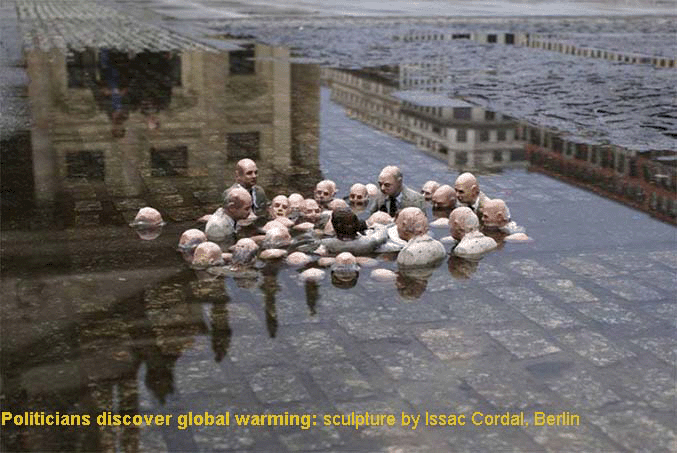
Edie 31st Oct 2024
Dozens of populous cities including Dubai, which hosted last year’s
international climate summit, will face high physical risks from the
climate crisis by 2050, the London Stock Exchange Group (LSEG) has warned.
LSEG’s new Net-Zero Atlas projects that half of the world’s largest 49
cities will be at high risk of one or more climate hazards by 2050—up
from just one in five today.
Hazards covered in the analysis include
floods, cyclones, heatwaves and water stress. Cities in the Middle East and
Southeast Asia are particularly vulnerable to multiple hazards, the Atlas
explains. Jakarta is expected to experience at least quadruple the number
of extreme heat days in 2050 as it did last year. And cities including
Singapore, Surabaya, Dubai, Riyadh, and Jeddah face similar heatwave risks,
which would be compounded by water stress.
This does not mean that cities
in other geographies are immune to physical climate risks. LSEG predicts
that, by 2050, London will experience a 133% increase in heatwave days and
a 22% rise in water stress, and Manchester will face a 93% increase in
heatwaves and a 45% rise in water stress.
https://www.edie.net/half-of-worlds-biggest-cities-to-face-severe-climate-risks-by-2050-lseg-finds/
Gravelines nuclear power plant: EDF refuses to respond on flood risks and tries to silence whistleblowers

Greenpeace France reminds that Monday morning’s action in the perimeter of the Gravelines power plant carries a message of public interest on the risks of marine submersion and flooding on the Gravelines power plant, an area combining climatic, industrial and nuclear vulnerabilities. For Greenpeace France, in light of the forecasts of scientists and the large uncertainties of the different climate scenarios, it is too dangerous to build two new nuclear reactors on this site, as EDF aims to do.
Greenpeace France 30th Oct 2024, https://www.greenpeace.fr/espace-presse/gravelines-edf-refuse-de-repondre-sur-les-risques-dinondations-et-tente-de-faire-taire-les-lanceurs-dalerte/
After more than 48 hours of deprivation of liberty, 10 of the 12 activists arrested have just been released. This arrest follows the action of Greenpeace France in the perimeter of the Gravelines power plant . Since 9 a.m. this morning, a gathering has been taking place in front of the Dunkirk Judicial Court, at the initiative of several local organizations that came to support the activists. The court informed the activists that a trial would be held on March 3, 2025 at 1:30 p.m. for intrusion into a civil facility housing nuclear materials in assembly. EDF has filed a complaint [1].
After spending two nights in police custody, the activists were brought before the Dunkirk Judicial Court in the early morning, at the request of the public prosecutor. The first activist to be released was deprived of his liberty for a total of 52 hours.
Greenpeace France reminds that Monday morning’s action in the perimeter of the Gravelines power plant carries a message of public interest on the risks of marine submersion and flooding on the Gravelines power plant, an area combining climatic, industrial and nuclear vulnerabilities. For Greenpeace France, in light of the forecasts of scientists and the large uncertainties of the different climate scenarios, it is too dangerous to build two new nuclear reactors on this site, as EDF aims to do.
While EDF refused to respond to Greenpeace France’s questions sent during the summer concerning the consideration of the impacts of climate change on the choice of the Gravelines site and the construction of new nuclear reactors, Greenpeace France dug into the subject and examined EDF’s project file, which resulted in the publication of a report on October 3 demonstrating the underestimation of the seriousness of climate change and the risks inherent in this project to build new reactors.
Greenpeace France also got involved in the consultation areas, particularly the ongoing public debate in Gravelines, and repeated its questions to obtain information on flood risks and the protective measures planned for the new reactors, ahead of the meetings on nuclear safety (theme of 19 November) and climate change (theme of 10 December). After Monday’s action, media reported that EDF did not wish to comment.
For Pauline Boyer, Energy Transition campaign manager at Greenpeace France: ” EDF is ignoring our questions about the risks that the construction of the two EPR2 reactors in Gravelines would create for the population, the workers at the plant and for the environment. In line with its behavior during the public debate for its similar project in Penly, it is clearly sending a signal of contempt for questions from the public, whether NGOs or residents. EDF is operating a diversion strategy by taking activists to court over the form of their action, in order to better evade the substantive issues. EDF is losing more points of trust. EDF will not succeed in gagging the whistleblowers. “
For Marie Dosé, the activists’ lawyer: ” The custody measures are unjustified and have only one purpose: to dissuade activists from alerting the population on a subject of general interest. All of them could have been the subject of a free hearing but, once again, the prosecuting authority preferred to make them sleep two nights in cells and bring them hastily before the court. “
Two activists remain in court at the time of writing this press release.
Australian Civil Society Statement for COP29 Baku, Azerbaijan
(from Scott Ludlam, on behalf of numerous, and increasing number of Australian civil groups)) 30 Oct 24
We, the undersigned Australian Civil Society organisations are united in support for the global clean energy transition and opposition to the nuclear industry playing a spoiling role in this transition.
Nuclear power is too slow, costly and inflexible to play any meaningful role in the global decarbonisation efforts. Nuclear also brings unique risks and long-lived wastes.
Given the environmental, economic and human urgency of addressing climate change and advancing the energy transition the nuclear industry must not be allowed to cause the global diplomatic community any further delay.
Australia is moving purposefully away from centralised fossil fuel combustion and toward distributed renewable energy generation and storage. In 2024, 40% of Australia’s electricity is generated from renewable energy. This capacity is proven, delivering and expanding rapidly.
We have been fortunate to learn from the world’s experience with nuclear power. We understand why its role in global energy systems and its contribution to global electricity production has been in decline for decades. Its legacy is one of underperformance, burgeoning cost, intractable health impacts and long-lived radioactive wastes.
Despite this, a coordinated campaign is currently being waged to undermine public support for this decarbonisation effort. The last thing Australia needs now is nuclear distraction and delay.
As the former Australian Chief Scientist Dr. Alan Finkel said, “Any call to go directly from coal to nuclear is effectively a call to delay decarbonisation of our electricity system by 20 years”.
Australia, and the world, cannot afford this delay. We stand resolute in our support for real climate action through the clean energy transition and in our opposition to false nuclear promises.
Record levels of heat-related deaths in 2023 due to climate crisis, report finds
Almost half of global land area saw extreme drought for at least one month, according to Lancet Countdown
Anna Bawden, https://www.theguardian.com/environment/2024/oct/30/record-levels-of-heat-related-deaths-in-2023-due-to-climate-crisis-report-finds
Heat-related deaths, food insecurity and the spread of infectious diseases caused by the climate crisis have reached record levels, according to a landmark report.
The Lancet Countdown’s ninth report on health and the climate breakdown reveals that people across the world face unprecedented threats to their health from the rapidly changing climate.
“This year’s stocktake of the imminent health threats of climate inaction reveals the most concerning findings yet,” warned Dr Marina Romanello, executive director of the Lancet Countdown at University College London.
“Once again, last year broke climate change records with extreme heatwaves, deadly weather events, and devastating wildfires affecting people around the world. No individual or economy on the planet is immune [to] the health threats of climate change.
The relentless expansion of fossil fuels and record-breaking greenhouse gas emissions compounds these dangerous health impacts, and is threatening to reverse the limited progress made so far and put a healthy future further out of reach.”
The report finds that in 2023, extreme drought lasting at least one month affected 48% of the global land area, while people had to cope with an unprecedented 50 more days of health-threatening temperatures than would have been expected without the climate crisis. As a result, 151 million more people faced moderate or severe food insecurity, risking malnutrition and other harm to their health.
Heat related deaths among the over-65s rocketed by 167% in 2023, compared with the 1990s. Without the climate crisis, an ageing global population means such deaths would have increased, but only by 65%. High temperatures also led to a record 6% more hours of lost sleep in 2023 than the 1986–2005 average. Poor sleep has a profound negative effect on physical and mental health.
Hotter and drier weather saw greater numbers of sand and dust storms, which contributed to a 31% increase in the number of people exposed to dangerously high particulate matter concentrations, while life-threatening diseases such as dengue, malaria and West Nile virus continue to spread into new areas as a result of higher temperatures.
But despite this, “governments and companies continue to invest in fossil fuels, resulting in all-time high greenhouse gas emissions and staggering tree loss, reducing the survival chances of people all around the globe”, the authors found.
In 2023, global energy-related carbon dioxide emissions reached an all-time high, 1.1% above 2022, and the proportion of fossil fuels in the global energy system increased for the first time in a decade during 2021, reaching 80.3% of all energy.
Responding to the findings, Dr Tedros Adhanom Ghebreyesus, director general of the World Health Organization, said: “The climate crisis is a health crisis. As the planet heats up, the frequency and intensity of climate-related disasters increase, leaving no region untouched.”
The report makes it clear, he added, that “climate change is not a distant threat, but an immediate risk to health”.
Meltdown nightmares: silent spring for climate change

“Dirty Secrets of Nuclear Power in an Era of Climate Change,” strips away the myth that nuclear energy solves climate change
By Choi Hee-jin, October. 29. 2024, Korea Times: https://m-koreatimes-co-kr.cdn.ampproject.org/c/s/m.koreatimes.co.kr/pages/article.amp.asp?newsIdx=384891—
Asia is buzzing with the 2024 Nobel Prize announcements. The Nobel Prize in literature was awarded to a Korean author, Han Kang, and the Peace Prize to the Japanese organization Nihon Hidankyo, formed by Hibakusha in 1956 to improve support for victims and lobby governments to abolish nuclear weapons. Today, I would like to introduce a timely book that came out this summer on the topic of the Nobel Peace Prize.
In 1962, Rachel Carson published “Silent Spring,” a landmark book that ignited the modern environmental movement by exposing the hidden and devastating effects of widespread pesticide use. Her message raised public awareness about the harmful effects of DDT and led to the establishment of the Environmental Protection Agency in 1970. Consequently, it contributed to banning DDT in the United States in 1972 and internationally in 2004.
Like Carlson’s book, the recently released “Dirty Secrets of Nuclear Power in an Era of Climate Change,” strips away the myth that nuclear energy solves climate change and calls our attention to nuclear power. Its authors are Doug Brugge, professor and chair of the Department of Public Health Sciences at the University of Connecticut, and Aaron Datesman, visiting professor at the University of Virginia and engineer at NASA’s Goddard Space Flight Center.
Before delving into the book, some fundamental questions about climate change should be addressed. Is climate change real? Yes, it is happening. As temperatures continue to rise swiftly, the melting of glaciers and polar ice is becoming more pronounced, serving as a visible and reliable sign of climate change. What is the cause? There is much debate on this topic, but human activity — particularly our reliance on fossil fuels in built environments, cities, and infrastructure — is the main culprit. What is crucial in addressing climate change? Time. It depends on how quickly we switch from fossil fuels to other energy sources. Nuclear power, even in “highly developed” countries, takes a significant amount of time to implement as a solution.
Hidden Costs
Brugge and Datesman conclude that the effects of nuclear power may be more severe and longer lasting because some radioactive materials have such long half-lives, and nuclear accidents are so catastrophic. It exposes the hidden problems of the nuclear industry by looking at its impacts on people and the environment, with a focus on uranium mining, waste management and the dangers of nuclear proliferation.
Uranium mining disproportionately impacts Indigenous communities, leaving a legacy of pollution and health problems. The waste dilemma poses another challenge, with no permanent storage solution for high-level nuclear waste, potentially poisoning water, food chains and ecosystems for thousands of years.
The history of Fukushima and Chernobyl still haunts us and reminds us of the danger of nuclear accidents. The authors say even well-designed reactors are prone to failure due to human error, natural disaster or terrorism. These types of accidents would be a national security issue and would require massive long-term clean-up, and the communities affected would continue to live with the effects.
Economic realities of nuclear power
The economics of nuclear are also covered. Supporters point to the financial benefits of nuclear. But the book shows that the actual costs still need to be added in. Recent numbers bear this out: between 2010 and 2020, the cost of utility-scale solar and onshore wind fell 85 percent and 56 percent, respectively, while nuclear costs increased. The economics are shifting and making nuclear look less and less like a solution to climate change. The authors argue that renewable energy technologies offer a safer and more viable path to a decarbonized future.
A call for responsible energy choices
Nuclear power is being promoted as a solution in many countries and regions. Still, its inherent risks and unsolved problems mean there are better options for achieving net zero emissions and a carbon-free world. “Dirty Secrets of Nuclear Power in the Age of Climate Change” calls for global action to transition to more sustainable and equitable energy solutions. No one knowingly leaves a ticking time bomb in their house when there are safer alternatives.
In industrial history, miners would take small canaries deep into the earth, their delicate respiratory systems acting as an early warning system for toxic gases. A canary’s song, or its silence, could mean the difference between life and death for miners. While we continue to grapple with the ever-present dangers of invisible nuclear radiation and the consequences of its hazardous waste, we seem to treat future generations as unwitting canaries.
Perhaps the debate over nuclear power is outdated. It is essential to envision a completely new society with a carbon-free economy that ensures sustainable prosperity. We need to invest boldly in new alternatives and develop innovative technologies that harness nature’s limitless energy before it’s too late.
Choi Hee-jin is the author of “Future Cities” in The Routledge Handbook for Sustainable Cities and Landscapes in the Pacific Rim (2022), Salzburg Global Seminar Fellow (2023), and founder and CEO of RestFullness(restfullness.net), a platform for rest. She leads vocational formation and leadership sessions and coaches young leaders at METES Institute(metes.io).
Climate Goal “Will Be Dead Within a Few Years” Unless World Acts, UN Warns
The world is well on track to blow past a goal of limiting global warming to 1.5 degrees Celsius that many countries have put at the center of their climate efforts
By Sara Schonhardt & E&E News
Climate Goal “Will Be Dead Within a Few Years” Unless World Acts, UN
Warns. The world is well on track to blow past a goal of limiting global
warming to 1.5 degrees Celsius that many countries have put at the center
of their climate efforts. I
f current trends continue, “there is virtually
no chance” of limiting global warming over the past 170 years to 1.5
degrees, according to the latest emissions gap report from the United
Nations Environment Programme (UNEP). Even in the most optimistic
scenarios, where all countries deliver on their emission-cutting pledges,
“there remains about a 3-in-4 chance that warming will exceed 1.5C,” it
adds.
Scientific American 25th Oct 2024, https://www.scientificamerican.com/article/climate-goal-will-be-dead-within-a-few-years-unless-world-acts-un-warns/
1 This Month
To see nuclear-related stories in greater depth and intensity – go to https://nuclearinformation.wordpress.com/
12 February – Webinar The Big Push: New Nuclear Projects in Canada
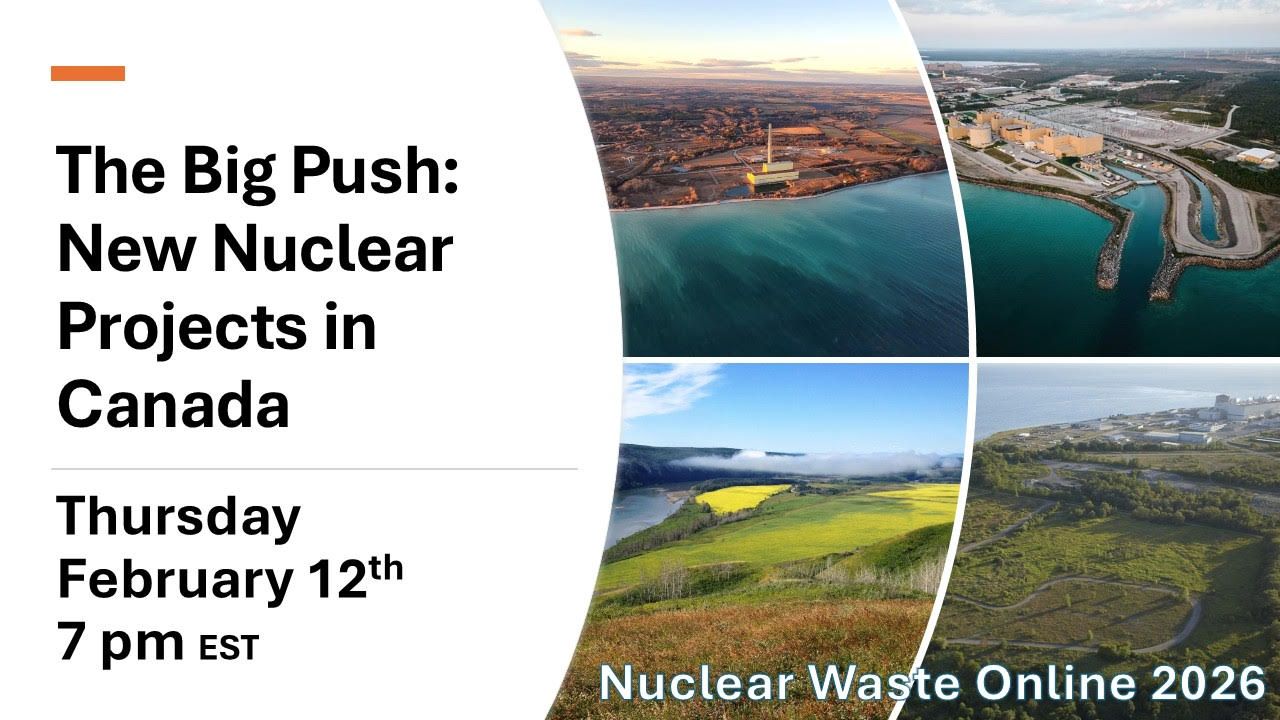
Thursday, February 12, 7 pm Eastern | 2nd of 4 sessions in the 2026 Nuclear Waste Online webinar series
Join a webinar on the push for new nuclear generation in Canada. Go to Northwatch.org to register or use the registration link https://us02web.zoom.us/webinar/register/WN_ZfWOf1GITqSRIZX8CB-A9w
-
Archives
- February 2026 (127)
- January 2026 (308)
- December 2025 (358)
- November 2025 (359)
- October 2025 (376)
- September 2025 (258)
- August 2025 (319)
- July 2025 (230)
- June 2025 (348)
- May 2025 (261)
- April 2025 (305)
- March 2025 (319)
-
Categories
- 1
- 1 NUCLEAR ISSUES
- business and costs
- climate change
- culture and arts
- ENERGY
- environment
- health
- history
- indigenous issues
- Legal
- marketing of nuclear
- media
- opposition to nuclear
- PERSONAL STORIES
- politics
- politics international
- Religion and ethics
- safety
- secrets,lies and civil liberties
- spinbuster
- technology
- Uranium
- wastes
- weapons and war
- Women
- 2 WORLD
- ACTION
- AFRICA
- Atrocities
- AUSTRALIA
- Christina's notes
- Christina's themes
- culture and arts
- Events
- Fuk 2022
- Fuk 2023
- Fukushima 2017
- Fukushima 2018
- fukushima 2019
- Fukushima 2020
- Fukushima 2021
- general
- global warming
- Humour (God we need it)
- Nuclear
- RARE EARTHS
- Reference
- resources – print
- Resources -audiovicual
- Weekly Newsletter
- World
- World Nuclear
- YouTube
-
RSS
Entries RSS
Comments RSS
 nuclear-news