PSEG spokesman Joseph Delmar Sr. says the utility company’s Salem Unit 2 reactor was manually taken offline by control room operators early Thursday morning at 3:01 a.m. due to frazil icing conditions at the circulating water intake structure on the non-nuclear side of the power plant. ………Chris Franklin can be reached at cfranklin@njadvancemedia.com. Follow him on Twitter @cfranklinnews or on Facebook. Have a tip? Tell us. nj.com/tips. https://www.nj.com/salem/2019/02/its-so-cold-even-a-nuclear-reactor-in-nj-cant-do-its-job.html
New Jersey nuclear reactor shut down due to extreme cold weather
 It’s so cold, even a nuclear reactor in N.J. can’t do its job,Feb 1, By Chris Franklin | For NJ.com
Climate change brings water shortage to India and Pakistan
Water wars: Are India and Pakistan heading for climate change-induced conflict? DW , 30 Jan 19,
Across the world, climate change is sparking conflict as people struggle over dwindling resources. The fight over water could quickly escalate between India and Pakistan — and both have nuclear arms.
Yemen, Somalia and Syria are just some of the places where climate change is increasingly regarded as a root cause of violent conflict. But while much of the focus on climate change-attributed conflict has predominantly been on Africa and the Middle East, a potentially even deadlier clash over resources may be looming on the horizon in Asia.
That’s because India and Pakistan — bitter rivals over water — both have nuclear weapons in their arsenal.
The two countries have a long but strained agreement over sharing water from the Indus River and its tributaries. Waters from the Indus, which flow from India and the disputed Kashmir region into Pakistan, were carved up between India and Pakistan under the 1960 Indus Water Treaty (IWT).
Read more: Water scarcity in Pakistan – A bigger threat than terrorism
The IWT divides the six major rivers of the Indus basin between Pakistan and India. Pakistan was granted rights to most of the water in the region’s western rivers — the Indus, Jhelum and Chenab — which flow through Indian-administered Kashmir.
The dispute over the Kashmir region — a flashpoint between India and Pakistan for more than six decades — is hugely intertwined with water security. Both countries claim the whole region, but each only controls a part of it.
While the IWT has managed to survive the wars and other hostilities, it is increasingly being strained to its limit. Pakistan has accused India of throttling its water supply and violating the IWT by constructing dams over the rivers flowing into Pakistan from Kashmir.
“Any country with nuclear weapons, if they’re backed into a corner because they have no water — that’s really dangerous,” said Jeff Nesbit, author and executive director of non-profit climate communication organization Climate Nexus.
‘A matter of survival’
For Sherry Rehman, Parliamentary Leader of the left-wing opposition Pakistan People’s Party (PPP) in the Senate, water security, especially in South Asia, “has become a regional security threat.”
“We are now facing challenges brought about by climate change which were not a primary focus during the negotiations for the Indus Water Treaty,” she told DW.
“It has become a matter of survival,” she continued. “Aside from the lack of formal dialogue, the rhetoric floating around suggesting a possible water war is particularly alarming.”
A treaty under threat
For Pakistan, the Indus waters are a lifeline: most of the country depends on it as the primary source of freshwater and it supports 90 percent of the country’s agricultural industry.
And while Pakistan was considered relatively plentiful with water, a mixture of mismanaged irrigation, water-intensive agriculture and climate change has reduced the Indus to a trickle in parts.
A 2018 report from the International Monetary Fund ranked Pakistan third among countries facing severe water shortages.
When the rapidly-melting glaciers in the Himalayas, which feed the Indus waters, eventually disappear as predicted, the dwindling rivers will be slashed even further…………
Elsewhere in Asia, other conflicts have also been linked to climate change. For instance the unprecedented flooding in Thailand in 2011 which sparked major protests over unfair emergency supplies distribution and ultimately led to a military coup that overthrew the democratically-elected government in 2014. The military junta is still in power to this day.
On a global level, Janani Vivekananda, climate security expert at consultancy Adelphi, is somewhat more hopeful about how the struggle over water will play out.
“The trend is people cooperate rather than fight over water because it’s just too important and I think this is what will happen just out of necessity,” she told DW. “Because there’s too much to lose.” https://www.dw.com/en/water-wars-are-india-and-pakistan-heading-for-climate-change-induced-conflict/a-47203933
The One Earth Climate Model to curb climate change, without nuclear power
 Leonardo DiCaprio’s foundation just announced a bold new plan to curb climate change https://www.fastcompany.com/90296468/leonardo-dicaprios-foundation-just-announced-a-bold-new-plan-to-curb-climate-change
The One Earth Climate Model says we can curb temperature rises without resorting to nuclear power or using unproved technologies. It will be expensive–but far less than the subsidies we currently give fossil fuel companies. BY ADELE PETERS , 30 Jan 19
A landmark climate report in late 2018 explained exactly what’s at stakeif the world doesn’t limit global warming to 1.5 degrees Celsius, from the total loss of coral reefs to millions of people at risk from sea level rise. Now, a new report lays out a blueprint to keep warming in check– without, as many plans do, relying on controversial nuclear power or new technologies to capture CO2 (including machines that suck carbon dioxide from the air) that haven’t yet been proven at scale. The report says it can happen for far less money than we’re currently spending to subsidize fossil fuels.
The researchers took a detailed, bottom-up look at the energy sector, modeling each hour of energy use through 2050 on 72 regional energy grids, studying local solar and wind data, and projecting energy demand and the need for storage. They considered three scenarios. In one, based on projections from the International Energy Agency, they looked at how the world could continue to rely heavily on fossil fuels and warm an apocalyptic 5 degrees. In another, they modeled how the world could limit warming to 2 degrees. The last scenario looked at a 1.5-degree limit.
To stay under 1.5 degrees of warming, the report says, the world needs to move quickly to renewable energy, reaching 100% renewables by 2050. By 2020, we’ll need to be phasing out an average of two coal power plants every week. Heating, cooling, and transportation will have to shift to electricity on a massive scale. Energy use will have to become much more efficient, with total demand dropping by more than a third.
The changes in the energy system–all based on currently available technology–can get the world most of the way to the 1.5-degree target. “Negative emissions,” or sucking carbon out of the air, is necessary for the rest. While other climate models include new carbon-capture technology, the researchers found that planting and protecting forests could take up enough carbon to avoid unproven solutions. Through changes in land use, particularly large-scale reforestation in tropical forests and reducing logging, it’s possible to sequester around 150 gigatons of carbon dioxide. “Forests do a much better job as natural carbon sinks–and they are an asset for our planet that should be conserved for a wealth of reasons, which is why we propose the restoration of forests and a moratorium on deforestation within this generation,” Teske says. (The report acknowledges that this solution has risks, including the possibility that increasing wildfires burn down trees, or prolonged droughts mean that soil isn’t taking up as much carbon.)
A fast transition to renewable energy would also create more jobs than the business-as-usual path, the report says. By 2050, on a 1.5-degree pathway, the world would have 46.3 million energy sector jobs, versus 29.9 million in a 5-degree scenario. The transition would be expensive, with a cost of around $1.7 trillion a year. But governments currently spend an estimated $5 trillion a year to support fossil fuels, or $10 million a minute every day. Shifting to clean power could happen at a third of the cost.
The report makes it clear that it’s technically and economically possible to make the changes we need. The gap is political and social. “Staying below 1.5 Celsius is still possible, but it’s going to take radical action by governments to implement the right policy frameworks and public mobilization on an unprecedented scale if we’re to build the zero-carbon future that the world so desperately needs,” says Teske.
Protests over inaction on climate change – in Belgium and France
Climate change protests in Belgium, France, https://www.sbs.com.au/news/climate-change-protests-in-belgium-france 30 Jan 19, Brussels and Paris have been the site of strong protests demanding more action on climate change. At least 70,000 people have braved cold and rain in Brussels to demand the Belgian government and the European Union increase efforts to fight climate change.The event was described as Belgium’s biggest climate march ever, with trains so clogged that thousands of people didn’t make the march in time.
“Young people have set a good example,” protester Henny Claassen said amid banners urging better renewable energy use and improved air quality.
“This is for our children, for our grandchildren, and to send a message to politicians.”
The march ended at the headquarters of the European Union. The 28-nation bloc has been leading global efforts to counter climate change but still came in for the protesters’ criticism.
“Society as a whole could do a lot more because they’re saying ‘Yes, we’re doing a lot,’ but they’re doing not that much. They could do a lot more,” demonstrator Pieter Van Der Donckt said.
Citizen activism on climate change Sunday was not limited to Belgium.
Thousands of people made human chains or held other climate events around France.
In Paris, there was a debate inspired by a recent petition for legal action to force the government to set more ambitious goals for reducing carbon emissions that create global warming.
President Emmanuel Macron sees himself as a climate crusader, but suffered a serious setback when fuel tax increases meant to help wean France off fossil fuels backfired dramatically, unleashing the country’s yellow vest protests now in their third month.
Donald Trump proud of fundamentally misunderstanding climate change?
Independent 29th Jan 2019 , Donald Trump has again appeared to fundamentally misunderstand climate
change by suggesting extreme cold weather in the US is evidence global
warming does not exist. “In the beautiful Midwest, wind chill temperatures
are reaching minus 60 degrees, the coldest ever recorded,” Mr Trump tweeted
late on Monday evening. “In coming days, expected to get even colder.
People can’t last outside even for minutes.
What the hell is going on with Global Waming (sic)? Please come back fast, we need you!” he added
sarcastically. Experts were quickly forced to correct the president online,
including the National Oceanic and Atmospheric Administration, a
government research agency which simply tweeted the statement, “Winter
storms don’t prove global warming isn’t happening.” It follows a number of
recent tweets by the president expressing gleeful disregard for the
scientific consensus that holds human carbon emissions responsible for
recent global temperature increases.
https://www.independent.co.uk/news/world/americas/us-politics/trump-twitter-climate-change-global-warming-us-weather-polar-vortex-cold-a8751641.html
Germany phasing out coal, but will not import nuclear power as replacement
Do not want imported nuclear power to make up for coal phase-out: German minister, http://www.hurriyetdailynews.com/do-not-want-imported-nuclear-power-to-make-up-for-coal-phase-out-german-minister-140816Germany‘s Economy Minister Peter Altmaier on Jan. 28 said that he did not want Germanyto compensate for a planned phase out of coal-fired power by 2038 by importing nuclearpower from neighboring countries.
“We want energy security to be provided at all times,” the minister told broadcaster ZDF, but added: “We do not want to import cheap nuclear power from other countries.”
Germany‘s coal commission on Jan. 26 said the country should shut down all of its coal-fired power plants by 2038 at the latest, proposing at least 40 billion euros ($45.7 billion) in aid to regions affected by the phase-out.
Our global home”is on fire” – Greta Thunberg at the World Economic Forum 2019
Greta Thunberg | Special Address, Annual Meeting of the World Economic Forum 2019
‘Our house is on fire’: Greta Thunberg, 16, urges leaders to act on climatehttps://www.theguardian.com/environment/2019/jan/25/our-house-is-on-fire-greta-thunberg16-urges-leaders-to-act-on-climate
Swedish school strike activist demands economists tackle runaway global warming. Read her Davos speech here,
Our house is on fire. I am here to say, our house is on fire.
Doomsday Clock at 2 minutes to midnight – “The New Abnormal”
 Welcome to “The New Abnormal” Bulletin of the Atomic Scientists By Bulletin Staff, January 24, 2019 A new abnormal: It is still 2 minutes to midnight Humanity now faces two simultaneous existential threats, either of which would be cause for extreme concern and immediate attention. These major threats—nuclear weapons and climate change—were exacerbated this past year by the increased use of information warfare to undermine democracy around the world, amplifying risk from these and other threats and putting the future of civilization in extraordinary danger. Welcome to “The New Abnormal” Bulletin of the Atomic Scientists By Bulletin Staff, January 24, 2019 A new abnormal: It is still 2 minutes to midnight Humanity now faces two simultaneous existential threats, either of which would be cause for extreme concern and immediate attention. These major threats—nuclear weapons and climate change—were exacerbated this past year by the increased use of information warfare to undermine democracy around the world, amplifying risk from these and other threats and putting the future of civilization in extraordinary danger.
There is nothing normal about the complex and frightening reality just described. WASHINGTON, D.C. – January 24, 2019 – Citing lack of progress on nuclear risks and climate change dangers as “the new abnormal,” the Doomsday Clock remains at 2 minutes to midnight, as close to the symbolic point of annihilation that the iconic Clock has been since 1953 at the height of the Cold War. The decision announced today to keep the Doomsday Clock at two minutes before midnight was made by the Bulletin of the Atomic Scientists’ Science and Security Board in consultation with the Board of Sponsors, which includes 14 Nobel Laureates. The full text of the Doomsday Clock statement is available at http://www.thebulletin.org. The statement includes key recommendations about how to #RewindtheDoomsdayClock. Video from the Doomsday Clock announcement at the National Press Club in Washington, D.C., is available at http://clock.thebulletin.org/and on the Bulletin of the Atomic Scientists’Facebook page at https://www.facebook.com/BulletinOfTheAtomicScientists/. …….https://thebulletin.org/2019/01/press-release-welcome-to-the-new-abnormal/ |
|
It makes sense to exclude Nuclear, Fossils With Carbon Capture,and Biofuels from the Green New Deal
|
Why Excluding Nuclear, Fossils With Carbon Capture, & Biofuels From The Green New Deal Makes Financial & Climate Sense, Clean Technica January 24th, 2019 , By Mark Z. Jacobson & Mark A. DelucchiThe Green New Deal and multiple proposed laws and resolutions in the U.S. House (HRes.540, HR.3314, HR.3671) and Senate (SRes.632, S.987) call for the United States to move entirely from fossil fuels to clean, renewable electricity and/or all energy. A new bill was just introduced by Rep. Ted Lieu (D-Los Angeles County) and Rep. Jimmy Gomez (D-CA), calling for the U.S. to produce 100 percent of its electric power from renewables by 2035. Recently, though, some vocal advocates have pushed back, claiming that the only way prices will stay low with large amounts of renewables on the power grid is to use nuclear power, fossil fuels with carbon capture, and biofuels, which they claim are “zero carbon.” Here is why nuclear, fossils with CCS, and biofuels should be excluded. All three technologies are opportunity costs. They raise costs to consumers and society, slow solutions to global warming and air pollution by increasing carbon and emissions relative to clean, renewables (thus are not zero carbon), and/or create risks that clean, renewables don’t have. For example, onshore wind and utility PV are now the cheapest forms of electricity in most countries, including the U.S. New nuclear today costs 4 to 6 times that of new solar or wind to produce the same electricity. Further, a nuclear plant takes 5 to 17 years longer between planning and operation than does a solar or wind farm. Thus, every dollar spent on nuclear results in 1/5th the energy production and 5 to 17 years more coal and gas burning than if wind or solar were installed instead. This delay and lower energy production from new nuclear condemns millions more to die from air pollution, which today kills 4 to 9 million people worldwide. By choosing to build several nuclear plants a decade ago that have yet to operate, China suffered an increase in its overall CO2 emissions by 1.4 percent between 2016 and 2017 rather than seeing a decrease of 3.4 percent if it had spent the money on wind and solar instead. Given that many 100% renewable policies call for a full transition of electricity by 2035, and given the financial and time requirements of nuclear, it is all but impossible for any more than a few new nuclear plant to be in place in by then. In terms of emissions, nuclear is not zero carbon. A new plant emits 9 to 37 times the carbon emissions over its life as onshore wind, partly due to the fossil fuels used in mining and refining uranium continuously and building the facility but more because coal and gas plants are emitting during the long planning-to-operation time of a nuclear plant. Just as importantly, according to the Intergovernmental Panel on Climate Change, there is “robust evidence and high agreement” that nuclear power raises concerns about weapons proliferation, core meltdown, creation and storage of radioactive waste, and land-use degradation from mining. Wind and solar power do not have these concerns. Next, neither coal nor natural gas with carbon capture and sequestration (CCS) is remotely close to zero carbon. For example, the Petra Nova project in Texas combines a coal plant with CCS. However, a natural gas plant was built just to run the CCS equipment, and when accounting for the actual efficiency, natural gas combustion emissions, CO2 combustion emissions, and methane leaks from mining the gas, the plant reduces only 22 percent of the carbon it was designed to over 20 years – at an additional cost of $4,200/MW. That same investment could have been spent on wind and solar to replace the entire coal plant and 100% of its emissions. Adding CCS to coal plants also increases air pollution and land degradation by about 25 percent. Finally, the captured CO2 is used for enhancing oil recovery, causing even greater damage to climate and health. Thus, CCS represents an enormous opportunity cost compared with developing wind or solar. Finally, biofuels for transportation and electricity cause substantial air pollution, climate-relevant emissions, land degradation, and water drawdown compared with truly clean, renewables such as wind and solar………..https://cleantechnica.com/2019/01/24/why-excluding-nuclear-fossils-with-carbon-capture-biofuels-from-the-green-new-deal-makes-financial-climate-sense-realitycheck/ |
|
|

Nuclear, climate threats keep Doomsday Clock close to apocalypse

Time’s running out
A renewed nuclear arms race, rising greenhouse gas emissions and the emergence of state-sponsored disinformation campaigns have left the modern world as close to annihilation as it was at the height of the Cold War, atomic scientists said on Thursday.
What is the Doomsday Clock?
The Doomsday Clock, created by the Bulletin of the Atomic Scientists as an indicator of the world’s susceptibility to apocalypse, remained at two minutes to midnight for a second year running in what the scientists called a dangerous “new abnormal.”
“Though unchanged from 2018, this setting should be taken not as a sign of stability but as a stark warning to leaders and citizens around the world,” the Chicago-based group said in a statement.
Two main factors
Humanity’s two simultaneous existential threats of nuclear war and climate change were exacerbated during the past year by the “increased use of information warfare to undermine democracy around the world,” the group said.
“In many forums, including particularly social media, nationalist leaders and their surrogates lied shamelessly, insisting that their lies were truth, and the truth ‘fake news,'” it said.
Nuclear threat
Since the election of US President Donald Trump in 2016, the clock has closed in on midnight in successive 30-second moves in 2017 and 2018, in part because of escalating tensions with North Korea over its nuclear program.
The last time the clock was as close to midnight as it has been in the past two years was in 1953, when the US-Soviet arms race escalated as Moscow tested a hydrogen bomb in August after the detonation of an American H-bomb the previous November.
Despite a softening of barbed rhetoric between Trump and North Korean leader Kim Jong Un over the past year, the group saw rising threats in nuclear-armed nations’ programs of “‘nuclear modernisation’ that are all but indistinguishable from a worldwide arms race.”
On climate, the group said carbon dioxide emissions resumed an upward climb in the past two years.
Clocking out
To turn back the clock, it recommended steps including fortifying and extending US-Russian nuclear treaties with limits on modernisation programs, adopting safeguards to prevent peacetime military incidents along NATO countries’ borders, citizen demands for action on climate change and multilateral talks to discourage the misuse of information technology.
The bulletin was founded by scientists who helped develop the United States’ first atomic weapons. When the clock was created in 1947, it was set at seven minutes to midnight.
Greta Thunberg speaks out for climate, at World Economic Forum
The Latest: Teen climate activist chides Davos elites https://www.newsobserver.com/news/business/article224945785.html,THE ASSOCIATED PRESS, JANUARY 23, 2019 DAVOS, SWITZERLAND
UK CAN meet its climate goals without the Wylfa nuclear plant
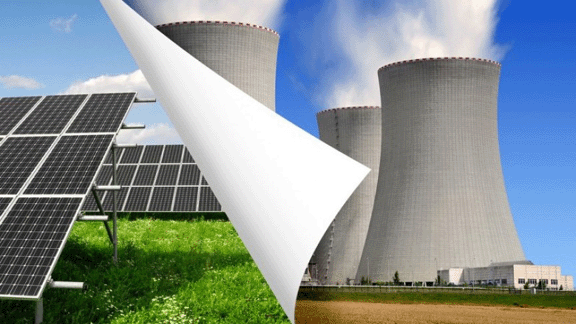
Q&A: Can the UK meet its climate goals without the Wylfa nuclear plant?
Carbon Brief, 21 January 2019 “……. recent analysis from the government’s official advisers the Committee on Climate Change (CCC) shows the UK could meet its power demand and climate goals to 2030 at low cost, without any new nuclear beyond the Hinkley C scheme already being built in Somerset.
This new analysis reflects the dramatic cost reductions seen for renewables in recent years. Greg Clark, the UK’s secretary of state for business, energy and industrial strategy (BEIS), made a similar point last week as he spoke in parliament about the failed Wylfa deal. He told MPs:
“The economics of the energy market have changed significantly in recent years. The cost of renewable technologies such as offshore wind has fallen dramatically…The challenge of financing new nuclear is one of falling costs and greater abundance of alternative technologies, which means that nuclear is being outcompeted.”……….
The CCC’s “central renewables” and “high renewables” scenarios meet the 2030 carbon target without new nuclear beyond Hinkley C. In these scenarios, nuclear generation in 2030 is 35TWh – the estimated output of Hinkley C plus Sizewell B, each running for 90% of available hours……….
each of the 2030 scenarios supplies enough electricity to meet projected demand, meaning the lights would not “go out”. Gas would still supply 20-25% of electricity, most of which would be used to cover peak demand during winter or to fill gaps in variable renewable output.
The CCC scenarios out to 2030 all massively expand renewables, whether or not additional new nuclear plants get built. The renewable share of the mix increases from 33% in 2018 to at least 58% in 2030. Nuclear’s share falls from 18% in 2018 to between 10% and 17% in 2030. At the low end, where no new nuclear is added after Hinkley C, it is renewables that make up the gap.
[The CCC says: “We do not consider [the BEIS 2030] pathway credible.” This pathway sees nuclear’s share hold steady, though, as BEIS notes, this is “not based on [nuclear] developers’ proposed pipeline”. BEIS also assumes imports via electricity interconnectors reach 21% of the total while the CCC assumes net-zero imports, with interconnectors helping balance supply and demand.]
The CCC says expanding wind and solar is a “low-regrets” option as renewables are likely to be cheaper than new gas, with similar costs to running existing gas plants or raising imports, even after accounting for the costs of integrating their variable output onto the grid. The CCC adds:
“If new nuclear projects [beyond Hinkley C] were not to come forward, it is likely that renewables would be able to be deployed on shorter timescales and at lower cost.”
Replacing the output of the shelved new nuclear plants at Wylfa, Moorside and Oldbury with renewables would be 13-33% cheaper, including the costs of balancing variable output, according to quickfire analysis from the Energy and Climate Intelligence Unit.
Note that reductions in per-capita electricity generation have saved the UK the equivalent of four Hinkley Cs of demand since 2005, according to recent Carbon Brief analysis. The CCC assumes continued efficiency improvements to 2030 are offset by demand for electric vehicles and heating. ……https://www.carbonbrief.org/qa-can-the-uk-meet-its-climate-goals-without-the-wylfa-nuclear-plant
’Human activity has created a new era yet climate change can be stopped’ – David Attenborough
Sir David Attenborough calls for ‘urgent’ climate change action
David Attenborough tells Davos: ‘The Garden of Eden is no more’Human activity has created a new era yet climate change can be stopped, says naturalist, Guardian, Graeme Wearden in Davos, Tue 22 Jan 2019 Last modified on Tue 22 Jan 2019 Sir David Attenborough has warned that “the Garden of Eden is no more”, as he urged political and business leaders from around the world to make a renewed push to tackle climate change before the damage is irreparable.Speaking at the start of the World Economic Forum (WEF) in Davos, Switzerland, the 92-year-old naturalist and broadcaster warned that human activity has taken the world into a new era, threatening to undermine civilisation.
“I am quite literally from another age,” Attenborough told an audience of business leaders, politicians and other delegates. “I was born during the Holocene – the 12,000 [year] period of climatic stability that allowed humans to settle, farm, and create civilisations.” …..
“The Holocene has ended. The Garden of Eden is no more. We have changed the world so much that scientists say we are in a new geological age: the Anthropocene, the age of humans,” he declared.
In a stark warning to the world leaders and business chiefs flocking to the WEF this week, Attenborough warned that the only conditions that humans have known are changing fast.
“We need to move beyond guilt or blame, and get on with the practical tasks at hand.”…..
Get it right, he argued, and humans can create a world with clean air and water, unlimited energy and sustainable fish stocks, but only if decisive action is taken now.
“Over the next two years there will be United Nations decisions on climate change, sustainable development and a new deal for nature. Together these will form our species’ plan for a route through the Anthropocene.
“What we do now, and in the next few years, will profoundly affect the next few thousand years,” he added.
Speaking to journalists after his speech, Attenborough warned that economic models needed to change. “Growth is going to come to an end, either suddenly or in a controlled way,” he explained, citing the old joke that anyone who thinks you can have infinite growth in finite circumstances is “either a madman or an economist”. ………https://www.theguardian.com/tv-and-radio/2019/jan/21/david-attenborough-tells-davos-the-garden-of-eden-is-no-more
Greenland ice melt is happening at an unexpectedly fast rate

Greenland ice melting four times faster than in 2003, study finds, Southwest part of the island could be major contributor to sea level rise, EurekAlert, 21 Jan 19, OHIO STATE UNIVERSITY COLUMBUS, Ohio – Greenland is melting faster than scientists previously thought–and will likely lead to faster sea level rise–thanks to the continued, accelerating warming of the Earth’s atmosphere, a new study has found.
Scientists concerned about sea level rise have long focused on Greenland’s southeast and northwest regions, where large glaciers stream iceberg-sized chunks of ice into the Atlantic Ocean. Those chunks float away, eventually melting. But a new study published Jan. 21 in the Proceedings of the National Academy of Sciences found that the largest sustained ice loss from early 2003 to mid-2013 came from Greenland’s southwest region, which is mostly devoid of large glaciers.
“Whatever this was, it couldn’t be explained by glaciers, because there aren’t many there,” said Michael Bevis, lead author of the paper, Ohio Eminent Scholar and a professor of geodynamics at The Ohio State University. “It had to be the surface mass–the ice was melting inland from the coastline.”
That melting, which Bevis and his co-authors believe is largely caused by global warming, means that in the southwestern part of Greenland, growing rivers of water are streaming into the ocean during summer. The key finding from their study: Southwest Greenland, which previously had not been considered a serious threat, will likely become a major future contributor to sea level rise………https://www.eurekalert.org/pub_releases/2019-01/osu-gim011419.php
1 This Month
26 September – International Day for the Total Elimination of Nuclear Weapons





PLEASE OPPOSE HR 8255 AND S.3639 – bills would accelerate satellite deployment, with no environmental review or safeguards – https://ncstd5li.quorum.us/campaign/169331/
To see nuclear-related stories in greater depth and intensity – go to https://nuclearinformation.wordpress.com
-
Archives
- September 2026 (305)
- August 2026 (330)
- July 2026 (355)
- June 2026 (287)
- May 2026 (306)
- April 2026 (356)
- March 2026 (251)
- February 2026 (267)
- January 2026 (308)
- December 2025 (358)
- November 2025 (359)
- October 2025 (375)
-
Categories
- 1
- 1 NUCLEAR ISSUES
- business and costs
- climate change
- culture and arts
- ENERGY
- environment
- health
- history
- indigenous issues
- Legal
- marketing of nuclear
- media
- opposition to nuclear
- PERSONAL STORIES
- politics
- politics international
- Religion and ethics
- safety
- secrets,lies and civil liberties
- spinbuster
- technology
- Uranium
- wastes
- weapons and war
- Women
- 2 WORLD
- ACTION
- AFRICA
- Atrocities
- AUSTRALIA
- Christina's notes
- Christina's themes
- culture and arts
- Events
- Fuk 2022
- Fuk 2023
- Fukushima 2017
- Fukushima 2018
- fukushima 2019
- Fukushima 2020
- Fukushima 2021
- general
- global warming
- Humour (God we need it)
- Nuclear
- RARE EARTHS
- Reference
- resources – print
- Resources -audiovicual
- Weekly Newsletter
- World
- World Nuclear
- YouTube
-
RSS
Entries RSS
Comments RSS

