 Dr. Gregory Jaczko served as Chairman of the U.S. Nuclear Regulatory Commission from 2009-2012, and as a commissioner from 2005-2009. As Chairman, he played a lead role in the American government’s response to the Fukushima nuclear accident in Japan. Dr. Jaczko is now an adjunct professor at Princeton University and Georgetown University, and an entrepreneur with a clean energy development company. He is the author of Confessions of a Rogue Nuclear Regulator.
Arctic ice – summers without it could happen sooner than predicted
 Ice-free Arctic summers could happen on earlier side of predictions
A new study in AGU’s journal Geophysical Research Letters predicts the Arctic Ocean will be ice-free in summer by mid-century.EurekAlert, AMERICAN GEOPHYSICAL UNION, 27 Feb 19
WASHINGTON — The Arctic Ocean could become ice-free in the summer in the next 20 years due to a natural, long-term warming phase in the tropical Pacific that adds to human-caused warming, according to a new study.
Computer models predict climate change will cause the Arctic to be nearly free of sea ice during the summer by the middle of this century, unless human greenhouse gas emissions are greatly reduced.
But a closer examination of long-term temperature cycles in the tropical Pacific points towards an ice-free Arctic in September, the month with the least sea ice, on the earlier side of forecasts, according to a new study in the AGU journal Geophysical Research Letters.
“The trajectory is towards becoming ice-free in the summer but there is uncertainty as to when that’s going to occur,” said James Screen, an associate professor in climate science at the University of Exeter in the U.K. and the lead author of the new study………https://www.eurekalert.org/pub_releases/2019-02/agu-ias022719.php
How quickly we ‘normalise’ rising temperatures

Just by the way- Scientists found that frogs DO jump out of the water as it gets hot. They are smarter than we are.  https://tinyurl.com/y3wgyqc7
New research finds that we normalize rising temperatures remarkably quickly. https://psmag.com/environment/as-the-climate-changes-are-we-all-boiling-frogs,TOM JACOBS, FEB 26, 2019
Nuclear power is no solution to the climate crisis
 Nukes Are No Answer To Climate Crisis RALPH NADER RADIO HOUR https://ralphnaderradiohour.com/nukes-are-no-answer-to-climate-crisis/?fbclid=IwAR1WWrHrMbT0bflR2p7fJDw89KeS_qb1fMSRcAX6ESDXanFL6A2hDNbM8To
Climate change taking its toll on the Sea of Galilee and the Jordan River
The Sea of Galilee: A Sea of Miracles Disappearing
 Where Jesus once preached, the holy waters are draining away, Climate change and conflict have left the river Jordan a stagnant stream and the Sea of Galilee critically low, Guardian, Oliver Holmes Sun 24 Feb 2019
Once a raging torrent, the lower Jordan has been starved of water to become a stagnant stream, filled with sewage and dirty run-off from farms. Around 95% of its historical flow has been diverted by agriculture during the past half-century. And the river’s primary source, the Sea of Galilee – where Christians believe the son of God walked on water – has for years been dammed to prevent its demise.
Biblical bodies of water in the Holy Land, eternalised in Christian, Jewish and Muslim ancient texts as godly, are now facing very human threats: climate change, mismanagement and conflict.
Following five consecutive years of drought, the Sea of Galilee has sunk to a 100-year low. A number of small islands have emerged at the water’s surface, and several holiday homes that were built on the shoreline now stand at least 100 metres from the boggy edge.
Overuse has also taken its toll. Last summer, the level of the lake dropped close to a black line, a level at which it could lose its status as a freshwater body. “The black line is our best guess of that point,” says Gidon Bromberg, the Israeli director of EcoPeace, an organisation of Israeli, Palestinian and Jordanian environmentalists. “It was tens of centimetres above the black line,” he says, adding that such a shallow depth has not been seen in records taken over the past century.
As the lake’s level falls, it cannot wash away salt fast enough, and its salinity rises. If the Sea of Galilee’s waters were left to hover around the black line, its flora and fauna would start to perish. A glimpse of the lake’s grim future might be seen 350km downriver at the lowest place on the planet: the Dead Sea, a body almost devoid of fish and plant life. “Once the lake becomes saline, that could be irreversible,” says Bromberg, speaking at the muddy edge of the water, reeds poking up behind him………
As long as the Sea of Galilee is under threat, the river Jordan will be too. And their eventual deaths could have explosive ramifications as water in this region has been a key source of conflict. The river Jordan is shared by Israel, the occupied Palestinian territories, Jordan and Syria, all of which use its depleting reserves………
EcoPeace hopes that good water management will spur on peace to the region. Bromberg is now advocating for a deal in which Israel, which is on the Mediterranean, supplies desalinated water to Jordan. In exchange, Jordan, which is low on water but full of open desert with 320 sunny days a year, will supply solar power.
In the meantime, the river Jordan remains polluted. Most Christian pilgrims who want to be baptised in the holy waters do not venture to the original site where John the Baptist is believed to have led Jesus into the water. That location is in the occupied Palestinian territories next to Jordan, and the Israeli army mined it decades ago. Pilgrims were only allowed to return some years ago……… https://www.theguardian.com/world/2019/feb/23/israel-where-jesus-preached-holy-waters-draining-away-sea-of-galilee-river-jordan?CMP=share_btn_tw
Climate change encroaching on Marshall Islands – drastic effort to “elevate” some of them
 Climate change forces low-lying Marshall Islands to ‘elevate islands’, Climate change has left the low-lying Marshall Islands with little choice but to consider drastic measures. https://www.sbs.com.au/news/climate-change-forces-low-lying-marshall-islands-to-elevate-islands, 24 Feb 19, The far-flung Marshall Islands needs to raise its islands if it is to avoid being drowned by rising sea levels, President Hilda Heine has warned.
Plans are underway for national talks on which of the 1,156 islands, scattered over 29 coral atolls, can be elevated in a dramatic intervention to ensure safety on the islands.
“Raising our islands is a daunting task but one that must be done,” Heine said in an interview with the Marshall Islands Journal published Friday.
“We need the political will, and especially traditional leaders’ commitment, to see this through.
“We must come together as a nation as this is about our survival as a nation, as a people and as a culture.”
A “climate crisis” policy document prepared by the office of the chief secretary painted a bleak outlook for the Pacific Ocean archipelago with a population of 55,000.
It cited an increasing frequency of “inundation events, severe droughts, coral bleaching events, and… looking forward, there is very good reason to believe that conditions and prospects for survival will only worsen.”
Most of the islands are less than two metres (6.5 feet) above sea level and the government believes physically raising the islands was the only way to save the Marshall Islands from extinction.
They have not yet outlined specifics of how this would be achieved expect to have plans formulated by the end of the year. In the meantime, they are keeping a close watch on the ambitious City of Hope project on an artificial island in the Maldives as a viable option.
To lay the foundations of the city – which is expected to accommodate 130,000 people when completed in 2023 – sand is being pumped onto reefs from surrounding atolls and it is being fortified with walls three metres above sea level, which will make it higher than the tallest natural island in the Maldives.
“Whatever approach is selected, it will involve selecting islands to raise, add to, or build upon” Heine said.
“All Marshallese stakeholders, but especially traditional landowners, need to be at the forefront of this discussion if we are ever going to move the conversation forward.”
The Marshall Islands also aims to increase engagement with the three other all-atoll nations – Kiribati, Tuvalu and the Maldives – on climate issues.
“As a group, the atoll nations need to come together to formulate their unique concerns and develop their positions and plans and identify financial needs related to climate impacts,” said Heine, who chairs the Coalition of Atoll Nations Against Climate Change.
Church of England backs further action on climate change
 CofE backs further action on climate change
A motion brought by the dioceses of London and Truro was approved, committing the Church to accelerating its existing environmental programme and calling on every diocese to put in place an environmental programme overseen by a designated member of the bishop’s staff team…… https://www.christiantoday.com/article/cofe-backs-further-action-on-climate-change/131845.htm
New report warns of climate Armageddon in less than 150 years
 Earth facing ‘global warming Armageddon’ in less than 150 years By Mark Waghorn, SWNS, February 21, 2019 Earth is facing global warming Armageddon in just 140 years, warns a new study.
Scientists say, New York Post the concentration of carbon dioxide is rising faster than at any time since the age of the dinosaurs.
And our planet is just 140 years away from a climate change event similar to one that triggered mass extinctions, according to the research.
It could lead to species being wiped out on a massive scale in fewer than five generations.
Lead author Professor Philip Gingerich, of the University of Michigan, said: “You and I won’t be here in 2159, but that’s only about four generations away.
“When you start to think about your children and your grandchildren and your great-grandchildren, you are about there.”
The study, published in the journal Paleoceanography and Paleoclimatology, found humans are pumping CO2 into the air at a rate ten times higher than 56 million years ago.
That sparked an event known as the Paleocene-Eocene Thermal Maximum (PETM) when temperatures rose by five to eight degrees Celsius (9 to 14 degrees Fahrenheit).
It killed off both land and sea animals — and took more than 150,000 years for the planet to return to normal. This has been used as a benchmark for modern climate change in the past. But the latest finding shows we are on track to meet it much sooner than feared.
The pace of today’s warming far outstrips any climate event that has happened since the extinction of the dinosaurs.
Professor Gabriel Bowen, a geophysicist at the University of Utah who reviewed the research for the journal, said: “Given a business-as-usual assumption for the future, the rates of carbon release that are happening today are really unprecedented, even in the context of an event like the PETM…….. https://nypost.com/2019/02/21/earth-facing-global-warming-armageddon-in-less-than-150-years/
Climate change bringing crises, population displacement, wars to Middle East countries

Climate change will fuel more wars and displacement in the Middle East, experts warn
‘Terrorist organisations like ISIS also capitalise on climate change to get new members’ https://www.independent.co.uk/news/world/middle-east/middle-east-climate-change-war-food-water-refugees-jihadis-un-a8786911.html, 20 Feb 19, Borzou Daragahi The Hague
World climate targets – the present efforts are too slow to meet these
 World climate targets ‘unlikely to be met’, SBS, 20 Feb 19,
 New research indicates the way people use land is having an impact on global climate change targets, which may not be met. Global targets to limit climate change are unlikely to be met due to delays in changing the way people use land, according to new research.The study, involving researchers from the Karlsruhe Institute of Technology (KIT) and the University of Edinburgh, suggests that efforts to make land management less damaging to the climate need to be stepped up dramatically if high levels of climate change are to be avoided.The 2015 Paris Agreement to limit average global temperature increases to 1.5C above pre-industrial levels relies heavily on changes in the management of agricultural land and forests around the world, researchers said.
Many countries plan to prevent deforestation or establish new forests over large areas to absorb carbon dioxide from the air, and to reduce greenhouse gas emissions from agriculture, changes which would remove up to 25 per cent of the greenhouse gases released by human activity every year.
However, the new research shows that such changes in land use usually take decades to happen, far too slowly to help slow climate change to the agreed level.
Dr Calum Brown of KIT, lead author of the study, said: “The 195 countries that signed the Paris Agreement in 2015 set out a range of actions they would take to tackle climate change.
“In most cases little progress has been made in implementing these actions and often the situation has actually worsened in the last three years.
“Our research suggests that many of the plans for mitigation in the land system were unrealistic in the first place and now threaten to make the Paris target itself unachievable.”
The research highlights deforestation in tropical regions, which has accelerated recently after previously slowing down…….. https://www.sbs.com.au/news/world-climate-targets-unlikely-to-be-met
William Happer, a climate sceptic, to be appointed to USA’ s White House climate change panel
White House climate change panel to include man who touted emissions, Guardian, Emily Holden in Washington, 21 Feb 2019
William Happer, a physicist who has suggested higher levels of carbon dioxide are beneficial, would be on committee, The White House is planning to assess how climate change impacts national security and will involve a prominent doubter of the scientific consensus that manmade warming is putting the US at risk.
William Happer, a physicist who has suggested higher levels of carbon dioxide are beneficial, would be on committee, The White House is planning to assess how climate change impacts national security and will involve a prominent doubter of the scientific consensus that manmade warming is putting the US at risk.
Donald Trump’s staff have drafted an executive order to establish a Presidential Committee on Climate Security, according to reports from the Washington Post and New York Times. It would include senior aide William Happer, a Princeton physicist who has suggested – in conflict with the vast majority of climate scientists – that higher levels of carbon dioxide are beneficial.
A recent assessment from the national intelligence director, Daniel Coats, called climate change a significant security risk, the Post noted……
Donald Trump’s staff have drafted an executive order to establish a Presidential Committee on Climate Security, according to reports from the Washington Post and New York Times. It would include senior aide William Happer, a Princeton physicist who has suggested – in conflict with the vast majority of climate scientists – that higher levels of carbon dioxide are beneficial.
A recent assessment from the national intelligence director, Daniel Coats, called climate change a significant security risk, the Post noted…….Donald Trump’s staff have drafted an executive order to establish a Presidential Committee on Climate Security, according to reports from the Washington Post and New York Times. It would include senior aide William Happer, a Princeton physicist who has suggested – in conflict with the vast majority of climate scientists – that higher levels of carbon dioxide are beneficial.
A recent assessment from the national intelligence director, Daniel Coats, called climate change a significant security risk, the Post noted.
…….In 2017, Happer told the Scientist that climate change research has become a “cult movement” https://www.theguardian.com/environment/2019/feb/20/white-house-climate-change-national-security-panel
Sudden rises in methane levels – scientists warn on need for urgent action on climate change
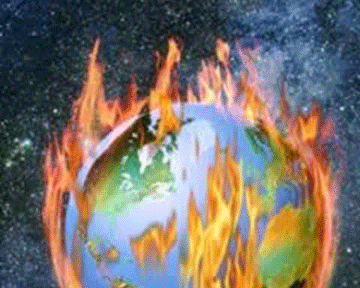 Sharp rise in methane levels threatens world climate targets, Experts warn that failure to act risks spike in global temperatures, Guardian, Robin McKie, Sun 17 Feb 2019 Dramatic rises in atmospheric methane are threatening to derail plans to hold global temperature rises to 2C, scientists have warned.
In a paper published this month by the American Geophysical Union, researchers say sharp rises in levels of methane – which is a powerful greenhouse gas – have strengthened over the past four years. Urgent action is now required to halt further increases in methane in the atmosphere, to avoid triggering enhanced global warming and temperature rises well beyond 2C.
“What we are now witnessing is extremely worrying,” said one of the paper’s lead authors, Professor Euan Nisbet of Royal Holloway, University of London. “It is particularly alarming because we are still not sure why atmospheric methane levels are rising across the planet.”
Methane is produced by cattle, and also comes from decaying vegetation, fires, coal mines and natural gas plants. It is many times more potent as a cause of atmospheric warming than carbon dioxide (CO2). However, it breaks down much more quickly than CO2 and is found at much lower levels in the atmosphere.
During much of the 20th century, levels of methane, mostly from fossil fuel sources, increased in the atmosphere but, by the beginning of the 21st century, it had stabilised, said Nisbet. “Then, to our surprise, levels starting rising in 2007. That increase began to accelerate after 2014 and fast growth has continued.”
Studies suggest these increases are more likely to be mainly biological in origin. However, the exact cause remains unclear. Some researchers believe the spread of intense farming in Africa may be involved, in particular in tropical regions where conditions are becoming warmer and wetter because of climate change. Rising numbers of cattle – as well as wetter and warmer swamps – are producing more and more methane, it is argued.
This idea is now being studied in detail by a consortium led by Nisbet, whose work is funded by the Natural Environment Research Council. This month the consortium completed a series of flights over Uganda and Zambia to collect samples of the air above these countries.
“We have only just started analysing our data but have already found evidence that a great plume of methane now rises above the wetland swamps of Lake Bangweul in Zambia,” added Nisbet.
However, other scientists warn that there could be a more sinister factor at work. Natural chemicals in the atmosphere – which help to break down methane – may be changing because of temperature rises, causing it to lose its ability to deal with the gas.
Our world could therefore be losing its power to cleanse pollutants because it is heating up, a climate feedback in which warming allows more greenhouse gases to linger in the atmosphere and so trigger even more warming……… https://www.theguardian.com/environment/2019/feb/17/methane-levels-sharp-rise-threaten-paris-climate-agreement
Vast replenishing of world’s forests could cancel out humans’greenhouse emissions
Independent 16th Feb 2019 Replenishing the world’s forests on a grand scale would suck enough carbon dioxide from the atmosphere to cancel out a decade of humanemissions, according to an ambitious new study. Scientists have established
there is room for an additional 1.2 trillion trees to grow in parks, woods
and abandoned land across the planet. If such a goal were accomplished,
ecologist Dr Thomas Crowther said it would outstrip every other method for
tackling climate change – from building wind turbines to vegetarian
diets.
https://www.independent.co.uk/environment/forests-climate-change-co2-greenhouse-gases-trillion-trees-global-warming-a8782071.html
Nuclear Regulatory Commission removes a critical safety regulation
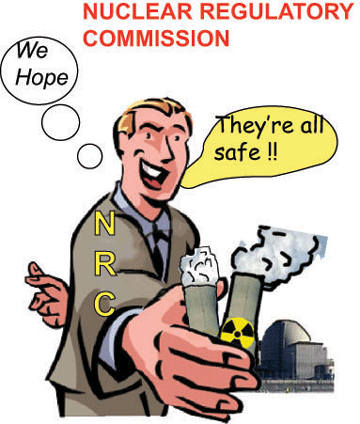 NRC Guts a Critical Safety Regulation, Recklessly Disregarding the Critical Lessons of the Fukushima Disaster https://www.ucsusa.org/press/2019/nrc-guts-critical-safety-regulation-recklessly-disregarding-critical-lessons-fukushima?fbclid=IwAR0-uToPAgtkdHj4rZ9dqJ5n7skVycU6y5UxjG_a_12lt7ZLhIwKCHfwZSM#.XGdxVOQzbGg– January 24, 2019 Decision Will Leave U.S. Nuclear Plants Dangerously Vulnerable to Major Floods and Earthquakes
WASHINGTON —The Nuclear Regulatory Commission’s (NRC) Republican majority, in a 3-2 vote, approved a stripped-down version of a rule originally intended to protect U.S. nuclear plants against extreme natural events, such as the massive earthquake and tsunami that triggered meltdowns at the Fukushima Daiichi nuclear plant in Japan in March 2011.
The commission majority struck a provision from the draft final rule the NRC staff recommended in December 2016 requiring plant owners to protect their facilities from the real-world hazards they face today instead of “design-basis” hazards that were estimated using now-obsolete information and methodologies when the plants were built decades ago.
The commission majority’s act will leave unresolved how the NRC will address new information showing that plants may experience bigger floods and earthquakes than they are now required to withstand. It is possible that the commission will not require all plant owners whose facilities face greater hazards to make structural upgrades.
“Nearly eight years after the Fukushima accident, the NRC continues to disregard a critical lesson: Nuclear plants must be protected against the most severe natural disasters they could face today—not those estimated 40 years ago,” said Dr. Edwin Lyman, senior scientist and acting director of the Nuclear Safety Project at the Union of Concerned Scientists.
After Fukushima, an NRC task force recommended that the NRC “order licensees to reevaluate the seismic and flooding hazards at their sites … and if necessary, update their design basis and SSCs [structures, systems and components] important to safety to protect against the updated hazards.”
To date, the NRC has only implemented the first part of the recommendation: Owners have reevaluated seismic and flooding hazards. What they found is not reassuring. For instance, the flooding reevaluations revealed that roughly two-thirds of U.S nuclear plants face hazards beyond what they were originally designed to handle, including higher flood levels from extreme precipitation, upstream dam failure and storm surge. The reevaluated flood height for local intense precipitation for the Palisades plant in Michigan, for example, was more than 25 feet higher than the level considered in the plant’s original design. Similar concerns were identified in many seismic risk evaluations.
Despite these findings, the NRC failed to implement the second part of the task force recommendation to require plant owners to strengthen their defenses against greater hazards. The rule that was approved today was originally intended to close that gap. The commission majority’s action today removed that requirement and will simply maintain the uncertain—and inadequate—status quo.
“The NRC must require plant owners to upgrade their facilities based on the best current information, the most realistic analyses, and the potentially devastating impacts of increased flooding from climate change,” said Dr. Lyman. “Failing to do so will leave some nuclear plants dangerously unprepared and needlessly invite disaster.”
Thousands of young people walk out of lessons in protest at political inaction over climate crisis
School pupils call for radical climate action in UK-wide strike, Guardian, Matthew Taylor, Sandra Laville , Amy Walker , Poppy Noor and Jon Henley16 Feb 2019
Thousands of young people walk out of lessons in protest at political inaction over crisis Thousands of schoolchildren and young people have walked out of classes to join a UK-wide climate strike amid growing anger at the failure of politicians to tackle the escalating ecological crisis.Organisers said more than 10,000 young people in at least 60 towns and cities from the Scottish Highlands to Cornwall joined the strike, defying threats of detention to voice their frustration at the older generation’s inaction on the environmental impact of climate change.Anna Taylor, 17, one of the most prominent voices to emerge from the new movement, said the turnout had been overwhelming. “It goes some way to proving that young people aren’t apathetic, we’re passionate, articulate and we’re ready to continue demonstrating the need for urgent and radical climate action.”
Thousands of young people walk out of lessons in protest at political inaction over crisis Thousands of schoolchildren and young people have walked out of classes to join a UK-wide climate strike amid growing anger at the failure of politicians to tackle the escalating ecological crisis.Organisers said more than 10,000 young people in at least 60 towns and cities from the Scottish Highlands to Cornwall joined the strike, defying threats of detention to voice their frustration at the older generation’s inaction on the environmental impact of climate change.Anna Taylor, 17, one of the most prominent voices to emerge from the new movement, said the turnout had been overwhelming. “It goes some way to proving that young people aren’t apathetic, we’re passionate, articulate and we’re ready to continue demonstrating the need for urgent and radical climate action.”
Organisers estimated around 3,000 schoolchildren and young people gathered in London, with 2,000 in Oxford, 1,000 each in Exeter and Leeds and several hundred in Brighton, Bristol, Sheffield and Glasgow.
In London, the protesters held banners and chanted as police and onlookers watched. They blocked the roads outside parliament chanting “Turn off your engines” at passing cars, and “We want the chance for change now” before mounted police moved them away. There were three arrests in London in connection with the protests. A 19-year-old man and a 16-year-old girl were arrested for obstructing the highway, and a 17-year-old boy for a public order offence.
In Manchester, hundreds gathered outside the Central Library before marching to the Royal Northern College of Music with signs reading “Climate over capitalism” and chanting “Whose future? Our future.”
Matt Sourby, 18, said his journey from Queen Elizabeth school in Kirkby Lonsdale, Cumbria, was worth it: “This is our future and this is making a difference. The government has to listen. I feel incredibly powerful just being here.”
The protests won the backing of a former UN climate chief, who said it was “time to heed the deeply moving voice of youth”.
Christiana Figueres, who led the historic 2015 Paris agreement, said the fact that children were so worried about their future they were prepared to strike should make adults sit up and take notice.
“It is a sign that we are failing in our responsibility to protect them from the worsening impacts of climate change,” she said.
The school strike movement started in August when Greta Thunberg, then 15, held a solo protest outside the Swedish parliament. Now, up to 70,000 schoolchildren each week hold protests in 270 towns and cities worldwide.
On Friday, tens of thousands marched again, some for the sixth week in succession, through towns and cities across Europe.
For the first time up to 1,000 pupils demonstrated in Paris chanting “Don’t go breaking my earth” and “One, two, three degrees – a crime against humanity”.
In Berlin, a large crowd gathered for the sixth week in a row. “We’re here now because we want to be able to be here in 50 years’ time,” read one banner……….
Thunberg hit back at the Conservative government, saying on Twitter that political leaders had wasted 30 years by not taking action against climate change. https://www.theguardian.com/environment/2019/feb/15/uk-climate-change-strike-school-pupils-children-environment-protest
The wipeout of the Earth’s small creatures – by climate change
 Climate change is killing off Earth’s little creatures http://theconversation.com/climate-change-is-killing-off-earths-little-creatures-109719, Distinguished Research Professor and Australian Laureate, James Cook University, February 12, 2019 Climate change gets blamed for a lot of things these days: inundating small islands, fueling catastrophic fires, amping-up hurricanes and smashing Arctic sea ice.
But a global review of insect research has found another casualty: 40% of insect species are declining and a third are endangered. It confirms what many have been suspecting: in Australia and around the world, arthropods – which include insects, spiders, centipedes and the like — appear to be in trouble.
The global review comes hard on the heels of research published in the Proceedings of the National Academy of Sciences USA that suggests a potent link between intensifying heat waves and stunning declines in the abundance of arthropods.
If that study’s findings are broadly valid – something still far from certain – it has chilling implications for global biodiversity.
Arthropod Armageddon
In the mid-1970s, researchers on the Caribbean island of Puerto Rico conducted a large-scale study to measure the total biomass (living mass) of insects and other arthropods in the island’s intact rainforests, using sweep nets and sticky-traps.
Four decades later, another research team returned to the island and repeated the study using identical methods and the same locations. To their surprise, they found that arthropod biomass was just one-eighth to one-sixtieth of that in the 1970s – a shocking collapse overall.
And the carnage didn’t end there. The team found that a bevy of arthropod-eating lizards, birds and frogs had fallen sharply in abundance as well.
In the minds of many ecologists, a widespread collapse of arthropods could be downright apocalyptic. Arthropods pollinate some of our most important food crops and thousands of wild plant species, disperse seeds, recycle nutrients and form key links in food chains that sustain entire webs of life.
This ecological ubiquity arises because arthropods are so abundant and diverse, comprising at least two-thirds of all known species on Earth. In the 1940s, evolutionary biologist J. B. S. Haldane quipped that “God has an inordinate fondness for beetles.” Humans might think we rule the world, but the planet really belongs to arthropods.
Killer heat waves
The researchers who documented the arthropod collapse in Puerto Rico considered a variety of possible causes, including pesticides and habitat disruption. But the evidence kept pointing to another driver: rising temperatures.
Weather stations in Puerto Rico indicate that temperatures there have risen progressively in the past several decades – by 2℃ on average.
But the researchers are far less worried about a gradual increase in temperature than the intensification of heat waves—which have risen markedly in Puerto Rico. This is because nearly all living species have thresholds of temperature tolerance.
For example, research in Australia has shown that at 41℃, flying foxes become badly heat-stressed, struggling to find shade and flapping their wings desperately to stay cool.
But nudge the thermometer up just one more degree, to 42℃, and the bats suddenly die.
In November, heat waves that peaked above 42℃ in north Queensland killed off almost a third of the region’s Spectacled Flying Foxes. The ground beneath bat colonies was littered with tens of thousands of dead animals. Dedicated animal carers could only save a small fraction of the dying bats.
The El Niño connection
El Niño events – fluctuations in Pacific sea-surface temperatures that drive multi-year variations in weather across large swaths of the planet – are also part of this story. New research appears to be resolving longstanding uncertainties about El Niños and global warming.
Recent studies published in Nature and Geophysical Research Letterssuggest global warming will in fact intensify El Niños – causing affected areas to suffer even more intensively from droughts and heat waves.
And this ties back to Puerto Rico, because the researchers there believe a series of unusually intense El Niño heatwaves were the cause the arthropod Armageddon. If they’re right then global warming was the gun, but El Niño pulled the trigger.
Beyond heat waves
Puerto Rico is certainly not the only place on Earth that has suffered severe declines in arthropods. Robust studies in Europe, North America, Australia and other locales have revealed big arthropod declines as well.
And while climatic factors have contributed to some of these declines, it’s clear that many other environmental changes, such as habitat disruption, pesticides, introduced pathogens and light pollution, are also taking heavy tolls.
So, at a planetary scale, arthropods are suffering from a wide variety of environmental insults. There’s no single reason why their populations are collapsing.
Read more: Climate change: effect on sperm could hold key to species extinction
The bottom line is: we’re changing our world in many different ways at once. And the myriad little creatures that play so many critical roles in the fabric of life are struggling to survive the onslaught.
1 This Month
26 September – International Day for the Total Elimination of Nuclear Weapons





PLEASE OPPOSE HR 8255 AND S.3639 – bills would accelerate satellite deployment, with no environmental review or safeguards – https://ncstd5li.quorum.us/campaign/169331/
To see nuclear-related stories in greater depth and intensity – go to https://nuclearinformation.wordpress.com
-
Archives
- September 2026 (305)
- August 2026 (330)
- July 2026 (355)
- June 2026 (287)
- May 2026 (306)
- April 2026 (356)
- March 2026 (251)
- February 2026 (267)
- January 2026 (308)
- December 2025 (358)
- November 2025 (359)
- October 2025 (375)
-
Categories
- 1
- 1 NUCLEAR ISSUES
- business and costs
- climate change
- culture and arts
- ENERGY
- environment
- health
- history
- indigenous issues
- Legal
- marketing of nuclear
- media
- opposition to nuclear
- PERSONAL STORIES
- politics
- politics international
- Religion and ethics
- safety
- secrets,lies and civil liberties
- spinbuster
- technology
- Uranium
- wastes
- weapons and war
- Women
- 2 WORLD
- ACTION
- AFRICA
- Atrocities
- AUSTRALIA
- Christina's notes
- Christina's themes
- culture and arts
- Events
- Fuk 2022
- Fuk 2023
- Fukushima 2017
- Fukushima 2018
- fukushima 2019
- Fukushima 2020
- Fukushima 2021
- general
- global warming
- Humour (God we need it)
- Nuclear
- RARE EARTHS
- Reference
- resources – print
- Resources -audiovicual
- Weekly Newsletter
- World
- World Nuclear
- YouTube
-
RSS
Entries RSS
Comments RSS

