UK Parliament: protesters disrupt Brexit debate by baring bottoms over inaction on climate change
ABC News 2 Apr 19, While some view the British parliament as a symbol of political stasis since the 2016 Brexit referendum, other Brits have utilised Westminster’s symbolic power to press — literally and figuratively — for faster action on climate change.
On Monday, members of climate change action group Extinction Rebellion stripped half-naked in the House of Common’s glass-walled public gallery during a Brexit debate, and some appeared to have glued themselves to the glass.
As MPs started yet another day of lengthy debate on how or even whether the country should leave the European Union, 14 protesters stripped to their underpants to show slogans painted on their backs, including: “Climate justice now”.
……. more acts of civil disobedience would occur in the lead up to the group’s ‘International Rebellion’ on climate change inaction slated for April 15.
In the moments afterward, numerous people took to Twitter to poke fun at a parliament that has otherwise been considered stale and mired in a prolonged Brexit debate….. https://www.abc.net.au/news/2019-04-02/british-protesters-bare-bottoms-in-parliament-to-protest-climate/10961468
A huge global wake-up call- the human devastation of climate change
Cyclone Idai: thousands still missing in Mozambique
The human devastation of climate change: Why Cyclone Idai should be a wake-up call for us all https://www.dailymaverick.co.za/article/2019-03-25-the-human-devastation-of-climate-change-why-cyclone-idai-should-be-a-wake-up-call-for-us-all/
By Tessa Knight• 25 March 2019
While many politicians, world leaders and big corporations speak about the future effects of climate change, poor and impoverished nations are already struggling to battle the consequences of rising global temperatures. Hundreds of people have been confirmed dead in Mozambique, Malawi and Zimbabwe after Cyclone Idai tore through the southern African countries on 14 and 15 March. With wind speeds reaching up to 177km/h, the United Nations has said the cyclone is potentially one of the worst natural disasters to hit the region.
James Kambaki, head of field HR at Doctors Without Borders Southern Africa told Daily Maverick on Friday that the organisation can only reach the city of Beira, which was hardest-hit by Idai, by ship and by helicopter. According to Kambaki, 90% of the city’s infrastructure was destroyed, and much of it is still under water.
Jamie LeSueur, one of the first people to lead a team from the International Federation of Red Cross, said: “The situation is terrible. The scale of devastation is enormous.”
Although the storm itself tore through the country more than a week ago, the citizens of Mozambique were still struggling to survive its effects.
“Two days ago the people reported that their reservoir of clean, treated water would last another two or three days. It’s now the third day and they need clean water still,” said Kambaki when speaking of Beira, which has a population of about 500,000 people.
First responders describe seeing victims of the storm “stranded on rooftops, in trees and other elevated areas”, Unicef spokesperson Christophe Boulierac told BBC.
The cyclone has created a humanitarian catastrophe in both Beira and other parts of southern Africa hit by the storm. With thousands still missing or injured in some of the poorest places in the world, Mozambique, Zimbabwe and Malawi will probably feel the effects of Idai for years.
But according to environmental activists Noëlle Garcin and Glen Taylor-Davies, Idai is just the start of extreme weather patterns.
“Politicians speak of global warming as if it’s a future problem, but it’s already here, it’s already happening,” said Garcin, Project Manager of Action 24, a programme that forms part of the African Climate Reality Project, “and the poor are affected the most.”
According to Taylor-Davis, South African team leader for 350 Africa, the people who are causing climate change — big corporations that burn fossil fuels and governments that support coal mining and the extractive industry –are not affected by it.
“The poor aren’t causing the problem, but they bear the brunt of climate change. They are suffering from drought, they suffer the worst in storms because they just aren’t able to build houses that can withstand storms or escape to higher ground,” Taylor-Davis told Daily Maverick.
Both Garcin and Taylor-Davis agree that climate change is unjust. Although President Cyril Ramaphosa recently launched the Good Green Deed initiative, which encourages South Africans to do one good green action per day, ordinary citizens are not the root cause of climate change.
It has been well documented that 71% of greenhouse gas emissions are produced by just 100 companies. Although Garcin acknowledges that it is important for people to reduce their carbon footprint, placing the onus of climate change on regular people is not only unrealistic, it is also dangerous.
Mozambique is a prime example of the inequalities of global warming. The country ranks 180 out of 189 countries on the UN’s Human Development Index, which measures education, economic prosperity and life expectancy. The country contributes a measly 0.14% of global greenhouse gas emissions. According to the World Bank at least half of the population of Mozambique lives in poverty, with the divide between rich and poor quickly becoming more extreme. A legacy of colonialism and civil war has left the country unable to protect itself against extreme weather and rising ocean levels.
“Looking at Beira, this was a city that was absolutely not prepared to deal with such an event, and there are multiple reasons for that, but one of the main reasons is that it’s a poor area,” said Garcin.
“This cyclone is laying bare the fundamental injustices of climate change, and it’s something we need to talk about because this is just going to keep happening.”
Although many people, including US President Donald Trump, refuse to believe that climate change is real, the evidence is surely undeniable: Extreme weather disasters are becoming more prevalent around the world, be it Mozambique’s cyclone, South Africa’s drought or even the wildfires in California. DM
As all their “selling points” fail, the nuclear lobby jumps on the climate change bandwagon

Nuclear Energy Institute Seizes on Climate Momentum to Push for Policy Boost
“The answer to the climate crisis won’t be as simple as replacing carbon with renewables and batteries,” according to NEI’s president and CEO. Greentech Media
Korsnick argued that nuclear’s cultural capital is on the rise, helped along by concerns about climate change and calls for 100 percent clean energy, but she suggested the industry needs better federal and state policy to grow.
….. Energy Secretary Rick Perry announced $3.7 billion in additional loan support for the expansion of the Vogtle nuclear plant in Georgia. …..
Vogtle is a polarizing but important point of focus for the nuclear industry’s future. The Georgia expansion is the only large-scale nuclear project underway in the nation — another, V.C. Summer in South Carolina, was canceled in 2017 — and the first to be built in the U.S. in decades. It’s also billions of dollars over budget and significantly behind schedule, in part because key contractor Westinghouse announced Chapter 11 bankruptcy during construction.
……. Korsnick said more states should follow Connecticut, New Jersey, New York and Illinois in allowing nuclear plants to compete as carbon-free sources or receive credits. Efforts to advance similar policies failed in Minnesota and are currently underway in Ohio and Pennsylvania.
Though environmental groups have mixed views on nuclear, groups in both Ohio and Pennsylvania have spoken out against the support packages.
But Korsnick said a boost in conversations around climate action, the Green New Deal and state-level clean energy goals is bringing more positive attention to the technology.
“It’s this realization that 100 percent renewables — it’s not going to happen,” she said.
Not everyone agrees. On Monday, Puerto Rico committed to 100 percent renewables, joining Hawaii and Washington, D.C. Illinois is considering a similar measure. …. https://www.greentechmedia.com/articles/read/nei-climate-momentum-boost-nuclear#gs.35vnl9
Climate change brings more extreme weather – Mozambique is drowning
|
Cyclone Idai: thousands still missing in Mozambique Mozambique Is Drowning. Nebraska Has Flooded. We Need a Green New Deal. BY William Rivers Pitt, Truthout, March 23, 2019 The ocean has come for the coastal African nation of Mozambique. Tropical Cyclone Idai, a devastating storm that pummeled the country with fierce winds, was followed by a massive flood that has obliterated dams, swept away homes and bridges, erased roads, shuttered airports, and damaged 90 percent of the city of Beira, home to more than 500,000 people. There are bodies in the water and no one to collect them, making diseases like cholera an imminent threat.
More than 1,000 are confirmed dead, a number that is sure to rise. Thousands more are homeless and seeking refuge. “Many people were waiting for food, water and medicine,” reports The New York Times, “in makeshift shelters in primary schools and other government buildings.” Satellite imagery over Mozambique shows a new flood-made inland sea that is 30 miles wide in places. “We’ve never had something of this magnitude before in Mozambique,” said non-governmental organization coordinator Emma Beatty. To the west in Zimbabwe and Malawi, more than 100 people are known dead, hundreds more are missing and the damage is extensive. “There are at least three major ways that the Mozambique floods are related to climate change,” reports Eric Holthaus for Grist. “First, a warmer atmosphere holds more water vapor, which makes rainfall more intense. Idai produced more than two feet of rainfall in parts of the region — nearly a year’s worth in just a few days. Second, the region had been suffering from a severe drought in recent years in line with climate projections of overall drying in the region, hardening the soil and enhancing runoff. Third, sea levels are about a foot higher than a century ago, which worsens the effect of coastal flooding farther inland.” For years, stories of massive climate disasters such as these may have felt distant to many U.S. readers, but the climate crisis has arrived here, too. Eastern Nebraska Flooding – March 15 2019 A massive climate change-driven flood has transformed the middle of the United States into a bowl of soup. The waters have rolled down the Mississippi and Missouri Rivers and inundated huge swaths of Kansas, Nebraska, Missouri, Minnesota, Wisconsin and Iowa. Multiple towns in every state have been severely damaged, and thousands of farms that were already struggling have been scourged. On average, it takes about 28 days for river-borne floodwaters to recede, but repairing the wreckage left behind is expected to take years. Tens of thousands of people have been affected, and many are now without homes. “In case you were wondering, the climate crisis isn’t coming. It’s already here,” writes Charles P. Pierce regarding flood preparations at Offutt Air Force Base near Omaha. “The one institution of government that actually believes that is the United States military, and that’s a good thing, too, because, in this case, the exaggerated effect of the crisis and the extreme weather that results from it — the blizzards, the ‘bomb cyclone,’ the huge snowmelt, and the flooding — has become the national security threat that the Pentagon has seen coming.”…….. The ongoing pushback against the Green New Deal (GND) by most Republicans and some Democrats highlights the degree to which our leaders are willing to wait until the roof caves in on us before they act. …… According to various polls, more than 70 percent of people in the U.S. believe that climate change is happening right now, and two-thirds of Republicans believe their party is out of step with reality on the issue. Activists like those in the Sunrise Movement are petitioning lawmakers to get it in gear, and are planning a traveling explanation tour through coal states like Kentucky and Pennsylvania to make the case that waiting is no longer an option. Let us hope their entreaties do not again go ignored. We are out of time. Nebraska can tell you all about it. https://truthout.org/articles/mozambique-is-drowning-nebraska-has-flooded-we-need-a-green-new-deal/ |
|
|
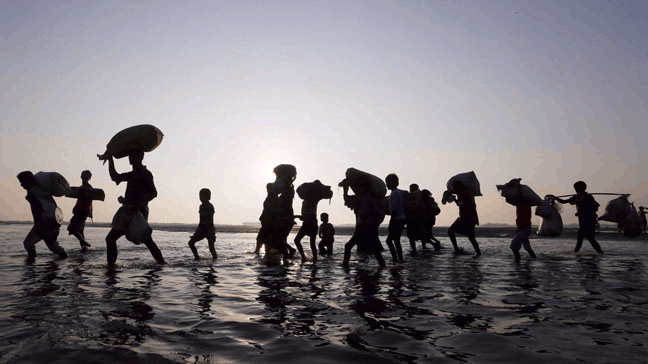
Cyclone Idai Lays Bare Deadly Reality of Climate Change in Africa
 https://allafrica.com/view/group/main/main/id/00066940.html 24 Mar 19,
Although experts have said it was too early to draw specific conclusions from Idai, for a continent already wracked by the effects of climate change, the Tropical Cyclone has been another chilling reminder of the destructive power of the kind of storms that will become more common in the future. It has been described as the worst weather-related disaster to hit the southern hemisphere, and the UN says more than 2 million people have been affected.
VERDADE By Adérito Caldeira
A week after Tropical Cyclone IDAI “massacred” the center of Mozambique, there are still people under siege in the trees and on the roofs of houses in the provinces of Sofala and Manica.
“The affected area is much larger than we thought, there are almost 125 kilometers of flood areas” said Saviano Abreu of the United Nations Office for the Coordination of Humanitarian Affairs (OCHA). The location of 92 more corpses raised the number of fatalities to 294.
In Nhamatanda in Sofala province 47 bodies were found. Government official Toze Joseph said that there are other communities under water with which communication is impossible
The remaining 45 bodies were located and removed at Dombes administrative post in Sussundenga, Manica province.
In the neighboring province of Manica other 45 bodies were removed from the water at the Administrative office of Dombe in Sussendenga district, said the governor Manuel Rodrigues.
Since Tuesday, March 19, the Government has not publicly updated the number of affected people or fatalities.
“We are still updating the numbers. When the flood waters subside, more bodies will be discovered. When I addressed the nation and world, I said the numbers of dead will increase and that is what is happening,” said President Philip Nyusi in Tete.
Nyusi had earlier said that the number of deaths could rise to a thousand.
Southern Africa: they’ve had cyclones before, but climate change increases the intensity
Cyclone Idai: The worst humanitarian crisis in Mozambique’s history | DW News
‘Bodies are floating’: Cyclone Idai leaves trail of destruction with more than a million affected, news.com.au Stephanie Bedo and Ben Graham, MARCH 20, 2019
They can’t even count the dead in a city of 500,000 people as chilling images show the unprecedented disaster is far from over.
Countless people have been killed and almost a million left destitute after what could be one of the worst weather-related disasters in the southern hemisphere.
A national disaster has been declared after Cyclone Idai left a trail of death, destruction and homelessness in southern Africa.
Where once streets teemed with life, only the swamped shells of homes are left in the wake of the devastation that has affected millions in Malawi, Mozambique and Zimbabwe.
Footage taken from the skies over Mozambique’s central port city of Beira, a city of half a million people, shows there is no discernible trace of life left.
More than 90 per cent of the city was destroyed as 170km/h winds tore across southeastern Africa, according to the International Federation of Red Cross and Red Crescent Societies.
“If the worst fears are realised … then we can say that it is one of the worst weather-related disasters, tropical-cyclone-related disasters in the southern hemisphere,” said Clare Nullis of the UN World Meteorological Organisation.
Emergency workers called it the region’s most destructive flooding in 20 years, and heavy rains are expected to continue until Thursday. In the low-lying coastal city of Beira, the water has nowhere to drain. “This is not going to go away quickly,” Ms Nullis said.
In Mozambique, the rapidly rising floodwaters created “an inland ocean,” endangering tens of thousands of families, aid workers said as they scrambled to rescue survivors and airdrop food, water and blankets to survivors.
Those left clinging to life amid the ruins could be battered by eight-metre waves during high tides over the coming days. Herve Verhoosel of the World Food Program said the crisis “is getting bigger by the hour”.
……. The official death toll of Cyclone Idai — the deadliest storm in generations to hit Mozambique and Zimbabwe — more than doubled to more than 350 overnight, but that is expected to rise again, dramatically.
…… “The waters of the Pungue and Buzi rivers overflowed, making whole villages disappear and isolating communities, and bodies are floating,” said Mozambican President Filipe Nyusi.
Mr Nyusi said Idai, which ripped through the impoverished southeast African country of 30 million people on Thursday, was a “disaster of great proportions”.
The cyclone struck the Indian Ocean city of Beira late that day and then moved inland to Zimbabwe and Malawi, with strong winds and torrential rain lashing the region.
But it has taken days for the scope of the disaster to begin to emerge in Mozambique, which has a poor communication and transportation network and a corrupt and inefficient bureaucracy.
……United Nations officials said on Tuesday that more than 2.6 million people had been affected and $28 million had been allocated to Mozambique, Zimbabwe and Malawi from its emergency response fund. …….. https://www.news.com.au/world/africa/more-than-1000-feared-dead-from-cyclone-in-mozambique/news-story/193caf3fb1ac18040e2891964f969e27
The children’s climate fight is a fight against despair
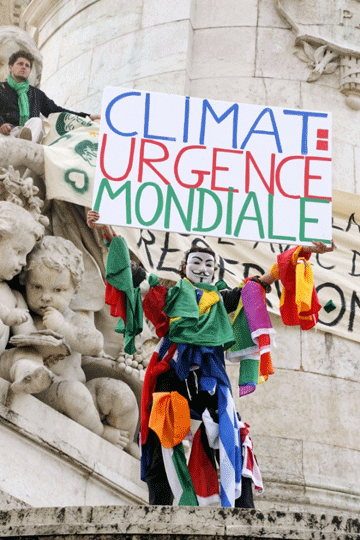 The youth climate strikes fight back against despair https://grist.org/article/the-youth-climate-strikes-fight-back-against-despair/, Last week, as I stood on the front steps of the Minnesota State Capitol, I watched hundreds of high schoolers stream by as they left their classes to join in the U.S. Youth Climate Strike. One sign in particular stood out to me: “Why are we studying for a future we won’t have?” The youth climate strikes fight back against despair https://grist.org/article/the-youth-climate-strikes-fight-back-against-despair/, Last week, as I stood on the front steps of the Minnesota State Capitol, I watched hundreds of high schoolers stream by as they left their classes to join in the U.S. Youth Climate Strike. One sign in particular stood out to me: “Why are we studying for a future we won’t have?”
|
|
Over 1.4 million young people went on strike for climate action
Hong Kong students join global school strike calling for action against climate change
Activist Greta Thunberg, 16, says action proved ‘no one is too small to make a difference’ More than 1.4 million young people around the world took part in school strikes for climate action, according to environmental campaigners.Greta Thunberg, the 16-year-old Swedish student whose solo protest last August prompted the global movement, said: “We proved that it does matter what you do and that no one is too small to make a difference.”
Children walked out of schools on Friday in 2,233 cities and towns in 128 countries, with demonstrations held from Australia to India, the UK and the US, according to the Fridays for the Future website. Further strikes are planned for 12 April…….https://www.theguardian.com/environment/2019/mar/19/school-climate-strikes-more-than-1-million-took-part-say-campaigners-greta-thunberg
The climate change “generation gap”

A June 2014 Washington Post-ABC News poll asked a nationally representative sample of American respondents several questions about their support for climate policies. Specifically, those surveyed were asked whether they would be in favor of government greenhouse gas regulations that increased their monthly energy expenses by $20 per month. Overall, 63 percent of respondents expressed support for the proposed policy, including 51 percent of Republicans and 71 percent of Democrats.
Interestingly, there was a significant age gap among the responses. For Democrats under age 40, support for the policy proposal was 78 percent, as compared to 62 percent over age 65. Among Republicans, 61 percent under age 50 supported the proposed regulations, as compared to 44 percent over age 50. According to a Pew Research Center survey, younger Americans are also more likely to correctly answer that the planet is warming and that this warming is primarily due to human activities.
……. A recent survey conducted by the National Center for Science Education found that teachers who identified as Republicans, teachers who regarded the Bible as the actual word of God to be taken literally, and teachers who favored libertarian and small-government views, were all less likely to emphasize the scientific consensus on climate change and more likely to air opposing views in the classroom.
Consequently, this survey of US middle and high school science teachers found that while approximately 70 percent of these teachers spent one to two hours on climate change per course, only 54 percent taught students about the scientific consensus on human-caused global warming. Thirty percent incorrectly characterized climate change as being natural in origin, and 15 percent ignored the origins of climate change or the topic of climate change entirely. Although the survey identified systemic obstacles to teaching about climate change in American classrooms, those obstacles will eventually be overcome, and climate literacy will improve as a result—at least among the younger generation.
Exposure to the opinions of one’s peer group may also help explain the climate age gap, as older men are the most common faces of climate denial. For example, in 2009 the American Physical Society was petitioned by 206 of its members (approximately 0.45 percent of its membership) to change its climate position and reject the expert consensus on climate change. An analysis of the petition signatories by John Mashey found that approximately 86 percent were born before 1950 (compared to approximately 40 percent of the society’s membership as a whole), and 97 percent were born before 1960 (compared to approximately 60 percent of the overall membership). Climate denial conferences are also disproportionately attended by old white men.
But age is not the only predictor of climate change denial.
The climate acceptance ethnicity gap. African- and Hispanic-Americans were also more likely to correctly answer the Pew Research Center climate questions—and to express concern about climate change—than white Americans. ……..
Climate denial caters to a small and dwindling population of old, white, conservative, American men. As with global temperatures, American acceptance of and concern about human-caused climate change is currently at record levels, and is certain to keep rising in the long-term. https://thebulletin.org/2019/03/a-generation-gap-when-it-comes-to-climate-change/?utm_source=Bulletin%20Newsletter&utm_medium=iContact%20email&utm_campaign=GenerationGap_03152019
Nuclear power plants under threat from climate change

Susan Stranahan: Climate change’s threat to nuclear plants https://www.twincities.com/2019/03/17/susan-stranahan-climate-changes-threat-to-nuclear-plants/
|
|
International shame for human society, that children have to take the lead on climate action
 The Observer view on the school climate strikes: it’s shameful that children need to take the lead https://www.theguardian.com/commentisfree/2019/mar/17/observer-view-on-schools-climate-strike, Observer Editorial, 17 Mar 19,
 Such forecasts should have spurred global action a long time ago. Yet politicians across the world have consistently refused to act and for decades have procrastinated, discounting evidence that clearly shows global warming is already affecting our planet. Many factors account for this inaction. Lobbying by oil and gas companies obsessed with short-term gain has certainly been involved. Others have argued that only God can have a planet-wide influence and that humanity is being presumptuous in believing it could alter a global ecosystem. In addition, there are those who believe bids to introduce limits on coal and oil burning are simply the work of leftwing, anti-capitalist conspirators.
Such befuddled notions are no longer acceptable in an overheating world. In failing to act over climate change, our leaders are in real danger of betraying a generation of young people who, in a few decades, are likely to inherit a blighted world that has been denuded of much of its wildlife, coastline and fertile land. The future of our children is being stolen before their eyes.
n the face of this stark scenario, the decision by children round the planet to vent their anger and to stage an international campaign of protests and school walkouts last week is to be welcomed. It was a just response to a global injustice. Without a voice in a political debate in which their future is being threatened by the political inability of their elders, young people have had little choice. Teachers may complain that the disruption caused by last week’s protests only increases their workload and wastes lesson times, but it is clear the campaign is being driven by genuine outrage, a grievance that also explains the considerable breadth of these protests.
From Australia to America, pupils simply put down their books and took to the streets. More than 100 towns and cities in the UK saw protests. In Sydney, about 30,000 young folk held a climate march, while in Delhi more than 200 children walked out of classes.
Equally impressive were the comments and blogs. In India, 13-year-old Arya Dhar Gupta from Gurugram, whose air is some of the world’s most polluted, revealed it was no longer safe for her to play outdoors. Others called for a moratorium on all new coal, oil and gas plants. Some demanded massive investment in renewable energy projects.
But perhaps most telling were the words of Anastasia Martynenko from Kiev. She supported her actions in terms that starkly highlight the depth of her elders’ failures and underline the now desperate need for a reinvigoration of global climate policies. “We are happy to be the driving force… because when our children ask us what have you done for our future, we will have an answer.”
In over 2000 cities, hundreds of thousands of children left school to protest for climate cxation
Even in chilly Oklahoma, USA – Students rally for climate change
Hundreds of thousands leave schools world-wide to protest climate change inaction, SBS NEWS< 17 Mar 19, Hundreds of thousands of students in more than 2000 cities from Australia to Uganda and Germany left the classroom on Friday to protest government inaction on climate change.
How Leonardo DiCaprio is fighting climate change with finance
 Putting his money where his mouth is. Your Money, 18 Mar 2019, Jack Derwin Digital Journalist, Oscar-winning actor and Hollywood heartthrob Leonardo DiCaprio has long been an environmental activist, but he’s now turning to the world of finance to help tackle his chosen cause.
DiCaprio has announced he will become a senior adviser to a new $150 million environmental unit at fund manager Princeville Capital that invests directly into tech companies fighting global warming.
Taking to Twitter, it appears he is willing to put his money where his mouth is, becoming an investor himself.
“What I like about Leo’s fund if you are predisposed to wanting to improve the climate or stop climate change, this is a fund that invests in companies that are trying to mitigate the effects of climate change,” The Motley Fool head of investment Scott Phillips told Your Money Live.
The major difference between DiCaprio’s fund and other ethical funds is rather than divesting from big polluters, his is actively investing in potential future solutions…….. https://www.yourmoney.com.au/wealth/investment/leonardo-dicaprio-climate-change/
 |
ReplyForward
|
Schoolchildren around the world “on strike” demanding action on climate change
‘Fridays for future’ marches for climate change going global | DW News
It’s our time to rise up’: youth climate strikes held in 100 countries https://www.theguardian.com/environment/2019/mar/15/its-our-time-to-rise-up-youth-climate-strikes-held-in-100-countries Sandra Laville, Matthew Taylorand Daniel Hurst, Sat 16 Mar 2019
School and university students continue Friday protests to call for political action on crisis From Australia to America, children put down their books on Friday to march for change in the first global climate strike.
The event was embraced in the developing nations of India and Uganda and in the Philippines and Nepal – countries acutely impacted by climate change – as tens of thousands of schoolchildren and students in more than 100 countries went on “strike”, demanding the political elite urgently address what they say is a climate emergency. Continue reading
Nebraska nuclear station is threatened by flooding, as Missouri River continued to rise
 Deadly, Historic Midwest Flooding Threatens Ericson Dam, Nuclear Plant in Nebraska, By Pam Wright and Ron Brackett, weather.com 15 Mar 19,
At a Glance
- New evacuations were ordered overnight in Minnesota and Wisconsin.
- A Nebraska farmer was killed trying to rescue a stranded motorist.
- A Nebraska nuclear plant is threatened.
- A ‘compromised’ dam forced evacuations along the Niobrara River.
- A third of the 24,000 residents in Norfolk, Nebraska, were ordered to evacuate Thursday.
- Flooding in parts of the Midwest has left one man dead threatens a Nebraska dam and nuclear power plant as heavy rains mixed with a melting snowpack swell waterways to historic levels……..
- In Nebraska, a utility company was placing sandbags around a threatened nuclear power plant Thursday as the Missouri River continued to rise, the Omaha World-Journal reports.
Mark Becker, spokesman for the Nebraska Public Power District, told the newspaper that should the river hit the level of 45.5 feet as projected by the National Weather Services this weekend, the Cooper Nuclear Station, which accounts for 35 percent of NPPD’s power, will have to be shut down………… https://weather.com/news/news/2019-03-14-flooding-severe-tornadoes-nebraska-iowa-texas
1 This Month
26 September – International Day for the Total Elimination of Nuclear Weapons





PLEASE OPPOSE HR 8255 AND S.3639 – bills would accelerate satellite deployment, with no environmental review or safeguards – https://ncstd5li.quorum.us/campaign/169331/
To see nuclear-related stories in greater depth and intensity – go to https://nuclearinformation.wordpress.com
-
Archives
- September 2026 (291)
- August 2026 (330)
- July 2026 (355)
- June 2026 (287)
- May 2026 (306)
- April 2026 (356)
- March 2026 (251)
- February 2026 (267)
- January 2026 (308)
- December 2025 (358)
- November 2025 (359)
- October 2025 (375)
-
Categories
- 1
- 1 NUCLEAR ISSUES
- business and costs
- climate change
- culture and arts
- ENERGY
- environment
- health
- history
- indigenous issues
- Legal
- marketing of nuclear
- media
- opposition to nuclear
- PERSONAL STORIES
- politics
- politics international
- Religion and ethics
- safety
- secrets,lies and civil liberties
- spinbuster
- technology
- Uranium
- wastes
- weapons and war
- Women
- 2 WORLD
- ACTION
- AFRICA
- Atrocities
- AUSTRALIA
- Christina's notes
- Christina's themes
- culture and arts
- Events
- Fuk 2022
- Fuk 2023
- Fukushima 2017
- Fukushima 2018
- fukushima 2019
- Fukushima 2020
- Fukushima 2021
- general
- global warming
- Humour (God we need it)
- Nuclear
- RARE EARTHS
- Reference
- resources – print
- Resources -audiovicual
- Weekly Newsletter
- World
- World Nuclear
- YouTube
-
RSS
Entries RSS
Comments RSS

