Erica Cirino is a science photojournalist, covers stories about wildlife and the environment, most often related to biology, conservation and policy. She is based in New York and Copenhagen.
Climate change is already gravely threatening American nuclear reactors
 Jon Tidon 30 May 19 Hate to say it. It is true though. Expect a nuclear accident in the United States soon.
Trump has deregulated supervision of the 97 old nuclear reactors, in America.
Sixty of the old, beat-up, reactors are in flood zones and hurricane zones. The others are so old and decrepit, that any inclement-unpredictable weather, could cause a nuclear accident.
The soil in much of the Midwestern United States, Southeastern USA, and in the Southern United States is saturated with water from flooding, this year. That is the way it is now, in May 2019.
The soil is saturated from atmospheric rivers of rain, moving in quickly and, dumping their massive loads of water. The atmospheric-river phenomenon has been going on, for more than 10 years now, in the United States.
Atmospheric rivers of rain that come put of nowhere.
Hurricanes have grown progresssively worse and more numerous, in the past 10 years .
A deadly one-two punch of spring floods and later, Tropical storms and hurricanes, is upon us again.
The combination of flooding-saturation and then serial Hurricanes, cause Mega Climate Disasters. It also increases the probability of a Nuclear Accident in these regions, where there are numerous reactors.
We saw it with Hurricane Florence in Carolina, Harvey in Texas, Maria in Florida and Puerto Rico.
Paces like Tennessee, Arkansas, Louisiana, Texas are saturated with water now. The water in the Atlantic and Gulf Of Mexico is hotter and higher, than it has ever been. People could not go to the beach, along much of the Gulf of Mexico on Memorial day because, the surf flooded the beaches. The beaches were flooded, from high winds and storming in the Gulf of Mexico. Similar phenomenon preceded the Horrendous Hurricane seasons, of the past few years. The surface of the Gulf is warmer than ever.
Nuclear power, useless against climate change, is itself threatened by climate change’s weather extremes
|
Nuclear power is not the answer in a time of climate change, https://aeon.co/ideas/nuclear-power-is-not-the-answer-in-a-time-of-climate-change Heidi Hutner, Erica Cirino-November 2018, In the Woolsey Fire scorched nearly 100,000 acres of Los Angeles and Ventura counties, destroying forests, fields and more than 1,500 structures, and forcing the evacuation of nearly 300,000 people over 14 days. It burned so viciously that it seared a scar into the land that’s visible from space. Investigators determined that the Woolsey Fire began at the Santa Susana Field Laboratory, a nuclear research property contaminated by a partial meltdown in 1959 of its failed Sodium Reactor Experiment, as well as rocket tests and regular releases of radiation. The State of California’s Department of Toxic Substances Control (DTSC) reports that its air, ash and soil tests conducted on the property after the fire show no release of radiation beyond baseline for the contaminated site. But the DTSC report lacks sufficient information, according to the Bulletin of Atomic Scientists. It includes ‘few actual measurements’ of the smoke from the fire, and the data raises alarms. Research on Chernobyl in Ukraine following wildfires in 2015 shows clear release of radiation from the old nuclear power plant, calling into question the quality of DTSC’s tests. What’s more, scientists such as Nikolaos Evangeliou, who studies radiation releases from wildfires at the Norwegian Institute for Air Research, point out that the same hot, dry and windy conditions exacerbating the Woolsey Fire (all related to human-caused global warming) are a precursor to future climate-related radioactive releases.
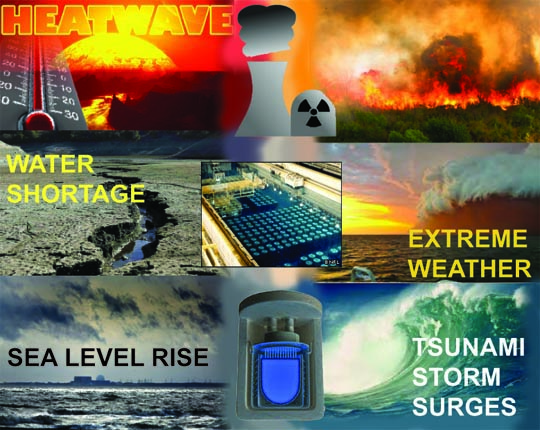
With our climate-impacted world now highly prone to fires, extreme storms and sea-level rise, nuclear energy is touted as a possible replacement for the burning of fossil fuels for energy – the leading cause of climate change. Nuclear power can demonstrably reduce carbon dioxide emissions. Yet scientific evidence and recent catastrophes call into question whether nuclear power could function safely in our warming world. Wild weather, fires, rising sea levels, earthquakes and warming water temperatures all increase the risk of nuclear accidents, while the lack of safe, long-term storage for radioactive waste remains a persistent danger.
 The Santa Susana Field Laboratory property has had a long history of contaminated soil and groundwater. Indeed, a 2006 advisory panel compiled a report suggesting that workers at the lab, as well as residents living nearby, had unusually high exposure to radiation and industrial chemicals that are linked to an increased incidence of some cancers. Discovery of the pollution prompted California’s DTSC in 2010 to order a cleanup of the site by its current owner – Boeing – with assistance from the US Department of Energy and NASA. But the required cleanup has been hampered by Boeing’s legal fight to perform a less rigorous cleaning. Like the Santa Susana Field Lab, Chernobyl remains largely unremediated since its meltdown in 1986. With each passing year, dead plant material accumulates and temperatures rise, making it especially prone to fires in the era of climate change. Radiation releases from contaminated soils and forests can be carried thousands of kilometres away to human population centres, according to Evangeliou. Kate Brown, a historian at the Massachusetts Institute of Technology and the author of Manual for Survival: A Chernobyl Guide to the Future (2019), and Tim Mousseau, an evolutionary biologist at the University of South Carolina, also have grave concerns about forest fires. ‘Records show that there have been fires in the Chernobyl zone that raised the radiation levels by seven to 10 times since 1990,’ Brown says. Further north, melting glaciers contain ‘radioactive fallout from global nuclear testing and nuclear accidents at levels 10 times higher than elsewhere’. As ice melts, radioactive runoff flows into the ocean, is absorbed into the atmosphere, and falls as acid rain. ‘With fires and melting ice, we are basically paying back a debt of radioactive debris incurred during the frenzied production of nuclear byproducts during the 20th century,’ Brown concludes. Flooding is another symptom of our warming world that could lead to nuclear disaster. Many nuclear plants are built on coastlines where seawater is easily used as a coolant. Sea-level rise, shoreline erosion, coastal storms and heat waves – all potentially catastrophic phenomena associated with climate change – are expected to get more frequent as the Earth continues to warm, threatening greater damage to coastal nuclear power plants. ‘Mere absence of greenhouse gas emissions is not sufficient to assess nuclear power as a mitigation for climate change,’ conclude Natalie Kopytko and John Perkins in their paper ‘Climate Change, Nuclear Power, and the Adaptation-Mitigation Dilemma’ (2011) in Energy Policy. Proponents of nuclear power say that the reactors’ relative reliability and capacity make this a much clearer choice than other non-fossil-fuel sources of energy, such as wind and solar, which are sometimes brought offline by fluctuations in natural resource availability. Yet no one denies that older nuclear plants, with an aged infrastructure often surpassing expected lifetimes, are extremely inefficient and run a higher risk of disaster. ‘The primary source of nuclear power going forward will be the current nuclear fleet of old plants,’ said Joseph Lassiter, an energy expert and nuclear proponent who is retired from Harvard University. But ‘even where public support exists for [building new] nuclear plants, it remains to be seen if these new-build nuclear plants will make a significant contribution to fossil-emissions reductions given the cost and schedule overruns that have plagued the industry.’ Lassiter and several other energy experts advocate for the new, Generation IV nuclear power plants that are supposedly designed to deliver high levels of nuclear power at the lowest cost and with the lowest safety risks. But other experts say that the benefits even here remain unclear. The biggest critique of the Generation IV nuclear reactors is that they are in the design phase, and we don’t have time to wait for their implementation. Climate abatement action is needed immediately. ‘New nuclear power seemingly represents an opportunity for solving global warming, air pollution, and energy security,’ says Mark Jacobson, director of Stanford University’s Atmosphere and Energy Programme. But it makes no economic or energy sense. ‘Every dollar spent on nuclear results in one-fifth the energy one would gain with wind or solar [at the same cost], and nuclear energy takes five to 17 years longer before it becomes available. As such, it is impossible for nuclear to help with climate goals of reducing 80 per cent of emissions by 2030. Also, while we’re waiting around for nuclear, coal, gas and oil are being burned and polluting the air. In addition, nuclear has energy security risks other technologies don’t have: weapons proliferation, meltdown, waste and uranium-worker lung-cancer risks.’ Around the world, 31 countries have nuclear power plants that are currently online, according to the International Atomic Energy Agency. By contrast, four countries have made moves to phase out nuclear power following the 2011 Fukushima disaster, and 15 countries have remained opposed and have no functional power plants. With almost all countries’ carbon dioxide emissions increasing – and China, India and the US leading the pack – the small Scandinavian country of Denmark is an outlier. Its carbon dioxide emissions are decreasing despite it not producing any nuclear power. Denmark does import some nuclear power produced by its neighbours Sweden and Germany, but in February, the country’s most Left-leaning political party, Enhedslisten, published a new climate plan that outlines a path for the country to start relying on its own 100 per cent renewable, non-nuclear energy for power and heat production by 2030. The plan would require investments in renewables such as solar and wind, a smart grid and electric vehicles that double as mobile batteries and can recharge the grid during peak hours. Gregory Jaczko, former chairman of the US Nuclear Regulatory Commission and the author of Confessions of a Rogue Nuclear Regulator (2019), believes the technology is no longer a viable method for dealing with climate change: ‘It is dangerous, costly and unreliable, and abandoning it will not bring on a climate crisis.’ Edited by Pam Weintraub |
–
|
Young voters supported Europe’s Greens – big winners in European elections
 Guardian 28th May 2019 Europe’s Greens, big winners in Sunday’s European elections, will use
their newfound leverage in a fractured parliament to push an agenda of urgent climate action, social justice and civil liberties, the movement’s leaders say. “This was a great outcome for us – but we now also have a great responsibility, because voters have given us their trust,” Bas Eickhout, a Dutch MEP and the Greens’ co-lead candidate for commission president, told the Guardian.
“Our voters, especially the younger generation, for many of whom we are now their first choice, are deeply
concerned about the climate crisis, and they are pro-European – but they feel the EU is not delivering. They want us to change the course of Europe.”https://www.theguardian.com/environment/2019/may/28/greens-eu-election-mandate-leverage-climate-policy
concerned about the climate crisis, and they are pro-European – but they feel the EU is not delivering. They want us to change the course of Europe.”https://www.theguardian.com/environment/2019/may/28/greens-eu-election-mandate-leverage-climate-policy
Scotland the first country to set legally binding annual emission reduction targets
Scotsman 29th May 2019 , Scotland is leading way by being first country to set legally binding annual emission reduction targets, writes Jamie Livingstone, head of Oxfam Scotland. Earlier this month, Environment Secretary Roseanna Cunningham reaffirmed in the Scottish Parliament the First Minister’s declaration that we are facing a “climate emergency”.
It’s a phrase that’s suddenly in vogue among political leaders from Edinburgh to Cardiff, London, Dublin and
beyond. It’s not hard to see why. Politicians are feeling the climate heat after schoolchildren went on strike and campaigners brought prominent locations, including in Edinburgh, to a standstill.
A recent poll by Stop Climate Chaos Scotland shows 70 per cent of people in Scotland support further action on climate change. It follows dire warnings by climate scientists that we have until 2030 to avert a climate catastrophe.
Political language is, it seems, catching up with reality. And not before time. When I hear the words “climate emergency”, I picture Jenipher, a young woman from the Mulanje district of southern Malawi. When I met her in 2016, Malawi was suffering from the worst drought the country had experienced in over 30 years, one made worse by climate change. Jenipher’s crops had withered; her family was starving; her life depended on the rain
coming next season.
Wide swathe of USA affected by major tornadoes -to the alarm of climate scientists
 Tornadoes Cut Across Unusually Wide Swaths of US, Raising Alarm for Climate Scientistshttps://www.commondreams.org/news/2019/05/27/tornadoes-cut-across-unusually-wide-swaths-us-raising-alarm-climate-scientists “There’s reason to believe major outbreak days are getting worse.” by Julia Conley, staff writer,
As the death toll in Oklahoma rose to six Monday amid an outbreak of nearly 200 tornadoes across the Midwest in recent days—as well as in areas far less accustomed to them—climate scientists said such patterns may carry warnings about the climate crisis and its many implications for extreme weather events.
In Oklahoma, tornadoes touched down in at least two cities, including El Reno and Sapulpa, over the weekend, injuring dozens and leveling a number of homes. The tornado that hit El Reno, a suburb of Oklahoma City, was given an EF3 rating, with wind speeds up to 165 miles per hour. Only about five percent of tornadoes are given an EF3 rating or higher.
Outside the Midwest, at least one twister touched down near Washington, D.C., with reports of tornadoes in Texas and Colorado, and Chicago facing a tornado watch on Monday.
While tornadoes have long been a fixture in the Midwest, meteorologist Eric Holthaus tweeted last week that there is “reason to believe major outbreak days…are getting worse,” while climate scientists are examining links between the storms and the climate crisis.
The so-called “Tornado Alley,” which covers parts of Texas and Kansas as well as Oklahoma, appears to be growing, according to a study published in Nature last year—making tornadoes more frequent in states that rarely saw them previously including Arkansas, Mississippi, and eastern Missouri.
“What all the studies have shown is that this particular part of the U.S. has been having more tornado activity and more tornado outbreaks than it has had in decades before,” Mike Tippett, a mathematician who studies the climate at Columbia University told PBS Newshour earlier this year.
As the Kansas City Star reported on Sunday, scientists believe the warming of the globe—fueled by human activities like fossil fuel extraction—is contributing to higher amounts of water vapor in the atmosphere, causing heavier rainfalls which can spawn tornadoes.
The increase in destructive tornadoes across wider swaths of the country than in previous decades “may be suggestive of climate change effects,” Purdue University researcher Ernest Agee told the Star. And the unusual occurrence of tornadoes in far more densely-populated areas than those that frequently see such weather events has led to concerns that tornadoes will become more deadly and destructive than they’ve been in the past
Record -breaking carbon dioxide now in the atmosphere

Carbon dioxide soars to record-breaking levels not seen in 800,000 years, Fox News, 26 May 19, There is more carbon dioxide in the atmosphere than there has been for 800,000 years — since before our species evolved.
On Saturday (May 11), the levels of the greenhouse gas reached 415 parts per million (ppm), as measured by the National Oceanic and Atmospheric Administration’s Mauna Loa Observatory in Hawaii. Scientists at the observatory have been measuring atmospheric carbon dioxide levels since 1958. But because of other kinds of analysis, such as those done on ancient air bubbles trapped in ice cores, they have data on levels reaching back 800,000 years. [8 Ways Global Warming Is Already Changing the World]
But every story has its villains: Humans are burning fossil fuels, causing the release of carbon dioxide and other greenhouse gases, which are adding an extra blanket on an already feverish planet. So far, global temperatures have risen by about 1.8 degrees Fahrenheit (1 degree Celsius) since the 19th century or pre-industrial times, according to a special report released last year by the United Nation’s Intergovernmental Panel on Climate Change……
“We keep breaking records, but what makes the current levels of CO2 in the atmosphere most troubling is that we are now well into the ‘danger zone’ where large tipping points in the Earth’s climate could be crossed,” said Jonathan Overpeck, the dean of the School for Environment and Sustainability at the University of Michigan. “This is particularly true when you factor in the additional warming potential of the other greenhouse gases, including methane, that are now in the atmosphere.”
The last time atmospheric carbon dioxide levels were this high, way before Homo sapienswalked the planet, the Antarctic Ice Sheet was much smaller and sea levels were up to 65 feet (20 meters) higher than they are today, Overpeck told Live Science.
“Thus, we could soon be at the point where comparable reductions in ice sheet size, and corresponding increases in sea level, are both inevitable and irreversible over the next few centuries,” he said. Smaller ice sheets, in turn, might reduce the reflectivity of the planet and potentially accelerate the warming even more, he added…….. https://www.foxnews.com/science/carbon-dioxide-soars-to-record-breaking-levels-not-seen-in-800000-years
Climate change protest action growing
Climate change protests held worldwide to call for government action
A fight for the future as climate change school strikes grow for fourth month running An estimated 4,000 teenagers and young people turn out in Manchester – and another 1.5m around the world – to demand they inherit a planet that is not dying, The Independent, 27 May 19, Colin Drury, Manchester
Torres Strait Islanders take their human rights case to UN against Australia, on climate change.

Torres Strait Islanders ask UN to hold Australia to account on climate ‘human rights 
 abuses’ The Conversation, Professor Environment and Development Sociology, The University of Queensland. May 27, 2019 Climate change threatens Australia in many different ways, and can devastate rural and urban communities alike. For Torres Strait Islanders, it’s a crisis that’s washing away their homes, infrastructure and even cemeteries.The failure to take action on this crisis has led a group of Torres Strait Islanders to lodge a climate change case with the United Nations Human Rights Committee against the Australian federal government.
It’s the first time the Australian government has been taken to the UN for their failure to take action on climate change. And its the first time people living on a low lying island have taken action against any government.
This case – and other parallel cases – demonstrate that climate change is “fundamentally a human rights issue”, with First Nations most vulnerable to the brunt of a changing climate.
The group of Torres Strait Islanders lodging this appeal argue that the Australian government has failed to take adequate action on climate change. They allege that the re-elected Coalition government has not only steered Australia off track in meeting globally agreed emissionsreductions, but has set us on course for climate catastrophe.
In doing so, Torres Strait Islanders argue that the government has failed to uphold human rights obligations and violated their rights to culture, family and life………
Torres Straight Islanders are on the frontlines
Some Torres Strait Islands are less than one metre above sea level and are already affected by climate change.
Rising tides have delivered devastating effects for local communities, including flooding homes, land and cultural sites, with dire flooding in 2018 breaking a sea wall built to protect local communities…….
Parallel threats across the Pacific
While the Torres Strait appeal to the UN is groundbreaking, the challenges facing Torres Strait Islanders are not unique.
Delegates at the Pacific Islands Forum in Fiji last week described climate change as the “single greatest threat” to the region, with sea level rise occurring up to four times the global average in some countries in the Pacific.
Climate change is already causing migration across parts of the Pacific, including relocation of families from the Carteret Islands to Bougainville with support from local grassroots organisation Tulele Peisa.
The Alliance of Small Island States, an intergovernmental organisation, has demanded that signatories to the Paris Agreement, including through the Green Climate Fund, recognise fundamental loss and damages communities are facing, and compensate those affected.
The growing wave of climate litigation
Across the Torres Strait, the Pacific, and other regions on the frontline of climate change, there are a diversity of responses in defence of land and seas. These are often grounded in local and Indigenous knowledge……https://theconversation.com/torres-strait-islanders-ask-un-to-hold-australia-to-account-on-climate-human-rights-abuses-117262?
Australia’s opportunity to lead on climate action, and rejection of nuclear power
Australia is now a divided society. The Adani coal mine dispute is symbolic of this division. The majority see climate change as an urgent issue. But others see coal mining as a lifeline for rural communities.
It is now the job of the environmental movement to explain to those communities, how clean energy is economic – provides jobs, can revitalise rural areas, can play a role in conserving water, and bring this society together, in positive action.
We also need to revive Australia’s role as a good global citizen. It takes a comedian to work this out. Charlie Pickering of the ABC’s “The Weekly” pointed out that Australia emits less than 2% of global greenhouse gases. The big emitters, like China and USA emit far more. (graph – not perfectly accurate, adjusted from Charlie Pickering’s Facebook) https://www.facebook.com/officialcharliepickering/videos/295306311406255/?v=295306311406255 )

However, the countries like Australia, that emit 2% or less of the total, together make up 41% of the global total, the largest contributor. If these countries together took action on climate change, they would make a major difference. But if each decides that they’re too small to matter, – the world is in trouble,
Australia used to be a leader in so many humanitarian and environmental areas. What Australia does IS WATCHED by the world. Australia has the opportunity to act on global warming, and show itself once again to be a good global citizen.
Australia needs also to retrieve its former international respectability , by giving REAL help to Pacific Islanders, as sea levels rise. (We also might want help from other countries when we have an environmental crisis, e.g bushfires.)
The Greens get it. Labor might get it. The COALition have shown that their loyalty is to the fossil fuel industries, not to the Australian public.
In working to deal with the climate crisis, we must not fall prey to the blandishments of the nuclear industry. Their shills will be coming out from under their rocks, touting nuclear power as the cure. It’s like how the tobacco lobby might recommend smoking as a cure for obesity, ( a thought first expressed by Dr Helen Caldicott)
‘New Nuclear Is off the Table” as far as action on climate change is concerned
|
Former U.S. Nuclear Safety Chief: ‘New Nuclear Is off the Table https://www.ecowatch.com/nuclear-safety-chief-climate-crisis-2637882298.html?rebelltitem=1#rebelltitem1 ‘ “Nuclear power was supposed to save the planet,” Jaczko wrote in a recent op-ed for The Washington Post. As an atomic physicist, he once endorsed that view. But his years on the NRC changed his mind:
Jaczko describes how his experience revealed the pervasive political influence of the nuclear power industry in Congress and among his fellow commissioners. Their opposition derailed much of the safety measures he proposed in the wake of the Fukushima nuclear disaster in Japan. In 2011 an investigative series by the Associated Press detailed the collusion between regulators and the industry to weaken safety standards to keep existing plants economically viable. Jaczko’s efforts to protect the American public likely cost him his career at the NRC. He now leads an offshore wind power startup and is speaking out at an important juncture for the nation’s energy future. Electric utilities that operate nuclear plants are boasting of being “carbon free” by mid-century. They insist that their aging nuclear plants must be part of the equation to keep costs down. But even though Japan closed most of its reactors after Fukushima, carbon emissions went down, because the Japanese ramped up energy efficiency and solar investments. “It turns out that relying on nuclear energy is actually a bad strategy for combating climate change,” Jaczko wrote. “One accident wiped out Japan’s carbon gains. Only a turn to renewables and conservation brought the country back on target.” Jaczko’s heightened concern for a nuclear accident in the U.S. is also well founded. The former director of the nuclear safety project at Union of Concerned Scientists, David Lochbaum, determined that the industry’s efforts to continue to run aging nuclear plants 20 to 30 years or even longer than their initial licenses allowed for is akin to playing Russian roulette. Since Fukushima, Germany has ordered the shutdown of all nuclear plants by 2022. Japan has reopened only a few reactors. Even France, long a champion of nuclear power, is ramping down its nuclear fleet because of safety concerns. But in the U.S., the Trump administration and lawmakers in some states continue to support taxpayer-financed subsidies to bail out money-losing nuclear plants. On grounds of both economics and safety, that’s a fool’s bet. |
|
Wildfires rage in Israel during heatwave
24 May 19, JERUSALEM (Reuters) – Firefighters on Thursday battled wildfires that scorched swathes of forests in central Israel, forcing some small towns to be evacuated, during a heatwave that brought record temperatures to parts of the country.Rescue efforts focused on a wooded area between Jerusalem and Tel Aviv, where ground teams and airplane tankers fought back the flames for hours. By nightfall, the fires were mostly under control, according to police……. https://www.reuters.com/article/us-israel-wildfires/wildfires-rage-in-israel-during-heatwave-idUSKCN1ST2F1
A devastating threat to the marine ecosystem – the Impact of Ocean Acidification
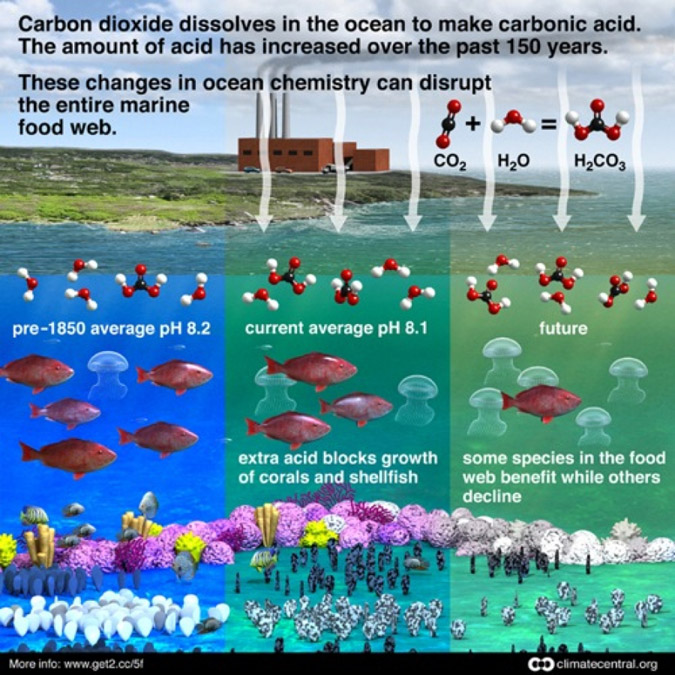
What Is the Impact of Ocean Acidification? https://www.envirotech-online.com/news/water-wastewater/9/breaking-news/what-is-the-impact-of-ocean-acidification/49250 Ocean acidification could have a massively damaging impact on millions of people all over the world in the coming years and decades, according to a new study from the University of Plymouth. By concentrating on heavily acidified hotspots in Japan and the Mediterranean, the study’s authors claim they can predict what may happen on a global scale if carbon continues to seep into the sea.The study is just latest in a growing body of work from its two authors, who have demonstrated that acidification can have a potentially devastating effect on marine ecosystems, with reefs under particular threat. This not only endangers the coral and oysters which comprise the reefs themselves, but also the myriad fish, crustaceans and other marine organisms which call them home.
What is ocean acidification?
Ocean acidification can be defined by a fall in pH levels in the water, caused primarily by carbon seeping into their vicinity. This can be caused naturally by volcanic fissures, such as at the two sites monitored by the study’s authors, but is becoming more and more commonplace through anthropomorphic activity, given that we release around a million tonnes of CO2 into the atmosphere every hour.
Roughly one quarter of that amount finds its way into the ocean and dissolves; once that happens, it reacts with the salty seawater to create a weak acidic substance. This causes surface ocean water to experience a fall in pH levels of approximately 0.002 units per year. That might not sound like much, but cumulatively it could have a sizable impact on the harmony of the water upon which so many marine creatures depend to survive and thrive.
Reefs at risk
The warming temperatures of the world’s oceans have already done significant damage to marine reefs; one only need to look at what’s happened to the Great Barrier reef for confirmation. As if that wasn’t bad enough, the acidification studied by Professor Jason Hall-Spencer and Dr Ben Harvey has been found to further jeopardise their longevity, especially for those composed of oysters or corals, which are particularly sensitive to the acidic effect.
The degradation of reefs not only spells trouble for the corals themselves, but also for the more than 25% of all marine animals which use them as a habitat. As well as being a hammer blow for biodiversity, this could also deplete stocks of many varieties of fish and shellfish which are popular for human consumption. Finally, reefs also provide an important breakwater for coastal communities; losing them would mean reduced protection against extreme weather events at sea.
What can be done?
In a world in which our seas and oceans are already suffering from myriad different problems, such as plastic pollution, dangerous blue green algae, habitat disruption from shipping, oil spills and many more, the last thing that the Earth’s waterways need right now is another threat in the form of increased oceanic temperatures and acidification. As a result, the lead author of the study Professor Hall-Spencer has called for immediate action.
“The Paris Agreement on climate change was welcome, but it does not mention ocean acidification, nor the fact that this rapid change in surface ocean chemistry undermines the social, economic and environmental pillars of sustainable development,” he remarked. “The time is ripe for a ‘Paris Agreement for the oceans’, with the specific target to minimise and address the impacts of ocean acidification, including through enhanced scientific cooperation at all levels.”
New nuclear power is not competitive, and not a viable way to deal with climate change
 Former U.S. Nukes Chief: “New nuclear is off the table” https://www.ewg.org/energy/22657/former-us-nukes-chief-new-nuclear-tableFrom 2009 to 2012, Gregory Jaczko was chairman of the Nuclear Regulatory Commission, which approves nuclear power plant designs and sets safety standards for plants. But he now says that nuclear power is too dangerous and expensive – and not part of the answer to the climate crisis. Former U.S. Nukes Chief: “New nuclear is off the table” https://www.ewg.org/energy/22657/former-us-nukes-chief-new-nuclear-tableFrom 2009 to 2012, Gregory Jaczko was chairman of the Nuclear Regulatory Commission, which approves nuclear power plant designs and sets safety standards for plants. But he now says that nuclear power is too dangerous and expensive – and not part of the answer to the climate crisis.
“Nuclear power was supposed to save the planet,” Jaczko wrote in a recent op-ed for The Washington Post. As an atomic physicist, he once endorsed that view. But his years on the NRC changed his mind:
Jaczko describes how his experience revealed the pervasive political influence of the nuclear power industry in Congress and among his fellow commissioners. Their opposition derailed much of the safety measures he proposed in the wake of the Fukushima nuclear disaster in Japan. In 2011 an investigative series by The Associated Pressdetailed the collusion between regulators and the industry to weaken safety standards to keep existing plants economically viable. Jaczko’s efforts to protect the American public likely cost him his careerat the NRC. He now leads an offshore wind power startup and is speaking out at an important juncture for the nation’s energy future. Electric utilities that operate nuclear plants are boasting of being “carbon free” by mid-century. They insist that their aging nuclear plants must be part of the equation to keep costs down. But even though Japan closed most of its reactors after Fukushima, carbon emissions went down, because the Japanese ramped up energy efficiency and solar investments. “It turns out that relying on nuclear energy is actually a bad strategy for combating climate change,” Jaczko wrote. “One accident wiped out Japan’s carbon gains. Only a turn to renewables and conservation brought the country back on target.” Jaczko’s heightened concern for a nuclear accident in the U.S. is also well founded. The former director of the nuclear safety project at Union of Concern Scientists, David Lochbaum, determined that the industry’s efforts to continue to run aging nuclear plants 20 to 30 years or even longer than their initial licenses allowed for is akin to playing Russian roulette. Since Fukushima, Germany has ordered the shutdown of all nuclear plants by 2022. Japan has reopened only a few reactors. Even France, long a champion of nuclear power, is ramping down its nuclear fleet because of safety concerns. But in the U.S., the Trump administration and lawmakers in some states continue to support taxpayer-financed subsidies to bail out money-losing nuclear plants. On grounds of both economics and safety, that’s a fool’s bet. |
|
Responsible journalism would be covering the climate chaos like we did the start of the second world war
What if we covered the climate crisis like we did the start of the second world war? In the war, the purpose of journalism was to awaken the world to the catastrophe looming ahead of it. We must approach our climate crisis the same wayI have been asked to bring this gathering to a close by summing up how we can do better at covering the possible “collapse of our civilizations and the extinction of much of the natural world,” to quote the noted environmentalist David Attenborough, speaking at the recent United Nations climate summit in Poland.
I don’t come with a silver bullet ……
Many of us have recognized that our coverage of global warming has fallen short. There’s been some excellent reporting by independent journalists and by enterprising reporters and photographers from legacy newspapers and other news outlets. But the Goliaths of the US news media, those with the biggest amplifiers—the corporate broadcast networks—have been shamelessly AWOL, despite their extraordinary profits. The combined coverage of climate change by the three major networks and Fox fell from just 260 minutes in 2017 to a mere 142 minutes in 2018—a drop of 45%, reported the watchdog group Media Matters.
Meanwhile, about 1,300 communities across the United States have totally lost news coverage, many from newspaper mergers and closures, according to the University of North Carolina School of Media and Journalism. Hundreds of others are still standing only as “ghost newspapers.” They no longer have resources for even local reporting, much less for climate change. ……
he networks put their reporters out in raincoats or standing behind police barriers as flames consume far hills. Yet we rarely hear the words “global warming” or “climate disruption” in their reports. The big backstory of rising CO2 levels, escalating drought, collateral damage, cause and effect, and politicians on the take from fossil-fuel companies? Forget all that. Not good for ratings, say network executives.
But last October, the UN Intergovernmental Panel on Climate Change, a scientifically conservative body, gave us 12 years to make massive changes to reduce global greenhouse-gas emissions 45 percent below 2010 levels and to net zero by 2050. On his indispensable site, TomDispatch.com, Tom Engelhardt writes that humanity is now on a suicide watch.
Soon, some of you will be traveling to the ends of the earth to report on this Great Disruption. To Indonesia, where oil-palm growers and commodities companies are stripping away forests vital to carbon storage. To the Amazon, where President Bolsonaro’s government plans to open indigenous reserves to industrial exploitation, threatening the lungs of the Earth. To India, where President Modi pretends to be an environmentalist even as he embraces destructive development. To China, where President Xi’s Belt and Road initiative, the biggest transportation-infrastructure program in the history of the world, threatens disaster for earth systems. You will go to the Arctic and the Antarctic to report on melting ice, and to the shores of African cities, Pacific atolls, and poor Miami neighborhoods being swallowed by rising oceans. And to Nebraska, and Iowa, and Kansas, and Missouri, where this spring’s crop is despair as farmers and their families grieve their losses.
And some of you will go to Washington, to report on the madness—yes, I said madness—of a US government that scorns reality as fake news, denies the truths of nature, and embraces a theocratic theology that welcomes catastrophe as a sign of the returning Messiah.
Madness! Superstition! Destruction and death.
Can we get this story right? Can we tell it whole? Can we connect the dots and inspire people with the possibility of change?
What’s journalism for? Really, in the war, what was journalism for, except to awaken the world to the catastrophe looming ahead of it?
Here’s the good news: While describing David Wallace-Wells’s stunning new book The Uninhabitable Earth as a remorseless, near-unbearable account of what we are doing to our planet, The New York Times reports it also offers hope. Wallace-Wells says that “We have all the tools we need…to aggressively phase out dirty energy…”; [cut] global emissions…[and] scrub carbon from the atmosphere…. [There are] ‘obvious’ and ‘available,’ [if costly,] solutions.”
What we need, he adds, is the “acceptance of responsibility.”
Our responsibility as journalists is to tell the story so people get it…….. https://www.theguardian.com/commentisfree/2019/may/22/climate-crisis-ed-murrow-bill-moyers
Climate change action is a top priority for UK’s moderate Conservatives
Guardian 19th May 2019 , Moderate Conservatives including Nicky Morgan and Amber Rudd are urging contenders for their party’s leadership to put the battle against the climate emergency at the forefront of the contest.
The 60-strong One Nation group of senior Tories, created as a bulwark against what they perceive as their party’s lurch to the right, is calling for the environment to form a central part of the leadership debate. The heat is on over the climate crisis. Only radical measures will work.
1 This Month

22 June – Virtual Event –Climate Change: New Data, New Debate

Monday, June 22, 2026 2:30 p.m. – 3:15 p.m. CT
YouTube. Register here

Protect Sazan Island from the Trump family! https://secure.avaaz.org/campaign/en/protect_sazan_island_from_the_trump_family_loc/?bqFCVab&v=174511&cl=22707147157&_checksum=5e9dde668860e8231c33699735e16a1fbf22ab2cb01da50c999fe8732b9775ef&utm_source=email&utm_medium=blast_email&utm_campaign=174511
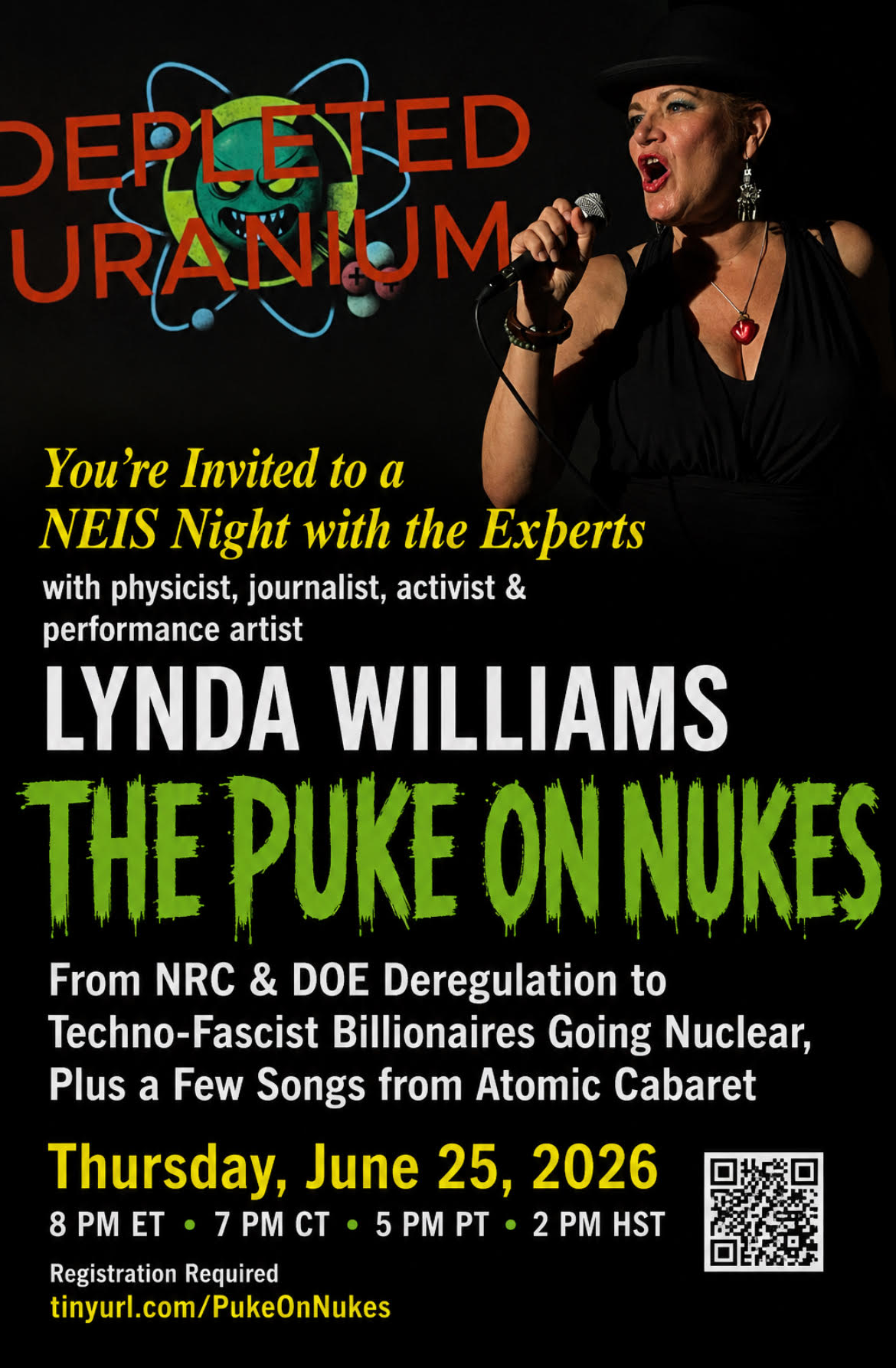
25 June- THE PUKE ON NUKES
Thursday, June 25, 2026
7pm Central Time (8pm ET, 6pm MT, 5pm PT) UTC – 5
From NRC & DOE Deregulation to Techno-Fascist Billionaires Going Nuclear, Plus a Few Songs from Atomic Cabaret REGISTER
26 June – Radiation Trainwreck at the NRC / Join the Protect Better Campaign – https://us02web.zoom.us/meeting/register/4ZlZ5_qLSHGiLSCg8FF6Bg#/registration


Cuba Is Not a Failed State – It Is a Besieged State
PETITION: “Global Appeal to Endorse Palestinian Right of Return of Refugees”
To see nuclear-related stories in greater depth and intensity – go to https://nuclearinformation.wordpress.com
-
Archives
- June 2026 (211)
- May 2026 (306)
- April 2026 (356)
- March 2026 (251)
- February 2026 (268)
- January 2026 (308)
- December 2025 (358)
- November 2025 (359)
- October 2025 (376)
- September 2025 (257)
- August 2025 (319)
- July 2025 (230)
-
Categories
- 1
- 1 NUCLEAR ISSUES
- business and costs
- climate change
- culture and arts
- ENERGY
- environment
- health
- history
- indigenous issues
- Legal
- marketing of nuclear
- media
- opposition to nuclear
- PERSONAL STORIES
- politics
- politics international
- Religion and ethics
- safety
- secrets,lies and civil liberties
- spinbuster
- technology
- Uranium
- wastes
- weapons and war
- Women
- 2 WORLD
- ACTION
- AFRICA
- Atrocities
- AUSTRALIA
- Christina's notes
- Christina's themes
- culture and arts
- Events
- Fuk 2022
- Fuk 2023
- Fukushima 2017
- Fukushima 2018
- fukushima 2019
- Fukushima 2020
- Fukushima 2021
- general
- global warming
- Humour (God we need it)
- Nuclear
- RARE EARTHS
- Reference
- resources – print
- Resources -audiovicual
- Weekly Newsletter
- World
- World Nuclear
- YouTube
-
RSS
Entries RSS
Comments RSS
 nuclear-news