Researchers still don’t fully understand Arctic melt and sea level rise
 These Are the Biggest Climate Questions for the New Decade These Are the Biggest Climate Questions for the New DecadeThe 2010s brought major climate science advances, but researchers still want to pin down estimates of Arctic melt and sea level rise, Scientific Amrican , By Chelsea Harvey, E&E News on January 4, 2020 The 2010s were almost certainly the hottest decade on record — and it showed. The world burned, melted and flooded. Heat waves smashed temperature records around the globe. Glaciers lost ice at accelerating rates. Sea levels continued to swell. At the same time, scientists have diligently worked to untangle the chaos of a rapidly warming planet. In the past decade, scientists substantially improved their ability to draw connections between climate change and extreme weather events. They made breakthroughs in their understanding of ice sheets. They raised critical questions about the implications of Arctic warming. They honed their predictions about future climate change. The 2010s were almost certainly the hottest decade on record — and it showed. The world burned, melted and flooded. Heat waves smashed temperature records around the globe. Glaciers lost ice at accelerating rates. Sea levels continued to swell. At the same time, scientists have diligently worked to untangle the chaos of a rapidly warming planet. In the past decade, scientists substantially improved their ability to draw connections between climate change and extreme weather events. They made breakthroughs in their understanding of ice sheets. They raised critical questions about the implications of Arctic warming. They honed their predictions about future climate change. Some of these links are straightforward. Melting Arctic ice pouring into the ocean can raise global sea levels. Thawing permafrost can release large amounts of carbon dioxide and methane into the atmosphere, potentially accelerating the rate of global warming. Others are more contentious. In the last decade, a growing scientific debate has arisen about the influence of Arctic warming on global climate and weather patterns, particularly in the midlatitudes…….. One ongoing project known as the Polar Amplification Model Intercomparison Project is conducting a series of coordinated model experiments, all using the same standard methods, to investigate the Arctic climate and its connections to the rest of the globe. Experts say these kinds of projects may help explain why modeling studies conducted by different groups with different methods don’t always get the same results. Outside that debate, there are still big questions about the Arctic climate to resolve. Scientists know the Arctic is heating up at breakneck speed — but they’re still investigating all the reasons why. Researchers believe a combination of feedback processes are probably at play. Sea ice and snow help reflect sunlight away from the Earth. As they melt away, they allow more heat to reach the surface, warming the local climate and causing even more melting to occur……. OCEANS AND ICE Sea-level rise is one of the most serious consequences of climate change, with the potential to displace millions of people in coastal areas around the world. At the moment, the world’s oceans are rising at an average rate of about 3 millimeters each year. It appears to be speeding up over time. That may not sound like much, but scientists are already documenting an increase in coastal flooding in many places around the world…….. Some scientists worry that as ice loss continues to speed up in both Greenland and Antarctica, parts of the ice sheets could eventually destabilize and collapse entirely — leading to catastrophic sea-level rise. In recent years, scientists have discovered that warm ocean currents are helping to melt some glaciers from the bottom up, both in Greenland and particularly in parts of West Antarctica. Better understanding the relationship between oceans and ice is a key priority for glacier experts, Tedesco said. At the same time, monitoring the way water melts and moves along the top of the ice is also a major priority. In Greenland, climate-driven changes in the behavior of large air currents like the jet stream may be helping to drive more surface melting……. EXTREME WEATHER EVENTSThe past decade saw leaps and bounds in a field of climate research known as “attribution science” — the connection between climate change and extreme weather events. It was once thought to be impossible, but scientists are now able to estimate the influence of global warming on individual events, like heat waves or hurricanes. In the past few years alone, scientists have found that some events are now occurring that would have been impossible in a world with no human-caused climate change. As attribution science has advanced, researchers have been able to tackle increasingly complex events, like hurricanes and wildfires, which were previously too complicated to evaluate with any confidence. They’ve gotten faster, too — researchers are now able to assess some extreme events nearly in real time. Some organizations are working to develop sophisticated attribution services, similar to weather services, which would release analyses of extreme events as soon as they occur. The German national weather service; the United Kingdom’s Met Office; and the Copernicus program, part of the European Centre for Medium-Range Weather Forecasts, have all begun exploring these kinds of projects. At the same time, scientists are working to improve their predictions of future extreme events in a warming world. So far, climate models predict that many extreme weather events will happen more frequently, or will become more severe, as the climate continues to change. Heat waves will be hotter, hurricanes will intensify, heavy rainfall events may happen more frequently in some places, and droughts may be longer in others……. PROJECTING THE FUTURE Predicting how much the Earth will warm, given a certain level of greenhouse gas emissions, may seem like the simplest goal of climate modeling. But it’s harder than it sounds. Climate models don’t always agree on the Earth’s exact sensitivity to greenhouse gas emissions — although they do tend to fall within a certain range. If global carbon dioxide concentrations were to double, for instance, models from the past decade have tended to predict that the Earth would warm from between 1.5 and 4.5 degrees Celsius……. https://www.scientificamerican.com/article/these-are-the-biggest-climate-questions-for-the-new-decade/?amp |
|
Very unwise plan: UK’s Bradwell B nuclear project vulnerable to climate extremes
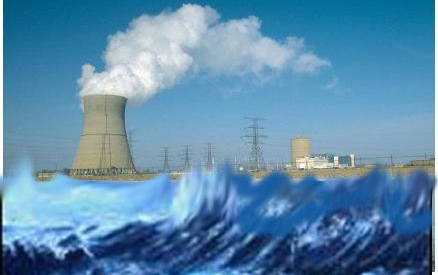 BANNG 2nd Jan 2020, It may appear that all has been quiet on the eastern front in the recent past but CGN seems intent on carrying out its plans to build Bradwell B and is continuing with its site investigations. 2020 will be an important, probably crucial, year in terms of whether plans for new nuclear power plants move forward. The Bradwell B Generic Design Assessment (GDA) will be at its peak. EDF will apply for Development Consent (DCO) for Sizewell C.
We anticipate there will be a big push by the new Government and the
nuclear industry for new nuclear development. And Bradwell B will be slowly
approaching its pre-application stage, which could begin within the next
two years.
growing and BANNG will need all supporters to play a part.
erosion.
Australia’s bushfires and their danger to nuclear waste transport
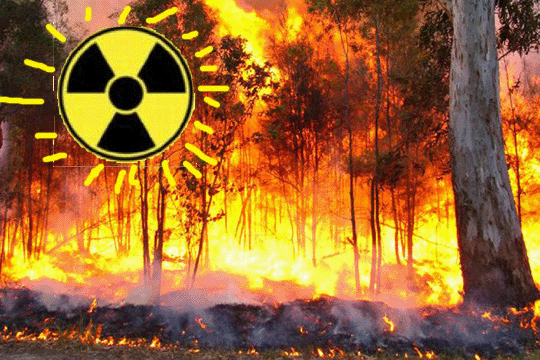
In all the propaganda for a nuclear waste dump in Kimba, South Australia,  there was no mention of bushfire risks. An extraordinary omission, don’t you think?
 The whole bizarre plan to trek the Lucas Heights nuclear reactor wastes some 1700km by land, or even longer by sea, would entail trucking highly radioactive (they call it intermediate) wastes through forest areas, towns, ports, to what used to be an agricultural area.
The nuclear industry touts itself as the cure for climate change. In reality,it is the other way around. For Australia especially, climate change, bushfires, water shortages – make every aspect of the nuclear industry ever more dangerous.
The Lucas Heights nuclear reactor itself is uncomfortably close to the bushfires. But nobody’s talking about that. That reactor shoud be shutdown, and no more wastes produced.
Dangerous climate is now upon Australia- Michael Mann
 Australia, your country is burning – dangerous climate change is here with you now , Guardian, Michael Mann 1 Jan 2020, I am a climate scientist on holiday in the Blue Mountains, watching climate change in action,
After years studying the climate, my work has brought me to Sydney where I’m studying the linkages between climate change and extreme weather events.
Prior to beginning my sabbatical stay in Sydney, I took the opportunity this holiday season to vacation in Australia with my family. We went to see the Great Barrier Reef – one of the great wonders of this planet – while we still can. Subject to the twin assaults of warming-caused bleaching and ocean acidification, it will be gone in a matter of decades in the absence of a dramatic reduction in global carbon emissions.
We also travelled to the Blue Mountains, another of Australia’s natural wonders, known for its lush temperate rainforests, majestic cliffs and rock formations and panoramic vistas that challenge any the world has to offer. It too is now threatened by climate change.
I witnessed this firsthand.
I did not see vast expanses of rainforest framed by distant blue-tinged mountain ranges. Instead I looked out into smoke-filled valleys, with only the faintest ghosts of distant ridges and peaks in the background. The iconic blue tint (which derives from a haze formed from “terpenes” emitted by the Eucalyptus trees that are so plentiful here) was replaced by a brown haze. The blue sky, too, had been replaced by that brown haze. ……
The brown skies I observed in the Blue Mountains this week are a product of human-caused climate change. Take record heat, combine it with unprecedented drought in already dry regions and you get unprecedented bushfires like the ones engulfing the Blue Mountains and spreading across the continent. It’s not complicated.
The warming of our planet – and the changes in climate associated with it – are due to the fossil fuels we’re burning: oil, whether at midnight or any other hour of the day, natural gas, and the biggest culprit of all, coal. That’s not complicated either.
When we mine for coal, like the controversial planned Adani coalmine, which would more than double Australia’s coal-based carbon emissions, we are literally mining away at our blue skies. The Adani coalmine could rightly be renamed the Blue Sky mine.
In Australia, beds are burning. So are entire towns, irreplaceable forests and endangered and precious animal species such as the koala (arguably the world’s only living plush toy) are perishing in massive numbers due to the unprecedented bushfires.
The continent of Australia is figuratively – and in some sense literally – on fire.
Yet the prime minister, Scott Morrison, appears remarkably indifferent to the climate emergency Australia is suffering through, having chosen to vacation in Hawaii as Australians are left to contend with unprecedented heat and bushfires.
Morrison has shown himself to be beholden to coal interests and his administration is considered to have conspired with a small number of petrostates to sabotage the recent UN climate conference in Madrid (“COP25”), seen as a last ditch effort to keep planetary warming below a level (1.5C) considered by many to constitute “dangerous” planetary warming.
But Australians need only wake up in the morning, turn on the television, read the newspaper or look out the window to see what is increasingly obvious to many – for Australia, dangerous climate change is already here. It’s simply a matter of how much worse we’re willing to allow it to get.
Australia is experiencing a climate emergency. It is literally burning. It needs leadership that is able to recognise that and act. And it needs voters to hold politicians accountable at the ballot box.
Australians must vote out fossil-fuelled politicians who have chosen to be part of the problem and vote in climate champions who are willing to solve it.
- Michael E Mann is distinguished professor of atmospheric science at Pennsylvania State University. His most recent book, with Tom Toles, is The Madhouse Effect: How Climate Change Denial Is Threatening Our Planet, Destroying Our Politics, and Driving Us Crazy (Columbia University Press, 2016).https://www.theguardian.com/commentisfree/2020/jan/02/australia-your-country-is-burning-dangerous-climate-change-is-here-with-you-now
The Green New Deal: Not Insanity, but an Investment.
businesses alike.
results of his number crunching and concluded that while the implementation
of a worldwide Green New Deal during a seven-year span would cost a
whopping $76 trillion dollars, the global economy would recoup that massive
sum relatively quickly by reaping annual savings of about $11 trillion –
not to mention the fact that citizens would benefit from reduced climate
action risks, cleaner air, fewer blackouts and more reliable sources of
energy and power.
https://www.triplepundit.com/story/2019/green-new-deal-not-insanity-investment/86036
European Union split on nuclear energy, but manages a draft Green Finance deal.
Green-finance deal survives EU split on nuclear energy. European Central Bank chief Christine Lagarde has underlined the importance of the reform, with sustainable finance deals reaching one half a trillion dollars in 2018.
But the long-standing disagreement over nuclear energy has undermined the EU’s efforts to cut greenhouse emissions, with a promise last week by EU leaders for carbon neutrality by 2050 nearly scuppered by a feud over atomic energy.
https://www.khmertimeskh.com/50671303/green-finance-deal-survives-eu-split-on-nuclear-energy 23 Dec 19, EU negotiators have been struggling for weeks to finalise a harmonised classification system for green finance in Europe that could decide the fate of hundreds of billions of euros in investment.
The lobbying frenzy in Brussels over the new EU norm has been immense, with soon to Brexit Britain also making its voice heard while protecting the interests of the City of London financial hub.
“This is a historic moment… the much-needed enabler to get green investments to flow and help Europe reach climate neutrality by 2050,” said EU Commission Vice President Valdis Dombrovskis.
Late on Monday, EU lawmakers approved an offer by member states that delayed the nuclear question – as well as the role of natural gas cherished by Berlin – until the end of 2021.
“I am fully aware that the nuclear problem will return in two years’ time. We pushed back the matter,” said the chairman of the European Parliament’s Environment Committee, French centrist MEP Pascal Canfin.
“The risk was to take the whole classification hostage,” he added.
Ever since the European Commission’s proposal was put on the table in May 2018, nuclear energy has been the subject of a huge fight between its supporters, led by France and backed by Eastern European countries.
But opponents of nuclear power – such as Germany, Austria, Luxembourg and Greece – have refused to back down, with domestic opinion fearing atomic energy disasters, such as Fukushima or Chernobyl.
The compromise suggested by Finland, which holds the EU’s rotating presidency, was reached with MEPs behind closed doors and needs final approval by member states envoys on Wednesday.
Once approved, the European Commission will then have two years to draw up detailed lists of sectors eligible for a Green finance label, based on the criteria.
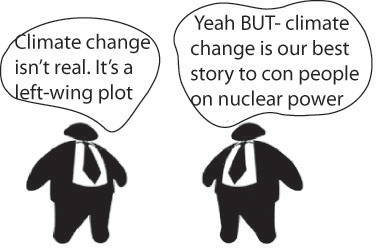
These 32 experts refute the claim that nuclear power is a sustainable method against climate change
|
Global investment in nuclear is in stark decline https://www.ft.com/content/75ea3180-0a02-11ea-bb52-34c8d9dc6d84 From Dr Paul Dorfman et al
We write in response to James E Hansen et al’s letter (“EU must include nuclear power in its list of sustainable sources”, December 17), which mistakenly advocates nuclear energy to address climate change. In fact, spending on new nuclear power significantly reduces our chances in effectively responding to climate change. This is because, for nuclear to be considered a feasible option, new reactors should be able to be completed economically, efficiently and on time — however, practical experience proves otherwise. Nuclear new-build represents a high-risk technical, regulatory and investment option, with significant delay and cost overrun. Market analysis shows investment in nuclear power to be uneconomic — this holds for all plausible ranges of investment costs, weighted average costs of capital, and wholesale electricity prices.
In the end, the fate of new nuclear seems inextricably linked with, and determined by, that of renewable energy technology rollout. Worldwide, market trends for new nuclear are in stark decline and renewables are markedly rising.
The, perhaps obvious, explanation for this dynamic can be found in the ramping costs of the former and the plummeting costs of the latter.
Please use the sharing tools found via the share button at the top or side of articles. Copying articles to share with others is a breach of FT.com T&Cs and Copyright Policy. Email licensing@ft.com to buy additional rights. Subscribers may share up to 10 or 20 articles per month using the gift article service. More information can be found here.
https://www.ft.com/content/75ea3180-0a02-11ea-bb52-34c8d9dc6d84 AUTHORS:
Dr Paul Dorfman, UCL Energy Institute, University College London Prof Tom Burke, Imperial and University Colleges, E3G
Prof MV Ramana, School of Public Policy and Global Affairs, University of British Columbia
Prof Benjamin K Sovacool, Science Policy Research Unit, University of Sussex
Prof Andy Stirling Centre on Social Technological and Environmental Pathways to Sustainability, University of Sussex
Prof Steve Thomas Public Services International Research Unit, University of Greenwich
Prof Keith Barnham Physics Department, Imperial College London
Prof David Elliott, The Open University Prof Mark Lemon, Institute of Energy and Sustainable Development, De Montfort University
Prof Manfred Mertins, Brandenburg University of Applied Sciences
Prof Benjamin K Sovacool, Science Policy Research Unit, University of Sussex
Prof Andy Stirling, Centre on Social Technological and Environmental Pathways to Sustainability, University of Sussex
Prof Steve Thomas, Public Services International Research Unit, University of Greenwich
Dr Abhishek Agarwal, Aberdeen Business School, Robert Gordon University
Dr Sarah J Darby, Environmental Change Institute, University of Oxford
Dr John Downer, Global Insecurities Centre, University of Bristol
Dr Ian Fairlie, Vice President CND
Dr Phil Johnstone, Science Policy Research Unit, University of Sussex
Dr Pascal Hingamp, Mediterranean Institute of Oceanography, Marseille University
Dr Dan van der Horst, School of Geosciences, University of Edinburgh
Dr Helga Kromp-Kolb, Vienna University of Natural Resources and Life Sciences, former Head of the Austrian Nuclear Advisory Board
Dr Jeremy Leggett, Solarcentury
Dr David Lowry, Institute for Resource and Security Studies, Cambridge Massachusetts
Dr med. Alex Rosen, IPPNW Germany
Dr Michael Schöppner, Vienna University of Natural Resources and Life Sciences
Dr Eva Stegen, Elektrizitätswerke Schönau, Energy Watch Group
Dr David Toke, Department of Politics and International Relations, University of Aberdeen
Cllr David Blackburn, UK and Ireland NFLA
Paul Brown, Climate News Network Eur Ing
Herbert Eppel, Chartered Environmentalist and Director of HE Translations Ltd
Friederike Frieß, MSc. Dr.rer.nat., Vienna University of Natural Resources and Life Sciences
Michel Lee, Council on Intelligent Energy & Conservation Policy
Jonathon Porritt, Author and Campaigner Ulli Sima, Vienna Deputy Mayor, Cities for a Nuclear Free Europe
David Thorpe, One Planet Life
|
|
Male dominated climate talks falter, while women’s perspective is excluded
|
The first step to achieving this aim would be gender parity at international climate conferences such as the Madrid COP. While we don’t yet know how many of the 13,000 registered governmental delegates were women, based on past numbers they are unlikely to make up more than a quarter. This is not the only forum where the experiences of women are ignored. Our research, spanning Kenya, Cambodia and Vanuatu, has found women are working collectively to strengthen their communities in the face of climate change. But their knowledge about climate risk is dismissed by scientists and political leaders. Bridging climate awareness When women are excluded from local and national-level governance, the absence of their voices at regional and global levels, such as COP meetings, is virtually assured. Our work across Africa, Asia and the Pacific found scientists – generally male – lack awareness of the knowledge women hold about the local consequences of climate change. At the same time, those women had little access to scientific research. In places where the labour is divided by gender, women and men learn different things about the environment. Though the women in our research generally did not know about government policies or programs on climate change and disaster risk reduction, they were very aware of environmental change. In Kenya, the pastoralist women we spoke to are acutely aware of the link between their physical insecurity and extreme drought. Continue reading |

European Union’s “taxonomy” of sustainable activities includes nuclear
 Green-Finance Deal Reached by EU States on Nuclear Compromise https://www.bloomberg.com/news/articles/2019-12-16/green-finance-deal-reached-by-eu-states-on-nuclear-compromise
By Alexander Weber, December 16, 2019, Green-Finance Deal Reached by EU States on Nuclear Compromise https://www.bloomberg.com/news/articles/2019-12-16/green-finance-deal-reached-by-eu-states-on-nuclear-compromise
By Alexander Weber, December 16, 2019,
Diplomats from the European Union’s 28 countries agreed to advance with key legislation for green financial products, bringing the bloc a step closer to embedding environmental goals in standards for banks, money managers and insurers. Envoys signed off on a deal on the EU’s list of sustainable activities after more lenient wording on the inclusion of nuclear energy won the backing of countries including France and the U.K., according to an official involved in the talks, who asked not to be named, in line with policy. A first attempt to strike a deal last week failed amid divisions over the role that nuclear energy should play in the framework. The EU’s list of sustainable activities for investment purposes, dubbed “taxonomy,” is the centerpiece of its push to regulate the fast growing market of green finance, in the hope of directing trillions of euros to fund a radical revision of the region’s economy. It’s meant to define what’s green and what’s not, an effort that could find a range of uses and serve as an example for governments around the world. The difficulty of agreeing on the rules shows what kind of obstacles the EU has to overcome to meet its ambitious climate targets. Leaders last week agreed that the bloc should achieve zero net emissions in 2050, paving the way for a flurry of legislation that’s needed for the unprecedented clean-up of the economy. The member states now have to present their compromise to the European Parliament, which has been critical of allowing fossil fuels and nuclear power to be classified as sustainable and thus eligible to be financed with green bonds and similar financial products. |
|
European Union’s sustainable finance debate bogged down in question of including nuclear power
|
Nuclear power toxifies EU sustainable finance debate EU28 ambassadors meet on Monday morning to see if they can come up with a compromise that can keep all sides happy Mehreen Khan 15 Dec 19 https://www.ft.com/content/f4ee6bfc-1fb2-11ea-b8a1-584213ee7b2b Nuclear power toxifies EU sustainable finance debate EU28 ambassadors meet on Monday morning to see if they can come up with a compromise that can keep all sides happy Share on Twitter (opens new window) Share on Facebook (opens new window) Share on LinkedIn (opens new window) Save Mehreen Khan YESTERDAY Agreeing on international climate deals is harder than it looks. Despite rising public pressure for policymakers to grapple with the challenge, marathon talks at the UN’s COP25 summit ended this weekend in failure. In what was the world’s longest ever climate negotiation (14 consecutive days), international delegates in Madrid failed to agree rules for how rich and poorer countries should construct a new global carbon trading market. The FT’s Leslie Hook dissects how the summit came to an inconclusive end and why the EU and environmental NGOs are lamenting the outcome.
The EU, which was part of the negotiations in Madrid, will be discouraged by the rancour over carbon trading permits — especially as Brussels is drawing up contentious plans to force third countries to pay a price for carbon it exports to the bloc.
Away from the UN talks, EU governments will have to face down their own green divisions on Monday when they meet to discuss much-anticipated market rules on sustainable finance products. Despite hopes for a deal before the end of the year, France and eastern European capitals last week demanded the rules make explicit to investors that nuclear energy is part of the EU’s journey towards carbon neutrality.
EU28 ambassadors meet on Monday morning to see if they can come up with a compromise that can keep all sides happy. Austria and Luxembourg have led the charge against giving a green-stamp to nuclear, with Germany also resisting over concerns about the environmental impact of nuclear waste.
While the EU has championed itself as a global leader in climate policy, Brussels has yet to prove whether it can “walk the talk” on green policy. The debate over the classification system (known as the “taxonomy”) is the new European Commission’s first real test.
Energy policy is a fiercely protected part of governments’ national powers. Divisions were laid bare in a tense leaders’ summit last week where member states ultimately failed to convince Poland to sign up to the bloc’s 2050 net zero carbon target. But in a triumph for France and its eastern allies, the summit conclusions gave an explicit nod to nuclear as “part of the energy mix” in some countries.
Diplomats think the summit agreement on nuclear should pave the way for pro-nuclear countries to win the argument over the taxonomy. Even if they do, another battle with MEPs lies ahead. Should ambassadors get a compromise on Monday, it still has to be agreed by the European Parliament, which has insisted on its “no” to nuclear.
Pascal Canfin, head of the EP’s environment committee and member of Emmanuel Macron’s En Marche, also held firm on the issue. He told the Brussels Briefing that EU governments should not “modify the balanced political compromise” agreed with MEPs earlier this month. “All parties know that it is the only deal that could have been reached. That’s why I’m confident we will get a formal endorsement this week,” said Mr Canfin.
|
|
Marathon UN climate talks have a rather disappointing outcome
Disappointment as marathon climate talks end with slim deal. AP News, By FRANK JORDANS and ARITZ PARRA,MADRID (AP) 15 Dec 19, — Marathon U.N. climate talks ended Sunday with a slim compromise that sparked widespread disappointment, after major polluters resisted calls for ramping up efforts to keep global warming at bay and negotiators postponed debate about rules for international carbon markets for another year.
Organizers kept delegates from almost 200 nations in Madrid far beyond Friday’s scheduled close of the two-week talks. In the end, negotiators endorsed a general call for greater efforts to tackle climate change and several measures to help poor countries respond and adapt to its impacts.
U.N. Secretary-General António Guterres said he was “disappointed” by the meeting’s outcome.
“The international community lost an important opportunity to show increased ambition on mitigation, adaptation and finance to tackle the climate crisis,” he said. “We must not give up and I will not give up.”
The final declaration cited an “urgent need” to cut planet-heating greenhouse gases in line with the goals of the landmark 2015 Paris climate change accord. But it fell far short of explicitly demanding that countries submit bolder emissions proposals next year, which developing countries and environmentalists had demanded……
Thankfully, the weak rules on a market-based mechanism, promoted by Brazil and Australia, that would have undermined efforts to reduce emissions, have been shelved,” said Mohamed Adow, director of Nairobi-based campaign group Power Shift Africa.
Helen Mountford, from the environmental think-tank World Resources Institute, said that “given the high risks of loopholes discussed in Madrid, it was better to delay than accept rules that would have compromised the integrity of the Paris Agreement.”…….
Delegates made some progress on financial aid for poor countries affected by climate change, despite strong resistance from the United States to any clause holding big polluters liable for the damage caused by their emissions. Countries agreed four years ago to funnel $100 billion per year by 2020 to assist developing nations, but so far nowhere near that amount has been raised. …..
The United States will be excluded from much of those talks after President Donald Trump announced the country’s withdrawal from the Paris accord, a process than comes into force Nov. 4, 2020……. https://apnews.com/aca79ab4956f370b8892ba574fe56834
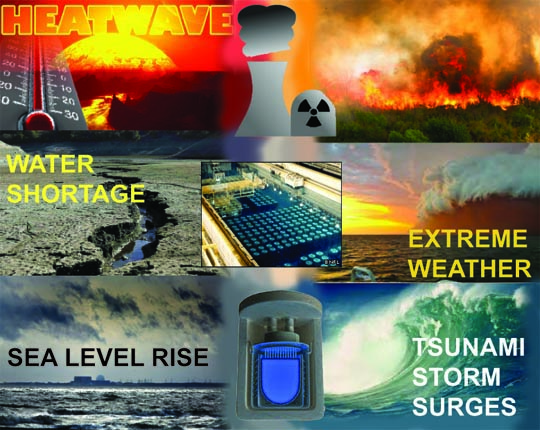
The world is headed for climate crisis and nuclear destruction
|
The world is headed for climate crisis and nuclear destruction https://www.idsnews.com/article/2019/12/opextinction121119 BRYCE GREENE In August 1945, the development and dropping of the atomic bombs ushered humanity into an unprecedented era. For the first time in human history, we possessed the capacity for complete species destruction.
Current actions regarding climate and atomic bombs taken by lawmakers are putting the world at risk of this destruction again. Since 1947, an organization known as the Bulletin of the Atomic Scientists developed a theoretical model to describe just how close we are to the brink. The end result was a clock whose countdown to midnight signified the approaching end of humanity. This model was dubbed The Doomsday Clock. Over the years, scientists have adjusted the clock according to their assessment of the risk of destruction. In 1953, the clock was moved to 11:58 as Americans and Soviets developed the hydrogen bomb, a weapon with destructive capabilities orders of magnitude greater than the Hiroshima bomb. Given the effects of nuclear winter alone, such a war have almost certainly wiped out all of humanity, the catastrophic event known as omnicide. In subsequent years, the U.S. maintained Cold War-level military spending and rejected a series of nuclear arms treaties. This aggressive stance, along with a nuclear North Korea and fears of nuclear terrorism, has prompted the clock to shift continuously back towards midnight. In 2007, the bulletin included a new variable for measuring omnicidal dangers: climate change. The effects of a steadily warming planet pose an enormous threat to organized human existence. Global warming increases the frequency and severity of natural catastrophes such as wildfires, floods, freak storms and droughts. Increased carbon in the atmosphere is causing decreased nutrition levels in crops. Coastal areas around the world will sink under water, and entire countries will be uninhabitable due to excessive heat. The effects of this would be enough to tear apart the liberal world order. Since then, the clock has been inching closer to destruction. In 2018, the bulletin moved the clock to 2 minutes to midnight, as close as it has ever been in the clock’s history. The reasons are clear. President Donald Trump and the rest of the Republicans continued to march the U.S. on the path towards climate and nuclear catastrophe. In many ways they are aided by a Democratic establishment who scoff at a Green New Deal while taking hundreds of thousands in fossil fuel money. Earlier this year, the administration announced that it was going to withdraw from the Paris Climate Agreement, absolving itself of the responsibility to help limit emissions. Of course, Trump and America aren’t the only culprits behind the world’s emissions. The Bulletin of the Atomic Scientists notes that most of the countries of the world have “failed miserably” in their goal to reduce emissions. After a brief plateau in emissions, global emissions resumed their rise after 2017. After the Obama administration initiated a $1 trillion investment in “modernizing” our nuclear arsenal, Trump is also hastening our march to nuclear annihilation by expanding that investment. In response, Vladmir Putin announced Russia’s own modernization efforts. Additionally, Trump announced that the U.S. was abandoning the INF treaty that limits the kinds of nuclear weapons that could be developed The administration’s Nuclear Posture Review highlights the need to be prepared to use nukes in a wide variety of circumstances, as well as plans to develop “more-useable” nuclear weapons. None of this will increase our safety. We are at the beginning of a new nuclear arms race. Earlier this year, Trump announced he would reimpose sanctions of Iran, violating the Iran nuclear deal. The direct human costs of the sanctions aside, this raises the risk of a conflagration in the region that could lead to nuclear exchange. A nuclear North Korea continues to hang over Southeast Asia. Though the Trump meeting with Kim was a step in the right direction, no concrete actions were taken. All of these problems are exacerbated by the new paradigm of weaponized information. In 2019, the Bulletin announced that information warfare techniques pose another threat to civilization. In a world of fake news and alternative facts, the information ecosystem is threatened with utter chaos. The Bulletin writes that “by manipulating the natural cognitive predispositions of human beings, information warriors can exacerbate prejudices, biases, and ideological differences.” The modern information society makes such manipulation exponentially more dangerous. Society will not be able to deal with the problems we face if citizens cannot trust the information they encounter. The Bulletin says, “This new abnormal is simply too volatile and dangerous to accept as a continuing state of world affairs.” Our society is living with a gun pointed at our head, and the people who run the world seem intent on playing around with the trigger. But it doesn’t have to be this way. The Bulletin of the Atomic Scientists released a statement saying “The means for managing dangerous technology and reducing global-scale risk exist; indeed, many of them are well-known and within society’s reach, if leaders pay reasonable attention to preserving the long-term prospects of humanity, and if citizens demand that they do so.” As citizens of the world, we have a job to do. |
|
Sceptisim over Boris Johnson’s promises environment and climate
 The Conversation 13th Dec 2019, Rebecca Willis: Climate change had a higher profile in the UK election campaign than ever before, with parties competing hard over their offer to concerned voters.
But this was a debate that the Conservatives – who won a landslide majority – largely stood back from. Their manifesto was light on detail compared to the other parties, and Boris Johnson chose not to take part in the first ever UK televised leaders’ debate on climate.
Conservative candidates were conspicuous by their absence in local climate
hustings, too. Neither was climate mentioned in their legislative plan for
the first hundred days. The Conservative government did legislate for a net
zero carbon emissions target back in June, following the advice of the
Committee on Climate Change. And there was an explicit manifesto pledge to
deliver on this target, with no signs of backtracking.
In his speech to the party faithful on the morning of his election, Johnson declared his ambition to “make this country the cleanest, greenest on Earth, with the most far-reaching environmental programme”, adding: And you the people of this country voted to be carbon-neutral in this election – you voted to be carbon-neutral by 2050. And we’ll do it.
But targets don’t reduce carbon. Policies do. And despite its much-admired Climate Change Act, the UK’s policy record lately has not been good. The Committee on Climate Change have repeatedly warned that the UK is off track to meet future commitments, a verdict shared by the independent Climate Action Tracker project, which assesses each country’s performance against the Paris Agreement. It rated the UK as “insufficient”, with policies compatible
with a 3°C world – not the 1.5°C level that we desperately need.
If the new government is serious about its commitment, it will have to signal this soon, and with confidence. Steps that it could and should take straight
away include: instigating a swift review of governance for net-zero, giving
responsibility and resources to other government departments, and,
crucially, to local areas, to deliver on carbon strategy; prioritising
climate and environmental protection in negotiations for a trading
relationship with the European Union; moving quickly to consult on a
phase-out date for petrol and diesel vehicles, as promised in its
manifesto; removing the de facto ban on onshore wind energy, which the
Committee on Climate Change advised needs to increase in capacity by 1GW a
year; confirming its opposition to fracking, and making its moratorium
permanent; pledging to formally consider the results of the national
citizens’ assembly on climate change, Climate Assembly UK, due to report
in 2020.
Weak outcome of UN climate change talks in Madrid
Key points:
- UN secretary-general Antonio Guterres said he was “disappointed” by the meeting’s outcome
- The final talks fell short of promising to enhance countries’ pledges to cut planet-heating greenhouse gases next year
- There was no final agreement on regulation for international carbon markets, with the EU warning that weak rules sought by some countries would undermine the system
Those failures came even after organisers added two more days to the 12 days of scheduled talks in Madrid.
In the end, delegates from almost 200 nations endorsed a declaration to help poor countries that are suffering the effects of climate change, although they did not allocate any new funds to do so.
The final declaration called on the “urgent need” to cut planet-heating greenhouse gases in line with the goals of the landmark 2015 Paris climate change accord.
That fell far short of promising to enhance countries’ pledges to cut planet-heating greenhouse gases next year, which developing countries and environmentalists had lobbied the delegates to achieve.
The Paris accord established the common goal of avoiding a temperature increase of more than 1.5 degrees Celsius by the end of the century.
So far, the world is on course for a 3 to 4-degree Celsius rise, with potentially dramatic consequences for many countries, including rising sea levels and fiercer storms.
Negotiators in Madrid left some of the thorniest issues for the next climate summit in Glasgow in a year, including the liability for damages caused by rising temperatures that developing countries were insisting on.
That demand was resisted mainly by the United States……..
observers said big emissions emitters like China, the United States and India need to stop shirking their responsibilities.
“Regressive governments put profit over the planetary crisis and the future of generations to come,” the conservation group WWF said in a statement.
Ms Mountford said the talks this year “reflect how disconnected country leaders are from the urgency of the science and the demands of their citizens in the streets.”
“They need to wake up in 2020,” she added. https://mobile.abc.net.au/news/2019-12-16/un-climate-summit-ends-with-no-deal-on-carbon-markets/11801772
UN climate talks not getting very far on climate action
UN talks struggle to stave off climate chaos, https://www.sbs.com.au/news/un-talks-struggle-to-stave-off-climate-chaos 13 Dec 19, Observers and delegates at the UN’s COP25 climate summit said negotiators had largely failed to live up to the conference’s motto: Time for Action.
United Nations climate negotiations in Madrid were set to wrap up with even the best-case outcome likely to fall well short of what science says is needed to avert a future ravaged by global warming.
The COP25 summit comes on the heels of climate-related disasters across the planet, including unprecedented cyclones, deadly droughts and record-setting heatwaves.
As pressure inside and outside the talks mounts, old splits dividing rich polluters and developing nations – over who should slash greenhouse gas emissions by how much, and how to pay the trillions needed to live in a climate-addled world — have reemerged.
Newer fissures, meanwhile, between poor, climate vulnerable nations and emerging giants such as China and India – the world’s No.1 and No.4 emitters – may further stymie progress.
To not lose time, the 12-day meet was moved at the last minute from original host Chile due to social unrest.
Not even appearances from wunderkind campaigner Greta Thunberg – named Time Person of the Year Wednesday, much to the chagrin of Donald Trump — could spur countries to boost carbon-cutting pledges that are, taken together, woefully inadequate.
“We are appalled at the state of negotiations,” said Carlos Fuller, lead negotiator for the Association of Small Island States (AOSIS), many of whose members face an existential threat due to rising sea levels.
Shifting alliances
The narrow aim of the Madrid negotiations is to finalise the rulebook for the 2015 climate accord, which enjoins nations to limit global temperature rises to “well below” two degrees Celsius.
Earth has already warmed 1C, and is on track to heat up another two or three degrees by 2100.
But “raising ambition” on emissions remains the overarching goal in Madrid.
There are two very clear visions,” Spain’s minister for energy and climate change Teresa Ribera told reporters.
“There are those that want to move quicker and those that want to hide behind things which aren’t working, so as not to advance.”
The deadline under the Paris treaty for revisiting carbon cutting commitments – known as NDCs, or nationally determined contributions – is 2020, ahead of the next climate summit in Glasgow.
But Madrid was seen as a crucial launch pad where countries could show their good intentions. Nearly 80 countries have said they intend to do more, but they only represent 10 percent of global emissions.
Conspicuously absent are China, India and Brazil, all of whom have indicated they will not follow suit, insisting that first-world emitters step up.
Fantasy land’
But some countries historically aligned with the emerging giants over the course of the 25-year talks broke rank Thursday.
“The failure of major emitters — including Australia, the United States, Canada, Russia, India, China, Brazil – ‘to commit to submitting revised NDCs suitable for achieving a 1.5C world shows a lack of ambition that also undermines ours,” AOSIS said in a statement.
The talks received a meagre shot in the arm Friday after the EU pledged to make the bloc carbon-neutral by 2050.
The much-heralded decision was immediately undermined however by the refusal of Poland – a major emitter – to sign on.
The UN said this month that in order for the world to limit warming to 1.5C, emissions would need to drop over seven percent annually to 2030, requiring nothing less than a restructuring of the global economy.
In fact, they are currently rising year-on-year, and have grown four percent since the Paris deal was signed.
“It’s basically like what’s happening in the real world and in the streets, the protesters, doesn’t exist,” Alden Meyer from the Union of Concerned Scientists, told AFP.
“We are in a fantasy land here.”
Without strong commitments from big emitters to up their own contributions to the climate fight, Meyer said the talks would have failed to fulfil their purpose.
“Countries need to be on a track to be 1.5C compatible, that’s the bottom line.”
1 This Month
26 September – International Day for the Total Elimination of Nuclear Weapons





PLEASE OPPOSE HR 8255 AND S.3639 – bills would accelerate satellite deployment, with no environmental review or safeguards – https://ncstd5li.quorum.us/campaign/169331/
To see nuclear-related stories in greater depth and intensity – go to https://nuclearinformation.wordpress.com
-
Archives
- September 2026 (281)
- August 2026 (330)
- July 2026 (355)
- June 2026 (287)
- May 2026 (306)
- April 2026 (356)
- March 2026 (251)
- February 2026 (267)
- January 2026 (308)
- December 2025 (358)
- November 2025 (359)
- October 2025 (375)
-
Categories
- 1
- 1 NUCLEAR ISSUES
- business and costs
- climate change
- culture and arts
- ENERGY
- environment
- health
- history
- indigenous issues
- Legal
- marketing of nuclear
- media
- opposition to nuclear
- PERSONAL STORIES
- politics
- politics international
- Religion and ethics
- safety
- secrets,lies and civil liberties
- spinbuster
- technology
- Uranium
- wastes
- weapons and war
- Women
- 2 WORLD
- ACTION
- AFRICA
- Atrocities
- AUSTRALIA
- Christina's notes
- Christina's themes
- culture and arts
- Events
- Fuk 2022
- Fuk 2023
- Fukushima 2017
- Fukushima 2018
- fukushima 2019
- Fukushima 2020
- Fukushima 2021
- general
- global warming
- Humour (God we need it)
- Nuclear
- RARE EARTHS
- Reference
- resources – print
- Resources -audiovicual
- Weekly Newsletter
- World
- World Nuclear
- YouTube
-
RSS
Entries RSS
Comments RSS

