“It is unacceptable that the EDF tariff reform is being adopted quietly, to the detriment of the users”
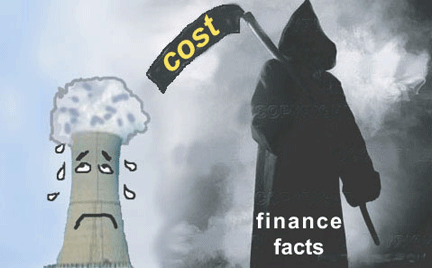
With electricity bills reaching record highs and 7 million people facing
energy poverty, it’s time to acknowledge the failure of a model. Twenty
years of brutal energy sector liberalization have failed to bring about
either lower prices or the investment promised by private operators in
exchange for regulated access to historical nuclear electricity (ARENH).
Created in 2011 to allow alternative suppliers to purchase EDF’s nuclear
production at a fixed and highly advantageous price, this mechanism was
supposed to generate sustainably competitive offers. On the contrary, it
has led to instability, private rent-seeking, industrial fragmentation, and
debt for EDF.
Le Monde 29th Oct 2025,
https://www.lemonde.fr/idees/article/2025/10/29/il-est-inacceptable-que-la-reforme-des-tarifs-d-edf-soit-adoptee-discretement-au-detriment-des-usagers_6650111_3232.html
Starmer,Macron, Merz…3 unwise leaders degrading their economies while destroying Ukraine.
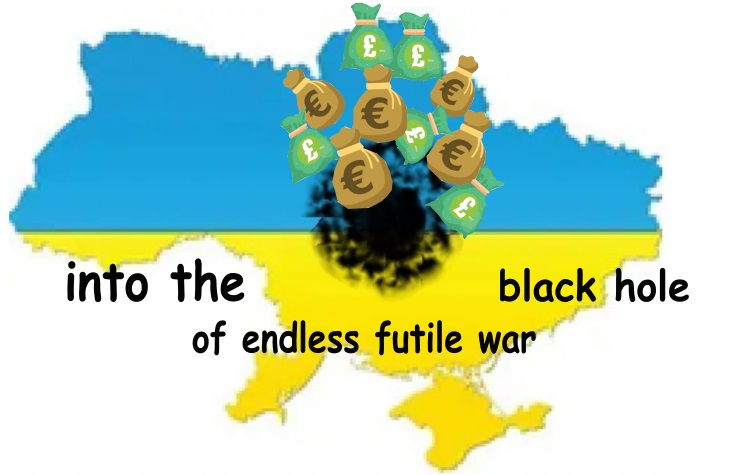
President Trump has largely ceased supplying weapons directly to Ukraine. But he’s cool about goosing US weapons builders’ profits by selling them to Europe’s Big 3 so they can take over squandering their treasure on an impossible, quixotic effort to defeat Russia.
Walt Zlotow, West Suburban Peace Coalition, Glen Ellyn IL ,1 Nov 25
The UK’s Keir Starmer, France’s Emmanuel Macron and Germany’s Friedrich Merz are wildly unpopular. Starmer has the best approval rating at 13% followed by Macron at 11%. Merz is nearly invisible at 5%.
There are several reasons but likely tops is their insistence on continuing the lost US/NATO proxy war against Russia destroying Ukraine for nearly 4 years.
President Trump has largely ceased supplying weapons directly to Ukraine. But he’s cool about goosing US weapons builders’ profits by selling them to Europe’s Big 3 so they can take over squandering their treasure on an impossible, quixotic effort to defeat Russia. Trump, a realist on the war Biden made inevitable, wants out, not only on funding the war, but on endlessly funding Europe’s paranoia about a reconstituted Soviet empire. This is one foreign policy Trump is getting right.
Starmer, Macron and Merz are degrading their economies as they reduce critically needed social spending on the commons to fund a wildly unpopular war. No wonder far right, nationalistic political movements are nipping at their heels and may soon send them packing.
Europe has a pittance of America’s wealth to fund continuation of the war. Yet, the Starmer, Macron, Merz trio endlessly bleat that Ukraine can prevail, even get back its massive lost territory now forever part of Russia, if only they provide Ukraine more, more, more. They fear monger that Russia will come for them next unless they’re defeated in Ukraine. No responsible historian, political scientist or retired diplomat (without a job to protect) would support that delusional view.
Two things are certain. The economies and political stability of the UK, France, and Germany are being severely undermined by their leaders’ refusal to negotiate the war’s end, acknowledging Russia’s valid security concerns. Second, Ukraine descends deeper into failed state status, losing more cannon fodder and territory, every day the war grinds on.
What is not certain if Starmer, Macron and Merz do not come to their senses, is whether nuclear confrontation between Russia and NATO can be avoided. All 3 need to be forced to watch ‘Forrest Gump’ to learn that ‘Stupid is as stupid does.
Japan’s seismic history and the Westinghouse deal.
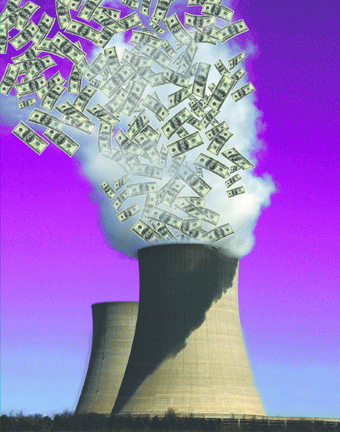
Letter to Ft.com : It almost feels impolite to point out some simple facts regarding your story “Westinghouse and US government strike $80bn nuclear reactor deal”. We are celebrating what Donald Trump hails as its “great friendship” between US and Japan, in addition to the election of our
first female prime minister, and an $80bn nuclear reactor deal — struck
by Washington and funded by Tokyo — all under the bright banner of what
appears to be a new era for our two countries.
Yet the simple fact remains,
whether we like it or not, that Japan is one of the most seismically active
countries in the world, which makes operating nuclear power plants far
riskier there than in the US.
The major nuclear players in both countries
— Westinghouse and Tokyo Electric Power (Tepco) — have faced bankruptcy or financial collapse. All publicly available, reliable data shows that solar power is significantly cheaper than new nuclear energy. Both our
countries’ leaders have issued similarly nationalistic statements on green
energy — President Trump even signed executive orders on “Unleashing
American Energy”, implicitly pointing to a common foe, namely China.
Warren Buffett once wrote that “more money has been stolen with the point
of a pen than at the point of a gun”. These nuclear power plant projects
will consume billions of dollars over the coming decades — long after
today’s leaders have left office. Future generations are being made the
“collateral” for decisions taken today.
FT 31st Oct 2025, https://www.ft.com/content/77769193-1cb0-4d8e-807a-e57936617de9
The Biggest Single Contributor to the UN Budget is also the Biggest Single Defaulter
By Thalif Deen, https://www.ipsnews.net/2025/10/the-biggest-single-contributor-to-the-un-budget-is-also-the-biggest-single-defaulter/?utm_source=email_marketing&utm_admin=146128&utm_medium=email&utm_campaign=The_Biggest_Single_Contributor_to_the_UN_Budget_is_also_the_Biggest_Single_Defaulter_As_Civil_Societ
UNITED NATIONS, Oct 31 2025 (IPS) – The United States, the largest single contributor to the UN budget, is using its financial clout to threaten the United Nations by cutting off funds and withdrawing from several UN agencies.
In an interview with Breitbart News U.S. Representative to the United Nations, Ambassador Mike Waltz said last week “a quarter of everything the UN does, the United States pays for”.
“Is there money being well spent? I’d say right now, no, because it’s being spent on all of these other woke projects, rather than what it was originally intended to do, what President Trump wants it to do, and what I want it to do, which is focus on peace.”
Historically, the United States has been the largest financial contributor, typically covering around 22% of the UN’s regular budget and up to 28% of the peacekeeping budget.
Still, ironically, the US is also the biggest defaulter. According to the UN’s Administrative and Budgetar Committee, member states currently owe $1.87 billion of the $3.5 billion in mandatory contributions for the current budget cycle.
And the US accounts for $1.5 billion of the outstanding balance.
Speaking to reporters in Kuala Lumpur last week, Secretary-General Antonio Guterres said: “We are not reforming the UN because of the liquidity crisis that is largely due to the reduction of payments from one main contributor, the United States”.
“What we are doing is recognizing that we can improve, that we can be more efficient, more cost-effective, more able to provide in full respect of our mandates to the people we care for in a more efficient way”.
“We are doing a number of reforms, making the Organization leaner but more effective. And that is the reason why there will be a number of reductions of positions in the Secretariat, but not the same everywhere.”
“And in particular, everything that relates to support to developing countries on the field in order for them to be able to overcome the present difficulties will not be reduced, on the contrary, will be increased,” he pointed out.
Mandeep S. Tiwana, Secretary General CIVICUS, a global civil society alliance, told IPS funding modalities for the UN need to be made simpler and also brought into the 21st century.
The present process, he pointed out, is too complicated and not easy to comprehend. Formulations for assessed and voluntary contributions are confusing and bureaucratic with some countries paying too much and others too little.
A simpler and fairer way would be assessed contributions be based on small percentage of a country’s Gross National Income. This would also allow formulations to be transparent and understandable by people around the world for whom the UN is exists,” declared Tiwana.
The five biggest funders of the UN, based on mandatory assessed contributions for the regular and peacekeeping budgets, are the United States, China, Japan, Germany, and the United Kingdom. These countries are responsible for a majority of the UN’s funding and are among the largest economies in the world.
United States: Pays the largest share, at around 22% for the regular budget and over 26% for peacekeeping.
China: The second-largest contributor, responsible for about 20% of the regular budget and nearly 19% of peacekeeping contributions.
Japan: Contributes approximately 7% to the regular budget and over 8% to peacekeeping.
Germany: Pays about 6% of the regular budget and 6% of the peacekeeping budget.
United Kingdom: Accounts for roughly 5% of both the regular and peacekeeping budgets.
Referring to the latest financial contribution, UN Deputy Spokesperson Farhan Haq told reporters October 30, “We thank our friends in Beijing for their full payment to the Regular Budget. China’s payment brings the number of fully paid-up Member States to 142,” (out of 193)
Asked how that money would help UN navigate through these difficult times, Haq said: “To be honest, any payments are helpful, but this is a very large payment– of more than $685 million– so it’s well appreciated.”
“And certainly, we thank the government in Beijing. But of course, we also stress that all governments need to pay their dues in full. You’ve seen the sort of financial pressures we’ve been under, and we do need full payments from all Member States,” he declared.
Kul Gautam, a former UN assistant secretary-general (ASG) and deputy director of UNICEF, pointed out that in 1985, Swedish Prime Minister Olof Palme proposed a simple remedy: no single country should pay—or be allowed to pay—more than 10% of the UN’s budget.
That, he said, would reduce dependence on any one donor while requiring modest increases from others. Ironically, Washington opposed it, fearing it might lose influence.
Asked for a clarification, he told IPS “it is my understanding that the assessed contributions to the UN regular budget are negotiated and approved by the UN General Assembly based on the recommendations of the GA’s Committee on Contributions, which determines a scale of assessments every three years based on a country’s “capacity to pay.”
The Committee on Contributions recommends assessment levels based on gross national income and other economic data, with a minimum assessment of 0.001% and a maximum assessment of 22%.
The scale of assessment of the UN regular budget does not need the approval of the Security Council, nor is it subject to veto by the P-5.
In the case of the UN’s peacekeeping budget, he said, the scale of assessment is based on a modification of the UN regular budget scale, with the P-5 countries assessed at a higher level than for the regular budget due to their role in authorizing and renewing peacekeeping missions.
Historically, the Security Council has authorized the UN General Assembly to create a separate assessed account for each peacekeeping operation. Thus, the Security Council definitely has a say in determining the peacekeeping budget.
In his interview with Breitbart News US Ambassador Mike Waltz also said: “And I would say to those who say, why don’t we just shut this thing down and walk away?”
“Well, I think we need it to be reformed in line with its potential that President Trump sees. And I think my answer would be: we need one place in the world where everybody can talk”.
President Trump is a president of peace, he said. He wants to keep us out of war. He wants to put diplomacy first. He wants to create deals.
“Well, there’s one place in the world, and that’s right here at the UN that the Chinese, the Russians, the Europeans, developing countries all over the world can come and do their best to hash things out,” declared.
In an October 17 statement, Guterres said: “My proposed programme budget for 2026 of 3.715 billion US dollars is slightly below the 2025 approved budget – excluding post re-costing and major construction projects in Nairobi and under the Strategic Heritage Plan.
This figure includes funding for 37 Special Political Missions – reflecting a net decrease due to the liquidation of the United Nations Assistance Mission for Iraq and the planned drawdown of the United Nations Transitional Assistance Mission in Somalia.
The proposed budget provides for 14,275 posts – and reflects our commitment to advance the three pillars of our work – peace and security, development, and human rights – in a balanced manner.
“We propose to continue supporting the Resident Coordinator System with a 53 million US dollars commitment authority for 2026 – identical to 2025.”
The 50 million US dollars grant for the Peacebuilding Fund is also maintained, he said..
IPS UN Bureau Report
Trump cuts Westinghouse reactors deal

one thing should be clear, significant financial risks are still there. Only four Westinghouse AP1000 units were ever financed in the US and remain a testament to nuclear power high risk, recurring and gross failure to financially control runaway cost-of-completion and time-to-completion estimates.
October 30, 2025, https://beyondnuclear.org/trump-cuts-westinghouse-reactors-deal/
On October 28, 2025, the Trump White House announced its commitment to stake at least $80 billion of US federal dollars to initiate yet another very risky run at new construction of Westinghouse Electric Company’s AP1000 nuclear stations. This is the follow-up to his May 23, 2025 executive orders to “unleash” more atomic power in the nation. Only this time, the Trump deal entitles the federal government, the designated buyer of the new reactors, to a 20% equity stake thereafter in Westinghouse’s returns in excess of $17.5 billion. Trump’s financing deal was cut with Westinghouse’s newest parent companies Brookfield Asset Management and Cameco, after the March 29, 2021 Westinghouse bankruptcy as of “the largest historic builder of nuclear power plants in the world.” At the time of the bankruptcy, Westinghouse was a wholly owned subsidiary of Japan’s Toshiba Corporation. Toshiba itself only narrowly escaped the financial meltdown.
On his latest visit to Asia, President Trump signed a nuclear deal with Japan newest, most hawkish and first woman Prime Minister, Saneae Takaichi, also announced on October 28th with an agreement to invest hundreds of billions of dollars in US critical infrastructure including in Trump’s pledge to domestically build new Westinghouse AP1000 reactor units and small modular reactors in the United States conditional on the involvement of Japanese contractors.
The Trump deal doesn’t specify just how much US taxpayer money will be spent on the new Westinghouse units Trump wants to build.
But one thing should be clear, significant financial risks are still there. Only four Westinghouse AP1000 units were ever financed in the US and remain a testament to nuclear power high risk, recurring and gross failure to financially control runaway cost-of-completion and time-to-completion estimates. Those new AP-1000 project orders were the only four units that managed to muster financing in South Carolina (V.C. Summer Units 2 & 3) and Georgia (Vogtle Units 3 & 4) of 34 US units announced in the 2007 launch with much ballyhoo of a so-called “nuclear renaissance.” The two projects’ financing was only made possible by the two state regulators indenturing their electricity ratepayers to Construction Work In Progress (CWIP) charges through their respective Public Utility Commissions levying a series of customer rate hikes in advance of electricity usage to guarantee construction financing. Otherwise, without public ratepayer on the hook for the advanced financing, a total of 30 other proposed new “advanced” reactor units (including 8 additional AP1000 units) were cancelled and withdrawn nationwide without a shovel in the ground.
South Carolina’s V.C. Summer AP1000 construction project was abandoned in 2017 with $10 billion in sunk costs and shrouded in FBI arrests, federal criminal convictions and guilty pleas by two high ranking SCANA utility executives, CEO Kevin Marsh, and Vice President Stephen Byrne, pleaded guilty to defraud South Carolina state regulators and its ratepayers after being charged with the crime by the U.S. Attorney’s office. Additionally, two Westinghouse Electric executives, Carl Churchman, a Vice President, pled guilty to making related false statements to the FBI investigators and sentenced to serve house detention and Jeffrey A. Benjamin, Senior Vice President for new plants and major products, who plead guilty to conspiracy to commit wire and securities fraud and serving one year and a day in federal prison.
Georgia’s Vogtle AP1000 two-unit project was eventually completed seven years behind the schedule to start operations in 2023 and 2024 with their original estimated combined cost of construction ballooning from $14 billion to an estimated $36.8 billion. Due to the expansion, massive rate hikes and prolonged delay, the Vogtle nuclear power station is now the largest and most expensive generator of electricity by atomic power in the United States.
In other related news, on Friday, October 24, 2025, South Carolina’s Santee Cooper Board of Directors unanimously voted to authorized the state-owned utility to sign a letter of intent to ask Brookfield Assets Management, previously mentioned as one of Westinghouse’s parent companies, to sign a Memorandum of Understanding (MOU) to take over the completion of the previously abandoned and only partially built nuclear reactors.
Santee Cooper’s CEO Jimmy Stanton was quoted by The State news service to pledge that, “There are no additional financial risks for our customers at all”. The Letter of Intent is meant to be the first step in a new permitting for the completion of construction project and then obtaining a federal license for full power operations. The original Nuclear Regulatory Commission (NRC) combined construction and operating license that Santee Cooper and SCE&G held is no longer valid following their 2017 abandonment of construction. The new licensee, assuming that to be Brookfield Assets or its qualified proxy, will need to go back to the US NRC and the state to reacquire the necessary permits to restart what is now called “the greatest construction failure in state history.” Santee Cooper has said it does not plan to hold the federal construction permit. Customers of Dominion Energy, the VC Summer Unit 1 new operator, are already on the hook to pay roughly 5% of their monthly bills for the original expansion project.
Furloughing Workers for Armageddon: Trump, Nuclear Weapons and the NNSA
To maintain and reproduce an arsenal of mass death and thanatotic desire, you need people of suspended moral principles. “Oversight matters,” Plonski remarks. “Reducing the federal workforce means increased risk in ensuring the reliability and safety of our nuclear stockpile.”
30 October 2025 Dr Binoy Kampmark, https://theaimn.net/furloughing-workers-for-armageddon-trump-nuclear-weapons-and-the-nnsa/
Instead of satirising nuclear war – a possible if difficult thing to do – the time has come to satirise the laying off and furlough of those who solemnly monitor and maintain such machinery fit, not for preserving life so much as ending it at a fiery, radiated terminus. If it’s not possible to totally disarm a nuclear inventory, it might be possible to reduce the forces behind them or render some idle. It turns out that this is happening in Freedom’s Land itself, the United States of America.
Those responsible for maintaining the US nuclear weapons arsenal have not been having the best of years. In February, President Donald Trump signed an executive order directing the heads of agencies to “promptly undertake preparations to initiate large-scale reductions in force, consistent with applicable law.” This was part of the now infamous Department of Government Efficiency Workforce Optimization Initiative. Within a few days, 300 employees at the National Nuclear Security Administration (NNSA), located within the Department of Energy, were fired. Prior to that, it had 2,000 staff and 55,000 contractors at its disposal.
The NNSA describes, as one of its “core missions” ensuring that the US “maintains a safe, secure, and reliable nuclear stockpile through the application of unparalleled science, technology, engineering, and manufacturing.” Easy to forget, on reading this, that we are not talking about agricultural supplies or lifesaving medicines, but over 3,000 nuclear warheads and ongoing production specific to that agency. “The Office of Defense programs,” the description goes on to say, “carries out NNSA’s mission to maintain and modernize the nuclear stockpile through the Stockpile Stewardship and Management System.”
NNSA deputy division director, Rob Plonski, was understandably upset that his citadel was being thinned. Ego, reputation and prowess in the nuclear field was at stake. “We cannot expect to project strength, deterrence and world dominance while simultaneously stripping away the federal workforce,” he moaned in a post on LinkedIn. He would have taken heart by the subsequent rescinding of the termination decision for all but 28 of the staff by NNSA acting director Teresa Robbins.
Trump, on the other hand, was having one of his more lucid moments, telling reporters on February 13 that nuclear forces should not be exempt from budgetary trimming. “There’s no reason for us to be building brand-new nuclear weapons. We already have so many, you could destroy the world 50 times over, 100 times over.” Daryl Kimball, executive director of the Arms Control Association, was having none of that. DOGE employees, he charged, were storming “in with absolutely no knowledge of what these departments are responsible for.” They barely realised that the purge was less to do with the Department of Energy than “the department of nuclear weapons.”
In October, the NNSA was again revisited by crisis, with the decision to furlough 1,400 employees due to that event distinct to US politics, the government shutdown. Till that point, the shutdown had lasted almost three weeks, with the Senate failing to pass a continuing resolution bill since October 1. Only 400 essential employees are being retained, labouring in patriotic sweat without pay. A spokesperson for the DOE explained that they would be working “to support the protection of property and safety of human life.”
Since its creation in 2000, the agency has had few such hiccups. “This has never happened before,” noted Energy Secretary Chris Wright during a news conference at the Nevada National Security Site on October 20. “This should not happen.” Wright, however, spoke of pursuing “creative ways” in paying the vast number of contractors, at least till the end of October.
Particular concern centres on the Pantex plant in Texas, the assembly and disassembling site for nuclear weapons, and the Y-12 National Security Complex in Tennessee, responsible for, according to the DOE, the retrieval and storage of nuclear materials, fuelling of naval reactors, and the performance of “complementary work for other government and private-sector entities.”
The NNSA had tried to argue that money be made available from previously passed spending bills to prevent the furlough. A DOE spokesperson proved icy in remarking that, “While the administration was able to identify funds to keep NNSA weapons laboratories, plants, and sites operating with our contractors, legal and budgetary limitations required the administration to begin furloughing NNSA federal employees.”
Therein lies the problem. To maintain and reproduce an arsenal of mass death and thanatotic desire, you need people of suspended moral principles. “Oversight matters,” Plonski remarks. “Reducing the federal workforce means increased risk in ensuring the reliability and safety of our nuclear stockpile.” With the support of 26 lawmakers, Rep. Dina Titus (D-Nev.) in her October 23 letter to Wright and NNSA administrator Brandon Williams similarly argued that the federal employees in question “play a critical oversight role in ensuring that the work required to maintain nuclear security is carried out in accordance with long-standing policy and the law.” Trump has also been fuzzy on the matter of nuclear weapons, acknowledging the nonsense of increasing the pile, yet simultaneously wanting tighter deadlines to deliver ever more modern weapons to the Pentagon.
This fantastically confused state of affairs throws up an interesting question: Why not turn the attention to reducing the stockpile itself and pause the euphemistically named modernisation process? A slimmer, sharper workforce for a more diminished, manageable arsenal of death that should never be used in any case. The National Security State remains, however, a tough, insatiable customer.
Golden Dome funding lags as industry partners line up

By John T. Seward – The Washington Times – Tuesday, October 28, 2025
The head of President Trump’s Golden Dome missile defense program gave a classified briefing to the Senate Armed Services Committee last week that described the secretive architecture of the project, The Washington Times has learned.
U.S. Space Force Gen. Michael A. Guetlein, who was tapped earlier this year by Mr. Trump to lead the design of Golden Dome, told committee members about key target dates for the project’s delivery.
Gen. Guetlein also outlined how the project will integrate missile detection capabilities and early warning systems, said two sources familiar with the briefing who spoke on the condition of anonymity to discuss aspects of the classified meeting.
Sen. Dan Sullivan, Alaska Republican and a member of the Armed Services Committee, confirmed the meeting to The Times but declined to comment on specifics because of the classified nature of the planned Golden Dome architecture.
Mr. Sullivan, who is routinely involved with the military’s missile defense programs because of his state’s strategic geographic location, said he was impressed with Gen. Guetlein’s presentation.
“He just has a really good sense of how he wants to layer it and put it together,” the senator said. “He’s got a plan, you know, it’s got like 30-day, 60-day, 120-day, and I thought it was good.”
Speculation about the specific architecture of the Golden Dome is rampant among defense industry insiders. So is unease over the status of some $24.5 billion in funding that Congress approved this year for the missile shield’s development.
Multiple sources have told The Times that none of the money has been allocated for contracts and that White House Office of Management and Budget is holding the funds.
Some defense strategy analysts say Congress’ approval of the money was unprecedented.
The initial $24.5 billion was included in the passage of H.R. 1, the One Big Beautiful Bill Act, in July. At the time, Mr. Trump touted the money as an initial down payment for the Golden Dome.
“Congress pre-appropriated $24.5 billion without a program plan, scheduled requirements — nothing,” said Todd Harrison, a senior fellow at the American Enterprise Institute.
“Never have we seen that much money appropriated in advance of a program actually starting,” Mr. Harrison said during a virtual panel discussion last week.
The discussion, hosted by the Center for New American Security, was titled: “Stuck in the Cul-de-Sac: How U.S. Defense Spending Prioritizes Innovation over Deterrence.”
Mr. Harrison said the Pentagon and the Trump administration have not publicly defined Golden Dome’s capability goals.
Analysts estimate the missile shield will be a multidecade program costing hundreds of billions of dollars for space-based and other futuristic missile defense capabilities that will continue to evolve technically over time.
Under the One Big Beautiful Bill Act, initial funding was made available for the next four years, with spending flexibility baked into the law that could make congressional oversight difficult.
There is consensus among many in the national security community that Golden Dome is urgently needed amid rising nuclear and ballistic missile threats from U.S. adversaries, most notably Russia, China, North Korea and Iran.
Mr. Harrison said the potential exists for the systems involved in the project to be focused on every threat, from small drones fulfilling a counter small uncrewed systems (C-sUAS) role to protecting against things “like a strategic nuclear strike from Russia or China, or both of them simultaneously, or a rogue missile from North Korea.”
Such concerns didn’t stop the initial funding for Golden Dome from being approved by law, a situation that has drawn criticism from some Democrats on the Senate Armed Services Committee.
The committee’s ranking Democrat, Sen. Jack Reed of Rhode Island, has called the $24.5 billion for Golden Dome a “slush fund” and said the Trump administration may try to use the funds however it sees fit.
“We’re still waiting for really detailed plans,” Mr. Reed said. “It’s such a comprehensive program, but there’s nothing there yet. What is the priority?”………………………………… https://www.washingtontimes.com/news/2025/oct/28/golden-dome-funding-lags-industry-partners-line/
Bechtel boss urges US government to share risk of nuclear build-out

The construction group that rescued the last big US nuclear energy project
from bankruptcy has called on Washington to share the risk of cost overruns to deliver Donald Trump’s “American nuclear renaissance”.
Bechtel president Craig Albert told the Financial Times industry could deliver on the president’s executive orders to start work on developing 10
large-scale nuclear reactors by 2030. But government and the private sector would need to work together to overcome financing hurdles linked to risks of cost overruns and delays.
“The advice we’ve been giving the government is . .there is overrun risk, and no one company can take it all because they’d be betting their company,” he said in an interview.
“The government has provided very good tax incentives that improve the
rate of return, but that doesn’t address overrun risk, that just improves
the rate of return. So, I do think the government will have a role to
play.”
FT 28th Oct 2025. https://www.ft.com/content/74d1f5f0-a255-4e63-8ffa-86a9cdf663df
The Next Nuclear Renaissance?

Will a new wave of nuclear power projects deliver the safe and economical electricity that proponents have long predicted?
CATO Institute, Fall 2025, By Steve Thomas
Over the past decade, there has been a growing interest in building new nuclear power stations, particularly among policymakers. This comes some two decades after a previously forecast “nuclear renaissance” petered out, having produced few orders, all of which went badly wrong.
This article reviews the previous renaissance: What was promised, what was delivered, and why it failed. It then considers the current claims of a new renaissance led by Small Modular Reactors, forthcoming “Generation IV” designs, new large reactors, and extending the lifetime of existing nuclear plants. Despite the need for clean generation, the growing demand for electricity to power new technologies and global development, and claims of nuclear generation breakthroughs that are either here or soon will be, this new renaissance appears destined for the same failure as the previous ones.
The Last Renaissance
Around the start of this century, there was a great deal of publicity about a new generation of reactors: so-called Generation III+ designs. These would evolve from the existing dominant “Gen III” designs—Pressurized Water Reactors (PWRs) and Boiling Water Reactors (BWRs), collectively known as Light Water Reactors (LWRs)—rather than be radical new designs. There was no clear definition of the characteristics that would qualify a design as Gen III+ rather than just Gen III LWRs. However, Gen III+ was said to incorporate safety advances that would mitigate the risks of incidents like the 1979 partial meltdown at Three Mile Island (a Gen II design) and the 1986 Chernobyl meltdown (a Soviet design that used Gen I/II technology). Three Gen III+ designs received the most publicity: the Westinghouse AP1000 (Advanced Passive), the Areva EPR (European Pressurized Water Reactor), and the General Electric ESBWR (Economic Simplified Boiling Water Reactor).
The narrative was that Gen III designs had become too complex and difficult to build because designers were retrofitting safety features to avoid another Three Mile Island. Gen III+ supposedly went back to the drawing board, rationalizing existing systems and incorporating new safety features, thereby supposedly yielding a cheaper and easier-to-build design. A particular feature of these designs was the use of “passive safety” systems. In an accident situation, these did not require an engineered safety system to be activated by human operators and were not dependent on external sources of power; instead, the reactor would avoid a serious accident by employing natural processes such as convection cooling. These had an intuitive appeal, and a common assumption was that because they were not mechanical systems, they would be cheaper, and because they involved natural processes, they would never fail. Neither assumption is correct.
Another major safety feature resulting from the Chernobyl disaster was a system that, if the core was melting down, prevented the molten core from burning into the surrounding ground and contaminating it. A common approach was a “core-catcher” (already used in a few early reactors) that would be placed underneath the reactor. An alternative, often used for smaller reactors, was a system to flood the core with so much water that it would halt the meltdown.
After the September 11, 2001, terrorist attacks, designers attempted to further increase safety by strengthening the reactor shell so it could withstand an aircraft or missile impact. The core-melt and aircraft protection features inevitably tended to increase the size and complexity of the Gen III+ designs.
Nuclear advocates also claimed that the large cost and time overruns of previous plants were caused in part by the high proportion of work carried out on site. To combat this and the additional complexity noted above, designers vowed to rely more on factory-made modules that could be delivered by truck, reducing sitework mostly to “bolting together” the pieces. In practice, there was significant variability between the Gen III+ designs, with the AP1000 and ESBWR relying much more on passive safety and modular construction than the EPR.
What sold these designs to policymakers were some extraordinary claims about construction costs and times. It was claimed that their cost (excluding finance charges; so-called “overnight cost”) would be around $1,500–$2,000 per kilowatt (kW), meaning a large, 1,000-megawatt (MW) reactor would cost $1.5–$2 billion. Construction time would be no more than 48 months. While there were few existing nuclear projects then to compare the new designs with, these projected costs and times were far below the levels then being achieved with existing designs.
These claims convinced the US government, under President George W. Bush, and the UK government, under Prime Minister Tony Blair, to launch large reactor construction programs. As those countries were two of the pioneering users of nuclear power, this appeared to be a strategically important victory for the nuclear industry.
US / In 2002, President Bush announced his Nuclear 2010 program, so-called because it was expected the first reactor under the program would come online in 2010. It was assumed the new nuclear designs would be competitive with other forms of generation,………………………………………..
In states with regulated electricity markets, utilities were concerned that regulators might not allow them to recover their costs from consumers if there were time and cost overruns. Most of the other projects were abandoned on these grounds, leaving only two to enter the construction stage: a two-reactor project to join an existing reactor at the V.C. Summer plant in South Carolina, and a two-reactor project to join two existing reactors at the A.W. Vogtle project in Georgia. All four new reactors would be Westinghouse AP1000s.
In those two states, regulators gave clear signals that the utilities would be allowed to recover all their costs. The state governments broke with regulatory practice by passing legislation allowing the utilities to raise rates and start recovering their costs from the date of the investment decision, not the date when the reactors entered service…………………………………………….
Consumers started paying for the reactors in 2009–2010, even though construction didn’t start until 2013. By 2015, both projects were in bad shape, way over time and budget. Westinghouse, then owned by Toshiba of Japan, was required to offer fixed-price terms to complete the projects. Those prices soon proved far too low, and in March 2017 Westinghouse filed for Chapter 11 bankruptcy protection. The whole of Toshiba was reportedly at risk as a result. In August 2017, the V.C. Summer project was abandoned. The A.W. Vogtle project continued, and the first reactor was completed in July 2023 with the second unit following in April 2024, six or seven years behind schedule and at more than double the forecasted cost. There are now no proposals for additional large reactor projects in the United States.
UK / In 2003, a UK Energy White Paper (DTI 2003) concluded there was no case for nuclear power because renewables and energy efficiency measures were cheaper. According to the report, “the current economics of nuclear power make it an unattractive option for new generating capacity and there are also important issues for nuclear waste to be resolved.” Only three years later and despite the lack of evidence that nuclear had become cheaper or that renewables and energy efficiency had become more expensive, Blair reversed the government’s position, claiming nuclear power was “back on the agenda with a vengeance.”
As with the US program, the assumption was that the new designs would be competitive. A key promise that made the program politically acceptable was there would be no public subsidies. Politicians—even those who were favorable to nuclear—were aware that previous UK nuclear projects had gone badly and the costs of this had fallen on taxpayers and electricity consumers. The energy minister told a Parliamentary Select Committee:
There will be no subsidies, direct or indirect. We are not in the business of subsidizing nuclear energy. No cheques will be written; there will be no sweetheart deals.
This promise of no subsidies remained government policy until 2015, despite it being clear long before then that new nuclear projects were only going forward in anticipation of large public subsidies……………………………………………………………
Three consortia were created, each led by some of the largest European utilities………………………………………………….. As early as 2007, the consortium led by EDF established a leading presence, with the CEO of EDF Energy, Vincent de Rivaz, notoriously claiming that Christmas turkeys in the UK would be cooked using power from the Hinkley Point C EPR in 2017. In 2010, the UK energy secretary still claimed Hinkley would begin generating no later than 2018.
The Final Investment Decision (FID) for Hinkley was not taken until October 2016, when it was expected the two reactors would be completed by October 2025 at an overnight cost of £18 billion (in 2015 pounds sterling, equivalent to $35 billion in today’s dollars). ……………………………………………..In January 2024, EDF issued a new cost and time update—its fifth—with completion now expected to be as late as 2032 at a cost of £35 billion (in 2015 pounds sterling, equivalent to $68.7 billion in today’s dollars). As a result, EDF wrote off €12.9 billion ($14 billion) of its investment in Hinkley Point C in 2023. By 2018, EDF recognized the error it made in accepting the risk of fixing the power price, and it abandoned plans for an EPR station at Sizewell using the Hinkley C financial model. In July 2025, an FID was taken on the Sizewell C project using a different financial model and completion is not expected before 2040.
The effect of the 2011 Fukushima, Japan, nuclear plant disaster, where a tsunami resulted in meltdowns in three reactors, combined with the effect of competition in wholesale and retail markets in electricity meant that European utilities could not justify to their shareholders the building of new reactors. The Horizon and Nugen consortia were sold to reactor vendors Westinghouse and Hitachi–GE, respectively. Those firms did not have the financial strength to take significant ownership stakes in the reactors, but they saw this as an opportunity to sell their reactors on the assumption that investors could later be found. Westinghouse (then planning three AP1000s for the Moorside site) filed for Chapter 11 bankruptcy protection in 2017. Hitachi–GE abandoned its two projects (four ABWRs, two each at Wylfa and Oldbury) in 2019 when it became clear that, despite the UK government offering to take a 30 percent stake in the reactors and to provide all the finance, other investors were not forthcoming.
Lessons learned / Thus ended the last nuclear renaissance. Its failure does not determine the outcome of the present attempt, but there are some important lessons that will shape the outcome this time:
- While governments have always had to play a facilitating role in nuclear power projects, such as providing facilities to deal with the radioactive waste, they were centrally involved in the 2000 renaissance. This trend has continued, and governments are now offering to provide finance, take ownership stakes, offer publicly funded subsidies, and impose power purchase agreements that will insulate the reactors from competitive wholesale electricity markets.
- Forecasts of construction costs and times made by the nuclear industry must be treated with extreme skepticism. The claim that the new designs would be so cheap they would be able to compete with the cheapest generation option then available—natural gas generation—proved so wide of the mark that other claimed characteristics, such as supplying base-load power and offering low-carbon generation, are now given as the prime justifications for the substantial extra cost of nuclear power over its alternatives.
- The technical characteristics claimed to give advantages to the Gen III+ designs (such as factory-manufactured modules and passive safety) have not been effective in controlling construction times and costs.
- The large reactor designs now on offer are the same ones that were offered previously. No fundamentally new designs have started development this century. It is hard to see why these designs that have failed by large margins to meet expectations will now be so much less problematic……………………………………………… https://www.cato.org/regulation/fall-2025/next-nuclear-renaissance#small-modular-reactors
America’s $80bn nuclear reactor fleet exposes Sizewell C costs.

The plants are expected to be bankrolled by Japanese investors as part of the $550bn investment pledged by Tokyo under the new US-Japan trade deal.
The United States has announced an $80 billion plan to build a fleet of nuclear power plants for less than two thirds of the cost per gigawatt of
Britain’s Sizewell C project. About eight of Westinghouse’s one
gigawatt AP1000 reactors are to be built across America, under a
partnership between the US government and the reactor-maker’s owners,
Brookfield and Cameco, to accelerate nuclear power deployment. The plants are expected to be bankrolled by Japanese investors as part of the $550 billion investment pledged by Tokyo under the new US-Japan trade deal.
The cost of about $10 billion (£7.5 billion) per gigawatt of new capacity is
significantly cheaper than the UK government’s recently approved plans
for the Sizewell C plant in Suffolk. Sizewell is due to generate 3.2
gigawatts of electricity — enough to power six million homes — at a
cost of £38 billion, or £11.9 billion per gigawatt. The contrast will do
nothing to alleviate concerns about the high costs of Britain’s nuclear
programme, although the US plans are still at a much earlier stage.
Critics have blamed factors including the UK’s choice of EDF’s “EPR”
reactor and safety red tape for inflating nuclear construction costs in
Britain. The costs of the 3.2GW Hinkley Point plant in Somerset, already
under construction, are estimated to have risen to as much as £48 billion.
Times 28th Oct 2025,
https://www.thetimes.com/business-money/companies/article/americas-80bn-nuclear-reactor-fleet-exposes-sizewell-c-costs-qxcqfdv5z
South Carolina’s state utility says private firm set to restart abandoned $9 billion nuclear project.
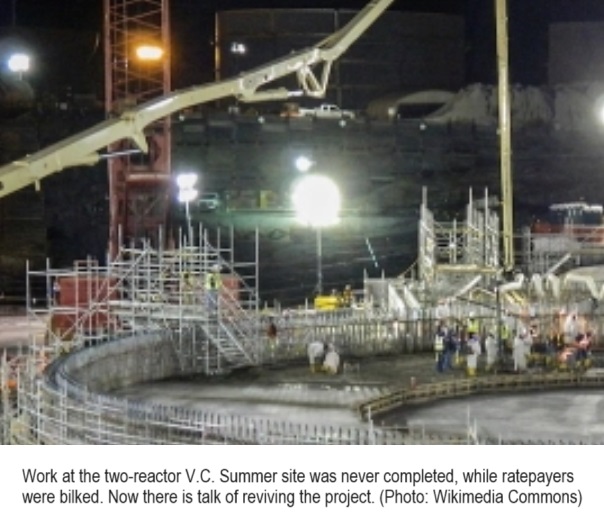
After eight years in the elements, all the equipment and the structure of the plant, which was less than halfway finished, will need to be carefully inspected before it can be used. The permits to build and the licenses to operate the nuclear plants will need to be renewed, likely starting from scratch.
The permits to build and the licenses to operate the nuclear plants will need to be renewed, likely starting from scratch,
the agreement appears to let Brookfield walk away if it decide it’s not feasible.
By ASSOCIATED PRESS, 25 October 2025, https://www.dailymail.co.uk/wires/ap/article-15225007/South-Carolinas-state-utility-says-private-firm-set-restart-abandoned-9-billion-nuclear-project.html
COLUMBIA, S.C. (AP) – South Carolina’s state-owned utility is looking to a private company to revive a project to build two nuclear power plants that was abandoned eight years ago, losing more than $9 billion without generating a watt of power.
Santee Cooper’s board agreed Friday to start six weeks of negotiations with Brookfield Asset Management that they hope will lead to a deal that lets the private company build the nuclear plants at the V.C. Summer site near Jenkinsville at their own risk to generate power that they could mostly sell to whom they want, such as energy-gobbling data centers.
Santee Cooper said Brookfield preliminarily agreed to provide the utility with some of the power generated. But that and probably thousands of other details will have to be negotiated. In a twist, Brookfield took over the assets of Westinghouse Electric Co., which had to declare bankruptcy because of difficulties building new nuclear reactors.
Utility officials said the agreement gives hope the state can get something out of a debacle that led to four executives going to prison or home confinement for lying to regulators, shareholders, ratepayers and investigators and left millions of people paying for decades for a project that never produced electricity.
“The risk to the ratepayer is nil. The risk to the taxpayer is nil,” Santee Cooper Board Chairman Peter McCoy said.
There are still too many hurdles for the project to get past to consider this a win right now, said Tom Clements, executive director of the nuclear watchdog group Savannah River Site Watch.
After eight years in the elements, all the equipment and the structure of the plant, which was less than halfway finished, will need to be carefully inspected before it can be used. The permits to build and the licenses to operate the nuclear plants will need to be renewed, likely starting from scratch, Clements said.
“I still believe that the cost, technical and regulatory hurdles are too big to lead to completion of the project,” Clements said, adding the agreement appears to let Brookfield walk away if it decide it’s not feasible.
Santee Cooper heard from 70 bidders and received 15 formal proposals to restart construction of the reactors. Interest in the project has grown as power demand in the U.S. surges with the increase in data centers as artificial intelligence technology develops.
Santee Cooper executives credited President Donald Trump’s executive order in May calling for the U.S. to quadruple the amount of power generated by nuclear plants over the next 25 years for opening the door to the potential agreement.
“You have placed South Carolina in the epicenter of the resurgence of nuclear power in the United States,” Santee Cooper CEO Jimmy Staton said.
Santee Cooper was the minority partner with what was then South Carolina Electric and Gas when construction on the two new nuclear plants started in 2013 at the V.C. Summer site – about 25 miles (40 kilometers) northeast of Columbia – where SCE&G was already operating a reactor.
The project needed to be finished in seven years to get tax credits to keep the project’s cost from overwhelming the utilities, but it ended up behind schedule almost immediately.
Executives lied about the problems to keep money coming in. Taxpayers and ratepayers ended up on the hook because of a state law that allowed the utilities to charge for costs before any power was generated.
Two nuclear reactors built in a similar way in Georgia went $17 billion over budget before they were fully operational in 2023.
Buzz around nuclear shows the hole that [?]green shipping is in.

COMMENT. Note the headline – they’re still pretending that nuclear is “green”
Nuclear shipping is great in theory, but not a serious plan for decarbonisationSMRs are not the done deal their cheerleaders make them out to be
They have advantages over hydrogen, as long as money is no object
On paper, new nuclear for shipping offers great promise. But the fact it is being taken seriously shows how forlorn efforts to replace diesel have become in 2025
Lloyd’s List 24th Oct 2025, https://www.lloydslist.com/LL1155212/Buzz-around-nuclear-shows-the-hole-that-green-shipping-is-in
ED MILIBAND’S NUCLEAR NIGHTMARES
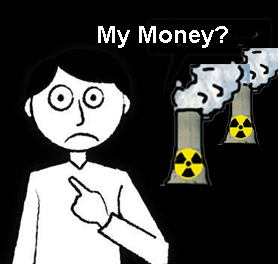
Jonathon Porritt, 22 Oct 25, https://jonathonporritt.com/uk-nuclear-subsidies-desnz-spending/
Meanwhile, in a parallel universe, the legions of nuclear fat cats residing here in the UK are smiling very broadly indeed. It would appear that both Rachel Reeves and Ed Miliband have nothing better to do with our money, as taxpayers, than to go on filling up their subsidy saucers more or less on demand.
Taxpayers really don’t know very much about how DESNZ spends our money. More problematically, not a lot of the UK’s more or less mis-informed energy correspondents are particularly interested in helping taxpayers to understand what’s really going on – for the most part because they’re ‘ideologically captured’, with very little interest in the truth.
A bit harsh? Well, why is it, for instance, that not one of them provides any serious analysis of DESNZ’s annual expenditure? Not least as the details of this (on p.18 of its 2024-2025 Annual Report & Accounts) are completely mind-blowing. To summarise:
DESNZ TOTAL DEPARTMENTAL SPEND
Total departmental spend: £8.6 billion
Total spend on nuclear power: £5.1 billion (60%)
Total spend on everything else: £3.5 billion (40%)
See what I mean? Literally mind-blowing! A few more details on the nuclear side of things:
*Great British Nuclear: £26 million (the more or less useless quango overseeing this fiasco).
*Nuclear Decommissioning Agency : £3 billion (dealing with the legacy of past nuclear programmes).
*Support for Sizewell C power station: £1.67 billion.
*UK Atomic Energy Agency (UKAEA): £400 million (doing bonkers stuff like nuclear fusion).
That’s the size of the nuclear sink hole: roughly £5.1 billion! Leaving roughly £3.5 billion for everything else, including all direct support for renewables, ‘delivering affordable energy’, science, research and ‘capability’, as well as other arm’s length bodies. Moreover, even that low figure is not quite what it seems: roughly £450 million is set aside for another of Ed Miliband’s sink holes, namely Carbon Capture and Storage.
Do you need any more persuading that this is obviously a completely mis-titled Department: instead of DESNZ, it really should be called DNPB&B – the Department of Nuclear Power and Bits & Bobs.
Where the hell are you, Rachel Reeves? For those sick of your hangdog ‘black hole blathering‘, it would be wonderful to think you might instruct just a few of your civil servants to instruct the ever-well-meaning Ed Miliband to undertake an exercise in zero budgeting for FY 25/26. Great British Nuclear could go at a stroke of a pen – no one would notice. The UKAEA’s budget could be halved, leaving it to focus on decommissioning redundant reactors and dealing with nuclear waste. Subsidies for Sizewell C could be massively reduced – although the Department did such a poor deal with various private sector investors that there will be significant compensation to be paid.
Sadly, of course, there is nothing that can be done about the £3 billion set aside, EVERY YEAR, for dealing with the legacy of earlier nuclear programmes – decommissioning, site security, managing nuclear waste and so on. Nuclear campaigners have struggled for years to explain that our ‘nuclear legacy’ is in fact our ‘current nuclear reality’, and that this is a figure which can only grow and grow over the years. The Public Accounts Committee looked recently at the cost of decommissioning many of the facilities at Sellafield, currently assessed at £396 million through to 2070, and couldn’t have made their incredulity any clearer. On top of that, we have the looming additional cost of building a long-term Geological Disposal Facility, for which taxpayers will be paying hundreds of billions of pounds through to the end of this century.
Ask the Treasury or officials at DNPN&B what they believe that total legacy figure will be in FY2030/2031,or FY2040/2041, and you can be absolutely guaranteed to get literally no answer at all.
And yet – AND YET – we go on pouring yet more billions into NEW waste-generating nuclear monstrosities like Hinkley C and now Sizewell C.
It’s nearly 50 years since the highly influential Flowers Report was published in 1976. Its single most important recommendation was as follows:
“There should be no commitment to a large programme of nuclear fission power until it has been demonstrated beyond reasonable doubt that a method exists to ensure the safe containment of long-lived, highly radioactive waste for the indefinite future.”
We are, truly, led by nuclear donkeys.
Meanwhile, back in the real world, all this never-ending filling-up of the industry’s subsidy saucers has massive opportunity costs for what we should really be doing with precious taxpayers’ money.
As in:
- getting as enthusiastically as possible behind the potential for tidal power (see yesterday’s blog).
- getting as enthusiastically as possible behind retrofitting and the green economy (see tomorrow’s blog).
I’ll return to the whole question of just how many billions Rachel Reeves could divert from these nuclear sink holes as we get a little closer to the budget in November.
Managing our ‘Energy Legacy’: £85 million (roughly half the total figure).
Nuclear construction workers plan third strike.
Construction workers employed by contractors at a nuclear site are to go
on strike for a third time in two months in a dispute over pay. Unite
members at Sellafield in Cumbria will take action from Monday until 2
November after previously striking earlier in October and for four days in
September.
The union said it was because construction workers at other
nuclear projects received pay premiums that contractors at Sellafield did
not match. Sellafield Ltd said it did not directly employ those taking part
in the action but “safety and security” would continue to be its priority
throughout the strike.
BBC 24th Oct 2025,
https://www.bbc.co.uk/news/articles/cwy16l08eldo
Inside Oklo: the $20bn nuclear start-up without any revenue.

Nuclear technology company Oklo has no revenues, no licence to operate
reactors and no binding contracts to supply power.
But this has not stopped
the Silicon Valley-based start-up from riding a wave of investor enthusiasm
that has propelled its stock market valuation above $20bn, a rise of more
than 500 per cent since the turn of the year.
The company, backed by
technology boss Sam Altman and with close ties to Donald Trump’s energy
secretary, has set ambitious targets to deliver commercial power to its
first customers in 2027, having broken ground on its pilot in Idaho last
month. Oklo, led by the husband-and-wife team Jacob and Caroline DeWitte, envisages a future powered by a new generation of small modular reactors that use liquid sodium rather than water as a coolant.
FT 22nd Oct 2025, https://www.ft.com/content/cdf09f0e-d673-41f4-8faa-fe795a2b872e
1 This Month

of the week – Shut Down Drone Warfare!


Tell the Ukrainian Government to Drop Prosecution of Peace Activist Yurii Sheliazhenko

Petition to revoke the licensing of the Near Surface Nuclear Disposal Facility (NSDF) at Chalk River. https://www.ourcommons.ca/petitions/en/Petition/Details?Petition=e-7247
To see nuclear-related stories in greater depth and intensity – go to https://nuclearinformation.wordpress.com
-
Archives
- April 2026 (44)
- March 2026 (251)
- February 2026 (268)
- January 2026 (308)
- December 2025 (358)
- November 2025 (359)
- October 2025 (376)
- September 2025 (257)
- August 2025 (319)
- July 2025 (230)
- June 2025 (348)
- May 2025 (261)
-
Categories
- 1
- 1 NUCLEAR ISSUES
- business and costs
- climate change
- culture and arts
- ENERGY
- environment
- health
- history
- indigenous issues
- Legal
- marketing of nuclear
- media
- opposition to nuclear
- PERSONAL STORIES
- politics
- politics international
- Religion and ethics
- safety
- secrets,lies and civil liberties
- spinbuster
- technology
- Uranium
- wastes
- weapons and war
- Women
- 2 WORLD
- ACTION
- AFRICA
- Atrocities
- AUSTRALIA
- Christina's notes
- Christina's themes
- culture and arts
- Events
- Fuk 2022
- Fuk 2023
- Fukushima 2017
- Fukushima 2018
- fukushima 2019
- Fukushima 2020
- Fukushima 2021
- general
- global warming
- Humour (God we need it)
- Nuclear
- RARE EARTHS
- Reference
- resources – print
- Resources -audiovicual
- Weekly Newsletter
- World
- World Nuclear
- YouTube
-
RSS
Entries RSS
Comments RSS
 nuclear-news