The great ratepayer robbery: how UK new nuclear rips off its customers

the taxpayer will be liable for the inevitable cost overruns and the RAB scheme itself makes it even less likely that developers will keep within the bounds of their agreements, thereby further increasing costs.
decision on Sizewell C as a stitched up deal behind closed doors, bringing extra cost to the consumer, producing unmanageable waste and squandering our capital on a white elephant scheme.
it is criminal that our time and money is wasted and all our futures thrown away on the back of this scam.
How new nuclear rips off its customers
By Linda Clare Rogers
A recent BBC documentary called Big Oil versus the World exposed the excellent job by oil companies in fending off what could have been an existential threat to their future, at the cost of one for the rest of us. The program revealed how the oil industry brought us near to catastrophe while knowingly lying about the role of fossil fuels in creating global warming.
There are vital lessons to be learned from this about the nuclear power industry. As with the oil industry, the nuclear industry continues to mislead us about the need for nuclear power to save the planet, in order to preserve itself. And, like the oil industry, it contributes to the catastrophe of global warming.
Nuclear power stations take too long to build to help mitigate the effects of global warming, and divert money from renewable power and other more immediate means of doing so.
To add insult to injury, we, as taxpayers, are now being asked to contribute to this catastrophe by paying for the building of yet more destructive nuclear power stations. The astronomical cost of nuclear power means that the industry itself can’t and won’t take on the economic risk.
Instead, money taken from our earnings and our benefits (in the U.K, low-income people on Universal Credit are not to be exempted), to set up new nuclear build, is meant to encourage other investors to take the risk in the future. This is before the plants are actually built.
The name of the UK government scheme , or, more accurately, scam, is the Regulated Asset Base model, known as RAB. (Editor’s note: In the U.S., a similar fleecing of ratepayers exists in some states, known as Construction Work In Progress or CWIP.)
In the introduction to RAB — the Ministerial Foreword to the Statement on Procedure and Criteria for Designation — we are told that the government will be taking one nuclear project to Final Investment Decision this parliament and two projects to Final investment Decision in the next parliament, including small modular reactors. The push for this scenario is undermining safety, fleecing the taxpayers at a time of economic crisis, and disregarding the real problems increasingly associated with nuclear power.
The Nuclear Energy Financing Act 2022 implements the nuclear RAB model and is meant to facilitate investment in the design, construction, commissioning and operation of new nuclear energy generation projects.
There are two criteria that government say have to be met in order that a new nuclear power project should receive RAB funding. But both of these criteria are largely meaningless:
Criterion one: the Secretary of State is of the opinion that the development of the relevant nuclear project is sufficiently advanced to justify the designation of the nuclear company in relation to the project, for instance, that the project has received a Development Consent Order (DCO).
Criterion two: the Secretary of State is of the opinion that designating the nuclear company in relation to the project is likely to result in value for money.
The government draft designation document for the two-reactor EDF project at Sizewell C in Suffolk, emphasizes these criteria. To fulfill the first, it is necessary that a DCO is approved, amongst other markers. The DCO contains evidence about the suitability of the proposed site for the project as well as the impact on the local community and its environment.
The Planning Inspectorate have advised that the DCO for Sizewell C be rejected. This in itself is really important news. Those of us who have been fighting against the building of Wylfa B, or Wylfa Newydd, are familiar with this scenario.
The Planning Inspectorate also advised the Secretary of State to reject the DCO application for Wylfa B. Many of the reasons were on similar grounds as those given for the rejection of the application for Sizewell C. The scheme broke habitat regulations and had detrimental impacts on biodiversity and the environment.
Notably, one of the main reasons for the advised rejection of the DCO for Sizewell C was the impact on the local water supply. We need only see what happened in France this past summer, with the shutdown of nuclear power stations due to the overheating of the rivers necessary for the cooling of the plants, to see that issues over water supply will only get worse as climate change gets worse.
So, for RAB funding to be designated, the DCO has to be granted. The Planning Inspectorate recommended it be rejected, and the government went ahead and passed it anyway. This is a profoundly dangerous decision and needs to be fought.
Hard on issuing the DCO will come the designation of RAB funding. The second criterion to allow for this will also be sure to pass: value for money for the taxpayer. The government explains that RAB will be eliminating significant compound interest on capital invested, thus saving us money. It makes the hopeful statement that, “the RAB model has the potential to reduce the financial cost for new nuclear projects, thereby reducing consumer bills while still preserving incentives for the private sector to complete nuclear projects to time and budget”.
Commentators have made it clear that the taxpayer will be liable for the inevitable cost overruns and the RAB scheme itself makes it even less likely that developers will keep within the bounds of their agreements, thereby further increasing costs.
The model has been criticized by two advisory bodies, the Climate Change Committee and the National Infrastructure Commission.
The draft document for the designation of RAB for Sizewell C would be laughable if it were not so serious in its implications and its precedent for further nuclear developments.
Under the heading —Results: Value for Money for Consumers — we are told, “this has been calculated by comparing the cost of the electricity system with and without Sizewell C….. The modelling compares the cost of an electricity system with a RAB funded Sizewell C against two different net zero compliant counterfactuals.” (These latter are the use of renewables and carbon capture and storage.)
It then provides a chart showing the costings and savings for the taxpayer. All that can be seen in each and every box are a row of the letter x. No figures at all.
When the chief executive of the Nuclear Industry Association, Tom Greatrex, was asked what he knew about the lack of figures available for the Sizewell C agreement on Radio 4, he could give no answer, but offered that RAB was a “different finance mechanism” that would allow for a very predictable price for electricity for a very long time.
This is another example of the nuclear industry and government getting together to present a false narrative: this one uses the present scandal of the cost of energy to persuade us that nuclear power can give us future security and control over future energy supplies.
It should be noted that Hitachi withdrew its application to build Wylfa Newydd for cost reasons, prior to the advised rejection of the DCO. The £5 billion offered by UK government to subsidize building that project was not enough for the Japanese company. This underlines how little risk developers are willing to take and how much risk government is happy to heap on us.
Another major issue with the RAB funding scheme is that, as government documents delicately put it, “the Secretary of State is aware that there could be a perception of a conflict of interest between his role in determining the DCO application for the Sizewell C project and his role in determining whether or not to designate the nuclear company. To avoid any perceived conflict of interest the Secretary of State will delegate the final decision on the DCO to another BEIS minister.”
Well that sorts that problem out then. Of course, while the taxpayer is paying for a nuclear project, it is unlikely to be halted by government. The overriding of the Planning Inspectorate findings against Sizewell C bears this out. How will the government not grant a Final Investment Decision, due next year?
Greenpeace has described the decision on Sizewell C as a stitched up deal behind closed doors, bringing extra cost to the consumer, producing unmanageable waste and squandering our capital on a white elephant scheme.
We say no to nuclear, no to RAB and will be looking to other allies and partners to fight this scheme. Maybe, like the Peace Tax 7, we can find ways to withhold our payments. Perhaps there are legal ways to stop the self -serving deceptions and corruption.
We need to keep calling out the UK government and the Welsh government on these deceptions. When so many people are in fuel poverty and it is so important that the best is made of our precious resources, it is criminal that our time and money is wasted and all our futures thrown away on the back of this scam.
Linda Clare Rogers is a member of People Against Wylfa B and CND Cymru.
NextEra Energy finds that small nuclear reactors (SMRs) really are the biggest boondoggle of all
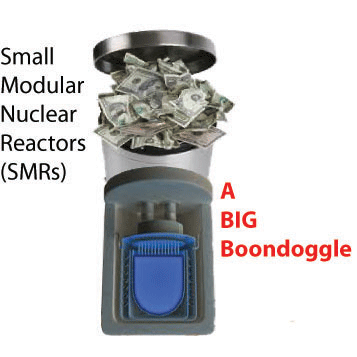
There were a couple of interesting developments in June in regards to electric power. One was that NextEra Energy issued its Investor Conference Report 2022 to its stockholders. Another was a paper from Stanford University, “Low-cost solutions to global warming, air pollution, and energy insecurity for 145 countries,” (LCS study) by Mark Z. Jacobson, et al. Looking into them is rather interesting.
The first of these makes very clear that in the opinions of the people running NextEra Energy, combustion
generating sources and nuclear power are getting too expensive. Furthermore, their opinion is that the most expensive of these, at least in the late 2020s, will be small modular nuclear reactors (SMRs).

We should make clear, just in case anyone doesn’t know, that NextEra is hardly anti-nuclear. While it is already the biggest investor in renewable energy in the US, it does own seven nuclear reactors, including the one at Seabrook. Electricity from new, near-firm solar and wind plants is a good deal less expensive than electricity from existing nuclear plants.
Let’s state this clearly: We are paying extra for electricity from nuclear plants, even after they have been paid down, and even though the sun can shine and the wind can blow almost all the time, because of really cheap battery storage. Put another way, it would be cheaper to close the nuclear plants and replace them with new renewable facilities.
Clean Technica 4th Oct 2022 https://cleantechnica.com/2022/10/04/why-should-we-pay-extra-for-nuclear-power/
Will Sizewell C nuclear really go ahead? EDF’s €60bn debt, and €52bn costs for French nuclear build.
When EDF board members joined a video call in late August to discuss a landmark UK nuclear project, they were instead treated to a stand-off between the utility’s outgoing boss and the French state. Rather than signing off the Sizewell C plant in Suffolk as Jean-Bernard Lévy had pushed for, the biggest French power producer’s controlling shareholder demanded more time to finish new audit reports and the meeting descended into acrimony, according to people familiar with the discussions.
“Some people didn’t understand what they were doing there and why there wasn’t going to be a decision on anything,” one of the people said. “It was messy.” The episode, one of several clashes at the company to have spilled into the open in recent months, will provide little comfort to Lévy’s successor, Luc Rémont, who is due to take over as chief executive and chair just as Paris executes a plan to buy out the 16 per cent of EDF it does not already own.
While the nationalisation clarifies the ownership structure, the company could still be subject to demands from the French state that have not always been in its immediate interest, including that it shield consumers from soaring energy prices. Big strategic questions on everything from Sizewell to renewable energy investments, meanwhile, still loom large.
Rémont, currently a senior executive at industrial conglomerate Schneider Electric, will need to solve
the group’s short-term problems while also preparing EDF to take on some of France’s biggest nuclear construction projects in two decades — a period when it has struggled to complete any on time or on budget.
The company’s electricity output is on course to reach all-time lows this year, after corrosion problems at the company’s nuclear plants added to maintenance stoppages and led to the outage at one point of more than half the French fleet of 56 reactors. That has strained supplies across Europe just as the region pivots away from Russian gas, while also turning France into a net power importer for the first time.
French officials have so far insisted that the Sizewell C plant in Britain will go ahead, adding that the state had commissioned extra audits simply to calculate the financial consequences of removing a Chinese state-backed company from the project.
But the government may eventually want to revisit some of its choices, bankers and union representatives close to EDF said, particularly as the group grapples with costly investments. By the end of this year, EDF’s
net debt is already forecast to swell to about €60bn, while its French construction programme alone could cost another €52bn.
FT 5th Oct 2022
https://www.ft.com/content/559ce578-fa0d-4bbe-9860-9d512b1510e1
Sizewell C nuclear plan – an insane legacy for our grandchildren
Letter: Dave Haskell, Cardigan: It is the height of madness to fund
another nuclear fission power station at Sizewell costing £34 billion,
with Hinkley C currently costing £24 billion and yet to come on stream.
What a legacy to leave to our children and grandchildren – foreign owned,
very expensive and years to build, dangerous, hazardous waste and
horrendous decommissioning costs – not to mention a potential target for
terrorists.
Cambrian News 1st Oct 2022
https://www.cambrian-news.co.uk/news/why-we-must-avoid-using-nuclear-power-565623
Russia’s oil and gas sanctioned, – but its profitable nuclear trade allowed to roll on!
Russia’s nuclear trade with Europe flows despite Ukraine war. European
Union nations are continuing to import and export nuclear fuel that is not
under EU sanctions on Russia. While the European Union has agreed to
curtail its use of Russian oil and gas, its member nations continue to
import and export nuclear fuel that is not under EU sanctions — to the
chagrin of the Ukrainian government and environmental activists.
A cargo ship carrying uranium that departed from the French port of Dunkirk
traveled across the North Sea on Thursday, heading toward the Russian
Baltic port of Ust-Luga. It was the third time in just over a month that
the Panama-flagged Mikhail Dudin ship docked in Dunkirk to transport
uranium from or to Russia.
Environmental group Greenpeace France denounced
the ongoing shipments and called for stopping all trade in nuclear fuel,
which it said was “financing the war in Ukraine, extending (Europe’s)
energy dependence and delaying the transition to renewable energy.” The
EU’s executive arm, the European Commission, did not propose targeting
Russia’s nuclear sector in its latest sanctions package presented
Wednesday.
ABC News 29th Sept 2022
Giant pensions group Phoenix considers investing in nuclear, but wary of the financial risks
One of Britain’s biggest investors is preparing to back the
Government’s plans for a nuclear renaissance, but only if ministers
overhaul the funding model that previously led to the collapse of proposed
power stations. Andy Briggs, chief executive of pensions giant Phoenix
Group, said he has been in talks with the Government about investing in
nuclear power infrastructure and is exploring how it could support the
creation of new plants.
His support is unusual for the industry, with
pension companies traditionally avoiding nuclear because of the huge
up-front costs involved. However, Mr Briggs also warned that ministers need
to give private sector investors greater clarity on returns around the
investment if the FTSE 100 company is to back future projects. He said:
“We’re in ongoing dialogue regularly [with Government] on this. To
date, we haven’t made significant investments into nuclear, [but] it’s
something we would consider.”
Under the new proposed model, companies
building plants would be paid during the construction phase, cutting down
their development risk and allowing them to secure cheaper financing. Mr
Briggs said: “There’s definitely risks associated with it so we would
need to be comfortable that there’s a robust and safe model around it. It
seems to us likely that it will form part of the [energy] solution going
forward provided it’s done safely and sensibly. “It’s about getting
clarity on the model around it…but it’s definitely an area of potential
interest where there may be attractive returns in long-term, illiquid
assets.”
Telegraph 2nd Oct 2022
https://www.telegraph.co.uk/business/2022/10/02/pension-titan-vows-back-nuclear-power-renaissance/
US Senate Approves $12 Billion In New Aid For Ukraine Amid War

Russia-Ukraine War: It comes as Russian President Vladimir Putin plans to declare the annexation of parts of Ukraine occupied by Russian troops on Friday.
NDTV WorldAgence France-Presse September 30, 2022,
It also provides $4.5 billion for Kyiv to keep the country’s finances stable.
The US Senate approved $12 billion in new economic and military aid for Ukraine Thursday as part of a stopgap extension of the federal budget into December.
The measure, agreed by senators of both parties, includes $3 billion for arms, supplies and salaries for Ukraine’s military, and authorizes President Joe Biden to direct the US Defense Department to take $3.7 billion worth of its own weapons and materiel to provide Ukraine.
It also provides $4.5 billion for Kyiv to keep the country’s finances stable and keep the government running, providing services to the Ukrainian people.
It comes as Russian President Vladimir Putin plans to declare the annexation of parts of Ukraine occupied by Russian troops on Friday……………
The Ukraine aid is part of a short-term extension of the federal budget, which is to expire at the end of the fiscal year on September 30 without the parties in Congress having agreed to a full-year allocation for fiscal 2022-23………. https://www.ndtv.com/world-news/us-senate-approves-12-billion-in-new-aid-for-ukraine-amid-war-3390355
Electricite de France, (EDF) loaded with debt and safety problems , gets a new CEO
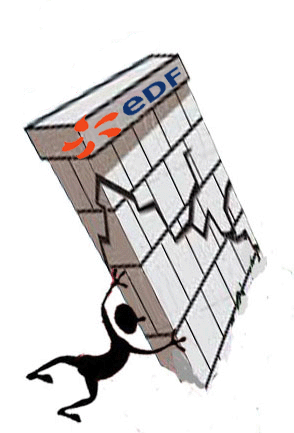
The French government has picked a senior Schneider Electric executive to
head EDF as it moves to fully renationalise the embattled nuclear power
operator and seeks an end to reactor outages straining electricity supplies
across Europe.
Luc Rémont is set to become chair and chief executive after
President Emmanuel Macron cleared his nomination at the group, which is 84
per state-owned, the Élysée Palace said. His appointment, still subject
to parliamentary checks, comes as the government kicks off a
nationalisation process.
A €9.7bn tender offer to buy out minority
shareholders could be handed to regulators next week, two people close to
the process said. The management overhaul at France’s former electricity
monopoly follows a fraught search for candidates that underscored some of
the turmoil around a group with huge industrial tasks ahead and that has
long been intertwined with politics.
Run-ins between the government and outgoing boss Jean-Bernard Lévy over some of the company’s operational problems have spilled into the public in recent weeks, in a blame game over
the state of its existing reactors and France’s hesitation to invest more in the sector. Already highly indebted, EDF is gearing up to build at least six new nuclear reactors in France, the biggest order in more than a quarter of a century.
It is still struggling with long delays and cost overruns on existing projects. A record number of outages at its 56 reactors have plunged its nuclear output to 30-year lows, torn a hole in its profits and turned France into a net importer of power in the middle of an energy crisis. On Thursday, a series of strikes over wages further squeezed EDF’s output.
FT 29th Sept 2022
https://www.ft.com/content/43a1dbd8-fbf0-420e-919e-e9b67bf8305d
The real Winners of Ukraine war – the USA weapons manufacturers! U.S. Announces $1.1 Billion In Aid For Building Ukraine’s Military

The United States has now committed approximately $16.9 billion in security assistance to Ukraine since January 2021
Radio Free Europe, 29 Sept 22, The United States will provide an additional $1.1 billion in military aid to Ukraine, including funding for about 18 more advanced rocket systems and other weapons to counter drones, the White House announced on September 28.
The package is aimed at helping Ukraine secure its longer-term defense needs under the Ukraine Security Assistance Initiative, which funds the purchase of weapons and equipment. This means it could take a year or more for Ukraine to get the systems.
Most of the other military aid packages announced by the United States have thus far used Pentagon drawdown authority to provide weapons more immediately.
The new package “represents a multi-year investment in critical capabilities to build the enduring strength of Ukraine’s Armed Forces” as they continue to battle the invading Russian Army, the Pentagon said in a statement.

The package includes funding for 18 units of the High-Mobility Artillery Rocket System, known as HIMARS, and 12 Titan systems, which are used to counter drones………………
Also in the package is funding for about 150 armored vehicles, 150 tactical vehicles for towing weapons, trucks and trailers, and a variety of radars, communications, and surveillance equipment.
The United States has now committed approximately $16.9 billion in security assistance to Ukraine since January 2021. https://www.rferl.org/a/ukraine-us-military-aid-1-1-billion/32056533.html
Subsidies to Nuclear Power in the Inflation Reduction Act still won’t save the poor economics of nuclear power – Cato Institute
Subsidies to Nuclear Power in the Inflation Reduction Act, Cato Institute By David Kemp and Peter Van Doren, 28 SEpt 22, Last month, the United States enacted the Inflation Reduction Act (IRA),……… The act includes many provisions to subsidize clean power plants, including nuclear generators.
Many believe that nuclear is the perfect solution to climate change…….. Our recent working paper examines the economics of nuclear power and concludes that it is very high‐cost relative to natural gas generators. Most importantly in the context of climate change, we also determine that the potential climate benefits of nuclear are insufficient to offset its costs.
From the 1960s to 1980s, many nuclear power plants were built, but nuclear construction costs rose dramatically resulting in a severe decline in new construction. Very few plants have been built in the United States and Western Europe in the past several decades. In fact, the most recent projects in the West (the United States, France, the United Kingdom, and Finland) have experienced numerous issues with quality control, supply chains, and labor force management, leading to a more than doubling of construction schedules and costs. The fact that nuclear construction costs increased dramatically in countries with different regulatory regimes suggests that the problem is not simply overly cautious regulators.[1]………………..
Nuclear power is capital intensive. Thus, its levelized cost of electricity (LCOE) depends mostly on its construction cost. To model different scenarios, our calculations use three levels of construction costs for nuclear. The highest level (a cost of $9,000 per kilowatt of capacity constructed) represents the average construction costs of the West’s most recent projects. The middle and low levels ($6,700 and $4,000 per kilowatt, respectively) envision substantial reductions in nuclear construction costs through some combination of regulatory reform, improvements to construction management, or innovation. The low level, which is nearly 65 percent lower than the most recent nuclear project in the United States (the Vogtle plant in Georgia where ongoing construction has reached costs of about $11,000 per kilowatt), is particularly optimistic. Whether such a reduction is achievable is not known, but historically US nuclear construction costs have increased as new capacity has been built………………………………………………………..
The IRA expands subsidies to new nuclear plants through two options for tax credits, a production tax credit (PTC) and an investment tax credit (ITC)……………………………………………………………………………………..
The IRA subsidies are not sufficient to change the economics of nuclear power. ………..https://www.cato.org/blog/subsidies-nuclear-power-inflation-reduction-act
UK’s nuclear waste cleanup operation could cost £260bn
“While we are clear about the current legacy of waste which already exists, a GDF would have to handle additional waste from new facilities being developed,” the NWService said. “The actual cost will … depend on the number of new nuclear projects that the UK develops in future and any additional waste from those stations.”
Cost of safely clearing waste from ageing power stations is soaring, say experts,
https://www.theguardian.com/environment/2022/sep/23/uk-nuclear-waste-cleanup-decommissioning-power-stations Sandra Laville Environment correspondent
The cost of decommissioning the UK’s 20th-century nuclear waste could rise to £260bn as the aged and degrading sites present growing challenges, according to analysis presented to an international group of experts.
As the government pursues nuclear energy with the promise of a new generation of reactors, the cost of safely cleaning up waste from previous generations of power stations is soaring.
Degrading nuclear facilities are presenting increasingly hazardous and challenging problems. Ageing equipment and electrical systems at Sellafield, which is storing much of the country’s nuclear waste and is one of the most hazardous sites in the world, are increasing the risk of fire, according to the Nuclear Decommissioning Authority. They require increasing maintenance and present growing risk. Last October a faulty light fitting started a blaze at a Sellafield facility which led to its closure for several weeks.
Analysis by Stephen Thomas, a professor of energy policy at the University of Greenwich, estimates the total bill for decommissioning the UK’s nuclear waste mountain will grow to £260bn.
Thomas told a conference of international experts the cost of decommissioning Sellafield had risen from to £110bn, according to freedom of information requests.
Other sites that need decommissioning are the 11 Magnox power stations, built between the 1950s and 1970s, including Dungeness A in Kent, Hinkley Point A in Somerset and Trawsfynydd in north Wales, and seven advanced gas-cooled reactors built in the 1990s, including Dungeness B, which closed last year, Hinkley Point B and Heysham 1 and 2 in Lancashire.
Deterioration of one of the Magnox stations, Trawsfynydd, which shut down in 1991, is such that substantial work is needed to make it safe, according to the NDA. “Work that would then need to be undone to complete reactor dismantling,” the agency said.
Thomas told the International Nuclear Risk Assessment Group similar problems are expected at other Magnox sites. The timetable for decommissioning the old nuclear power stations has been abandoned, with no new timescale yet published.
The Nuclear Waste Service has said deferring decommissioning for 85 years from shutdown, which was previous policy, is not suitable for all the reactors because of their different ages and physical conditions. Decommissioning of some Magnox stations will have to be brought forward, the NWS has said
Attempts to speed up the decommissioning would only add to the growing bill, Thomas said, which he estimated had increased to £34bn.
In 2005, the cost for decommissioning and disposing of the radioactive waste from nuclear power stations built in the 1950s, 70s and 90s was put at £51bn.
Last year the NDA estimates rose to £131bn, and its latest annual report said £149bn was needed to pay for the clear up. But Thomas said rising costs meant the total bill was on track to reach £260bn.
Part of the soaring increase is the cost of building a large underground nuclear waste dump or geological deposit facility (GDF) to safely store the 700,000 cubic metres of radioactive waste – roughly the volume of 6,000 double decker buses – from the country’s past nuclear programme.
The mammoth engineering project was initially predicted to cost £11bn but the bill is now estimated to be up to £53bn because of uncertainty about where the site will be located, and the need to provide space for an unspecified amount of waste from the new generation of nuclear reactors which the government wants to build.
Four areas of the country are being considered for the GDF but no decision on where it will be located has yet been made.
“While we are clear about the current legacy of waste which already exists, a GDF would have to handle additional waste from new facilities being developed,” the NWService said. “The actual cost will … depend on the number of new nuclear projects that the UK develops in future and any additional waste from those stations.”
The cleanup of past nuclear waste will take more than 100 years, the NDA has said. Highlighting the challenges of the degrading and hazardous facilities, the authority said in its annual report that robots and drones were increasingly being used to carry out site inspections.
How we got to an $850 billion Pentagon budget – “independent” think tanks are funded by weapons corporations.

Speaking Security Newsletter | Note n°173 | 16 September 2022, Stephen Semler
Situation
The Senate might vote on the fiscal year 2023 military budget this month. Or it might not; nobody’s sure. What’s for certain is that the bill the Senate considers will have at least as much as $850 billion for the Pentagon. In other words, we’re staring down a $72 billion year-to-year increase in military spending with this legislation: The FY2022 version of the same bill (National Defense Authorization Act, or NDAA) licensed $778 billion for the Pentagon.
How we got to an $850 billion Pentagon budget
In March, Joe Biden proposed increasing annual military spending by $35 billion—to $813 billion—as part of his FY2023 budget request. In June, the House Armed Services Committee (HASC) added another $37 billion on top of that before advancing the $850 billion bill to the House floor for approval.
This decision was reportedly a matter of course for the committee. According to one HASC member, there was “almost no debate” on dumping another $37 billion on top of Biden’s own proposed increase. An overlooked reason why the committee’s move was so automatic was the ‘expertise’ that made a $72 billion year-to-year increase seem appropriate or even natural.
Think tanks are said to be free from the ugly forces that bias in-house policy planning—namely, all the lobbying and campaign cash that encourage members of Congress to make decisions based on parochial interests and not the public’s. The problem is that establishment think tanks are corrupted by the same monied interests members of Congress are. In this case, we’re talking about the arms industry.
Every think tank represented in a House Armed Services Committee hearing to provide expert testimony from January 1, 2020 through September 16, 2022 that disclosed its donors received funding from military contractors (the one that didn’t disclose its donors was the hawkish American Enterprise Institute).
The result? Military contractors were able to launder their profit-driven interests through ostensibly non-political institutions, while powerful lawmakers on the HASC got their parochially-driven policy positions validated by ostensibly unbiased ‘expertise’.
Small modular reactors: What is taking so long?
Next-generation nuclear has long been just around the corner, but debate still rages over the silver-bullet credentials of small modular reactors.
By Oliver Gordon The growing urgency of the climate crisis and, more recently, the energy crisis has reawakened global interest in nuclear energy. Even the likes of Bill Gates and Elon Musk have waded into the debate to petition for a more prominent role for nuclear power in the transition to net-zero greenhouse gas emissions. To that end, there is much expectation surrounding the development of small modular reactors (SMRs), a new generation of nuclear reactors that are being marketed as the solution to all of nuclear power’s previous shortcomings.
To that end, there is much expectation surrounding the development of small
modular reactors (SMRs), a new generation of nuclear reactors that are
being marketed as the solution to all of nuclear power’s previous
shortcomings.
In fact, SMRs are not forecast to hit the commercial market
before 2030, and although SMRs are expected to have lower up-front capital
costs per reactor, their economic competitiveness is still to be proven in
practice once they are deployed at scale.
Nuclear reactors are extremely
complex systems that must comply with stringent safety requirements, taking
into account a wide variety of accident scenarios. The licensing process is
extensive and country-dependent, implying some standardisation will be
required for SMRs to properly take off.
However – beyond the perennial
oscillation of public acceptance of nuclear energy – there are still a
variety of challenges SMR technology needs to overcome before it can reach
commercial deployment. “The hardest is economics,” says M V Ramana, the
Simons Chair in Disarmament, Global and Human Security at the School of
Public Policy and Global Affairs at the University of British Columbia,
Canada, and author of The Power of Promise: Examining Nuclear Energy in
India. “Nuclear energy is an expensive way to generate electricity.”
Energy Monitor (accessed) 21st Sept 2022
https://www.energymonitor.ai/sectors/power/small-modular-reactors-smrs-what-is-taking-so-long
Nuclear industry Beating Retreat at Bradwell?
https://www.nuclearpolicy.info/news/beating-retreat-at-bradwell/ 21 Sept 22, Recent news received by the Nuclear Free Local Authorities from an Essex resident appears to indicate that the development of a new Chinese-backed nuclear power plant at Bradwell-on-Sea is at a halt.
Like Operation Sealion before it, this unwanted foreign invasion of Southern England seems also to have been indefinitely postponed.
The Bradwell B power station project has been led by majority shareholder, the China General Nuclear Power Group (CGN), a Chinese-state owned energy corporation, with junior partners, French-state owned EDF Energy. CGN owned 66.5% of the equity and EDF Energy the rest. CGN had proposed to install two of its own UK HPR1000 reactors designed specifically for the plant, and the design received approval from the Office of Nuclear Regulation only in February 2022.
However, even before then, things were turning sour for the project. UK – China relations have been on a downward track for many months and Conservative MP Iain Duncan Smith described Chinese investors as ‘not trusted vendors’ in Parliament. Giving substance to this sentiment, the Conservative Government passed the National Security and Investment Act, which entered into force in January 2022. This allows Whitehall ‘to intervene in certain acquisitions that could harm the UK’s national security’ such as civil nuclear power plants, and Ministers have frequently talked openly about their determination to terminate Chinese involvement in the Bradwell project.
Householders have now received letters that appear to indicate that the Bradwell B project team is indeed making a withdrawal from the site. Workers will soon be returning to fill in the exploratory boreholes they dug from 2018 to 2020 to conduct ‘early investigative surveys’ into ground conditions. Restorative work will take place from mid-September to make land available once more to enable local farmers to grow crops. And there is news that the project team will be ‘closing the current site compound’ and ‘removing the temporary site offices’ ‘by the end of the year’. Furthermore, there are no plans to ‘conduct further temporary ground investigation and load testing works’, for which planning approval has been granted, in 2023.
Commenting Councillor David Blackburn, Chair of the NFLA Steering Committee, said: “We do not know for certain if the Bradwell B project is finally dead and buried, but the fact that the project team is beating retreat from the site is a clear indication that no work will progress for the foreseeable future.
“Clearly Chinese involvement, which includes the bulk of the equity investment and the employment of a reactor specifically designed for this project, is as dead as the Dodo! It is unlikely that EDF Energy, which is already tens of billions of Euros in debt, will want to take on any further financial liability given its existing heavy involvement in both the Hinkley Point C and Sizewell C nuclear power projects, and frankly the appetite of most private investors to back new nuclear projects is almost nil”.
For more information, please contact NFLA Secretary Richard Outram by email on richard.outram@manchester.gov.uk or telephone 07583 097793
Wow! The nuclear lobby comes up with a new plan “to compel governments to make difficult decisions”
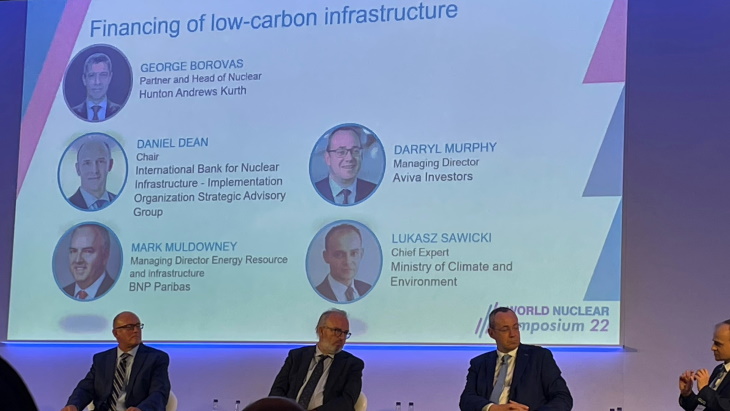
The solution that we have created – the creation of a multilateral bank that will support nuclear investment and nuclear infrastructure all across the world – is a needed tool to achieve these objectives.
The proposed International Bank for Nuclear Infrastructure (IBNI)will be based on the same model as the World Bank, European Bank for Reconstruction and Development and the Asian Development Bank, among others.
“What a multilateral can do, through the establishment, adoption and enforcement of country-level agreements, is compel governments to make the politically-difficult decisions.
Financing issues for nuclear under the spotlight
World Nuclear News, 09 September 2022 The financing of nuclear projects under current mechanisms faces many challenges, panelists at World Nuclear Symposium agreed. However, plans for a new multilateral bank specifically for nuclear infrastructure could help projects move forward.
I think we all share a vision that nuclear needs to play a major role in the attainment of [energy security, sustainable development, climate targets] policy objectives,” said Daniel Dean, chair of the International Bank for Nuclear Infrastructure (IBNI) Implementation Organisation Strategic Advisory Group.
“The more we make nuclear accessible, financeable and achievable in countries throughout the world, the more that nuclear will be considered as a viable option to achieve those carbon transition objectives. But we are talking about multiple trillions of dollars of investment to achieve this vision. That is a problem given the existing financing mechanisms, the existing commercial structures being utilised to deliver nuclear projects.
George Borovas, partner and head of nuclear at law firm Hunton Andrews Kurth, who chaired the session, said the financing of nuclear projects is “an issue that is dear to my heart”. He said he has seen many such projects fail because of a lack of the right financial solutions……… You have to think about the financing solution up front.”
“General issues of public acceptance, reputational risk, potential controversies inevitably makes a lot of banks nervous, or at least cautious, about engaging with nuclear,” said Mark Muldowney of BNP Paribas…………..

Dean said nuclear must been considered from an Environmental, Social and Governance (ESG) perspective as an investor.
“We need to establish a better basis for the ESG status of nuclear and its role in terms of net-zero and its role in energy security,” he said. “That’s important as that will start to aggregate stability and actually say that nuclear is something that collectively financiers want to finance.”
what you need for that assessment is for industry collectively to put together the case why nuclear makes sense – from a policy point of view that’s the government’s domain
Dean said it is not just a financing issue. “It is a multidimensional problem that needs a multidimensional solution. The solution that we have created – the creation of a multilateral bank that will support nuclear investment and nuclear infrastructure all across the world – is a needed tool to achieve these objectives.
…………………… The proposed IBNI will be based on the same model as the World Bank, European Bank for Reconstruction and Development and the Asian Development Bank, among others.
“What a multilateral can do, through the establishment, adoption and enforcement of country-level agreements, is compel governments to make the politically-difficult decisions. https://world-nuclear-news.org/Articles/Financing-issues-for-nuclear-under-the-spotlight
1 This Month



26 September – International Day for the Total Elimination of Nuclear Weapons


PLEASE OPPOSE HR 8255 AND S.3639 – bills would accelerate satellite deployment, with no environmental review or safeguards – https://ncstd5li.quorum.us/campaign/169331/
To see nuclear-related stories in greater depth and intensity – go to https://nuclearinformation.wordpress.com
-
Archives
- September 2026 (233)
- August 2026 (330)
- July 2026 (355)
- June 2026 (287)
- May 2026 (306)
- April 2026 (356)
- March 2026 (251)
- February 2026 (267)
- January 2026 (308)
- December 2025 (358)
- November 2025 (359)
- October 2025 (375)
-
Categories
- 1
- 1 NUCLEAR ISSUES
- business and costs
- climate change
- culture and arts
- ENERGY
- environment
- health
- history
- indigenous issues
- Legal
- marketing of nuclear
- media
- opposition to nuclear
- PERSONAL STORIES
- politics
- politics international
- Religion and ethics
- safety
- secrets,lies and civil liberties
- spinbuster
- technology
- Uranium
- wastes
- weapons and war
- Women
- 2 WORLD
- ACTION
- AFRICA
- Atrocities
- AUSTRALIA
- Christina's notes
- Christina's themes
- culture and arts
- Events
- Fuk 2022
- Fuk 2023
- Fukushima 2017
- Fukushima 2018
- fukushima 2019
- Fukushima 2020
- Fukushima 2021
- general
- global warming
- Humour (God we need it)
- Nuclear
- RARE EARTHS
- Reference
- resources – print
- Resources -audiovicual
- Weekly Newsletter
- World
- World Nuclear
- YouTube
-
RSS
Entries RSS
Comments RSS
 nuclear-news