Nice work if you can get it: £750 a day for leading Lincolnshire’s nuclear dump bid
A typical employee working full-time in the East Lindsay Council area can
expect to be paid just over £90 per day, according to the latest
government survey of earnings. With the 2022 Annual Survey of Hours and
Earnings reporting that median earnings in the district are just £462.50
per week, many local workers will be envious upon hearing that the Interim
Chair of the Theddlethorpe GDF Community Partnership continues to be paid
£750 per day for his work leading the bid to bring an unwanted nuclear
waste dump to the Lincolnshire coast. The revelation was contained in a
response from Nuclear Waste Services (NWS) to a recent Freedom of
Information Act request about the ongoing renumeration of Mr Jon Collins
made by the Nuclear Free Local Authorities (NFLA).
NFLA 2nd Nov 2022
Sizewell C nuclear station to be funded 20% by French taxpayers, and 20% by British taxpayers.

French government officials have officially approved the involvement of
state-owned company EDF in the development of Britain’s Sizewell C nuclear
power plant, Boris Johnson’s last flagship program as Prime Minister. I can
reveal. In his last keynote address as Prime Minister, Mr Johnson had urged
his successors to “go nuclear and go big and go with Sizewell C”.
While questions remain about how the project will be funded, with I After
previously revealing how it has approached investors in the UAE, Australia
and Saudi Arabia for financial backing, the UK has now secured the full
backing of French officials – a big step forward for the plant. The UK is
expected to plan a 20 per cent stake in Sizewell C, with EDF taking a
further 20 per cent – leaving 60 per cent of the project dependent on
investors.
UK Daily News 28th Oct 2022
French nuclear power group EDF to have a bigger loss than previously expected
French nuclear power group EDF is expecting a hit of around 32 billion
euro ($32.18 billion) to its full-year core earnings from lower nuclear
production, a bigger loss than previously forecast and its sixth profit
warning this year.
The French government, which already owns 84% of EDF, is
in the process of fully re-nationalising the company, the debt-laden
operator of Europe’s largest fleet of nuclear power plants.
Reuters 27th Oct 2022
https://www.reuters.com/business/energy/french-utility-giant-edfs-history-2022-07-08/
USA’s Westingouse likely to build and fund 49% of Poland’s first nuclear power station
Poland is likely to choose the United States engineering firm Westinghouse
Electric to build its first nuclear power plant and provide 49% equity
financing for the project. State-owned Korea Hydro Nuclear Power (KHNP) may
also be involved in a separate and parallel private nuclear project, Polish
Deputy Prime Minister Jacek Sasin said earlier this week. Warsaw has also
been talking to France’s state-owned EdF utility which has built and
operates the country’s nuclear power plants. After years of shelved plans
to build a civil nuclear capacity in Poland from scratch, the energy crunch
caused by the war in Ukraine, lower gas supplies from Russia and lack of
immediate renewable substitutes, have kicked the issue back up the
political agenda.
Deutsche Welle 28th Oct 2022
https://www.dw.com/en/us-south-korean-firms-to-operate-nuclear-plants-in-poland/a-63576093
Scotland ‘could fund England’s nuclear plants after independence’ under “regulated asset base” (RAB) model

the RAB model was favoured by the Tory government because “the fact is the market has fled nuclear”.
“The market has fled nuclear because of the risk and liability. The only way of getting nuclear through is with vast public subsidy, and this is a way of disguising that public subsidy.
the RAB model had been tried before in the US – under the name Early Cost Recovery – “and failed miserably”.
And that public money would come at the very start of construction. They would be paying right from the word go, so this is essentially free money. Even with that there really doesn’t seem to be much interest from the market.”
SCOTTISH bill payers could still be funding nuclear projects south of the Border through additional fees on their energy bills even after independence, one expert has said.
It comes as the UK Government looks to award the first contracts for new nuclear stations in England, which will be funded through the “regulated asset base” (RAB) model.
This RAB model will see electricity suppliers pay a levy to “relevant licensee nuclear companies”, with the costs passed on to consumers in the form of additional fees on top of their energy bills. Under conservative UK Government estimates, this could mean Scottish households’ energy bills rising by around £100 a year.
Dr Paul Dorfman, the chair of the non-profit Nuclear Consulting Group and associate fellow at the University of Sussex’s Science Policy Research Unit, told The National that the RAB model was favoured by the Tory government because “the fact is the market has fled nuclear”.
“RAB is absolutely, unequivocally all about trying to incentivise the market,” he said, “and it is doing it with public money.”
Dorfman went on: “And that public money would come at the very start of construction. They would be paying right from the word go, so this is essentially free money. Even with that there really doesn’t seem to be much interest from the market.”
The nuclear expert, who will give evidence on the topic to a Westminster committee next week, said the RAB model had been tried before in the US – under the name Early Cost Recovery – “and failed miserably”.
He said: “It can work for projects which you know will come in on time, but nuclear has huge liabilities and huge over-runs, and that’s precisely why it doesn’t work. RAB doesn’t work for projects with high liability and high risk.
“The market has fled nuclear because of the risk and liability. The only way of getting nuclear through is with vast public subsidy, and this is a way of disguising that public subsidy.
Dorfman warned that once the UK Government started sinking billions of pounds into efforts to begin construction of eight new nuclear stations by 2030, it would “become a fait accompli”.
He said that even after 17 years – the amount of time he estimates it will take from a contract being awarded to a nuclear plant being finished – “the UK public, and the Scots public, who may no longer be part of the UK, will still be liable for that”.
Dorfman said the first RAB nuclear contracts looked set to be awarded in 2023, estimating that would mean a completion date of the first nuclear plants around 2040.

“That’s too late for our climate,” he said. “It’s far too late for the current energy crisis. The point is of course, why do this when last year solar and wind made up three-quarters of all total new electricity generation capacity installed worldwide?”
“
The Nuclear Consulting Group chair further cautioned that no one knows for certain what the RAB funding arrangements will be.
Craig Dalzell, the head of policy and research at Common Weal, a think tank which has recently produced a report on the RAB funding model, said the “ongoing liability” for new nuclear projects in England should “not be outsourced to Scotland post-independence”.
Dalzell told The National: “The idea that Scottish energy users could be paying for the UK’s nuclear RAB schemes even after independence will surely be something that should be resisted. The Scottish Government should do everything it can to extract guarantees from the UK Government that this will not be the case and that the ongoing liability for these plants will not be outsourced to Scotland post-independence.
“At the very least, any payments for these plants should be taken into account when the time comes for independence negotiations and I would expect these charges to be offset against other debts or added to an equivalent payment from the remaining UK to Scotland to compensate for their mismanagement of energy policy.”
The UK Government’s Department for Business, Energy and Industrial Strategy declined to comment, saying only that its policy has not changed despite a new Secretary of State, Grant Shapps, taking control.
You can read Dr Dorfman’s written evidence on nuclear power to the House of Commons’ Science and Technology Committee here.
About 100 Zaporizhzhia Nuclear Power Plant employees, including senior managers, agree to collaborate with Russian occupiers
Ukrainska Pravda ANASTASIIA ZHARYKOVA – FRIDAY, 28 OCTOBER 2022,
Out of the 6,700 Zaporizhzhia Nuclear Power Plant (ZNPP) employees who continue working at the plant since its occupation by Russian forces, about 100 workers have signed contracts with Rosatom [Russia’s state nuclear energy corporation] under pressure from the Russians. Several senior managers are among those who had agreed to work for Russia, too…………………. more https://news.yahoo.com/100-zaporizhzhia-nuclear-power-plant-145214038.html
Russia is funding its war on Ukraine by selling $billions of uranium to Europe’s nuclear industry- no sanctions on that!
The Russian nuclear industry has once again managed to avoid inclusion in the latest round of EU sanctions – the eighth in a row to skirt this vital issue in an apparent acknowledgment that Europe’s dependence on Russian nuclear fuel cannot easily be reversed.
Since the start of the war in February, the media has been so focused on Russian fossil fuels, particularly natural gas, that it has avoided any discussion of Europe’s nuclear dependence on Russia completely. However, the topic can no longer be safely ignored. The Kremlin has already earned several hundred billion dollars so far this year by selling fossil fuels to Europe, a financial cushion that has allowed Moscow to fund its horrific war in Ukraine.
While Europe is less reliant on Russia supplying its atomic energy sector than it is its fossil fuel sector, the dependence of the European atomic energy industry on Russian nuclear fuel is as surprising as it is alarming. Much work has gone into weaning Europe off Russian fossil fuels, with time being of the essence as Brussels seeks to curtail Moscow’s lucrative revenue streams as quickly and as comprehensively as possible. However, its nuclear industry has not yet been the focus of any such efforts.
Moscow Times 22nd Oct 2022
https://www.themoscowtimes.com/2022/10/22/europe-should-sanction-russias-nuclear-industry-now-a79089
Rooppur nuclear power plant: Cost may rise for multiple factors
Daily Star Rejaul Karim Byron, Tue Oct 25, 2022 ,
Rooppur Nuclear Power Plant Project may see a cost rise due to slow progress in power grid upgrade, possible changes in the loan repayment method amid the Russia-Ukraine war and the devaluation of the taka.
The Tk 113,092-crore plant has two units with a power generation capacity of 1,200 megawatts each. Of the amount, Tk 91,040 crore ($11.38 billion) will be provided by Russia as loan, according to an agreement.
Project officials said the first unit will be ready for commercial operation in December 2023 and the second one in July 2024.
The plant, however, may face delay in going into commercial operation as the Infrastructure Development for Power Evacuation Facility, scheduled to be completed by December next year, has seen only 27 percent financial progress and 45 percent physical progress in nearly five years till September this year.
Talking to reporters at the plant site recently, Shawkat Akbar, project director of Rooppur Nuclear Power Plant, said they would not be able run the plant until the power grid upgrade is done under the infrastructure development facility.
“Once we use nuclear fuel in the plant, we can’t stop production,” he pointed out.
Work of the infrastructure development facility under the Power Grid Company of Bangladesh (PGCB) began in April 2018 at a cost of Tk 10,981 crore with Tk 8,219 crore funding from the Indian Line of Credit…………………………………………………….. more https://www.thedailystar.net/news/bangladesh/news/rooppur-nuclear-power-plant-cost-may-rise-multiple-factors-3151171
American companies might make fuel for small nuclear reactors, except that there seems to be no market for them.
Russia’s Uranium Dominance Threatens America’s Next-Gen Nuclear Plans, By Tsvetana Paraskova – Oct 23, 2022, 10:00 AM CDT
- The United States has ambitious plans for its nuclear power industry.
- Russia’s stranglehold on the uranium market threatens to delay progress in nextgen nuclear power projects.
- U.S. companies are scrambling to develop the domestic uranium supply chain needed to fuel nuclear power ambitions.
……………………..
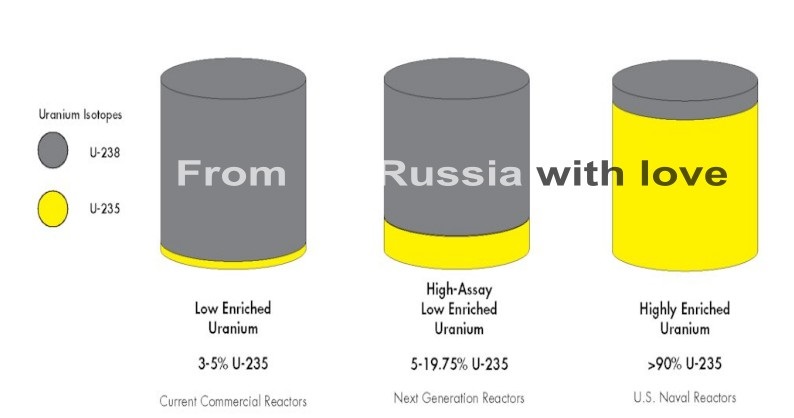
there is one major hurdle to the construction of most advanced reactors under development in the United States—the uranium type of fuel on which those reactors are designed to run is currently sold commercially by only one company in the world. And that company is a subsidiary of Russia’s ROSATOM, the Russian State Atomic Energy Corporation.
The federal government and U.S. companies developing advanced nuclear reactors—including Bill Gates’ TerraPower—recognize the urgent need to eliminate reliance on a Russian state corporation for nuclear fuel for America’s next-generation nuclear reactors.
The association Uranium Producers of America noted during a Senate committee hearing after the Russian invasion of Ukraine that “almost none of the fuel needed to power America’s nuclear fleet today comes from domestic producers, while U.S. nuclear utilities purchase nearly half of the of the uranium they consume from state-owned entities (SEO) in Russia, Kazakhstan, and Uzbekistan.”
“We estimate that there is more than $1 billion in annual U.S. dollar purchases of nuclear fuel flowing to ROSATOM,” said Scott Melbye, president of the association and Executive Vice President at Uranium Energy Corp.
ROSATOM is not under Western sanctions after the Russian invasion of Ukraine because of the Russian state firm’s importance in the supply chain of the global nuclear power industry. But the U.S. firms developing the next generation of more efficient, cheaper, and more environmentally friendly nuclear reactors don’t want to do business with Russia anymore.
Hence, the need for a commercially viable and stable domestic supply chain of the fuel for those advanced reactors—HALEU, or high assay low enriched uranium. ……………………………………….
the U.S. government faces the “chicken and egg” dilemma in HALEU supply, Matt Bowen, Research Scholar at the Center on Global Energy Policy at Columbia University SIPA, and Paul M. Dabbar, Distinguished Visiting Fellow at the same center, wrote in a paper in May this year/
“Existing enrichment companies, such as Urenco, Orano, GLE, and Centrus, could make HALEU, but these companies would likely be hesitant to invest too much in building HALEU infrastructure and completing NRC licensing without being confident there will in fact be a profitable market for the product,” they say.
What is Regulatory Asset Base and how will it affect future energy charges for Scots?
THE UK Government is set on using a Regulatory Asset Base (RAB) model to fund
nuclear projects south of the Border. This will directly result in Scots
paying more on their energy bills. Here, former Scottish Office chief
statistician Jim Cuthbert explains what an RAB model is, and the problems
behind it. There are two main problems.
First, the construction phase of
nuclear projects is extremely long. Further, nuclear construction is
notoriously beset by technical difficulties. Midway through a nuclear
construction project, it will be extremely difficult for the regulator to
resist pressure for the RAB base to be inflated to overcome any technical
problems or uncertainties.
Secondly, the operating life of nuclear projects
is again very long, with the UK Government’s current working assumption
being about 60 years. This means that any surplus which is built into the
stream of future RAB payments will be available to be capitalised over this
long period – which will greatly increase the potential windfall profits
to be extracted by the original equity investors.
The National 23rd Oct 2022
https://www.thenational.scot/politics/23071054.rab-will-affect-future-energy-charges-scots/
America’s new nuclear power industry has a Russian problem
Kitco News Reuters Friday October 21, 2022,

WASHINGTON/LONDON, Oct 20 (Reuters) – U.S. firms developing a new generation of small nuclear power plants to help cut carbon emissions have a big problem: only one company sells the fuel they need, and it’s Russian.
That’s why the U.S. government is urgently looking to use some of its stockpile of weapons-grade uranium to help fuel the new advanced reactors and kick-start an industry it sees as crucial for countries to meet global net-zero emissions goals.
Production of HALEU is a critical mission and all efforts to increase its production are being evaluated,” a spokesperson for the U.S. Department of Energy (DOE) said……..
without a reliable source of the high assay low enriched uranium (HALEU) the reactors need, developers worry they won’t receive orders for their plants. And without orders, potential producers of the fuel are unlikely to get commercial supply chains up and running to replace the Russian uranium……
The fact that Russia has a monopoly on HALEU has long been a concern for Washington but the war in Ukraine has changed the game, as neither the government nor the companies developing the new advanced reactors want to rely on Moscow.
HALEU is enriched to levels of up to 20%, rather than around 5% for the uranium that powers most nuclear plants. But only TENEX, which is part of Russian state-owned nuclear energy company Rosatom, sells HALEU commercially at the moment.
While no Western countries have sanctioned Rosatom over Ukraine, mainly because of its importance to the global nuclear industry, U.S. power plant developers such as X-energy and TerraPower don’t want to be dependent on a Russian supply chain.
“We didn’t have a fuel problem until a few months ago,” said Jeff Navin, director of external affairs at TerraPower, whose chairman is billionaire Bill Gates. “After the invasion of Ukraine, we were not comfortable doing business with Russia.”
………….. with large-scale projects still challenging for reasons including huge up-front costs, project delays, cost overruns and competition from cheaper energy sources such as wind, several developers have proposed so-called small modular reactors (SMR).
While the SMRs on offer from companies such as EDF (EDF.PA) and Rolls-Royce (RR.L) use existing technology and the same fuel as traditional reactors, nine out of 10 of the advanced reactors funded by Washington are designed to use HALEU…….
Companies in the United States and Europe have plans to produce HALEU on a commercial scale but even in the most optimistic scenarios, they say it would take at least five years from the point they decide to proceed……
“Nobody wants to order 10 reactors without a fuel source, and nobody wants to invest in a fuel source without 10 reactor orders,” said Daniel Poneman, chief executive of U.S. nuclear fuel supplier Centrus Energy Corp (LEU.A)…..
TerraPower, for example, said it will need 15 tonnes of HALEU for the first fuel load of its advanced reactor.
Other potential HALEU producers are further behind.
French state-owned uranium mining and enrichment company Orano says it could start producing HALEU in five to eight years, but will only apply for a production licence once it has customers with long-term contracts.
In a response to a DOE request for information about how to establish a programme to support HALEU production, Orano said it would be down to the U.S. government to kick-start the industry.
“Orano’s assessment shows that the single most important factor enabling success is the DOE guaranteeing a certain volume of demand,” the company said in a statement on its website.
European uranium enrichment company Urenco, meanwhile, says it is considering sites in the United States and Britain for HALEU production but has yet to apply for licences.
CLOCK IS TICKING
For TerraPower and X-energy, which have projects planned in the U.S. states of Wyoming and Washington respectively, the clock is ticking.
Washington awarded them contracts to build two demonstration rectors by 2028 and shared the costs. But without Russian fuel, that deadline will fall well before any alternative commercial suppliers would be up and running.
While the 20% enrichment levels for HALEU are well below the roughly 90% level needed for weapons, companies need special licences to produce it. Additional security and certification requirements are also required for production sites, packaging and transportation of the fuel.
To speed up the process and break the deadlock, the U.S. government is looking to “downblend” weapons-grade highly enriched uranium sitting in its stockpile, though that will also take time…..
The Inflation Reduction Act U.S. President Joe Biden signed in August contained $700 million to secure HALEU supplies from the government and a consortium partnered with the DOE for use in advanced reactors and research.
In September, the White House asked Congress for another $1.5 billion in a temporary government funding bill to boost domestic supply of low enriched uranium and HALEU, to address potential difficulties in accessing Russian fuel.
Lawmakers took the measure out of the bill over concerns about costs, though it remains a priority for some Biden officials, including Energy Secretary Jennifer Granholm.
Last year, nuclear power stations in the United States imported about 14% of their uranium from Russia, along with 28% of their enrichment services, according to the U.S. Energy Information Administration.
Reporting by Sarah McFarlane and Susanna Twidale in London and Timothy Gardner in Washington; Editing by Veronica Brown and David Clarke https://www.kitco.com/news/2022-10-21/America-s-new-nuclear-power-industry-has-a-Russian-problem.html
The Economics Of European Nuclear Power Don’t Add Up
the French nuclear industry is a basketcase, financially speaking………… the enormous public as well as private investment involved “will put a heavy burden on the French budget”
Rainer Baake, the managing director of the Climate Neutrality Foundation in Germany, puts it bluntly. “Why would anyone invest in nuclear?” he wonders.
https://www.forbes.com/sites/christinero/2022/10/21/the-economics-of-european-nuclear-power-dont-add-up/?sh=63eed2ae5d0c— Christine Ro, Oct 21, 2022,
There are clear climate and energy security benefits to nuclear power, of course. But Baake says that it’s telling that countries without liberalized markets are the ones mainly investing in new nuclear plants (China domestically and Russia internationally, including in Slovakia and Belarus).
For the huge startup costs and risks make nuclear power financially illogical, according to Baake, who as a politician helped craft a plan for Germany to transition away from nuclear energy.
In European democracies, governments need to be heavily involved in propping up the nuclear industry. And though extensive subsidies have also helped renewable power to expand, renewables are now historically cheap. (They would be even cheaper without old-fashioned wholesale pricing systems based on gas, as in the UK.)
One place that has seen massive reductions in the prices of solar and wind energy is Germany, which has embarked on a double phaseout of nuclear and coal power. After protracted legal and political negotiations, the nuclear phaseout was supposed to have been completed in 2022. But the energy price crisis, following the Russian invasion of Ukraine, has led to the decision to keep two plants running until at least April 2023.
One of those plants, Neckarwestheim 2, is in the state of Baden-Württemberg. Andre Baumann is the state secretary for the Ministry for the Environment, Climate Protection and Energy Sector in Baden-Württemberg. As he points out, “the sun will not send us an energy bill.” Thanks in part to cheap solar energy, by 2035 the state is expected to produce more energy than it uses. This will involve a rapid ramp-up of supply: “Currently we can’t deliver solar panels and converters fast enough.”
In France, currently half of nuclear power plants are offline. And according to Yves Marignac, who heads the Nuclear and Fossil Energy Unit at the négaWatt Association in France, the French nuclear industry is a basketcase, financially speaking.
For one thing, as with the Olympics, costs for decommissioning always overrun. There’s a “lack of provisions for covering long-term costs,” says Marignac, and French nuclear operators consistently underestimate the expenses. Marignac says that according to global experiences, it currently costs about EUR 1 billion (approx. USD 974 million) to decommission each reactor.
Part of the problem is that the French operators are allowed to factor in just hazy intentions of reusing nuclear materials, which are then excluded from their waste disposal responsibilities. The separated plutonium stockpile is now at 80 tons, according to Marignac, with nuclear companies claiming that they’ll firm up plans for this material in later decades. And plutonium from energy production wouldn’t be practical for military use, Marignac says.
Long-term waste disposal is an even murkier matter. In Switzerland, the government and nuclear operators both contribute to funds for decommissioning and waste disposal. The current financing, of CHF 23.1 billion (roughly the same amount in USD), includes two deep geological repositories, although they wouldn’t even begin operating until at least 2050. The funds wouldn’t need to be paid in until 2100 at the earliest. Even within these nearly-impossible-to-plan-for timeframes, that CHF 23.1 billion is almost certainly a vast underestimate.
As for creating a reactor in the first place, many construction projects never actually make it to the operation stage. There is “virtually no chance of making new reactors profitable under current market conditions,” Marignac asserts.
Indeed, the Swiss energy company Axpo would be uninterested in building new ones if the law there were to change to allow this, while the exhausted German nuclear operators don’t even want an extension of current licenses. Meanwhile, France has green-lit at least six new facilities.
As the enormous public as well as private investment involved “will put a heavy burden on the French budget,” Marignac argues that the French utility EDF needs to be fully nationalized.

What of smaller, less clunky sources of nuclear power: the small modular reactors (SMRs) championed by the likes of Bill Gates? Baake is again characteristically direct regarding SMRs. “There’s only one problem: they don’t exist.”
The obvious question then is what should replace nuclear power, especially in nuclear-dependent countries like France and Bulgaria. The usual answer is renewable energy, although it’s not clear how quickly their use could be increased given supply issues (not to mention the human rights abuses associated for instance with solar components sourced from Xinjiang, China).
Amid painfully high energy prices, Europe is bracing for a winter that will be even costlier. Eventually, the costs of energy infrastructure will be passed on to taxpayers in some form, for multiple generations.
For many nuclear observers looking just at the balance sheets, nuclear power should be relegated to the past.
Strikes at French nuclear plants – what’s at stake?
Forrest Crellin, 19 Oct 22, PARIS, (Reuters) – Strikes at France’s nuclear power plants have affected about a third of its reactors, in many cases delaying maintenance work and complicating operator EDF’s (EDF.PA) efforts to boost production ahead of winter.
Currently 20 out of 56 reactors have been impacted, a union official said on Wednesday. Of these, maintenance plans of 17 have been disrupted, with some seeing their restart schedule delayed by a few days and some by up to three weeks.
THE EFFECT ON SUPPLY
France’s nuclear output was already expected to hit a 30-year low in 2022 due to a record number of reactor outages for corrosion issues and planned maintenance, at a time when Europe is facing an energy crisis because of the war in Ukraine.
Rolling strikes over wages by the FNME-CGT union at some plants have added to the problem.
Maintenance delays at nine reactors have caused the loss of 4.4 terawatt hours (TWh) of nuclear power generation – nearly a quarter of the power produced in September – compared to the maintenance schedule before the strikes began, data from consultancy Energy Aspects showed.
France is a net importer of electricity and the strikes will further boost power imports, particularly from Britain, the consultancy said.
Power grid operator RTE warned on Tuesday that prolonged strikes further delaying the restart of reactors could have “heavy consequences” for electricity supply over the winter.
Britain’s National Grid has also cited maintenance issues at French nuclear reactors as a factor that could affect UK energy supplies this winter……………..
the strikes raise a question mark over power availability for November………………….
WHAT’S THE COST?
FNME-CGT secretary general Sébastien Menesplier said a one day outage at an EDF reactor usually cost about 1 million euros ($976,600) but that at current electricity prices that could be “5 to 10 times more”.
With the baseload November power price around 587 euros ($573) per megawatt-hour (MWh), the cost of a reactor not running is probably not far from 10 million euros per day, said Emeric de Vigan, vice president of power at data and analytics firm Kpler.
However, French forward baseload contracts have fallen from highs over 1,000 euros in late August, as maintenance delays at EDF have been mostly be priced in.
“With that being said, events like this come at the worst possible time, when French nuclear is needed the most, and even more so for the coming months,” Rystad analyst Fabian Ronningen said.
WHAT’S THE LEGAL POSITION?
Workers are legally obligated to ensure the continuity of the public electricity service, requiring them to raise production or resume operations to return reactors to the grid to avoid power cuts………………………………. more https://www.reuters.com/business/energy/strikes-french-nuclear-plants-whats-stake-2022-10-19/
Off the hook: UK government absolves nuclear operators from accident liability
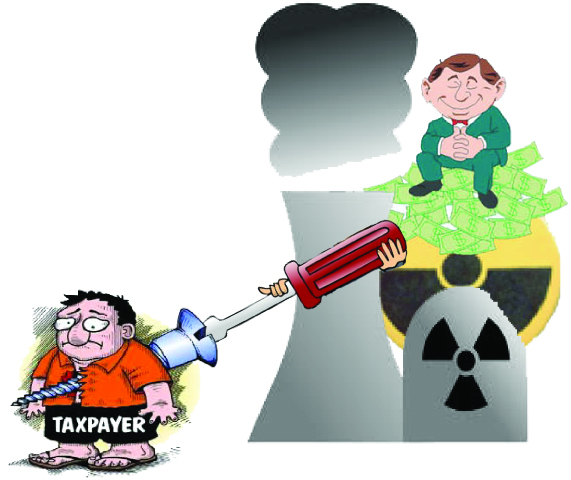
“It’s as we suspected”, says the Chair of the Nuclear Free Local Authorities, expressing his disappointment that once more the UK Government is providing a subsidy to the nuclear industry by absolving operators of the need to pay compensation in the event of an accident.
In a letter to Energy Minister Lord Callanan, Councillor David Blackburn asked how nuclear operators, at present French-owned EDF Energy, would be expected to comply with the requirements of the revised provisions of the Paris Convention that they pay out up to 700 million Euro in damages after an accident, whether through taking out insurance with private-sector underwriters to pay the compensation in the event of an accident or by setting aside funds in an escrow account. This liability will increase by a further 100 million Euro in each of the next five years.
In the letter, Cllr Blackburn also expressed the NFLA’s fears that the UK Government would provide a taxpayer funded bailout for the industry by taking on the liability itself, and Lord Callanan’s reply, citing an immature insurance market, makes it clear that this will indeed be the case: ‘the Government has agreed initially to provide an indemnity, for an economic charge, to cover increased personal injury liabilities for the 10-to-30-year period’.
Commenting Councillor Blackburn said: “This is yet another example of a situation in which nuclear enjoys the benefit of a public subsidy.
“Exactly like the situation with the Nuclear Liabilities Fund, where taxpayers pick up the tab for the cost of decommissioning, which in the last two financial years has meant a further £10.7 billion of public money going to the Fund, the poor suffering British taxpayer will have to shell out up to 1.2 billion Euros, that should be paid by the industry, in the event of a nuclear accident.
“By accepting liability, the government is de-risking nuclear operations. And EDF Energy and its ultimate owner, France, are laughing – they can dodge the liability and walk away scot-free if calamity strikes”.
The NFLA has now sent a request under the Freedom of Information Act seeking further details of the so-called ‘economic charge’ paid by nuclear operator EDF Energy to allow them to evade their legal responsibilities. https://www.nuclearpolicy.info/news/off-the-hook-uk-government-absolves-nuclear-operators-from-accident-liability/
‘A nuclear waste dump and seaside resort don’t go well together’.
Campaigners say the proposal will harm Mabletherpe’s tourism sector. A
proposed nuclear waste dump is hanging over communities like ‘the Sword
of Damocles’, campaigners have claimed.
A company is exploring whether the former Theddlethorpe Gas Terminal could be used to store the waste
underground. They claim it would create 4,000 jobs, and safely store the
radioactive material. However, the Guardians of the East Coast say that the
long decision-making process will harm tourism in Mablethorpe.
Ken Smith, chair of the group, said: “A nuclear waste dump and a bucket-and-spade
resort don’t go well together either. For every job created there, one
could be lost in the tourism industry. “And investment won’t come while
the possibility of the nuclear waste is hanging over Theddlethorpe like the
Sword of Damocles. “It would be better that we found out either way
sooner rather than later. The town will get more run down while a decision
is dragging on.” He likened the long-running fight, which could take 10
to 15 years, to a “war of attrition”.
The Lincolnite 19th Oct 2022
1 This Month



26 September – International Day for the Total Elimination of Nuclear Weapons


PLEASE OPPOSE HR 8255 AND S.3639 – bills would accelerate satellite deployment, with no environmental review or safeguards – https://ncstd5li.quorum.us/campaign/169331/
To see nuclear-related stories in greater depth and intensity – go to https://nuclearinformation.wordpress.com
-
Archives
- September 2026 (233)
- August 2026 (330)
- July 2026 (355)
- June 2026 (287)
- May 2026 (306)
- April 2026 (356)
- March 2026 (251)
- February 2026 (267)
- January 2026 (308)
- December 2025 (358)
- November 2025 (359)
- October 2025 (375)
-
Categories
- 1
- 1 NUCLEAR ISSUES
- business and costs
- climate change
- culture and arts
- ENERGY
- environment
- health
- history
- indigenous issues
- Legal
- marketing of nuclear
- media
- opposition to nuclear
- PERSONAL STORIES
- politics
- politics international
- Religion and ethics
- safety
- secrets,lies and civil liberties
- spinbuster
- technology
- Uranium
- wastes
- weapons and war
- Women
- 2 WORLD
- ACTION
- AFRICA
- Atrocities
- AUSTRALIA
- Christina's notes
- Christina's themes
- culture and arts
- Events
- Fuk 2022
- Fuk 2023
- Fukushima 2017
- Fukushima 2018
- fukushima 2019
- Fukushima 2020
- Fukushima 2021
- general
- global warming
- Humour (God we need it)
- Nuclear
- RARE EARTHS
- Reference
- resources – print
- Resources -audiovicual
- Weekly Newsletter
- World
- World Nuclear
- YouTube
-
RSS
Entries RSS
Comments RSS
 nuclear-news