Middle East investors and French developers for Sizewell C nuclear station to be paid by “an extra tax” on UK public’s bills ?

Alison Downes of campaign group Stop Sizewell C criticised the idea of foreign investors paid with money from ‘an extra nuclear tax on our bills’. She added: ‘The promise of UK energy independence looks pretty hollow if Sizewell C turns out to be French-built and Middle East-funded.’
UAE wealth fund may invest in Sizewell C – Mubadala one of main names in frame to back £20bn nuclear plant. Emirati sovereign wealth fund Mubadala has been tipped as a potential investor in Sizewell C. Sources said the investment group, whose board includes the owner of Manchester City FC, is one of the main names in the frame to back the £20billion nuclear plant.
They suggested talks with the fund may already have taken place. Mubadala is chaired by UAE president Sheikh Mohamed bin Zayed Al Nahyan. Its vice-chairman Sheikh Mansour bin Zayed Al Nahyan bought Manchester City in 2008.
The Government is expected to give the go-ahead to Sizewell C within days with a ‘general investment decision’ that will formalise taxpayer support. The Government and French energy firm EDF, which is developing the power station, are each taking a 20 per cent stake. They are racing to recruit investors to fill a 60 per cent funding gap.
Ministers have put in place a new funding model, the ‘regulated asset base’, which lets investors receive cash back during construction. This is intended to attract pension funds and institutional investors. But they are also said to be approaching potential supporters in the Middle East, Australia and North America.
Alison Downes of campaign group Stop Sizewell C criticised the idea of foreign investors paid with money from ‘an extra nuclear tax on our bills’. She added: ‘The promise of UK energy independence looks pretty hollow if Sizewell C turns out to be French-built and Middle East-funded.’
A BusinessDepartment spokesman said it would ‘not be appropriate to comment on potential investors’.
Mail on Sunday 26th Nov 2022
https://www.thisismoney.co.uk/money/markets/article-11472637/UAE-wealth-fund-invest-Sizewell-C.html
Kamala Harris, nuclear saleswoman extraordinaire, touting small nuclear reactors to Thailand

US to help Thailand harness nuclear energy, Manila Times. By Agence France-Presse, November 28, 2022
IN SEARCH OF CLEAN FUEL A staff member works at the production line of Dunan Metals Co. Ltd in the Thai-Chinese Rayong industrial zone in Rayong province, Thailand, Nov. 8, 2022. The United States will help Thailand develop nuclear power through a new class of small reactors, part of a program aimed at fighting climate change, Vice President Kamala Harris announced on a visit Saturday, November 26. XINHUA PHOTO
BANGKOK: The United States will help Thailand develop nuclear power through a new class of small reactors, part of a program aimed at fighting climate change, Vice President Kamala Harris announced on a visit Saturday.
The White House said the assistance was part of its Net Zero World Initiative, a project launched at last year’s Glasgow climate summit in which the United States partners with the private sector and philanthropists to promote clean energy.
Thailand does not have nuclear power, with the public mood on the issue souring after the 2011 Fukushima disaster in Japan.
The White House said it would offer technical assistance to the Southeast Asian country to deploy the developing technology of small modular reactors, which are factory-built and portable………………
The White House did not give a timeline but said it would support Thailand, which is highly vulnerable to climate change, in its goal of going carbon neutral by 2065.
Harris is visiting the US ally for an Asia-Pacific Economic Cooperation summit and discussed climate efforts in a meeting with Thai Prime Minister Prayut Chan-O-Cha………… https://www.manilatimes.net/2022/11/28/news/world/us-to-help-thailand-harness-nuclear-energy/1868041
Small Modular Nuclear Reactor cost overruns: the same old problems haunt new nuclear in Utah
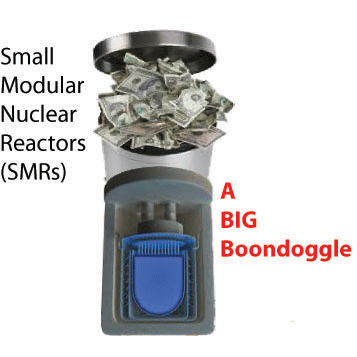
Much hope is being placed on Small Modular Reactors (SMR) making new
nuclear plants competitive. But David Schlissel at IEEFA summarises their
research into the publications, updates and statements coming from the
stakeholders involved with the SMR by UAMPS (Utah Associated Municipal
Power Systems) and NuScale Power Corporation that shows that costs are
going out of control, a persistent problem in the nuclear industry.
The original target power price of $55/MWh has risen to $100 (with subsidies)
and is likely to rise further by the time it’s switched on in 2030, says
Schlissel. Construction costs and delays are the main causes (as usual). So
concerned are potential customers that, since February 2022, only 101MW of
the plant’s total 462MW have been subscribed to.
It will be difficult to
secure financing for the plant without a fully subscribed project.
Meanwhile, IEEFA figures say renewable resources and battery storage will
provide reliable electricity at lower cost than the UAMPS plant, even if
the price for the power from the project is just $58 per MWh. And
renewables and battery costs are still declining.
Energy Post 25th Nov 2022 more https://energypost.eu/small-modular-reactor-cost-overruns-the-same-old-problems-haunt-new-nuclear-in-utah/
The projected cost of new nuclear power has risen by fourfold since 2008 – and it is still rising
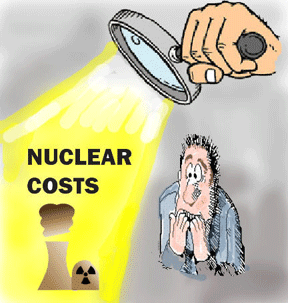
The projected cost of new nuclear power has risen by almost fourfold since
the UK Government made estimates in 2008, and the cost is still rising.
Nuclear analysts warn that the cost to consumers of funding Sizewell C
through the so-called ‘Regulatory Asset Base’ (RAB) model will be much
higher than has been projected by the Government.
In 2008 as the Government argued for more nuclear power stations to be built, the Government, in a
White Paper on nuclear costs, said that each 1.6 GWe EPR reactor would cost
around 2.8 billion. But the most recently released (by EDF) cost of the
Hinkley C EPR double reactor is £25.5 billion (in 2015 prices) and assumes
the plant will be completed by 2027.
This equates to £12.75 billion per
each 1.6 GWe reactor, as reported by World Nuclear News. This is nearly
four times the estimate made by the UK Government in 2008 after inflation
is taken into account.
100% Renewables 25th Nov 2022
UK government underestimated the cost to the public of Regulated Asset Base financing of nuclear power
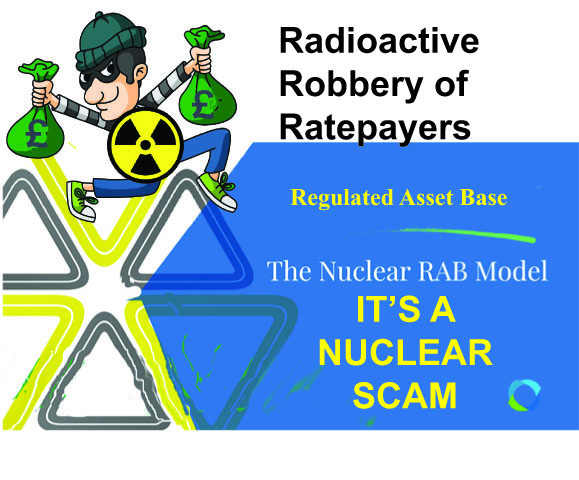
The government has been accused of under-estimating the cost to customers
of its new financing support mechanism for nuclear power, which could add
£100 onto annual bills if ex-prime minister Boris Johnson’s pledge to
roll out a new fleet of the plants is honoured.
At a meeting of the
All-Party Parliamentary Group on Energy Costs, held at the House of Commons
on Wednesday (23 November), University of Greenwich emeritus professor of
energy Steve Thomas criticised the use of the Regulated Asset Base (RAB)
for nuclear projects.
Utility Week 24th Nov 2022
Rolls-Royce calls for formal funding talks over small nuclear plants
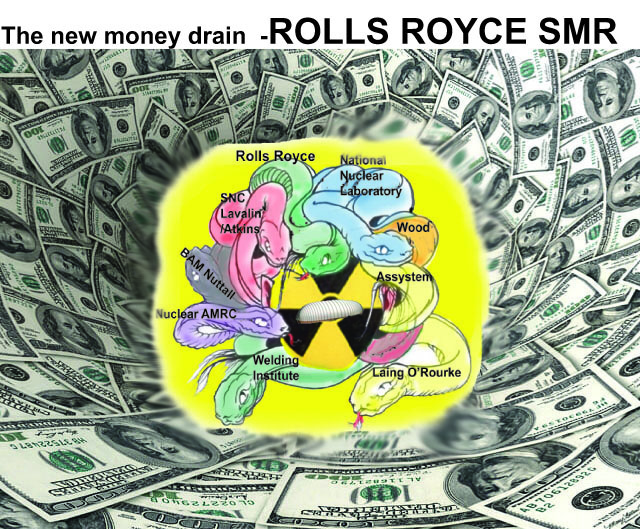
Ft.com Nathalie Thomas in Edinburgh and Sylvia Pfeifer in London, 23 Nov 22
Rolls-Royce has urged the UK government to enter formal negotiations over the funding for small nuclear reactors, which it hopes to build in England or Wales by the early part of next decade.
Tom Samson, head of the company’s small modular reactor business, told a committee of MPs on Wednesday that Britain would face an electricity crisis next decade if it did not push ahead with building more “baseload” power stations that offer a reliable [?] source of generation when weather-dependent renewables including wind and solar are not producing.
Rolls-Royce is leading a consortium that has designed a 470-megawatt [that’s LARGE !] small modular nuclear reactor, which could produce enough power for a city the size of Leeds and would be built in factories before being deployed at existing nuclear sites in England and Wales.
It wants the government to enter formal talks over potential funding models and how the technology could be deployed so it can start building factories. The first Rolls-Royce-designed SMR would cost £2.5bn, although the UK engineering company has argued the cost of each plant will drop to £2bn once it has a pipeline of orders.
……….. the first Rolls-Royce SMR would probably need a funding model underpinned by the government or bill payers.
The company has previously talked about models such as “contracts for difference”, which are used for technologies such as offshore wind and guarantee developers a set price for their output.
Alternatively, it has said it may consider a “regulated asset base” mechanism, whereby a surcharge is added to consumer energy bills long before any plant is operating to help finance schemes.
Samson warned the government it did not have the luxury of spending another two to three years talking about whether to build more nuclear capacity……………
Former prime minister Boris Johnson said while in office that he wanted up to 24 gigawatts of nuclear capacity by 2050 — up from just 5.9GW at present — but chancellor Jeremy Hunt’s recent Autumn Statement referred only to the 3.2GW Sizewell C nuclear project in Suffolk, about which the government is in negotiations with French state-backed energy group EDF. Opponents of nuclear argue that is expensive compared with other technologies.
……………. “The government is investing in these new technologies through the £385mn Advanced Nuclear Fund including £210mn towards the Rolls-Royce SMR programme,” a BEIS spokesperson said. https://www.ft.com/content/21a54a90-1b51-4561-ba9e-c1677e0262ed
—
USA Vice-President For the Nuclear Industry Kamala Harris on a marketing jaunt for NuScam’s Small Nuclear Reactors to Southeast Asia

Thailand, Philippines, Indonesia – nuclear reactors such a jolly idea in this earthquake ring of fire ?
US to supply Thailand, Philippines with modular nuclear reactors
BenarNews staff, 2022.11.23, Bangkok.
The United States says it will help Thailand and the Philippines with a new civilian nuclear technology to reduce climate-damaging emissions, but experts warn the final products are years away from being operational and other hurdles exist.
Plans by the U.S. to supply its longtime Southeast Asian allies with so-called small modular reactors (SMRs) were unveiled during Vice President Kamala Harris’ trip to both countries in recent days.
While attending the Asia-Pacific Economic Cooperation meetings in Bangkok last weekend, Harris launched a new clean energy partnership with Thailand.
From there, the vice president went to the Philippines where she announced that Washington and Manila were starting negotiations on the 123 Agreement, which would allow for civilian nuclear cooperation.
The U.S. nuclear technology plans for Thailand and the Philippines are firsts involving Southeast Asian nations.
The SMRs, which can be as small as a bucket and transportable, are to be constructed under “the highest standards of safety, security and nonproliferation,” officials said.
Another country in Southeast Asia that has shown interest in developing such reactors – Indonesia – appears to be looking at designs from several countries. [Never mind about the earthquakes?]
In a press release, the White House said the new partnership with Thailand would “build capacity for the secure and safe deployment of advanced nuclear reactor technologies.”
“This partnership will help Thailand take advantage of the unique benefits of SMRs that provide 24/7 reliable power, complement other clean energy sources, use a small land footprint and incorporate advanced safety features.”
The Thai government has set a goal of Net Zero Emissions by 2065, but no timeline for the SMR partnership. Washington praised the “unique benefits” of reactors which, besides providing reliable power, also fight climate change.
Small modular reactors generally are defined as advanced nuclear reactors with a capacity of less than 300 MW, according to the International Energy Agency.
A reactor could be as small as a five-gallon (18.9-liter) bucket. The traditional design has fuel and control rods, and energy is transported through boiling water, according to NuScale, a U.S. SMR manufacturer, which estimated initial costs at about U.S. $500 million.
The agreement with Manila calls for the U.S. and the Philippines to cooperate on advanced nuclear technologies to ensure energy security as that Southeast Asian country transitions to clean energy.
Once in force, the 123 agreement “will provide the legal basis for U.S. exports of nuclear equipment and material to the Philippines. The United States is committed to working with the Philippines to increase energy security and deploying advanced nuclear reactor technology as quickly as safety and security conditions permit to meet the Philippines’ dire baseload power needs,” the White House said in a statement.
Under President Ferdinand Marcos Jr.’s father, the late dictator Ferdinand E. Marcos, the Philippines began construction of the Bataan Nuclear Power Plant in 1976, in an area about 100 km (62 miles) west of Manila. The plant, constructed above a major fault line, was mothballed amid safety concerns after the 1986 Chernobyl disaster.
Today, the Philippines runs a couple of research reactors for training and education purposes while Thailand has no nuclear power.
……….. Tanagorn said Thais were concerned about safety in light of the 2011 Fukushima nuclear disaster caused by a tsunami in Japan. Other obstacles are the limited number of investors and the lack of domestic laws and regulation of nuclear activities.
John Timmer, science editor of Ars Technica, a web portal focusing on science and technology, said that with nuclear reactors, the principle is always “safety first.”
“The approval process for that reason tends to be long and includes a lot of documentation,” he said.
“The SMRs are designed to be much safer, but they haven’t been built (in the U.S.) in a final form yet, so it’s difficult to say whether the real-world experience will show that to be the case and also how useful they’ll be for addressing climate change,” Timmer told BenarNews.
“I’ve been hearing about SMRs for about a decade,” he said, adding that “until we build and get a sense what operating them is like and what costs are like, I’m going to be a bit skeptical.”
Cost is another obstacle.
“We’ve never built one of these, so this is going to be a learning experience and for the first few years. It’s going to be more expensive and more complicated to complete,” Timmer said.
‘Widespread misconceptions’
Economist John Quiggin, a professor at the University of Queensland in Australia, listed economic viability of nuclear power plants compared to coal, gas or solar and wind facilities as one of the “widespread misconceptions.”
“When pressed, nuclear fans will mostly shift the argument to the ill-defined notion of ‘small modular reactors,’ which don’t actually exist, and may never [exist],” Quiggin said, noting there are operating examples of small reactors, but “those are made on a one-off basis and are expensive because they forgo size economies.”
Once the reactors can be factory-produced “the ‘modular’ idea is to counter this loss with the economic gains of high-volume,” he said.
“There has been a lot of talk lately about a revival of nuclear power, partly in response to the need to replace the energy previously supplied by Russia, and partly as a longer-term response to climate change,” Quiggin said.
While in office U.S. President George W. Bush launched a nuclear power program, which led to talks of a “nuclear renaissance” but yielded only two projects despite no effective opposition “except from consumers objecting to the massive costs.”
Quiggin expects that the number of SMRs constructed will be also “tiny.”
“The work of decarbonizing energy supply will be done almost entirely by the sun and the wind,” he said.
Jason Gutierrez in Manila contributed to this report. https://www.benarnews.org/english/news/philippine/nuclear-reactors-11232022142149.html
U.S. Nuclear Reactors Among the Oldest in the World
NUCLEAR PROGRAMS
Statista, by Katharina Buchholz, Nov 23, 2022,
The United States’ 92 nuclear reactors currently in operation have a mean age of 41.6 years, the third oldest in the world. The only nuclear fleets that are older are those of Switzerland (46.3 years) and Belgium (42.3 years). Also older are the singular reactors in use in Armenia and the Netherlands.
The U.S. was among the first commercial adopters of nuclear energy in the 1950s, explaining the number of aging reactors today. A building boom between the 1960s and 1970s created today’s nuclear power plants in the United States. The five reactors completed in the 1990s and the one finished in 2016 were all holdovers of delayed construction projects from the 1970s experiencing roadblocks due to regulatory problems and mounting opposition to nuclear energy. The most recent construction start date of a completed U.S. reactor today is 1978 – one year before the nuclear accident at Three Mile Island, which further cemented the public’s rejection of nuclear energy and the challenges of updating nuclear reactor infrastructure today. However, two reactors started at Vogtle power plant in Georgia in 2013 will join the grid soon as the newest additions to the U.S. fleet. They too experienced many regulatory and other delays, culminating in the bankruptcy of the reactor construction company. The U.S. government stepped in with a loan so that the project can now be finished almost 17 years after its initial proposal.
The U.S. today is one of only 15 countries which the World Nuclear Industry Status Report lists as actively pursuing nuclear energy. This includes new nuclear programs in the United Arab Emirates, Belarus and Iran that were started in the past decade only, as well as a younger program in China that started producing power in 1991 and today has a mean reactor fleet age of just nine years. India, running a nuclear energy program since 1969, nevertheless saw much more recent construction than the U.S., achieving a current mean reactor age of 24.2 years. Many European countries which were early adopters of the technology are meanwhile phasing out their programs, at times before the end of reactors’ expected lifespans……….. https://www.statista.com/chart/28805/mean-age-of-nuclear-reactor-fleets-in-selected-countries/
Costs of NuScam’s Small Modular Nuclear Reactors revised upwards – yet again!

According to industry reports the builders of the NuScale small modular reactor (SMR) project recently submitted revised cost estimates to their muni and co-op partners. Initial cost estimates were for power to be produced at about $58/MWh. This figure was recently revised upwards to roughly $90-$100/Mwh, a projected price increase of 60-70%.
The causes cited by management for these price increases were twofold: inflation (in material costs, i.e. steel) and higher interest rates. This initial NuScale project located at the federal government’s Idaho National Laboratories in Idaho Falls would consist of six 77 MW reactors with the units slated to enter commercial service in 2029-2030. These estimates of per KWH cost are significantly above those we have seen recently for renewables plus storage.
Oil Price 21st Nov 2022
Even with billions of dollars in tax credits, costs skyrocket at U.S. Small Modular Reactor Project
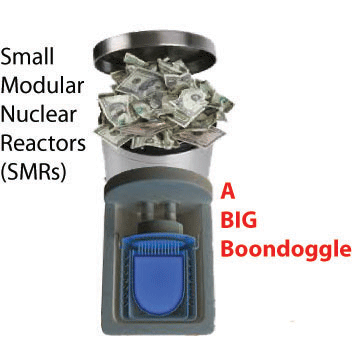
Costs Skyrocket at U.S. Small Modular Reactor Project https://www.theenergymix.com/2022/11/18/costs-skyrocket-at-u-s-small-modular-reactor-project/?fbclid=IwAR2o88KrFfN4Z5XD2pX8Kwpqk1eNAzrBmYFFcAySiVwckPjbA2aZ-311Je8 November 18, 2022
Higher steel costs and rising interest rates are taking the blame after a small modular nuclear reactor project in Utah reported a cost increase from US$58 to $90 or $100 per megawatt-hour for the electricity it’s meant to produce.
Utah Associated Municipal Power Systems is planning to bring the six NuScale reactors online in 2029 with combined output of 462 megawatts. But “the rise in prices likely means the UAMPS project will not hit certain engineering, procurement, and construction benchmarks, allowing participants to renegotiate the price they pay or abandon the project,” Utility Dive reports.
“It was like a punch in the gut when they told us,” said Scott Hughes, power manager for Hurricane City Power, one of the 27 municipal utilities that had signed on to buy power from UAMPS’ advanced nuclear Carbon Free Power Project (CFPP).
“The increased costs in the new Class 3 cost estimate currently being finalized for the CFPP have been shocking, even to NuScale and Fluor, the company responsible for overall management of the project,” the Institute for Energy Economics and Financial Analysis (IEEFA) writes, citing minutes of an October, 2022, Idaho Falls Power Board meeting.
Another municipal utility official called the increase a “big red flag in our face”.
The new cost projections factor in billions of dollars in tax credits the project would receive under the Biden administration’s Inflation Reduction Act, amounting to a 30% saving. IEEFA estimates the total subsidy at $1.4 billion.
Without the IRA, the cost per megawatt-hour would be closer to $120. Utility Dive and IEEFA both say any price above $58/MWh could allow the utilities to renegotiate their contracts or leave the project with no financial penalty.
“The next question is what are we going to do instead?” Hughes told Utility Dive. “Or what if the project fails, what are we gonna do? There’s not a lot of options.”
Then again, if other cities abandon the CFPP, it “might just fail anyway,” he added.
With seven years remaining before the project goes online, Hughes said material costs and interest rates could come back down. But the history doesn’t back that hope. “Nuclear industry experience over the past four decades points to the likelihood of future cost increases and schedule delays during all phases of the project—design, construction, licencing, and testing,” IEEFA says.
The institute cites the Vogtle nuclear project in Georgia, the only new reactors currently under construction in the U.S., where costs have increased 140% and work has fallen more than six years behind schedule since construction began in 2011.
UAMPS doesn’t plan to complete design work until 2024, and has eight years of design, licencing, construction, and pre-operational and start-up testing ahead. (IEEFA puts the project start date at 2030, not 2029.) But even at today’s revised pricing, “a target power price between $90 and $100 per MWh will make the CFPP even more uneconomic compared to renewable and battery storage resources costs that are expected to continue to decline over the next decade.”
In October, analysis by investment banking giant Crédit Suisse found that IRA funding combined with other available tax credits would bring solar project costs in as low as $4 per megawatt-hour, or less than half a penny per kilowatt-hour, falling to zero (literally) in the second half of the decade.
UK’s Sizewell nuclear project remains unfinanced
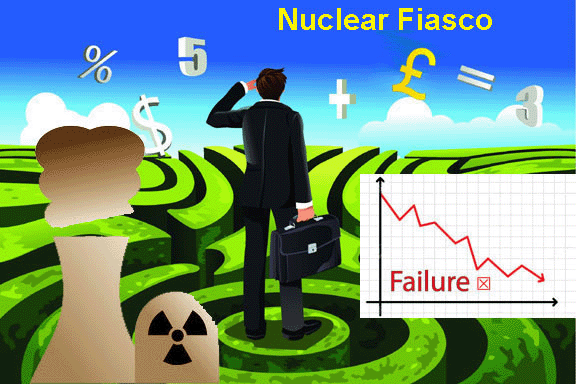
Alistair Osborne: The wind of change with no direction. Sizewell all at C.
Sometimes the brackets do a lot of work: “The government will continue to
secure the UK’s energy security through delivering new nuclear power,
including Sizewell C (subject to final agreement)”.
How far away is that deal? Maybe an unbuilt nuke on a Suffolk flood plain really can attract an
investor fan club. But, as yet, this £20 billion to £30 billion project
— the top end, natch, knowing nuclear — remains unfinanced.
France’s EDF only wants about 20 per cent of the project, with the taxpayer possibly
taking a fifth. And the only money pledged to date is the £700 million
from Boris Johnson on his way out of No 10. Final agreement may prove some
way off.
Times 18th Nov 2022
https://www.thetimes.co.uk/article/alistair-osborne-the-wind-of-change-with-no-direction-w8kcq5l9b
USA desperate to sell NuScam’s small nuclear reactors – its latest targeted buyer is Thailand
Kamala Harris – nuclear saleswoman
BANGKOK: The United States will help Thailand develop nuclear power through a new class of small reactors, part of a programme aimed at [?] fighting climate change, Vice President Kamala Harris announced on a visit Saturday (Nov 19).
The White House said the assistance was part of its Net Zero World Initiative, a project launched at last year’s Glasgow climate summit in which the US partners with the private sector and philanthropists to promote [?]clean energy…………
Harris, who is visiting the US ally for an Asia-Pacific Economic Cooperation summit, will discuss the nuclear power initiative in a meeting later Saturday with Thai Prime Minister Prayut Chan-o-cha…………. more https://www.channelnewsasia.com/world/us-help-thailand-develop-small-nuclear-reactors-3085781
The fading promise of low-cost power from UAMPS’ Small Modular Reactors – Institute for Energy Economics and Financial Analysis
Small Modular Reactor Update: The Fading Promise of Low-Cost Power from
UAMPS’ SMR. The original target power price for a planned 12-module SMR by
UAMPS (Utah Associated Municipal Power Systems) and NuScale Power
Corporation was $55 per megawatt-hour (MWh).
When UAMPS reduced the size of the carbon-free power plant (CFPP) to six modules in the summer of 2021, it raised the target power price to $58 per MWh. Recent presentations to the
power boards of Washington City and Hurricane, two of the Utah communities
that have signed agreements to buy power from the CFPP, suggest that
project power prices are now likely to end up in the range of $90-$100 per
MWh.
The prices include an anticipated $1.4 billion subsidy from the U.S.
Department of Energy and a new subsidy from the Inflation Reduction Act
(IRA) on the order of $30 per MWh. The unsubsidized price of the power from
the CFPP would be substantially higher than $100 per MWh, perhaps even
double the current $58 target price.
IEEFA 17th Nov 2022
https://ieefa.org/resources/small-modular-reactor-update-fading-promise-low-cost-power-uamps-smr
France’s EDF, Credit Agricole sign 1 bln euro nuclear loan

https://www.reuters.com/business/energy/frances-edf-credit-agricole-sign-1-bln-euro-nuclear-loan-2022-11-18/ LONDON, Nov 18 (Reuters) – EDF (EDF.PA) and Credit Agricole (CAGR.PA) said on Friday they had signed a 1 billion euro ($1.04 billion) loan to finance the maintenance of nuclear power plants in France.
The loan is part of EDF’s major refit programme to improve the security and extend the operating life of nuclear reactors beyond 40 years.
The deal is the first transaction in which the funds will be entirely dedicated to investments in EDF’s nuclear activities, Credit Agricole and EDF said in a statement.
Westinghouse deal for Poland ushering in a new nuclear wave. Can it deliver on time and on budget?

Westinghouse spokeswoman Cathy Mann said last week that it was “too soon to say how financing will play out until we get further into developing the agreements and contracts.”
“The U.S. EXIM bank will offer robust financing,” she said, and because of its involvement, “U.S. content will be maximized.”
It was the first year that the International Atomic Energy Agency, which monitors nuclear power plants all over the world and ensures nonproliferation, had its own pavilion at the global climate event, Director General Rafael Mariano Grossi boasted on Wednesday in Egypt. He spent the day hosting panels and answering questions about how this nuclear wave differs from the ones that came before it.
ANYA LITVAK Pittsburgh Post-Gazette alitvak@post-gazette.com 14 Nov 22
Sebastian Barkowski, Poland’s special envoy for international climate and energy cooperation, arrived at the global climate summit in Egypt as a member of a new club: the nuclear club.
Earlier this month, his government picked Cranberry-based Westinghouse Electric Co. to supply the first three nuclear reactors to Poland, with another three units to be awarded in the future.
The deal, which is estimated to be worth about $20 billion, was in the works for a few years and represents Westinghouse’s first sale of its AP1000 plant abroad since it launched the reactor design in a deal with China in 2007.
Until the last moment, it was a geopolitical nail biter, with high-ranking U.S. officials such as Energy Secretary Jennifer Granholm and Vice President Kamala Harris intervening on Westinghouse’s behalf, and the U.S. nuclear firm filing a lawsuit against Korea Electric Power Corp. which had also submitted a bid for the Polish project.
Poland is surrounded by countries with nuclear power fleets but the large European nation never got its only attempt at nuclear off the ground.
Burning coal supplies 75% of its electricity needs, Mr. Barkowski said during a panel at COP27 on Wednesday, and driving that number down to meet climate goals was the main motivation behind Poland’s plan to build between 6 and 9 gigawatts of nuclear power. In 2020, the Polish government signed an intergovernmental agreement with the U.S. and Westinghouse to pursue this plan.
It was the first year that the International Atomic Energy Agency, which monitors nuclear power plants all over the world and ensures nonproliferation, had its own pavilion at the global climate event, Director General Rafael Mariano Grossi boasted on Wednesday in Egypt. He spent the day hosting panels and answering questions about how this nuclear wave differs from the ones that came before it.
In a conversation with Mr. Grossi, Fatih Birol, the executive director of the International Energy Agency, revised his year-ago prediction that “nuclear may well make a comeback” to a more definitive “nuclear is making a comeback.”
When asked what could derail that, Mr. Grossi talked of his fear that a Ukrainian nuclear powerplant in the warzone might suffer an attack that causes a nuclear accident — “the background music of my visit to Zaporizhzhia was bombs and mortars” — and that the fallout from that would ruin nuclear’s momentum the same way that Chernobyl and Fukushima had done.
Mr. Birol, meanwhile, zeroed in on the more mundane issue that has taken the wind out of nuclear’s sails before.
“The nuclear industry, to be honest with you, doesn’t have a very good reputation in terms of delivering on time and on budget,” he said.
With all the new reactor orders piling up, “It is important that the nuclear industry have more discipline,” he said.
That was something that Westinghouse’s future owner, the Canadian nuclear fuel company Cameco Corp. which signed a deal last month to acquire a 49% stake in Westinghouse, thinks about as well.
The Chinese and the Russians are good at building new nuclear plants, Cameco’s CEO Tim Gitzel said during a World Nuclear News podcast last week.
“We in the west now need to show that we’re back in the game and that we can take our share of the market,” he said.
Poland’s project with Westinghouse is a big deal, he said.
“I think there are more to come. And so we need to show the world that we can deliver our projects on time, on budget.”
In the U.S., Westinghouse’s attempt to restart large nuclear construction with a pair of reactors in South Carolina and another two in Georgia ended in bankruptcy in 2017. The South Carolina project was cancelled after billions had already been spent. In Georgia, nuclear fuel was finally loaded into the first reactor last month and the unit is slated to start producing power this year — 15 years after construction began. …………………………………………….
Westinghouse was bringing the lawsuit now, the company wrote in the complaint, because it had gotten word that KEPCO was about to sign a memorandum of intent with a group in Poland and that it had been invited to bid on projects in Czech Republic and Saudi Arabia.
Providing the technical information requested in those bids would trigger Westinghouse’s responsibility under U.S. nuclear export regulations, the company argued, and KEPCO has been non-committal about cooperating in the process.
So Westinghouse is asking the court to “enjoin defendants from delivery of technical information regarding Korean reactor designs outside the Republic of Korea,” specifically in Poland, Saudi Arabia and Czech Republic.
KEPCO had not filed a reply as of Wednesday.
Show me the money
A 15-year construction project is extremely difficult to finance, Dario Liguti, director of Sustainable Energy at the United Nations Economic Commission for Europe, said during a COP27 panel on nuclear financing.
That’s partly why “the nuclear plants that have been built, have been built with public money,” he said.
Countries like China, Russia, or France, where nuclear companies are at least partially owned by the government, offer the backing of the government when financing new builds.
In the U.S., that role, albeit much diminished, is filled by the U.S. Export-Import Bank, which provides financing for entities to buy American products and services.
The U.S. government has a variety of reasons to help such projects along.
A recent analysis of nuclear financing by researchers at Columbia University’s Center on Global Energy Policy includes this list: “supporting American jobs, assisting other countries’ decarbonization efforts and confronting the broader problem of climate change, reducing other countries’ fossil fuel dependencies for geopolitical reasons, limiting Chinese and Russian influence in general, and the national security value in the United States having some role in international nuclear reactor commerce.”
Export-Import Bank, which helped to finance dozens of nuclear export deals, mostly in the 1970s, hasn’t done any in decades.
Westinghouse asked for up to $5 billion in export assistance from ExIm when it sold the first four AP1000 units to China, the analysis said, and while the bank approved the request, the project did not end up using the offer.
In Polish newspapers, government officials suggested that the Westinghouse offer included $17 billion in financing, including through ExIm.
Elias Gedeon, Westinghouse senior vice president of commercial operations, said during an interview at an economic forum in September that the proposed financing also includes money from Westinghouse and Bechtel, the engineering and construction firm that took over the AP1000 project in Georgia in 2017.
“This is something that we have not done before,” Mr. Gedeon said, “but we have committed to put equity in this project in Poland.”
Westinghouse spokeswoman Cathy Mann said last week that it was “too soon to say how financing will play out until we get further into developing the agreements and contracts.”
“The U.S. EXIM bank will offer robust financing,” she said, and because of its involvement, “U.S. content will be maximized.”
Westinghouse is also continuing to sign agreements with companies in Poland and in other European countries to establish a European supply chain that could handle not just the Polish nuclear project but the others that might follow. Last year, it opened a shared global services center in Krakow which now employs 165 people and more will be hired, she said. In southwestern Pennsylvania, Westinghouse had about 3,100 employees at the end of last year.
Asked if Westinghouse can stick to the timeline envisioned in the Polish plan, Ms. Mann said that Westinghouse has learned from its experience delivering the first AP1000 plants in China and in Georgia.
On social media networking site LinkedIn last month, Westinghouse’s CEO Patrick Fragman thanked the governments of Poland and the U.S. for shepherding this agreement and promised full speed ahead.
“We are ready, able and willing to move very fast now.” https://www.post-gazette.com/business/powersource/2022/11/14/new-nuclear-faces-old-skepticism-can-it-deliver-on-time-and-on-budget/stories/202211130052
1 This Month
Chernobyl: The Lost Tapes – A good documentary on Chernobyl on SBS available On Demand for the next 3 weeks– https://www.sbs.com.au/ondemand/tv-program/chernobyl-the-lost-tapes/2352741955560

of the week–London Campaign for Nuclear Disarmament

Tell the Ukrainian Government to Drop Prosecution of Peace Activist Yurii Sheliazhenko
To see nuclear-related stories in greater depth and intensity – go to https://nuclearinformation.wordpress.com
-
Archives
- April 2026 (152)
- March 2026 (251)
- February 2026 (268)
- January 2026 (308)
- December 2025 (358)
- November 2025 (359)
- October 2025 (376)
- September 2025 (257)
- August 2025 (319)
- July 2025 (230)
- June 2025 (348)
- May 2025 (261)
-
Categories
- 1
- 1 NUCLEAR ISSUES
- business and costs
- climate change
- culture and arts
- ENERGY
- environment
- health
- history
- indigenous issues
- Legal
- marketing of nuclear
- media
- opposition to nuclear
- PERSONAL STORIES
- politics
- politics international
- Religion and ethics
- safety
- secrets,lies and civil liberties
- spinbuster
- technology
- Uranium
- wastes
- weapons and war
- Women
- 2 WORLD
- ACTION
- AFRICA
- Atrocities
- AUSTRALIA
- Christina's notes
- Christina's themes
- culture and arts
- Events
- Fuk 2022
- Fuk 2023
- Fukushima 2017
- Fukushima 2018
- fukushima 2019
- Fukushima 2020
- Fukushima 2021
- general
- global warming
- Humour (God we need it)
- Nuclear
- RARE EARTHS
- Reference
- resources – print
- Resources -audiovicual
- Weekly Newsletter
- World
- World Nuclear
- YouTube
-
RSS
Entries RSS
Comments RSS
 nuclear-news