The planet’s economist: has Kate Raworth found a model for sustainable living?

Her hit book Doughnut Economics laid out a path to a greener, more equal society. But can she turn her ideas into meaningful change?
by Hettie O’Brien, Guardian, 8 June 23
The problem is that there are few templates for an economy that
radically shrinks the world’s carbon footprint without also shrinking our
quality of life. The economist Kate Raworth believes she has a solution.
It is possible, she argues, to design an economy that allows humans and the
environment to thrive. Doing so will mean rejecting much of what defined
20th-century economics. This is the essential premise of her only book,
Doughnut Economics: Seven Ways to Think Like a 21st Century Economist,
which became a surprise hit when it was published in 2017.
The book, which
has been translated into 21 languages, brings to mind a charismatic
professor dispensing heterodox wisdom to a roomful of students. “Citizens
of 2050 are being taught an economic mindset that is rooted in the
textbooks of 1950, which in turn are rooted in the theories of 1850,”
Raworth writes.
By exposing the flaws in these old theories, such as the
idea that economic growth will massively reduce inequality, or that humans
are merely self-interested individuals, Raworth wants to show how our
thinking has been constrained by economic concepts that are fundamentally
unsuited to the great challenges of this century.
Guardian 8th June 2023
France fully nationalises debt-laden nuclear power group EDF, after its record loss last year

EDF quits Paris stock exchange after full nationalisation. French nuclear
power group EDF (EDF.PA) returns to full state ownership on Thursday with
its de-listing from the Paris stock exchange after it suffered a record
loss last year and saw nuclear output fall to a 34-year low.
The government launched a buyout for the 16% stake it did not already own in EDF in late
2022, stumping up around 10 billion euros ($10.9 billion) to take full
control of the debt-laden operator of Europe’s largest fleet of nuclear
power plants.
Reuters 8th June 2023
https://www.reuters.com/business/energy/french-utility-giant-edfs-history-2022-07-08
Lockheed Martin CEO James Taiclet super ecstatic over USA govt’s budget deal.

There you have it folks. Galloping defense spending on perpetual warfare and 835 overseas bases, enriching James Taiclet and his defense CEO comrades. Meanwhile every decent, life enhancing aspect of American life gets the scrapes leftover.
Walt Zlotow, West Suburban Peace Coaliton, Glen Ellyn IL 5 June 23
Only American happier than Biden with budget deal
Everyone knows President Biden is ecstatic over the budget deal which prevents another default crisis during his last 2 years
But few knew the guy even happier than Biden, Lockheed Martin CEO James Taiclet. He’s super ecstatic the deal provided a 3% bump to $886 billion in defense spending, while other areas of discretionary spending are frozen at current year levels.
Taiclet wasn’t bashful about bragging over the victory garnered in part by $13 million Taiclet speeds every year lobbying Congress to keep defense spending racing upwards toward a trillion bucks in blood money.
He told defense investors at the Annual Strategic Decisions Conference after the fix was in for weapons makers:
“The current agreement…is 3 percent growth for two years in defense where other areas of the budget are being reduced. And I think, again, that’s as good an outcome as our industry or our company could ask for at this point.”
Lockheed Martin, America’s largest defense contractor, receives 73% of its $66 billion annual sales net sales from the U.S. government. Taiclet is equally thrilled personally as well as for his shareholders. His $24 million in annual compensating largely consists of performance related bonuses.There you have it folks. Galloping defense spending on perpetual warfare and 835 overseas bases, enriching James Taiclet and his defense CEO comrades. Meanwhile every decent, life enhancing aspect of American life gets the scrapes leftover.
AUKUS Fissile or Fizzer? Rex Patrick on the trouble with Virginia Class second hand submarines

In what Paul Keating has described as ‘the worst deal in all history’, we’ve decided to buy into more second hand military hardware from the US; this time Virginia class nuclear submarines.
ED note – and we are left with their toxic wastes, also
by Rex Patrick | Jun 5, 2023 https://michaelwest.com.au/aukus-fissile-or-fizzer-rex-patrick-on-the-trouble-with-virginia-class-second-hand-submarines/
Former submariner Rex Patrick looks under the hood of the second-hand Virginia-class nuclear submarines to see what Australia has bought. Even AUKUS fans might not like what they see.
February 2011 is a time many in the Royal Australian Navy (RAN) would certainly prefer to forget. Within the month, the Defence Minister Stephen Smith had announced a number of trouble-plagued military landing craft would be disposed of and a review would be conducted into Support Ship Repair and Management Practices. Four months later Chief of Navy, Vice Admiral Russ Crane, was gone.
On February 3, 2011, the biggest storm to have ever hit Queensland crossed the Australian coastline and carved a swath of destruction across the state. The storm displaced 10,000 people and caused $3.5 billion in damage. And the Navy was unable to respond with any amphibious ships to help Queenslanders.
On September 26, 2010, the Defence Minister had been advised that two former US Navy ships, HMAS Manoora and HMAS Kanimbla, were in what was described as an ‘operational pause’. By December the decision was made that Manoora would be decommissioned, although that news never made it to the Minister until January 28, 2011, when a tropical depression was forming off Queensland. The Minister was also advised that Kanimbla was to be unavailable to the RAN for 18 months.
That left HMAS Tobruk, a 30 year old ship, as the standby ship. On February 28, the Navy advised the Minister it was on 48 hours’ notice to go to sea. By February 2, with Yasi now a category 5 cyclone, Tobruk entered dock for emergence repairs. It left the dock two days later but was unfit to sail for any of the Yasi response.
The Navy had failed Australians.
Rust buckets
Manoora and Kanimbla were naval clunkers. The two elderly ships had been picked up from the US Navy as an ‘opportunity buy’. There’s normally a reason things come at a bargain basement price. (Our Air Force made the same mistake after it bought second hand C-27J Spartan light tactical aircraft from the US Air Force that don’t do the job… we never learn.)
The Auditor-General detailed the saga in his September 2000 Amphibious Transport Ship Project Audit. After the RAN inspected the two ships in early 1994 the ships were bought for the grand price of $61 million. A $55 million contract was immediately signed with Newcastle’s Forgacs shipyard to do a quick overhaul.
The quick upgrade went from 14 months to 44 months and the price went to $203 million. As the Auditor finished up his work at the turn of the millennium, the price was closing in on $450 million.
That Defence bought rust buckets and spent almost 10 times the purchase cost repairing them just meant It was ‘operations normal’.
Second hand Virginias
Fast forward to 2023. Have we learned any lessons? It appears not.
In what Paul Keating has described as ‘the worst deal in all history’, we’ve decided to buy into more second hand military hardware from the US; this time Virginia class nuclear submarines.
Under questioning from Senator Jacqui Lambie at Estimates last week, the Navy revealed that the submarines we’ll likely get in the mid-2030s are boats built from 2020.
The estimated reactor life of the Virginia-class boats is 33 years. So we will hope to get about 20-years out of these second-hand vessels. The actual time they’ll be available for operations will be much less when you take into extended maintenance and refits.
The head of the nuclear submarine program, Vice Admiral Mead, suggested that we might get one new boat, if we’re lucky (we’ll get what we’re told by the US Congress).
The Chief of Navy, Vice Admiral Hammond, assured the Senate that we won’t see a repeat of the Manoora and Kanimbla debacle, saying the Navy’s ‘subsafe’ program won’t allow that.
Getting a grip
But even if Admiral Hammond is right (and Defence’s credibility on procurement is pretty well shot), the fact is that the Virginia Class program has some problems Australia is unlikely to be able to deal with.
The first highly noticeable issue with the Virginia class is a problem that has surfaced with the submarine’s acoustic coating that’s designed to reduce the ‘target strength’ of the submarine (how much sound energy from an enemy active sonar bounces off the submarine, back to the enemy).
The coating is prone to peeling off at high speed leaving loose cladding that slaps against the hull, making dangerous noise, and causes turbulent water flow, which also causes dangerous hull resonance (where the hull sings at its resonant frequency, like a tuning fork) and extra propulsion noise. I know a bit about this as a former underwater acoustics specialist.
The issue, reported in 2017 and again in 2019, is easily seen on the side of the submarine andalmost certainly without a fix at this stage.
Admiral Hammond tried to brush off the issue in the Senate. In response to Senator Lambie, he claimed that the photos she had tabled were of submarines that had come to the end of long patrols. But submarines are designed to do long patrols. I wonder how comfortable the Admiral would be landing at Heathrow Airport in London from Sydney, with the aircraft captain advising the parts of the wings normally fall off on long haul flights.
It’s not OK for our submariners to find that the boats they are using to keep us safe become noisy, and thus increasingly vulnerable to detection and destruction, halfway through their deployment.
Lack of availability
The bigger problem for Australia is the challenge the US Navy is encountering keeping (particularly) aging Virginia-class submarines at sea. Part of the problem is parts supply difficulties, with cannibalisation (taking parts from other submarines) regularly happening to keep a diminished number of boats at sea.
A November 2022 press report stated, “The U.S. Navy has nearly twice as many submarines sidelined for maintenance than it should, and those boats in maintenance ultimately require three times more unplanned work than they should, the program executive officer for attacks subs has said”.
It went on to say, “Of the 50 attack subs, [Rear Admiral] Rucker said 18 are in maintenance or waiting for their turn. Industry best practice would call for just 20% to be tied up in repairs, or 10 boats instead of 18”.
If the US Navy is having difficulty with keeping its boats at sea, with significant in-country industrial capability, how will Australia hope to keep our Virginia subs at sea? Our second-hand, ageing boats may spend as much time undergoing maintenance at Australian dockyards, or more likely waiting in a queue at a US dockyard, as they might be available for operations.
We may be eventually end up getting eight AUKUS submarines, only to find we can only keep two, instead of three in a fully operational state.
Absurdity
That would be $368 billion to have only one or two submarines are sea. And that’s just absurd. There were, and still are other, more sensible and cost-effective paths available.
Sometime in the future Australia may face the strategic equivalent of Cyclone Yasi, a defence contingency in which the number of operational submarines we have available will be of vital importance to our national security.
Tragically, however, absurd is ‘operation normal’ for Defence procurement. SNAFU
Amidst all the enthusiastic promotion of Small Nuclear Reactors, there’s still the admission that SMRs are simply unaffordable

The future of energy: small modular reactors (SMRs) and nuclear power, small caps, By Colin Hay June 5, 2023
‘………………………………………………………………………………………… A recent report from international energy analysts Wood Mackenzie, suggested that lower costs technological developments such as small modular reactors (SMRs) may help speed up the introduction of new nuclear power plants……………………
However, the company added that for nuclear power to flourish, governments, developers and investors must work together to establish a new nuclear ecosystem, one that makes nuclear affordable………………
According to one Wood Mackenzie report, ‘The nuclear option: Making new nuclear power viable in the energy transition’, despite policy support and market growth, cost is the biggest economic hurdle to the uptake of more nuclear power and the much-vaunted small modular reactors systems…………………..
“The nuclear industry will have to address the cost challenge with urgency if it is to participate in the huge growth opportunity that low-carbon power presents. At current levels, the cost gap is just too great for nuclear to grow rapidly,” said David Brown, a Director, Energy Transition Service at Wood Mackenzie, and lead author of the report.
Mr Brown said scaling up the SMR market will depend on how fast costs fall to a level that is competitive against other forms of low-carbon power generation.
According to Wood Mackenzie estimates, conventional nuclear power currently has a levelised cost of electricity (LCOE) of at least four times that of wind and solar……………..
CSIRO plays down SMR’s Australian potential
Australia’s leading science agency, the CSIRO, has also recently raised the cost issue with regard to the local introduction of new nuclear technology.
In a recent report, “The question of nuclear in Australia’s energy sector”, the CSIRO noted that there has been increased debate around the use of nuclear power in Australia.
………. the report suggested that at present, the numbers don’t stack up.
“… a review of the available evidence makes it clear that nuclear power does not currently provide an economically competitive solution in Australia – or that we have the relevant frameworks in place for its consideration and operation within the timeframe required,” the CSIRO report said.
……. The report noted that only two SMRs are currently in operation, located in Russia and China, and both have experienced cost blowouts and delays.
Paul Graham, a CSIRO energy economist and lead author of the Australian Energy Market Operator’s (AEMO) GenCost report, says more data needs to be provided to support the push for nuclear power in Australia.
He said that with the use of standard formula for levelised costs, plus the additional calculations specific to storage and transmission, wind and solar come in at a maximum of $83 per megawatt hour in 2030.
“In contrast, SMRs come in at $130 to $311 per megawatt hour.”…………………………………………….. m https://smallcaps.com.au/future-energy-small-modular-reactors-smrs-nuclear-power/
Unseemly scramble as makers of small nuclear reactors try to con UK government

NuScale joins Rolls-Royce and Bill Gates in race to build UK nuclear
reactors. A US nuclear developer is poised to join the race to build new
reactors in the UK and has urged the government to go faster in picking a
preferred technology.
NuScale, based in Oregon, said it was “very
active” in the UK market and that it would “engage with the activity
around the government’s SMR competition”.
The UK is running a contest to
find suppliers of small modular reactors (SMRs), which hold the promise of
zero-emission, lower-cost nuclear power as they can be made in a factory
and assembled on site. This reduces the vast overheads of large nuclear
projects.
NuScale is developing an SMR called VOYGR, which is based on a
traditional nuclear design called a pressurised water-cooled reactor. It is
the first SMR to have been certified by the US Nuclear Regulatory
Commission.
The UK government has set up a new body, Great British Nuclear
(GBN), to select new projects. It is aiming to settle on winning SMR
designs by the autumn.

Tom Mundy, president of VOYGR services and delivery,
said NuScale would not require development money from GBN as its project
was ready to deploy. “We don’t need the support that has been suggested
… We’re ready to deliver the project much earlier than GBN has
suggested,” he said. “GBN suggests people could start building SMRs by
2030. That means taking a final investment decision then. That’s too late
for us. We have got customers taking final investment decisions much
earlier,” Mundy added. “Let’s get going.”
NuScale’s rivals in the
race include GE Hitachi, also of the US, and Rolls-Royce, which wants to
win an order in its home market. TerraPower, a start-up founded and chaired
by Bill Gates, has also indicated that it wants to build nuclear projects
in the UK. It has a type of SMR called an advanced modular reactor (AMR) in
development.
Times 4th June 2023
Nuclear energy just helped Finland slash electric costs by a staggering 75% — so why doesn’t the US follow suit? 3 reasons we are cool on the power source
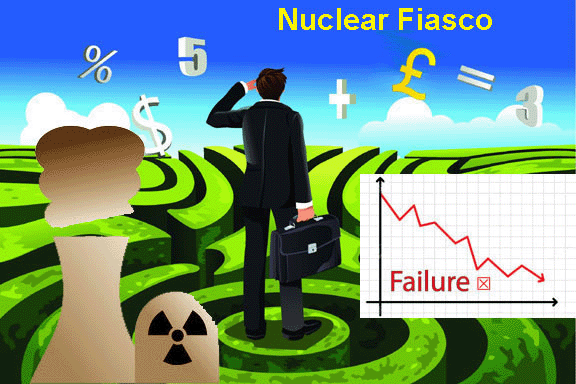
Of course all bets on stability are off in the event of a meltdown — and in terms of catastrophes compared to anything possible with solar or wind, you might also say it’s not even close.
But in the end, nuclear is complicated — and it only takes a tsunami, fat finger on the control panel or mechanical breakdown to once again become reacquainted with the fallout.
Vishesh Raisinghani, Sun, June 4, 2023 https://finance.yahoo.com/news/nuclear-energy-just-helped-finland-110000152.html
The first new European nuclear plant in 16 years has already slashed Finland’s energy bill by three-fourths.
Olkiluoto 3, or OL3, joins two existing reactor units that have powered Finland’s grid for decades. This latest unit adds 1,600 megawatts to the plant’s production capacity — which means 30% of the nation’s electricity will soon come from just one plant on a tiny island in Western Finland.
When the new OL3 unit was fully activated in April, average spot electricity prices fell to €60.55 ($65.69) per megawatt hour. That’s 75.38% lower than the average spot price in December 2022 (€245.98 per megawatt hour).
While its operating company TVO called it “the greatest single climate act in Finland,” others argue that the benefits are hardly worth the risks.
Here’s why most countries are cool on this technology.
Fear
High-profile incidents like at Three Mile Island, Chernobyl and Fukushima have severely impacted the reputation of nuclear energy. Even if an overwhelming number of plants are safe, it only takes one accident to render the land around a plant uninhabitable.
In the U.S., “nukes” (as protesting musicians nicknamed them in the 1980s) continue to be unpopular. The number in the U.S. has dropped from a peak of 107 in 1990 to 93 as of 2022, according to the Pew Research Center.
Roughly 1-in-4 Americans say their government should actively discourage nuclear energy production, which could explain why so few plants have been built over the last 10 years. Yet fear is only part of the equation, as the financial bottom line also plays a crucial role in the lack of any nuclear energy embrace.
Cost
New nuclear power plants are mostly being built in countries where all infrastructure is cheaper to build. China is currently developing 24 new plants — the most in the world. Meanwhile, India is building eight new reactors. It’s simply cheaper to build plants in these regions.
According to the World Nuclear Association, the overnight cost of building a new plant in China, which assumes no interest payments, is $2500/kWe, while the cost in the U.S. is $6041/kWe (short for kilowatt-electric or one thousand watts of electric capacity). This price disparity is another reason why nuclear power isn’t favored in the developed world — though the causes go far beyond this.
Time
Nuclear power takes several years to deploy — and that’s on the conservative end. A plant can typically be constructed over a period of five years. However, regulatory and financial hurdles could delay these projects along the way. Meanwhile, a typical wind farm can be fully deployed in as little as six months, according to EDF Energy.
The classic example of how mismanaged a nuclear project can get is as close as Georgia. There, the third reactor at Plant Vogtle went online at full capacity in late May but was supposed to start generating power in 2016. It was approved for construction in 2009, and overruns pushed the cost to more than $17 million; combined with a fourth reactor still in the testing phase, the total price comes to a staggering $35 billion.
‘The most reliable source’
Indeed, time and cost ultimately represent the biggest barrier to adoption. Even Finland’s energy experts understand the commercial challenges. “[Nuclear] it seems is not very attractive for the investors,” Jukka Ruusunen, chief executive of Finland’s national grid operator Fingrid, told The National.
However, nuclear power has several non-commercial advantages. Unlike wind and solar, nuclear energy output is stable regardless of weather and sunshine hours. The U.S. Energy Department once called it “the most reliable energy source and it’s not even close.”
Of course all bets on stability are off in the event of a meltdown — and in terms of catastrophes compared to anything possible with solar or wind, you might also say it’s not even close.
Russia’s invasion of Ukraine has also highlighted nuclear’s potential to deliver national security and energy independence. Yet the near catastrophes at the Chernobyl plant during the war almost seem to counteract that fact.
On the upside, Finland’s new nuclear plant has helped it avoid blackouts despite sanctions on Russian energy and could help explain why several other European countries are also now pushing for more nuclear power.
But in the end, nuclear is complicated — and it only takes a tsunami, fat finger on the control panel or mechanical breakdown to once again become reacquainted with the fallout.
Unlimited money to Ukraine is now allowed, through USA’s “Debt Sealing” arrangement.

Debt Ceiling Deal Puts No Limits on Ukraine Aid https://scheerpost.com/2023/06/02/debt-ceiling-deal-puts-no-limits-on-ukraine-aid/
Emergency spending that has been used to arm Ukraine is exempt and it could also be used to arm Taiwan
June 2, 2023, By Dave DeCamp / Antiwar.com
The debt ceiling agreement reached between the White House and House Republicans places no constraints on spending on the war in Ukraine, a White House official told Bloomberg.
The $113 billion that has been authorized to spend on the war in Ukraine so far was passed as supplemental emergency funds, which is exempt from the spending caps that are part of the debt ceiling deal.
According to the Congressional Budget Office, funding “designated as an emergency requirement or for overseas contingency operations would not be constrained, and certain other funding would not be subject to the caps.” The deal suspends the nation’s debt limit through January 1, 2025.
Hawks in Congress are looking to use emergency spending to increase the $886 billion military budget that was agreed to as part of the deal. The emergency funds could go beyond Ukraine and might be used to send weapons to Taiwan or for other spending that hawks favor as part of their strategy against China.
“We are almost certainly going to need a supplemental for Ukraine, which is, in my view, one of the most pressing defense challenges we have right now,” said Sen. Richard Blumenthal (D-CT), according to Roll Call. “And the other obligations flow from China and Taiwan on one hand and Russia and Ukraine on the other.”
Other senators said they favor using the emergency funding to raise military spending altogether. The $886 billion budget is what President Biden asked for 2024, but Republican hawks have blasted the request as “inadequate.”
“Clearly our support for Ukraine will be outside the budget, as it has been in the past, but I’d like to see additional support for our own military in emergency supplementals as well,” said Sen. Mitt Romney (R-UT).
The Senate passed the agreement, known as the Fiscal Responsibility Act of 2023, on Thursday night in a vote of 63-36, sending the bill to President Biden’s desk. The legislation was passed through the House on Wednesday in a vote of 314-117.
Dutch government sets many $millions in funding for nuclear power , and to encourage investors in nuclear

Power Magazine, 1 June 23
Government officials in the Netherlands have earmarked more than $350 million to fund further development of nuclear energy in the country, including extending the operating license of the 485-MW Borssele nuclear power plant. The Borssele station at present is the Netherlands only nuclear power facility. Officials in late April released a draft of the “Climate Fund for 2024” that included money for the Borssele extension, along with two new large-scale reactors and a development plan for small modular reactors (SMRs). The draft also said millions of dollars were being set aside to help develop a nuclear power workforce in the Netherlands.
……………………………………………….The draft budget provides more support for development of SMRs, with about $72 million to bring more interest from nuclear power investors.
……………………………….Amsterdam-based ULC-Energy in August of last year signed an agreement with the UK’s Rolls-Royce SMR for collaboration on SMR deployment in the Netherlands……………………………………………….. https://www.powermag.com/dutch-officials-set-funding-for-nuclear-power-program/—
Putin bribes ‘friendly nations’ with use of 24-hour ‘floating nuclear power stations’
As war rages on in eastern Ukraine, Russia’s state-owned nuclear energy company Rosatom has announced it will share floating nuclear power plant (FNPP) technology only with “friendly nations” to help supply electricity.
By ALESSANDRA SCOTTO DI SANTOLO 29 May 23
Russia will supply floating nuclear power plant (FNPP) technology to enable around-the-clock supply of electricity to remote areas of allied countries, the Kremlin-linked energy company announced…………………………………………………….. more https://www.express.co.uk/news/world/1775103/putin-floating-nuclear-power-plant-rosatom-russia—
Rolls Royce to cut thousands of jobs
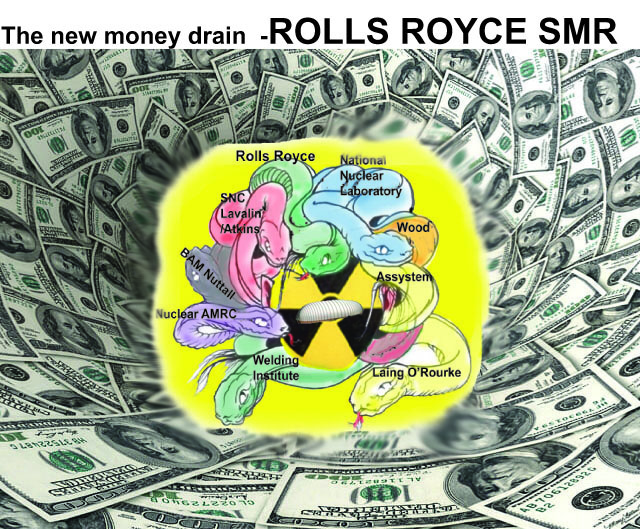
Rolls-Royce is expected to cut thousands of jobs as it launches a dramatic
turnaround plan to save costs. New chief executive Tufan Erginbilgic, who
has described the aero-engineering giant as a “burning platform” that
needs to reform to survive, has parachuted in consultants led by McKinsey
to advise on streamlining the company. Plans to merge departments could cut
10 per cent of the company’s approximately 30,000 non-manufacturing
staff, one consultancy source said. Part of the programme will involve
merging its non-manufacturing departments in each of Rolls’s civil
aerospace, defence and power systems divisions.
Times 27th May 2023
https://www.thetimes.co.uk/article/rolls-royce-prepares-to-swing-the-axe-on-jobs-phlxmxbnk
Point Lepreau nuclear power station – too many expensive shutdowns

Ongoing Lepreau maintenance outage is 5th since 2018 to go over budget.
N.B. Power told to get more ‘realistic’ about its nuclear planning and budgeting
Robert Jones · CBC News · May 24, 2023
N.B. Power is finding itself mired in another slow-moving and pricey maintenance shutdown at the Point Lepreau nuclear generating station after a faulty seal on a pump delayed a restart of the plant last week.
It’s the fifth planned outage at the station since 2018 to hit delays and go over its budget.
The recurring problem is one that an outside review blames largely on optimism inside N.B. Power that maintenance work at the station will go according to plan — despite years of experience showing it rarely does…………………..
Previous planned outages that dragged on longer than expected in 2018, 2019, 2020 and 2022 cost N.B. Power a combined $202 million more than expected, worsening its already fragile finances.
Utility’s struggles linked to Lepreau maintenance problems
A recent Price Waterhouse Coopers Canada review of N.B. Power operations found planned maintenance outages at Lepreau that went poorly have been a key contributor to the utility’s financial struggles.
It blamed much of that on rosy expectations inside N.B. Power that fixing issues at the plant will go better in the future than it has in the past……………………………………. more https://www.cbc.ca/news/canada/new-brunswick/lepreau-maintenance-outage-1.6852499
French defense minister opposes American takeover of nuclear firm
Economy ministry makes the final ruling.
BY GIORGIO LEALI, MAY 24, 2023 https://www.politico.eu/article/french-defense-ministry-to-block-american-takeover-of-nuclear-firm/
PARIS — France’s defense minister Sébastien Lecornu said he would veto the takeover of nuclear-submarine parts supplier Segault by American industrial machinery giant Flowserve.
“The defense ministry will veto the loss of operational control over company Segault,” Lecornu told French lawmakers Tuesday evening. “I never announced it publicly, but it’s done,” he said.
“For us it’s simple: we don’t want Segault to be controlled by an American company,” said an official from the defense ministry who was not authorized to be named.
France’s economy ministry, which has the final word on the file, was however quick to stress that no decision had been made. “The foreign investment screening procedure is ongoing,” said a French economy ministry spokesperson, declining to comment on the potential outcome.
While the defense ministry participates in the decision-making, the French economy ministry makes the final ruling.
France-based Segault is currently owned by Canada’s industrial valves group Velan, which is being bought by American industrial machinery giant Flowserve. If the deal goes through, Segault would become American-controlled, raising concerns in Paris’ halls of power that Washington would then have access to strategic French technology.
Paris last month confirmed that it was looking for a French buyer, as the file turned into a test of France’s industrial sovereignty ambitions.
Segault supplies components for nuclear-propelled submarines built by state-owned shipbuilder Naval Group and also makes industrial valves that are used on France’s flagship Charles de Gaulle aircraft carrier.
America’s Wars and the US Debt Crisis

To surmount the debt crisis, America needs to stop feeding the Military-Industrial Complex, the most powerful lobby in Washington.
JEFFREY D. SACHS, May 20, 2023, Common Dreams https://www.commondreams.org/opinion/military-spending-debt-crisis
In the year 2000, the U.S. government debt was $3.5 trillion, equal to 35% of the Gross Domestic Product (GDP). By 2022, the debt was $24 trillion, equal to 95% of GDP. The U.S. debt is soaring, hence America’s current debt crisis. Yet both Republicans and Democrats are missing the solution: stopping America’s wars of choice and slashing military outlays.
Suppose the government’s debt had remained at a modest 35% of GDP, as in 2000. Today’s debt would be $9 trillion, as opposed to $24 trillion. Why did the U.S. government incur the excess $15 trillion in debt?
The single biggest answer is the U.S. government’s addiction to war and military spending. According to the Watson Institute at Brown University, the cost of U.S. wars from fiscal year 2001 to fiscal year 2022 amounted to a whopping $8 trillion, more than half of the extra $15 trillion in debt. The other $7 trillion arose roughly equally from budget deficits caused by the 2008 financial crisis and the Covid-19 pandemic
Facing down the military-industrial lobby is the vital first step to putting America’s fiscal house in order
To surmount the debt crisis, America needs to stop feeding the Military-Industrial Complex (MIC), the most powerful lobby in Washington. As President Dwight D. Eisenhower famously warned on January 17, 1961, “In the councils of government, we must guard against the acquisition of unwarranted influence, whether sought or unsought, by the military-industrial complex. The potential for the disastrous rise of misplaced power exists and will persist.” Since 2000, the MIC led the U.S. into disastrous wars of choice in Afghanistan, Iraq, Syria, Libya, and now Ukraine.
The Military-Industrial Complex long ago adopted a winning political strategy by ensuring that the military budget reaches into every Congressional district. The Congressional Research Service recently reminded Congress that, “Defense spending touches every Member of Congress’s district through pay and benefits for military servicemembers and retirees, economic and environmental impact of installations, and procurement of weapons systems and parts from local industry, among other activities.” Only a brave member of Congress would vote against the military-industry lobby, yet bravery is certainly no hallmark of Congress.
America’s annual military spending is now around $900 billion, roughly 40% of the world’s total, and greater than the next 10 countries combined. U.S. military spending in 2022 was triple that of China. According to Congressional Budget Office, the military outlays for 2024-2033 will be a staggering $10.3 trillion on current baseline. A quarter or more of that could be avoided by ending America’s wars of choice, closing down many of America’s 800 or so military bases around the world, and negotiating new arms control agreements with China and Russia.
Yet instead of peace through diplomacy, and fiscal responsibility, the MIC regularly scares the American people with a comic-book style depictions of villains whom the U.S. must stop at all costs. The post-2000 list has included Afghanistan’s Taliban, Iraq’s Saddam Hussein, Syria’s Bashar al-Assad, Libya’s Moammar Qaddafi, Russia’s Vladimir Putin, and recently, China’s Xi Jinping. War, we are repeatedly told, is necessary for America’s survival.
A peace-oriented foreign policy would be opposed strenuously by the military-industrial lobby but not by the public. Significant public pluralities already want less, not more, U.S. involvement in other countries’ affairs, and less, not more, US troop deployments overseas. Regarding Ukraine, Americans overwhelmingly want a “minor role” (52%) rather than a “major role” (26%) in the conflict between Russia and Ukraine. This is why neither Biden nor any recent president has dared to ask Congress for any tax increase to pay for America’s wars. The public’s response would be a resounding “No!”
While America’s wars of choice have been awful for America, they have been far greater disasters for countries that America purports to be saving. As Henry Kissinger famously quipped, “To be an enemy of the United States can be dangerous, but to be a friend is fatal.” Afghanistan was America’s cause from 2001 to 2021, until the U.S. left it broken, bankrupt, and hungry. Ukraine is now in America’s embrace, with the same likely results: ongoing war, death, and destruction.
The military budget could be cut prudently and deeply if the U.S. replaced its wars of choice and arms races with real diplomacy and arms agreements. If presidents and members of congress had only heeded the warnings of top American diplomats such as William Burns, the U.S. Ambassador to Russia in 2008, and now CIA Director, the U.S. would have protected Ukraine’s security through diplomacy, agreeing with Russia that the U.S. would not expand NATO into Ukraine if Russia also kept its military out of Ukraine. Yet relentless NATO expansion is a favorite cause of the MIC; new NATO members are major customers of U.S. armaments.
The U.S. has also unilaterally abandoned key arms control agreements. In 2002, the U.S. unilaterally walked out of the Anti-Ballistic Missile Treaty. And rather than promote nuclear disarmament—as the U.S. and other nuclear powers are required to do under Article VI the Nuclear Non-Proliferation Treaty—the Military-Industrial Complex has sold Congress on plans to spend more than $600 billion by 2030 to “modernize” the U.S. nuclear arsenal.
Now the MIC is talking up the prospect of war with China over Taiwan. The drumbeats of war with China are stoking the military budget, yet war with China is easily avoidable if the U.S. adheres to the One-China policy that properly underpins U.S.-China relations. Such a war should be unthinkable. More than bankrupting the U.S., it could end the world.
Military spending is not the only budget challenge. Aging and rising healthcare costs add to the fiscal woes. According to the Congressional Budget Office, debt will reach 185 percent of GDP by 2052 if current policies remain unchanged. Healthcare costs should be capped while taxes on the rich should be raised. Yet facing down the military-industrial lobby is the vital first step to putting America’s fiscal house in order, needed to save the U.S., and possibly the world, from America’s perverse lobby-driven politics.
USA pours $billions into Poland, in effort to market USA’s small and large nuclear reactors to Europe

The Road to US Nuclear Energy Revival May Run through Warsaw
BY Matt Bowen , Sagatom Saha • MAY 23, 2023
United States civil nuclear diplomacy is back on the move. Last month, the Export–Import Bank of the United States (EXIM) and the Development Finance Corporation (DFC) announced financing of up to $3 billion and $1 billion, respectively, to deploy US small modular reactors (SMRs) in Poland.[1] SMRs—smaller, more uniform designs intended to be factory-manufactured to lower nuclear energy costs—have benefited from congressional support and interagency interest in the Biden administration. This follows the Trump administration’s reversal of a legacy prohibition on DFC funding of US nuclear energy exports.
United States civil nuclear diplomacy is back on the move. Last month, the Export–Import Bank of the United States (EXIM) and the Development Finance Corporation (DFC) announced financing of up to $3 billion and $1 billion, respectively, to deploy US small modular reactors (SMRs) in Poland.[1] SMRs—smaller, more uniform designs intended to be factory-manufactured to lower nuclear energy costs—have benefited from congressional support and interagency interest in the Biden administration. This follows the Trump administration’s reversal of a legacy prohibition on DFC funding of US nuclear energy exports………..
The Polish Opportunity
With EXIM Bank and DFC having just signed letters of intent to support the deployment of the GE-Hitachi BWRX-300 SMR with Orlen Synthos Green Energy as the most recent example,[3] Poland has been the epicenter of the revival of US commercial nuclear diplomacy.
The 2020 US-Poland Intergovernmental Agreement (IGA) on nuclear energy cooperation[4] was a political commitment, and in 2021 the US Trade and Development Agency funded a front-end engineering (FEED) study for potential deployment of a AP1000 nuclear power plant.[5] These developments likely facilitated Poland’s selection of the Westinghouse AP1000 for large reactor builds in 2022.[6]
Separately, Poland-headquartered mining company KGHM announced a plan in 2023 to deploy modular reactors designed by the US company NuScale Power, and in April submitted an application to the Polish Ministry of Climate and Environment to build NuScale SMRs in Poland.[7]
Successfully deploying both large-scale reactors and SMRs in Poland could accelerate progress throughout a region (Romania, Slovakia, Estonia, Czech Republic, and Ukraine) that has coal plants in need of retirement by mid-century to meet decarbonization goals. Poland’s neighbors have, in some cases, handshake agreements to adopt US nuclear technologies. For example, at the 2021 United Nations Climate Change Conference in Glasgow, US special presidential envoy for climate John Kerry and Romanian president Klaus Iohannis jointly announced Romania’s intention to build NuScale SMRs. A May 2023 announcement at the G7 Leaders’ Summit included support for the Romanian SMR project of up to $275 million from the United States, Japan, Republic of Korea, and United Arab Emirates, as well as Letters of Interest issued by EXIM and DFC for potential support of up to $3 billion and $1 billion for project deployment – similar to potential package for Poland.[8] US diplomatic efforts also contributed to the Czech Republic at least excluding Russian and Chinese companies from a tender to build a new reactor that will entail roughly $6.6 billion of investment into the country.[9]
Financing the Deal
For all of the announcements, there are no done deals just yet. Part of Russia’s competitive edge in the past has stemmed from the ability of Rosatom, its state-owned enterprise, to offer a “one-stop shop” including favorable financing terms that private sector companies cannot match alone.[10] The United States will ultimately have to grapple with this challenge if it expects to be competitive in international markets.
To date, the US playbook in Poland has consisted of an IGA demonstrating US political commitment and an intent to finance; funding for FEED work from USTDA; and now, letters of intent from EXIM Bank and DFC. The process has been improvised and tactical, but it could be replicated elsewhere as part of a long-term, sustainable approach. The missing piece at the end—US government financing agencies’ ability to quickly finalize deals—could make the difference, especially as the United States competes with Russia and China for reactor supply deals.
The US may be able to improve the efficiency and terms of its reactor export financing offers to other countries through measures such as:…………………………………………………more https://www.energypolicy.columbia.edu/the-road-to-us-nuclear-energy-revival-may-run-through-warsaw/
1 This Month



26 September – International Day for the Total Elimination of Nuclear Weapons


PLEASE OPPOSE HR 8255 AND S.3639 – bills would accelerate satellite deployment, with no environmental review or safeguards – https://ncstd5li.quorum.us/campaign/169331/
To see nuclear-related stories in greater depth and intensity – go to https://nuclearinformation.wordpress.com
-
Archives
- September 2026 (219)
- August 2026 (330)
- July 2026 (355)
- June 2026 (287)
- May 2026 (306)
- April 2026 (356)
- March 2026 (251)
- February 2026 (267)
- January 2026 (308)
- December 2025 (358)
- November 2025 (359)
- October 2025 (375)
-
Categories
- 1
- 1 NUCLEAR ISSUES
- business and costs
- climate change
- culture and arts
- ENERGY
- environment
- health
- history
- indigenous issues
- Legal
- marketing of nuclear
- media
- opposition to nuclear
- PERSONAL STORIES
- politics
- politics international
- Religion and ethics
- safety
- secrets,lies and civil liberties
- spinbuster
- technology
- Uranium
- wastes
- weapons and war
- Women
- 2 WORLD
- ACTION
- AFRICA
- Atrocities
- AUSTRALIA
- Christina's notes
- Christina's themes
- culture and arts
- Events
- Fuk 2022
- Fuk 2023
- Fukushima 2017
- Fukushima 2018
- fukushima 2019
- Fukushima 2020
- Fukushima 2021
- general
- global warming
- Humour (God we need it)
- Nuclear
- RARE EARTHS
- Reference
- resources – print
- Resources -audiovicual
- Weekly Newsletter
- World
- World Nuclear
- YouTube
-
RSS
Entries RSS
Comments RSS
 nuclear-news