Even a relatively small slice of the Pentagon and Department of Energy nuclear budgets could create many more jobs if invested in green energy, sustainable infrastructure, education, or public health – anywhere from 9% to 250% more jobs, depending on the amount spent…..
Tom Dispatch, JULY 30, 2023
Yes, the atomic bombs dropped on Hiroshima on August 6 and Nagasaki on August 9, 1945, would kill staggering numbers of people and be an eerily (if all too grimly) appropriate ending to the war that started with the Japanese sneak attack on Pearl Harbor on December 7, 1941, and, by August 1945, had resulted in the saturation bombing of 64 Japanese cities.
The scientist who led the team responsible for creating the bombs that destroyed those two cities (and for the initial nuclear test in New Mexico that, as we only recently learned, spread fallout over 46 states, Canada, and Mexico), the 41-year-old J. Robert Oppenheimer, would later borrow a line from the Bhagavad Gita, the Hindu scriptures, to describe his mood at the time: “Now, I am become death, the destroyer of worlds.” And eerily enough, the use of the weapon that would prove to be the second way humanity found to destroy our planet — the first, climate change, was already in effect but not yet known — would find all too few in the U.S. government hesitant to use it at that time. As historian John Dower would put it in his memorable book Cultures of War,
“The policy makers, scientists, and military officers who had committed themselves to becoming death… never seriously considered not using their devastating new weapon. They did not talk about turning mothers into cinders or irradiating even the unborn. They brushed aside discussion of alternative targets, despite the urging of many lower-echelon scientists that they consider this. They gave little if any serious consideration to whether there should be ample pause after using the first nuclear weapon to give Japan’s frazzled leaders time to respond before a second bomb was dropped.”
They just did it, twice, and the world changed radically. Almost 80 years later, at a moment when a global leader is once again evidently considering the possible use of what are now called “tactical nuclear weapons” (but can be several times more powerful than the bombs that destroyed Hiroshima and Nagasaki), Oppenheimer is having his moment in the sun (or is it a blaze of atomic light?) in a film that, to the surprise of many, has hit the big time in an almost nuclear fashion. And as TomDispatch regular and Pentagon expert William Hartung reminds us while considering that three-hour odyssey of a film, what “Oppie” began then has by now become a full-scale nuclear-industrial complex on a planet where ultimate destruction, it often seems, always lurks just around the corner. Tom
The Profiteers of Armageddon
Oppenheimer and the Birth of the Nuclear-Industrial Complex
“…………………………………………………………………………………………………………………… A feature film on the genesis of nuclear weapons may not strike you as an obvious candidate for box-office blockbuster status. As Nolan’s teenage son said when his father told him he was thinking about making such a film, “Well, nobody really worries about nuclear weapons anymore. Are people going to be interested in that?” Nolan responded that, given what’s at stake, he worries about complacency and even denial when it comes to the global risks posed by the nuclear arsenals on this planet. “You’re normalizing killing tens of thousands of people. You’re creating moral equivalences, false equivalences with other types of conflict… [and so] accepting, normalizing… the danger.”
These days, unfortunately, you’re talking about anything but just tens of thousands of people dying in a nuclear face-off. A 2022 report by Ira Helfand and International Physicians for the Prevention of Nuclear War estimated that a “limited” nuclear war between India and Pakistan that used roughly 3% of the world’s 12,000-plus nuclear warheads would kill “hundreds of millions, perhaps even billions” of us. A full-scale nuclear war between the United States and Russia, the study suggests, could kill up to five (yes, five!) billion people within two years, essentially ending life as we know it on this planet in a “nuclear winter.”
Obviously, all too many of us don’t grasp the stakes involved in a nuclear conflict, thanks in part to “psychic numbing,” a concept regularly invoked by Robert Jay Lifton, author of Hiroshima in America: A History of Denial (co-authored with Greg Mitchell), among many other books. Lifton describes psychic numbing as “a diminished capacity or inclination to feel” prompted by “the completely unprecedented dimension of this revolution in technological destructiveness.”
Given the Nolan film’s focus on Oppenheimer’s story, some crucial issues related to the world’s nuclear dilemma are either dealt with only briefly or omitted altogether.
The staggering devastation caused by the bombings of Hiroshima and Nagasaki is suggested only indirectly without any striking visual evidence of the devastating human consequences of the use of those two weapons. Also largely ignored are the critical voices who then argued that there was no need to drop a bomb, no less two of them, on a Japan most of whose cities had already been devastated by U.S. fire-bombing to end the war…………………..
The film also fails to address the health impacts of the research, testing, and production of such weaponry, which to this day is still causing disease and death, even without another nuclear weapon ever being used in war. Victims of nuclear weapons development include people who were impacted by the fallout from U.S. nuclear testing in the Western United States and the Marshall Islands in the Western Pacific, uranium miners on Navajo lands, and many others. Speaking of the first nuclear test in Los Alamos, New Mexico, Tina Cordova of the Tularosa Basin Downwinders Consortium, which represents that state’s residents who suffered widespread cancers and high rates of infant mortality caused by radiation from that explosion, said “It’s an inconvenient truth… People just don’t want to reflect on the fact that American citizens were bombed at Trinity.”
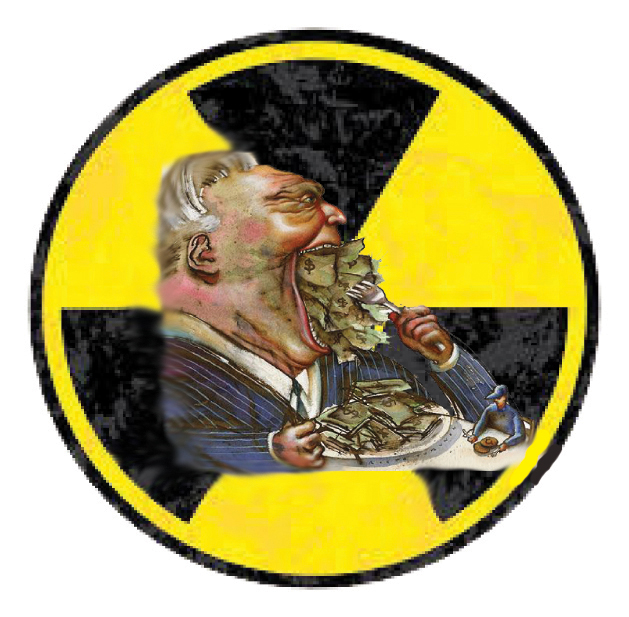
Another crucially important issue has received almost no attention. Neither the film nor the discussion sparked by it has explored one of the most important reasons for the continued existence of nuclear weapons — the profits it yields the participants in America’s massive nuclear-industrial complex.
Once Oppenheimer and other concerned scientists and policymakers failed to convince the Truman administration to simply close Los Alamos and place nuclear weapons and the materials needed to develop them under international control — the only way, as they saw it, to head off a nuclear arms race with the Soviet Union — the drive to expand the nuclear weapons complex was on. Research and production of nuclear warheads and nuclear-armed bombers, missiles, and submarines quickly became a big business, whose beneficiaries have worked doggedly to limit any efforts at the reduction or elimination of nuclear arms.
The Manhattan Project and the Birth of the Nuclear-Industrial Complex
……………………………………………………. According to nuclear expert Stephen Schwartz, author ofAtomic Audit, the seminal work on the financing of U.S. nuclear weapons programs, through the end of 1945 the Manhattan Project cost nearly $38 billion in today’s dollars, while helping spawn an enterprise that has since cost taxpayers an almost unimaginable $12 trillionfor nuclear weapons and related programs. And the costs never end. The Nobel prize-winning International Campaign to Abolish Nuclear Weapons (ICAN) reports that the U.S. spent $43.7 billion on nuclear weapons last year alone, and a new Congressional Budget Office report suggests that another $756 billion will go into those deadly armaments in the next decade.
Private contractors now run the nuclear warhead complex and build nuclear delivery vehicles. They range from Raytheon, General Dynamics, and Lockheed Martin to lesser-known firms like BWX Technologies and Jacobs Engineering, all of which split billions of dollars in contracts from the Pentagon (for the production of nuclear delivery vehicles) and the Department of Energy (for nuclear warheads). To keep the gravy train running — ideally, in perpetuity — those contractors also spend millions lobbying decision-makers. Even universities have gotten into the act. Both the University of California and Texas A&M are part of the consortium that runs the Los Alamos nuclear weapons laboratory.
The American warhead complex is a vast enterprise with major facilities in California, Missouri, Nevada, New Mexico, South Carolina, Tennessee, and Texas. And nuclear-armed submarines, bombers, and missiles are produced or based in California, Connecticut, Georgia, Louisiana, North Dakota, Montana, Virginia, Washington state, and Wyoming. Add in nuclear subcontractors and most states host at least some nuclear-weapons-related activities.
And such beneficiaries of the nuclear weapons industry are far from silent when it comes to debating the future of nuclear spending and policy-making.
Profiteers of Armageddon: The Nuclear Weapons Lobby
The institutions and companies that build nuclear bombs, missiles, aircraft, and submarines, along with their allies in Congress, have played a disproportionate role in shaping U.S. nuclear policy and spending. They have typically opposed the U.S. ratification of a Comprehensive Nuclear Test Ban treaty; put strict limits on the ability of Congress to reduce either funding for or the deployment of intercontinental ballistic missiles (ICBMs); and pushed for weaponry like a proposed nuclear-armed, sea-launched cruise missile that even the Pentagon hasn’t requested, while funding think tanks that promote an ever more robust nuclear weapons force.
A case in point is the Senate ICBM Coalition (dubbed part of the “Dr. Strangelove Caucus” by Arms Control Association Director Daryl Kimball and other critics of nuclear arms). The ICBM Coalition consists of senators from states with major ICBM bases or ICBM research, maintenance, and production sites: Montana, North Dakota, Utah, and Wyoming. The sole Democrat in the group, Jon Tester (D-MT), is the chair of the powerful appropriations subcommittee of the Senate Appropriations Committee, where he can keep an eye on ICBM spending and advocate for it as needed.
The Senate ICBM Coalition is responsible for numerous measures aimed at protecting both the funding and deployment of such deadly missiles. ……………………….. That Coalition’s efforts are supplemented by persistent lobbying from a series of local coalitions of business and political leaders in those ICBM states. Most of them work closely with Northrop Grumman, the prime contractor for the new ICBM, dubbed the Sentinel and expected to cost at least $264 billion to develop, build, and maintain over its life span that is expected to exceed 60 years.
Of course, Northrop Grumman and its 12 major ICBM subcontractors have been busy pushing the Sentinel as well. They spend tens of millions of dollars on campaign contributions and lobbying annually, while employing former members of the government’s nuclear establishment to make their case to Congress and the executive branch. And those are hardly the only organizations or networks devoted to sustaining the nuclear arms race. You would have to include the Air Force Association and the obscurely named Submarine Industrial Base Council, among others.
The biggest point of leverage the nuclear weapons industry and the arms sector more broadly have over Congress is jobs. How strange then that the arms industry has generated diminishing job returns since the end of the Cold War. According to the National Defense Industrial Association, direct employment in the weapons industry has dropped from 3.2 million in the mid-1980s to about 1.1 million today.
Even a relatively small slice of the Pentagon and Department of Energy nuclear budgets could create many more jobs if invested in green energy, sustainable infrastructure, education, or public health – anywhere from 9% to 250% more jobs, depending on the amount spent. Given that the climate crisis is already well underway, such a shift would not only make this country more prosperous but the world safer by slowing the pace of climate-driven catastrophes and offering at least some protection against its worst manifestations.
A New Nuclear Reckoning?
Count on one thing: by itself, a movie focused on the origin of nuclear weapons, no matter how powerful, won’t force a new reckoning with the costs and consequences of America’s continued addiction to them. But a wide variety of peace, arms-control, health, and public-policy-focused groups are already building on the attention garnered by the film to engage in a public education campaign aimed at reviving a movement to control and eventually eliminate the nuclear danger.
Past experience — from the Campaign for Nuclear Disarmament that helped persuade Christopher Nolan to make Oppenheimer to the “Ban the Bomb” and Nuclear Freeze campaigns that stopped above-ground nuclear testing and helped turn President Ronald Reagan around on the nuclear issue — suggests that, given concerted public pressure, progress can be made on reining in the nuclear threat. The public education effort surrounding the Oppenheimer film is being taken up by groups like The Bulletin of the Atomic Scientists, the Federation of American Scientists, and the Council for a Livable World that were founded, at least in part, by Manhattan Project scientists who devoted their lives to trying to roll back the nuclear arms race; professional groups like the Union of Concerned Scientists and Physicians for Social Responsibility; anti-war groups like Peace Action and Win Without War; the Nobel Peace prize-winning International Campaign to Abolish Nuclear Weapons; nuclear policy groups like Global Zero and the Arms Control Association; advocates for Marshall Islanders, “downwinders,” and other victims of the nuclear complex; and faith-based groups like the Friends Committee on National Legislation. The Native American–led organization Tewa Women United has even created a website, “Oppenheimer — and the Other Side of the Story,” that focuses on “the Indigenous and land-based peoples who were displaced from our homelands, the poisoning and contamination of sacred lands and waters that continues to this day, and the ongoing devastating impact of nuclear colonization on our lives and livelihoods.”
On the global level, the 2021 entry into force of a nuclear ban treaty — officially known as the Treaty on the Prohibition of Nuclear Weapons — is a sign of hope, even if the nuclear weapons states have yet to join. The very existence of such a treaty does at least help delegitimize nuclear weaponry. It has even prompted dozens of major financial institutions to stop investing in the nuclear weapons industry, under pressure from campaigns like Don’t Bank on the Bomb.
In truth, the situation couldn’t be simpler: we need to abolish nuclear weapons before they abolish us. Hopefully, Oppenheimer will help prepare the ground for progress in that all too essential undertaking, beginning with a frank discussion of what’s now at stake. https://tomdispatch.com/the-profiteers-of-armageddon/
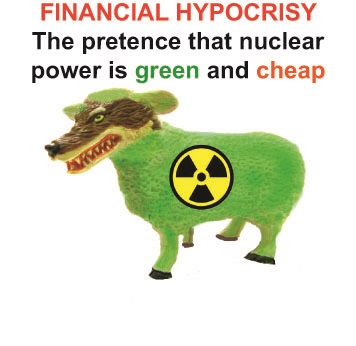
FORTUNE, BY STEPHANIE COOKE, July 29, 2023 Since the turn of the millennium, at least $50 billion has been spent on a frantic effort to create a new Golden Age for nuclear energy in the U.S. Billions more are being lavished on an even more desperate effort to launch small reactors as supposedly safer, cheaper alternatives to yesteryear’s elephant-sized versions. Most of the money comes from ratepayers and taxpayers, accompanied by an avalanche of public relations that rivals the 1950s “Atoms for Peace” campaign with its claims of “too cheap to meter” electricity.
So far, the effort has produced little in tangible assets: roughly one gigawatt of capacity from the Watts Bar-2 reactor completed after decades of on-and-off-again construction and the promise of 2 GW from the long-delayed Plant Vogtle in Georgia. So far, not a single molecule of CO2 emissions has been avoided by a new reactor, and the primary beneficiaries are not the people who paid but publicly-owned utilities, reactor design companies, and PR and law firms. They are part of a chorus of advocacy groups and government agencies, led by the Department of Energy (DOE), advancing the idea that low-carbon nuclear is essential to any long-term climate change solution.
The story is selling well but the push for more and more money—in direct subsidies, ratepayer financing, and government grants or loans–has a dark side. To cite just a few examples, former state officials and utility executives in Illinois and Ohio face lengthy prison terms for bribery schemes linked to subsidies for unprofitable nuclear plants. In South Carolina, two former Scana executives received prison sentences after pleading guilty to criminal charges in 2020 and 2021 over a nuclear project that ultimately collapsed. Two Westinghouse executives also charged are facing a similar fate, with one still awaiting trial in October.
When it comes to costs and schedules, the lack of honesty surrounding nuclear projects is often breathtaking. In Georgia, where two Westinghouse reactors at Vogtle have been under construction since 2009, only one is completed and is now struggling to achieve commercial operation after multiple unplanned reactor and turbine trips, according to recent Georgia Public Service Commission staff testimony. That testimony also included allegations that utility executives have been providing “materially inaccurate” cost estimates over the project’s life. Vogtle’s estimated total $33 billion cost, as outlined in the testimony, versus $13.3 billion originally estimated makes it the most expensive power plant ever built in the United States. Most of the tab is being footed by ratepayers, with the US taxpayer, via DOE, providing $12 billion in loans.
And still, the messaging that nuclear is a must for reducing emissions goes on at a fever pitch. But the message is distorted: The industry cannot deliver what is needed. The U.S. lost its industrial base, including heavy forging capacity, decades ago–and the costs of a major nuclear buildout could now be in the trillions.
Moreover, the billions currently being spent on nuclear are crowding out viable, less costly solutions for decarbonizing the power sector (not only renewables such as wind and power but also high-voltage direct current transmission lines to deliver them to where they’re needed), thus slowing the transition. A surfeit of renewables projects is seeking grid access, enough to meet 90% of the Biden administration’s goal of a carbon-free power sector by 2035, according to a Berkeley Lab report, but the country’s Balkanized electricity market system, monopolistic utilities, and lack of adequate transmission capacity will likely prevent most of it from succeeding.
The transmission capacity needed for renewables will require anywhere from $30 billion to $90 billion to meet demand by 2030, with the figures rising to $200 billion to $600 billion between 2030 and 2050, according to a study by the Brattle Group. Squandering such sums on nuclear should be out of the question.
Our current fleet of 92 reactors generates about a fifth of the nation’s electricity, but most of the plants are slated for permanent closure by 2050, assuming they operate well beyond their 40-year design life. The DOE admits that such “life extensions” put operators in uncharted waters because there is no actual experience to support 60- or 80-year reactor lifetimes.
The problem of where to put used nuclear fuel (radioactive waste) remains after funding was withdrawn for an estimated $100 billion underground repository project at Yucca Mountain in Nevada. Proposed privately-owned interim storage sites in New Mexico and Texas, though licensed by the U.S. Nuclear Regulatory Commission, face intense local and state opposition as well as political obstacles at the federal level.
Industry officials privately acknowledge these challenges. Even so, nuclear is receiving the most favorable media coverage since the 1950s, and the latest annual Gallup poll on nuclear, released in April, showed the highest level of support in a decade for nuclear power among the American public–at 55%. Nuclear opponents in Congress are now silent on the issue or even hinting at changed views, and bipartisan support in Congress has over the past couple of years resulted in billions in tax incentives and other forms of support for both existing and planned nuclear plants.
But public opinion is fickle–and no guarantee for the future. Since Gallup began polling on nuclear in 1994, support peaked at 62% in 2010, a year before the triple meltdowns at Fukushima. After that, it went steadily down, to a low of 44% in 2016. Nor is popular opinion an indicator of whether nuclear’s formidable technical, financial, environmental, and geopolitical challenges can be overcome.
The primary aims of today’s promoters are to prevent aging, uneconomic reactors from closing, and to secure funding for small modular reactors (SMRs) and “advanced” reactors (and associated fuels).
The push for smaller reactors appears to have been an act of desperation by a nuclear-centric energy agency–the DOE (which also oversees the country’s nuclear weapons programs)—after its failed attempt to create a nuclear “renaissance” in the early 2000s. Although that project generated interest (utilities filed plans for 28 large-scale reactors), only the two at Vogtle were ever built………………………………………………………………………………………
Exciting news in the latest PAX-ICAN report “Moving away from mass destruction” out today: the number of financial institutions across the globe rejecting nuclear weapons keeps growing! The number of financial institutions excluding the nuclear weapons industry from their investments continues to grow year on year, and many are naming the UN nuclear weapons ban treaty as a reason to stop funding the bomb.
The 109 financial institutions profiled in this report know that nuclear weapons represent a systemic reputational and regulatory risk, and are putting policies in place that limit or completely exclude any financial engagement with this controversial industry.
The report shows the financial community is taking a more responsible approach, embracing the positive role they can play in further stigmatising and delegitimizing nuclear weapons. Even with Russia’s illegal invasion of Ukraine, and skyrocketing defence spending, the financial community is holding a firm line against financing weapons of mass destruction.
These policies do more than simply cut off the funding to the individual companies producing nuclear weapons: they signal that doing business off weapons of mass destruction is not a viable business model particularly now the UN Treaty on the Prohibition of Nuclear Weapons is in place. https://www.dontbankonthebomb.com/policy-analysis-report-moving-away-from-mass-destruction/
“The veil of secrecy surrounding nuclear spending is a desperate attempt by the UK Government to hide how outrageously unaffordable these weapons have become”
The Ferret, Rob Edwards, 27 Jul 23
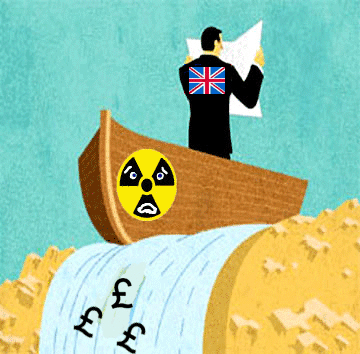
Delivery of nuclear reactors to power a new fleet of Trident submarines on the Clyde has been branded as “unachievable” for the second year running by a UK Government watchdog.
The Infrastructure and Projects Authority (IPA) has given a £3.7 billion reactor-building project run by Rolls Royce for the Ministry of Defence (MoD) a “red” rating for 2022-23. The project was also assessed as red in 2021-22, as reported by The Ferret.
According to the IPA, red means that “successful delivery of the project appears to be unachievable”. This is because of “major issues” that do not appear to be “manageable or resolvable”.
The 2022-23 rating for another scheme crucial to renewing the Trident nuclear weapons system — a £1.9bn construction project at the Faslane and Coulport nuclear bases near Helensburgh — has been kept secret. In 2021-22 it was assessed as red.
The planned date for the final delivery to the Clyde of the new Dreadnought-class submarines, armed with Trident nuclear warheads, has also been classified as confidential by the MoD “for the purpose of safeguarding national security”.
The Scottish National Party (SNP) accused the UK Government of desperately trying to hide how “outrageously unaffordable” the Trident programme had become. The Scottish Greens described the programme as “a grotesque money pit”.
Campaigners criticised the MoD for “rewarding failure” by throwing money at nuclear projects, and for concealing the truth about the problems and delays. They warned of “everyday harms” from the risks of radiation leaks, as well as “catastrophic accidents”.
………………………………………The IPA’s latest annual report for 2022-23 assessed the feasibility of 52 military projects costing a total of £255.4bn. Eleven were related to the UK’s nuclear weapons programme and together cost more than £57bn, though the overall costs for three of them were kept secret.
The manufacture of nuclear reactors at a Rolls-Royce factory in Derby was the only project to be publicly rated as red. The reactors are to drive four new Trident-armed Dreadnought submarines due to start replacing existing Vanguard submarines at Faslane “in the early 2030s”.
…………………………………………………………….. Another previously mysterious project called Aurora was rated as amber. It is to make the plutonium components for new nuclear bombs at Aldermaston in Berkshire and is reckoned to cost between £2bn and £2.5bn.
The planned completion date for Aurora has been kept secret, along with the end dates for four other nuclear projects, including the Dreadnought and Astute submarine programmes. The dates were withheld under a freedom of information law exemption meant to protect national security.
2022-23 assessments for two other nuclear projects have also been classified as confidential so as not to prejudice international relations and the defence of the UK. One, Teutates, is a collaboration on nuclear weapon safety with France and the other is called “Clyde Infrastructure”.
The Clyde project is to build a series of new facilities at Faslane and Coulport to support nuclear submarine operations. It was rated as red by the IPA in 2021-22, and amber in 2020-21 and 2019-20.
The cost of the Clyde project has increased 19 per cent from £1.6bn to £1.9bn in the last year. According to the IPA, this is because of “challenges in delivering in a nuclear and operational environment”.
Trident ‘a moral abomination’
The SNP lambasted the UK Government for writing “blank cheques” to maintain the Trident programme. “The veil of secrecy surrounding nuclear spending is a desperate attempt by the UK Government to hide how outrageously unaffordable these weapons have become,” said the party’s Westminster defence spokesperson, Dave Doogan MP.
“The hollowing-out of the armed forces to pay for the ever-expanding nuclear vanity-weapons budget has led the UK to possess just 0.1 per cent of the world’s nuclear warheads — but at eye-watering cost while conventional capabilities atrophy.”
The Green MSP Ross Greer described nuclear weapons as a “moral abomination” that had no place in Scotland. “As these figures show, they are also a grotesque money pit that is swallowing up billions of pounds and giving huge handouts to international arms dealers,” he said.
The Nuclear Information Service, which researches and criticises nuclear weapons, pointed out that the MoD had been repeatedly given additional billions for its nuclear programme. “But there’s no sign that throwing money at the problem is having any effect beyond rewarding failure,” the group’s director, David Cullen, told The Ferret.
The Scottish Campaign for Nuclear Disarmament attacked the nuclear industry for its “big back catalogues” of cost escalations and time over-runs. “The nuclear propulsion of the nuclear weapon system only adds to the repertoire of everyday harms from radiation leaks and opportunities of catastrophic accidents,” said campaign chair, Lynn Jamieson……………………………………………………………….. https://theferret.scot/trident-nuclear-project-watchdog/
– Electricite de France SA said the risk of further delay to two nuclear reactors in southwest England has risen because of construction setbacks.
EDF flagged last year that the plants may start 15 months late. The reactors at Hinkley Point have been touted by the UK government as sparking a nuclear renaissance, boosting energy independence and reducing reliance on fossil fuels. But the work has been plagued by multiple holdups and cost overruns.
The increased risk of a 15-month delay is due to “performances on civil works and challenges on mechanical, electrical, heating, ventilation and air conditioning,” EDF said Thursday in an earnings presentation. “Progress is below the planned trajectory and action plans have been set.”
The reactors, costing as much as £32 billion ($41.5 billion), are due to start operating in 2027 and 2028. The ballooning budget has fueled controversy over the vast sums needed for new nuclear developments, even as other low-carbon technologies such as offshore wind have also faced inflationary pressures.
Hinkley Point’s setbacks come as EDF seeks to arrange financing for a second pair of atomic plants — at Sizewell in eastern England — that would use the same design. Delays and cost overruns may deter investors who also face increasing demands for capital from renewables, which provide swifter returns.
The debt-laden French utility has a 66.5% stake in Hinkley Point, while China General Nuclear Power Corp. owns the rest. As funding requirements now exceed contractual commitments, shareholders will be asked to provide additional equity voluntarily starting in the fourth quarter.
“The probability that CGN will not fund the project beyond its committed equity cap is high,” EDF said Thursday. “Financing solutions are being investigated, in the event that CGN does not allocate its voluntary equity.”
Let’s do a quick global whiparound. A former coal plant in the UK is being transformed into the world’s largest battery storage project; European renewables giant Octopus is planning to invest $20 billion in offshore wind by 2030; Thyssenkrupp, Europe’s second-largest steelmaker, has secured €2 billion from the German government for green steel investment; US regulators just opened the Gulf of Mexico to offshore wind leases; Egypt has brought its clean energy targets forward by five years and allocated land for a 10 GW wind project to provide electricity to 11 million households; Israel now requires all new non-residential buildings to be covered in solar; India is about to launch a staggering 20 GW tender for new battery manufacturing; 4.4 GW of rooftop solar has been installed in South Africa in the last year; the Philippines just awarded a whole lot of new solar projects; Brazil says its solar industry has created around 960,000 jobs since 2012; and Barbados is now targeting a 100% carbon neutral economy by 2030.
In the last six months nearly every mainstream media outlet has pointed out that China is still building a lot of coal, implying the country is hedging its bets on renewables. It’s not. In the first half of 2023, around $5 billion has been invested in coal and fossil gas and a similar amount in both hydro and nuclear; $10 billion has been invested in wind, $18 billion in solar, and an astonishing $28 billion in transmission.
The IEA has a new report showing that renewables are on track to meet all the growth in global electricity demand over the next two years. This would represent a key milestone in the fight against climate change–once all new demand is met, renewables will start eating into fossil fuels’ share of the power mix.
The global price of polysilicon (the stuff they make solar panels from) has dropped by 78% over the past year.
Since August 2022, $278 billion in clean energy project investments and 170,600 clean energy jobs have been created in the United States. ‘We’ve been talking about bringing manufacturing jobs back to America for my entire life. We’re finally doing it, right? That’s pretty exciting.’ WaPo
The US offshore wind sector is booming. There has been a 272% increase in the number of offshore wind supplier contracts since 2021, and 47% of that growth has occurred since the passage of the IRA. Nine in every ten contracts are going to companies that are either headquartered or have a presence in the US. Industrial policy FTW. Renew.biz
The 12.5% royalty rate that oil companies in the United States have to pay for the use of federal lands has remained unchanged for over one hundred years. The government is now reforming that system, raising the minimum rate to 16.7% and prioritising renewables development on federal lands over fossil fuel development. Grist.
In the first half of this year, wind and solar generated more power than coal in the United States. Wind and solar produced 343 terawatt-hours (TWh) from January through June 2023, while coal produced 296 TWh. Five years ago, coal’s share was quadruple that of wind and solar combined. Next step: fossil gas. Canary
California, the seventh-biggest US crude oil producer, has put a near-halt on issuing permits for new drilling this year. The state’s Geologic Energy Management Division has approved seven new active well permits in 2023. Compare that with the more than 200 it had issued by this time last year. Reuters
Australia’s big banks have turned their backs on the country’s largest coal miner, refusing to refinance a billion-dollar debt in a major rebuff that will force Whitehaven Coal to source loans offshore, potentially speeding up the demise of the sector. Couldn’t have happened to nicer people. SMH
The European Union has adopted new rules intended to make it easier for electric vehicle owners to travel across the continent. From 2025 onward, the new regulation requires fast-charging stations offering at least 150kW of power to be installed every 60km along the EU’s TEN-T system of highways, the bloc’s main transport corridors. Verge
A reminder from Hannah Ritchie. ‘The internal combustion engine is shockingly inefficient. For every dollar of petrol you put in, you get just 20 cents’ worth of driving motion. The other 80 cents is wasted along the way, most of it as heat from the engine. Electric cars are much better at converting energy into motion. For every dollar of electricity you put in, you get 89 cents out.’………………………………………………………………
Outrageous Costs and Deadly Dangers are the Real Risks of Keeping Diablo Open
Independent , By Grant Smith and Anthony Lacey, Wed Jul 26, 2023
California ratepayers might have to foot a staggering $45 billion-plus cost to keep the aging Pacific Gas & Electric, or PG&E, Diablo Canyon nuclear power plant online beyond its slated 2025 closure.
The outrageous price tag is the estimated cost for operating the plant from 2021-2045, or hundreds of millions of dollars every year. And that’s just the expense of prolonging the troubled facility’s life. It doesn’t account for the enormous extra costs that would be incurred following a major disaster like a reactor leak or an earthquake that damages the plant.
EWG used testimony recently filed byThe Utility Reform Network, or TURN, in PG&E’s current rate case to parse the capital and operating expenses of the plant. EWG considered PG&E’s estimates for the plant costs, which likely lowball the true expense, and TURN’s assessment of the plant expenses, which may be closer to the actual burden.
EWG estimates it will likely amount to hundreds of millions of dollars every year, for total costs ranging from more than $20 billionto nearly $45 billion from2023 through 2045 — or more.
That’s just the base cost of running the facility. The alarming figure doesn’t account for the additional massive costs that would come from a disaster at the plant, like an earthquake or a nuclear reactor leak, or unanticipated maintenance and security costs that often plague old nuclear power plants.
That cost — reaching tens of billions of dollars — will be passed on to 15.8 million Californians already fleeced by PG&E’s exorbitant electricity bills. According to EWG estimates, keeping Diablo Canyon open could add from $55to $124 a year to the typical utility bill, considering the cost of the facility as a fixed charge over 23 years.
Or it could be even higher because these costs, at the moment, are highly speculative and the older Diablo Canyon gets, the higher the capital and operating costs will become to keep it online and providing electricity.
An extension of the facility’s life for 20 years after its scheduled 2025 shutdown could also generate other large costs just to ensure its ongoing operation. Many aging nuclear power plants are notorious for wasting millions of dollars on unanticipated maintenance and security costs…………………………………………………..
An Unnecessary Nuclear Facility
What’s just as outrageous as the potential $45 billion-plus cost of extending Diablo Canyon’s life is the fact that the state has no need to keep the plant open after the scheduled 2025 closure………………………………………………………………………
The Danger of Diablo Canyon
Diablo Canyon, located on California’s central coast in San Luis Obispo County, sits atop a web of fault lines and rests above a cliff below the Pacific Ocean, putting it at heightened risk of damage from an earthquake, tsunami or both.
The facility was set to close both of its two reactor units by 2025, following a carefully crafted 2018 deal between PG&E, unions and environmentalists. The deal had the support of state regulators and then-Lieutenant Gov. Gavin Newsom, who was elected governor in 2018.
The government is to plough another £170million of taxpayers’ cash into the proposed Sizewell C nuclear plant. The Department for Energy Security and Net Zero said the cash was in addition to the £679 million the government invested in the Suffolk power station late last year, when it took joint control of the project with EDF, of France.
Last year’s investment included about £100 million to buy China General Nuclear out of its 20 per cent stake. EDF said: “This is another big endorsement and will put us in an even stronger position to begin full construction.” The government said the money would be used “to prepare the Sizewell C site for future construction, procure key components from the project’s supply chain and expand its workforce”. It said it was “previously allocated funding for development work”.
The government pledged in the budget in 2021 to provide up to £1.7 billion “to enable a final investment decision in a large-scale nuclear project this parliament”.
Stop Sizewell C, a campaign group, said: “It sticks in the throat to see ministers splashing more taxpayers’ cash months before a final investment decision, while maintaining total secrecy about whether Sizewell C can achieve value for money.”
Extending operations of the Diablo Canyon nuclear power plant through 2045 could cost California ratepayers as much as $45 billion, a new report has found.
The state’s biggest utility, Pacific Gas and Electric (PG&E), is currently in the process of seeking a license renewal that could enable the aging facility to run for another 20 years — with the widespread support of state legislators, but in opposition to environmental activists.
If the plant ends up staying online for two more decades, total costs to run the site could range from more than $20 billion to nearly $45 billion from 2023 through 2045, according to a new analysis from the Environmental Working Group (EWG).
“Keeping Diablo Canyon open past its closure date is a terrible idea for many reasons, including the staggering price tag that unwitting ratepayers will face for keeping the dilapidated and dangerous nuclear plant operating,” EWG President Ken Cook, who is also a Bay Area resident, said in a statement.
While PG&E in 2016 had announced plans to retire the site and decommission its two reactors when their licenses expire — in November 2024 and August 2025, respectively — California enacted legislation last fall seeking to extend operations until 2030.
About six months later, the federal Nuclear Regulatory Commission granted PG&E an exemption that enabled the plant to stay open under its current licenses while the agency considers renewal application — whose terms would apply for 20 years……………………………………
The EWG analysis — based in part on testimony filed by the Utility Reform Network, a consumer advocacy group — estimated that keeping the plant open would likely require hundreds of millions of dollars every year.
Because that cost would need to be passed on to the consumer, households could then expect an increase of between $55–124 per year on typical utility bills, according to the analysis.
“It’s clearly a high-cost, no-reward and puzzling scenario for California, given its decades-long leadership on the environment,” a statement from EWG said……………………………………..
The estimated $20 billion–$45 billion cost to ratepayers could be even higher, the EWG analysts argued, stressing that these projections don’t account for expenditures associated with disasters, such as radiation leaks or earthquake damage.
Grant Smith, EWG energy advisor and co-author of the report, argued that the 6-8 percent of California’s electricity that is provided by Diablo Canyon could easily come from cleaner and safer sources.
“California added enough renewables in the past year to match the power output of Diablo Canyon,” Smith said.
EDF will need to invest around 25 billion euros ($28 billion) each year to keep its nuclear fleet and network in shape and build new reactors required for France’s energy transition, the company’s CEO said on Wednesday.
Grilled by lawmakers during a hearing before the French National Assembly’s economic affairs committee, EDF’s Luc Remont said France also needed to rethink parts of the company’s business model and its electricity tariff policy to allow the utility to boost investments.
The diminutive reactors are likely to be just as prone to delays and cost overruns as their behemoth predecessors.
I just read Pal Hockenos’ fine story about small nuclear reactors. But Hockenos is naive to think that Bill Gates and co. give a hoot about our future. What they do care about is their own increasing $squillions. And the coming source of new $squillions is in weaponry – that’s where all sorts of applications for SMRs lie. And Gates etc are well aware that the fixing-climate story is just a cover for the real practical purpose.
IN RECENT YEARS, the nuclear power lobby and its advocates have begun to sing a new song. They have bailed on the monstrous reactors of the 20th century — not because of safety or toxic waste concerns, but because of the reactors’ exorbitant expense and ponderous rollout schedules. And they have switched their allegiance to a next generation nuclear fission technology: small modular reactors, which they claim will help rescue our warming planet, as well as the nuclear power industry— once they exist.
Respected thinkers such as former U.S. president Barack Obama, French president Emmanuel Macron, and Microsoft co-founder and philanthropist Bill Gates have toasted the idea of small modular reactors, or SMRs, as a potentially reliable, almost-emissions-free backup to intermittent renewable energy sources like wind and solar. Advocates claim that because SMRs will be smaller than the giants that currently dominate horizons, they will be safer, cheaper, and quicker to build. Although SMRs will have only a fraction of the power-generating capacity of traditional nuclear power reactors, proponents envision that they will, one day, be assembled in factories and transported as a unit to sites — like Sears’ mail-order Modern Homes of the early 1900s.
Currently, half of the states in the EU, both major political parties in the U.S, and the five BRICS nations — Brazil, Russia, India, China, and South Africa — have indicated that they want to split atoms for the purpose of generating energy. U.S. President Joe Biden included billions of dollars in tax credits for nuclear energy in the Inflation Reduction Act and the Infrastructure Investment and Jobs Act. Gates has gone so far as to invest a chunk of his fortune in a firm he founded, TerraPower, a leading nuclear innovation company. But despite the prodigious chatter, the endeavor to blanket the Earth with SMRs is a Hail Mary pass that’s very unlikely to succeed.
Granted, it is certainly a step in the right direction that most observers now see the postwar, giga-watt-scale water-cooled reactors as obsolete. When constructed new, these behemoths generate electricity at up to nine times the cost of large-scale solar and onshore wind facilities, and can take well over a decade to get up and running. Perhaps for this reason, there has been one, and only one, new nuclear power project initiated in the U.S. since construction began on the last one 50 years ago: a two-reactor expansion of the Vogtle Electric Generating Plant in Georgia. The first of the reactors came online this year — seven years behind schedule. The staggering $35 billion cost for the pair is more than twice the original projection.
But SMRs are just as likely to face similar delays and cost overruns. Currently, there are just two existing advanced SMR facilities in the world that could be reasonably described as SMRs: a pilot reactor in China and Russia’s diminutive Akademik Lomonosov. More small reactors are under construction in China, Russia, and Argentina, but all of them are proving even more expensiveper kilowatt than traditional reactors.
It’s worth noting that in the U.S., and everywhere else in the world, nuclear policy relies heavily on subsidies to be economically competitive. Starting next year, utilities operating nuclear facilities in the U.S. can qualify for a tax credit of $15 per megawatt-hour — a break that could be worth up to $30 billion for the industry as a whole. However, even these giveaways won’t reduce the projected costs of SMR-generated electricity to anywhere near the going prices of wind and solar power.
In the U.S., the only SMR developer with a design approved by the Nuclear Regulatory Commission is NuScale, which plans to deploy six modules at one site in Idaho that will together generate less electricity than a smallish standard nuclear reactor. So far, however, NuScale has yet to lay a single brick. Its biggest win to date is securing $4 billion in federal tax subsidies. In January of this year, NuScale announced plans to sell electricity not at $58 per megawatt-hour, as originally pledged, but at $89 per megawatt-hour, citing higher than anticipated construction costs. The new projection is nearly twice the average global cost of utility-scale solar and onshore wind, according to calculations by BloombergNEF. And without the government subsidies, NuScale’s price tag would be that much higher.
In fact, there’s a fair chance that not a single NuScale SMR will ever be built: The company has said it will not begin construction until 80 percent of its expected generation capacity is subscribed, and currently buyers have signed up for less than a quarter of the plant’s capacity.
Gates’s TerraPower has an even longer way to go, although it too is cashing in on subsidies. The U.S. Department of Energy has pledged up to $2 billion in matching funds to construct a demonstration plant in Wyoming. Yet TerraPower recently announced it’s facing delays of at least two years because of difficulties securing uranium fuel from its lone supplier: Russia.
Even if the unlikely rollout of SMRs eventually happens, it will unfold too late to curb the climate crisis. And the reactors will face many of the same safety and radioactive waste concerns that plagued their larger counterparts, if only at smaller scales. Meanwhile, the siren song of nuclear energy is diverting critical resources from the urgent task of building out clean technologies. And the idea that nuclear reactors would serve as “backups” for wind and solar is misguided because the reactors can’t be ramped up and down quickly.
……………………………The technology of the future is already here. Clean wind and solar energy — coupled with updated smart grids, expanded storage capacity, hydrogen technology, virtual power plants, and demand response strategies — can work. Our energy systems of the future will look like a patchwork quilt, with diverse energy sources kicking in at different times during the day, and with the mix differing from one day to the next.
Bill Gates and like-minded innovators should put their minds and fortunes to work on this futuristic project of the present — and leave the 20th century relic that is nuclear power in the past, where it belongs
“Great British Nuclear has no legal basis – the Energy Bill has been delayed till the autumn, so it can’t do anything legally.
“Great British Nuclear has no budget, so it can’t buy anything or commission anything.
“Great British Nuclear has no premises.
“Great British Nuclear has no paid staff.”
Great British Nuclear officially launched, sparks funding doubts. Electrical Review 18th July 2023
“………………… So we’ve heard that Great British Nuclear has high hopes to kickstart a renaissance period for nuclear power in the UK, but how does it plan on achieving that? Well, thanks to the official launch, we now have more concrete information as to what the body plans to do.
The UK Government has officially launched Great British Nuclear, a new Government agency that is designed to support the growth of nuclear energy in the UK.
The official launch of Great British Nuclear was initially tipped for July 13, although the launch was pushed back due to “unforeseen circumstances.” Despite the delayed start, the Government has high hopes for the new department, with it hoping to create a renaissance for nuclear energy in the UK.
One of Great British Nuclear’s first acts will be to kickstart a competition for small modular reactor (SMR) technology, which it believes could help boost energy security, create cheaper power, and grow the economy through well-paid jobs.
Many in the industry have been calling for the UK Government to do more to encourage the construction of more nuclear power, including SMRs, as the UK transitions towards cleaner power generation. The UK Government has even gone so far as to claim that nuclear will be essential to our net zero future, noting that it will provide a ‘baseload’ to cover more intermittent renewable energy generation – something that our Gossage Gossip columnist recently described as a ‘load of cobblers’.
How will Great British Nuclear Help?
So we’ve heard that Great British Nuclear has high hopes to kickstart a renaissance period for nuclear power in the UK, but how does it plan on achieving that? Well, thanks to the official launch, we now have more concrete information as to what the body plans to do.
From today, companies can register their interest with Great British Nuclear to participate in a competition to secure funding support to develop their SMRs. Additionally, the Government body is eager to explore future sites for new large gigawatt-scale nuclear power plants, such as those at Hinkley Point C and Sizewell C.
That’s about as much as we know about Great British Nuclear’s initial plans – although the UK Government is throwing its weight behind the nuclear industry with a brand-new funding package totalling up to £157 million.
This includes:
Up to £77.1 million of funding for companies to accelerate advanced nuclear business development in the UK and support advanced nuclear designs to enter UK regulation, maximising the chance of small and advanced modular reactors being built during the next ParliamentUp to £58 million funding for the further development and design of a type of advanced modular reactor (AMR) and next generation fuel. AMRs operate at a higher temperature than SMRs and as a result they could provide high temperature heat for hydrogen and other industrial uses alongside nuclear power. This includes:
Up to £22.5 million to Ultra Safe Nuclear Corporation UK in Warrington to further develop the design of a high temperature micro modular reactor, a type of AMR suited to UK industrial demands including hydrogen and sustainable aviation fuel production.
Up to £15 million to the National Nuclear laboratory in Warrington to accelerate the design of a high temperature reactor, following its success in Japan.
Up to £16 million to National Nuclear Laboratory in Preston to continue to develop sovereign coated particle fuel capability, a type of robust advanced fuel which is suitable for high temperature reactors.
A further £22.3 million from the Nuclear Fuel Fund will enable eight projects to develop new fuel production and manufacturing capabilities in the UK, driving up energy security and supporting the global move away from Russian fuel. This will include:
Over £10.5 million to Westinghouse Springfields nuclear fuel plant in Preston to manufacture more innovative types of nuclear fuel for customers both in the UK and overseas, boosting jobs and skills in the North West.
Over £9.5 million to Urenco UK in Capenhurst Chester, an international supplier of nuclear materials, to enrich uranium to higher levels, including LEU+ and high assay low enriched uranium (HALEU). LEU+ will allow for current reactors and SMRs to run for longer between refuelling outages, improving reactor efficiency and economics both in the UK and abroad. HALEU development will ensure that the UK remains at the forefront of fuel development for future advanced reactors.
Over £1 million has also been awarded to Nuclear Transport Solutions, a subsidiary of the Nuclear Decommissioning Authority, to develop transport solutions to facilitate a supply chain for highly enriched uranium in the UK and internationally.
Over £1.2 million to support MoltexFLEX, a UK molten salt reactor developer based in the North West, to build and operate rigs for the development of molten salt fuel. Molten Salt Reactors (MSRs) are an AMR type that use a molten salt as a coolant and fuel, leading to intrinsic safety compared with conventional fuels.
Is the UK Government unable to fund its promised nuclear renaissance?
Despite announcing £157 million in investment for the nuclear industry in the UK, many experts will argue that the UK Government’s funding plans are woefully inadequate to meaningfully move the needle.
Recent nuclear projects within the UK have been unable to get off the ground without significant Government intervention, including Hinkley Point C, which the Government has committed at least £679 million towards, despite the new reactor facing constant delays – with its opening date now set for September 2028.
Rolls-Royce, which is currently undergoing regulatory testing on its small modular reactor technology, has suggested that SMRs will be cheaper – although the company still believes each SMR will carry a price tag of at least £1.8 billion when they start rolling out of factories in 2030. That is expected to get you around 440 MW of generation – which for the same price, you could purchase 782 Enercon E82 onshore wind turbines, netting you up to 2346 MW of generation.
One industry insider suggested that the UK Government’s woeful funding figures was “the best example I have ever seen of what a Government on its last legs sounds like when it has nothing to say and no money to spend.” Adding that, “All this amount will buy you, literally, is a very large pile of paper and possibly a few more headlines.”
Given the Conservative Party’s performance in recent polls, it’s likely the UK Government is unwilling to commit large amounts to Great British Nuclear when it’s unlikely to be in Government for much longer. Unfortunately, large infrastructure projects of this nature require huge investment across multiple parliamentary terms – and the short-sighted nature of the country’s leaders got us into this situation in the first place. In fact, by the time Hinkley Point C comes online, it will be 20 years since the Government of the day supported a new reactor.
Will the launch of Great British Nuclear move the needle?
The UK Government is hopeful that Great British Nuclear will move the needle in the development of nuclear power technology in the UK. While it may not have the budget to invest in new nuclear reactors itself – it could potentially foster an environment that is ultimately friendly to nuclear power.
Unfortunately, as our industry insider notes:
“Great British Nuclear has no legal basis – the Energy Bill has been delayed till the autumn, so it can’t do anything legally.
“Great British Nuclear has no budget, so it can’t buy anything or commission anything.
While the EU is on course to wean itself off Russian fossil fuels, it’s struggling to kick its nuclear habit. That’s because Russia’s nuclear industry still wields huge clout.
Less than a week after the first Russian tanks rolled into Ukraine, an Ilyushin Il-76 cargo aircraft, belonging to Russian cargo airline Volga-Dnepr, flew across Belarus and Poland before landing in Slovakia.
The mysterious jet taking off from Russia took flight trackers by surprise as only a day ago the European Union had closed its airspace to Russian airlines and private jets in response to Moscow’s invasion of Ukraine.
Soon, it became clear that the plane was exempted from the ban as it was shipping critical nuclear fuel for Slovakia’s four Russian-designed nuclear reactors.
About a month later, a Russian aircraft of the same make flew even further into neighboring Hungary again to deliver nuclear fuel. Much like Slovakia, Hungary is fully dependent on atomic fuel from Russia to power its nuclear power plants.
The twin flights were yet another symptom of Europe’s decadeslong binge on Russian energy. Nuclear fuel sourced from Russia’s state-owned nuclear agency Rosatom and its units helps generate nearly half the total electricity produced in Slovakia and Hungary and more than a third in the Czech Republic and Bulgaria.
While the EU is on course to wean itself off Russian fossil fuels, it’s struggling to kick its Russian nuclear habit. As a result, hundreds of millions of euros continue to flow into Moscow’s coffers.
The bloc has found it politically unpalatable to impose sanctions on the Russian civil nuclear industry……………………….
The Rosatom leverage
The EU’s foot-dragging stems from the outsized influence the Russian nuclear industry enjoys globally. Russia accounts for more than 45% of the world’s uranium enrichment capacity, delivering atomic fuel to nuclear power plants in several countries, including in the US, which despite its harsh sanctions regime against Moscow continues to pay $1 billion (€912 million) a year to source fuel from Rosatom.
Almost 20% of raw uranium imported by the EU comes from Russia, Euratom Supply Agency data shows, with another 23% coming from Kazakhstan, where Rosatom is a major player. Russia also supplies a large proportion of the fuel rods for European nuclear power plants.
“Rosatom is one of the few companies in the world that has mastered the entire nuclear fuel cycle, i.e. enrichment, fuel production and also reprocessing,” said Sonja Schmid, professor of science and technology studies at Virginia Tech University and the author of “Producing Power: The Pre-Chernobyl History of the Soviet Nuclear Industry.”
Central and Eastern European countries are particularly reliant on Russian fuel. There are a total of 18 Russian-designed nuclear reactors — in Slovakia, Bulgaria, Hungary, the Czech Republic and Finland — that currently run exclusively on Russian fuel and rely on Russian technologies.
“Many investors, given a choice, would not want to profit from companies that manufacture weapons of mass destruction,” said As You Sow’s Andrew Behar.
Amidst what the Bulletin of Atomic Scientists calls “an exceedingly dangerous nuclear situation” facing humanity today, the largest U.S. mutual funds—which manage the retirement and other savings of tens of millions of Americans—are profiting from investments in nuclear weapons, cluster munitions, and other banned or controversial arms, an analysis by a leading shareholder advocacy group revealed Tuesday.
Measured by dollars invested, the top 25 U.S. asset managers “all earn a D grade or worse, with significant investments in arms manufacturers and major military contractors, including companies involved with nuclear weapons and controversial weapons like cluster munitions, anti-personnel landmines, incendiary weapons, and depleted uranium,” Berkeley, California-based As You Sow said in its new report.
Some of the largest corporate 401(k)s like American Funds, John Hancock Funds, and Franklin Templeton Investments were among the most heavily invested in these armaments, while “fund managers that focus on sustainable investing have less exposure to military weapons, on average.”
Seven funds profiled in the analysis—Eventide Funds, Ecofin, New Alternatives, Vert Asset Management, Aspiration Funds ,Thrivent, and Kayne Anderson—held no investments in the controversial weapons.
“Many investors, given a choice, would not want to profit from companies that manufacture weapons of mass destruction,” As You Sow CEO Andrew Behar said in a statement. “Yet nearly every retirement plan has nuclear and other controversial weapons embedded in their plan. Our new ratings empower investors with the tools to know what they own so they can invest their money in alignment with their values.”
As You Sow’s mutual fund ratings are part of the group’s Weapons Free Funds investment tool, “built to help responsible investors prioritize peace and people over war and violence.”
Common Dreams reported last month that nuclear-armed nations spent $82.9 billion on their arsenals last year, with the United States accounting for more than half of the global total, according to the Nobel Prize-winning International Campaign to Abolish Nuclear Weapons.
Major banks yet to match EU with nuclear green label, study finds
None of the world’s 30 major banks have explicitly included nuclear energy in their criteria for issuing green or sustainability-linked bonds, researchers said on Thursday (6 July), despite an EU decision last year to label it as sustainable.
The European Union decided last year to include nuclear power plants in its list of investments that can be labelled and marketed as green. The move aimed to guide investors towards climate-friendly technologies, but split EU countries who disagree on atomic energy’s green credentials.
So far, banks have not followed the EU’s lead in their own green bond rules, according to an analysis by Columbia University’s Center on Global Energy Policy. The study looked at the 30 banks deemed systemically important by the Financial Stability Board.














 nuclear-news