EDF’s historic $13.5 billion loss in 2022 – as France became an importer of electricity
Electricite de France SA reported a historic loss for 2022 after repairs
choked its nuclear output, but the utility predicted a significant rebound
in earnings this year as production recovers. The state-controlled
generator swung to a net loss, excluding non-recurring items, of €12.7
billion ($13.5 billion) last year after a profit of €4.7 billion in 2021,
according to a statement on Friday.
The company’s woes exacerbated the
region’s energy crisis by turning France — traditionally a powerhouse
producer — into a net importer of electricity. President Emmanuel
Macron’s government, which is trying to regain full ownership of the
nuclear giant to reassure creditors, wants new Chief Executive Officer Luc
Remont to restore production and prepare the company to start building new
reactors in France and the UK.
Bloomberg 17th Feb 2023
https://www.bnnbloomberg.ca/edf-reports-record-loss-after-nuclear-output-choked-by-repairs-1.1885186
Zelensky is literally selling Ukraine to US corporations on Wall Street.
Ukraine’s Western-backed leader Volodymyr Zelensky opened the New York Stock Exchange telling Wall Street his country is “open” for foreign corporations to exploit it with $400 billion in state selloffs.
ByBen Norton, 2022-09-09
Ukraine’s Western-backed leader Volodymyr Zelensky virtually opened the New York Stock Exchange on the morning of September 6, symbolically ringing the bell via video stream.
Zelensky announced that his country is “open for business” – that is to say, that foreign corporations are free to come and exploit its plentiful resources and low-paid labor.
In a speech launching the neoliberal selloff program Advantage Ukraine, Zelensky offered Wall Street “a chance for you to invest now in projects worth of hundreds of billions of dollars.”
The financial news service Business Wire published a press release from the Ukrainian government in which Zelensky boasted:
The $400+ [billion] in investment options featured on AdvantageUkraine.com span public private partnerships, privatization and private ventures. A USAID-supported project team of investment bankers and researchers appointed by Ukraine’s Ministry of Economy will work with businesses interested in investing.
………………………….. The press release cited executives of US corporate giants Google, Alphabet, and Microsoft, who salivated over the economic possibilities offered by Ukraine.
Reuters noted that the Ukrainian government hired British public relations firm WPP to run the marketing operation for Advantage Ukraine.
Zelensky coordinated his New York Stock Exchange publicity stunt with an editorial in the Wall Street Journal imploring US capitalists to “Invest in the Future of Ukraine.”
“I committed my administration to creating a favorable environment for investment that would make Ukraine the greatest growth opportunity in Europe since the end of World War II,” Zelensky wrote.
Multipolarista previously reported on a meeting by Western governments and corporations in Switzerland in July in which they planned harsh neoliberal economic policies to impose on Ukraine.
The Western participants published documents calling to cut labor laws, “open markets,” drop tariffs, deregulate industries, and “sell state-owned enterprises to private investors.”
In an interview with Multipolarista, economist Michael Hudson compared the new emergency anti-labor laws imposed by the Ukrainian government to the brutal neoliberal policies implemented by Chile’s far-right Pinochet dictatorship after a CIA-backed coup in 1973.
“It’s jaw dropping,” Hudson said of Zelensky’s Wall Street Journal op-ed. “It’s like a parody of what a socialist would have written about how the class war would be put in into action by a fascist government.”
“So of course he was welcomed on the stock exchange for abolishing labor’s rights,” Hudson added. “You could not have a more black-and-white example” of class war………………………………… https://geopoliticaleconomy.com/2022/09/09/zelensky-selling-ukraine-wall-street/
Southern Co boosts cost estimate, delays timing for nuclear reactors

Feb 16 (Reuters) https://www.reuters.com/business/energy/southern-co-boosts-cost-estimate-delays-timing-nuclear-reactors-2023-02-16/ – U.S. energy company Southern Co (SO.N) on Thursday delayed the timing and boosted cost estimates for its Georgia Power utility’s share of two nuclear reactors being built in Georgia.
The Vogtle plant reactors in Burke County, Georgia, already billions of dollars over budget and years behind schedule, are the only nuclear power units under construction in the United States.
In an investor presentation, Southern forecast Georgia Power costs would rise to $10.593 billion, up from a prior forecast of $10.383 billion in its third quarter results in October.
Southern also pushed back the in service dates for the new reactors to May or June of 2023 for Unit 3 and late in the fourth quarter of 2023 to the end of the first quarter of 2024 for Unit 4.
“After careful consideration and given our experience on Unit 3 and the degree of critical work ahead of us, we are further risk adjusting our Unit 4 schedule,” Southern Co Chief Executive Thomas Fanning said on a call with investors.
Fanning, who will be succeeded by Georgia Power’s CEO Chris Womack in the coming months, said Unit 3 required additional fixes to pipes, a valve and flow through the reactor’s cooling pumps. He added that the company expects testing on Unit 4 to reveal more needed fixes.
“We’re just trying to get anything we can see right now,” Fanning said.
In January, Southern said in a filing with the U.S. Securities Exchange Commission that it expected Unit 3 to enter service during April 2023. In its third quarter earnings, the company said it expected Unit 3 to enter service in the first quarter of 2023 and Unit 4 in the fourth quarter of 2023.
When Georgia approved the Vogtle expansion in 2009, the two 1,117-megawatt Westinghouse AP1000 reactors were expected to cost about $14 billion in total for all owners and enter service in 2016 and 2017.
Some analysts have estimated total costs, including financing, have ballooned to more than $30 billion following delays related to the pandemic, the nuclear accident at Japan’s Fukushima plant in 2011 and the 2017 bankruptcy of Westinghouse, the project’s former contractor.
The Vogtle owners include Georgia Power (45.7%), Oglethorpe Power Corp (30%), Municipal Electric Authority of Georgia (22.7%) and Dalton Utilities (1.6%).
Oglethorpe and Dalton have said they wanted to freeze their spending on the project.
EDF posts record net loss after nuclear fleet hit by repairs
French energy company EDF has reported a significant downturn in its 2022 results after repairs choked its nuclear power output and government measures tightened, but it saw UK profits soar due to high electricity prices.
Annabel Cossins-Smith 17 Feb 23, https://www.power-technology.com/news/edf-posts-record-losses-after-nuclear-troubles/
rench energy giant EDF on Friday posted a record loss for 2022 after necessary repairs to its nuclear power reactors saw a serious decline in electricity output.
A company spokesperson said in a press release that in November last year just 30 of 56 reactors were operational but that this number has now risen to 43. It cited stress corrosion on 16 of its reactors as a key reason for its output decline, stating that 10 of these have been or are currently being treated.
The state-controlled gas and electricity supplier saw a net loss, excluding non-recurring items, of $13.5bn (€12.7bn) last year, a significant decline from its profits of $5bn (€4.7bn) in 2021. Its raw earnings (EBITDA) stood at -$5.3bn (-€5bn), compared with a positive EBITDA of $19bn (€18bn) in 2021.
“The target for 2023 is to improve operational performance,” EDF CEO Luc Rémont said on a call, Bloomberg reports. “The aim is to achieve an EBITDA that will be significantly higher than in 2021.”
The company also posted a net financial debt of $68.6bn (€64.5bn), up 50% from 2021. An EDF statement cited issues with cash flow from operations, hybrid bonds and a $3.7bn (€3.5bn) capital increase as reasons behind this.
However, EDF’s UK profits soared, largely due to electricity price rises in the country. This took its underlying profits to $1.4bn (£1.2bn), up from a loss of $25m (£21m) in 2021.
The company has said that its losses in France in particular come in part due to government price caps. The French government set these to protect consumers from soaring energy prices, shortly before taking majority control of the company last year.
“The French government’s exceptional regulatory measures to limit the increase in sales prices to consumers in 2022 had an adverse estimated effect of -€8.2 billion (-$8.7bn) in EBITDA”, a company press release stated. It added that “before these measures, EBITDA benefited from market price rises passed on to customers for an estimated amount of €8.7 billion ($9.2bn)”.
EDF began legal proceedings against the French government in August last year, claiming $8.8bn (€8.3bn) in damages after the company was forced to sell more of its power to rivals at prices below market rates as a way to counter its monopoly position in France.
The government is also continuing efforts to nationalise the company. Power stations operated by EDF provide almost 70% of France’s electricity, mainly through its nuclear fleet.
Russia’s Grip on Nuclear-Power Trade Is Only Getting Stronger.
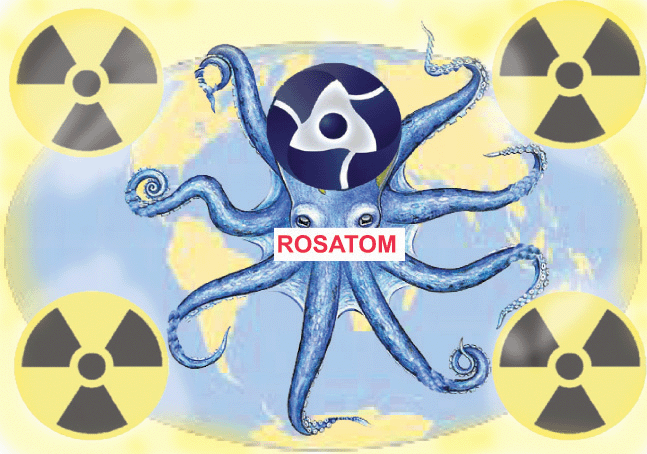
New data shows exports in the strategic industry jumped more than 20% last year, as
long-term projects boost Russian influence. Russia’s nuclear exports have
surged since the invasion of Ukraine, boosting the Kremlin’s revenue and
cementing its influence over a new generation of global buyers, as the US
and its allies shy away from sanctioning the industry. Exclusive trade data
compiled by the UK’s Royal United Services Institute show that Russian
nuclear fuel and technology sales abroad rose more than 20% in 2022.
Bloomberg 14th Feb 2023
At Sellafield nuclear site workers ready to go on strike
Hundreds of Sellafield cleaners have voted to strike in anger at a broken
pay promise More than three hundred workers employed by Mitie at the
nuclear power plant have said they are ready to take industrial action.
Bosses had promised to up workers’ pay from November last year to help
with the cost of living crisis. Now they have gone back on their word and
say a pay rise will only be paid from April – six months later. Workers
and GMB representatives will meet in the coming days to discuss strike
dates.
GMB 14th Feb 2023
Young people want to work in genuinely clean industries

MILLIONS of youngsters want a career in the green industries with many
planning to pursue roles in renewable energy and engineering. A poll of
1,000 people aged between 15 and 25 found 71 per cent want to work towards
a career which doesn’t have a negative impact on the planet.
The Sun 9th Feb 2023
https://www.thesun.co.uk/news/21331673/young-workers-green-industries/
‘We need a plan B’: Australian Unions have ‘deep concerns’ about AUKUS pact

The shipbuilding federation – which represents unions including the AMWU, Electrical Trades Union and the Australian Workers Union – is urging the government to build an additional six conventionally powered submarines in Australia before the arrival of a fleet of nuclear-powered submarines.
The shipbuilding federation – which represents unions including the AMWU, Electrical Trades Union and the Australian Workers Union – is urging the government to build an additional six conventionally powered submarines in Australia before the arrival of a fleet of nuclear-powered submarines.
Matthew Knott, February 7, 2023 https://www.theage.com.au/politics/federal/we-need-a-plan-b-unions-have-deep-concerns-about-aukus-pact-20230206-p5ciaf.html
Labor’s traditional union allies say they harbour deep concerns about Australia’s plan to acquire a fleet of nuclear-powered submarines and fear the AUKUS pact will not deliver the promised bonanza of Australian manufacturing jobs.
The federal government is preparing to announce the details of its nuclear-powered submarine plan in March, with preparation under way for Prime Minister Anthony Albanese to travel to Washington for a possible joint press conference with US President Joe Biden and British Prime Minister Rishi Sunak
During a visit to Washington over the weekend, Defence Minister Richard Marles said AUKUS would create “thousands” of new local jobs and expressed confidence Australia would not be left with a capability gap between the retirement of the current Collins class fleet and the arrival of nuclear-powered vessels.
Despite Marles’ assurances, Australian Shipbuilding Federation of Unions national convener Glenn Thompson said he remained “apprehensive” about a possible capability gap and urged the government to develop a backup plan in case AUKUS falls over.
“It’s one thing to say that this is going to create thousands of jobs, but you actually have to be able to build something well in advance of whatever AUKUS comes up with,” said Thompson, an assistant national secretary of the Australian Manufacturing Workers Union (AMWU).
“It’s of great concern to us about where the workforce is coming from and how are we addressing the issue of Australia’s sovereignty.”
Thompson noted there had been no pledge from the government that AUKUS would create as many local jobs as the 5000 positions promised under the cancelled contract with French company Naval Group.
The shipbuilding federation – which represents unions including the AMWU, Electrical Trades Union and the Australian Workers Union – is urging the government to build an additional six conventionally powered submarines in Australia before the arrival of a fleet of nuclear-powered submarines.
Marles last week stated definitively that the government “has no plans for any conventionally powered interim submarine capability, as we move towards gaining the nuclear-powered submarine capability”. Senior defence figures, including in the Navy, have fiercely resisted the idea of an interim conventional submarine.
“There’s a whole lot of uncertainties,” Thompson said of the AUKUS pact. “I just think from a capability perspective the country needs to have a plan B.”
Thompson said he feared local construction of the nuclear-powered submarines would not begin until the late 2040s or early 2050s, a decade after the Collins-class vessels begin being decommissioned.
“It’s very rare that these defence projects deliver on time,” he said. “By the mid-2040s you could have two-thirds of the existing fleet retired, so there could be a substantial capability gap.”
Marles told The Sydney Morning Herald and The Age last month that AUKUS would be “a genuine three-country collaboration”, raising expectations Australia will acquire a joint next-generation submarine model combining American and British technology.

While not specifying what proportion of the submarines would be built in Australia, Marles said the Osborne Naval Shipyard in Adelaide would play a major role in the project.
“We must develop an industrial capability in Australia,” he said. “That’s the only way this can work, and that’s what will be expected of us by both the UK and the US.”
Marles told parliament on Monday the government was “on track” to make its AUKUS announcement in the very near future.
He said while there had been a “very real potential of a capability gap opening up with our submarines, I am confident that the pathway we announced will provide a solution to this”.
Russia marketing nuclear reactors to Myanmar
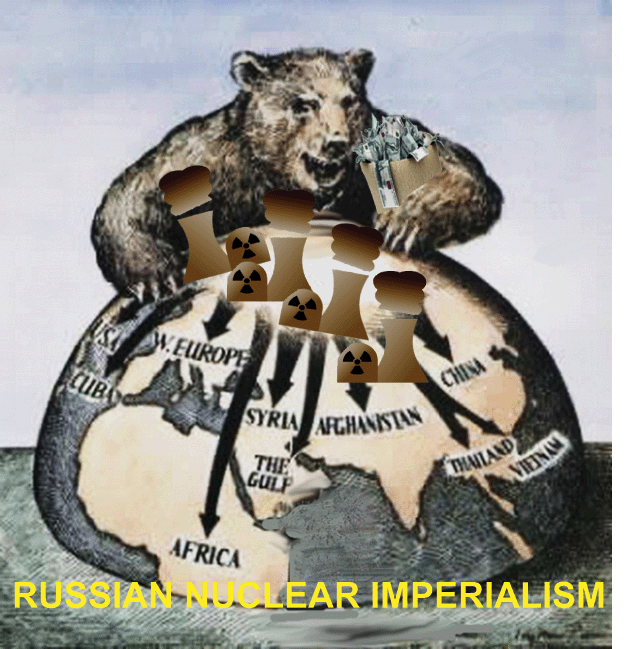
Myanmar signs new nuclear energy agreement with Russia. The
Intergovernmental Agreement on cooperation in the use of nuclear energy for
peaceful purposes will see the two countries working together on the use of
nuclear technology in a number of areas, including training of a workforce
for building and running a small modular reactor.
World Nuclear News 7th Feb 2023
https://www.world-nuclear-news.org/Articles/Myanmar-signs-nuclear-energy-cooperation-agreement
Cameco Agrees to New Deal With Ukraine’s Nuclear Energy Utility
Feb. 8, 2023 , By Stephen Nakrosis https://www.marketwatch.com/story/cameco-agrees-to-new-deal-with-ukraine-s-nuclear-energy-utility-271675897372—
Cameco Corp. said it agreed to terms with SE NNEGC Energoatom, the Ukrainian state-owned nuclear energy utility, to provide natural uranium hexafluoride, or UF(6), through 2035.
“Key commercial terms, such as pricing mechanism, volume and tenor, have been agreed to, but the contract is subject to finalization, which is anticipated in the first quarter of 2023,” Cameco said.
The deal, which runs from 2024 to 2035, will see all deliveries in the form of UF(6). “The contract will contain a required degree of flexibility, given present circumstances in Ukraine,” Cameco said.
The agreement will see Cameco supply 100% of Energoatom’s UF(6) requirements for the nine nuclear reactors at the Rivne, Khmelnytskyy and South Ukraine nuclear power plants. The deal also has an option for Cameco to supply six reactors at the Zaporizhzhya nuclear power plant, which is currently under Russian control, should it return to Energoatom’s operation, the companies said.
Poland might have tax-payer fund its ambitious nuclear plans, -and hope that investors might come in later.
Poland / Could ‘SaHo Model’ Be Way Forward For Financing Warsaw’s Ambitious Nuclear Plans?
NUCNET, By Patrycja Rapacka, David Dalton, 6 February 2023
Proposed scheme could solve problems in nuclear sector related to high risk and high costs of capital.
Poland is showing interest in a “new and innovative” nuclear financing model in which the state assumes the role of investor in the first stages of investment but gradually sells shares in the nuclear company to final investors who are entitled to use electricity for own consumption produced by reactors at cost…… (subscribers only) more https://www.nucnet.org/news/could-saho-model-be-way-forward-for-financing-warsaw-s-ambitious-nuclear-plans-2-1-2023
US announces first transfer of seized Russian assets to Kiev
https://www.rt.com/business/570949-us-russia-assets-ukraine/ 6 Feb 23 Money confiscated from a Russian businessman will be made available to ‘support the people of Ukraine’
US Attorney General Merrick Garland announced on Friday the first transfer of assets, confiscated as part of anti-Russia sanctions, to Ukraine to pay for the country’s reconstruction.
The measure affects $5.4 million expropriated from Russian businessman Konstantin Malofeyev on charges of sanctions evasion, according to the top official.
“With my authorization today, forfeited funds will next be transferred to the State Department to support the people of Ukraine,” Garland said, adding that the funds were confiscated following an indictment against Malofeyev, issued last April.
Earlier this week, a federal court in New York allowed prosecutors to confiscate $5.4 million belonging to Malofeyev, paving the way for the funds to be used to help rebuild Ukraine.
In June, millions were seized from a US bank account belonging to Malofeyev, against whom the US Treasury Department announced sanctions in April “for having acted or purported to act for or on behalf of, directly or indirectly” the Russian government.
The businessman, who owns Russian Orthodox Christian channel Tsargrad TV, has been on the US sanctions list since 2014. Malofeyev previously claimed that he had no holdings in the West since then.
In December, US President Joe Biden signed legislation allowing the Department of Justice to transfer some forfeited assets to the State Department to aid Ukraine. US law restricts how the government can use such assets.
Death and Japan’s nuclear shelter salesman

Khrushchev once speculated that the survivors of the apocalypse would envy the dead. I agree.
LEO LEWIS, https://www.ft.com/content/5dbd0e08-5eec-4486-a1ba-fe1948d11159— 5 Feb 23
The “doomsday clock” maintained since 1947 by the Bulletin of Atomic Scientists is many things. An index of our gossamer proximity to annihilation; a metaphor for the human paradox of progress and regression; a near-drained reservoir of hope that the gods will spare us from ourselves. And, of course, a superb marketing tool for any half-decent nuclear shelter salesman.
The Bulletin’s January 24 decision to move the hands of its doomsday clock closer to midnight (signifying global catastrophe) than they have ever been before should, logically, give the bunker business a recession-defying sales spike. The collective shrug it will actually get is more profoundly alarming.
For Hiroki Nakajima, the marketing director of shelter-maker World Net International (WNI), these are comparatively good times. North Korean ballistic missile tests and China’s rising military power, he says, have driven Japanese shelter sales significantly higher than in the past. The fear factor soared after Vladimir Putin invaded Ukraine and started issuing explicit nuclear threats. WNI historically used to sell only a couple of $80,000 premium shelters a year; in 2022 that shot up to a still modest 25 — hardly a nation gripped with fear.
Nakajima, whose best customers are the very wealthy and very nervous, says he will consider listing the company on the Tokyo Stock Exchange “as society’s needs require”. He delivers his nuclear shelter sales pitch from a medium-sized warehouse with models arranged by size, blast resilience and interior decor. I am shown into one with eggshell blue padded walls and, optimistically given the post-Armageddon broadcasting constraints, a wall-mounted TV.
We are in the smallish seaside town of Yaizu, a pretty fishing port that looks back on to a snow-capped Mount Fuji and whose placidness contrasts effectively with the mental picture of the horrors that would make a shelter purchase value for money. Nakajima’s marketing strategy includes judicious repetition of the phrase “your whole family will die” wherever appropriate; mostly as the certain outcome of any attempt at self-preservation other than buying a WNI shelter.
As efforts to induce apocalyptic terror go, it is valiant stuff. But he is talking to someone who grew up in Britain in the 1980s: someone who has had his wits scared out of him by far, far more proficient fearmongers. Set against (among others) Threads, The War Game, When the Wind Blows and the Protect and Survive public information films, Japanese shelter marketing feels almost upbeat. As Cold War children we hummed pop songs that were more chillingly referential to nuclear obliteration than the WNI website. And that was when the Doomsday clock was set further from midnight than it is now.
But Nakajima is not without support in his bid to set out the risks. Last month, the Japanese government began considering for the first time what a shelter subsidy scheme might look like, suggesting that its assessment of the nuclear threat has advanced from the general to the specific. Should such a subsidy emerge, says Nakajima, sales could be 100 times what they are now.
I sit for some time in WNI’s cramped showcase shelter, imagining the circumstances that might bring me to this bunker if I ever owned one: the mass extinction beyond its sturdily engineered walls, the irradiated cinders of civilisation blown against its air filter intake, the endless weeks cocooned with whichever loved ones made it in time, mourning those who did not. Nikita Khrushchev once speculated that the survivors of such a war would envy the dead. I agreed, and Nakajima quietly lost a customer.
The faint feeling of absurdity in WNI’s showroom points, obliquely, to a problem with the doomsday clock. Arguably the most potent symbol of humanity’s collective need to change tack, the clock is now set at just 90 seconds to midnight but seems to have lost its capacity to terrify at a time when we should be more terrified than ever before.
For while the clock is most closely associated in the public mind with the threat of nuclear war, it has long been a broader metric of imperilment from all human-made global disaster — a spectrum of risk ranging from climate change, and the denial of it, to microscopic autonomous robots.
The trouble with the clock is that, where once it was a paramount siren, it is now merely one of many alarms telling us that we are doomed. Under cover of that surfeit of fear, the clock has now gone pretty much as far as it can without being right. That is something none of us — even those with the best shelter $80,000 will buy — can afford to see proved.
Nuclear too expensive and not needed — Beyond Nuclear International

Detailed research shows mistake in pursuing nuclear power
Nuclear too expensive and not needed — Beyond Nuclear International
Energy scientists show obsolescence of nuclear power in an all-renewable future
From Claverton Energy Group
Sizewell C is much more expensive and slower to build than proven and reliable alternative low carbon solutions says an energy think tank that examined nuclear projects in the United Kingdom. Even the unfinished twin reactors at Hinkley C can’t compete with renewables.
Baseload generators such as nuclear power plants are not needed in an all-renewable future and their use will almost certainly increase overall costs to consumers says an elite Claverton Energy Group of experts. Professor Mark Barrett, from University College London (UCL), who has modeled the comparative costs of nuclear and renewable power, using hour-by-hour wind and solar data with 35 years of weather data, said:
“Nuclear power is more expensive and slower to build than renewables, particularly offshore wind. 7 GW of wind will generate about 40% more electricity than Hinkley at about 30-50% of the cost per kWh and will be built in half the time. Neither wind nor nuclear plants operate all the time, so both will need backup. Modeling shows the total cost of renewable generation to be less than nuclear and to be just as able to provide continuous power even with wind and solar droughts.”
This detailed modeling of the entire heat, power and transport system in the UK, has been carried out by a number of top-flight university researchers and shows that:
Continue readingChina marketing nuclear reactors to Pakistan
Pakistani Prime Minister Shehbaz Sharif has inaugurated the third unit of
the Karachi Nuclear Power Plant (KANUPP), which has 1.1GW of power
generating capacity. Built with an investment of $2.7bn, the K-3 nuclear
unit is expected to ease Pakistan’s ongoing energy crisis, according to
Bloomberg.
It is the second Chinese-designed Hualong One reactor to be
deployed at KANUPP, having been built with the Chinese Government’s
assistance under the China-Pakistan Economic Corridor (CPEC) initiative. At
the inauguration ceremony, Prime Minister Sharif said Pakistan ‘badly
needs’ clean and cheap sources of energy, be they nuclear, hydropower or
other renewables.
Power Technology 3rd Feb 2023
https://www.power-technology.com/news/pakistan-karachi-nuclear-power-plant/
1 This Month
Chernobyl: The Lost Tapes – A good documentary on Chernobyl on SBS available On Demand for the next 3 weeks– https://www.sbs.com.au/ondemand/tv-program/chernobyl-the-lost-tapes/2352741955560

of the week–London Campaign for Nuclear Disarmament

Tell the Ukrainian Government to Drop Prosecution of Peace Activist Yurii Sheliazhenko
To see nuclear-related stories in greater depth and intensity – go to https://nuclearinformation.wordpress.com
-
Archives
- April 2026 (143)
- March 2026 (251)
- February 2026 (268)
- January 2026 (308)
- December 2025 (358)
- November 2025 (359)
- October 2025 (376)
- September 2025 (257)
- August 2025 (319)
- July 2025 (230)
- June 2025 (348)
- May 2025 (261)
-
Categories
- 1
- 1 NUCLEAR ISSUES
- business and costs
- climate change
- culture and arts
- ENERGY
- environment
- health
- history
- indigenous issues
- Legal
- marketing of nuclear
- media
- opposition to nuclear
- PERSONAL STORIES
- politics
- politics international
- Religion and ethics
- safety
- secrets,lies and civil liberties
- spinbuster
- technology
- Uranium
- wastes
- weapons and war
- Women
- 2 WORLD
- ACTION
- AFRICA
- Atrocities
- AUSTRALIA
- Christina's notes
- Christina's themes
- culture and arts
- Events
- Fuk 2022
- Fuk 2023
- Fukushima 2017
- Fukushima 2018
- fukushima 2019
- Fukushima 2020
- Fukushima 2021
- general
- global warming
- Humour (God we need it)
- Nuclear
- RARE EARTHS
- Reference
- resources – print
- Resources -audiovicual
- Weekly Newsletter
- World
- World Nuclear
- YouTube
-
RSS
Entries RSS
Comments RSS
 nuclear-news