Nuclear Troubles Send French Winter Power Prices Soaring

By Michael Kern – Apr 19, 2023 https://oilprice.com/Latest-Energy-News/World-News/Nuclear-Troubles-Send-French-Winter-Power-Prices-Soaring.html
France’s power prices for early 2024 are double the German prices for next winter as the huge French nuclear fleet continues to show signs of weak output and availability.
The French power price for the first quarter of 2024 was at $455 (416 euros) per megawatt-hour (MWh) on Wednesday. That’s more than double the price for the same period in Germany, where the power price was at $185 (169 euros) per MWh for early 2024, according to data compiled by Bloomberg.
France has had troubles at many of its nuclear reactors, half of which have been shut down for repairs and maintenance at several times over the past year.
Germany, meanwhile, took its last three nuclear power plants offline on Saturday, ending more than six decades of commercial nuclear energy use, Germany ended the nuclear power era despite continued concerns about energy security and energy supply after the Russian invasion of Ukraine and the end of pipeline natural gas deliveries from Russia, which was the largest gas supplier to Europe’s biggest economy before the war.
In France, concerns about the operations at France’s large nuclear power fleet resurfaced last month after the French nuclear safety authority, ASN, told energy giant and large nuclear reactor operator EDF to review its program of reactor checks, following the finding of another crack at a nuclear power plant.
This led to an 8% one-day surge in French power prices for next year, the biggest jump since the end of January.
For much of last year, France’s nuclear power generation was well below capacity, as more than half of the country’s reactors were offline at one point in the autumn due to repairs or maintenance.
At the moment, French nuclear power plants are producing 17.5% less than the average output rate for 2020 and 2021. That’s down from 23% last year, so there is some progress, but concerns remain.
Fukushima’s fishing industry survived a nuclear disaster. 12 years on, it fears Tokyo’s next move may finish it off.
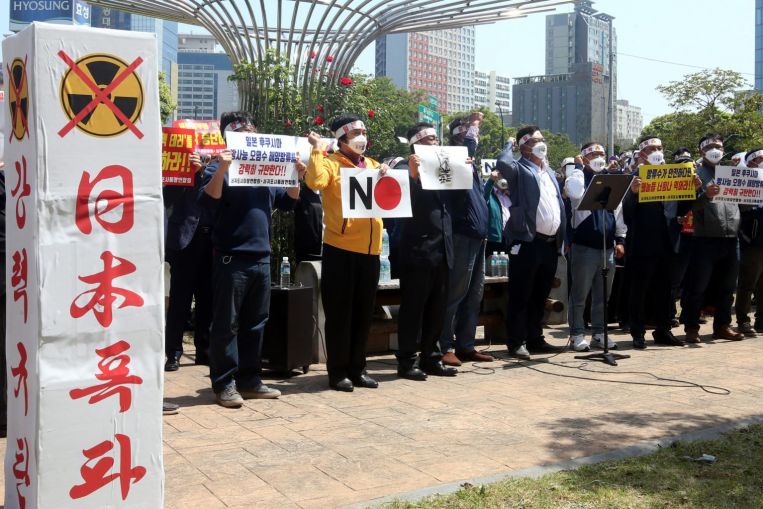
By Emiko Jozuka, Krystina Shveda, Junko Ogura, Marc Stewart and Daniel Campisi, CNN, April 19, 2023
It is still morning when Kinzaburo Shiga, 77, returns to Onahama port after catching a trawler full of fish off Japan’s eastern coast.
But the third-generation fisherman won’t head straight to market. First, he’ll test his catch for radiation.
It’s a ritual he’s repeated for more than a decade since a devastating earthquake and tsunami triggered a nuclear meltdown at the Fukushima Daiichi power plant in 2011, spewing deadly radioactive particles into the surrounding area.
Radiation from the damaged nuclear plant leaked into the sea, prompting authorities to suspend fishing operations off the coast of three prefectures that had previously provided Japan with half of its catch.
That ban lasted over a year and even after it was lifted, Fukushima-based fishermen like Shiga were for years mostly limited to collecting samples for radioactivity tests on behalf of the state-owned electricity firm Tokyo Electric Power Company, or TEPCO, rather than taking their catches to market.
Ocean currents have since dispersed the contaminated water enough that radioactive Cesium is nearly undetectable in fish from Fukushima prefecture. Japan lifted its last remaining restrictions on fish from the area in 2021, and most countries have eased import restrictions.
Shiga and others in the industry thought they’d put the nightmare of the past years behind them.
So when Japan followed through on plans to gradually release more than 1 million metric tons of filtered wastewater into the Pacific Ocean from the summer of 2023 – an action the government says is necessary to decommission the plant safely – the industry reeled.
The Japanese government and the International Atomic Energy Agency (IAEA), a United Nations body promoting the peaceful use of nuclear energy, say the controlled release, which is expected to take decades, will meet international safety regulations and not harm the environment, as the water will be treated to remove radioactive elements – with the exception of tritium – and diluted more than 100 times.
But with the deadline for the planned water release looming this summer, Fukushima’s fishermen fear that – whether the release is safe or not – the move will undermine consumer confidence in their catches and once again threaten the way of life they have fought so hard to recover…………………………………………………………………..
While radioactive wastewater contains dangerous elements including Cesium and Strontium, TEPCO says the majority of those particles can be separated from the water and removed. TEPCO claims its filtering system, called advanced liquid processing (ALPS), can bring down the amount of those elements far below regulatory standards.
But one hydrogen isotope cannot be taken away, as there is currently no technology available to do so. This isotope is radioactive tritium, and the scientific community is divided on the risk its dissemination carries………………………………………………………
“For decades, nuclear power plants worldwide – including in the United States, Canada, Britain, France, China and South Korea – have been releasing waste contaminated with tritium, each under its own national quota,” said Tim Mousseau, an environmental scientist at the University of South Carolina.
But Mousseau argues tritium is overlooked because many countries are invested in nuclear energy, and “there’s no way to produce it without also generating vast amounts of tritium.”
“If people started picking on TEPCO in Fukushima, then the practice of releasing tritium to the environment in all of these other nuclear power plants would need to be examined as well. So, it opens up a can of worms,” he said, adding the biological consequences of exposure to tritium have not been studied sufficiently.
In 2012, a French literature review study said tritium can be toxic to the DNA and reproductive processes of aquatic animals, particularly invertebrates, and the sensitivity of different species to various levels of tritium needs to be further investigated.
Currently, countries set different standards for the concentration of tritium allowed in drinking water. For example. Australia, which has no nuclear power plants, allows more than 76,000 becquerel per liter, a measure used to gauge radioactivity, while the WHO’s limit is 10,000. Meanwhile, the US and the European Union have much more conservative limits – 740 and 100 becquerel per liter respectively.
Ian Fairlie, an independent consultant on radioactivity in the environment, told CNN that “two wrongs don’t make a right” when it comes to Japan’s decision to release tritiated water. He argues TEPCO should build more storage tanks to allow for the decay of the radioactive tritium, which has a half-life of 12.3 years.
Lack of trust for the ‘nuclear village’
In Japan, the Fukushima wastewater issue has become highly contentious due to a lack of trust among influential advocates of nuclear energy, or what’s locally known as the “nuclear village.”
The informal group includes members of Japan’s ruling party (the Liberal Democratic Party), the Ministry of Economy Trade and Industry and the nuclear industry.
“(The nuclear village) used to tell us that nuclear energy is 100% safe – but it wasn’t, as the Fukushima Daiichi plant accident revealed,” said Koichi Nakano, a political scientist at Sophia University, in Tokyo.
A series of missteps after the disaster further eroded public trust, according to a 2016 report written by Kohta Juraku, a researcher at Tokyo Denki University.
For instance, in 2012, the government and TEPCO presented a proposed action plan to local fishing representatives that involved pumping up groundwater before it flooded into the nuclear reactor buildings and releasing it into the sea. Fishing bodies were on board but the plan was it postponed until 2014 after 300 tons of radioactive water leaked from the plant into the sea, infuriating fishers……………………………………… https://edition.cnn.com/2023/04/19/asia/japan-fukushima-disaster-wastewater-fishing-concerns-hnk-dst-dg-intl/index.html
US ready to lend Poland $4 billion for nuclear energy plan
A project to develop about 20 small nuclear power reactors in Poland is moving forward as Polish energy company Orlen and two U.S. government financial institutions signed an agreement
abc news, By MONIKA SCISLOWSKA Associated Press, April 17, 2023,
WARSAW, Poland — A project to develop small nuclear power reactors in Poland is moving forward, with Polish energy company Orlen and two U.S. government financial institutions signing an agreement Monday.
Poland is turning toward energy that is renewable [whaa a at – nuclear renewable?] or does not use climate-changing fossil fuels as it tries to break its reliance on coal. Moscow’s invasion of Ukraine also has accelerated Poland’s drive to cut its dependence on Russian oil and natural gas…………………
One German company persists with nuclear power -interests in reactors in Sweden.
Germany is getting out of nuclear power – not completely
Market Screener, 04/11/2023 DÜSSELDORF (dpa-AFX) – Even after Germany’s last three nuclear power plants shut down on April 15, a German company will continue to produce nuclear power. Uniper, the energy company nationalized in the wake of the gas crisis, has stakes in three nuclear power plants in Sweden, and is a majority shareholder in one of them. “
Uniper is currently planning to build an electric, non-nuclear research and test facility at the Oskarshamn nuclear power plant site, with construction set to begin next year, he said. The project will be carried out in cooperation with the company Blykalla and the Royal Institute of Technology, he said. The research facility will focus on testing materials and components for a new type of reactor, called a Small Modular Reactor (SMR)………..
The German Institute for Economic Research (DIW) recently expressed its disapproval of SMR plants, which are understood to be reactors with an electrical output of up to 300 megawatts. SMR concepts are not mature and will not be available in the foreseeable future, according to a study. They were old reactor concepts that had not become established because of economic disadvantages due to the lower outputs.
“Further, they remain radiologically hazardous because the problems of increased transport and interim storage of radioactive waste would multiply.” Despite decades of research, he said, hardly any nuclear power plants in the SMR category have been able to begin commercial power operations. Even assuming optimistic conditions, he said, a cost-competitive bid cannot be assumed./tob/DP/zb https://www.marketscreener.com/quote/stock/E-ON-SE-3818998/news/Germany-is-getting-out-of-nuclear-power-not-completely-43462261/
Classic Megaproject Early Mistakes Will Create A Fiscal Disaster For Netherlands Nuclear

The Netherlands doesn’t have a plan, just an aspiration. They don’t have a schedule, just a notional target that is close enough to 2030 to sound good. They don’t have a budget, they have a number that they think that they can sell. There’s just so much failure inherent in this proposal that it’s like asking a flatland triangle to successfully build the Pyramid of Giza. Where to start?
As the data shows, 55 nuclear construction projects globally had cost overruns greater than 50%, and the average of those projects were 204% overruns, which is to say that they cost three times more than budgeted for.
The first bias and most evident here, is strategic misrepresentation, aka lying outright or obfuscating the likely truth in order to get something going. When equivalent projects are looked at, €5 billion is clearly a gross understatement of the real costs, but is also clearly the only number that the government believes it can sell.
By Michael Barnard, 5 Apr,23, https://cleantechnica.com/2023/04/05/classic-megaproject-early-mistakes-will-create-a-fiscal-disaster-for-netherlands-nuclear/
Recently, the new coalition government of the Netherlands looked across its decarbonization portfolio, realized that it had failed to meet renewables targets, and so announced that it would build two nuclear power reactors with 1-1.6 GW capacity each. And the government is claiming that it will have them running in 2035, but has only outlined costs through 2030 of €5 billion ($5.5 billion).
The Netherlands’ plan does have a couple of things going for it. The country actually has a small, 50-year old, 485-MW nuclear reactor at Borssele, and they are apparently going to build the new reactors on the same site. They’ve also extended the life of the very old reactor, which has people understandably concerned. So they have operational experience with nuclear, albeit with a very different technology with considerably different operational characteristics, predating as it does most computerization of control systems.
They have already jumped through the International Atomic Energy Agency’s 28 or so major hoops. They already have the seven overlapping, somewhat concentric layers of security from international to internal site high-security areas in place and know what is required. The combination puts them ahead of countries that don’t have existing nuclear reactors, and ahead of projects attempting to site reactors in a new location.
What doesn’t the Netherlands have or know about these reactors?
They don’t know what technology they will use. Some reports say that they will stick with third-generation nuclear technology, which sounds conservative until you realize that Hinkley in the UK, Flamanville in France, Vogtle and Summer in the US, and Olkiluoto in Finland were all third generation AP1000s and European Pressurized Reactors (EPR), and all have suffered massive cost and budget overruns.
They don’t have any trained, certified, or security cleared design or construction resources. The requirements for nuclear design and construction resources are substantially higher than for wind, solar, and other generation options. High security clearances are required for a vastly greater percentage of nuclear construction resources than for other forms of electrical generation, especially as they’ll be doing construction on a running nuclear site. Many people in non-nuclear trades such as boilers, turbines, electricians, and the like who would be acceptable for a wind farm, solar farm, or hydro project will not pass the filters for nuclear projects. In fact, many utility-scale construction projects employ vast numbers of unskilled day laborers that they pick up off street corners at the beginning of the day and drop off again at the end.
They don’t have a significant nuclear engineering program in any of their universities. The nuclear chair in TU Delft retired a decade or so ago and was never replaced. There’s a professor of nuclear engineering at the school, Jan Leen Kloosterman, and he’s clearly excited by this opportunity and hoping that the chair will be re-established with him sitting in it per his public comments.
They have no one who has ever led and run the construction of a nuclear plant. The people who built Borssele are dead or retired to Spain or Portugal, one assumes.
They don’t have a primary contractor, and that’s much more of a problem than it was a decade ago. The three major countries that are building or attempting to build nuclear reactors in other jurisdictions are Russia, China, and France. Russia has made itself an international pariah and clearly wouldn’t pass basic security checks. China has been politically blackballed because it’s stopped being a cheap manufacturer of consumer goods and become instead a major economic competitor which has surpassed the US by several measures and is set to surpass it by most of the rest by 2035. And then there’s France, which has proven to Europe and the world that it is incompetent to build new nuclear reactors, and has had problems operating its own.
The Netherlands doesn’t have a plan, just an aspiration. They don’t have a schedule, just a notional target that is close enough to 2030 to sound good. They don’t have a budget, they have a number that they think that they can sell. There’s just so much failure inherent in this proposal that it’s like asking a flatland triangle to successfully build the Pyramid of Giza. Where to start?
Continue readingMissouri House votes to ease restrictions on nuclear power plant construction costs
The Consumers Council of Missouri is among those who oppose the plan, saying if the plant is never completed, electric customers still bear the costs.
Kurt Erickson ST Louis Post Dispatch, 27 Mar 23,
JEFFERSON CITY — Utility companies like Ameren Missouri could begin billing customers for the upfront costs of building nuclear power facilities under a plan advancing in the General Assembly.
In debate Monday, the Missouri House gave preliminary approval to legislation allowing utility companies to add the cost of a new nuclear plant or renewable energy generator to customers’ rates while they’re under construction.
That’s a practice that was banned by Missouri voters in 1976 in response to the utility company’s attempt to collect costs while it was building the state’s first and only nuclear power plant in Callaway County.
Then, and now, consumer advocates object to the concept of forcing utility users to pay for something that is not yet in service, especially when Ameren recently obtained a rate increase and, in February, announced a 7% increase in its quarterly cash dividend, signaling healthy economic times.………………………..
The Consumers Council of Missouri is among those who oppose the plan, saying if the plant is never completed, electric customers still bear the costs.
In South Carolina, the concept enabled a utility to charge ratepayers for the construction of two nuclear reactors that were never completed. During that period, South Carolina ratepayers were charged billions of dollars until the project faltered and ultimately collapsed, the watchdog organization said.
Large industrial users of electricity, including Ford Motor Co. and other manufacturers, also oppose the plan……………………………
Rep. Doug Clemens, D-St. Ann, warned that the measure could hurt consumers.
“This particular scheme is essentially giving a blank check to our utility companies,” Clemens said. “We’ll never see productivity out of this scheme.”………………………
The proposal needs a final vote in the House before moving to the Senate for further deliberations.
The legislation is House Bill 225. more https://www.stltoday.com/news/local/govt-and-politics/missouri-house-votes-to-ease-restrictions-on-nuclear-power-plant-construction-costs/article_d8ad48b5-988a-5809-a61d-c6daed2f7b76.html
Nuclear skills shortage in Britain
Across the UK, businesses of all shapes, sizes and sectors face increasing
competition for talent. But the big question is: does the country – with
its long-standing skills gap in a number of industries – have the
foundations to build a workforce which can meet our economic and
environmental ambitions?
Nuclear faces a perfect storm in developing future
talent with the combination of a historic lack of investment, an ageing
workforce and the government’s aspirations for growth in civil and
defence (due to the drive to reach net zero and national security
concerns). This means the sector must increase its recruitment levels by
300% at a time of fierce competition for talent.
New Civil Engineer 27th March 2023
https://www.newcivilengineer.com/latest/boosting-nuclear-knowledge-in-schools-plays-a-crucial-role-in-building-the-workforce-of-the-future-27-03-2023/
NuScale Power the canary in the small modular nuclear reactor market
SMRs are being marketed as a solution to the climate crisis, but they’re already far more expensive and take much longer to build than renewable and storage resources – that we already have.
Utility Dive, David Schlissel, 21 Mar 23, Davis Schlissel is the Institute for Energy Economics anf Financial Analysis director of resource planning analysis.
NuScale is hoping to be among the first of about a dozen companies trying to take advantage of the much-hyped market for small modular nuclear reactors or SMR. So far, however, the Oregon-based company is looking like the first canary in the coal-mine.
Considered a leader in the new technology, NuScale is marketing its SMR project by claiming that the reactor design project will save time and money – persistent problems for traditional large nuclear plants.
But NuScale and the Utah Municipal Power Systems, its partner in an SMR project planned for Idaho, announced early in January, that the target price for the power from their proposed modular reactor had risen by 53% from $58/MWh to $89/MWh……..
The announcement has serious implications for all would-be SMR manufacturers………………
the new $89/MWh target price already means that power from the NuScale SMR will be much more expensive than renewable and storage resources even with an estimated $4.2 billion in tax-payer subsidies.
……………………………….. The gap is only going to get larger as the costs of building SMRs rise and costs of renewables and storage continue to decline.
………….. Using SMRs as backups for renewables will not be financially feasible
………………………………….evryone – utilities, ratepayers, legislators, federal officials and the general public, should be very sceptical about theindustry’s current claim that the new SMRs will cost less and be built faster than previous designs. https://www.utilitydive.com/news/nuscale-power-small-modular-reactor-smr-ieefa-uamps/645554/
European Tiny Modular Reactor Deal Starts With Absurdly Expensive Electricity

Already 2.4 times as expensive as very, very expensive Hinkley. First of a kind, so very likely to double or more in price. Very unlikely to be built before 2040 due to long-tailed risks.
Small modular reactors won’t achieve economies of manufacturing scale, won’t be faster to construct, forego efficiency of vertical scaling, won’t be cheaper, aren’t suitable for remote or brownfield coal sites, still face very large security costs, will still be costly and slow to decommission, and still require liability insurance caps. They don’t solve any of the problems that they purport to while intentionally choosing to be less efficient than they could be. They’ve existed since the 1950s and they aren’t any better now than they were then.
By Michael Barnard, 25 Mar 23, https://cleantechnica.com/2023/03/23/european-tiny-modular-reactor-deal-starts-with-absurdly-expensive-electricity/
Supposedly a European energy deal has been reached in which a US firm sells a bunch of tiny nuclear reactors to European countries at an enormous price per GW. It’s hard to think that anybody would ink the deal as described.
It was a Bloomberg piece, and Bloomberg normally gets the facts right, although Bloomberg New Energy Finance gets the framing right far more often. And a bit of evaluation seems to confirm the basics. So let’s tear it apart.
Let’s start with small modular nuclear reactors (SMR). The premise is that they will be a lot cheaper than big nuclear reactors because, you know, modularity. Anything you can manufacture in large numbers drops in price, typically by 20% to 27% for every doubling of units. That’s a truism known as Wright’s Law after the first management consultant who observed it, the experience curve per Boston Consulting Group which happily stole and rebranded it or just the learning curve.
There are a bunch of problems with this premise when it comes to nuclear electricity generation. I’ve written about them, had my content peer-reviewed and included in text books, and debated them with nuclear industry proponents for audiences of a couple of hundred institutional investors likely representing funds worth close to a trillion, so I’m just going to quote myself:
Small modular reactors won’t achieve economies of manufacturing scale, won’t be faster to construct, forego efficiency of vertical scaling, won’t be cheaper, aren’t suitable for remote or brownfield coal sites, still face very large security costs, will still be costly and slow to decommission, and still require liability insurance caps. They don’t solve any of the problems that they purport to while intentionally choosing to be less efficient than they could be. They’ve existed since the 1950s and they aren’t any better now than they were then.
As I discussed with Professor Bent Flyvbjerg, megaprojects expert and author of How Big Things Get Done recently, small modular reactor firms are trying to hunt for an optimized point on the continuum between the efficiencies of big thermal generation and modularity, and I don’t think they are going to find it.
And that’s really true for Last Energy if this reporting is remotely accurate. So what’s the story? Well, apparently they’ve signed a $19 billion deal to supply 34 nuclear reactors that are 20 MW each. Apparently they are going to at least Poland and the UK, although regulatory approval stands in their way.
The first thing that caught my eye was the MW capacity. 34 reactors of 20 MW each only adds up to 680 MW of nameplate capacity. That’s smaller than a billion dollar offshore wind farm that takes ten months to build.
Side note: Nuclear nameplate capacities are usually reported with units of MWe, or megawatts of electricity. That’s because their thermal energy output is perhaps three times the size, but meaningless, as all we care about is the electricity. I just stick with MW usually because the best comparison is to wind and solar which don’t create and waste a lot of heat. However, at 20 MWe, the tininess of the reactor and related thermal generation suggests that the efficiency of turning heat into electricity is probably much worse. That’s the point about thermal generation liking to scale and why everyone building nuclear went bigger in the 1970s and 1980s so that it wouldn’t be as expensive.
So, 20 MW. Is that accurate? I went to their public website, and sure enough, that’s the size. It’s their only claimed product, although they have built and delivered none of them anywhere.
The second thing that caught my attention was the eye-watering price tag, $19 billion. That seems really high even for nuclear, and especially high for only 680 MW.
Maybe this would be reasonable if nuclear normally had capacity factors of 20%, and this tech was operating at 90%, but nuclear globally runs about 90% of the time. It has high uptime, which proponents overstate as an advantage, but is the reality. You can’t actually operate nuclear less than 90% of the time and have it be reasonably priced due to the cost of building the stuff.
How does this compare? Let’s pick the British Hinkley Point C nuclear expansion, one of the most expensive and slowest in the developed world. It is so expensive that the developers demanded and got about $150 per MWh wholesale guaranteed for 35 years with inflation bumps. This when offshore wind energy is running around $50 per MWh wholesale and onshore wind and solar are running around $30 per MWh wholesale. Yeah, Hinkley is absurdly expensive electricity.
Let’s take a walk through memory lane. Hinkley was supposed to deliver electricity for about $24 per MWh when it was originally proposed in 2008, and be in operation by now. Five times the cost per MWh accounting for inflation, so a clear miss. And the current plan is pretending that in 2027 it’s going to be grid-connected, but that’s undoubtedly 2028 at earliest, 20 years after it was originally set in motion, and 11 years after start of construction. So far, so nuclear.
Hinkley’s current cost projection — five years from grid connection, so incredibly likely to rise by billions — is about $40 billion. That’s a lot of amortization per MWh, hence the remarkably high wholesale price. As a reminder, Iceland, which runs 100% on renewables, is delivering consumer retail prices lower than this wholesale price. All of Canada is providing consumer rates below this wholesale cost, although recent news makes it clear that nuclear heavy Ontario are subsidizing consumer rates by US$4.4 billion annually to prevent revolt. Hmmm, is this a trend?
Surely Hinkley must be turning out to be more expensive than this SMR deal? Well, no. Hinkley is building two big, complex, next-generation EPR reactors with 1,630 MW capacity each. That’s 3,260 MW total capacity. That’s almost five times the capacity of the Last Energy SMRs. For only two times the cost.
The ratio is pretty clear. These SMRs will be about 2.4 times the cost per MWh of the very expensive Hinkley facility. All else being equal — and the only reason we have to think this won’t be equal is that nuclear costs always rise, so the $19 billion is likely to be closer to $40 billion — this is already about $360 per MWh wholesale prices for electricity.
What’s the consumer retail price of electricity in the UK? About $340. What about coal heavy Poland? $181.
Yes, the very first announcement of a nuclear deal, probably well over a decade before anything might be connected to the grid, has wholesale rates well over consumer retail rates today.
On original – image of project categories which meet time, budget, and benefits expectations vs ones that don’t, from How Big Things Get Done by Bent Flyvbjerg and Dan Gardner -(nuclear is the worst!)
This is the first version of new material from Flyvbjerg and his team. They have assembled over 16,000 megaprojects’ worth of data on budget, schedule, and asserted benefits vs actuals over 25 categories of projects. This is a view by likelihood of cost overruns. The top of the chart has the least likely categories to go over budget once the shovel hits the ground. The bottom has the categories most likely to go over budget, often by multiples of the original projections. You’ll note where nuclear lies.
SMRs are attempting to fix that by making a bunch of smaller, repeatable reactors instead of big ones. As I pointed out earlier, they are foregoing the efficiencies of being big enough to receive the benefits of physics for thermal generation in order to hunt for a point where modularity optimizes costs and risks sufficiently to make it economically viable.
However, at 2.4 times the cost per MWh of one of the most expensive nuclear generation projects on the planet, clearly they are nowhere near the field, never mind anywhere near the goal. As Flyvbjerg points out several times, first of a kind projects have massive long-talked risks, and Last Energy’s announcement has first of a kind in big neon screaming signage over every part of the deal.
Already 2.4 times as expensive as very, very expensive Hinkley. First of a kind, so very likely to double or more in price. Very unlikely to be built before 2040 due to long-tailed risks. Who exactly signed a deal like this, and why?
UPDATE:
Comments from Lyle Morton, Vice President of Marketing & Communications, Last Energy: Reaching out to clarify an important detail regarding the Last Energy announcement. The $19bn is not a cost figure but the total value of the electricity under contract over the duration of the 4 contracts — which range from 20-24 years.
My take: That’s still a ridiculous $160-$170 per MWh wholesale by the initial terms of the deals before all of the inevitable problems with first of a kind deployments. Even at $160-$170, I’ll believe this only when I see it in operation, at the price point specified, and delivering benefits as promised. I won’t be holding my breath.
A $1 trillion defense budget would be madness — Beyond Nuclear International

And more than half of it will go to weapons manufacturers
https://beyondnuclearinternational.org/2023/03/26/a-1-trillion-defense-budget-would-be-madness/
Biden has requested an obscene $886 billion for defense, but it could go higher
By William Hartung, 26 Mar 23
The Pentagon has released its budget request for Fiscal Year 2024. The figure for the Pentagon alone is a hefty $842 billion. That’s $69 billion more than the $773 billion the department requested for Fiscal Year 2023
Total spending on national defense — including work on nuclear weapons at the Department of Energy — comes in at $886 billion. Adding in likely emergency military aid packages for Ukraine later this year plus the potential tens of billions of dollars in Congressional add-ons could push total spending for national defense to as much as $950 billion or more for FY 2024. The result could be the highest military budget since World War II, far higher than at the peaks of the Korean or Vietnam Wars or the height of the Cold War.
The proposed budget is far more than is needed to provide an effective defense of the United States and its allies.
If past experience is any guide, more than half of the new Pentagon budget will go to contractors, with the biggest share going to the top five — Lockheed Martin, Boeing, Raytheon, General Dynamics, and Northrop Grumman — to build everything from howitzers and tanks to intercontinental ballistic missiles. Much of the funding for contractors will come from spending on buying, researching, and developing weapons, which accounts for $315 billion of the new budget request.

he National Priorities Project gives us a look at the imbalance of government spending for 2021 with the military consuming almost half.
As suggested above, Congress will probably add a substantial amount to the Pentagon’s request, largely for systems and facilities located in the states and districts of key members. That’s no way to craft a budget — or defend a country. When it comes to defense, Congress should engage in careful oversight, not special interest politics.
Unfortunately, in recent years the House and Senate have accelerated the practice of jacking up the Pentagon’s budget request, adding $25 billion in FY 2022 and $45 billion in FY 2023. Given threat inflation with respect to China and the ongoing war in Ukraine, there is a danger that the $45 billion added for FY2023 could be the floor for what might be added by Congress in the course of this year’s budget debate.
Exceptions to the rush to throw more money at the Pentagon may come from opposite ends of the political spectrum. Representatives Barbara Lee (D-Calif.) and Mark Pocan (D-Wis.) have introduced the “People Over Pentagon Act,” which calls for a $100 billion annual cut in the DoD budget. A group of conservative lawmakers centered around the Freedom Caucus have called for a freeze on the discretionary budget at FY2022 levels. But different members have given different views on how Pentagon spending would fit into a budget freeze, from assertions that it will be “on the table” to a denial by one at least one member, Rep. Chip Roy (R-Texas), that Pentagon cuts should come into play at all.
It has been reported that President Dwight D. Eisenhower believed that we should spend all we need for national defense and not one penny more. But the new motto of the Pentagon and the Congress appears to be “spend now and ask questions later.” Rather than matching funding to a viable national security strategy, the Pentagon and the Congress are pushing for whatever the political market will bear. The notion that tradeoffs need to be made against other urgent national priorities is a foreign concept to most members of the House and Senate, as they have routinely raised the Pentagon budget at the expense of other urgent national needs.
There is more than money at stake. An open-ended strategy that seeks to develop capabilities to win a war with Russia or China, fight regional wars against Iran or North Korea, and sustain a global war on terror that includes operations in at least 85 countries is a recipe for endless conflict.
We can make America and its allies safer for far less money if we adopt a more realistic, restrained strategy and drive a harder bargain with weapons contractors that too often engage in price gouging and cost overruns while delivering dysfunctional systems that aren’t appropriate for addressing the biggest threats to our security.
The Congressional Budget Office has crafted three illustrative options that could ensure our security while spending $1 trillion less over the next decade. A strategy that incorporates aspects of these plans and streamlines the Pentagon budget in other areas could be sustained at roughly $150 billion per year less than current levels.
A new approach would take a more objective, evidence-based view of the military challenges posed by Russia and China, rely more on allies to provide security in their own regions, reduce the U.S. global military footprint, and scale back the Pentagon’s $2 trillion plan to build a new generation of nuclear weapons. Cutting wasteful spending practices and slowing or replacing spending on unworkable or outmoded systems like the F-35 and a new $13 billion aircraft carrier could save billions more. And reducing spending on the half a million-plus private contractors employed by the Pentagon could save hundreds of billions over the next decade.
The Pentagon doesn’t need more spending. It needs more spending discipline, tied to a realistic strategy that sets clear priorities and acknowledges that some of the greatest risks we face are not military in nature. Today’s announcement is just the opening gambit in this year’s debate over the Pentagon budget. Hopefully critics of runaway spending will have more traction this year than has been the case for the past several years. If not, $1 trillion in annual military spending may be just around the corner, at great cost to taxpayers and to the safety and security of the country as a whole.
William D. Hartung is a senior research fellow at the Quincy Institute for Responsible Statecraft. His work focuses on the arms industry and U.S. military budget. He was previously the director of the Arms and Security Program at the Center for International Policy and the co-director of the Center’s Sustainable Defense Task Force.
Where the $1.3 Trillion Per Year U.S. Military Budget Goes

The Duran, by Eric Zuesse, March 24, 2023
Nobody can give a precise dollar-number to U.S. ‘Defense’ spending because the U.S. ‘Defense’ Department has never been able to pass an audit, and is by far the most corrupt of all federal Departments (and is the ONLY Department that has never passed an audit), and also because much of America’s military spending is being paid out from other federal Departments in order to keep down the published annual U.S. Government ‘Defense’ expenditure numbers (which come from ONLY the “U.S. ‘Defense’ Department).
Those are expenditures for America’s privatized and overwhelmingly profit-driven Military-Industrial Complex. (By contrast: Russia and China require, by law, that their armaments-firms be majority-owned by the Government itself.)
According to the best available estimates, the U.S. Government has been spending, in total, for over a decade now, around $1.3T to $1.5T annually on ‘defense’, and this is around half of all military spending worldwide by all 200-or-so nations, and is more than half (around 53%) of all of the U.S. federal Government’s ‘discretionary’ (or congressionally voted for) annual expenditures.
Unlike regular manufacturers, which sell entirely or mainly to consumers and to businesses, not to their Government, armament-firms need to control their Government in order to control their markets (which are their Government and its ‘allied’ Governments — including NATO), and so they (in purely capitalist countries such as the U.S.) do control their Government. This is why the armaments-business (except in countries whose armaments-sector is socialized) is infamously corrupt. In order to hide the extent of that corruption (and to promote ever-higher military spending), the ‘news’-media need — in those countries — to be likewise effectively controlled by the investors in those firms.
Consequently, America, which has no national-security threat from any country (so, these astronomical ‘defense’-expenditures are blatantly inappropriate), spends annually around half of all of the money that the entire world spends on the military. And most of that money gets paid to its armaments-firms. Or, as Stephen Semler, an expert on these matters, put it regarding last year’s numbers, “How much of the $858 billion authorized by the FY2023 NDAA will be transferred to military contractors? I estimate $452 billion.” ………………………………
If this had not been happening each year after the end of the Soviet Union in 1991, then the current U.S. federal debt would be far less, if any at all — but, in any case, that expense (which went, and is going, to exceptionally rich individuals) will be paid by future generations of Americans, by means of both increased taxes and reduced services from the U.S. Government. What pays for bombs (and funds the purchase of yachts) today will be taken from everyone’s infants tomorrow. And it is taking millions of lives in the targeted lands, and has been doing so for decades now. A psychopathic U.S. Government is producing these results………………………………………………………………………………………………
The presumption is that the voters don’t care, and that the ‘news’-media won’t enlighten the voters about this matter, and about how it impacts, for example, which nations the US will categorize as being an “ally,” to sell weapons to, and which nations it will categorize as being an “enemy,” to target for conquest………………………………………………….. more https://theduran.com/where-the-1-3-trillion-per-year-u-s-military-budget-goes/
Strikes hit French nuclear output, disrupt EDF maintenance plans
By Forrest Crellin, March 24, 2023 https://www.reuters.com/business/energy/strikes-hit-french-nuclear-output-disrupt-edf-maintenance-plans-2023-03-24/
PARIS, March 24 (Reuters) – Strikes in France are impacting maintenance plans at EDF’s (EDF.PA) nuclear plants, curbing production just as the utility hoped to rebound from a 34-year output low last year.
At least 14 nuclear reactors in EDF’s fleet of 56 have suffered some delay affecting their maintenance plans, data from the CGT union showed.
France is witnessing widespread industrial action sparked by planned government policy changes including a move to raise the retirement age by two years.
For EDF that has meant nuclear power output in 2023 even lower than last year when it had swathes of reactors offline for repairs and checks for stress corrosion cracks.
Those factors compounded a backlog in regular maintenance due to the COVID-19 pandemic.
On Friday the average hourly nuclear availability until the end of the year was down by around 4% to 44 gigawatts (GW) from 46 GW in January when the strikes began, ICIS analysis showed.
The impact is expected to be more acute in the summer, with availability to June dropping by around 9% to 39 GW from 43 GW, they added.
EDF declined to comment on the impact of the strikes on its maintenance plans.
If average availability drops by another 8 GW this year, EDF’s minimum production target of 300 terawatt-hours (TWh) will become challenging, Refinitiv analyst Nathalie Gerl said.
Refinitiv estimates EDF will achieve production of 296 TWh this year.
The current reduction in availability has so far equated to around a 1% cut to generation for the full year, or 3 to 4 TWh, ICIS data showed.
CGT spokeswoman Virginie Neumayer said EDF’s production targets were “ambitious or even very optimistic” noting they required a vast staff recruitment plan to deal with stress corrosion found in its reactors in late 2021.
“The disorganisation generated by schedule shifts is therefore complex to manage and will be felt over time,” she said.
French nuclear safety watchdog ASN requested EDF revise its maintenance program due to new cracks discovered this month in some reactors.
The French first-quarter 2024 baseload power contract, an indication of market confidence in power supply through the end of next winter, has risen more than 30% in the last two weeks after the latest cracks were discovered and the maintenance delays started.
Author of controversial memo puts the final nail in the coffin: Nuclear power in Denmark is not cost-effective
Even with district heating generation and a higher capacity factor, nuclear power in Denmark is still too expensive, according to calculations by an associate professor in energy planning at Aalborg University.
ING, Frederik Marcher Hansen 14. Mar 2023
Nuclear power in Denmark makes no sense, asserts Jakob Zinck Thellufsen, associate professor in energy planning at Aalborg University, during a presentation at the IDA trade union.
The controversial energy technology can neither help us achieve the climate goal for 2030 nor pay for itself compared to wind and solar energy, even if the nuclear power plants run almost continuously and generate district heating as a side benefit.
Jakob Zinck Thellufsen is the main author of the memo “Facts about nuclear power: Input for a fact-based discussion of the advantages and disadvantages of nuclear power as part of the green transition in Denmark”.
The memo was published in October last year and brought a lot of criticism.
Jakob Zinck Thellufsen has recalculated the scenarios for nuclear power in Denmark in the second version of the memo, which is currently being finalized, but which he partially revealed during the presentation.
………………………… Overall, however, this does not change the conclusion…………………………………..
Even if the construction costs are reduced to EUR 4.5 million per MW, the costs of a nuclear power-dominated energy system will be about 5 billion higher than of an energy system dominated by wind and solar power…………………………..
We can see that it’s possible to do it significantly faster in Asia, in around seven to nine years. But we have to compare that to the time required to build an offshore wind farm (including planning, ed.). And if it is pure construction time that we are looking at, it takes longer,” he says.1
Thus, nuclear power in Denmark will not be able to play a role in reaching the Danish climate goal of 70 percent lower CO2 emissions in 2030 compared to 1990, he states.
SMRs are also too expensive
Jakob Zinck Thellufsen has also looked at the small modular reactors, SMRs, which are claimed by proponents of nuclear power to be able to solve one of the biggest problems with conventional nuclear power—the costs.
During his presentation, he showed a figure of what the first SMRs from UK’s Rolls Royce and USA’s NuScale are expected to cost.
The cost is around EUR 55–70 per MWh, while the cost of the Danish offshore wind farm Thor is significantly lower at EUR 40 per MWh, and the cost of offshore wind turbines in Denmark in 2030 is expected to be just over EUR 30 per MWh.
“I’m not sure that either Rolls Royce’s or NuScale’s SMRs will be the right choice in the future, but it can be quite difficult to find figures on what they actually cost. […] and the technology is also developing, so it might be cheaper to do it (buy SMRs, ed.), but there the technology is also developing here (points to the figures for offshore wind, ed.), so the competition continues,” he says.
Where should we place them (the SMRs, ed.)? And how long can we wait for this to happen? That, I think, is an interesting topic to discuss.” https://ing.dk/artikel/author-of-controversial-memo-puts-the-final-nail-in-the-coffin-nuclear-power-in-denmark-is?utm_source=twitter&utm_medium=social&utm_content=social_top__20230322150732&utm_campaign=socialbuttons
Bad news for NuScale.

The unpredictable costs of nuclear have stung another US pioneer. NuScale, which received regulatory approval in January for its Voygr design, is the first SMR to get final approval from the Nuclear Regulatory Commission (NRC) for deployment in the US.
At the same time as it announced approval, however, NuScale that the cost of its systems has expanded, so it now expects to deliver electricity at $90 per MWh, instead of the $55/MWh it initially promised.
That’s significant because, despite receiving $4.2 billion in subsidies, NuScale is now promising electricity which is much more expensive than that from renewable sources such as solar and wind. Without funding from the Inflation Reduction Act and previous government schemes, NuScale’s power would be around $120/MWh, according to Utility Dive.
From : Last Energy claims to have sold 24 nuclear reactors in the UK for £2.4 billion
Last’s 20MW disposable power plants join a queue of six companies selling SMRs in Britain more https://www.datacenterdynamics.com/en/news/last-energy-claims-to-have-sold-24-nuclear-reactors-in-the-uk-for-24-billion/
Rolls Royce marketing its mini nuclear reactors to Sweden, Finland, Czech Republic, but deals could collapse

Rolls-Royce could build mini-nuclear reactors in Sweden and Finland under
plans being explored by Helsinki’s national energy company. Finnish
government-owned utility Fortnum has signed an early stage deal with
Rolls-Royce’s nuclear power business to explore uses of its small modular
reactors (SMRs) in the two Nordic countries. Shares in Rolls-Royce jumped
over 6pc in London on the news, amid a broader market rally.
The early stage deal comes as Rolls-Royce awaits a UK government decision on whether
to buy the reactors, which are smaller and cheaper than full scale plants.
Rolls-Royce’s 470MW units cost £1.8bn each. As well as the Finns, the
Czech government is also considering purchasing the technology as part of
efforts to decarbonise energy systems. Despite international interest,
Rolls-Royce has warned that deals may collapse unless Britain signals it
backs the technology by placing its own orders.
Telegraph 21st March 2023
1 This Month
Chernobyl: The Lost Tapes – A good documentary on Chernobyl on SBS available On Demand for the next 3 weeks– https://www.sbs.com.au/ondemand/tv-program/chernobyl-the-lost-tapes/2352741955560

of the week–London Campaign for Nuclear Disarmament

Tell the Ukrainian Government to Drop Prosecution of Peace Activist Yurii Sheliazhenko
To see nuclear-related stories in greater depth and intensity – go to https://nuclearinformation.wordpress.com
-
Archives
- April 2026 (139)
- March 2026 (251)
- February 2026 (268)
- January 2026 (308)
- December 2025 (358)
- November 2025 (359)
- October 2025 (376)
- September 2025 (257)
- August 2025 (319)
- July 2025 (230)
- June 2025 (348)
- May 2025 (261)
-
Categories
- 1
- 1 NUCLEAR ISSUES
- business and costs
- climate change
- culture and arts
- ENERGY
- environment
- health
- history
- indigenous issues
- Legal
- marketing of nuclear
- media
- opposition to nuclear
- PERSONAL STORIES
- politics
- politics international
- Religion and ethics
- safety
- secrets,lies and civil liberties
- spinbuster
- technology
- Uranium
- wastes
- weapons and war
- Women
- 2 WORLD
- ACTION
- AFRICA
- Atrocities
- AUSTRALIA
- Christina's notes
- Christina's themes
- culture and arts
- Events
- Fuk 2022
- Fuk 2023
- Fukushima 2017
- Fukushima 2018
- fukushima 2019
- Fukushima 2020
- Fukushima 2021
- general
- global warming
- Humour (God we need it)
- Nuclear
- RARE EARTHS
- Reference
- resources – print
- Resources -audiovicual
- Weekly Newsletter
- World
- World Nuclear
- YouTube
-
RSS
Entries RSS
Comments RSS
 nuclear-news