Finland’s OL2 nuclear reactor off grid; power prices rise
Reuters, August 18, 2023
OSLO, Aug 18 (Reuters) – Finland’s OL2 nuclear power reactor was shut down early on Friday and will remain offline until Aug. 28 due to problems caused by increased moisture in the facility’s turbine, operator TVO said, helping to pushing up electricity prices.
There was no impact on nuclear safety, TVO added.
The outage comes at a time of low wind power generation that has already lifted Finnish prices, according to Refinitiv analyst Petter Engblom Nordby.
Electricity prices for Friday soared up to 270 euros per megawatt hour (MWh) for hours where demand is typically highest, far exceeding prices in other parts of the Nordics and continental Europe, data from power exchange Nord Pool showed……………….. Reporting by Nora Buli in Oslo and Louise Rasmussen in Copenhagen, editing by Terje Solsvik https://www.reuters.com/business/energy/finlands-ol2-nuclear-reactor-off-grid-power-prices-rise-2023-08-18/
Huge study of nuclear workers in France, the United Kingdom, and the United States confirms low dose radiation as a cause of cancer.

What this study adds
- The results of an updated study of nuclear workers in France, the UK, and the US suggest a linear increase in the relative rate of cancer with increasing exposure to radiation
- Some evidence suggested a steeper slope for the dose-response association at lower doses than over the full dose range
- The risk per unit of radiation dose for solid cancer was larger in analyses restricted to the low dose range (0-100 mGy) and to workers hired in the more recent years of operations
Cancer mortality after low dose exposure to ionising radiation in workers in France, the United Kingdom, and the United States (INWORKS): cohort study
BMJ 2023; 382 doi: https://doi.org/10.1136/bmj-2022-074520 (Published 16 August 2023)Cite this as: BMJ 2023;382:e074520
David B Richardson, professor1, Klervi Leuraud, head of service2, Dominique Laurier, deputy director of health2, Michael Gillies, medical statistician3, Richard Haylock, senior research scientist3, Kaitlin Kelly-Reif, senior research scientist4, Stephen Bertke, research statistician4, Robert D Daniels, senior research scientist4, Isabelle Thierry-Chef, senior research scientist5, Monika Moissonnier, research assistant6, Ausrele Kesminiene, senior visiting scientist6, Mary K Schubauer-Berigan, programme head6
Abstract
Objective To evaluate the effect of protracted low dose, low dose rate exposure to ionising radiation on the risk of cancer.
Design Multinational cohort study.
Setting Cohorts of workers in the nuclear industry in France, the UK, and the US included in a major update to the International Nuclear Workers Study (INWORKS).
Participants 309 932 workers with individual monitoring data for external exposure to ionising radiation and a total follow-up of 10.7 million person years.
Main outcome measures Estimates of excess relative rate per gray (Gy) of radiation dose for mortality from cancer.
Results The study included 103 553 deaths, of which 28 089 were due to solid cancers. The estimated rate of mortality due to solid cancer increased with cumulative dose by 52% (90% confidence interval 27% to 77%) per Gy, lagged by 10 years. Restricting the analysis to the low cumulative dose range (0-100 mGy) approximately doubled the estimate of association (and increased the width of its confidence interval), as did restricting the analysis to workers hired in the more recent years of operations when estimates of occupational external penetrating radiation dose were recorded more accurately. Exclusion of deaths from lung cancer and pleural cancer had a modest effect on the estimated magnitude of association, providing indirect evidence that the association was not substantially confounded by smoking or occupational exposure to asbestos.
Conclusions This major update to INWORKS provides a direct estimate of the association between protracted low dose exposure to ionising radiation and solid cancer mortality based on some of the world’s most informative cohorts of radiation workers. The summary estimate of excess relative rate solid cancer mortality per Gy is larger than estimates currently informing radiation protection, and some evidence suggests a steeper slope for the dose-response association in the low dose range than over the full dose range. These results can help to strengthen radiation protection, especially for low dose exposures that are of primary interest in contemporary medical, occupational, and environmental settings.
Conclusions This major update to INWORKS provides a direct estimate of the association between protracted low dose exposure to ionising radiation and solid cancer mortality based on some of the world’s most informative cohorts of radiation workers. The summary estimate of excess relative rate solid cancer mortality per Gy is larger than estimates currently informing radiation protection, and some evidence suggests a steeper slope for the dose-response association in the low dose range than over the full dose range. These results can help to strengthen radiation protection, especially for low dose exposures that are of primary interest in contemporary medical, occupational, and environmental settings.
…………………………………………………………………………………………………………………………………………………………………………………………………………………………… Discussion
This study, which involved a major update to an international cohort mortality study of radiation dosimeter monitored workers, reports evidence of an increase in the excess relative rate of solid cancer mortality with increasing cumulative exposure to ionising radiation at the low dose rates typically encountered by French, UK, and US nuclear workers. The study provides evidence in support of a linear association between protracted low dose external exposure to ionising radiation and solid cancer mortality.
…………………………………………………
What is already known on this topic
- Ionising radiation is an established cause of cancer
- The primary quantitative basis for radiation protection standards comes from studies of people exposed to acute, high doses of ionising radiation
What this study adds
- The results of an updated study of nuclear workers in France, the UK, and the US suggest a linear increase in the relative rate of cancer with increasing exposure to radiation
- Some evidence suggested a steeper slope for the dose-response association at lower doses than over the full dose range
- The risk per unit of radiation dose for solid cancer was larger in analyses restricted to the low dose range (0-100 mGy) and to workers hired in the more recent years of operations
US tightens export controls of nuclear power items to China
By Timothy Gardner, August 19, 2023
WASHINGTON, (Reuters) – The Biden administration has tightened controls on the export of materials and components for nuclear power plants to China, saying it would ensure the items were used only for peaceful purposes and not the proliferation of atomic weapons.
The steps are among the latest signs of strained relations between Washington and Beijing, which have clashed over spying allegations, human rights, China’s industrial policies, and U.S. export bans on advanced technologies.
The Bureau of Industry and Security (BIS), an arm of the Commerce Department, now requires exporters to get specific licenses to export certain generators, containers and software intended for use in nuclear plants in China.
The Nuclear Regulatory Commission (NRC), the federal agency responsible for nuclear energy safety, also requires exporters to get specific licenses to export special nuclear material and source material.
That includes different types of uranium as well as deuterium, a hydrogen isotope that, in large amounts, could be used in reactors to make tritium, a nuclear weapons component.
The Biden administration sees the action as “necessary to further the national security interests of the United States and to enhance the common defense and security” the NRC said.
A U.S. official said the changes, made on Monday, were prompted by general policy toward China…………………….
Non-proliferation analyst Edwin Lyman of the Union of Concerned Scientists non-profit group said the changes were “more symbolic than substantive” and doubted China’s nuclear weapons program would be meaningfully impacted.
…………………………….U.S. company Westinghouse has four AP1000 reactors in China. In 2018 Donald Trump’s administration issued restrictions on exports of nuclear reactor technology newer than the AP1000 due to proliferation concerns. Westinghouse did not immediately respond to a request for comment about the U.S. requirements.
Reporting by Timothy Gardner; additional reporting by Michael Martina; editing by Barbara Lewis https://www.reuters.com/world/us/us-tightens-export-controls-nuclear-power-items-china-2023-08-18/
Why the Glut of ‘Wonder Weapons’ to Ukraine Won’t Make a Difference

The primary purpose of American and Western militarism is to make profits for private corporations, the military-industrial complex.
Typically, the weapons are vastly overpriced, overhyped and designed for perpetual consumption.
They are not for winning a war. They’re for being used up, so you have to replace them now, with yet new buying.”
Finian Cunningham, August 15, 2023, https://strategic-culture.org/news/2023/08/15/us-capitalism-and-why-glut-of-wonder-weapons-ukraine-wont-make-difference/
It is slowly and reluctantly dawning on Western officials and their servile media that the Ukraine counteroffensive is failing. Not only the two-month-old counteroffensive but indeed the entire conflict. Ukraine hasn’t a chance of prevailing against Russia’s superior forces.
Still, the violence and killing go on. No diplomacy, peace, or sanity. Why?
Only a couple of months ago, the Western media were full of bravado claims that the United States’ and NATO’s weapons and training would turn the tide for a “stunning victory” against Russia. Today, those same media are meekly reporting on a “grinding counteroffensive” (Washington Post, New York Times, CNN) and “failed expectations” (London Times).
How to explain the glaring conundrum? The United States and its European NATO allies have supplied the Kiev regime with up to $100 billion worth of weaponry over the past year, ranging from battlefield tanks to Patriot missiles. And the military gifts keep coming, with the Biden administration requesting another $12 billion for Ukraine last week. In the coming months, the U.S. and its allies are planning to supply F-16 fighter jets.
And yet all this mind-boggling largesse won’t make a difference to the outcome of an eventual Russian victory. Tens of thousands more Ukrainian soldiers will be killed of course and a wider all-out nuclear war with Russia is a reprehensible risk. But why does the insanity continue? Why are Western politicians and media not exploring diplomatic alternatives to the endless slaughter?
A fundamental reason for this debacle and ultimate scandal is the inherent vice of U.S. militarism. American militarism and that of other Western capitalist states is not about the conventional understanding of “military” or “defense” for the purpose of defending nations, or indeed for actually winning wars. The primary purpose of American and Western militarism is to make profits for private corporations, the military-industrial complex.
Typically, the weapons are vastly overpriced, overhyped and designed for perpetual consumption. Take the U.S.-made Patriot air-defense system, or the Abrams tank, or the F-35 fighter jets. Independent military analysts will tell you these systems are overpriced junk that don’t really do the job they are supposed to do. Russian forces have been wiping out the Patriot and Western tanks with relative ease using superior hypersonic weapons.
Michael Hudson, the respected geopolitical commentator and author of the book ‘Superimperialism’, nails it when he observes that U.S. militarism is not about essentially defending that nation or its allies – it’s all about corporate profiteering. The weapons created by the U.S. military-industrial complex are not purposed for the conventional definition of military performance, that is to knock out the enemy and win battles.
“The arms are for creating huge profit for the U.S. military-industrial complex,” commented Hudson in a recent interview with Steven Grumbine.
In the case of Ukraine, he added, U.S. and NATO weapons “are for buying, and they’re for giving to the Ukrainians, to let Russia blow them up. But they’re not for fighting. They are not for winning a war. They’re for being used up, so you have to replace them now, with yet new buying.”
The conflict in Ukraine is exposing the long-held hype and charade attached to American and NATO weaponry. It’s being brutally outed as a paper tiger.
What Hudson is describing, in effect, is the utter scam and scandal of the U.S.-led proxy war in Ukraine against Russia. It’s on a level of Catch-22-style farce. It’s a racket for profiteering by U.S. and Western military industries. All paid for by taxpayers in the West and with the blood of Ukrainians blown to smithereens or maimed for life.
Fundamentally, this is what U.S. and Western capitalism is all about. The economic system for elite private profit is driven by militarism and global exports of arms. Western capitalism has long abandoned civilian industrial production and over the last few decades has become dominated by the military-industrial complex that owns politicians, media and lawmakers to do its bidding.
The war in Ukraine was instigated by NATO expansionism and strategic threat to Russia over many years. Moscow’s warnings were habitually dismissed. That was part of the showdown demanded by the U.S. executive of Western imperialism to subjugate Russia as a geopolitical rival, in the same way that China is also targeted. But in addition to that came the ultimate racket of funneling weapons to Ukraine. Not only that, but the European lackeys will now be obliged to stock up their depleted arsenals for decades to come by buying from Raytheon, Lockheed Martin, Boeing, and so on. It’s a perfectly rigged system.
By contrast, Russia’s military is designed to actually defend its nation. Russian weapons are outperforming NATO’s junk in Ukraine because the former are not manufactured for private profit and Wall Street investors but for the purpose of actually winning wars.
That’s why Ukraine is losing this conflict, disastrously and despicably. The weapons funneled to the Kiev regime were never meant to “defend a nation from Russian aggression”. That was just the laughable public relations hype to sell expensive weapons funded by Western taxpayers. Of course, the Nazi Kiev regime has milked the cash cow with corruption, but the bigger problem is the war racket at the rotten heart of U.S. capitalism and its military-industrial complex.
The Ukrainian puppet president Vladimir Zelensky is crying for more weapons. Of course, the corrupt Kiev regime is. Biden and Western politicians are calling for more weapons. Of course, they are. Their political funding depends on lobbyists from the weapons companies. The Western media distort the obscenity as “grinding counteroffensive”. Of course, they do because they are locked into their own self-serving lies about the war in Ukraine.
The corrupt Kiev regime rounds up civilians to be sent to a slaughterhouse while U.S. corporations and Wall Street feast on profits. And Western workers and the public are bled white from austerity. This war in Ukraine is the ghoulish epitome of Western capitalism.
Japan’s controversial nuclear waste water plan could impact the UK’s decarbonisation agenda
House of Commons Science, Innovation and Technology Committee drily warned that this new nuclear power station “may not now represent good value for UK taxpayers”.
Andrew Warren, 15 August 2023
The UK government has already broken with precedent and
contributed £870m towards Sizewell C’s development costs. Poverty
campaigners have noted that this is a near identical sum to that spent on
the government’s now-abandoned Warm Front programme, energy upgrading the
homes of low-income families. Such largesse would certainly have gone a
long way towards helping reduce the rocketing number fuel poverty numbers
in England.
The government has also been employing Barclays Bank to try to
drum up the estimated £30bn needed to build the power station from UK
pension funds.
Already, three massive pension funds – BT, NatWest, People’s
Pension – have publicly stated that they will not be getting involved. As
the People’s Pension Fund laconically acknowledged this month: “Direct
investment into nuclear power infrastructure projects is not part of The
People’s Pension investment strategy. We will not be investing directly
into Sizewell C.”
Meanwhile, a recent report from the House of Commons
Science, Innovation and Technology Committee drily warned that this new
nuclear power station “may not now represent good value for UK taxpayers”.
Such financial concerns come in addition to the apparently insoluble
problem of how to deal with the ever-growing amounts of storing, let alone
disposing of, nuclear waste. The problem of knowing what do with
contaminated cooling water off Japan is only adding to the question marks
over the wisdom of putting many further billions of pounds into the
apparently spendthrift nuclear basket.
Business Green 15th Aug 2023
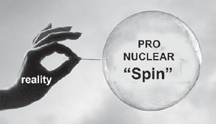
Famed director Oliver Stone gets it so very wrong about nuclear power
1Courting controversy. Famed director misses the fact that further spending on nuclear power wastes billions of dollars that should go to renewables
Beyond Nuclear Inteenational By John Dudley Miller, 13 Aug 23
Nuclear Now, the latest documentary from controversial writer/director Oliver Stone, argues that an undetermined large number of new nuclear power plants must be built quickly to power the world with clean energy, or it will not be possible to halt global warming at 2 degrees Celsius above preindustrial levels by 2050. If we exceed that limit, devastating climate changes will strike, causing killing heat, monster hurricanes, record-setting droughts, and the displacement of millions of people.
Over the years, Stone has drawn criticism for allegedly misstating historical facts in his movies (“Platoon,” “JFK,” “Natural Born Killers”), creating conspiracies where detractors claim there really were none. Appropriately, this new film begins by claiming a conspiracy against nuclear power. It asserts that nuclear has always been criticized unfairly, particularly by the oil industry, which it alleges has long exaggerated the harm that radiation from nuclear power plants causes.
But on the other hand, the next year the same man helped finance the first Earth Day, which was not and still is not anti-nuclear. That leaves it ambiguous whether his gift to Friends of the Earth was intended explicitly to oppose nuclear power or merely to support the environment.
The documentary states that it is based on a 2019 book, A Bright Future, which also calls for building much more nuclear power quickly. Although one of the book’s authors, Joshua Goldstein, is a non-scientist, international trade expert, the other, Staffan Qvist, is trained as a nuclear engineer and says he works as a “clean-energy” engineer. Stone and Goldstein are co-authors of Nuclear Now. Neither claims any formal training in nuclear engineering………………………………..
The documentary and book take an oddly casual view of the problems of storing spent nuclear fuel while it’s still radioactive. In a very controversial statement, the film claims that “Scientists actually know that nuclear waste doesn’t travel very far” if it leaks out of an underground repository. Since radiation is all around us, the book adds, it wouldn’t be “catastrophic” if some leaked out.
Contrary to the film’s cavalier assertion, however, every reactor fueled with Uranium-238 will automatically produce Plutonium-239 after fissioning, and that deadly element must not be allowed to leak out for the next 241,000 years, because it can cause fatal lung cancer if breathed in. No one can predict for certain what will happen underground that long from now. Homo Sapiens did not exist 241,000 years ago, only its precursor species. It is unlikely that any human-built structure has ever remained completely leak-tight for even 1,000 years.
Rather than tackle that problem, however, the book recommends leaving the waste in above-ground concrete casks for 100 years while some of the radioactivity decays and then letting our great-great-grandchildren worry about it. Why should they mind being saddled with our mess?
The documentary defends nuclear power as the safest energy source of all time. It misleadingly claims that no one died at Three Mile Island or Fukushima, when it’s still not certain that no one will ever die from cancer from those accidents, because radioactivity was released by both of them.
The documentary also presents as fact that only about 50 people died at the scene at Chernobyl, and that only about 4,000 more people will die later from radiation-caused cancers. However, the 2006 TORCH report (The Other Report on Chernobyl), commissioned by the European Parliament’s Green Party and analyzed by two British radiation biologists, estimated that somewhere between 30,000 and 60,000 people will ultimately die from Chernobyl cancers.
……………………………………………………………………. The New York Times reviewer Brandon Yu claims that the documentary “makes a compelling case for [nuclear power] as the energy source that can most reasonably and realistically help us face the [climate] crisis.” In fact, it does no such thing. Yu never compared the evidence for nuclear power to that of its main alternative, renewable power. So, he doesn’t know which one is preferable.
Yu didn’t compare the two energy sources because neither the book nor the documentary ever presents a head-to-head comparison of the costs and construction times necessary to build enough nuclear or renewable power fast enough. What viewers need is a formal cost and construction-time analysis. Instead, they’re left with the book’s unsubstantiated claim: “What the world already knows how to do in 10 or 20 years using nuclear power would take more than a century using renewables alone.” In truth, the needed number of new nuclear plants worldwide could never be built in two decades, judging from how long other reactors have typically required. According to the World Nuclear Industry Status Report 2022, the 62 reactors completed worldwide in the decade between 2012 and 2021 took an average of 9.2 years to build.
The only nuclear plant now under construction in the United States, Vogtle 3 and 4 in Georgia, has been markedly slow and expensive to build. The Vogtle 3 reactor and its twin built on the same site, Vogtle 4, were begun in 2009 and were supposed to be finished in seven years. Fourteen years later, Unit 3 finally entered commercial service on July 31 after several false starts. Unit 4 should be finished early next year. Originally estimated to cost $14 billion altogether, they have already cost $35 billion.
According to the U.S. Energy Information Administration Annual 2023 Energy Outlook, a large nuclear power plant that begins construction this year will, when completed, sell its electricity at 17 cents per kilowatt-hour. But both wind and solar plants begun this year will ultimately sell their power at 4 cents per KW-hr, one-quarter as expensive.
In addition, many American experts believe that large nuclear plants have become so prohibitively expensive that no more will ever be built in the U.S. Instead, small modular reactors (SMRs), creating 30 percent or less of the power of large ones, will take their place.
However, even the model of SMR most similar to current reactors and closest to being constructed, the NuScale reactor, recently announced that it expects to sell its electricity at 11.9 cents per unsubsidized KW-hr, before a years-long, 3-cent per KW-hr temporary subsidy is subtracted. That equals three times the expected cost of renewable power. Since the NuScale has never been built anywhere before and its reactor must first be redesigned, its price per KW-hr may well wind up costing as much or more than the 17 cents that large reactors would.
As expensive as the NuScale reactor may turn out to be, it’s clear that it will be cheaper than all the other proposed “advanced” SMRs that the Department of Energy is building, because none of them utilize water for cooling. Instead, they use exotic coolants like liquid sodium, molten salt or inert gas. Large-size versions of all these other reactors failed in the marketplace between the 1950s and the 1980s, so as new SMRs, they will be extremely expensive to engineer.
In addition, Stanford Professor Mark Z. Jacobson calculates from the exorbitant cost of the Vogtle reactors that any new nuclear power plants of any size will cost five to ten times as much as renewable plants, not just three to four times as much.
What all these analyses further make clear is that Congress should stop allocating billions of dollars to the Department of Energy to subsidize SMRs. Being so much more expensive than renewable power plants, these small plants will never be able to compete with renewables economically. Once DoE stops subsidizing them, they will go out of business. No utility wants to spend what will likely be much, much greater than 12 cents per KW-hr for nuclear power when they can buy renewable power for 4 cents per KW-hr.
Yet another reason why Congress should stop subsidizing SMRs is that they are inherently less economical than large nuclear plants, because they must spread fixed costs like salaries over the fewer kilowatt-hours of energy they create relative to higher-powered reactors. That makes their electricity cost more per KW-hr than that of much more powerful reactors. This built-in diseconomy of scale makes it quite possible that no SMR will ever be able to turn a profit, even if it could somehow find customers willing to pay three to ten times what renewable power costs.
Finally, there is considerable evidence now that renewables alone can be built fast enough to stop all power plant fossil fuel emissions by 2050. The 2021 Princeton University Net-Zero America report shows that that goal can be met in the U.S. The 2023 book by Stanford Professor Jacobson, No Miracles Needed, presents detailed evidence that 139 nations around the world can all meet that deadline if adequately funded………………………………………………….
more https://beyondnuclearinternational.org/2023/08/13/courting-controversy/—
more https://beyondnuclearinternational.org/2023/08/13/courting-controversy/—more https://beyondnuclearinternational.org/2023/08/13/courting-controversy/—
more https://beyondnuclearinternational.org/2023/08/13/courting-controversy/—more https://beyondnuclearinternational.org/2023/08/13/courting-controversy/—
more https://beyondnuclearinternational.org/2023/08/13/courting-controversy/—more https://beyondnuclearinternational.org/2023/08/13/courting-controversy/—
more https://beyondnuclearinternational.org/2023/08/13/courting-controversy/—more https://beyondnuclearinternational.org/2023/08/13/courting-controversy/—
more https://beyondnuclearinternational.org/2023/08/13/courting-controversy/—more https://beyondnuclearinternational.org/2023/08/13/courting-controversy/—
more https://beyondnuclearinternational.org/2023/08/13/courting-controversy/—more https://beyondnuclearinternational.org/2023/08/13/courting-controversy/—
more https://beyondnuclearinternational.org/2023/08/13/courting-controversy/—
Company involved in decommissioning of the Dounreay nuclear plant has gone into administration
A COMPANY, which was involved in the decommissioning of the Dounreay
nuclear plant, has gone into administration. James Fisher Nuclear (JFN) had
a base at Bower in premises previously occupied by Nicolson Engineering and
was part of Nuclear Decommissioning Ltd (NDL) – a joint venture which was
set up to decommission the Caithness site and others throughout the UK. JFN
was acquired by Myneration, a wholly-owned investment vehicle of Rcapital
Partners, from Cumbria-based James Fisher & Sons in March. It is based in
Preston, Lancashire.
John O’Groat Journal 10th Aug 2023
Putin profits from US and European reliance on Russian nuclear fuel
MARTHA MENDOZA and DASHA LITVINOVA, Yahoo News, 10 August 2023
WASHINGTON (AP) — The U.S. and its European allies are importing vast amounts of nuclear fuel and compounds from Russia, providing Moscow with hundreds of millions of dollars in badly needed revenue as it wages war on Ukraine.
The sales, which are legal and unsanctioned, have raised alarms from nonproliferation experts and elected officials who say the imports are helping to bankroll the development of Moscow’s nuclear arsenal and are complicating efforts to curtail Russia’s war-making abilities. The dependence on Russian nuclear products — used mostly to fuel civilian reactors — leaves the U.S. and its allies open to energy shortages if Russian President Vladimir Putin were to cut off supplies……
“We have to give money to the people who make weapons? That’s absurd,” said Henry Sokolski, executive director of the Washington-based Nonproliferation Policy Education Center. “If there isn’t a clear rule that prevents nuclear power providers from importing fuel from Russia — and it’s cheaper to get it from there — why wouldn’t they do it?”
Russia sold about $1.7 billion in nuclear products to firms in the U.S. and Europe, according to trade data and experts. The purchases occurred as the West has leveled stiff sanctions on Moscow over its 2022 invasion of Ukraine, blocking imports of such Russian staples as oil, gas, vodka and caviar.
The West has been reluctant to target Russia’s nuclear exports, however, because they play key roles in keeping reactors humming. Russia supplied the U.S. nuclear industry with about 12% of its uranium last year, according to the U.S. Energy Information Administration. Europe reported getting about 17% of its uranium in 2022 from Russia.
………………………………………. Many of the 30 countries generating nuclear energy in some 440 plants are importing radioactive materials from Russia’s state-owned energy corporation Rosatom and its subsidiaries. Rosatom leads the world in uranium enrichment, and is ranked third in uranium production and fuel fabrication, according to its 2022 annual report.
……………………………Rosatom’s CEO Alexei Likhachyov told the Russian newspaper Izvestia the company’s foreign business should total $200 billion over the next decade. That lucrative civilian business provides critical funds for Rosatom’s other major responsibility: designing and producing Russia’s atomic arsenal, experts say.
…………………………………. The value of Russian nuclear fuel and products sent to the U.S. hit $871 million last year, up from $689 million in 2021 and $610 million in 2020, according to the U.S. Census Bureau. In terms of weight, U.S. imports of uranium products from Russia nearly doubled from 6.3 tons in 2020 to 12.5 tons in 2022, according to trade data from ImportGenius.
……………………………………………………………………………….Europe is in a bind largely because it has 19 Russian-designed reactors in five countries that are fully dependent on Russian nuclear fuel. France also has a long history of relying on Russian-enriched uranium. In a report published in March, Greenpeace, citing the United Nations’ Comtrade database, showed that French imports of enriched uranium from Russia increased from 110 tons in 2021 to 312 tons in 2022.
Europe spent nearly $828 million (almost €750 million) last year on Russian nuclear industry products — including fuel elements, nuclear reactors, and machinery — according to Eurostat, the EU’s statistics office………………………………………more https://uk.news.yahoo.com/putin-profits-off-global-reliance-040103115.html?guccounter=1
War is a Racket… U.S. and NATO Arms Industries Make Record $400 BILLION in Sales from Proxy War With Russia

Strategic Culture Foundation, 11 Aug 23
Western capitalism is at once a sponsor and an addict of war.
Western weapons manufacturers are popping champagne corks over record sales with total revenues hitting $400 billion for last year. According to media reports, this coming year-end will see that record figure exceeded by another salivating $50 billion.
Ukraine may be resembling a bloodbath, as we noted in last week’s editorial. But apparently, Western military corporations are swimming in a bonanza of profits and stock market investments.
Most of this lucrative new business stems from NATO’s proxy war with Russia in Ukraine, which is heading toward its second year. There is no sign of a diplomatic effort from the West or the Kiev regime it sponsors to end the bloodshed.
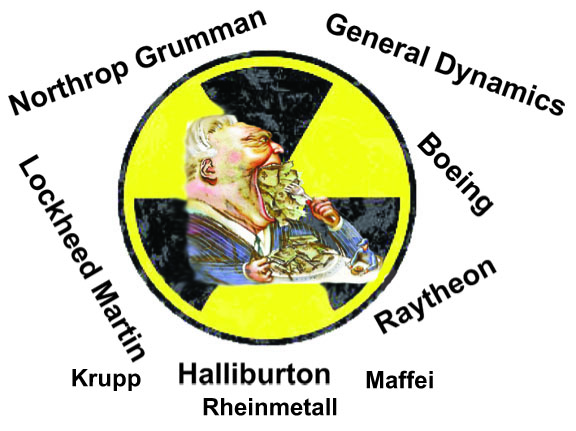
The main corporate beneficiaries making a financial killing from Ukraine are by far the American firms. They include such behemoths as Lockheed Martin, Boeing and RTX (formerly Raytheon). But also enjoying soaring profits are arms makers in other NATO countries: BAE in the United Kingdom, Airbus in France, Netherlands and Spain, Leonardo in Italy, and Germany’s Rheinmetall.
This week the Joe Biden administration requested another $24 billion in U.S. taxpayer-funded aid to Ukraine. It’s hard to keep track of the money flowing from NATO countries to prop up the Nazi regime in Kiev. Even the NATO authorities don’t seem to know the precise figures, such is the rampant corruption that is inevitably associated with the vast doling of funds. But estimates of total U.S. and NATO aid to Ukraine range from $150 billion to $200 billion over the past year alone.
What we are seeing is an audacious racket whereby the American and European public are subsidizing the funneling of their own taxpayers’ money into the coffers of weapons firms. And there is no democratic choice in the matter. It’s a fait accompli. Or, put another way, extortion.
Of course, too, part of this huge scam is the hefty financial cuts for the inner circle of the Kiev regime, including its puppet president, Vladimir Zelensky, and the brazenly sleazy defense chief Aleksy Reznikov. It is reckoned that at least $400 million has been grafted by the top members of the regime from the arms bazaar flowing into Ukraine. Reznikov has even boasted that his country serves as a testing ground for NATO weaponry.
Nearly a century ago, former U.S. Marine Corps General Smedley D Butler popularized the phrase, “war is a racket” as the title of his classic book in which he condemned how American capitalism profits obscenely from military invasions and killing.
Butler’s critique is as relevant today, perhaps more so, as evinced by the conflict in Ukraine.
Western media reports are increasingly admitting – albeit coyly – that the war is a disaster for the Kiev regime and, by extension, the NATO powers. The death toll among Ukrainian forces may be as high as 400,000 since the conflict erupted last February. The much-anticipated Ukrainian counteroffensive launched in early June has resulted in no territorial gains despite the horrendous casualties and despite the gargantuan supply of NATO weapons, training and logistical support.
A report in the Washington Post this week shows that most Ukrainian people are despairing of the grinding war and endless casualties. They see no point in the continuation of hostilities given the failure of the NATO-backed forces to make any advance against well-fortified Russian defense lines.
Yet against this grim reality, the U.S. and European officials keep running the taps of blood.
We see NATO leaders like Polish President Andrzej Duda this week urging for more weapons to be sent to Ukraine even while he concedes the military defeat so far.
Zelensky and his cronies are, not surprisingly, also demanding more NATO arms and claiming with bravado they will never negotiate with Russian President Vladimir Putin. Some people want this conflict to keep going because of their irrational Russophobia and simply because it is too lucrative for their own personal gain.
Where does democracy come into this? It doesn’t, whatsoever. Polls show that most Americans are opposed to the continuing supply of military aid to Ukraine. There are sound reasons to believe that most European citizens are also firmly against the fueling of a bloody war in which Ukrainian corpses keep piling higher. In addition, the perpetuation of this conflict runs the outrageous risk of spiraling out of control into an all-out war between the United States and Russia, the world’s biggest nuclear powers……………………………….. more https://strategic-culture.org/news/2023/08/11/war-iracket-us-nato-arms-industries-make-record-400-billion-sales-from-proxy-war-with-russia/
Welsh groups call on the National Eisteddfod to reject funding from USA nuclear and arms company Westinghouse
The National Eisteddfod receives sponsorship money for the Science Pavilion
from nuclear power and arms company Westinghouse from the United States.
Westinghouse recently announced that they are setting up an office at
M-Sparc, Gaerwen, Ynys Môn to develop nuclear decomissioning skills.
In 2017, Toshiba Westinghouse went bankrupt after having to abandon building
new nuclear reactors at the V.C.Summer site in South Carolina 40% into
construction.
Six directors were charged with financial fraud in the U.S.
Federal Court. The Westinghouse Columbia Fuel Fabrication Facility on a
secretive corner of their site produce radioactive tritium gas. This
tritium is then sent to the Savannah River site in South Carolina where it
is prepared to be inserted in all U.S. nuclear weapons.
CADNO, CND Cymru, Cymdeithas y Cymod, Cymdeithas yr Iaith and PAWB calls on the National Eisteddfod to reject any sponsorship from Westinghouse in future
Eisteddfodau from Westinghouse due to their connection to terrifying arms
of mass destruction.
PAWB 10th Aug 2023
Hinkley Point C unrest continues as steel erectors down tools
An unofficial one-day stoppage of work took place yesterday, as the new
nuclear power station site Hinkley Point C continues to be embroiled in
labour disputes and unrest. Steel erectors working for contractor William
Hare downed tools in response to existing shift rotation patterns on the
site, wanting to change the current 11/3 and 10/4 rotation to a regular
10/4 arrangement. The unrest follows a spate of similar walkouts at Hinkley
Point C. On the supply side, 150 platers, welders and sheet metal workers
at Darchem Engineering in Stockton-Upon-Tees (a Hinkley Point C supplier)
secured a pay boost worth up to 13% after seven weeks of walk-out action.
PBC Today 9th Aug 2023
Nippon Life bans investments in nuclear arms firms, tobacco companies

The company’s ESG investment list already excludes cluster munitions and landmine manufacturers and coal power programs.
By Kenneth Araullo, Aug 10, 2023
https://www.insurancebusinessmag.com/asia/news/life-insurance/nippon-life-bans-investments-in-nuclear-arms-firms-tobacco-companies-455734.aspx
Nippon Life, Japan’s largest life insurer, will not invest in nuclear weapons manufacturers as part of its new environmental, social, and governance (ESG) policy.
In addition to nuclear arms, tobacco-related companies – a first for a major insurer in the country – and palm-oil related businesses are also off its investment list. Nippon Life’s exclusion list already includes manufacturers of inhumane weapons like cluster munitions and landmines, in addition to coal-fired power generation programs.
With this change, Nippon Life is affirming its commitment to nuclear disarmament and abolition, an idea that is beginning to see huge strides ever since the G7 leaders’ “Hiroshima Vision on Nuclear Disarmament.” According to The Mainichi, Nippon Life decided that it should “clarify a corporate policy of not investing in or financing nuclear weapons manufacturers, based on the mission of the life insurance business and its public nature.”
In addition to Nippon Life, Dai-ichi Life already bans investments or loans to nuclear arms firms; this makes two of the largest insurers in the country now following the same ESG policy regarding such weapons.
Elsewhere, the Japan Fair Trade Commission (JFTC) has started its probe into four nonlife insurers which were alleged to have taken part in price fixing activities.
Small nuclear Reactor (SMR) Stock Analysis Overview
Investors Observer 10 Aug 23
What this means: InvestorsObserver gives Nuscale Power Corp (SMR) an overall rank of 40, which is below average. Nuscale Power Corp is in the bottom half of stocks based on the fundamental outlook for the stock and an analysis of the stock’s chart. A rank of 40 means that 60% of stocks appear more favorable to our system………. https://www.investorsobserver.com/symbols/smr—
Redundancies made as loss-making nuclear services firm sold for just £3 enters administration
The business employed hundreds of people
Jon Robinson,North West Business Editor, 9 AUG 2023
A loss-making nuclear decommissioning services firm that was sold earlier this year for just £3 has entered administration.
JFN Limited was acquired by UK private equity firm Rcapital from Cumbria-based James Fisher & Sons in March.
UK government backs Sizewell C nuclear, but their target investors are backing away.

Sizewell C was dealt another blow this weekend when The People’s Pension,
which has six million members, said it has no plans to back the plant. I
In a letter seen by The Mail on Sunday, the group said: ‘Direct investment into
nuclear power infrastructure projects is not part of The People’s Pension
investment strategy and we will not be investing directly into Sizewell C.’
Alison Downes of the Stop Sizewell C campaign group said: ‘The Government
may be throwing money at Sizewell C, but their target investors are rapidly
backing away. The People’s Pension has seen the writing on the wall and
won’t let their savers anywhere near this expensive, risky project.’
This is Money (at the end) 6th Aug 2023
https://www.thisismoney.co.uk/money/markets/article-12376007/Rolls-Royce-win-nuclear-power-race.html
1 This Month



26 September – International Day for the Total Elimination of Nuclear Weapons


PLEASE OPPOSE HR 8255 AND S.3639 – bills would accelerate satellite deployment, with no environmental review or safeguards – https://ncstd5li.quorum.us/campaign/169331/
To see nuclear-related stories in greater depth and intensity – go to https://nuclearinformation.wordpress.com
-
Archives
- September 2026 (219)
- August 2026 (330)
- July 2026 (355)
- June 2026 (287)
- May 2026 (306)
- April 2026 (356)
- March 2026 (251)
- February 2026 (267)
- January 2026 (308)
- December 2025 (358)
- November 2025 (359)
- October 2025 (375)
-
Categories
- 1
- 1 NUCLEAR ISSUES
- business and costs
- climate change
- culture and arts
- ENERGY
- environment
- health
- history
- indigenous issues
- Legal
- marketing of nuclear
- media
- opposition to nuclear
- PERSONAL STORIES
- politics
- politics international
- Religion and ethics
- safety
- secrets,lies and civil liberties
- spinbuster
- technology
- Uranium
- wastes
- weapons and war
- Women
- 2 WORLD
- ACTION
- AFRICA
- Atrocities
- AUSTRALIA
- Christina's notes
- Christina's themes
- culture and arts
- Events
- Fuk 2022
- Fuk 2023
- Fukushima 2017
- Fukushima 2018
- fukushima 2019
- Fukushima 2020
- Fukushima 2021
- general
- global warming
- Humour (God we need it)
- Nuclear
- RARE EARTHS
- Reference
- resources – print
- Resources -audiovicual
- Weekly Newsletter
- World
- World Nuclear
- YouTube
-
RSS
Entries RSS
Comments RSS
 nuclear-news