under the RAB mechanism, it seems that EDF will be paid for what they actually spend. This time it will be British, not French taxpayers and consumers, that will be paying for the cost overruns.
The Government are deceiving us about the cost effectivemess of their new funding mechanism for nuclear power
Dave Toke’s Green Energy Blog, DAVID TOKE, OCT 25, 2023
Consumers face a double whammy of bills to pay for the planned nuclear power plant, Sizewell C, due to be given a go-ahead soon. According to a ‘worst case scenario,’ consumers are likely to (collectively) pay around £34 billion in today’s prices before any electricity is generated from Sizewell C at all. But, in addition, according to my calculations, under this (quite likely) worst-case scenario consumers will then also pay around £160 per MWh in today’s prices for electricity produced by Sizewell C. This works out as £117 per MWh in 2012 prices (ie the base year for setting the cost of Hinkley C). The Government appears to be doing little or nothing to prevent this scenario from occurring.
Hence consumers could not only be paying much more per MWh than the controversially high Hinkley C deal (£92.5 per MWh in 2012 prices) but will also be paying large sums upfront before a kWh is even generated. In fact, despite being labeled as a ‘worst case scenario’, the estimate for Sizewell C costs that have been calculated is essentially based on the type of cost overrun experienced by attempts to build nuclear power plants in the West since 1990. That is nuclear construction costs end up being around double the amount initially budgeted.
I have taken the size of the upfront costs payable by consumers from an analysis done by Professor Stephen Thomas of Greenwich University. See also here. I have then taken his worst-case scenario figure for these upfront costs and converted them into a figure for costs per MWh by applying conventional economic tools. This involves using discounted cash flow analysis using a (real) 6 percent discount rate and assuming Sizewell C will be generating at an average of 90 percent of full capacity. This assumes using a contract type paying premium prices for energy generated similar to that used for Hinkley C (ie lasting for 35 years). I have based cost estimates of operating nuclear power plants on US experience, although operating costs form only a small element of the costs. The large bulk of the costs are concerned with repaying money loaned and invested in the power station.
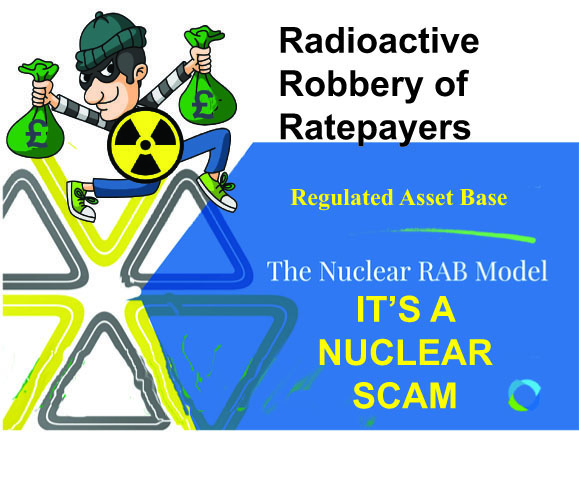
My analysis runs contrary to the narrative spread by the Government. They claim that the so-called Regulated Asset Base (RAB) mechanism for funding new nuclear power plants will make nuclear power cheaper for the consumer. On the contrary, it is likely to allow more to be paid to EDF for Sizewell C compared to Hinkley C. This is because consumers will be responsible for paying cost overruns for Sizewell C whilst in the case of Hinkley C it is EDF that takes responsibility for cost overruns. The total amounts that consumers will have to pay will remain unknown until it is far too late to do anything to stop consumers from having their electricity bills dramatically increased………………..
The RAB mechanism has been lauded as a cost-saver because it allows EDF to pay lower interest rates on money borrowed to finance construction compared to the borrowing costs applicable to building Hinkley C. Money needed to finance interest payments and investors during the construction period is charged to consumers whilst the plant is being built.
There’s one giant flaw in this argument. The Government seems to be heading towards giving the go-ahead to EDF to start construction without agreeing a price to be paid for electricity. This means that consumers will pay for whatever it costs to build the plant. The costs of nuclear power stations seem always to be a lot more than what was estimated at the time of the ‘final investment decision’ (FID).
This is different from what happened with Hinkley C. In the case of Hinkley C EDF was committed to paying for any cost overruns themselves without being paid any extra money. ………… EDF bears responsibility for these cost overruns – in effect the French taxpayers will pay since EDF is owned by the French Government.
Yet under the RAB mechanism, it seems that EDF will be paid for what they actually spend. This time it will be British, not French taxpayers and consumers, that will be paying for the cost overruns. OFGEM is being given responsibility for organising payments to EDF.
Ultimately, it seems, OFGEM will be the ‘fall guy’ when, many years down the line, there is public controversy over the costs of the power from Sizewell C. In an obscure piece of wording in an obscure document entitled ‘Revenue Stream for the nuclear RAB model’, the government says (page 12) ‘The amount a relevant licensee nuclear company is allowed to receive (‘allowed revenue’) in respect of its activities relating to the design, construction, commissioning, and operation of the relevant nuclear project would be determined by Ofgem’.
In other words, EDF will have virtually a blank cheque to pay all their costs. The only control OFGEM will have is to check that the costs have actually been spent or will be spent on the power plant.
People were surprised at the cost of the Hinkley C contract, but the surprise was based on the public being kept in ignorance of nuclear construction costs in the past. Now the Government has learned its lesson, and we shall see a return to the past practice of the public being kept in the dark about the costs of building nuclear power plants…………………………………………… https://davidtoke.substack.com/p/why-consumers-are-very-likely-to
US Georgia Power has reported the discovery of a malfunctioning coolant pump at unit 4 of its Vogtle NPP, resulting in a delay in commissioning of the unit. The problem in one of the reactor’s four pumps was found during pre-operational testing and startup of the unit, which had been expected begin operation later this year. Instead, the reactor now is forecast to begin operations in the first quarter of 2024.
Fuel loading at Vogtle 4 began in August. Unit 3 began commercial operation at the end of July. Vogtle 3&4 are both 1,117 MWe Westinghouse AP1000 pressurised water reactors (PWRs). The two units were originally expected to cost about $14bn and to enter service in 2016 and 2017 but suffered a series of delays, including Westinghouse’s bankruptcy in 2017.
The total cost of the project to build Vogtle 3&4 is now put at more than $30bn. Georgia Power owns 45.7% of the project; Oglethorpe Power Corp owns 30%; the Municipal Electric Authority of Georgia (MEAG) owns 22.7%; and the city of Dalton owns 1.6%. The units will be operated by Southern Nuclear.
The differences between the government and EDF, which are currently discussing the future regulatory framework for electricity prices, make several officials of the public company fear a possible resignation of Luc Rémont, the group’s CEO.
After a long period of disagreement, France and Germany finally reached a deal on electricity markets.
The Germans and French seized on a solution used in the UK for a quarter century to give the appearance of a functioning market: the contract for differences.
In an effort to find equilibrium between the European Union’s two biggest members, ministers reached a consensus that governments “have the option” to implement CfD’s for established nuclear reactors.
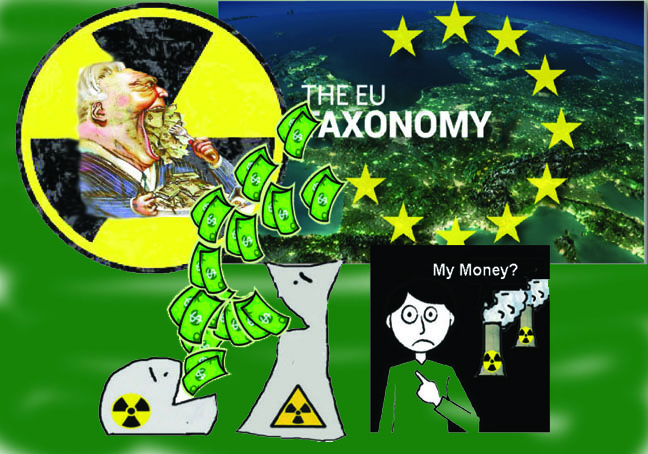
“……………………………………….. . France depends heavily on nuclear power generated by state-owned EDF. Existing French nuclear plants will require major capital improvements and the plants under construction are enormously expensive. The French government wants to subsidize its nuclear program, but other European Union (EU) countries (especially Germany) objected, because state subsidies are not in the spirit of the EU’s energy markets.
The market should determine prices, and should determine the appropriate means to supply the demand, the opponents argue. ……………………………
Europeans woke up to the likelihood that their unsubsidized firms would have to compete with heavily subsidized Chinese and American competitors. Furthermore, European firms looking at those American subsidies started talking about moving their facilities to the US, to qualify for the subsidies.
………………………………….. the risks of building a big nuclear plant are too great for any private enterprise to undertake. So the government has to step up to provide funds for the project.
The Germans and French seized on a solution used in the UK for a quarter century to give the appearance of a functioning market: the contract for differences. It works like this. The power producer sets a strike price with the buyer (who has signed a multiyear year agreement to buy the electricity). When the market price the generator can collect exceeds the strike price, the generator has to refund the surplus to the buyer. When the market price falls below the strike price, the buyer has to give the difference to the generator. Now here is the key to the deal. The strike price does not result from market forces but rather from the revenue needed to cover the cost of building or maintaining a nuclear unit, which the buyers cannot evade unless the nuke stops operating. The state, in the end, sets the price, and determines the terms of what really is a long term fixed contract made with a buyer that has no choice but to buy. In other words, this is not a commercial transaction, because in free markets, buyers have a choice: to buy or not buy.
To us, this deal, if it gets approval from the EU, signals that the EU fully acknowledges that choosing nuclear power is a political decision. And that expanding nuclear power requires government actions and explicit government financial support. That clears the air. Now let’s see what the policymakers do. https://oilprice.com/Alternative-Energy/Nuclear-Power/Germany-And-France-Finally-Compromise-On-Nuclear.html #nuclear #antinuclear #nuclearfree #NoNukes
A short-seller report gave investors plenty to worry about with NuScale Power(NYSE: SMR) stock on Thursday. On the back of that document, which criticized the nuclear reactor maker harshly at times, the company’s share price fell at double-digit rates. It ended the day nearly 12% lower, while the gloomy S&P 500 index only sank by 0.9%.
A short seller vented on NuScale
That morning, a firm called Iceberg Research published that NuScale Power report. This came not long after NuScale announced earlier this month that it had signed a contract to build a pair of its reactors for a U.S. company called Standard Power.
Iceberg poured freezing cold water on this arrangement, describing the deal as having no chance of being completed. In its view, Standard Power does not have the means to fulfill contracts of such size; it also said that Standard Power’s managing director, Adam Swickle, was found guilty of securities fraud some time ago.
While NuScale has what Iceberg describes as a “more credible contract” with Utah Associated Municipal Power Systems, the short seller does not feel that NuScale has a good chance of completing it.
According to Iceberg’s analysis, NuScale has only 15 months or so left of cash to finance its operations — quite a narrow window for a dramatic turnaround in fortunes.
A short-seller report gave investors plenty to worry about with NuScale Power(NYSE: SMR) stock on Thursday. On the back of that document, which criticized the nuclear reactor maker harshly at times, the company’s share price fell at double-digit rates. It ended the day nearly 12% lower, while the gloomy S&P 500 index only sank by 0.9%.
A short seller vented on NuScale
That morning, a firm called Iceberg Research published that NuScale Power report. This came not long after NuScale announced earlier this month that it had signed a contract to build a pair of its reactors for a U.S. company called Standard Power.
Iceberg poured freezing cold water on this arrangement, describing the deal as having no chance of being completed. In its view, Standard Power does not have the means to fulfill contracts of such size; it also said that Standard Power’s managing director, Adam Swickle, was found guilty of securities fraud some time ago.
While NuScale has what Iceberg describes as a “more credible contract” with Utah Associated Municipal Power Systems, the short seller does not feel that NuScale has a good chance of completing it.
According to Iceberg’s analysis, NuScale has only 15 months or so left of cash to finance its operations — quite a narrow window for a dramatic turnaround in fortunes.
Accusations of low-value equity
Iceberg doesn’t see a good way out with NuScale. It wrote in conclusion that “The company is struggling and we believe its equity has little to no value without government support.”
“Even if that support continues, the DOE’s usual policy is that costs have to be shared with the private sector, meaning that existing shareholders will be diluted,” the short seller added.
Germany has given leeway for France to use state subsidies to fund its nuclear power plants, unblocking a long-stalled reform of the EU electricity market in the face of vast state aid regimes in China and the US.
The agreement reached on Tuesday among energy ministers in Luxembourg will mean that France could use government support to finance its largely state-owned nuclear plants, which generate about 70 per cent of its electricity.
Such a move had been heavily contested by Germany, Austria and Luxembourg, which have been historically opposed to nuclear power but also feared that allowing Paris to subsidise its nuclear plants would provide French industry with structurally lower energy prices, giving it a competitive advantage.
As part of the new EU rules for the bloc’s electricity market, France will be allowed to use funding structures known as contracts for difference. These set a minimum price guarantee for power providers, as well as a ceiling above which the state can recover any revenue.
Russia on Monday (Oct 16) suspended all Japanese seafood imports in the aftermath of Tokyo’s release of wastewater from the Fukushima nuclear plant.
Previously, China had suspended the imports, saying that Tokyo has not proved the authenticity and accuracy of the nuclear wastewater data, nor that the ocean discharge of the water is harmless to the marine environment and human health.
China was Japan’s biggest market for fish, accounting for more than $500 million worth of exports in 2022.
Japan recently released treated radioactive water into the sea from its defunct nuclear reactor in Fukushima after the International Atomic Energy Agency approved the plan. ………………………………………………
What did Russia say?
Ever since it released the treated water, Japan has faced the wrath of some nations and a number of environmentalists.
Japan has also criticised Russia for its invasion of Ukraine, while Tokyo’s relations with Beijing, which has deepened ties with Moscow, have worsened.
As reported by the news agency AFP, Rosselkhoznadzor, Russia’s body responsible for regulating agriculture products, said that as a “precautionary measure”, it was “joining China’s provisional restrictive measures on the import of fish and seafood products from Japan as of October 16, 2023”.
World Nuclear News, 09 October 2023 #nuclear #anti-nuclear #nucler-free #NoNukes
The in-service date for the second AP1000 plant at the site near Waynesboro, Georgia, has been revised after a motor fault was discovered in a reactor coolant pump. Meanwhile, Georgia Power has agreed to pay the plant’s co-owner Oglethorpe Power Corporation USD308 million in settlement of an ongoing dispute.
The motor fault in one of the unit’s four reactor coolant pumps – or RCPs – was discovered during start-up and pre-operational testing, Georgia Power said in a filing to the US Securities and Exchange Commission (SEC)……………………………
Southern Nuclear believes that the motor fault on the RCP at Vogtle 4 is an isolated event, the companies said. The projected schedule for Vogtle 4 “primarily depends on the continued progression of pre-operational testing and start-up”, it added: “As testing continues, new challenges also may continue to be identified, which may result in required engineering changes or remediation related to plant systems, structures, or components (some of which are based on new technology that only within the last few years began initial operation in the global nuclear industry at this scale). These challenges may result in further schedule delays and/or cost increases.”
Dispute settled
In the same SEC filing, Georgia Power and its parent, Southern Company, announced the agreement with Oglethorpe Power to resolve a dispute regarding cost-sharing and tender provisions of the joint ownership agreements relating to Vogtle units 3 and 4. Georgia Power has agreed to make a payment of USD308 million to Oglethorpe for a portion of Oglethorpe’s previously incurred construction costs, as well as paying a portion of Oglethorpe’s further construction costs for the units – around USD105 million – based on the current capital cost forecast. It will also pay 66% of Oglethorpe’s costs of construction with respect to any amounts above the current project capital cost forecast. The parties have agreed to dismiss pending litigation on this issue, including counterclaims by Georgia Power.
Georgia Power resolved a similar dispute with another of the plant’s co-owners, the Municipal Electric Authority of Georgia (MEAG Power) in September 2022. Similar litigation with the other co-owner, Dalton Utilities, is still pending.
Construction of the two Westinghouse AP1000s began in 2013. Unit 3 ………………… Plant Vogtle is jointly owned by Georgia Power (45.7%), Oglethorpe (30%), MEAG Power (22.7%) and Dalton Utilities (1.6%).
French power giant EDF’s future investments could exceed €20 billion per year, Agnès Pannier-Runacher, the country’s energy transition minister, said on Thursday (28 September), adding that the exact level was the subject of discussion.
The state-owned utility is facing a mountain of investment needs to maintain its nuclear fleet as well as build new reactors and renewable power production. EDF CEO Luc Rémont had previously put the investments at €25 billion. “What we are talking about … for EDF is investments which could reach … more than €20 billion per year,” Pannier-Runacher said at a nuclear conference organised by the Organisation for Economic Co-operation and Development (OECD).
“There is a discussion about whether it is 20 (billion) or whether it is more,” she added. The French government has previously announced a plan to build at least six new model nuclear reactors, which Pannier-Runacher said would cost about €3 billion per year in investments.
BBC News By Peter Hoskins, Business reporter 2 October Britain’s biggest defence firm, BAE Systemshas won a £3.95bn ($4.82bn) contract to build a new generation of submarines as the security pact between the US, UK and Australia moves ahead.
In March, the three countries announced details of the so-called Aukus pact to provide Australia with nuclear-powered attack submarines by the late 2030s.
The pact aims to counter China’s ambitions in the Indo-Pacific region.
Beijing has strongly criticised the three countries over the deal.
……………………..”This multi-billion-pound investment in the Aukus submarine programme will help deliver the long-term hunter-killer submarine capabilities the UK needs to maintain our strategic advantage and secure our leading place in a contested global order,” UK Defence Secretary Grant Shapps said as the Conservative party conference got under way in Manchester.
………………….Other major UK defence contractors are also getting a boost from the Aukus deal.
End of the American Dream. Life As You Have Known It Will Never Be The Same Again… by Michael
It would be difficult to overstate the importance of the Military Industrial Complex to our society. It employs millions of people, and it brings in hundreds of billions of dollars each year. The Military Industrial Complex has always been one of the central pillars of our economy, and these days business is booming thanks to the war in Ukraine and the possibility of a war with China. Needless to say, those that run the Military Industrial Complex want the gravy train to continue, and so politicians that are pro-war are showered with campaign contributions. In both major parties, politicians that are pro-war greatly outnumber those that are anti-war, and that is not likely to change any time soon.
Smedley D. Butler fought in four major conflicts, and in 1935 he astutely observed that “war is a racket”…
“WAR is a racket. It always has been. It is possibly the oldest, easily the most profitable, surely the most vicious. It is the only one international in scope. It is the only one in which the profits are reckoned in dollars and the losses in lives.”
If the Military Industrial Complex suddenly disappeared, it would leave a giant, gaping hole in our economy that would be extremely difficult to fill. In an excellent piece that he posted earlier this week, Richard C. Cook shared some numbers about the Military Industrial Complex that are absolutely astounding…
Today about 2.1 million people are employed by the defense industry. According to Acara Solutions, a major MIC recruiting firm, their average annual salary is $106,700, 40 percent higher than the national average. The companies they work for produced revenues in 2022 of $741 billion. How much of their production is high-priced junk, no one knows. The performance of U.S.-produced armaments in the Ukraine conflict does not seem impressive. No modern U.S. weapons have ever been tested in an industrial-type war against an equal adversary.
The MIC also includes active-duty uniformed personnel of 1.37 million and reserves of 849,000. There are 750 U.S. military bases in more than 80 countries outside of the U.S. More than 100,000 U.S. military personnel are stationed in Europe. Annual salary and benefits of the military are currently $146 billion per year, escalating with COLAs compounded at two to three percent annually, sometimes more. Some former U.S. military personnel are assumed to be fighting in Ukraine as mercenaries or helping direct the fighting from safe locations like Kiev or Lvov.
Then there are the civilian employees. According to the DoD, it employs more than 700,000 civilians “in an array of critical positions worldwide,” with compensation totaling about $70 billion. According to the Government Accountability Office, we may also add 560,000 contractor employees, whose compensation is typically higher than the career workforce.
We can also add hundreds of thousands of executives, managers, employees and contractors of the three-letter Deep State agencies, such as the CIA, NSA, DEA, FBI, and now DHS, etc., who interface with the MIC day in and day out and are part of the same fabric of state-sanctioned force and enemy identification and interdiction.
In the entire history of the world, we have never seen anything quite like this.
And the Military Industrial Complex absolutely loves Joe Biden, because he has promised to keep the war in Ukraine going “for as long as it takes”…
It is likely that billions of people around the world view the conflict in Ukraine as a proxy war being waged by the U.S. against Russia. US President Joe Biden has pledged to aid Ukraine’s pursuit of victory “for as long as it takes,” without defining what the end state might be. Russian President Vladimir Putin has interpreted U.S. intentions to mean a fight “to the last Ukrainian.”
Unfortunately, there is a problem.
The Ukrainians are running out of warm bodies.
They have literally been grabbing men off the streets and throwing them into vans, but we didn’t care because it wasn’t our sons that were being forced to go to war.
Many Americans cheered when the Ukrainians began their ill-fated “counter-offensive”, but it turned out to be a disaster.
A senior U.S. intel official recently admitted to journalist Seymour Hersh that Ukraine has suffered approximately 75,000 casualties during this counter-offensive…
“There is no discussion in his headquarters or in the Biden White House of a ceasefire and no interest in talks that could lead to an end to the slaughter,” Hersh said.
Speaking of the Ukrainian claims of slow progress in an offensive that has lost an estimated 75,000 casualties, the official told Hersh: “It’s all lies.”
On many battlefields in Ukraine, there are unburied dead bodies just laying around all over the place.
As the anniversary of the purported Biden Regime sabotage of the Nord Stream pipeline approaches Sept. 26, veteran investigative reporter Seymour Hersh blamed a ”secret disinformation operation“ by CIA and MI-6 for misleading the public about the disastrous state of the US-led war effort.
“The war is over. Russia has won. There is no Ukrainian offensive anymore, but the White House and the American media have to keep the lie going,“ a senior US intel official told Hersh. “The truth is if the Ukrainian army is ordered to continue the offensive, the army would mutiny. The soldiers aren’t willing to die any more, but this doesn’t fit the B.S. that is being authored by the Biden White House.”
Where do we go from here?
The Military Industrial Complex certainly does not want this conflict to end, and Joe Biden has no intention of backing down.
So more warm bodies will be needed.
That is one of the reasons why there has been so much chatter about bringing back the draft here in the United States.
Recruitment has been way down in recent years, but our leaders desperately want to win this war with Russia and they also want to be ready to fight a war with China over Taiwan.
And so the stage is being set to draft young American boys and young American girls into military service…
The most recent edition of the US Army War College’s academic journal includes a highly disturbing essay on what lessons the US military should take away from the continuing war in Ukraine. By far the most concerning and most relevant section for the average American citizen is a subsection entitled “Casualties, Replacements, and Reconstitutions” which, to cut right to the chase, directly states, “Large-scale combat operations troop requirements may well require a reconceptualization of the 1970s and 1980s volunteer force and a move toward partial conscription.”
The context for this supposed need to reinstate conscription is the estimate that were the US to enter into a large-scale conflict, every day it would likely suffer thirty-six hundred casualties and require eight hundred replacements, again per day. The report notes that over the course of twenty years in Iraq and Afghanistan, the US suffered fifty thousand casualties, a number which would likely be reached in merely two weeks of large-scale intensive combat.
The military is already facing an enormous recruiting shortfall. Last year the army alone fell short of its goal by fifteen thousand soldiers and is on track to be short an additional twenty thousand this year. On top of that, the report notes that the Individual Ready Reserve, which is composed of former service personnel who do not actively train and drill but may be called back into active service in the event they are needed, has dropped from seven hundred thousand in 1973 to seventy-six thousand now.
Do you want your children to be fed into a meat grinder on the other side of the globe?
If not, it is time to stand up and say something………………………………………………………………………………………
We need to pull back from the brink before it is too late.
But our leaders won’t do that.
They don’t want to upset the Military Industrial Complex.
Unfortunately, we could also soon find ourselves in a war with China……………………………………………
The Military Industrial Complex wants to make even more money, and our politicians want to keep the campaign contributions rolling in.
So we will continue to speed toward a date with the unthinkable as the fate of our society hangs in the balance.
The U.S. government has embarked upon the first comprehensive modernization of its strategic nuclear arsenal since the Cold War ended three decades ago. The Department of Defense is simultaneously developing a new generation of ballistic-missile submarines, land-based intercontinental ballistic missiles, and long-range bombers.
Collectively, these three systems are referred to as the strategic “triad.” Every nuclear posture review conducted by the government since the Soviet Union collapsed—there have been five counting Biden’s—has endorsed the triad as the best approach to assuring nuclear deterrence.
During the Cold War, each leg of the triad was periodically modernized. However, with the waning of the Soviet threat, improvement slowed. As a result, the nuclear arsenal has aged markedly. With great-power competition now restored to prominence in the nation’s defense strategy, the deterrent is overdue for revitalization.
The most recent authoritative estimate of nuclear-weapons costs, produced by the Congressional Budget Office in July, projects that the Department of Defense and Department of Energy will spend $247 billion during the ten years ending in 2032 to modernize the nuclear force.
An even larger amount will be allocated in subsequent years, delivering revenues to hundreds of companies. For instance, industrial conglomerate TextronTXT-1.1% will provide reentry-vehicle technology for carrying nuclear warheads, and BoeingBA-2% hopes to build a successor to the E-4B flying command post (popularly known as the Doomsday plane).
However, four companies are poised to dominate modernization of the nuclear arsenal, each of them ultimately realizing tens of billions of dollars in sales.
Northrop Grumman NOC+0.5%is the big winner in this generation’s round of competitions to rebuild the nuclear force. ……………… The company thus finds itself firmly ensconced as a key contractor on all three legs of the triad for decades to come—an unprecedented achievement in the history of the nuclear program.
General Dynamics, a Virginia-based defense and aerospace conglomerate, will build the 12 Columbia-class ballistic missile submarines destined to carry two-thirds of U.S. strategic warheads, just as it built the existing Ohio class of strategic subs……….. Today it is the world’s leading producer of undersea warships, supporting modernization of both the U.S. and United Kingdom nuclear deterrents.
Lockheed Martin LMT-0.3%is the world’s biggest military contractor, and will play a number of roles in nuclear modernization. The Maryland-based company has built every generation of submarine-launched ballistic missile from the early Polaris weapons to today’s Trident II D5……………………………………………………………………………………..
Like General Dynamics, Lockheed Martin contributes to my think tank.
Global energy ministers met in Paris this week to discuss how to kick-start a new age of atomic power. Installed capacity must triple to 1,160 gigawatts by 2050, the Nuclear Energy Agency says. In the west, many countries’ goals will hinge on attracting private capital to a sector with a tarnished record.
Recent large projects in the US and Europehave run over budget and into delays. New, small reactors that can be built in factories by companies such as NuScale and Rolls-Royce to reduce risks are an exciting prospect. For larger projects in particular, governments will have to offer incentives and guarantees that will not always sit comfortably with taxpayers. ………..
France and the UK have ambitious targets. The UK is a test case for investor appetite to fund new plants. It wants to secure funding for the 3.2GW Sizewell C project, using a regulated asset base financing model. RAB …. offers investors returns during construction. That avoids the accumulation of interest on debt that would normally be paid off when projects open.
Households contribute to the financing via a surcharge on their energy bills. For that reason, it is not popular with consumer groups. Opposition will grow especially as investors will want the risk of any budget blow-ups to be shared with bill-payers, at least 50-50. Governments have unpopular decisions to make to achieve their nuclear aims.
The dominant player in France’s energy sector, Electricité de France (EDF), must leave room for smaller energy providers who offer an innovative alternative to the national nuclear energy champion model, writes Philippe Girard.
Philippe Girard is CEO of E-Pango and an expert in energy and electricity markets.
As the International Energy Agency has recently warned, Europe could face a very difficult winter this year despite coping impressively with the challenges of sky-high natural gas prices that followed Russia’s full-scale invasion of Ukraine.
Surprisingly, France needs to prepare to face another energy crisis this winter.
France’s nuclear energy sector has been hailed as the best in Europe, if not the world, for decades. France’s once robust nuclear sector, responsible for 70% of its energy production, should have positioned the country as a dominant force in Europe’s energy landscape.
However, in 2022, France was forced to import electricity from Germany, Spain and the UK when a significant proportion of France’s nuclear reactors had to close for unscheduled maintenance. How did this happen?
Many analysts attribute France’s current energy crisis to a combination of external factors such as the COVID-19 pandemic, climate change, inconsistent government policies and plain bad luck. Yet, pinning this crisis on these factors alone would be a mistake.
The story behind France’s energy sector turmoil is intimately linked to the machine behind it all, Electricité de France (EDF), the state-controlled energy company. Years of poor decision-making and mismanagement have eroded the country’s nuclear advantage, resulting in France importing energy rather than exporting it……………………………………………………………………….
In a landscape dominated by EDF, its responsibility must be questioned. By the end of 2022, EDF’s debts had reached a staggering €64.5 billion, making it one of the most heavily indebted companies globally. The full acquisition of EDF by the French State in 2023 was crucial for the company’s survival. Presently, the French government needs to boost EDF’s revenues without imposing higher electricity expenses on consumers. At the same time, it must navigate the delicate path of avoiding prosecution by the European Commission for potential infringements related to illegal state aid and distortion of competition.
The importance of preventing one dominant player from having a quasi-monopoly on non-intermittent capacity cannot be understated. In the case of EDF, it has negatively impacted the European and UK electricity markets.
Considering the turmoil caused by EDF and its place within the French energy ecosystem, ending EDF’s monopoly on the energy sector by diversifying energy providers and embracing innovation should be the way forward. Smaller energy providers offer an innovative alternative to the national champion model.
China’s imports of seafood from Japan slumped last month as Tokyo started to release treated waste water from the damaged Fukushima nuclear power plant. Imports of Japanese seafood fell 67.6% in August from the same month last year, China’s customs authority said.
Japan’s ministry of agriculture and fisheries says China was the world’s top importer of the country’s seafood. Last year, Asia’s largest economy imported 84.4 billion yen ($571m; £461m) of seafood from its neighbour. The sharp fall came as Japan prepared to start releasing the waste water and in the aftermath of the release.














 nuclear-news