Nuclear Fuel: Russian Cutoff Would Upend Global Market
Jan 5, 2024, Author, Grace Symes, London. Editor. Phil Chaffee
The global nuclear fuel market could be upended this year by one increasingly likely scenario: the possibility that Moscow cuts off all nuclear fuel supplies to the US in retaliation for a bill expected to pass this month in the US Congress.
That bill would ban imports of Russian low-enriched uranium with waivers through 2028, but US nuclear operators fear it would prompt more immediate Russian retaliation, which would in turn have far-reaching effects on the global nuclear fuel sector and leave US utilities in a precarious position, whether or not they were reliant on Russian fuel. US utilities are unlikely to have to actually stop operating reactors due to a lack of available fuel, , but sources expect such a scenario to push further north already high prices for uranium, conversion
and enrichment.
Energy Intelligence 5th Jan 2024
https://www.energyintel.com/0000018c-cabf-d61c-a7cc-fbbf5b580000
Nuclear Free Local Authorities (NFLAs) call upon nuke cops chief to issue statement on ‘toxic’ Sellafield allegations

Following the disturbing revelations in The Guardian that a ‘toxic’
workplace culture exists within the Civil Nuclear Constabulary, the Nuclear
Free Local Authorities Chair has written to the force’s Chief Constable
‘offering him the opportunity’ to issue a statement.
The Guardian
published its allegations on 6 December, and this article included a
comment from Chief Constable Chesterman who said that he has ‘made it
clear that anyone holding misogynistic, racist, homophobic, or other
unacceptable views, or who carries out behaviour that breaches our
standards of professional conduct, has no place in the CNC.’
NFLA 3rd Jan 2024
Mass layoffs at small nuclear reactor companies

Pioneering Nuclear Startup Lays Off Nearly Half Its Workforce. NuScale is the second major U.S. reactor company to cut jobs in recent months.

Huff Post, By Alexander C. Kaufman, Jan 5, 2024,
Almost exactly one year ago, NuScale Power made history as the first of a new generation of nuclear energy startups to win regulatory approval of its reactor design ― just in time for the Biden administration to begin pumping billions of federal dollars into turning around the nation’s atomic energy industry.
But as mounting costs and the cancellation of its landmark first power plant have burned through shrinking cash reserves, the Oregon-based company is laying off as much 40% of its workforce, HuffPost has learned.
At a virtual all-hands meeting Friday afternoon, the company announced the job cuts to remaining employees. HuffPost reviewed the audio of the meeting. Two sources with direct knowledge of NuScale’s plans confirmed the details of the layoffs.
NuScale did not respond to a call, an email or a text message seeking comment.
Surging construction costs are imperiling clean energy across the country. In just the past two months, developers have pulled the plug on major offshore wind farms in New Jersey and New York after state officials refused to let companies rebid for contracts at a higher rate.
But the financial headwinds are taking an especially acute toll on nuclear power. It takes more than a decade to build a reactor, and the only new ones under construction in the U.S. and Europe went billions of dollars over budget in the past two decades. Many in the atomic energy industry are betting that small modular reactors ― shrunken down, lower-power units with a uniform design ― can make it cheaper and easier to build new nuclear plants through assembly-line repetition.
The U.S. government is banking on that strategy to meet its climate goals. The Biden administration spearheaded a pledge to triple atomic energy production worldwide in the next three decades at the United Nations’ climate summit in Dubai last month, enlisting dozens of partner nations in Europe, Asia and Africa.
The two infrastructure-spending laws that President Joe Biden signed in recent years earmark billions in spending to develop new reactors and keep existing plants open. And new bills in Congress to speed up U.S. nuclear deployments and sell more American reactors abroad are virtually all bipartisan, with progressives and right-wing Republicans alike expressing support for atomic energy…………
Until November, NuScale appeared on track to debut the nation’s first atomic energy station powered with small modular reactors. But the project to build a dozen reactors in the Idaho desert, and sell the electricity to ratepayers across the Western U.S. through a Utah state-owned utility, was abandoned as rising interest rates made it harder for NuScale to woo investors willing to bet on something as risky a first-of-its-kind nuclear plant.
In 2022, NuScale went public via a SPAC deal, a type of merger that became a popular way for debt-laden startups to pay back venture capitalists with a swifter-than-usual initial public offering on the stock market.
In its latest quarterly earnings, NuScale reported just under $200 million in cash reserves, nearly 40% of which was tied up in restricted accounts……………………………………..
NuScale, which has four other projects proposed in the U.S. and tentative deals in at least eight other countries, isn’t the only nuclear startup navigating choppy waters.
In October, Maryland-based X-energy, which is working with the federal government to develop a next-generation reactor using gas instead of water for cooling, cut part of its workforce and scrapped plans to go public.
In September, California-based Oklo appeared to lose a $100 million contract to build its its salt-cooled “micro-reactors” at an Air Force base in Alaska, as the independent Northern Journal newsletter first reported. ………. https://www.huffpost.com/entry/nuscale-layoffs-nuclear-power_n_65985ac5e4b075f4cfd24dba
COP28’s Nuclear Energy Promise Is Still a Long Way Off

The role nuclear energy might play in the future global energy mix should be supported by realistic analysis not on hope about what might be accomplished on hypothetical pathways.
During the past decade, the industry has shifted its
attention from constructing relatively large scale ~1,000 MWe pressurized
and boiling water reactors to considering small modular reactors, SMRs ≤
300 MWe. It is widely believed that SMRs will be of lower cost than the
disastrous cost levels experienced at the Vogtle, GA, and abandoned V.C.
Summer, South Carolina, plant construction. Accordingly, SMRs have
attracted a great deal of private and federal investment, but low overnight
capital cost has yet to be demonstrated.
Optimism arose beginning in
mid-2022 that nuclear deployment in the United States was entering a period
of growth. The GE-Hitatchi BWRX-300 MWe SMR was selected for deployment by
the Ontario Power Group at its Darlington site. It is under consideration
by Saskatchewan’s SaskPower and the TVA at Clinch River, Tennessee.
NuScale, partnering with Utah Associated Municipal Power Systems (UAMPS),
planned to combine twelve 77 MWe pressurized water modules to produce a 924
MWe plant at the Department of Energy’s (DOE) Idaho Falls ID site by
2030. The DOE’s GEN IV Advanced Reactor Demonstration Program selected
X-Energy’s Xe-100 high-temperature gas reactor (four 80 MWe modules
ganged together to produce 320 MWe) and TerraPower’s 345 MWe molten salt
Natrium reactor, each to receive $110 million 50/50 cost share. X-Energy
has selected DOW’s Seadrift TX chemical plant as its first location.
TerraPower was selected at a retired coal plant at Kemmerer, WY, which
PacifiCorp will operate.
Toward the end of 2023, expectations collapsed.
COVID-19, unexpected inflation, and high borrowing rates have caused all
the early participants to extend their anticipated completion dates, exceed
initial cost targets, and indicate additional financing will be needed.
After the massive budget outlays of the Bipartisan Infrastructure Act and
Inflation Reduction Act legislation, it is unlikely that major additional
support will come from the federal government.
In November, NuScale
announced the cancelation of its UAMPS project, delivering a major setback
to nuclear energy expectations. The DOE has provided $232 million for the
project since 2020, and the department has backed the project with a $1.4
billion cost-share deal. The project was abandoned because of the
substantial cost overruns and the unwillingness of UAMPS members to pay
higher prices for the off-take electricity.
Accordingly, the United States
will not have acquired a record declining unit cost on SMR reactors, at
least until the mid-2030s. In sum, we are confronted with an aspirational
goal for the growth of international nuclear energy deployment at
mid-century and a decidedly guarded assessment of nuclear energy progress
today based on conditions in the United States, the country with the
largest deployment of nuclear reactors and a history of leading the world
in nuclear technology. The role nuclear energy might play in the future
global energy mix should be supported by realistic analysis, not hope about
what might be accomplished on hypothetical pathways.
The National Interest 2nd Jan 2024
EDF using Pontins Brean Sands has ‘big determinantal impact’ on local economy, tourism firm fears
It is unclear when the site will return to
being a holiday park. The continued use of Pontins Brean Sands to house
hundreds of Hinkley Point C workers is reportedly having a “big
determinantal impact” on the local economy, according to one tourism firm.
Up to 900 staff from Hinkley Point C have been living at Pontins Brean
Sands and are expected to be there across 2024 and perhaps beyond. The
holiday resort has seen a massive refurbishment of the chalets worth around
£2 million, which saw new kitchens, bathrooms, furniture, TVs, and new
Wi-Fi access installed. Yet Discover Brean has hit out at the continued use
of the site to Hinkley Point C workers and noted its impact on the local
economy and nearby traders.
Somerset Live 3rd Jan 2023
https://www.somersetlive.co.uk/news/somerset-news/edf-using-pontins-brean-sands-9009354
Backing the wrong horse: Government doubles Sizewell C funding on nuclear bad news day
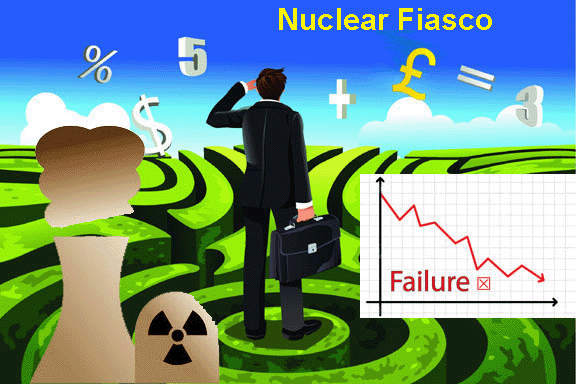
Given the Hinkley debacle, the NFLAs regret that Mr Bowie did not put his shovel to good use by burying the Sizewell project, but instead, like many reckless gamblers, Ministers and senior civil servants at the Department of Energy Security and Net Zero have chosen to blow more taxpayers’ money on a losing prospect, doubling their bet on Sizewell C to £2.5 billion.
The UK/Ireland Nuclear Free Local Authorities were incredulous to learn that government ministers chose to back Sizewell C with a further £1.3 billion of public money on the same day (23 January) French nuclear operator EDF announced that Sizewell’s older twin sister, Hinkley Point C, would begin operating even later and at an even greater cost.
The public relations team handling Hinkley Point C announcements at EDF Energy must have a thankless task as theirs is seemingly a role that involves continually dispensing bad news. Yesterday’s https://www.edf.fr/en/the-edf-group/dedicated-sections/journalists/all-press-releases/hinkley-point-c-update-1 took the biscuit (though whether the PR team could console themselves with any given the state of the corporate finances is debatable; humble pie maybe?)
In the latest in a long litany of gloomy announcements portending further cost and delivery overruns, the company has now advised that the expected cost of delivering Hinkley Point C has increased by anything from £5-9 billion (your guess is as good as theirs) or ultimately between £31 and £35 billion. But this is based on 2015 estimates, so with inflation the bill might run to £46 billion at today’s prices. And the anticipated year in which Reactor 1 might start generating has slipped from the summer of 2027 to sometime never in 2029, with Reactor 2 coming online about one year later (or maybe not).
Interestingly our friends in Stop Sizewell report that Nuclear Minister Andrew Bowie told them recently on his whistlestop visit to Suffolk, bearing a ceremonial shovel, that Hinkley would come online in the late 2020s or early 2030s, and even the Telegraph and Guardian have reported that the plant will not be operational until the next decade.
Rather unconvincingly EDF claims that ‘The project continues to capitalise on the experience gained from construction of the 4 other EPRs around the world’ which is hardly encouraging as Taishan-1 in China experienced a serious accident which led to its shutdown for many months; Flamanville-3 in France, started in 2007 and expected to commence generation in 2012, is only now about to start loading fuel after an unhappy history of faults and compromised quality control; and Olkiluoto-3 in Finland, begun in 2005 with a start date of 2010, was only finished last year after a prolonged construction period which included a bitter contractual dispute about the apportionment of the massively spiralling costs, followed by a corporate bankruptcy.
Given the Hinkley debacle, the NFLAs regret that Mr Bowie did not put his shovel to good use by burying the Sizewell project, but instead, like many reckless gamblers, Ministers and senior civil servants at the Department of Energy Security and Net Zero have chosen to blow more taxpayers’ money on a losing prospect, doubling their bet on Sizewell C to £2.5 billion.
Clearly, DESNZ is unaware that lumbering nuclear white elephants are not the best runners to back in a race, and that renewables, provided with equal financial encouragement, will romp home by a mile every time. Given its latest foolhardy behaviour, the NFLAs now venture to suggest that DESNZ be once more swiftly renamed – this time to the Department of No Energy and Zero Sense.
American weapons company Lockheed Martin scores again with sale of more F-35s to South Korea

3rd January 2024 – 16:30 GMT | by Norbert Neumann in London
South Korea has formalised its plans to expand its fleet of Lockheed Martin F-35A Lightning II fifth-generation fighter aircraft
South Korea has signed a letter of acceptance (LOA) to acquire an additional 20 Lockheed Martin F-35A Lightning II fifth-generation fighter aircraft. The Defense Acquisition Program Administration (DAPA) said on 1 January that the LOA was signed in December………. (Subscribers only) more https://www.shephardmedia.com/news/air-warfare/south-korea-to-enhance-air-force-with-more-f-35a-fighters/
Meet the Companies Profiting From Israel’s War on Gaza

“The scale of destruction and war crimes in Gaza would not be possible without massive weapon transfers from the U.S.,” . “As global resistance to war and apartheid grows, it is important that the public know exactly who is making this violence possible”
“As global resistance to war and apartheid grows, it is important that the public know exactly who is making this violence possible.”
SCHEERPOST, By Jessica Corbett / Common Dreams December 21, 2023
As of Wednesday, a U.S.-based Quaker group’s online database listed over two dozen companies profiting from the bloodshed in the Gaza Strip, where Israeli forces have spent the last 10 weeks waging what experts call a “genocidal” war that sent defense stocks soaring.
Backed by $3.8 billion in annual military aid from the United States, Israel declared war on October 7 in retaliation for a Hamas-led attack that killed over 1,100 people. Since then, Israeli forces have killed over 20,000 Palestinians in Gaza—sparking massive protests demanding a cease-fire around the world, including many led by Jewish people.
“War and attacks on civilians will never bring safety or peace to Israelis or Palestinians.”
The growing death toll, displacement, destruction of civilian infrastructure, and difficulties in delivering humanitarian aid to the besieged enclave have also increased scrutiny of a $14.3 billion package for the war that the Biden administration requested from Congress as well as criticism of the U.S. weapon-makers and billionaire donors who are arming and enabling the Israel Defense Forces (IDF).
“The scale of destruction and war crimes in Gaza would not be possible without massive weapon transfers from the U.S.,” said Noam Perry of the American Friends Service Committee (AFSC), the group behind the tool, in a statement Wednesday. “As global resistance to war and apartheid grows, it is important that the public know exactly who is making this violence possible.”
As the AFSC webpage details:
Shortly after October 7, the U.S. government started transferring to Israel massive amounts of weapons. Among these weapons, Israel received more than 15,000 bombs and 50,000 artillery shells within just the first month-and-a-half. These transfers have been deliberately shrouded in secrecy to avoid public scrutiny and prevent Congress from exercising any meaningful oversight.
Some of these weapons were purchased using U.S. taxpayers’ money through the Foreign Military Sales program; some were direct commercial sales purchased through Israel’s own budget; and some were replenished U.S. military stockpiles in Israel, which the Israeli military may also use. A list of known U.S. arms transfers is maintained by the Forum on the Arms Trade.
The webpage notes that the list is based on reporting, social media, and other open sources, and “focuses on weapons used by Israel because all Palestinian militant groups are already sanctioned and receive no support from Western governments or corporations.”
For example, Boeing, the world’s fifth-largest weapon manufacturer, makes F-15 fighter jets and Apache AH-64 attack helicopters used by the Israeli forces, as well as “multiple types of unguided small diameter bombs (SDBs) and Joint Direct Attack Munition (JDAM) kits” that have been used “extensively” during the war, including in a bombing of Gaza’s Jabalia refugee camp…………………………………………………………………………..
Other companies on the list include weapons giants such as General Dynamics, General Electric, L3Harris Technologies, Leonardo, Lockheed Martin, Northrop Grumman, and RTX—formerly Raytheon—as well as vehicle companies AM General, Ford, Oshkosh, Toyota, and drone manufacturers AeroVironment, Skydio, and XTEND…………………………………………………..
The other foreign firms on the list are ThyssenKrupp, the German company that built four warships for Israel, and Nordic Ammunition Company, which makes the M141 Bunker Defeat Munition, a shoulder-fired “bunker-buster” rocket……………………………………..
more https://scheerpost.com/2023/12/21/meet-the-companies-profiting-from-israels-war-on-gaza/—
Spiralling nuclear costs make UK’s Ministry Of Defence’s equipment plan unsustainable.

While there are shortfalls in every ‘Top Level Budget’ (TLB) in the plan, huge increases in the forecast cost of the MOD’s nuclear weapon upgrades is the most significant driver of these deficits.
While there are shortfalls in every ‘Top Level Budget’ (TLB) in the plan, huge increases in the forecast cost of the MOD’s nuclear weapon upgrades is the most significant driver of these deficits.
Nuclear Information Service 20.12.2023, DAVID CULLEN
The Ministry of Defence’s plan for equipment acquisition over the next decade has once again been branded unaffordable, with overspending on its nuclear programme now clearly responsible for the overall insolvency of the plan. After two years where the plan was predicting a modest surplus, due to the greatest increase in UK military spending since the Korean war, the apparently inexorable rising costs of the government’s nuclear weapon upgrades have created the largest deficit since the government started publishing these plans in 2012.
The Ministry of Defence (MOD) plans its equipment spending around a 10-year budget set by the Treasury. This is longer than most departments, due to the substantial costs and lead-in times involved. The plan covers spending on all equipment used by the armed forces, from submarines to small arms ammunition. The plan is updated annually to cover the next 10 financial years, and is intended to show Parliament that the MOD is able to properly finance its ambitions in military equipment spending.Once the plan is published the National Audit Office (NAO) carries out an analysis of the affordability, which is published separately. The MOD decided not to publish its 2023 Equipment Plan, telling the House of Commons Public Accounts Committee that it needed more time to “work through the consequences” of the 2023 Integrated Review Refresh (IRR) and its accompanying Defence Command Paper. However, all of the financial analysis for the plan has been undertaken and the NAO has published a report based on that analysis.
The MOD’s assessment
The MOD’s own figures show that there is a £16.9bn shortfall in the plan, compared to the £2.6bn surplus in the previous year’s plan. While there are shortfalls in every ‘Top Level Budget’ (TLB) in the plan, huge increases in the forecast cost of the MOD’s nuclear weapon upgrades is the most significant driver of these deficits.
The Defence Nuclear Organisation (DNO), the TLB which oversees the majority of the MOD’s spending on its programme, has seen its spending on the equipment plan increase 62% since last year to £99.5bn. The DNO appear to have been given approval to spend whatever is deemed necessary to avoid delays in the production of the Dreadnought submarine class, as the NAO says it has prioritised delivery to schedule “over immediate cost constraints”. This approach is apparently supported by the Treasury, and although it is hard to dispute their claim that fewer delays will in general lead to lower overall costs, it is a questionable approach to financial management………………………………………………………………………………………………………………….
………………………………………….. Over the full life of the Dreadnought programme, CAAS estimates that costs will be £4bn higher, a substantial increase from their estimate last year of costs being £1.2bn above current forecasts.
……………………… The NAO also highlights the propensity of project delays leading to increased costs, both in the projects themselves and in related programmes, such as maintaining equipment that had previously been scheduled for retirement. This has frequently been the case within the MOD’s nuclear programme, and again raises questions about the substantial ‘adjustments for realism’ in the DNO’s current calculations.
A lack of plans
The gulf in the MOD’s equipment plan finances in general, and nuclear project finances in particular, is emerging despite substantial increases in funding from the Treasury. In the 2023 Spring Budget £3bn of additional funding was announced alongside the IRR, and current budgets allow for annual increases of £2bn, both specifically for nuclear projects. £2bn of the Dreadnought programmes nominal £10bn contingency fund had already been spent by March 2023, and the current forecast cost for the project appears to anticipate another £1bn being spent. The Treasury have apparently ‘set out the arrangements’ for further contingency spending, although it is still to be agreed on a case-by-case basis. In practice, the contingency does not exist as a separate fund, and this ‘contingency’ is just a mechanism for the Treasury to approve overspend.
While the stated commitment of the MOD and Treasury to funding the Dreadnought programme above any other considerations is clearly intended to dispel any doubts about the viability of that project, it is hard to see any resolution to the current state of the equipment plan that does not involve spending on conventional equipment projects being cut. The NAO warns about this prospect and highlights the reliance of nuclear-armed submarine patrols on conventional forces that are not currently protected by the ring-fencing of the MOD’s nuclear spending.
………………………….. The MOD’s refusal to take difficult decisions now merely increases the number of tough choices that will await an incoming government after the next election. The most likely outcome of those choices is that once again conventional military spending will be cut to fund the government’s nuclear ambitions. https://www.nuclearinfo.org/comment/2023/12/spiralling-nuclear-costs-make-the-mods-equipment-plan-unsustainable/
CSIRO says wind and solar much cheaper than nuclear, even with added integration costs
The big mover – and one that is significant in the context of the Australian debate on the energy transition, and the federal Coalition’s insistence that nuclear is the answer to most questions – is the cost of nuclear and small modular reactors.

Giles Parkinson 21 December 2023 ReNewEconomy
The CSIRO has published the latest edition of its important GenCost report, and responded to critics by dialling in near term integration costs for wind, solar and storage. But the result is just the same – renewables are clearly Australia’s cheapest energy option, and the story for nuclear just got a whole ot worse.
The annual GenCost report, prepared in collaboration with the Australian Energy Market Operator since 2018, is an important guide to where Australia’s energy transition is at and where it should be heading, but over the past has become the target of attack from conservative naysayers and the pro-nuclear lobby.
CSIRO has defended its methodology, but to satisfy the critics has added in pre-2030 integration costs – including the new transmission lines being built to connect new generation – and finds that the story is much the same.
“While this change leads to higher cost estimates, variable renewables (wind and solar) were still found to have the lowest cost range of any new-build technology,” the CSIRO says, noting that this includes all integration costs up to and including 90 per cent renewables.
In the past year, cost of solar and offshore wind has fallen, the cost of battery storage has remained steady, but the cost of other technologies such as onshore wind and pumped hydro has increased.
The big mover – and one that is significant in the context of the Australian debate on the energy transition, and the federal Coalition’s insistence that nuclear is the answer to most questions – is the cost of nuclear and small modular reactors.
The CSIRO has been attacked by the pro-nuclear lobby, including conservative media and right wing think tanks, for what the lobby claims are inflated cost estimates, but the CSIRO says recent events have backed its numbers. In fact, they make clear that nuclear SMR costs are worse than thought.
CSIRO economist Paul Graham points to the collapse of a major deal this year involving the most advanced SMR projects in the US, the NucScale projects in Utah, which were withdrawn because of soaring costs.
Graham says it is significant because, as NuScale was listed and had to abide by strict regulatory disclosure rules, it had to be “honest” about the anticipated costs of SMRs.
And these were nearly double what was previously thought. In fact they ended up at the equivalent of $A31,000/MW, according to NuScale filings, and much higher than the $A19,000/MW estimated by the CSIRO in its previous report, and for which it was accused of inflating.
“The UAMPS (Utah utility) estimate implies nuclear SMR has been hit by a 70 per cent cost increase which is much larger than the average 20% observed in other technologies,” the CSIRO writes.
“The cancellation of this project is significant because it was the only SMR project in the US that had received design certification from the Nuclear Regulatory Commission which is an essential step before construction can commence.” Graham says that all other claims on nuclear SMR costs are just marketing and sales talk.
The reality, however, is that talk of nuclear SMRs as a solution for Australia’s energy transition and near term emissions targets are a distraction, given that the SMR technology is simply not available, and unlikely to be so for two decades.
The CSIRO report says some interesting things about the costs of wind and solar, technologies which are available and which do work. It says the costs of these technologies will continue to fall in coming years after the various price shocks that have affected the technologies over the last couple of years.
By including the costs of transmission and storage that is underway now and committed out to 2030 adds 40 to 60 per cent to the 2023 cost of deploying high shares of wind and solar, although that also ignores the technologies cost falls that will occur over time……………………………………………………………………………………….more https://reneweconomy.com.au/csiro-says-wind-and-solar-much-cheaper-than-nuclear-even-with-added-integration-costs/
Cost update blasts nuclear out of energy mix

Canberra Times, By Marion Rae, December 21 2023
A surge in the cost of small nuclear reactors has forced the national science agency to change its calculations for Australia.
The latest modelling of all energy sources, released by CSIRO on Thursday, includes data from a recently scrapped project in the United States that was showcasing nuclear small modular reactors (SMRs) as a way to fight climate change.
The draft GenCost 2023-24 report, out for consultation over summer, shows that while inflation pressures are easing there has been a recalculation on SMRs that puts them out of reach.
Real data on a high-profile six-reactor power plant in the United States has confirmed that the contentious technology costs more than any energy consumer wants to pay.
Project costs for the Utah project were estimated at $18,200 per kilowatt, but the company has since disclosed a whopping capital cost of $31,100/kW, prompting its cancellation in November.
In contrast, under existing policies the cost of new offshore wind in Australia in 2023 would be $5545/kW (fixed) and $6856/kW (floating), while rooftop solar panels are calculated at a modest $1505/kW………………………………………………………………………………………………………………..
A small but vocal group of industry backers have been calling for nuclear SMRs for some years, citing the emerging low-emission technology as being suitable for Australia’s vast and geologically stable landmass.
The coalition recently pledged to reopen the nuclear debate in Australia, where laws ban any research or use of nuclear energy despite the country having the world’s largest uranium reserves.
Regulators estimate it would be around 15 years to first production from a decision to build nuclear SMR in Australia, given the scale of legislative change required.
But even if a decision to pursue a nuclear SMR project in Australia were taken today, with political backing for new laws, it is “very unlikely” a project would be up and running as quickly as 2038, CSIRO said.
Further, CSIRO warned nuclear electricity costs put forward by proponents may be for technology that is not appropriate for Australia, or calculated from Russian and Chinese government-backed projects that don’t operate commercially. https://www.canberratimes.com.au/story/8467236/cost-update-blasts-nuclear-out-of-energy-mix/
Regulators approve deal for ratepayers to pay for Georgia Power’s new nuclear reactors

Almost 15 years of wrangling over who should pay for two new nuclear
reactors in Georgia and who should be accountable for cost overruns came
down to one vote Tuesday, with the Georgia Public Service Commission
unanimously approving an additional 6% rate increase to pay for $7.56
billion in remaining costs at Georgia Power Co.’s Plant Vogtle.
The rate increase is projected to add $8.95 a month to a typical residential
customer’s current monthly bill of $157. It would take effect in the
first month after Vogtle’s Unit 4 begins commercial operation, projected
to be sometime in March. A $5.42 rate increase already took effect when
Unit 3 began operating over the summer.
Bryan Jacob of the Southern Alliance for Clean Energy called the vote “disappointing.” He said residential and small business customers paid a disproportionate share of a financing charge that Georgia Power collected during construction, but Tuesday’s vote parceled out additional costs without giving customers credit for heavier shares of earlier contributions.
Independent 19th Dec 2023
https://www.independent.co.uk/news/ap-atlanta-georgia-westinghouse-augusta-b2466797.html
European nuclear Power Purchase Agreements (PPAs) may be unworkable – analysts
CAROLINE PAILLIEZ, Paris, France, SOPHIE TETREL, Paris, 18 Dec 2023
(Montel) Plans by France’s EDF to sell rights to its nuclear capacity to industrials across Europe via long-term power purchase agreements (PPA) while attractive may be unworkable, French analysts warned.
“If nuclear power is offered tomorrow in France at EUR 70/MWh, the whole of Europe will be interested,” said Peter Claes, head of Belgium’s Febeliec industry lobby, in light of a year of record high energy prices.
Yet the analysts, and even EDF itself, have warned that, in practice, the contracts were complex and potentially costly.
The PPAs were open to any big European power consumers wanting to…………………………..(Subscribers only) more https://www.montelnews.com/news/1533543/european-nuclear-ppas-may-be-unworkable–analysts
China’s CGN Halts Funding for UK’s Hinkley Nuclear Plant

- EDF may have to fund completion of £32.7 billion plant alone
- Britain took over CGN’s stake in a similar project last year
By Francois De Beaupuy, December 14, 2023
China General Nuclear Power Corp. has halted funding for the UK’s Hinkley Point C nuclear station in a fresh sign of tension between London and Beijing.
CGN skipped several installments in recent months, according to people familiar with the matter. That means Electricite de France SA, which was building the £32.7 billion ($41 billion) plant with CGN, may have to pay for its completion alone, they said, asking not to be named,
because the information isn’t public.
The withdrawal of funding comes
after the UK took over CGN’s stake in a similar nuclear project in
Sizewell last year following concerns over national security. Back then,
the government didn’t rule out that it might intervene in other cases of
Chinese involvement in UK energy supply, arguing that it would need to
consider risks to security and energy independence.
CGN’s plan to build a
Chinese-designed atomic plant in Southeast England is also up in the air.
It’s unclear whether the funding halt is temporary or definite, some of
the people said, adding that the project will continue in any case. A
spokesperson for EDF declined to comment when reached by Bloomberg, and CGN
didn’t respond to a request for comment.
Bloomberg 14th Dec 2023
France scores diplomatic wins on banks and nuclear in new EU rules

Paris successfully pushed for weaker due diligence reporting by lenders and state-backed funding for nuclear power plants
Alice Hancock in Brussels, 15 Dec 2, Ft.com
France has secured a partial carve-out for banks from new EU rules to make companies responsible for environmental impacts in their supply chains. Paris also won, in separate negotiations, assurance that state-backed funding for its nuclear power plants will be possible under a reform of the EU electricity market, the culmination of a concerted effort to champion the low-carbon fuel in the face of opposition from Luxembourg, Austria and Germany.
Agnès Pannier-Runacher, French energy minister, hailed the decision as “excellent news”. “It gives us the means to ensure long-term financing for the transformation of our electricity system,” she said……………………………
France, backed by countries including Italy and the Czech Republic, has succeeded in making sure that banks, asset managers and investment groups will only have to report on upstream activities such as purchasing office equipment. They will not have to undertake due diligence on the activities of clients to whom they are offering loans — something that the European parliament had pushed for in the talks.
In a note circulated among negotiators earlier this month, the European Central Bank also warned that “excluding the financial sector would be counterproductive to the intention of the [law], as it would allow the EU financial sector to continue to fund activities detrimental to the EU [environmental and social governance] agenda”.
Arianne Griffith, corporate accountability lead at the NGO Global Witness, said that it was “shocking” that EU countries had “sunk plans to ensure that banks stop investing in environmental and human rights abuses”. Eelco Van der Enden, chief executive of the Global Reporting Initiative, said that it was “disheartening” to see that the French effort had watered down the application of the rules to the financial sector but that a review clause in the agreement could offer the opportunity to include them at a later stage………………………………………..
Both the energy market reform and the due diligence rules must be formally approved by the European parliament and member states in votes due to take place early next year. Once the due diligence directive is approved, EU governments will have two years to introduce the rules in national legislation. https://www.ft.com/content/a4f7c547-1a58-482f-889e-f6400c44bbf7
1 This Month

of the week – Shut Down Drone Warfare!


Tell the Ukrainian Government to Drop Prosecution of Peace Activist Yurii Sheliazhenko

Petition to revoke the licensing of the Near Surface Nuclear Disposal Facility (NSDF) at Chalk River. https://www.ourcommons.ca/petitions/en/Petition/Details?Petition=e-7247
To see nuclear-related stories in greater depth and intensity – go to https://nuclearinformation.wordpress.com
-
Archives
- April 2026 (114)
- March 2026 (251)
- February 2026 (268)
- January 2026 (308)
- December 2025 (358)
- November 2025 (359)
- October 2025 (376)
- September 2025 (257)
- August 2025 (319)
- July 2025 (230)
- June 2025 (348)
- May 2025 (261)
-
Categories
- 1
- 1 NUCLEAR ISSUES
- business and costs
- climate change
- culture and arts
- ENERGY
- environment
- health
- history
- indigenous issues
- Legal
- marketing of nuclear
- media
- opposition to nuclear
- PERSONAL STORIES
- politics
- politics international
- Religion and ethics
- safety
- secrets,lies and civil liberties
- spinbuster
- technology
- Uranium
- wastes
- weapons and war
- Women
- 2 WORLD
- ACTION
- AFRICA
- Atrocities
- AUSTRALIA
- Christina's notes
- Christina's themes
- culture and arts
- Events
- Fuk 2022
- Fuk 2023
- Fukushima 2017
- Fukushima 2018
- fukushima 2019
- Fukushima 2020
- Fukushima 2021
- general
- global warming
- Humour (God we need it)
- Nuclear
- RARE EARTHS
- Reference
- resources – print
- Resources -audiovicual
- Weekly Newsletter
- World
- World Nuclear
- YouTube
-
RSS
Entries RSS
Comments RSS
 nuclear-news