Hinkley Point is glowing on my doorstep, but that won’t help us get a bus into town
In west Somerset broadband is patchy and childcare is scarce, but there’s always £10bn to spare for a badly run mega-project
In west Somerset broadband is patchy and childcare is scarce,
but there’s always £10bn to spare for a badly run mega-project.
Some 10,000 people work on site there (with another 12,000 associated jobs elsewhere).
Lifting the 245-tonne steel roof onto the first reactor, a few weeks ago,
utilised the world’s largest land-based crane. Hinkley Point C (next to the
original facilities A and B) will power some six million homes and what I
lie in bed at night wondering about is how the hell they feed the 10,000.
The Chinese state-owned CGN has a one-third stake in Hinkley and the French
state-controlled energy company EDF controls the rest.
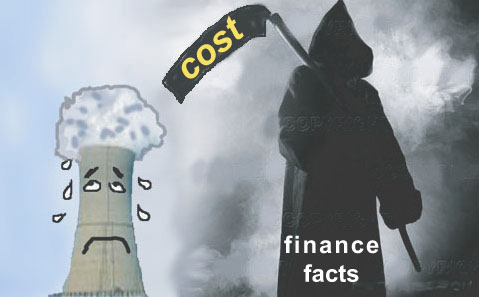
It’s due to start generating power in 2030 and is the world’s most expensive power station.
Then this week EDF announced that, whoops, they need another £10 billion.
Prices have increased since 2015, design changes require more steel and
concrete and, I imagine, given the French contingent at the facility,
increases in the price of butter have skyrocketed the projected costs of
croissants. The final costs could be around £46 billion with the project
looking at a four-year delay.
All of which is great if you’ve got a job
there, be it in security, catering or nuclear fission, but otherwise this
futurist megalith rather clashes with the neighbouring muddy fields of
Exmoor. There are three key stumbling blocks here: childcare is scarce,
broadband is patchy and there are no buses. Which leaves people feeling
that these infrastructure projects – Hinkley Point, HS2 – are like the huge
sewage pipes that run through the slums of Mumbai. They carve up and
disrupt the landscape and lives of those who exist around it, but it’s only
the comfortable middle classes who benefit.
Telegraph 27th Jan 2024
https://www.telegraph.co.uk/columnists/2024/01/27/william-sitwell-hinkley-point/
Hinkley Point C nuclear could go £28bn over budget, and tax-payer takes larger stake in Sizewell C nuclear.

The Chemical Engineer, by Adam Duckett, 28 Jan 24
EDF SAYS its Hinkley Point C nuclear power plant could be delayed to as late as 2031, with costs rising to £46bn (US$58bn).
The project, which includes building two 1,630 MW nuclear reactors in Somerset, was estimated to cost £18bn when it was first agreed in 2016 and had been scheduled to begin operations in 2025. The project has since struggled with a series of delays and cost hikes. The firm has now outlined three scenarios that push operations back until the end of the decade at the earliest.
The first reactor could begin operations in 2029, or, under a base case scenario that assumes delays in the electromechanical work and testing start-up, could fall back to 2030. Under a third scenario, there could be a further delay to 2031.
In a letter to staff, Stuart Crooks, managing director of Hinkley Point C, said: “Like other infrastructure projects we have found civil construction slower than we hoped and faced inflation, labour and material shortages on top of Covid and Brexit disruption.”
He added that EDF has been required to substantially adapt its reactor design to satisfy British regulations, requiring 7,000 changes that have added 35% more steel and 25% more concrete.
EDF says the delays and extra work will hike costs to between £31-35bn in 2015 values meaning under the worst case scenario the price could reach £46bn.
Hinkley Point C is key to the government’s target to almost quadruple nuclear power output from 6.5 GW today to 24 GW by 2050. To meet this goal, it published a plan earlier this month that includes building at least one other plant the size of Hinkley Point C and Sizewell C that EDF is planning in Suffolk, along with suites of smaller modular and advanced nuclear reactors…………….
News of the delay prompted further criticism from nuclear opponents who argue that governments should invest in renewables instead. There are also concerns that with the Chinese junior partner in Hinkley Point C refusing to contribute any more money to the project that the UK government will be called up on to help meet the climbing costs. A government spokesperson told the Financial Times that any additional costs “will in no way fall on taxpayers”.
Government takes larger stake in Sizewell C
Earlier this week, the UK government announced it would make an extra £1.3bn available to support EDF’s construction of Sizewell C so that construction work can continue ahead of a final investment decision being made later this year. Sizewell will use the same design as Hinkley Point C.
The government’s investment further consolidates its position as the majority shareholder in the project. Last year, it bought out the project’s Chinese state-owned partner China General Nuclear as part of efforts to limit Beijing’s involvement in critical infrastructure.
The government has now invested £2.5bn in Sizewell C and the project is being funded by a so-called regulated asset base model under which surcharges on consumer energy bills help fund the project while it’s being constructed. Last year, the government opened up a bidding process to attract external investors in a bid to raise an estimated £20bn to construct the plant. https://www.thechemicalengineer.com/news/hinkley-point-c-could-go-28bn-over-budget-as-edf-predicts-further-delays/
Growing mountain of wasted money is a radioactive prospect
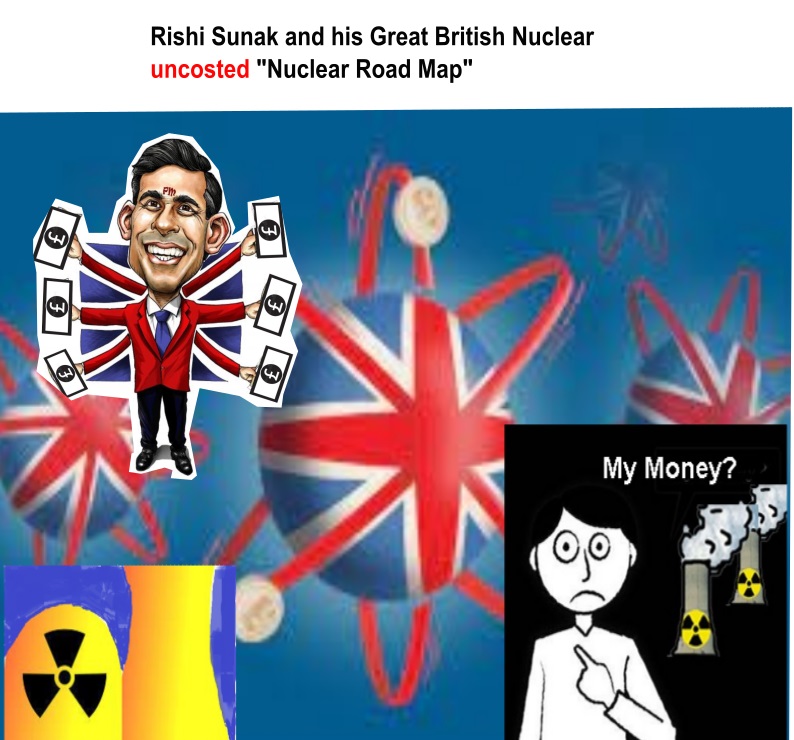
Alistair Osborne: Growing mountain of wasted money is a radioactive
prospect. Rishi Sunak’s apparent determination to press ahead with
mammoth investment in new nuclear reactors, whatever the cost, might not
prove to be the best solution.
It’s only a week since he set off — again — with his uncosted “nuclear road map”: a plan to have 24 gigawatts of new reactors by 2050, or seven more Hinkley Point Cs. On
Monday, the government sank another £1.3 billion into Sizewell C, so it
could “steam ahead” with that project, too, as Andrew Bowie, the
minister for nukes, put it.
Listen to him and investors are queueing up. So
what better news to encourage them than this jaw-dropper from EDF, the
state-backed French outfit behind both schemes? Hinkley Point’s costs
have shot up by as much as £10 billion to a top-end £35 billion, in 2015
prices.
And, instead of firing up in 2027, the first of the Somerset
nuke’s twin reactors could in an “unfavourable scenario” (the likely
outcome) be delayed until 2031. This is what comes with Hinkley’s
European pressurised reactor tech, as EDF has also proved at France’s
Flamanville, Finland’s Olkiluoto and China’s Taishan.
Indeed, two years after the Chinese nuke became operational, one unit had to be taken offline for a year’s repairs. So why is the government hellbent on a re-run with
Sizewell in Suffolk? Alison Downes from the Stop Sizewell C campaign is no
neutral voice. But she’s right to say the project “epitomises the
definition of insanity: doing the same thing over and over and expecting a
different result”. With Sizewell, though, things would be far pricier.
Under the contracts-for-difference regime, EDF is on the hook for
Hinkley’s costs. Repeat the trick at Sizewell and, under the new
regulated asset base model, consumers would find £10 billion added to
their bills — before the nuke’s even operational.
Times 25th Jan 2024
EDF a total basket case, weighed down by its 50 Billion pound nuclear turkey at Hinkley point
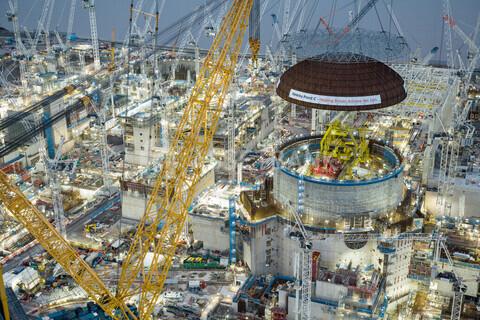
Jonathon Porritt, https://www.jonathonporritt.com/edf-a-total-basket-case-weighed-down-by-its-50-billion-nuclear-turkey-at-hinkley-point/ 25 Jan 24
EdF’s bosses must be thanking their lucky stars that President Macron decided to take complete control of EdF back in 2022. Otherwise, its latest announcements about further delays and cost increases for its new reactors at Hinkley Point would have sent any remaining investors running for the hills.
The scale of those announcements is staggering:
- The price tag for Hinkley Point C has now been reset at £31-34 billion (in 2015 prices), twice the original £18 billion.
- In today’s money, that’s around £46 billion – with further delays and cost hikes (rising to at least £50 billion) all but inevitable.
- EdF’s shortfall in completing Hinkley Point has risen substantially, and could now be as high as £25 billion on its balance sheet.
- EdF has admitted that 2029 is now the earliest Hinkley Point will come online. Fat chance of that.
Which makes Hinkley Point C even more of a bust than EdF’s current worst reactor construction nightmare at Flamanville in France. And significantly worse than its plant at Olkiluoto in Finland, which it just managed to get over the line last year.
So, watch out for the fallout.
Hinkley Point C was meant to be coming online in 2027. All neutral commentators now reckon 2031 (EdF’s so-called ”unfavourable scenario”) is the earliest that will happen. That’s a further four-year delay before its low-carbon electrons (providing 7% of the UK’s electricity) will be available to help the UK meet its various decarbonisation targets.
Add to that the knock-on impact of this on the Government’s/Labour’s hopes for a Hinkley Point look-alike (really!) at Sizewell C. The sales pitch to investors for that has now become even trickier than it was before: “Just look at this beautiful £50 billion turkey: another one just like it could be all yours at a bargain-basement price of, say, £40 billion”.
Which leads to the following conclusions:
EdF is even more screwed than it was before, deeper in debt, with further delays for rolling out its look-alike plant at Sizewell C now inevitable.- The Tory Government is screwed, with no chance of Hinkley Point C (let alone Sizewell C) making any serious short-term contribution to its decarbonisation strategy.
- Labour is screwed – for exactly the same reasons.
- The UK’s Net Zero strategy by 2050 looks less and less viable. And that will soon be tested, again, in the courts.
- All this because of the nuclear obsessions of the UK’s entire political establishment – Labour just as much as the Tories.
Happily, there’s no need to panic: the case for the “renewables + efficiency + storage + smart grids” option just got a whole lot stronger, both economically and politically. We just need the donkeys in Whitehall to give up on their nuclear turkeys. Finally!
US nuclear agency isn’t consistent in tracking costs for some construction projects, report says
Daily Mail, 26 Jan 24, PHOENIX (AP) – The U.S. agency in charge of maintaining the nation´s nuclear arsenal is not consistent when it comes to tracking the progress of small construction projects, making it difficult to prevent delays and cost overruns, congressional investigators said in a report released Thursday.
The Government Accountability Office warned in the report that even fewer projects will go under the microscope if officials raise the dollar limit for what qualifies as a small project. Congress has raised that threshold numerous times, reaching $30 million during the last fiscal year after having started at $5 million in 2003.
Without collecting and tracking information on minor projects in a consistent manner, National Nuclear Security Administration officials may not have the information they need to manage and assess project performance, the investigators said…………………………………………………
Greg Mello with the Los Alamos Study Group said large projects often are split into two or more smaller ones as a way to avoid federal and congressional oversight and accountability. He said better reporting after the fact won’t necessarily help NNSA do a better job of managing projects going forward.
“There are too many contractors and subcontractors in the value chain, too many profit opportunities and too few penalties for poor performance to expect high-quality results,” he said.
Mello pointed to the contracts to run Los Alamos and other sites that are part of the complex, saying they are worth tens of billions of dollars and are among the largest contracts in the federal government………………………..
Between 2019 and 2023, the congressional investigators documented 414 minor construction projects worth more than $3 billion at NNSA sites across several states. Most of that spending was done at Lawrence Livermore National Laboratory in California and at Sandia and Los Alamos labs in New Mexico.https://www.dailymail.co.uk/wires/ap/article-13008399/US-nuclear-agency-isnt-consistent-tracking-costs-construction-projects-report-says.html
Nuclear hype in meltdown

The latest nuclear power ‘renaissance’ is going in reverse.
Dr Jim Green , 23rd January 2024, https://theecologist.org/2024/jan/23/nuclear-hype-meltdown
Nuclear power went backwards last year and shrunk to below 10 percent of global electricity generation despite all the hype about a new nuclear ‘renaissance’. Meanwhile, renewables enjoyed record growth for the 22nd consecutive year and now accounts for more than 30 percent.
The nuclear renaissance of the late-2000s was a bust due to the Fukushima disaster and catastrophic cost overruns with reactor projects. The latest renaissance is heading the same way – nowhere.
There were five reactor start-ups and five permanent closures in 2023 with a net loss of 1.7 gigawatts (GW) of capacity. There were just six reactor construction starts in 2023, five of them in China.
Hype

Due to the ageing of the reactor fleet, the International Atomic Energy Agency (IAEA) anticipates the closure of 10 reactors (10 GW) per year from 2018 to 2050.
Therefore the industry needs an annual average of 10 reactor construction starts, and 10 reactor startups (grid connections), just to maintain its current output. Over the past decade (2014-23), construction starts have averaged 6.1 per year and reactor startups have averaged 6.7.
The number of operable power reactors is 407 to 413 depending on the definition of operability, well down from the 2002 peak of 438.
Nuclear power’s share of global electricity generation has fallen to 9.2 percent, its lowest share in four decades and little more than half of its peak of 17.5 percent in 1996.
Over the two decades 2004-2023, there were 102 power reactor startups and 104 closures worldwide: 49 startups in China with no closures; and a net decline of 51 reactors in the rest of the world.
In China, there were five reactor construction starts in 2023 and just one reactor startup. Put another way, there was just one reactor construction start outside China in 2023. One. So much for the hype about a new nuclear ‘renaissance’.
Deployment
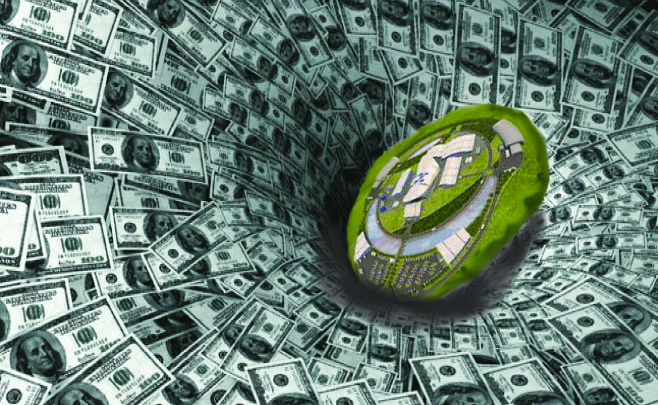
Small modular reactors (SMRs) are the subject of endless hype but there were no SMR construction starts or startups last year.
Indeed, the biggest SMR news in 2023 was NuScale Power’s decision to abandon its flagship project in Idaho despite securing astronomical subsidies amounting to around US$4 billion from the US Government. The company is far more likely to go bankrupt than to break ground on its first reactor.
The pro-nuclear Breakthrough Institute noted in a November 2023 article that efforts to commercialise a new generation of ‘advanced’ nuclear reactors “are simply not on track” and it warned nuclear advocates not to “whistle past this graveyard”.
The Institute said: “The NuScale announcement follows several other setbacks for advanced reactors. Last month, X-Energy, another promising SMR company, announced that it was canceling plans to go public. This week, it was forced to lay off about 100 staff.
“In early 2022, Oklo’s first license application was summarily rejected by the Nuclear Regulatory Commission before the agency had even commenced a technical review of Oklo’s Aurora reactor.
“Meanwhile, forthcoming new cost estimates from TerraPower and XEnergy as part of the Department of Energy’s Advanced Reactor Deployment Program are likely to reveal substantially higher cost estimates for the deployment of those new reactor technologies as well.”
Installed
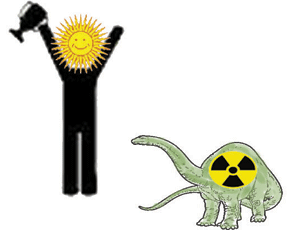
The International Energy Agency (IEA) has just released its ‘Renewables 2023’ report and it makes for a striking contrast with the nuclear industry’s malaise.
Nuclear power suffered a net loss of 1.7 GW capacity in 2023, whereas renewable capacity additions amounted to a record 507 GW, almost 50 percent higher than 2022. This is the 22nd year in a row that renewable capacity additions set a new record, the IEA states.
Nuclear power accounts for a declining share of global electricity generation (currently 9.2 percent) whereas renewables have grown to 30.2 percent.
The IEA expects renewables to reach 42 percent by 2028 thanks to a projected 3,700 GW of new capacity over the next five years in the IEA’s ‘main case’.
The IEA states that the world is on course to add more renewable capacity in the next five years than has been installed since the first commercial renewable energy power plant was built more than 100 years ago.
Milestones
Solar and wind combined have already surpassed nuclear power generation and the IEA notes that several other milestones are in sight:
‒ In 2025, renewables surpass coal-fired electricity generation to become the largest source of electricity generation
‒ In 2025, wind surpasses nuclear electricity generation
‒ In 2026, solar PV surpasses nuclear electricity generation
‒ In 2028, renewable energy sources account for over 42 percent of global electricity generation, with the share of wind and solar PV doubling to 25 percent.
An estimated 96 percent of newly installed, utility-scale solar PV and onshore wind capacity had lower generation costs than new coal and natural gas plants in 2023, the IEA states.
Tripling
The IEA states in its ‘Renewables 2023’ report that: “Prior to the COP28 climate change conference in Dubai, the International Energy Agency (IEA) urged governments to support five pillars for action by 2030, among them the goal of tripling global renewable power capacity.
“Several of the IEA priorities were reflected in the Global Stocktake text agreed by the 198 governments at COP28, including the goals of tripling renewables and doubling the annual rate of energy efficiency improvements every year to 2030.
“Tripling global renewable capacity in the power sector from 2022 levels by 2030 would take it above 11 000 GW, in line with IEA’s Net Zero Emissions by 2050 (NZE) Scenario.”
It adds: “Under existing policies and market conditions, global renewable capacity is forecast to reach 7300 GW by 2028. This growth trajectory would see global capacity increase to 2.5 times its current level by 2030, falling short of the tripling goal.”
In the IEA’s ‘accelerated case’, 4,500 GW of new renewable capacity will be added over the next five years (compared to 3,700 GW in the ‘main case’), nearing the tripling goal. The goal of tripling renewables by 2030 is a stretch but it is not impossible. Conversely, the ‘pledge’ signed by just 22 nations at COP28 to triple nuclear power by 2050 is absurd.
Military-strategic
China’s nuclear program added only 1.2 GW capacity in 2023 while wind and solar combined added 278 GW. Michael Barnard noted in CleanTechnica that allowing for capacity factors, the nuclear additions amount to about seven terrawatt-hours (TWh) of new low carbon generation per year, while wind and solar between them will contribute about 427 TWh annually, over 60 times more than nuclear.
Barnard commented: “One of the things that western nuclear proponents claim is that governments have over-regulated nuclear compared to wind and solar, and China’s regulatory regime for nuclear is clearly not the USA’s or the UK’s.
“They claim that fears of radiation have created massive and unfair headwinds, and China has a very different balancing act on public health and public health perceptions than the west. They claim that environmentalists have stopped nuclear development in the west, and while there are vastly more protests in China than most westerners realise, governmental strategic programs are much less susceptible to public hostility.
“And finally, western nuclear proponents complain that NIMBYs block nuclear expansion, and public sentiment and NIMBYism is much less powerful in China with its Confucian, much more top down governance system.
“China’s central government has a 30-year track record of building massive infrastructure programs, so it’s not like it is missing any skills there. China has a nuclear weapons programme, so the alignment of commercial nuclear generation with military strategic aims is in hand too. China has a strong willingness to finance strategic infrastructure with long-running state debt, so there are no headwinds there either.
“Yet China can’t scale its nuclear program at all. It peaked in 2018 with seven reactors with a capacity of 8.2 GW. For the five years since then then it’s been averaging 2.3 GW of new nuclear capacity, and last year only added 1.2 GW…”
This Author
Dr Jim Green is the national nuclear campaigner with Friends of the Earth Australia and a member of the Nuclear Consulting Group.
Hinkley Point C could be delayed to 2031 and cost up to £35bn, says EDF

As nuclear plant is hit by further delay, real cost will be far higher after inflation is included, as project uses 2015 prices
Guardian, Alex Lawson, Wed 24 Jan 2024
The owner of Hinkley Point C has blamed inflation, Covid and Brexit as it announced the nuclear power plant project could be delayed by a further four years, and cost £2.3bn more.
The plant in Somerset, which has been under construction since 2016, is now expected to be finished by 2031 and cost up to £35bn, France’s EDF said. However, the cost will be far higher once inflation is taken into account, because EDF is using 2015 prices.
The latest in a series of setbacks represents a huge delay to the project’s initial timescale. In 2007, the then EDF chief executive Vincent de Rivaz said that by Christmas in 2017, turkeys would be cooked using electricity generated from atomic power at Hinkley. When the project was finally given the green light in 2016, its cost was estimated at £18bn…………
Crooks said: “Running the project longer will cost more money and our budget has also been affected by rising civil construction costs. It is important to say that British consumers or taxpayers won’t pay a penny, with the increased costs met entirely by shareholders.”
EDF had previously said that the first reactor unit at the nuclear site would be due to be complete by June 2027, with a 15-month buffer period which was likely to be used – putting its completion at September 2028, and a further year for the second unit. It costs were estimated between £25bn and £26bn, and this was later revised up to £32.7bn in February 2023
EDF gave three scenarios, ranging from becoming operational is 2029, to delays pushing this back to 2031.
It said that the cost of completing Hinkley will be between £31bn and £34bn, although if completion is delayed to 2031 costs would rise to £35bn.
In December it emerged EDF’s partner in the project, China General Nuclear, had halted funding for Hinkley. The move came after the government took over CGN’s stake in Hinkley’s proposed sister site, Sizewell C in Suffolk, stripping the Chinese state-owned company of its role in the project.
The latest financial estimates are based on accounting in 2015 figures, meaning the total cost of the project could be far higher when inflation over the last decade is factored in. Hinkley’s ballooning costs have proved controversial with French taxpayers, which are picking up the tab.
Hinkley Point C and Sizewell C are expected to herald a new era of nuclear plants touted by the government.
Last year the government launched a delivery body, Great British Nuclear, with the aim of accelerating the development of new nuclear projects. Earlier this month ministers set out plans for out for the “biggest nuclear power expansion in 70 years”.
However, the Hinkley Point C delay will add to concerns over project delays and costs, as well as skills in an industry earmarked to deliver a quarter of the national electricity demand by 2050………………..
EDF said in January it would delay the shutdown of four of its UK nuclear reactors for at least two years and increase investment in its British nuclear fleet. https://www.theguardian.com/business/2024/jan/23/hinkley-point-c-could-be-delayed-to-2031-and-cost-up-to-35bn-says-edf—
EDF’s UK Hinkley Nuclear Costs Balloon as Plant Delayed Again – an “unmitigated disaster”?

A government spokesperson said the new plant is “not a government project” and as such “any additional costs or schedule overruns are the responsibility of EDF and its partners and will in no way fall on taxpayers”.
The government has also just doubled its own investment into Sizewell C to £2.5bn and is in the process of raising capital from private investors.
A government spokesperson said the new plant is “not a government project” and as such “any additional costs or schedule overruns are the responsibility of EDF and its partners and will in no way fall on taxpayers”.
The government has also just doubled its own investment into Sizewell C to £2.5bn and is in the process of raising capital from private investors.
Hinkley C: UK nuclear plant price tag could rocket by a third.
By Simon Jack, Business editor
The final cost of the Hinkley Point C nuclear plant being built in Somerset may soar by about a third, according to the French firm developing it.
EDF now estimates that the cost could hit £46bn, when taking price rises into account.
The completion date could also be delayed by three years………………………………
The French state-owned firm manages all five nuclear power stations that are currently generating electricity in the UK, along with three that are defueling, the first stage of winding down operations.
In 2022, the cost of the UK’s first new nuclear plant since the 1990s was estimated at £26bn, with a target date for completion of June 2027.
Previous cost estimates have been expressed in 2015 prices for easy comparison over time.
But taking inflation into account, the previous estimate on final costs of £26bn works out at £34bn today. The updated estimate of £31-35bn, could see costs hit £46bn in today’s prices – an increase of about a third.
In a letter to staff, seen by the BBC, Stuart Crooks, the managing director of Hinkley Point C, said there were 7,000 substantial design changes required by British regulations that needed to be made to the site, with 35% more steel and 25% more concrete needed than originally planned.
The revised estimates come after the government recently announced ambitions for the biggest expansion in nuclear power for 70 years.
The UK government has said in the past it wants nuclear to provide up to 25% of the UK’s electricity needs by 2050 as part of its plans to combat climate change.
A government spokesperson said the new plant is “not a government project” and as such “any additional costs or schedule overruns are the responsibility of EDF and its partners and will in no way fall on taxpayers”…………………………………….
Stuart Crooks, the managing director of Hinkley Point C, pointed out, however, that UK bill payers will not be directly affected by those building and cost time overruns.
The French firm EDF agreed to shoulder the risk and pay the full cost of construction, including any increases. This was in return for an agreed electricity price that was substantially higher than the average price in 2015 and would only rise in line with inflation.
“It is important to say that British consumers or taxpayers won’t pay a penny, with the increased costs met entirely by shareholders,” Mr Crooks’ letter read.
However, this price shock comes at a sensitive time for the UK government, which has agreed to allow construction costs for a new plant at Sizewell in Suffolk to be added to customers’ bills gradually over the decade which it will take to build.
The government has also just doubled its own investment into Sizewell C to £2.5bn and is in the process of raising capital from private investors.
Last week, the government triggered a “development consent order” that allows early-stage construction to begin in Suffolk despite several legal challenges from local and national opponents who have taken their fight to the Supreme Court.
Alison Downes of the campaign group Stop Sizewell C said that the announcement of additional funding was”inexplicable” following news of delays to one of the government’s key nuclear projects.
She described the Hinkley and Sizewell projects as an “unmitigated disaster”.
“The government should cancel Sizewell C instead of handing over scarce billions that could be used instead for renewables, energy efficiency or – in this [general] election year – schools and hospitals,” she added……………….. https://www.bbc.com/news/business-68073279
UK’s flagship nuclear plant could cost up to $59 billion, developer says
A major nuclear plant that Britain’s government hopes will generate affordable, low-carbon energy could cost up to 46 billion pounds, or $59 billion, and the completion date could be delayed to after 2029
abc news, By SYLVIA HUI Associated Press, January 25, 2024
LONDON — A major nuclear plant that Britain’s government hopes will generate affordable, low-carbon energy could cost up to 46 billion pounds ($59 billion), and the completion date could be delayed to after 2029, the firm developing it said Wednesday.
The U.K. government says nuclear projects like the Hinkley Point C plant are a key part of its plans to ensure greater energy independence and achieve its “net zero” by 2050 strategy.
But a re-evaluation showed that the final bill for the plant, being built in Somerset in southwest England, could soar to up to 34 billion pounds in 2015 prices — or 43 billion pounds in current value, French energy giant EDF said…………………………………. https://abcnews.go.com/Business/wireStory/uks-flagship-nuclear-plant-cost-59-billion-developer-106635464
Berkshire nuclear defence workers strike
Planet Radio 24 Jan 24
Workers at the Atomic Weapons Establishment (AWE) at Aldermaston and Burghfield are on a 24-hour strike after two months of other forms of industrial action in a dispute over pay.
Action short of a strike started in mid-November and will re-commence on Thursday January 25. ……………………………………….https://planetradio.co.uk/greatest-hits/berkshire-north-hampshire/news/workers-awe-aldermaston-burghfield-strike/
France presses UK to help fill multibillion-pound hole in nuclear projects

Call comes day after EDF flagged more delays of construction of power plant at Hinkley Point
Sarah White in Paris and Jim Pickard and Rachel Millard in London, 25 Jan 24, https://www.ft.com/content/3320c06e-7ce3-4a6b-ab22-4b8201a4cfca
The French government is pressing the UK to help plug a multibillion-pound hole in the budget of nuclear power projects being built in Britain by France’s electricity operator EDF. The call for a contribution from the UK is likely to cause tensions between Paris and London, a day after state-owned EDF admitted its construction of a new nuclear power station at Hinkley Point in Somerset would suffer further costly delays, taking the bill to as much as £46bn. The UK has said it will not put cash into the project, which counts EDF as a majority shareholder, and is already backed by a government guarantee on its revenues once it is up and running.
But Paris is pushing for a “global solution” that would also encompass funding issues at another planned UK plant, Sizewell C, said a French economy ministry official and another person close to the talks. “It’s a Franco-British matter,” the French economy ministry official said. “The British government cannot at the same time say EDF has to figure it out alone on Hinkley Point and at the same time ask EDF to put money into Sizewell. We’re determined to find a global solution to see these projects through.”
Sizewell in Suffolk has a different financial set-up to Hinkley. The UK this week said it would inject another £800mn of state funds, bringing its total contribution to £2.5bn at the £20bn plant, where it is the top shareholder. Its partner EDF has no obligation to put more money in. French officials said discussions on various options had begun several months ago with British counterparts, although they acknowledged London had flagged budgetary constraints that would have to be taken into account. In the UK, a government official played down the talks, adding that on Hinkley Point: “Costs will be the responsibility of EDF.”
An EDF executive told the BBC on Wednesday that the French company picks up “the tab for the cost overruns”. EDF on Tuesday warned Hinkley Point would not now be completed until 2029 at the earliest, four years later than its original start date, while the two reactors could cost up to £46bn to build at today’s prices, compared with a £18bn budget in 2016.
Other factors might play into the discussions, however. Under Prime Minister Rishi Sunak, Britain took the political initiative to eject Chinese group CGN as an investor in Sizewell — leaving that project in need of fresh private capital, but also prompting CGN to pull back from Hinkley, where it is a 33.5 per cent shareholder. The Chinese group has fulfilled its contracted payments on Hinkley but has no obligation to fund over-costs and stopped doing so a few months ago.
“The French don’t have many levers here but the CGN issue is a very real one,” a third person close to the talks said. Finding private investors to make up the Hinkley shortfall may be tough, several people close to the group said, although formulas such as state guarantees could be discussed. EDF is only just coming out of a period of financial turmoil, and has big investments to make at home, too, in the coming decades. It was fully renationalised last year
“Our goal here . . . is for what’s happening at Hinkley Point, with the delays and the issue with the Chinese partner’s decision, not to impact EDF’s financial trajectory excessively,” the French economy ministry official said. However, one UK nuclear industry figure said that EDF’s plight at Hinkley was the consequence of signing up to a deal with the UK government a decade ago, which at the time was criticised for being too generous to the French group. Under a so-called contract for difference signed with the state, construction costs are not covered but future electricity production is backed up by subsidies in case power prices fall below a certain threshold.
UK nuclear plant hit by new multiyear delay and could cost up to £46bn.
Britain’s flagship Hinkley Point C nuclear plant has been delayed until
2029 at the earliest, with the cost spiralling to as much as £46bn, in the
latest blow to a project at the heart of the country’s long-term energy
plans.
The surging bill and slipping schedule, announced on Tuesday by the
French state-owned operator and constructor EDF, will put pressure on the
UK government to provide extra financial support for the project.
EDF, which has also experienced long delays on recent parallel projects in
Finland and France that use the same reactor technology, blamed the latest
problems at Hinkley in Somerset on the complexity of installing
electromechanical systems and intricate piping. Hinkley was previously
delayed due to construction disruption during Covid pandemic.
Under EDF’s latest scenario, one of the two planned reactors at Hinkley Point C could
be ready in 2029, a two-year hold-up compared with the company’s previous
estimate of 2027. But it could be further delayed to 2031 in adverse
conditions, EDF said. It did not give an estimate for the second reactor.
EDF said the cost would now be between £31bn-£35bn based on 2015 prices,
depending on when Hinkley Point C was completed.
In today’s prices, the cost would balloon to as much as £46bn. The initial budget was £18bn, with a scheduled completion date of 2025. Alison Downes of Stop Sizewell C, a
campaign group opposed to the planned Suffolk nuclear plant, said EDF was
an “unmitigated disaster”. She added the UK government should cancel
Sizewell C, saying state funding for the project could be better spent on
“renewables, energy efficiency or, in this election year, schools and
hospitals”.
FT 23rd Jan 2024
https://www.ft.com/content/1157591c-d514-4520-aa17-158349203abd
EDF’s UK Hinkley Nuclear Costs Balloon as Plant Delayed Again

Francois de Beaupuy, Bloomberg News, Jan 23, 2024
(Bloomberg) — Electricite de France SA’s nuclear project at Hinkley Point in the UK will cost as much as £10 billion ($13 billion) extra to build and take several years longer than planned, the latest in a series of setbacks for the budget and timetable of the country’s largest energy project.
EDF now expects the two reactors it’s building in southwest England to cost between £31 billion and £35 billion in 2015 terms, the French energy company said in a statement on Tuesday. That’s up from an estimate of £25 billion to £26 billion in 2022, and is the fifth budget increase in eight years. At today’s prices, the project would cost as much as £46 billion, according to the Bank of England’s inflation calculator. …………………
The UK is struggling to get its huge nuclear program off the ground. The government is aiming for as much as 24 gigawatts of capacity by 2050 and will have to accelerate rapidly to achieve that. Hinkley Point will be the first new atomic station to start generating in Britain since 1995. Construction of complex nuclear plants is notoriously slow, and the cost overruns and delays at Hinkley may damp investor enthusiasm for the sector…………………………………..
The setback comes just one day after the UK government pledged to invest an additional £1.3 billion in EDF’s second UK project at Sizewell C. Ministers are hoping the commitment will attract enough private capital to make a final investment decision this year and make progress toward its ambitious 2050 target.
EDF was already struggling with the budget for Hinkley after China General Nuclear Power Corp, its partner in the project, stopped funding, potentially leaving the French company to foot the bill until it is completed. The government-owned French company will also have to spend tens of billions of euros on new atomic plants at home in the coming decades.
Hinkley Point C is not a French government project and so any additional costs or schedule overruns are the responsibility of EDF and its partners and will in no way fall on taxpayers, said a spokesperson for the UK Department for Energy Security and Net Zero.
…….. EDF’s current fleet of five nuclear plants is scheduled to shrink to just three by the end of 2026. Last year, output slumped to the lowest in more than four decades.
While rising costs of metals, cement and labor are affecting industries including large offshore wind projects, the revised plan may revive a controversy over how expensive the technology is and whether further delays are inevitable. Still, the UK government said this month that the country will build another large-scale nuclear power plant, beyond current projects led by EDF.
t’s not the first time Hinkley has ballooned beyond its budget. EDF increased its estimates in 2017, 2019, 2021, and 2022 from an initial estimate of £18 billion when the contract was signed with the UK in 2016.
At the start of the project, the French utility expected the first unit to start by the end of 2025. However, Brexit, the Covid pandemic and the war in Ukraine have disrupted supply chains and boosted the cost of labor and essential materials like steel and cement.
“Going first to restart the nuclear construction industry in Britain after a 20-year pause has been hard,” said Stuart Crooks, Managing Director for Hinkley Point C. https://www.bnnbloomberg.ca/edf-s-uk-hinkley-nuclear-costs-balloon-as-plant-delayed-again-1.2025542
Nuclear goes backwards, again, as wind and solar enjoy another year of record growth.

Jim Green 21 January 2024, https://reneweconomy.com.au/nuclear-goes-backwards-again-as-wind-and-solar-enjoy-another-year-of-record-growth/
The nuclear renaissance of the late-2000s was a bust due to the Fukushima disaster and catastrophic cost overruns with reactor projects. The latest renaissance is heading the same way, i.e. nowhere. Nuclear power went backwards last year.
There were five reactor start-ups and five permanent closures in 2023 with a net loss of 1.7 gigawatts (GW) of capacity. There were just six reactor construction starts in 2023, five of them in China.
Due to the ageing of the reactor fleet, the International Atomic Energy Agency (IAEA) anticipates the closure of 10 reactors (10 GW) per year from 2018 to 2050.
Thus the industry needs an annual average of 10 reactor construction starts, and 10 reactor startups (grid connections), just to maintain its current output. Over the past decade (2014-23), construction starts have averaged 6.1 and reactor startups have averaged 6.7.
The number of operable power reactors is 407 to 413 depending on the definition of operability, well down from the 2002 peak of 438.
Nuclear power’s share of global electricity generation has fallen to 9.2 percent, its lowest share in four decades and little more than half of its peak of 17.5 percent in 1996.
Over the two decades 2004-2023, there were 102 power reactor startups and 104 closures worldwide: 49 startups in China with no closures; and a net decline of 51 reactors in the rest of the world.
In China, there were five reactor construction starts in 2023 and just one reactor startup. Put another way, there was just one reactor construction start outside China in 2023. So much for the hype about a new nuclear renaissance.
Small modular reactors and ‘advanced’ nuclear power
Small modular reactors (SMRs) are the subject of endless hype but there were no SMR construction starts or startups last year. The biggest SMR news in 2023 was NuScale Power’s decision to abandon its flagship project in Idaho despite securing astronomical subsidies amounting to around US$4 billion (A$6.1 billion) from the US government.
The pro-nuclear Breakthrough Institute noted in a November 2023 article that efforts to commercialise a new generation of ‘advanced’ nuclear reactors “are simply not on track” and it warned nuclear advocates not to “whistle past this graveyard”:
It wrote:
“The NuScale announcement follows several other setbacks for advanced reactors. Last month, X-Energy, another promising SMR company, announced that it was canceling plans to go public. This week, it was forced to lay off about 100 staff.
“In early 2022, Oklo’s first license application was summarily rejected by the Nuclear Regulatory Commission before the agency had even commenced a technical review of Oklo’s Aurora reactor.
The nuclear renaissance of the late-2000s was a bust due to the Fukushima disaster and catastrophic cost overruns with reactor projects. The latest renaissance is heading the same way, i.e. nowhere. Nuclear power went backwards last year.
There were five reactor start-ups and five permanent closures in 2023 with a net loss of 1.7 gigawatts (GW) of capacity. There were just six reactor construction starts in 2023, five of them in China.
Due to the ageing of the reactor fleet, the International Atomic Energy Agency (IAEA) anticipates the closure of 10 reactors (10 GW) per year from 2018 to 2050.
Thus the industry needs an annual average of 10 reactor construction starts, and 10 reactor startups (grid connections), just to maintain its current output. Over the past decade (2014-23), construction starts have averaged 6.1 and reactor startups have averaged 6.7.
The number of operable power reactors is 407 to 413 depending on the definition of operability, well down from the 2002 peak of 438.
Nuclear power’s share of global electricity generation has fallen to 9.2 percent, its lowest share in four decades and little more than half of its peak of 17.5 percent in 1996.
Over the two decades 2004-2023, there were 102 power reactor startups and 104 closures worldwide: 49 startups in China with no closures; and a net decline of 51 reactors in the rest of the world.
In China, there were five reactor construction starts in 2023 and just one reactor startup. Put another way, there was just one reactor construction start outside China in 2023. So much for the hype about a new nuclear renaissance.
Nuclear decline vs. record renewables growth
The International Energy Agency (IEA) has just released its ‘Renewables 2023’ report and it makes for a striking contrast with the nuclear industry’s malaise.
Nuclear power suffered a net loss of 1.7 GW capacity in 2023, whereas renewable capacity additions amounted to a record 507 GW, almost 50 percent higher than 2022. This is the 22nd year in a row that renewable capacity additions set a new record, the IEA states. Solar PV alone accounted for three-quarters of renewable capacity additions worldwide in 2023.
Nuclear power accounts for a declining share of share of global electricity generation (currently 9.2 percent) whereas renewables have grown to 30.2 percent. The IEA expects renewables to reach 42 percent by 2028 thanks to a projected 3,700 GW of new capacity over the next five years in the IEA’s ‘main case’.
The IEA states that the world is on course to add more renewable capacity in the next five years than has been installed since the first commercial renewable energy power plant was built more than 100 years ago.
Solar and wind combined have already surpassed nuclear power generation and the IEA notes that over the next five years, several other milestones will likely be achieved:
— In 2025, renewables surpass coal-fired electricity generation to become the largest source of electricity generation
— In 2025, wind surpasses nuclear electricity generation
— In 2026, solar PV surpasses nuclear electricity generation
— In 2028, renewable energy sources account for over 42 percent of global electricity generation, with the share of wind and solar PV doubling to 25 percent
Tripling renewables
The IEA states in its ‘Renewables 2023’ report that:
“Prior to the COP28 climate change conference in Dubai, the International Energy Agency (IEA) urged governments to support five pillars for action by 2030, among them the goal of tripling global renewable power capacity. Several of the IEA priorities were reflected in the Global Stocktake text agreed by the 198 governments at COP28, including the goals of tripling renewables and doubling the annual rate of energy efficiency improvements every year to 2030. Tripling global renewable capacity in the power sector from 2022 levels by 2030 would take it above 11 000 GW, in line with IEA’s Net Zero Emissions by 2050 (NZE) Scenario.
“Under existing policies and market conditions, global renewable capacity is forecast to reach 7300 GW by 2028. This growth trajectory would see global capacity increase to 2.5 times its current level by 2030, falling short of the tripling goal.”
In the IEA’s ‘accelerated case’, 4,500 GW of new renewable capacity will be added over the next five years (compared to 3,700 GW in the ‘main case’), nearing the tripling goal.
Tripling nuclear?
The goal of tripling renewables by 2030 is a stretch but it is not impossible. Conversely, the ‘pledge’ signed by just 22 nations at COP28 to triple nuclear power by 2050 appears absurd.
The Labor federal government signed Australia up to the renewables pledge but not the nuclear pledge. The Coalition wants to do the opposite, and also opposes the Labor government’s target of 82 per cent renewable power supply by 2030.
One of the lies being peddled by the Coalition is that nuclear power capacity could increase by 80 percent over the next 30 years. That is based on a ‘high case’ scenario from the IAEA. However the IAEA’s ‘low case’ scenario — ignored by the Coalition — is for another 30 years of stagnation.
So should we go with the IAEA’s high or low scenarios, or split the difference perhaps?
According to a report by the IAEA itself, the Agency’s ‘high’ forecasts have consistently proven to be ridiculous and even its ‘low’ forecasts are too high — by 13 percent on average.
Nuclear power won’t increase by 80 percent by 2050 and it certainly won’t triple; indeed it will struggle to maintain current output given the ageing of the reactor fleet and recent experience with construction projects.
Comparing nuclear and renewables in China
China’s nuclear program added only 1.2 GW capacity in 2023 while wind and solar combined added 278 GW. Michael Barnard noted in CleanTechnica that allowing for capacity factors, the nuclear additions amount to about 7 terrawatt-hours (TWh) of new low carbon generation per year, while wind and solar between them will contribute about 427 TWh annually, over 60 times more than nuclear.
Barnard commented:
“One of the things that western nuclear proponents claim is that governments have over-regulated nuclear compared to wind and solar, and China’s regulatory regime for nuclear is clearly not the USA’s or the UK’s. They claim that fears of radiation have created massive and unfair headwinds, and China has a very different balancing act on public health and public health perceptions than the west. They claim that environmentalists have stopped nuclear development in the west, and while there are vastly more protests in China than most westerners realize, governmental strategic programs are much less susceptible to public hostility.
“And finally, western nuclear proponents complain that NIMBYs block nuclear expansion, and public sentiment and NIMBYism is much less powerful in China with its Confucian, much more top down governance system.
“China’s central government has a 30 year track record of building massive infrastructure programs, so it’s not like it is missing any skills there. China has a nuclear weapons program, so the alignment of commercial nuclear generation with military strategic aims is in hand too. China has a strong willingness to finance strategic infrastructure with long-running state debt, so there are no headwinds there either.
“Yet China can’t scale its nuclear program at all. It peaked in 2018 with 7 reactors with a capacity of 8.2 GW. For the five years since then then it’s been averaging 2.3 GW of new nuclear capacity, and last year only added 1.2 GW …”
Dr. Jim Green is the national nuclear campaigner with Friends of the Earth Australia and a member of the Nuclear Consulting Group.
Big costs sink flagship nuclear project and they’ll sink future small modular reactor projects too.

By Susan O’Donnell and M.V. Ramana, 024, https://beyondnuclearinternational.org/2024/01/21/big-costs-sink-flagship-nuclear-project/
The major news in the world of nuclear energy last November was the collapse of the Carbon Free Power Project in the United States. The project was to build six NuScale small modular nuclear reactors (SMRs). Given NuScale’s status as the flagship SMR design not just in the U.S. but even globally, the project’s cancellation should ring alarm bells in Canada. Yet SMRs are touted as a climate action strategy although it is becoming clearer by the day that they will delay a possible transition to net-zero energy and render it more expensive.
The NuScale project failed because there were not enough customers for its expensive electricity. Construction cost estimates for the project had been steadily rising—from USD 4.2 billion for 600 megawatts in 2018 to a staggering USD 9.3 billion (CAD 12.8 billion) for 462 megawatts. Using a combination of government subsidies, potentially up to USD 4.2 billion, and an opaque calculation method, NuScale claimed that it would produce electricity at USD 89 per megawatt-hour. When standard U.S. government subsidies are included, electricity from wind and solar energy projects, including battery storage, could be as cheap as USD 12 to USD 31 per megawatt-hour.
A precursor to the failed NuScale project was mPower, which also received massive funding from the U.S. Department of Energy. Described by The New York Times as the leader in the SMR race, mPower could not find investors or customers. By 2017, the project was essentially dead. Likewise, a small reactor in South Korea proved to be “not practical or economic”.
Ignoring this dire economic reality, provincial governments planning for SMRs – Ontario, New Brunswick, Saskatchewan and Alberta – published a “strategic plan” seemingly designed to convince the federal government to open its funding floodgates. Offering no evidence about the costs of these technologies, the report asserts: “The power companies assessed that SMRs have the potential to be an economically competitive source of energy.”
For its part, the federal government has coughed up grants totalling more than $175 million to five different SMR projects in Ontario, New Brunswick, and Saskatchewan. The Canada Infrastructure Bank loaned $970 million to Ontario Power Generation to develop its Darlington New Nuclear project. And the Canada Energy Regulator’s 2023 Canada’s Energy Future report envisioned a big expansion of nuclear energy based on wishful thinking and unrealistic assumptions about SMRs.
Canada’s support is puzzling when considering other official statements about nuclear energy. In 2021, Environment Minister Steven Guilbeault said that nuclear power must compete with renewable energy in the market. The previous year, then Environment Minister and current Energy and Natural Resources Minister Jonathan Wilkinson also emphasized competition with other sources of energy, concluding “the winner will be the one that can provide electrical energy at the lowest cost.” Given the evidence about high costs, nuclear power cannot compete with renewable energy, let alone provide electricity at the lowest cost.
Investing huge amounts of taxpayer money in technologies that are uncompetitive is bad enough, but an equally serious problem is wasting time. The primary justification for this government largesse is dealing with climate change. But the urgency of that crisis requires action now, not in two decades.
All the SMR designs planned in Canada’s provinces are still on the drawing board. The design furthest along in the regulatory process – the BWRX-300 slated for Ontario’s Darlington site – does not yet have a licence to begin construction. New Brunswick’s choices – a sodium cooled fast reactor and a molten salt reactor – are demonstrably problematic and will take longer to build.
Recently built nuclear plants have taken, on average, 9.8 years from start of construction to producing electricity. The requisite planning, regulatory evaluations of new designs, raising the necessary finances, and finding customers who want to pay higher electricity bills might add another decade.
SMR vendors have to raise not only the billions needed to build the reactor but also the funding to complete their designs. NuScale spent around USD 1.8 billion (CAD 2.5 billion), and the reactor was still left with many unresolved safety problems. ARC-100 and Moltex proponents in New Brunswick have each asked for at least $500 million to further develop their designs. Moltex has been unable to obtain the required funding to match the $50.5 million federal grant it received in 2021.
Adverse economics killed the flagship NuScale SMR project. There is no reason to believe the costs of SMR designs proposed in Canada will be any lower. Are government officials attentive enough to hear the clanging alarm bells?
Susan O’Donnell is adjunct research professor and primary investigator of the CEDAR project at St. Thomas University in Fredericton. M.V. Ramana is the Simons Chair in Disarmament, Global and Human Security and professor at the School of Public Policy and Global Affairs, University of British Columbia.
1 This Month

of the week – Shut Down Drone Warfare!


Tell the Ukrainian Government to Drop Prosecution of Peace Activist Yurii Sheliazhenko

Petition to revoke the licensing of the Near Surface Nuclear Disposal Facility (NSDF) at Chalk River. https://www.ourcommons.ca/petitions/en/Petition/Details?Petition=e-7247
To see nuclear-related stories in greater depth and intensity – go to https://nuclearinformation.wordpress.com
-
Archives
- April 2026 (103)
- March 2026 (251)
- February 2026 (268)
- January 2026 (308)
- December 2025 (358)
- November 2025 (359)
- October 2025 (376)
- September 2025 (257)
- August 2025 (319)
- July 2025 (230)
- June 2025 (348)
- May 2025 (261)
-
Categories
- 1
- 1 NUCLEAR ISSUES
- business and costs
- climate change
- culture and arts
- ENERGY
- environment
- health
- history
- indigenous issues
- Legal
- marketing of nuclear
- media
- opposition to nuclear
- PERSONAL STORIES
- politics
- politics international
- Religion and ethics
- safety
- secrets,lies and civil liberties
- spinbuster
- technology
- Uranium
- wastes
- weapons and war
- Women
- 2 WORLD
- ACTION
- AFRICA
- Atrocities
- AUSTRALIA
- Christina's notes
- Christina's themes
- culture and arts
- Events
- Fuk 2022
- Fuk 2023
- Fukushima 2017
- Fukushima 2018
- fukushima 2019
- Fukushima 2020
- Fukushima 2021
- general
- global warming
- Humour (God we need it)
- Nuclear
- RARE EARTHS
- Reference
- resources – print
- Resources -audiovicual
- Weekly Newsletter
- World
- World Nuclear
- YouTube
-
RSS
Entries RSS
Comments RSS
 nuclear-news