Nuclear power twice as expensive as the Swedish government thought?

Nuclear power may be almost twice as expensive as the government thought.
Nuclear power must stand on its own two feet, the government has said. But
Vattenfall’s latest assessment shows that new nuclear power can be almost
twice as expensive – which may require multibillion-dollar government
support.
Sweden’s forecasts from the Energy Agency are based on the fact
that electricity from new nuclear power is expected to cost 55-60 öre per
kilowatt hour. To be compared with 35 öre for wind power on land. SVT can
now reveal that Vattenfall has received price information from several
suppliers of both large and smaller so-called SMR reactors. The overall
conclusion is costs of 90-112 öre per kilowatt hour. Almost twice as much
as previous assessment, then. Vattenfall believes that this level mainly
applies to a first large-scale reactor, where you cannot lower the price
with economies of scale.
SVT Nyheter 16th Jan 2024
https://www.svt.se/nyheter/inrikes/karnkraften-kan-bli-nara-dubbelt-sa-dyr-som-regeringen-trott
US Offers Up To $500MM for Advanced Nuclear Fuel Production

by Jov Onsat, Rigzone Staff, Monday, January 15, 2024
The United States Department of Energy (DOE) is offering contracts worth up to $500 million in total for the production of a uranium fuel for smaller nuclear reactors, as it announced a breakthrough in an enrichment project
The request for proposals is for the enrichment of high-assay low-enriched uranium (HALEU). Currently this fuel is produced only in Russia and the US but only the former makes it at a commercial scale, according to the International Atomic Energy Agency (IAEA). The United Kingdom government earlier this month announced funding to enable domestic HALEU production.
“Currently, HALEU is not commercially available from U.S.-based suppliers, and boosting domestic supply could spur the development and deployment of advanced reactors in the United States”, the DOE noted in a press release announcing the funding offer……………………………………………………
Each contractor is assured of a minimum order value of $2 million. They must conduct enrichment and storage activities in the continental US and comply with the National Environmental Policy Act, the DOE said. Proposals are until March 8.
The $500 million offer includes a DOE request announced November for services to deconvert the uranium enriched through this funding into metal, oxide and other forms to be used as fuel for advanced reactor https://www.rigzone.com/news/us_offers_up_to_500mm_for_advanced_nuclear_fuel_production-15-jan-2024-175378-article/
B1 Federal Employees to Stage Walk Out Over Biden’s Support for Gaza Slaughter
Federal employees from nearly two dozen US government agencies will walk off their jobs on Tuesday in protest of President Biden’s full-throated support for Israel’s brutal assault on Gaza, Al-Monitor reported on Friday.
by Dave DeCamp January 14, 2024 https://news.antiwar.com/2024/01/14/federal-employees-to-stage-walk-out-over-bidens-support-for-gaza-slaughter/
Federal employees from nearly two dozen US government agencies will walk off their jobs on Tuesday in protest of President Biden’s full-throated support for Israel’s brutal assault on Gaza, Al-Monitor reported on Friday.
The Biden administration has faced significant internal dissent over the Israeli slaughter in Gaza, which has killed nearly 24,000 Palestinians, mostly women and children. Officials from across government agencies have signed letters protesting the US support for Israel, but a walkout will be the most dramatic step yet, besides the two resignations from administration officials.
Dozens of US officials are organizing the walkout as a group calling itself Feds United for Peace. They expect hundreds of other federal employees to join them on Tuesday.
Al-Monitor obtained a list of some of the agencies where employees are expected to participate in the protest, which includes the Executive Office of the President, the National Security Agency, the Departments of State, Defense, Homeland Security, and Veterans Affairs, and more.
In light of the Al-Monitor Report, House Republicans are calling for any employees who participate in the protest to be fired. “Any government worker who walks off the job to protest US support for our ally Israel is ignoring their responsibility and abusing the trust of taxpayers,” said House Speaker Mike Johnson (R-LA), according to Axios. “They deserve to be fired.”
President Biden is also facing dissent from within his re-election campaign as his backing of Israel’s mass killing of Palestinians is hurting his chances of winning another term. Seventeen Biden campaign staffers said in a letter protesting his support for Israel that they’ve seen “volunteers quit in droves, and people who have voted blue for decades feel uncertain about doing so for the first time ever, because of this conflict.”
$25 billion for refurbishment of Darlingon and Bruce reactors
Two Canadian nuclear refurbishment projects are in the top five of the largest public sector infrastructure projects currently under development in Canada, according to a newly published annual ranking. The annual Top100 Projects report, published by ReNew Canada magazine, features the 100 largest public sector infrastructure projects currently under development in the country ranked based on their confirmed project cost. Bruce Power’s refurbishment project is in third place with a project cost of CAD13 billion (USD9.7 billion), with Ontario Power Generation’s Darlington nuclear refurbishment in fourth place, at a cost of CAD12.8 billion.
Source: World Nuclear News, 15 January 2024
Hotel near Bridgwater could be repurposed to house Hinkley Point C workers
By Jamie Grover
Bridgwater Mercury 12th Jan 2024
PLANS have been submitted to Somerset Council to request permission for a hotel near Bridgwater and Highbridge to be repurposed in order to house Hinkley Point C workers.
It is proposed that Laburnum Lodges in West Hunstpill would be converted to accommodate workers at the EDF power plant for a minimum of five years, before then resuming usual operations as holiday accommodation.
The news comes after it was recently revealed EDF were once again in talks with Somerset Council to increase the workforce on site, despite an ongoing housing crisis in Bridgwater.
……………………………………………. Cllr Leigh Redman, Bridgwater Town Council spokesperson for Nuclear Issues, said that the original development consent order (DCO) signed by the secretary of state for Hinkley Point C, indicated that at peak, the number of workers on site would be 5,600.
This number was since raised to 8,600 due to the conversion of Pontins in Brean to become an accommodation site for workers at the power plant, which is now full.
There are now over 11,000 workers at Hinkley Point C, and EDF has confirmed its plans to bring in more staff in the near future.
To keep up to date with the application, or for more information, search reference number 52/23/00010 on the Somerset Council website.
Comments are welcomed until Tuesday, February 13, and approval could be given as early as Wednesday, February 14. https://www.bridgwatermercury.co.uk/news/24045404.hotel-near-bridgwater-house-hinkley-point-c-workers/
Sizewell C: UK and France-owned EDF look to raise £20bn for Suffolk nuclear site

The UK government and EDF energy has announced its bid to raise £20bn for an extension to EDF’s nuclear facility in Suffolk.
The British government and the French-owned energy company EDF plan to build the UK’s second-largest power station, Sizewell C, on the Suffolk site.
They hope to raise the money by the end of 2024, the energy minister responsible for the sector told the Financial Times.
Ministers approved the construction of the building in 2022 after a decade of consultations. It is expected to take a further decade to build, although delays and high costs at sister plant Hinkley Point C suggest that it may take even longer.
“It’s a phenomenal sum of money but we are genuinely very pleased and very positive about the reaction we have had through the capital-raising process so far,” Andrew Bowie told the Financial Times. “We are very much on track.”
The UK government has already committed £1.2bn to the project, while a UAE sovereign wealth fund is among several potential investors.
On Thursday, the UK government launched its £300m civil nuclear road map in the “biggest expansion of nuclear power for 70 years”, which restates its aim to build up the UK’s supply of nuclear energy to 24GW by 2024…………………… more https://www.cityam.com/sizewell-c-uk-and-france-owned-edf-look-to-raise-20bn-for-suffolk-nuclear-site/
Cancelled NuScale contract weighs heavy on new nuclear
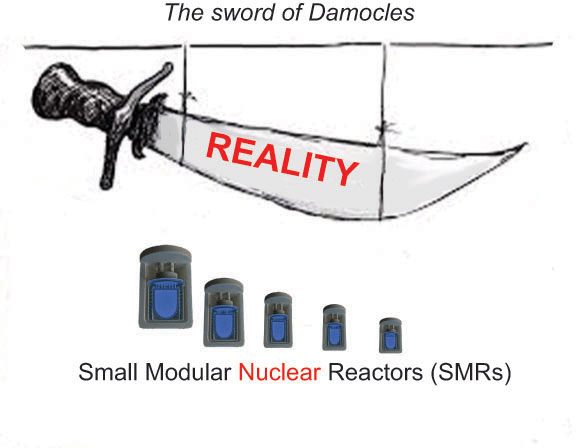
Paul Day, 11 Jan 24, https://www.reuters.com/business/energy/cancelled-nuscale-contract-weighs-heavy-new-nuclear-2024-01-10/
- Summary
- The failure of a high profile small modular reactor (SMR) contract in the United States has prompted concerns that Gen IV nuclear may be further off than expected.
NuScale, the first new nuclear company to receive a design certificate from the Nuclear Regulatory Commission (NRC) for its 77 MW Power Module SMR, said in November it was terminating its Carbon Free Power Project (CFPP) with the Utah Associated Municipal Power Systems (UAMPS).
UAMPS serves 50 community-owned power utilities in the Western United States and the CFPP, for which the Department of Energy approved $1.35 billion over 10 years subject to appropriations, was abandoned after the project failed to attract enough subscriptions.
NuScale shares tumbled 37% to less than $2 on the day of the news, November 8, and have remained largely between $2.5 and $3.5 since then. The shares hit highs of nearly $15 in August 2022 just three months after going public.
The CFPP had aimed to build NuScale SMR units at a site near Idaho Falls to be operable by 2029 though concerns arose that some at UAMPS members may be unwilling to pay for power from the project after NuScale raised the target price to $89/MWh in January, up from a previous estimate of $58/MWh.
The cancellation came shortly after another advanced reactor developer, X-Energy and special purpose acquisition company Ares Acquisition Corporation, called off a $1.8-billion deal to go public citing “challenging market conditions (and) peer company trading performance.”
The work with UAMPS had helped advance NuScale’s technology to the stage of commercial deployment, President and CEO John Hopkins said.
However, the failure of the much-anticipated proof case for advanced nuclear alongside the X-Energy market retreat left many questioning whether next generation nuclear could live up to its promises.
“Almost all these kinds of MoUs and contracts, as we saw with the NuScale contract, are just not worth the paper they’re written on. There are so many off ramps and outs for both sides and no one’s willing to expose themselves to the downside risk of projects that go way over budget cost and take too long,” says Ted Nordhaus, Founder and Executive Director of The Breakthrough Institute.
Nordhaus co-wrote a piece for The Breakthrough Institute, ‘Advanced Nuclear Energy is in Trouble’, a scathing criticism of policy efforts to commercialize advanced nuclear which, it says, to date have been entirely insufficient.
The nuclear industry was keen to ‘whistle past the graveyard’ of recent developments and efforts to commercialize the new generation of reactors ‘are simply not on track’, the Breakthrough piece said.
Mounting challenges
There are five areas that pose mounting challenges for the industry, according to Breakthrough; high interest rates and commodity prices, constrained supply chains, a regulatory regime that penalizes innovation, project costs versus system costs, and fuel production.
High interest rate and commodity costs in the last couple of years have hit the industry especially hard due to long project lead times. Nuclear supply chains are struggling to rebuild as tight regulation forces many materials to be tracked from certified mine to certified manufacturer.
The regulatory regime, meanwhile, continues to cut and paste large nuclear reactor regulations on to the small reactor designs, whether it makes sense to do so or not, Nordhaus wrote.
Delivery costs for small nuclear are relatively low due to the relatively small volumes of steel and mortar needed, but system costs must factor in safety regulation which is stricter than other types of energy projects. Proponents argue this makes it harder to compete with fossil fuels and renewables, which pay little to no cost for polluting or intermittency, the Institute says.
Advanced nuclear fuel production, meanwhile, had been outsourced to Russia for decades and is only now being hastily reassembled in the United States for the new reactors, with developers such as Terrapower forced to push delay their commercialization timelines due to a lack of fuel.
“Taken together, these developments suggest that current efforts are unlikely to be sufficient to deliver on the promise of advanced nuclear energy,” The Breakthrough Institute said.
Investor case
e
Over recent years, nuclear power has been recognized as an environmental, social, and governance (ESG) investible asset, taking its place alongside renewables in the European taxonomy and successfully raising cash through green bonds in Canada.
Such classifications allow nuclear companies to attract funds from investors looking to build increasingly popular clean energy portfolios.
Nuclear will also benefit from government schemes such as the U.S. Inflation Reduction Act (IRA), which is expected to subsidize new nuclear through Production Tax Credits (PTC) and Investment Tax Credits (ITC) on first-of-a-kind (FOAK) and nth-of-a-kind (NOAK) builds.
With billions of dollars earmarked for clean technologies and mounting concerns over missing emission targets, certain aspects of the nuclear industry have attracted new investors; Uranium spot prices have nearly doubled in the last year as bets are made on rising demand.
However, with all this tailwind, new nuclear has not been attracting the cash it needs. That’s partly due to developers’ lack of focus on development activities, according to Fiona Reilly, CEO of energy consultancy FiRe Energy.
“They’re so focused on the technology that they’re often not focusing on the commercial aspect. How to be more efficient, how to be more effective. What’s your risk register look like; corporate risks as well as technical risks? What’s your legal structure? Where is the money coming from?” says Reilly.
“They seem to think that if they have this great technology, then the market will finance the projects. How the project will reach financial close and make a return for investors does not always appear to be a key feature.”
The NuScale failure with UAMPS and X-Energy’s cancelled offering are just further bad signs for the market, and came just as the international nuclear community said they need to triple capacity by 2050 at the COP28 summit in Dubai.
“We’ve got to start building a mix of large and small reactors for different applications and, once we can start proving projects can be built in a commercial and efficient way, then you can start talking about targets,” says Reilly.
“You can’t set targets like these when we’re not even building the first reactors in many countries.”
Housing unaffordability – implications for Somerset with huge increase in nuclear workers for Hinkley Point C
EDF Energy is once again in talks with Somerset Council to negotiate an
increase in workers on the site. Cllr Leigh Redman, Bridgwater Town Council
spokesperson for Nuclear Issues, said that the original development consent
order (DCO) signed by the secretary of state, indicated that at peak the
number of workers on site would be 5,600.
This number was since raised to
8,600 due to the conversion of Pontins in Brean to become an accommodation
site for Hinkley Point C workers, which is now full. Back in November 2023,
EDF Energy approached the council to bring the workforce to over 10,000 as
the project entered its ‘peak construction phase’.
There are now over
11,000 workers at Hinkley Point C, and EDF plans to bring in more staff in
the near future. Cllr Redman said that although he appreciates the good
things EDF Energy has brought to Bridgwater, he feels people are losing out
on housing due to the company’s ‘disregard for limits set and agreed’. The
Bridgwater Town Councillor also explained that he frequently receives
messages from people struggling to find affordable properties to rent
locally, including one family of three squashed into a third floor flat
with nowhere to go.
Bridgwater Mercury 9th Jan 2024
https://www.bridgwatermercury.co.uk/news/24036533.edf-talks-somerset-council-workforce-increase/
Somerset 9th Jan 2024
https://www.somersetcountygazette.co.uk/news/24036578.edf-talks-somerset-council-workforce-increase/
Nuclear power and net zero: Too little, too late, too expensive

Prof Steve Thomas, Greenwich University, assesses the considerable obstacles to the UK government’s target for new nuclear power.
Article from Responsible Science journal, no.6; advance online publication: 9 January 2024.
Introduction
In October 2023, the British government reaffirmed the 2022 Boris Johnson target of bringing online 24 gigawatts (GW) of nuclear capacity, eight stations the size of Hinkley Point C, by 2050. In its response to a parliamentary committee report on the nuclear programme, the government claims a “roadmap will set out these next steps [to achieve the 24GW target] and will be available later in 2023.”[1] By early January 2024, the roadmap had not been published. While there is talk about Small Modular Reactors making a significant contribution, as I argued in my article on these in Responsible Science, no.5,[2] their rationale is based on some highly suspect assumptions about cost-savings from reducing reactor size. At most a few demonstration SMRs might be built, demonstrating only that they are far from being competitive with other options for low-carbon generation.
So, if the 24 GW target is to be met, most of the capacity will have to be in large (1.2 GW-plus) reactors. The government seems determined to drive through the Sizewell C project whatever the cost. This would comprise two reactors of the EPR-1 design used at Hinkley Point C, but that would leave a further seven to build.
To achieve the 24 GW target, at least four conditions must be met:
The equivalent of eight new nuclear projects must be completed by 2050.Mature, commercial, large reactor technologies must be available.Seven sites beyond Sizewell, suitable for 3 GW stations, must be approved.Owners and financiers for eight stations, expected to cost about £250bn, must be found.
1. When could new capacity come online?
Ambitious nuclear programmes are always accompanied by the same tired rhetoric offered for more than 50 years – of cutting red tape, streamlining planning and regulatory processes, learning from past mistakes, and taking advantage of new technologies. This has never worked in the past, not because we were not trying hard enough, but because nuclear power stations intrinsically take a long time from start of planning to first power, and new technologies have proved expensive and bring their own problems. The government acknowledged this in its Impact Assessment for the Regulated Asset Base (RAB) legislation which stated that it typically took 13-17 years from a Final Investment Decision (FID) to first power.[3] It could have added that most announced projects do not make it as far as FID. The Impact Assessment also stated that nuclear projects typically cost 20-100% more than the estimate at FID. Adding in a few years to get from project inception to FID and it is clear the whole process is likely to take 15-20 years. The Flamanville (France) and the Olkiluoto (Finland) projects will take longer than 20 years and with at least four years of construction left at Hinkley Point C, that project will take nearly 20 years if there are no more delays. Flamanville[4] and Olkiluoto[5] are about 300% over budget. Planning for any capacity that will be online by 2050 must be started by 2030.
2. Which technologies?
The EPR-1 design supplied by the French nationalised utility, EDF, is not credible for further orders. A former CEO of EDF described EPR-1 as “too complicated, almost unbuildable”.[6] Design work has been in progress for more than a decade on its replacement, EPR-2, which is claimed to be cheaper and easier to build. EDF plans to build six EPR-2s in France, the first coming online in 2035-37. EDF has said it would not try to sell the design until an EPR-2 was operating in France. Whether the EPR-2 will live up to the claims made is irrelevant. If we must wait till the after 2035 for it to be available, EPR-2s cannot be online in the UK by 2050.
Assuming designs from Russia and China are not acceptable, that leaves us with the other two designs meant to make up the Blair programme of 16 GW by 2030, the Hitachi-GE ABWR and the Westinghouse AP1000. While these have been approved by the UK safety regulator, they are not attractive. The three reactors of the ABWR design operating in Japan use a 1986 version of it. No orders for the updated designs are in prospect and the vendor appears not to be offering it for sale.
The record of the AP1000 is almost as bad as that of the EPR with all eight orders going badly wrong. The history of the ‘AP’ designs illustrates the nuclear industry’s duplicity on reactor size. Initially it was the AP600 (about 700 MW), but this was found to be uneconomic. It was scaled up to the AP1000 (1170 MW) and this was built in China and in the USA, but to improve the poor economics, China has scaled it up to 1550 MW (CAP1400). In March 2023, Westinghouse announced its new design would be a scaled down AP1000, the 300 MW AP300.
The other candidate is the South Korean APR1400. Like the ABWR, this has been built but using a design that did not take account of the lessons from the Chernobyl disaster (a means of preventing a molten core getting into the environment) or from the 9/11 attack (a need to toughen the shell enough to absorb a hit by an aircraft). It seems unlikely that an updated design could complete the required safety review in time for an FID to be taken on a project using this technology until after 2030. The record of APR1400 projects is problematic with long delays due partly to falsification of quality control documentation in South Korea and quality issues in the UAE.
3. Where would they be built?
Eight sites were identified as suitable in the government’s siting decision of 2010.[7] With Hinkley and Sizewell already under some sort of development, this leaves Moorside, Wylfa, Oldbury, Bradwell, Heysham and Hartlepool. There are concerns about the impact of sea-level rises for all the sites.[8] A project for the Wylfa site underwent review by the Planning Inspectorate which recommended the project not be consented because of its environmental impact. Moorside, Oldbury and Bradwell have undergone some investigations for new nuclear capacity for projects now abandoned and this preparatory work could be utilised to speed things up.[9] Heysham and Hartlepool would need detailed assessment to determine their suitability before any project could be proposed, so they might not be available by 2030. If eight projects (including Sizewell C) need to be completed by 2050, then either the planning advice at Wylfa would need to be ignored or at least one new site would be needed – and this also assumes all planning issues at the other sites could be adequately dealt with by the end of this decade and none of these locations would be earmarked for SMRs.
4. How would they be financed and who would own them?
When electricity utilities could pass on whatever costs they incurred, they enthusiastically supported nuclear projects. Now, if nuclear projects go wrong, it will be their shareholders who bear some of the costs, so interest from utilities, particularly investor-owned ones, has evaporated. Direct government ownership is an option, although it would be an extraordinary decision to invest taxpayers’ money in nuclear projects on the basis that no other investors would be willing to take this risk. So, innovative methods of finance are required.
The finance model used for Hinkley Point C, the Contracts for Difference (CfD) model, was both a poor deal for consumers and the plant owner, EDF. The power purchase price was set in 2013, three years before the investment decision, at £92.5/MWh in 2012 money, indexed to inflation (about £124/MWh in 2023 money) with cost overruns falling on EDF. This price is more than double the price for new offshore wind.[10] In 2013, the expected construction cost was £16bn but the latest estimate is £26bn (both in 2016 money).[11] So EDF will have to absorb the cost overrun of at least 60% but with no increase in the price it will get for its output. This form of CfD is not an option any sane investor would back for nuclear even though, for offshore wind, it is producing impressive results and will continue to be used.
The UK government is now proposing the Regulated Asset Base (RAB) financial model. The main architecture of the scheme is known although crucial details have not been published. How far this lack of information is down to the government leaving these open for negotiation, to the government not having decided on them yet, or to the government not being willing to admit the details, is difficult to determine. There is brave talk of risk-sharing but the reality is that it will not be the government that sets the terms, it will be investors unless the government is prepared to walk away with no deal. But the government seems likely to agree to whatever it takes to lure investors in. Deepa Venkateswaran, an analyst at Bernstein, said would-be investors in Sizewell needed to be “assured a return” that was locked in at the point of investment rather than subject to change.[12]
Under RAB, it would be the investors’ income that would be fixed, not the price paid for power. The power price would be whatever it took to generate the guaranteed annual income to the owners. All electricity retailers and therefore all consumers would be required to buy their share of the output. With the Hinkley Point CfD, the owner took the risk; with Sizewell RAB, consumers take the risk.
The selling point for the RAB model has been the claim that it would reduce the cost of finance and therefore the cost of power. RAB reduces financing costs in two ways. First, because the risks will fall on consumers and taxpayers, the project would be seen by financiers as low risk to them and would attract a low interest rate. Second, the finance charges would effectively be paid by consumers as a surcharge on their bills payable from the date of FID to completion of the plant, expected to be about 15 years. Finance costs savings would be paid for by consumers as a surcharge on bills and by them, not the project owners, assuming the project risk.
Despite this, the government is struggling to find investors. It has said there are at least four companies that have pre-qualified as potential investors,[13] although pre-qualifying commits them to nothing. EDF has been forced to offer to take about 20% of the project ownership, while the government has said it would take an unspecified stake but it will be at least 20%, but probably more, enough to fill any funding gap.
The original target for RAB was UK institutional investors but given lack of interest from this source, government now seems to be relying on more controversial sources such as Middle East investment funds.[14] It will be difficult to explain to the public why, if the Bradwell project was politically unacceptable because of the presence of Chinese money, a RAB project with, say, Saudi money is acceptable.
The government may be able to offer enough sweeteners to allow the Sizewell C project to proceed but replicating it will be more difficult. For each project, a technology, a site, and investors will have to be found. Politically it will be difficult for the government to keep taking expensive stakes in nuclear projects just because nobody else will. The scale of investment is huge, and, for example, Sizewell C alone is expected to cost about 10 times the cost of the Thames Tideway ‘super-sewer’ water project, the first major project to use the RAB model.
Conclusions
The electricity sector ought to be one of the first sectors to be decarbonised because of the availability of a range of viable technologies available to replace fossil-fuel generation. Boris Johnson set a target of decarbonising electricity by 2035[15] while Keir Starmer has set a target of 2030.[16] Given that even Sizewell C is unlikely to be online by 2035, the nuclear programme is an irrelevance in achieving net-zero. The only justification is if nuclear was the cheapest way to meet electricity demand growth by the time the first capacity could come online and the current chasm in cost between nuclear and renewables or energy efficiency measures suggests this is implausible. Judged by the requirements of time, technology availability, sites and availability of finance, the programme will fail badly. In doing so, large amounts of government time and taxpayer money will, as with previous UK nuclear programmes, be diverted away from the options that have a much higher success probability, are more cost-effective and can be deployed much quicker.
Steve Thomas is Emeritus Professor of Energy Policy at Greenwich University, UK. He has researched and written on nuclear power policy issues for 40 years.
References………………………………………………………………………………………………………………….. re https://www.sgr.org.uk/resources/nuclear-power-and-net-zero-too-little-too-late-too-expensive
Nuclear defence workers to strike over pay
Daisy Stephens & PA Media – BBC News, Thu, 11 January 2024
Workers at a nuclear warhead factory are set to strike in a dispute over pay, their union has announced.
Members of Prospect at Berkshire-based Atomic Weapons Establishment (AWE) will walk out for 24 hours on 24 January, after two months of other forms of industrial action.
The company is facing “a recruitment and retention crisis” and risks “being unable to fulfil its critical role in safeguarding our national security” if pay is not improved, Prospect general secretary Mike Clancy warned. ……………………………………more https://au.news.yahoo.com/nuclear-defence-workers-strike-over-150520892.html
Where your $trillions go, to risk all life

Peace and Planet News, by Anthony Donovan | Winter 2023 Edition
We’ve seen an amazing level of bipartisan support!” For what initiative do we hear this rare statement echoed about Congress today?
The 15th Annual Nuclear Deterrence Summit, held once again at the Hyatt Regency in Arlington, Va., Feb. 13–15. For three days the rooms are filled with a multitude of companies and government agencies from around the country connected to the Department of Energy, Department of Defense, and National Nuclear Security Administration that make up our nuclear weapons industry, and its terribly secretive renewed Mutually Assured Destruction (MAD) race.
What is termed the “Enterprise” is in full-out sales and confidence-building mode. It is here the relationships for securing contracts through the next 5 to 35 years are solidified.
One aged reporter who once covered the industry in the 1980s confides his shock after a dizzying day of presentations: “How did you know these gatherings were going on? I just found out last week! Can’t believe this, I mean, this is a new unbridled arms race! These people in there are totally convinced this is the only way to go.” Looking at only two of us with our sign, he asks, “Why aren’t more people in the streets? Where is the movement pushing back?”………………………………………………………………….
Attendees were a bit puzzled that I wasn’t with a company connected to the summit, but I continued to share my purpose, seeing that we desperately need their dedication and skillset to begin turning toward the critical needs before us today: sustainability, good jobs supporting our environment, food, water, air, housing, healthcare, education, infrastructure … you know the issue. Some were relieved that I was all for science and space exploration, but first, for the precious earth!
…………………………………………………… Most exhibitors were too young to remember that the vast majority of citizens had voted with their feet to end this madness, and that there was no transparency or democratic process in the decision to use our treasure to fund it all.
Inevitably the confounding old Cold War rhetoric arose, painting China and Russia as vile enemies that we can not trust to honor any agreements. ……………………..
Naturally, I’d let them know we had a most worthy instrument, The Treaty on the Prohibition of Nuclear Weapons, now international law, to help guide this needed transformation, despite its being dismissed by our mainstream media. Only a few had heard of it, and of those, few knew particulars.
Laser beamed on their one aspect of the industry, several with competitors present vying for the same contract, many met in the dozens of closed-door side rooms for private company presentations/briefings. There were open “networking breakfasts” lunches and evening cocktail parties and several daily general gatherings in the large Hyatt Ballroom focused on the latest in pit production, delivery platforms, command-and-control infrastructure and communications, warhead modernization, STRATCOM reports, reports from the heads of all our labs, Los Alamos, Oak Ridge, Sandia, etc. Presentations on increasing efficiency in product and organization, best practices, and cited pathways to “success.” After all, we are leading and “winning.” Exactly what we think we are winning made no sense to anyone on the nuclear abolition team.
There were exhibitors displaying highly specialized metal nose cones and delivery vehicle parts. Designers of fabrics that claim to protect from radioactivity, cybersecurity “experts,” nuclear waste management specialists, triad infrastructure architects, specialists in improving uranium refining, nuclear physicists and engineers specializing in all materials and their “enhanced delivery” of precision warhead targeting and interception by “safety” umbrellas, inter-agency communication specialists, and those through it all maintaining secure communications. My presence seemed harmless enough to this security. I think of all our very brave colleagues who’ve risked life to enter the kill zones of these most highly sealed-off omnicidal compounds to render witness of the crime against humanity.
Amazon, a “Gold Sponsor” of the summit, had an exhibit: “We have established good relations with the CIA, but we need to get better integrated with the NNSA. This is new to us. That’s why we’re here.”
In this very clearly white male-oriented world, there was also a presentation on the essential hiring of more “diversity” for the future. One enticing statement read they “offer specialized worth to employees by valuing their entire career life cycle–creating stable careers…” Ah, such security………..
The revolving door is astoundingly evident here, and the boundaries of government, military, with private companies is quite indistinguishable. Those with Navy, Air Force, and other triad experience are now running these private companies or working as their specialized “experts in technical and professional innovation. support and security.” One “private” company proudly advertising that 70% of “our expertise” hold all the necessary security clearances within the government!
…………………………….. Former General Lloyd Austin, who retired to become Raytheon’s CEO, was easily confirmed by our Congress to become our current Secretary of Defense under President Biden. In his hearings, General/CEO Austin guaranteed to our representatives that the Triad would get his full support to obtain all that it needed. What seems illegal goes unchallenged.
Along with the DOE, National Security Administration, and Budget Office, the regular old nuclear weapon corps were very present: General Dynamics, Huntington Ingalls, Bechtel, Flour, Honeywell, Aerospace, SAIC, etc., and a number of universities……………………………………………………………………………………………………..
Within 25 minutes we were surrounded by hotel security and managers asking us to leave the premises immediately. They then claimed even the sidewalks outside the hotel were private and we could not remain there………………………………………………………..
Ask your representative to sign H. Res. 77, sponsored by Rep. James McGovern, supporting the goals of the Treaty on the Prohibition of Nuclear Weapons! Ask your senator to call for the same in the Senate. Thank all the nations ratifying the TPNW. Ask your representative to observe the Ban Treaty’s Meeting of States this November in New York City at the United Nations. They are welcome to learn, and think deeper.
Knowing the horror of war was pushing ahead and with it an increasing, completely unnecessary risk of nuclear annihilation, there was ever-present sense of unity with the citizens of the world who are pleading and advocating another way. There were many thumbs up and waves from passing vehicles. Thinking of those who have young children/grandchildren, including a good number I got to speak with on this Summit floor, we felt there was nowhere else to be on this day celebrating the love in our hearts and in our lives, round the world, Valentine’s Day. https://peaceandplanetnews.org/where-your-trillions-go/
The ‘Ghost Budget’: How America Pays for Endless War
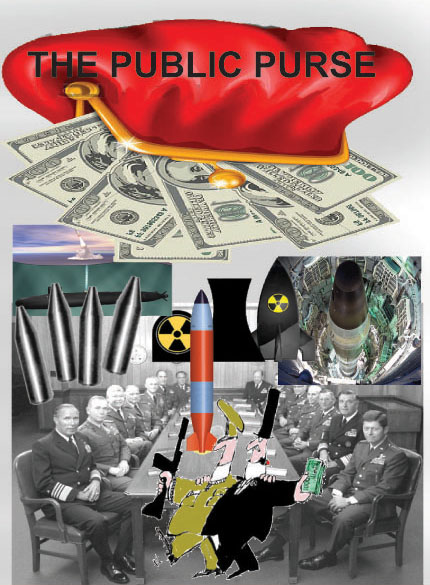
The post-9/11 war funding pattern was completely different. For the first time since the American Revolutionary War, war costs were covered almost entirely by debt. There were no wartime tax increases or cuts in spending. Quite the reverse
a “culture of endless money” inside the Pentagon.
the ability to keep borrowing and spending with minimal oversight allowed the United States to keep fighting indefinitely.
Prior to 2001, U.S. wars were financed through a mixture of higher taxes and budget cuts, and funded mostly through the regular defense budget. The post-9/11 war funding pattern was completely different.
By Linda Bilmes / Just Security https://scheerpost.com/2024/01/08/the-ghost-budget-how-america-pays-for-endless-war/
The post-9/11 wars in Iraq and Afghanistan were enabled by a historically unprecedented combination of budgetary procedures and financing methods. Unlike all previous U.S. wars, the post-9/11 wars were funded without higher taxes or non-war budget cuts, and through a separate budget. This set of circumstances – one that I have termed the “Ghost Budget” – enabled successive administrations to prosecute the wars with limited congressional oversight and minimal transparency and public debate. I adopted the name “Ghost Budget” because the term “ghost” appeared frequently in post-9/11 government reports in reference to funds allocated to people, places, or projects that turned out to be phantoms.
The Ghost Budget was the result of an interplay between changes in the U.S. budgetary process, a more assertive military establishment, and the conditions in global capital markets. It has had far-reaching implications for the conduct and course of the post-9/11 wars and for defense policy today.
Funding the Post-9/11 Wars
The “Ghost Budget” was the biggest budgetary anomaly in U.S. history. Prior to 9/11, U.S. wars were financed through a mixture of higher taxes and budget cuts, and funded mostly through the regular defense budget. One third of the costs of World War I and half the costs of World War II were met through higher taxes. During World War II, President Franklin D. Roosevelt described paying taxes as a “patriotic duty” as he raised taxes on business, imposed a “wealth tax,” raised inheritance taxes, and expanded the number of income taxpayers to roughly 80 percent of the workforce by 1945. Wars in Korea and Vietnam largely followed a similar pattern, with President Harry Truman pledging to make the country “pay as you go” for the Korean War. War funding was also a central issue in the Vietnam War, which ended when Congress refused to appropriate money for the South Vietnamese military.
The post-9/11 war funding pattern was completely different. For the first time since the American Revolutionary War, war costs were covered almost entirely by debt. There were no wartime tax increases or cuts in spending. Quite the reverse: far from demanding sacrifices, President George W. Bush slashed federal taxes in 2001 and again in 2003, just as the United States invaded Iraq. President Donald Trump reduced taxes further in 2017. Overall, federal taxes declined from 18.8 percent of GDP in 2001 to 16.2 percent by the start of 2020. In the same period, outstanding federal debt held by the public rose from $3.5 trillion to $20 trillion. War spending contributed at least $2.2 trillion to this increase.
Not only was the financing strategy unprecedented, but the budgetary mechanism used to approve the vast post-9/11 wartime spending also diverged radically from the past. In all previous conflicts, the United States paid for wars as part of its regular defense appropriations (the defense “base budget”), after the initial period (1-2 years) of supplemental “emergency” funding bills. By contrast, for the entire decade from FY 2001 to FY 2011, Congress paid for the conflicts in Iraq and Afghanistan as “emergencies,” devoid of serious legislative or executive oversight.
By statute, emergency spending is defined as “unanticipated…sudden…urgent…unforeseen…and temporary” and is typically reserved for one-off crises such as floods and hurricanes. Such emergency spending measures are exempt from regular procedural rules in Congress because the intent is to disburse money quickly in situations where delay would be harmful.
Congress continued to enact “emergency supplemental” funding even as the war effort expanded. The United States sent 130,000 military personnel into Iraq in 2003 (alongside troops from more than 30 countries). By 2009, there were 187,200 U.S. “boots on the ground” in Iraq and Afghanistan, supported by a similar number of military contractors, with nearly 500 U.S. military bases set up across Iraq, but the conflict was still being paid for as an “emergency.” In FY 2012, President Obama renamed the “Global War on Terror” as “Overseas Contingency Operations” (OCO) but the war continued to be funded using money that – although not designated as “emergency” – was explicitly exempted from regular spending limits on other government spending programs.
How We Got Here
There were three primary drivers of the Ghost Budget: unusual economic conditions, congressional budget dysfunction, and military assertiveness.
Economic Conditions: Unlike earlier wars, the post 9/11 conflicts took place in an era of free-flowing international capital markets. That provided the U.S. Treasury with access to a deep and global pool of capital, making it easy to borrow large amounts without negatively affecting the cost. It was also a period of historically low interest rates. Real interest rates (nominal rate minus inflation) on 10-year Treasury bonds fell from 3.4% at the start of 2001 to negative (-0.4%) by early 2021 — a 40-year low. Consequently, the Treasury was able to borrow trillions of dollars to pay for the wars, and simultaneously finance the tax cuts of 2001 and 2003 without having any material effect on the amount of debt service being repaid through the annual budget. By FY 2017, total public debt had more than tripled, but debt service payments as a percentage of annual budget outlays had decreased to 6.6 percent, compared to 8.5 percent of federal budget outlays in FY 2002. In terms of cash outlays, this meant that the United States paid only slightly more in interest payments in FY 2017 than it had in FY 2002 ($268 billion versus $232 billion in 2018 dollars). Borrowing seemed virtually painless.
Budget Dysfunction: For several decades, the federal budget process has become increasingly dysfunctional. This breakdown may be traced to the post-Watergate budget reforms enacted in 1974, which shifted power away from the President and to the Congress. Most budget experts from both parties agree that the reforms made the budget process weaker, less predictable, less capable of reconciling competing demands, and more prone to fiscal crises. Prior to 1974, the federal government had never ceased operations for lack of funding. Since then, it has “shut down” 22 times, completely or partially. There have been only four years in which Congress passed its annual appropriations bills on time, and a series of near-defaults and other fiscal crises. In the absence of reliable budgets, Congress has enacted hundreds of short-term stopgap “continuing resolutions” to pay the bills. In this context, it was convenient for all the stakeholders to fund the wars as an “emergency” outside the regular process. The President was able to exclude war funding from his annual defense budget request to Congress, thus presenting an artificially low number for the federal budget deficit. This helped the Bush administration sustain the pretense that the wars would be short, while pursuing its political agenda of cutting taxes. Meanwhile, Congress was freed from the need to find politically painful spending cuts elsewhere to pay for the war, and the Pentagon was able to prosecute the wars without worrying about whether Congress would pass the defense appropriations bills on time.
Military Assertiveness: In 2001, the Pentagon was actively seeking to increase its budget after a decade of post-cold war budget cuts. The Afghanistan and Iraq conflict not only reversed the downward trend in military spending, but opened the floodgates to a spending bonanza due to the nature of emergency and OCO appropriations. Unlike the regular defense base budget, the wartime supplemental money was easier to secure, had few restrictions on how it could be spent, and avoided the lengthy internal Planning, Programming, Budgeting & Execution Process (PPBE) budget justification process. Consequently, the Defense Department was able to shift war funding into other categories to obtain items on its long-time “wish list” that were only tangentially (or not at all) related to the wars in Iraq or Afghanistan. Former Defense Secretary Robert Gates termed this a “culture of endless money” inside the Pentagon.
By 2009, war spending accounted for almost one quarter of the total military budget; the Pentagon budget had grown to its highest level since the Second World War, and military spending had rebounded from 2.9% of GDP in FY 2001 to above 4% of GDP, where it remained through FY 2019. The OCO budget had evolved into a second defense budget that was largely untethered from the wars, and protected the military from congressional budget volatility.
Implications for Perpetual War
The Ghost Budget provided the ability to keep borrowing and spending in an almost unconstrained manner for more than two decades. The absence of new taxes insulated the public from the mounting cost of the wars and broke the expectation that wars would inevitably involve higher taxes. The OCO budget extended far beyond the immediate operational needs of the wars in Afghanistan and Iraq, perpetuating military actions throughout the region. As Immanuel Kant predicted in Perpetual Peace (1795), the ability to keep borrowing and spending with minimal oversight allowed the United States to keep fighting indefinitely.
Implications for Perpetual War
The Ghost Budget provided the ability to keep borrowing and spending in an almost unconstrained manner for more than two decades. The absence of new taxes insulated the public from the mounting cost of the wars and broke the expectation that wars would inevitably involve higher taxes. The OCO budget extended far beyond the immediate operational needs of the wars in Afghanistan and Iraq, perpetuating military actions throughout the region. As Immanuel Kant predicted in Perpetual Peace (1795), the ability to keep borrowing and spending with minimal oversight allowed the United States to keep fighting indefinitely.
The legacy of the Ghost Budget is that money is no longer a serious deterrent to war. To date, 99% of US assistance to Ukraine has been funded by supplemental emergency funds – which means that this spending is in addition to the $840 billion regular defense budget. The Biden administration has asked Congress to approve another $106 billion in emergency funding for the Middle East, Ukraine, and other regions. Regardless of the merits of any particular endeavor, the use of Ghost Budgets makes it far easier to prolong the fighting at any cost.
Nuclear Fuel: Russian Cutoff Would Upend Global Market
Jan 5, 2024, Author, Grace Symes, London. Editor. Phil Chaffee
The global nuclear fuel market could be upended this year by one increasingly likely scenario: the possibility that Moscow cuts off all nuclear fuel supplies to the US in retaliation for a bill expected to pass this month in the US Congress.
That bill would ban imports of Russian low-enriched uranium with waivers through 2028, but US nuclear operators fear it would prompt more immediate Russian retaliation, which would in turn have far-reaching effects on the global nuclear fuel sector and leave US utilities in a precarious position, whether or not they were reliant on Russian fuel. US utilities are unlikely to have to actually stop operating reactors due to a lack of available fuel, , but sources expect such a scenario to push further north already high prices for uranium, conversion
and enrichment.
Energy Intelligence 5th Jan 2024
https://www.energyintel.com/0000018c-cabf-d61c-a7cc-fbbf5b580000
Nuclear Free Local Authorities (NFLAs) call upon nuke cops chief to issue statement on ‘toxic’ Sellafield allegations

Following the disturbing revelations in The Guardian that a ‘toxic’
workplace culture exists within the Civil Nuclear Constabulary, the Nuclear
Free Local Authorities Chair has written to the force’s Chief Constable
‘offering him the opportunity’ to issue a statement.
The Guardian
published its allegations on 6 December, and this article included a
comment from Chief Constable Chesterman who said that he has ‘made it
clear that anyone holding misogynistic, racist, homophobic, or other
unacceptable views, or who carries out behaviour that breaches our
standards of professional conduct, has no place in the CNC.’
NFLA 3rd Jan 2024
Mass layoffs at small nuclear reactor companies

Pioneering Nuclear Startup Lays Off Nearly Half Its Workforce. NuScale is the second major U.S. reactor company to cut jobs in recent months.

Huff Post, By Alexander C. Kaufman, Jan 5, 2024,
Almost exactly one year ago, NuScale Power made history as the first of a new generation of nuclear energy startups to win regulatory approval of its reactor design ― just in time for the Biden administration to begin pumping billions of federal dollars into turning around the nation’s atomic energy industry.
But as mounting costs and the cancellation of its landmark first power plant have burned through shrinking cash reserves, the Oregon-based company is laying off as much 40% of its workforce, HuffPost has learned.
At a virtual all-hands meeting Friday afternoon, the company announced the job cuts to remaining employees. HuffPost reviewed the audio of the meeting. Two sources with direct knowledge of NuScale’s plans confirmed the details of the layoffs.
NuScale did not respond to a call, an email or a text message seeking comment.
Surging construction costs are imperiling clean energy across the country. In just the past two months, developers have pulled the plug on major offshore wind farms in New Jersey and New York after state officials refused to let companies rebid for contracts at a higher rate.
But the financial headwinds are taking an especially acute toll on nuclear power. It takes more than a decade to build a reactor, and the only new ones under construction in the U.S. and Europe went billions of dollars over budget in the past two decades. Many in the atomic energy industry are betting that small modular reactors ― shrunken down, lower-power units with a uniform design ― can make it cheaper and easier to build new nuclear plants through assembly-line repetition.
The U.S. government is banking on that strategy to meet its climate goals. The Biden administration spearheaded a pledge to triple atomic energy production worldwide in the next three decades at the United Nations’ climate summit in Dubai last month, enlisting dozens of partner nations in Europe, Asia and Africa.
The two infrastructure-spending laws that President Joe Biden signed in recent years earmark billions in spending to develop new reactors and keep existing plants open. And new bills in Congress to speed up U.S. nuclear deployments and sell more American reactors abroad are virtually all bipartisan, with progressives and right-wing Republicans alike expressing support for atomic energy…………
Until November, NuScale appeared on track to debut the nation’s first atomic energy station powered with small modular reactors. But the project to build a dozen reactors in the Idaho desert, and sell the electricity to ratepayers across the Western U.S. through a Utah state-owned utility, was abandoned as rising interest rates made it harder for NuScale to woo investors willing to bet on something as risky a first-of-its-kind nuclear plant.
In 2022, NuScale went public via a SPAC deal, a type of merger that became a popular way for debt-laden startups to pay back venture capitalists with a swifter-than-usual initial public offering on the stock market.
In its latest quarterly earnings, NuScale reported just under $200 million in cash reserves, nearly 40% of which was tied up in restricted accounts……………………………………..
NuScale, which has four other projects proposed in the U.S. and tentative deals in at least eight other countries, isn’t the only nuclear startup navigating choppy waters.
In October, Maryland-based X-energy, which is working with the federal government to develop a next-generation reactor using gas instead of water for cooling, cut part of its workforce and scrapped plans to go public.
In September, California-based Oklo appeared to lose a $100 million contract to build its its salt-cooled “micro-reactors” at an Air Force base in Alaska, as the independent Northern Journal newsletter first reported. ………. https://www.huffpost.com/entry/nuscale-layoffs-nuclear-power_n_65985ac5e4b075f4cfd24dba
1 This Month
19 February – VIRTUAL EVENT-Decision Time: AI and Our Nuclear Arsenal
12:45 p.m. Central / 1:45 p.m. Eastern
To see nuclear-related stories in greater depth and intensity – go to https://nuclearinformation.wordpress.com
-
Archives
- February 2026 (161)
- January 2026 (308)
- December 2025 (358)
- November 2025 (359)
- October 2025 (376)
- September 2025 (258)
- August 2025 (319)
- July 2025 (230)
- June 2025 (348)
- May 2025 (261)
- April 2025 (305)
- March 2025 (319)
-
Categories
- 1
- 1 NUCLEAR ISSUES
- business and costs
- climate change
- culture and arts
- ENERGY
- environment
- health
- history
- indigenous issues
- Legal
- marketing of nuclear
- media
- opposition to nuclear
- PERSONAL STORIES
- politics
- politics international
- Religion and ethics
- safety
- secrets,lies and civil liberties
- spinbuster
- technology
- Uranium
- wastes
- weapons and war
- Women
- 2 WORLD
- ACTION
- AFRICA
- Atrocities
- AUSTRALIA
- Christina's notes
- Christina's themes
- culture and arts
- Events
- Fuk 2022
- Fuk 2023
- Fukushima 2017
- Fukushima 2018
- fukushima 2019
- Fukushima 2020
- Fukushima 2021
- general
- global warming
- Humour (God we need it)
- Nuclear
- RARE EARTHS
- Reference
- resources – print
- Resources -audiovicual
- Weekly Newsletter
- World
- World Nuclear
- YouTube
-
RSS
Entries RSS
Comments RSS
 nuclear-news