Tax-payer to take bigger financial risks under new payment plan for nuclear command satellites

Under cost-plus or cost-reimbursement contracts, the government pays contractors for allowed expenses, plus an agreed upon profit margin. In fixed-price agreements, the contractor is paid a negotiated amount regardless of expenses incurred.
the development will move forward with the government absorbing the inherent risks.
Space Force bucks fixed-price trend for nuclear command satellites
Acquisition executive Frank Calvelli said the Space Force will award cost-plus contracts for the upcoming Evolved Strategic Satellite Communications System
Space News Sandra Erwin, February 26, 2024
WASHINGTON — In a departure from recent guidance, the Space Force will use cost-plus contracts for its high-priority strategic communications satellite program.
Space Force acquisition executive Frank Calvelli said Feb. 23 that the service has decided to not use fixed-price contracts for the Evolved Strategic Satellite Communications System (ESS), a critical component of the U.S. military’s nuclear command, control, and communications (NC3) network that provides nuclear-survivable communications.
Calvelli has previously indicated a preference for fixed-price contracts as a means to control costs and incentivize efficiency in satellite procurements. However, he said that an exception will be made for the ESS program.
Boeing and Northrop Grumman were selected in 2020 to build ESS satellite prototypes but Calvelli suggested that these designs are not mature enough to transition to fixed-price production.
“It’s not as far along as I would like for us to probably use fixed price,” Calvelli said at an event hosted by the Center for Strategic and International Studies.
The ESS program is estimated to be worth $8 billion. These new satellites are intended to augment and eventually replace the Advanced Extremely High Frequency (AEHF) network of nuclear-hardened satellites made by Lockheed Martin.
Draft solicitation in the works
Calvelli said the Space Systems Command is still working on a draft solicitation for ESS proposals, expected to be released this year.
He said he had expected the ESS payload designs to be more mature by now and nearing the prototyping stage. ESS was one of the programs selected for rapid-prototyping under a Pentagon initiative known as “middle tier acquisition”
“But it seems like we spent a lot of time in MTA just doing tech risk reduction or technology maturity,” said Calvelli. “Had we built a real payload or actually built the prototype, then maybe we could actually go off and do something fixed-price.”
Under cost-plus or cost-reimbursement contracts, the government pays contractors for allowed expenses, plus an agreed upon profit margin. In fixed-price agreements, the contractor is paid a negotiated amount regardless of expenses incurred.
Cost-plus contracts are used in higher risk projects where technical requirements are uncertain or unknown and the work involves “non-recurring engineering.” These are upfront costs associated with the design and development of a new product.
“Given the amount of NRE that still has to go into the ESS program, and feedback I’ve gotten from industry, we are probably looking more towards the traditional cost-plus model for something like that,” Calvelli said.
The use of cost-plus versus fixed-price contracts has been a contentious issue recently, with some defense companies experiencing significant losses on fixed-price contracts. Executives from major defense contractors, including Boeing, Northrop Grumman and Lockheed Martin, have warned that they would be reluctant to bid on some fixed-price programs due to the financial risk.
Calvelli has said the preference is to use fixed-price vehicles once new systems are proven but ESS does not meet that threshold so the development will move forward with the government absorbing the inherent risks.
No excuses for late deliveries
Calvelli during his talk at CSIS also said he plans to crack down on program delays, especially those blamed on supply chain woes or pandemic impacts. ……………………………….. https://spacenews.com/space-force-bucks-fixed-price-trend-for-nuclear-command-satellites/
Fatal Flaws Undermine America’s Defense Industrial Base
Many elements of the traditional DIB have yet to adopt advanced manufacturing technologies, as they struggle to develop business cases for needed capital investment.
In other words, while adopting advanced manufacturing technologies would fulfill the purpose of the US Department of Defense, it is not profitable for private industry to do so.
Despite virtually all the problems the report identifies stemming from private industry’s disproportionate influence over the US DIB, the report never identifies private industry itself as a problem.
If private industry and its prioritization of profits is the central problem inhibiting the DIB from fulfilling its purpose, the obvious solution is nationalizing the DIB by replacing private industry with state-owned enterprises. This allows the government to prioritize purpose over profits. Yet in the United States and across Europe, the so-called “military industrial complex” has grown to such proportions that it is no longer subordinated to the government and national interests, but rather the government and national interests are subordinated to it.
US defense industrial strategy built on a flawed premise
Beyond private industry’s hold on the US DIB, the very premise the NDIS is built on is fundamentally flawed, deeply rooted in private industry’s profit-driven prioritization.
The report claims:
The purpose of this National Defense Industrial Strategy is to drive development of an industrial ecosystem that provides a sustained competitive advantage to the United States over its adversaries.
The notion of the United States perpetually expanding its wealth and power across the globe, unrivaled by its so-called “adversaries” is unrealistic.
China alone has a population 4-5 times greater than the US. China’s population is, in fact, larger than that of the G7 combined. China has a larger industrial base, economy, and education system than the US. China’s education system not only produces millions more graduates each year in essential fields like science, technology, and engineering than the US, the proportion of such graduates is higher in China than in the US.
China alone possesses the means to maintain a competitive advantage over the United States now and well into the foreseeable future. The US, attempting to draw up a strategy to maintain an advantage over China (not to mention over the rest of the world) regardless of these realities, borders on delusion.
Yet for 60 pages, US policymakers attempt to lay out a strategy to do just that.
Not just China, but also Russia
While China is repeatedly mentioned as America’s “pacing challenge,” the ongoing conflict in Ukraine is perhaps the most acute example of a shifting balance of global power.
Despite a combined population, GDP, and military budget many times greater than Russia’s, the collective West is incapable of matching Russian production of even relatively simple munitions like artillery shells, let alone more complex systems like tanks, aircraft, and precision-guided missiles.
While the US and its allies appear to have every conceivable advantage over Russia on paper, the collective West has organized itself as a profit-driven rather than purpose-driven society.
In Russia, the defense industry exists to serve national security. While one might believe this goes without saying, across the collective West, the defense industry, like all other industries in the West, exists solely to maximize profits.
To best serve national security, the defense industry is required to maintain substantial surge capacity – meaning additional, unused factory space, machines, and labor on standby if and when large surges in production are required in relatively short periods of time. Across the West, in order to maximize profits, surge capacity has been ruthlessly slashed, deemed economically inefficient. Only rare exceptions exist, such as US 155 mm artillery shell production.
While the West’s defense industry remains the most profitable on Earth, its ability to actually churn out arms and ammunition in the quantities and quality required for large-scale conflict is clearly compromised by its maximization of profits.
The result is evident today as the West struggles to expand production of arms and ammunition for its Ukrainian proxies.
The NDIS report would note:
Prior to the invasion, weapon procurements for some of the in-demand systems were driven by annual training requirements and ongoing combat operations. This modest demand, along with recent market dynamics, drove companies to divest excess capacity due to cost. This meant that any increased production requirements would require an increase in workforce hours in existing facilities—commonly referred to as “surge” capacity. These, in turn, were limited further by similar down-stream considerations of workforce, facility, and supply chain limitations.
Costs are most certainly a consideration across any defense industry, but costs cannot be the primary consideration.
A central element of Russia’s defense industry is Rostec, a massive state-owned enterprise under which hundreds of companies related to national industrial needs including defense are organized. Rostec is profitable. However, the industrial concerns organized under Rostec serve purposes related to Russia’s national interests first and foremost, be it national health, infrastructure or security.
Because Russia’s defense industry is purpose-driven, it produced military equipment because it was necessary, not because it was profitable. As a result, Russia possessed huge stockpiles of ammunition and equipment ahead of the Special Military Operation (SMO) in February 2022. In addition to this, Russia maintained large amounts of surge capacity enabling production rates of everything from artillery shells to armored vehicles to expand quickly over the past 2 years.
Only relatively recently have Western analysts acknowledged this.
Continue reading

“military industrial complex” has grown to such proportions that it is no longer subordinated to the government and national interests, but rather the government and national interests are subordinated to it.
the collective West has organized itself as a profit-driven rather than purpose-driven society………………………………across the collective West, the defense industry, like all other industries in the West, exists solely to maximize profits.
By Brian Berletic, Orinoco Tribune. February 24, 2024 https://popularresistance.org/fatal-flaws-undermine-americas-defense-industrial-base/
The first-ever US Department of Defense National Defense Industrial Strategy (NDIS) confirms what many analysts have concluded in regard to the unsustainable nature of Washington’s global-spanning foreign policy objectives and its defense industrial base’s (DIB) inability to achieve them.
The report lays out a multitude of problems plaguing the US DIB including a lack of surge capacity, inadequate workforce, off-shore downstream suppliers, as well as insufficient “demand signals” to motivate private industry partners to produce what’s needed, in the quantities needed, when it is needed.
In fact, the majority of the problems identified by the report involved private industry and its unwillingness to meet national security requirements because they were not profitable.
For example, the report attempts to explain why many companies across the US DIB lack advanced manufacturing capabilities, claiming:
Many elements of the traditional DIB have yet to adopt advanced manufacturing technologies, as they struggle to develop business cases for needed capital investment.
In other words, while adopting advanced manufacturing technologies would fulfill the purpose of the US Department of Defense, it is not profitable for private industry to do so.
Despite virtually all the problems the report identifies stemming from private industry’s disproportionate influence over the US DIB, the report never identifies private industry itself as a problem.
If private industry and its prioritization of profits is the central problem inhibiting the DIB from fulfilling its purpose, the obvious solution is nationalizing the DIB by replacing private industry with state-owned enterprises. This allows the government to prioritize purpose over profits. Yet in the United States and across Europe, the so-called “military industrial complex” has grown to such proportions that it is no longer subordinated to the government and national interests, but rather the government and national interests are subordinated to it.
US defense industrial strategy built on a flawed premise
Beyond private industry’s hold on the US DIB, the very premise the NDIS is built on is fundamentally flawed, deeply rooted in private industry’s profit-driven prioritization.
The report claims:
The purpose of this National Defense Industrial Strategy is to drive development of an industrial ecosystem that provides a sustained competitive advantage to the United States over its adversaries.
The notion of the United States perpetually expanding its wealth and power across the globe, unrivaled by its so-called “adversaries” is unrealistic.
China alone has a population 4-5 times greater than the US. China’s population is, in fact, larger than that of the G7 combined. China has a larger industrial base, economy, and education system than the US. China’s education system not only produces millions more graduates each year in essential fields like science, technology, and engineering than the US, the proportion of such graduates is higher in China than in the US.
China alone possesses the means to maintain a competitive advantage over the United States now and well into the foreseeable future. The US, attempting to draw up a strategy to maintain an advantage over China (not to mention over the rest of the world) regardless of these realities, borders on delusion.
Yet for 60 pages, US policymakers attempt to lay out a strategy to do just that.
Not just China, but also Russia
While China is repeatedly mentioned as America’s “pacing challenge,” the ongoing conflict in Ukraine is perhaps the most acute example of a shifting balance of global power.
Despite a combined population, GDP, and military budget many times greater than Russia’s, the collective West is incapable of matching Russian production of even relatively simple munitions like artillery shells, let alone more complex systems like tanks, aircraft, and precision-guided missiles.
While the US and its allies appear to have every conceivable advantage over Russia on paper, the collective West has organized itself as a profit-driven rather than purpose-driven society.
In Russia, the defense industry exists to serve national security. While one might believe this goes without saying, across the collective West, the defense industry, like all other industries in the West, exists solely to maximize profits.
To best serve national security, the defense industry is required to maintain substantial surge capacity – meaning additional, unused factory space, machines, and labor on standby if and when large surges in production are required in relatively short periods of time. Across the West, in order to maximize profits, surge capacity has been ruthlessly slashed, deemed economically inefficient. Only rare exceptions exist, such as US 155 mm artillery shell production.
While the West’s defense industry remains the most profitable on Earth, its ability to actually churn out arms and ammunition in the quantities and quality required for large-scale conflict is clearly compromised by its maximization of profits.
The result is evident today as the West struggles to expand production of arms and ammunition for its Ukrainian proxies.
The NDIS report would note:
Prior to the invasion, weapon procurements for some of the in-demand systems were driven by annual training requirements and ongoing combat operations. This modest demand, along with recent market dynamics, drove companies to divest excess capacity due to cost. This meant that any increased production requirements would require an increase in workforce hours in existing facilities—commonly referred to as “surge” capacity. These, in turn, were limited further by similar down-stream considerations of workforce, facility, and supply chain limitations.
Costs are most certainly a consideration across any defense industry, but costs cannot be the primary consideration.
A central element of Russia’s defense industry is Rostec, a massive state-owned enterprise under which hundreds of companies related to national industrial needs including defense are organized. Rostec is profitable. However, the industrial concerns organized under Rostec serve purposes related to Russia’s national interests first and foremost, be it national health, infrastructure or security.
Because Russia’s defense industry is purpose-driven, it produced military equipment because it was necessary, not because it was profitable. As a result, Russia possessed huge stockpiles of ammunition and equipment ahead of the Special Military Operation (SMO) in February 2022. In addition to this, Russia maintained large amounts of surge capacity enabling production rates of everything from artillery shells to armored vehicles to expand quickly over the past 2 years.
Only relatively recently have Western analysts acknowledged this.
Continue reading
Energy Costs UK : The Price Of Power-Nuclear Fandango

British consumers of nuclear energy will be paying amongst the highest prices for electricity in the world.
masterinvestor, By Victor Hill 23 February 2024
Last month, UK energy secretary Claire Coutinho declared in the government’s Civil Nuclear Roadmap policy document that “Our nuclear industry is re-awakening”. That document pledges the UK to build 24 gigawatts of new nuclear power capacity over the next two decades. That is equivalent to six times the capacity of the one nuclear plant now under construction. Thus, at least one more massive nuclear plant is envisaged for an as yet unidentified location (although Wylfa in Anglesey, North Wales looks to be the most probable site).
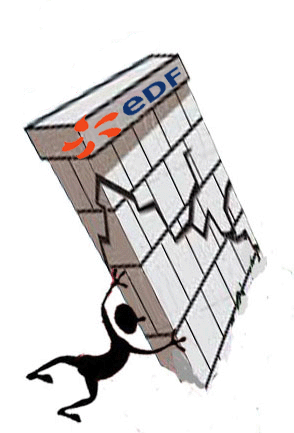
There is currently one nuclear power plant under construction in the UK – Hinkley Point C – and one planned – Sizewell C. But the latest news on these is discouraging. Last month the French majority state-owned energy company EDF announced that the first reactor Hinkley Point C in Somerset would not come onstream until 2029 at the earliest, and probably more like 2031. There is no date set as yet for the second reactor. The final cost of the project, it said, could rise to £46 billion – as compared to an initial budget back in 2016 when contracts were signed of £18-24 billion.
EDF has encountered problems in the construction of other nuclear plants which use the European Pressurised Reactor (EPR) technology deployed at Hinkley Point at Olkiluoto, Finland and Flamanville, France. Some engineers have spoken about a design flaw in this technology. While they were designed for maximum safety – especially in the wake of the radiation leak at Fukushima,……….
To make matters worse, the French finance minister, Bruno Le Maire, began to press the case for the UK government to cough up more funds to finish the project. Worse still, EDF cast doubt over its commitment to build the new reactor at Sizewell C in Suffolk, in which it will have a 20 percent stake, unless the funding issue over Hinkley Point were satisfactorily resolved.
The funding structure devised for Sizewell C envisaged that consumers would pay a levy on their electricity bills to help pay for construction costs. This is the so-called Regulated Asset Base (RAB) model. Opponents of the project have dubbed this a “nuclear tax” which will endure for decades.
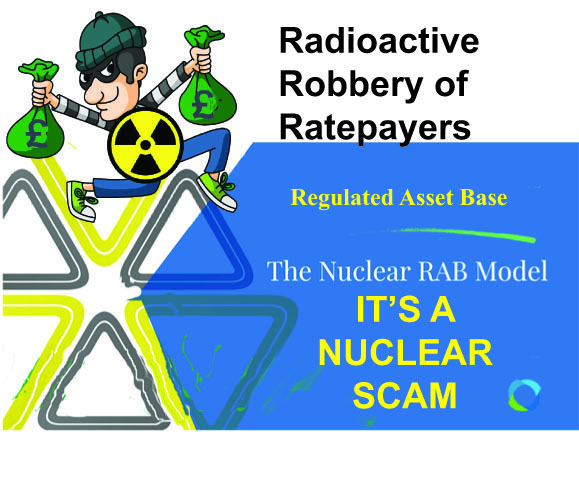
In contrast, Hinkley Point C will operate on the old contracts for difference model where the developers enjoy a guaranteed strike price once the reactors are operational. The original £89.50 per megawatt hour strike price has already been adjusted up to £125 in view of inflation. This means that British consumers of nuclear energy will be paying amongst the highest prices for electricity in the world.
The construction of Hinkley Point C was contracted by the UK government to EDF and China General Nuclear (CGN). Both Hinkley Point C and Sizewell C will have the capacity to power about six million households and will have an economic life of up to 60 years. The two plants could be producing 14 percent of Britain’s total electricity output in the late 2030s.
Ms Coutinho rushed out a press release on the evening of 23 January, saying: “Hinkley Point C is not a government project and so any additional costs or schedule overruns are the responsibility of EDF and its partners and will no way fall on [British] taxpayers”. This comment annoyed EDF and its main shareholder, the French government, to prompt a further statement. The substance of that was that unless the UK government offered something towards the shortfall at Hinkley Point, Sizewell C would simply not happen.
Eventually, the UK Department for Energy Security and Net Zero pledged an additional £1.8 billion of taxpayers’ money. The Minister for Nuclear and Renewables, Andrew Bowie MP, later admitted that he needed to raise an additional £20 billion of private finance to ensure that Hinkley Point C is completed…………………………………………………………………………………………………………………………………………
there has been no coherent political consensus around the need for nuclear power in the UK. The 2003 energy white paper published under Tony Blair’s government described nuclear power as an “unattractive option” – although Labour later changed its mind. There is still vocal opposition to nuclear power generation on safety grounds – and even more to the disposal of nuclear waste. The Low Level Waste Repository (LLWR) in Cumbria, operated by British Nuclear Fuels has been especially contentious. Many environmental and political activists associate nuclear energy production with nuclear weapons production. Moreover, there have been nine different energy secretaries sitting in cabinet since 2010. With such a level of turnover of people at the top, it has proven difficult to fashion policy.
At least the optimists foresee that Sizewell C will benefit from the lessons learnt at Hinkley Point C. Though, somehow, I doubt it……………………………. https://masterinvestor.co.uk/economics/energy-costs-the-price-of-power/—
Most Japan fishing groups hit by China import ban in Fukushima row
A Kyodo News survey has found that 80.6% of prefectural fisheries cooperative associations were affected by the discharge of treated radioactive water from the crippled Fukushima No. 1 nuclear plant into the sea, with many feeling the impact through China’s import ban on Japanese marine products. The survey, released Friday, found that 29 out of 36respondents among the members of the National Federation of FisheriesCooperative Associations said they “had felt” or “had somewhat felt”negative effects, including financial damage due to the water release,overwhelmingly due to the subsequent import ban by China
. Japan Times 24th Feb 2024 https://www.japantimes.co.jp/news/2024/02/24/japan/japan-fishing-groups-china-fukushima-ban/
Ukraine: how nuclear weapons continue to increase the risks, two years on
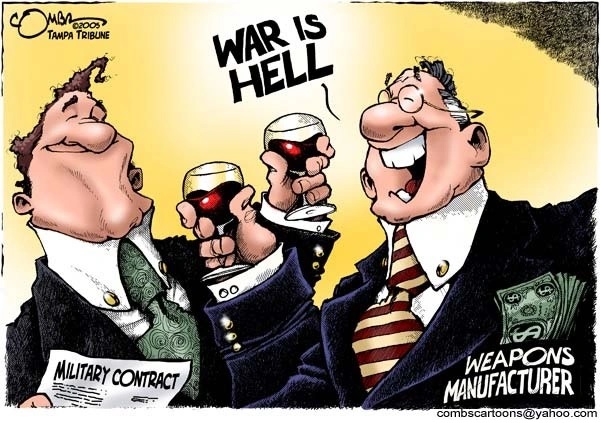
nuclear weapons industry has profited shamelessly off the world’s concerns over nuclear war. Since the conflict in Ukraine and the increased nuclear tensions that followed, profits for the companies that produce nuclear weapons drove up, with an $15.7 billion increase in share and bond holding and $57.1 billion increase in loans and underwriting.
https://www.icanw.org/ukraine_two_years_how_nuclear_weapons_increase_the_risks— 24 Feb 24
Two years after the start of Russia’s full-scale invasion of Ukraine, the risk of nuclear weapons use continues to escalate, while the looming threat of their use protracts this conflict with a high civilian cost. Nuclear-armed states and their allies waver between condemning nuclear threats and engaging in irresponsible practices such as nuclear sharing and championing their own nuclear deterrent. But the rest of the world is pushing back, condemning these behaviors and demanding the total elimination of these weapons of mass destruction through the UN Treaty on the Prohibition of Nuclear Weapons (TPNW).
Melissa Parke, Executive Director of ICAN, said: “This terrible war with its use of nuclear blackmail and overt threats to use nuclear weapons is a wake up call that the world needs to heed – as long as the nuclear-armed states hang on to their arsenals and cling to the misguided doctrine of deterrence, we face the likelihood these weapons will be used sooner or later. Nuclear weapons should be abolished before it is too late.”
The escalating nuclear risk
Following Vladimir Putin’s initial explicit threats to use nuclear weapons, we have seen nuclear-armed states and their allies continue to erode the decades-long nuclear taboo over the past two years. The escalation in nuclear rhetoric has not just been seen in Russia (Medvedev made explicit threats just this last weekend) but also in Israel and North Korea, and in recent calls by Polish and German politicians and NATO leaders for a European nuclear weapon. Nuclear threats heighten tensions in an already dangerous environment, reduce the threshold for use of nuclear weapons, and greatly increase the risk of nuclear conflict and global catastrophe.
The risk is also increased by the irresponsible practice of nuclear sharing, or stationing nuclear weapons, which seems to be on the rise. In June 2023, Vladimir Putin said Russia delivered its first tactical weapons to Belarus, though it is unclear how many nuclear weapons were transferred. This is a reckless and dangerous escalation that was widely condemned. But for NATO states, and particularly the five states that host US nuclear weapons, simply condemning Russia’s nuclear sharing without taking any action is insufficient and hypocritical. Particularly as the US and the UK also seemingly explore the return of US nuclear weapons to Lakenheath. Any nuclear sharing complicates decision making and increases the risk of miscalculation, miscommunication and potentially catastrophic accidents. It is time to end this practice that threatens peace and security and puts us all at risk.
Deterrence theory and nuclear weapons profiteers at the heart of the problem
The use of nuclear blackmail by Russia in the context of the Ukraine war has demonstrated the flawed nature of nuclear deterrence which, instead of ensuring stability, gave Russia the cover to commense its brutal and devastating invasion. Yet Russia’s nuclear threats have failed to deter the US and European countries from supplying Ukraine with weapons and money to fight Russia.
With current conflicts directly involving two nuclear-armed states, it is clear that nuclear deterrence doesn’t keep the peace. NATO states are playing into Putin’s hands by insisting nuclear weapons are a necessary deterrent. It only strengthens Putin’s position to promote his own “deterrent” now, whereas rejecting deterrence and reinforcing the nuclear taboo would limit his options.
Meanwhile, the conflict has also accelerated the global nuclear arms race, with the nine nuclear-armed states increasing spending to $82.9 billion in 2022. As a result, the nuclear weapons industry has profited shamelessly off the world’s concerns over nuclear war. Since the conflict in Ukraine and the increased nuclear tensions that followed, profits for the companies that produce nuclear weapons drove up, with an $15.7 billion increase in share and bond holding and $57.1 billion increase in loans and underwriting.
The global response to nuclear risk: the TPNW
The way to respond to the heightened risk of nuclear war is not to increase nuclear arsenals or threaten nuclear retaliation. The answer is for all countries to condemn nuclear threats, end their reliance on nuclear deterrence and join the UN Treaty on the Prohibition of Nuclear Weapons (TPNW). The TPNW specifically outlaws the threat to use nuclear weapons, as well as the irresponsible practice of nuclear sharing.
All nuclear-armed states need to take urgent steps to de-escalate tensions and to break free from the dangerous doctrine of nuclear deterrence, and nuclear disarmament must be an essential element of a negotiated peace between Russia and Ukraine. Multilateral nuclear disarmament is the only guarantee to prevent other nuclear-armed countries from following Russia’s lead and using their nuclear weapons as a shield to commit war crimes and terrorize civilian populations. Joining the TPNW is a crucial step to delegitimize nuclear deterrence and eliminate nuclear weapons.
Over the past two years, the states parties of the TPNW have been central in pushing back against any and all nuclear threats and challenging the false narrative of nuclear deterrence. At the First Meeting of States Parties in 2021, they condemned unequivocally “any and all nuclear threats, whether they be explicit or implicit and irrespective of the circumstances.” At the second meeting in New York,they agreed “to challenge the security paradigm based on nuclear deterrence by highlighting and promoting new scientific evidence about the humanitarian consequences and risks of nuclear weapons and juxtaposing this with the risks and assumptions that are inherent innnuclear deterrence.” It is time for all responsible states to join the TPNW.
Utility EdF Writes Down $14B Loss on Delayed UK Nuclear Megaproject

By Peter Reina, February 20, 2024, https://www.enr.com/articles/58180-utility-edf-writes-down-14b-loss-on-delayed-uk-nuclear-megaproject
Following recent news of additional delays and cost hikes on the U.K.’s 3,260-MW Hinkley Point C nuclear power plant, the project company has reported an impairment of $14 billion on its assets.
French state controlled utiilty firm Electricité de France (EdF), which controls project financing and construction, last month updated Hinkley Point C’s forecast completion to between 2029 and 2031, with costs rising to a range of $39-43 billion. The previous completion target set in May 2022 was June 2027. EdF is currently financing all project construction costs.
Announcing its 2023 annual report, the utility also set this March as the expected target date for fuel loading at its 1,650-MW Flamanville 3 nuclear power plant on the north French coast. When work started in 2007, fuel loading was forecast for 2011.
Citizens Advice says Sizewell C costs should not be paid with energy bill hikes

Independent advice provider calls for clarity on funding and says project may offer ‘poor value for money’
Guardian, Alex Lawson 19 Feb 24
Ministers have been urged by Citizens Advice to protect consumers from a hike in household energy bills to pay for the proposed Sizewell C power station, amid international tensions over the rising costs of nuclear projects.
The UK’s largest independent advice provider has raised concerns that the project in Suffolk may offer “poor value for money” and called for greater clarity on its funding, in a letter to the Department for Energy Security and Net Zero.
Estimates of the cost of Sizewell C vary wildy – from £20bn to £44bn – and a process to find international investors to join the UK government and France’s EDF is ongoing.
Last month, the owner of Sizewell C’s sister project, EDF’s Hinkley Point C in Somerset, said it would be delayed to 2031 and cost up to £35bn, blaming inflation, Covid and Brexit. This could reach £47.9bn under its worst-case scenario. On Friday, EDF said it had taken a €12.9bn hit on the project.
EDF, which is wholly owned by the French government, is on the hook for cost overruns at Hinkley. French officials have lobbied the UK government to share the burden of the extra costs after its Chinese partner, CGN, was removed from the Sizewell C project over security fears.
However, Sizewell C has a different funding structure to Hinkley, exposing households to potential overruns.
Sizewell C Ltd, the entity behind the project, updated its electricity licence to allow a Regulated Asset Base (RAB) model to be implemented.
RAB financing models, which have been used in the construction of the Thames Tideway Tunnel and Heathrow Terminal 5, are designed to encourage investment by offering a guaranteed income for investors during the construction phase of a large project and bring down financing costs, with the cost added to bills.
In a response to the consultation on the licence update, Citizens Advice chief energy economist Richard Hall said: “By providing investors with a relatively guaranteed income stream, and one that commences during the construction phase, it can be convincingly argued that applying the RAB model to new nuclear projects could reduce the cost of capital that consumers have to pay.
“Our concern has been, and remains, that consumers are not simply exposed to the cost of capital, but also the volume of capital that needs to be employed. If the volume of capital required balloons, the project may offer consumers poor value for money even if it is cheaply financed.”
He added: “Looking at new nuclear projects in general, and the type envisaged at Sizewell C in particular, the scope for material cost and time overruns is very significant. Consumers need to be protected from those risks. They have no way to manage them, and are reliant on the [energy] department to take steps to ensure that they are not on the hook for cost or time overruns.”
Hall also raised concerns over proposals for advertising and publicity costs included in the licence consultation. “Billpayers should not be paying for the Sizewell C sales pitch,” he said.
The latest estimates of the cost of Sizewell C, conducted by University of Greenwich Business School and seen by the Guardian, forecast that it would cost £38.4bn and be complete in 2039. Its analysis suggests that the consumer surcharge to fund it would rise from £4.07 a year in the first year of the project, to £27.82 in year 15, costing households an extra £239.21 in total during its construction.
Alison Downes of the Stop Sizewell C campaign said: “The government emphasise that Hinkley Point C is EDF’s risk and responsibility, but when Sizewell C overspends and overruns – as it inevitably will – future ministers will have to explain why it was considered acceptable to put its construction risk on to consumers and taxpayers. Why has the Hinkley fiasco not taught the government that a RAB-funded Sizewell is a bad idea?”…………………………. https://www.theguardian.com/business/2024/feb/19/citizens-advice-says-sizewell-c-costs-should-not-be-paid-with-energy-bill-hikes
The UK’s biggest nuclear waste dump faces an inquiry by the National Audit Office (NAO) over its soaring costs and safety record.

The public spending watchdog has said it wants to examine whether Sellafield in
Cumbria is “managing and prioritising the risks and hazards of the site
effectively in the short and long term”.
It follows growing concern over
the costs of managing the site’s nuclear legacy. An NAO statement said:
“Cleaning up the site is a long-term endeavour, likely to last well into
the next century. It is expected to cost £84bn (in discounted prices),
though this cost estimate is highly uncertain.”
Sellafield stores and
treats nuclear waste from weapons programmes and power generation. The site
comprises more than 1,000 buildings and has about 81,000 tonnes of
radioactive waste in storage. This is expected to rise to 3.3m tonnes over
the coming years.
About 2,000 tonnes comprise high level waste – the most
toxic – including around 140 tonnes of plutonium in what is the world’s
largest stockpile. The site employs about 11,000 people and cost the
taxpayer around £2.5bn last year. Scrutiny of its budget and safety record
come after a series of critical reports in the Guardian, with allegations
ranging from lax cyber security to a poor work culture. The Government,
which ultimately controls Sellafield, has defended the site’s operations,
insisting there is “no elevated risk to public safety as result of the
issues reported”.
Telegraph 15th Feb 2024
“Unbelievable” U.S. government bailouts fund zombie nuclear projects

Unbelievable” bailouts fund zombie nuke nightmares, February 13, 2024, https://beyondnuclear.org/unbelievable-bailouts-fund-zombie-nuke-nightmares
In Stateline on February 12, 2024, Alex Brown published an article entitled “Federal money could supercharge state efforts to preserve nuclear power: A plant in Michigan might become the first to reopen after closing.”
The massive level of federal and state subsidization being handed over to the nuclear power industry is reflected in the giddiness of the head of the nuclear engineering department at the University of Michigan:
“You’re starting to see a lot of states transition to a position where they’re supportive of nuclear,” said Todd Allen, chair of the Nuclear Engineering and Radiological Sciences department at the University of Michigan. “And compared to 30 years ago, the amount of federal support for nuclear is unbelievable.” (Emphasis added)
It is unbelievable, in a shocking and horrifying way. An analysis by NIRS shows the unwitting federal taxpayer largesse benefitting the nuclear power industry included in a single law, the Inflation Reduction Act of 2022.
The Stateline article focuses on the unprecedented, outrageously expensive, and extremely high risk Palisades zombie reactor restart scheme in Michigan. Beyond Nuclear has co-led grassroots environmental resistance to this restart, as well as to Holtec’s so-called “Small Modular Reactor” (SMR) new builds scheme on the same site.
We have posted about the $3.3 billion (yes, with a B!) in federal and state bailouts for the Palisades restart, another $7.4 billion for Holtec’s SMR new builds (including at Palisades, and at its sibling, decommissioned — although still radioactively contaminated, with on-site highly radioactive waste storage — reactor site in northern Michigan, Big Rock Point), as well as more recently announced federal taxpayer and ratepayer bailouts associated with the Palisades restart, a long list still growing with time! The requested restart bailout total alone is now at around $4.5 billion, and counting! Added to the SMR new builds bailout, nearly $12 billion, or more, in federal and state taxpayer, as well as ratepayer, bailouts could be sunk, just at the Palisades site alone!
The Stateline article quoted Beyond Nuclear’s radioactive waste specialist, Kevin Kamps, at length:
…While some environmental groups have embraced the nuclear investments, others have pointed to long-standing concerns about safety issues, citing infamous accidents such as those at Three Mile Island, Chernobyl and Fukushima. Opponents also note the long-term issue of radioactive waste storage, and in some cases assert that nuclear can stall the growth of renewables such as wind and solar.
“With the amount of money that’s gone into this [Palisades] restart scheme already, you could develop brand-new renewable energy proposals that would be online in the same time frame producing more electricity,” said Kevin Kamps, radioactive waste specialist at Beyond Nuclear, an environmental nonprofit that opposes nuclear energy…
Opponents of nuclear point to the canceled projects, delays and cost overruns as proof that nuclear isn’t viable.
“This is just throwing good money after bad,” said Kamps, the anti-nuclear advocate. “We stand horrified at the actions being taken by Congress and certain state governments.”
Kamps also cited previous nuclear disasters and warned of the risks of extending aging plants…
The Inflation Reduction Act of 2022 mentioned above is the law under which Holtec hopes to receive a $1.5 billion nuclear loan guarantee — $500 million more than it had talked about the past few years — which is interest-free and risk-free, in that it actually need not be paid back, leaving taxpayers holding the bag. The Bipartisan Infrastructure Law (Infrastructure Investment and Jobs Act) of 2021 is the law under which Holtec hopes to obtain $2 billion in Civil Nuclear Credits. President Joe Biden signed both bills into law.
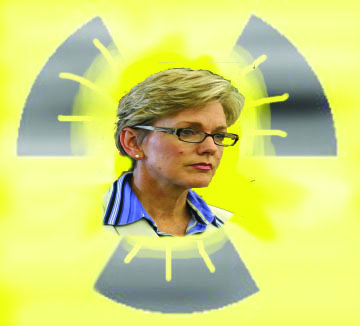
His Energy Secretary, Jennifer Granholm, a former governor and attorney general of Michigan, is in charge of deciding where the various bailouts get dispensed. This even includes the $7.4 billion for SMR development, even though that particular funding stream was created under the Energy Policy Act of 2005, as well as December 23, 2007 appropriations passed by Congress (both of which were enacted with President George W. Bush’s signature). Thus, we are horrified at the actions being taken by the Biden administration, as well.
Spending watchdog launches investigation into Sellafield

National Audit Office to examine risks and costs at nuclear waste site in Cumbria
Anna Isaac and Alex Lawson, 16 Feb 24 https://www.theguardian.com/business/2024/feb/15/spending-watchdog-launches-investigation-into-sellafield—
Britain’s public spending watchdog has launched an investigation into risks and costs at Sellafield, the UK’s biggest nuclear waste dump.
The National Audit Office (NAO), which scrutinises the use of public funds, has announced it will examine whether the Cumbria site is managing and prioritising the risks and hazards of the site effectively as well as deploying resources appropriately and continuing to improve its project management.
The findings of its investigation are expected to be published this autumn.
Sellafield is Europe’s most toxic nuclear site and also one of the UK’s most expensive infrastructure projects, with the NAO estimating it could cost £84bn to maintain the site into the next century.
Last year, Nuclear Leaks, a Guardian investigation into activities at Sellafield, revealed problems with cybersecurity, a radioactive leak and a “toxic” workplace culture at the waste dump.
Predictions of the ultimate bill for the site, which holds about 85% of the UK’s nuclear waste, vary. It cost £2.5bn to run the site last year, and the government estimates it could ultimately take £263bn to manage the country’s ageing nuclear sites, of which Sellafield accounts for the largest portion.
The site employs about 11,000 people and is the world’s largest store of plutonium. It comprises more than 1,000 buildings, many of which were not created with the intention of becoming long-term storage facilities for radioactive material.
Sellafield is so expensive that the Office for Budget Responsibility, which monitors threats to the UK government’s finances, has warned that it and other legacy sites pose a “material source of fiscal risk” to the country.
The NAO previously examined activities at Sellafield in 2018. It found some aspects of project management had improved but that more needed to be done to get a grip on vast costs and risks.
Amyas Morse, the head of the NAO at that time, found that the Nuclear Decommissioning Authority (NDA), which is tasked with management of Sellafield, needed to improve its explanation of its progress so that parliament could hold it to account.
This challenge was underlined when the Guardian uncovered how a worsening leak from a huge silo of radioactive waste at Sellafield could pose a risk to the public.
The leak, from one of the “highest nuclear hazards in the UK” – a decaying building known as the Magnox swarf storage silo – is expected to continue for at least a further 30 years. This could have “potentially significant consequences” if it gathers pace, risking the contamination of groundwater, according to an official document.
This was just one of a catalogue of safety risks arising from ageing infrastructure at the site. A document sent to members of the Sellafield board in November 2022, and seen by the Guardian, raised widespread concerns about a degradation of safety across the site, warning of the “cumulative risk” from failings ranging from nuclear safety to asbestos and fire standards.
Responding to the issues late last year, a Sellafield spokesperson said: “The nature of our site means that until we complete our mission, our highest hazard facilities will always pose a risk.”
Sellafield is owned by the NDA, a quango sponsored and funded by the Department for Energy Security and Net Zero that is tasked with cleaning 17 sites across the UK.
The NDA said it had a “responsibility to deliver for the public, including on value for money”.
“We welcome this continued scrutiny and look forward to working with the NAO,” a spokesperson said.
EDF’s setbacks weigh down the relaunch of nuclear power in Europe

Montel. EDF’s recent setbacks in its project to build two new generation EPR reactors in the United Kingdom darken the prospects for the revival of nuclear power in Europe, experts told Montel.
Montel) EDF's recent setbacks in its project to build two new generation EPR reactors in the United Kingdom darken the prospects for the revival of nuclear power in Europe, experts told Montel.

By: Muriel Boselli,  8 Feb 2024, https://montelnews.com/fr/news/1537158/les-revers-dedf-plombent-la-relance-du-nuclaire-en-europe-
A dispute between Paris and London over who should pay GBP 6-8 billion (in 2015 values) for new additional costs for the Hinkley Point C (HPC) project is tarnishing the image of the nuclear industry, at a time when nations European pro-nuclear companies seek to promote atomic energy in the fight against climate change, according to several experts.

Commissioning of the HPC project could be delayed by up to four years and completion costs are now expected to be between GBP31bn and £34bn, according to EDF announcements last month.

Hinkley's problems underline the "slow descent into hell" of the French nuclear industry, Jean-François Raux, former director of EDF and general delegate of the French Electricity Union (UFE), told Montel.

“I have fierce doubts about EDF's ability to build more reactors,” he said, highlighting the delays and additional costs of new construction in France, Finland and the United Kingdom.

Indeed, the start-up of the Flamanville EPR by mid-2024 was “very tense”, with EDF still having to submit compliance documents, the director of the Nuclear Safety Authority (ASN) declared last week. The project is already twelve years late.

According to a source close to the matter at EDF, the company could even withdraw from HPC, although this scenario is not the most likely. “The board of directors did not sign a blank check for Hinkley, it barely committed to financing the project for 2024,” he assures.

Threat to the relaunch of nuclear power
The French nuclear recovery program provides for the construction of six EPR2s in France at an estimated cost of EUR 52 billion. A first pair of reactors is planned at Penly, in the northwest of the country by 2035-2037.

However, these ambitions are threatened by difficulties encountered at the Hinkley site, experts said.

“The problem is that we will have to launch construction work on two European pressurized reactors at Penly, while we continue to inject billions into HPC,” estimated the source at EDF. “There will inevitably be plasters to wipe and skills to find,” he added, noting that the Penly EPRs will “inevitably encounter difficulties”.

Florence de Bonnafos, campaign manager at Greenpeace, agrees with these comments, believing that EDF's nuclear revival project is unrealistic given the latest cost estimates for the two HPC reactors.

“It’s still a bit complicated to make us believe that we will be able to build six reactors for the same budget as two reactors in Great Britain,” she said.

The schedule slip on the HPC project follows reports that EDF's Chinese partner CGN has pulled out of financing the project, leaving a gap of GBP1bn per year.

The issue could impact funding for the UK's other planned flagship nuclear project at Sizewell C, a joint venture between the UK government and CGN. EDF, in debt to the tune of EUR 65 billion, is expected to make a final investment decision next summer.

Political decisions
The subject of financing is at the heart of a standoff between the French and British governments, with Paris partly accusing the United Kingdom of having frozen its diplomatic relations with China.

Elsewhere, in the Czech Republic, where EDF has submitted a bid to build four reactors, officials could be tempted to choose Korean competitor KHNP, analysts said.

“The main problem is that the decisions taken are more political than industrial,” said the EDF source. “No one thought that we would do HPC and Flamanville in the given time. It was custard. »

In addition, Mr. Raux notes a lack of accountability within EDF. “In other sectors, when things go wrong, leaders are replaced,” he said.

This is the first part of a two-part article devoted to the prospects for nuclear development in the EU.
France’s first 6 EPR2 nuclear reactors will cost much more than the planned 52 billion euros.
Why the first six EPR2s will cost much more than the 52 billion euros
initially planned by EDF. During a hearing in the Senate, the executive
director of EDF’s new nuclear projects, Xavier Ursat, indicated that the
first six EPR2s will cost more than the 52 billion euros announced in 2021.
A first slippage in costs including the new estimate is promised for the
end of 2024.
Why the first six EPR2s will cost much more than the 52
billion euros initially planned by EDF. EDF does not brag about it. But in
the Senate commission of inquiry into the price of electricity, Xavier
Ursat, its executive director in charge of the engineering department and
new nuclear projects, was obliged to talk about it.
As predicted by an expert report in 2021, the construction of the first six EPR2s will indeed
cost more than the 51.7 billion euros, rounded to 52 billion by the State,
calculated by EDF at the time Emmanuel Macron had to decide on the relaunch
of a new nuclear program in France. A relaunch confirmed in his speech on
Belfort’s energy strategy on February 10, 2022. “We are carrying out a
new economic assessment. It led to a figure higher than 52 billion,”
Xavier Ursat declared to the senators. Which, for him, “is not very
surprising”.
L’Usine Nouvelle 12th Feb 2024
Small nuclear reactors (SMRs) still have plenty to prove.

Britain’s MPs are not paid to be polite. So it must have been with some restraint that the members of the environmental audit committee described the government’s nuclear strategy this week as “lacking clarity”, not least over small modular reactors.
Lacking clarity? You can think of better ways to describe the financially
radioactive shambles, complete with Rishi Sunak’s fantasy “road map”.
He’s glibly promising 24 gigawatts of capacity by 2050 — either another
seven Hinkley Point Cs or a mix of them and SMRs.
Surely he’s spotted what’s going on with that Somerset nuke? Costs up from £18 billion to as
much £35 billion in 2015 prices, or £46 billion in today’s money, with
its start-up likely to be delayed six years to 2031.
Maybe he hasn’t, because he’s planning a lookalike for Sizewell C in Suffolk, built by the
same French-backed EDF. Only this time it won’t be EDF but consumers and
the taxpayer on the hook for the construction cost overruns. As the
committee chairman Philip Dunne noted: “The UK has the opportunity to be
a genuine world leader in the manufacture of SMR nuclear capability with
great export potential.” But despite the taxpayer lobbing in £215
million to support their development, MPs are right to see a deficit on the
“clarity” front.
As Professor Steve Thomas from the University of
Greenwich says: “SMRs are up to a decade behind large reactors in terms
of their commercial development and their economics are speculative and
untested.” Rolls’s are 470 megawatts, one seventh of the 3.2GW Hinkley.
But who knows if it really can build them for £2.5 billion a pop? Or
whether it’ll prove feasible to cram several on a single site. In
November Utah Associated Municipal Power Systems canned a project to build
six 77MW NuScale SMRs at a site in Idaho. And even if they’d be far
smaller than Hinkley, they’d still need to be just as safe. Will safety
issues drive up costs? Also, who’s paying for them? Consumers, the
taxpayer, the private sector? And what’s the cost versus alternative
energy technologies?
Times 15th Feb 2024
https://www.thetimes.co.uk/article/shameful-shambles-over-mega-nukes-d6wzvp33v
Energy company Centrica boss says it could fund Suffolk nuclear plant Sizewell C
Energy company Centrica is considering pumping cash into the construction
of the Sizewell C nuclear power plant on the Suffolk coast, its chief
executive has revealed. Chris O’Shea said the Suffolk site was a
“possible future investment” as the government tries to secure funding
for the project. Ministers are bidding to raise hundreds of millions of
pounds from private companies to help build the plant, near Leiston.
East Anglia Daily Times 15th Feb 2024
https://www.eadt.co.uk/news/24122986.centrica-boss-says-fund-suffolk-plant-sizewell-c
Mirror 15th Feb 2024
https://www.mirror.co.uk/money/british-gas-owner-centrica-considers-32134974
Evening Standard 15th Feb 2024
Proactive Investor 15th Feb 2024
Bloomberg 15th Feb 2024
France: EDF Faces Unprecedented Nuclear Workload in France
Energy Intelligence Group, Fri, Feb 9, 2024, Grace Symes, London
As France faces two major nuclear efforts — the refurbishment and life extension of EDF’s domestic operating fleet and a major nuclear newbuild program — there are already signs that the country’s nuclear workforce is struggling to keep up. With 10-year safety reviews, or decennial visits (DVs), of EDF’s 56 domestic reactors growing ever more complex and time-consuming, EDF anticipates flatlined nuclear output from 2025 to 2026, and beyond that France will need to ramp up an industrial effort not seen in generations if it hopes to successfully launch simultaneous large newbuilds (related).
Energy Intelligence 9th Feb 2024
https://www.energyintel.com/0000018d-7944-d1ef-a5cd-fd647d920000
1 This Month

of the week – Shut Down Drone Warfare!


Tell the Ukrainian Government to Drop Prosecution of Peace Activist Yurii Sheliazhenko

Petition to revoke the licensing of the Near Surface Nuclear Disposal Facility (NSDF) at Chalk River. https://www.ourcommons.ca/petitions/en/Petition/Details?Petition=e-7247
To see nuclear-related stories in greater depth and intensity – go to https://nuclearinformation.wordpress.com
-
Archives
- April 2026 (103)
- March 2026 (251)
- February 2026 (268)
- January 2026 (308)
- December 2025 (358)
- November 2025 (359)
- October 2025 (376)
- September 2025 (257)
- August 2025 (319)
- July 2025 (230)
- June 2025 (348)
- May 2025 (261)
-
Categories
- 1
- 1 NUCLEAR ISSUES
- business and costs
- climate change
- culture and arts
- ENERGY
- environment
- health
- history
- indigenous issues
- Legal
- marketing of nuclear
- media
- opposition to nuclear
- PERSONAL STORIES
- politics
- politics international
- Religion and ethics
- safety
- secrets,lies and civil liberties
- spinbuster
- technology
- Uranium
- wastes
- weapons and war
- Women
- 2 WORLD
- ACTION
- AFRICA
- Atrocities
- AUSTRALIA
- Christina's notes
- Christina's themes
- culture and arts
- Events
- Fuk 2022
- Fuk 2023
- Fukushima 2017
- Fukushima 2018
- fukushima 2019
- Fukushima 2020
- Fukushima 2021
- general
- global warming
- Humour (God we need it)
- Nuclear
- RARE EARTHS
- Reference
- resources – print
- Resources -audiovicual
- Weekly Newsletter
- World
- World Nuclear
- YouTube
-
RSS
Entries RSS
Comments RSS
 nuclear-news