Bulgaria opposition urges freeze of nuclear project | Reuters
Bulgaria opposition urges freeze of nuclear projectTue Apr 21, 2009 – “………………….. SOFIA, April 21 (Reuters) – Bulgaria’s rightist opposition urged the government on Tuesday to freeze a multi-billion project to build a new nuclear power plant due to problems with funding in times of a global economic crisis…………..
…………sources close to the project say the state-owned utility NEK, which has a 51 percent stake in the project, has problems raising funding and Belene faces a delay. The government has estimated costs at 4 billion euros ($5.16 billion) but analysts and sources have said the price tag was more likely to be 6 billion. ………………………
“Bulgaria is the only European Union country which intends to build a nuclear power plant and take such huge loans in times of financial crisis,” UDF’s chairman Martin Dimitrov said.
He said such loans would only add to the economic pain Bulgaria was now experiencing and urged parliament to interfere and try to stop taking loans from Russia.
Bulgaria opposition urges freeze of nuclear project | Reuters
Lehman Brothers and yellowcake
Lehman Brothers and Yellowcake BIZMOLOGY by Larry Bills, April 20th, 2009 “………It turns out that Lehman Brothers, the powerful investment bank which collapsed last year and signaled the beginning of the economic meltdown, owns 500,000 pounds of uranium “yellowcake,” slightly less than what’s needed to make one nuclear bomb……………….. I don’t know if I’m crazy about a bankrupt company — struggling to pay off creditors — stockpiling uranium.
Bizmology » Blog Archive » Lehman Brothers and yellowcake
Yet another $50 billion for rust-bucket nukes?
Yet another $50 billion for rust-bucket nukes? Scoop by Harvey Wasserman 13 April 09 The nuke power industry is back at the public trough for the fourth time in two years demanding $50 billion in loan guarantees to build new reactors.Its rust-bucket poster child is now the ancient clunker at Oyster Creek, whose visible New Jersey rust and advanced radioactive decay are A-OK with the Nuclear Regulatory Commission, which just gave it a twenty-year license extension. The industry’s savior may be France, whose taxpayer-funded EdF and Areva Corporations may be poised to build their own reactors on US soil using French and American taxpayer money.
And President Obama’s first big test on nuke power may be how he fills a vacancy—and the chair—at the NRC.
The latest demand for a $50 billion taxpayer handout has been sleazed into the Senate budget bill………………………….This latest bailout incarnation has been widely tagged “nuclear pork” even in the right-wing Washington Times,………
………No independent financiers will take an un-subsidized flier on new reactors. Nuke operators can’t get private insurance on a major melt-down. With the proposed Yucca Mountain dump all but dead, the industry—after fifty years—has no certified place to take its high-level radioactive waste……………
……… green energy groups are organizing a national write-in campaign to begin next week, and a call-in effort for April 27, the day after the anniversary of the 1986 Chernobyl catastrophe. No one doubts the industry will pour on one legislative scam after another in its desperate attempt to get taxpayer money as it is being priced into oblivion by rapid advances in renewables and efficiency……………
……..whomever Obama appoints, it’s painfully clear that the world’s most expensive failed technology is not going away without a long, hard fight. ***
Dirty Plans of France to Nuke the US – Starting With DC!
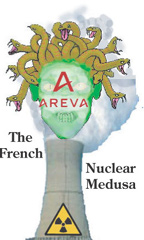 Dirty Plans of France to Nuke the US – Starting With DC! OpEd News 8 April 09 by Cathy Garger French radioactive disasters at home render an abysmal nuclear safety record – and now they are being helped to bring the same disasters here to the US!………the ASN, (Autorite de Surete Nucleaire) the French nuclear safety authority, yesterday came out with a report which states that 5 out of 19 of their nuclear power plants are “underperforming.” …………
the EPR (European Pressurized Reactor) design has never before operated anywhere in the world. Judging from the nuclear track record of the French state, the operation of this over-sized, unproven reactor will unquestionably ensure the further toxic and radioactive contamination of the MD-DC-VA area, surrounding the nation’s capital with deadly discharges – thermal, toxic, and radioactive – into the already heavily oxygen-depleted, Chesapeake Bay.
Despite many local citizens’ disdain for France‘s ambitious and greedy visions for the US, however? The far greatest sin is absolutement not France’s blatant disregard for the certain worsened contamination of the United States of America – demonstrated by its callous disregard shown both its own environment and own people………………………. the blame and focus must instead be placed squarely where it belongs… in the very laps of the US (s)elected officials themselves, as manifested by their enthusiastic and unanimous dedication to these experimental double-size nuclear monsters, originating with the radioactive French “christening” of the greater Washington, DC area.
……………Five (5) out of nineteen (19) French “underperformers” equates to a rate of 26 percent of nuclear power plants identified as sub-standard performers. In other words, France itself admits its own nuclear power plants have a measly 74% acceptable performance (think “safety”) rate……………………….It’s important to realize the French nuclear invasion is being welcomed with open arms by those in power in our very own government. AREVA’s big plans to take a colossal slice of what I’ve termed the US “nukuler insurgency” pie has been accomplished by AREVA’s Congressional lobbying efforts to the tune of over $5.2 million in the years 2005 to 2008 alone.
News Flash: Greed and Stupidity Can Coexist!
News Flash: Greed and Stupidity Can Co-exist THE HUFFINGTON POST Monica Youn 7 April 09 “…………………..A crucial function of government is to protect us from the consequences of the stupid decisions of other people – we should not have to worry that a nuclear power plant operator will decide that certain safety precautions simply aren’t profitable or necessary.
In the nuclear example, were the government to succumb to industry pressure and repeal certain safety regulations on nuclear plants, any resulting accident would be the result of policy as well as stupidity. In other economic sectors, regulations exist to prevent the profit-maximizing incentives of various industries from creating unacceptable levels of public risk………….
Nuclear financing watchdog established – ClimateChangeCorp.com
Nuclear financing watchdog established Climate Change Corp 7 Apr 2009 | Author: Jeanette Wiemers,
|Board will ensure that public doesn’t shoulder costs for nuclear cleanupThe UK government announced the members of its Nuclear Liabilities Financing Assurance Board, which will examine plans for financing nuclear waste cleanup from power stations, in an effort to keep taxpayers from having to bear the costs. Energy and Climate Change Minister Mike O’Brien said the Board will be yet another protection to ensure that taxpayers are protected from the costs of decommissioning and waste disposal from new nuclear power stations, and that the Board’s diverse membership will help to provide independent scrutiny and advice on the issue.
Nuclear financing watchdog established – ClimateChangeCorp.com
Halliburton is among defendants in nuclear waste lawsuit under CERCLA
Halliburton is among defendants in nuclear waste lawsuit under CERCLA Examiner.com Frank Taylor April 7
Halliburton Energy Services is one of the corporations from which the United States seeks to recover the response costs that it incurred due to releases and threatened releases of hazardous substances into the environment from facilities where radioactive materials were manufactured, repaired, reworked, stored, and processed for disposal. GE Healthcare Bio-Sciences Corp. and Pengo Industries, Inc., are among the other defendants in United States of America v. Halliburton Energy Services, Inc., (case number 4:07-cv-03795 in the United States District Court for the Southern District of Texas) The federal government, which filed the lawsuit in 2007, alleges that the defendants are liable under the Comprehensive Environmental Response, Compensation, and Liability Act of 1980, commonly known as CERCLA, for more than $26.7 million in unreimbursed response costs for the cleanup of sites in Houston, Webster, and Odessa. The State of Texas intervened in the case to recover the response costs that it had contributed to the federal government.
Mines and plants hit by low prices, high costs – Forbes.com
Thomson Reuters
FACTBOX-Mines and plants hit by low prices, high costs
04.07.09, 06:47 AM EDT – “……………….Uranium miner Denison Mines ( DNN – news – people ) will temporarily suspend production at its Sunday and Rim mines in the western United States and will likely shut its White Mesa mill in May……………
FACTBOX-Mines and plants hit by low prices, high costs – Forbes.com
A £1bn nuclear white elephant
A £1bn nuclear white elephant
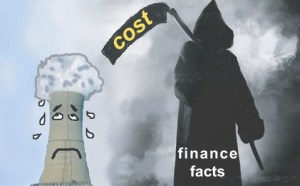
THE INDEPENDENT 7 April 09 Call for public inquiry as Sellafield recycling plant is costing taxpayer millions every year A controversial nuclear recycling plant, approved by the Government despite warnings over its economic viability and reliance on unproven technology, has racked up costs of more than £1bn and is still not working properly.
Backers of the plant at Sellafield, which promised to turn toxic waste into a useable fuel that could be sold worldwide, had claimed the plant would make a profit of more than £200m in its lifetime, producing 120 tonnes of recycled fuel a year. But after an investigation by The Independent, the Government admitted technical problems and a dearth in orders has meant it has produced just 6.3 tonnes of fuel since opening in 2001.
With construction and commissioning costs of more than £600m, the facility, known as the Mox plant because of the mixed oxides (Mox) fuel it is designed to produce, has cost more than £1.2bn, confirming its status as the nuclear industry’s most embarrassing white elephant and one of the greatest failures in British industrial history, losing the taxpayer £90m a year. Green campaigners and opposition MPs are now calling for the plant to be closed immediately, and a minister who fought its construction at the time has called for a public inquiry into how the plant was ever given the go-ahead.
‘No’ to nuclear power
‘No’ to nuclear power
Author: David Kennell
People’s Weekly World Newspaper 7 April 09 – “…………………………….The inherent danger of a nuclear accident is recognized by the Price-Anderson Act, which forces taxpayers (not the company) to be responsible for any major accident. Even if no accidents occur, or if plutonium-239 (half-life of 24,110 years), created in fast neutron reactors, is not lost or stolen to make nuclear weapons, there is still no known procedure to eliminate the high-level radioactive waste.
More than 95 percent of the waste products are cesium-137 and strontium-90, which have half-lives (lose 50 percent) of about 30 years. They are not the problem. The “transuranics” (isotopes of uranium, curium-245 and plutonium) have half-lives of thousands of years. So far, the much touted “recycling” requires purification of the transuranics and is very inefficient and difficult and has only been accomplished on a small laboratory scale. The planet is accumulating these highly lethal products with no place to put them.
About half the U.S. nuclear waste is at Hanford, Wash., in nuclear “sludge” acquired from our nuclear weapons program. The other half is from our 103 nuclear power plants. The Hanford waste is beginning to leak into the Columbia River.
As an aside, the unknown cost of waste disposal by currently unknown means is never considered when calculating dollar costs.
But the real costs cannot be measured in dollars. We are saddling future generations, hoping that future technology can solve the problem that has not been solved during the last 60 or so years…………….
Using nuclear fission to boil water is not only absurd — it could be the greatest folly of all time.
Costly Lepreau nuclear plant refit may extend into 2010
Costly Lepreau nuclear plant refit may extend into 2010: CBC News April 3, 2009 CBC News
NB Power says it can no longer predict exactly when the Point Lepreau nuclear power plant will be up and running again — and for every day it’s delayed it costs the province $670,000 to replace the electricity the plant would normally produce.The $1.4-billion project was supposed to be finished by this September, a date that was first pushed back to December and is now in danger of running into next year.
Gaëtan Thomas, NB Power’s vice-president nuclear, said Thursday that picking a completion date is no longer possible.
Fiscal stimulus and the environment
Greenstanding
Apr 2nd 2009
From The Economist print editionGordon Brown’s New Deal will do little to advance renewable energy
Mr Brown’s green New Deal looks flimsy. On March 31st HSBC, a big bank, published a report ranking countries by how green their economic-stimulus packages were. The bank reckons that Britain is allocating just 7% of its fiscal stimulus to greenery, compared with 12% in America, 34% in China and a whopping 81% in South Korea (see chart). A separate report prepared for Greenpeace, a pressure group, by consultants at the New Economics Foundation (NEF) considers only genuinely new funding and arrives at a figure of just 0.6%, or £120m……………………….
………………….It has moved speedily to revive the nuclear-power industry, by contrast. From a position of cordial dislike in 2003, the government announced itself in favour of new nuclear plants in principle as early as 2006.More recently ministers have been positively prescriptive, suggesting how many plants might be built and where. A takeover of British Energy, which runs most existing nuclear plants, by EDF, keen to build more, took place last year. A new nuclear laboratory has been founded, schemes to train workers set up and the vexed issue of waste disposal re-examined.Nuclear-power stations take many years to build, so new ones will not help Britain meet its 2020 targets for curbing emissions. But the technology is well understood. Politicians may have calculated that a few nuclear-power stations will be easier to sell the public than thousands of wind turbines. And energy does not have to be renewable to be low-carbon.
Fiscal stimulus and the environment | Greenstanding | The Economist
Uranium Suffering From GFC Too
FNArena News – April 01 2009
By Chris Shaw
Uranium prices have been under pressure in recent months and according to equity research group Resource Capital Research (RCR) the global financial crisis has been largely to blame as it has impacted on the market’s suppy/demand balance.
The group notes further price weakness is expected as while the spot price is currently US$42.50 per pound this is down from US$52.50 at the end of last year and the Fund Implied Price (FIP), which is a key leading indicator for spot prices, is currently at US$35.00 per pound. It has traded between US$30 and US$45 per pound in recent months………
……………….conditions are tougher for those companies at the production and development stage as they are facing funding challenges from the global financial crisis at the same time as permit and commissioning issues and other development factors are increasing related cost pressures.
Europe Won’t Buy Into Nuclear Power Until Waste Problem Is Solved
Europe Won’t Buy Into Nuclear Power Until Waste Problem Is Solved THE BUSINESS INSIDER Jay Yarow|Mar. 31, 2009, The renaissance of the nuclear power industry appears to be in a holding pattern. The two big problems: Lack of funding for the expensive construction of the reactors, and public skepticism about nuclear waste.
EE News attended a two-day nuclear energy conference last week and reported that Ute Blohm-Hieber, head of nuclear energy and waste management at the European Commission, agreed that waste is the “Achilles’ heel of the nuclear industry.” What’s interesting is that the news org didn’t have any word from the conference of workable solutions to the problem.
Europe Won’t Buy Into Nuclear Power Until Waste Problem Is Solved
Nearly $2 billion for Hanford cleanup
Nearly $2 billion for Hanford cleanup seattlepi.com By SHANNON DININNYASSOCIATED PRESS WRITERRICHLAND, Wash. — The Department of Energy plans to spend about $2 billion in stimulus money to speed some of the cleanup at south-central Washington’s highly contaminated Hanford nuclear reservation………………..The extra $2 billion equals what the federal government typically spends cleaning up Hanford each year……………………53 million gallons of radioactive brew, were left behind in 177 underground tanks. Some of those tanks are known to have leaked into the aquifer, threatening the neighboring Columbia River, and 144 tanks remain to be emptied.
1 This Month





PLEASE OPPOSE HR 8255 AND S.3639 – bills would accelerate satellite deployment, with no environmental review or safeguards – https://ncstd5li.quorum.us/campaign/169331/
To see nuclear-related stories in greater depth and intensity – go to https://nuclearinformation.wordpress.com
-
Archives
- October 2026 (58)
- September 2026 (339)
- August 2026 (330)
- July 2026 (355)
- June 2026 (287)
- May 2026 (306)
- April 2026 (356)
- March 2026 (251)
- February 2026 (267)
- January 2026 (308)
- December 2025 (358)
- November 2025 (359)
-
Categories
- 1
- 1 NUCLEAR ISSUES
- business and costs
- climate change
- culture and arts
- ENERGY
- environment
- health
- history
- indigenous issues
- Legal
- marketing of nuclear
- media
- opposition to nuclear
- PERSONAL STORIES
- politics
- politics international
- Religion and ethics
- safety
- secrets,lies and civil liberties
- spinbuster
- technology
- Uranium
- wastes
- weapons and war
- Women
- 2 WORLD
- ACTION
- AFRICA
- Atrocities
- AUSTRALIA
- Christina's notes
- Christina's themes
- culture and arts
- Events
- Fuk 2022
- Fuk 2023
- Fukushima 2017
- Fukushima 2018
- fukushima 2019
- Fukushima 2020
- Fukushima 2021
- general
- global warming
- Humour (God we need it)
- Nuclear
- RARE EARTHS
- Reference
- resources – print
- Resources -audiovicual
- Weekly Newsletter
- World
- World Nuclear
- YouTube
-
RSS
Entries RSS
Comments RSS

