Kazakhstan unrest dims Uranium One shares 40%
Kazakhstan unrest dims Uranium One shares 40%’Misunderstanding’ swirls about stake in Kazakh mine: CEOPeter Koven, Financial Post May 28, 2009
A political flare-up in Kazakhstan’s uranium sector has prompted new investor concerns about an authoritarian country that the world is relying on to provide much of its nuclear fuel in the future.
Yesterday, the government accused Mukhtar Dzhakishev, the former head of state-owned uranium miner Kazatomprom, of illegally selling stakes in uranium deposits to foreign companies……………………………..
The broader issue is that the arrest and the accusations, which came out of nowhere, reinforce the fact the political risk in Kazakhstan remains enormous for mining companies.
Uranium deposits are usually considered strategic by host countries, which makes it difficult for uranium miners such as Cameco Corp. to access most markets. As a result, they have flocked to Kazakhstan, which has emerged as a huge uranium hotbed in the past decade.
Canada to Seek Buyers for Atomic Energy of Canada, Globe Says – Bloomberg.com
Canada to Seek Buyers for Atomic Energy of Canada, Globe Says
By Greg Quinn
May 28 (Bloomberg) — Canada will seek buyers for part of Atomic Energy of Canada Ltd., seeking to boost sales of its Candu reactors, and is looking for new managers of a damaged reactor that makes medical isotopes, the Globe and Mail newspaper said.
The state-owned company would be split into a Candu division and a division for the isotope-producing reactor, the newspaper said, citing people it didn’t name who are familiar with the plans.
The isotope reactor will remain shut down for at least three months to make emergency repairs, and about C$7 billion ($6.3 billion) is needed for waste clean up at the site, the newspaper said.
Canada to Seek Buyers for Atomic Energy of Canada, Globe Says – Bloomberg.com
Niger Political Melee Could Affect Foreign Uranium Cos
Niger Political Melee Could Affect Foreign Uranium CosThursday Easy Bourse May 28th, 2009 / 20h15By Brian TruscottOf DOW JONES NEWSWIRESVANCOUVER -(Dow Jones)- As Kazakhstan investigates whether state officials sold uranium assets to foreign companies illegally, Niger – and its uranium market – is undergoing a small crisis of its own…………………..Political unrest, especially from opposing political parties, is spreading, with street demonstrations and the rise of anti-referendum coalitions.
On the face of it, this looks like political wrangling, but given the history of power grabs in African countries, this could be a precursor to economic instability in a region that often sees the military step in to resolve political upheavals, one uranium markets analyst said………………………..Niger Uranium Ltd. (URU.LN) has a number of potential prospects in development while Australia’s NGM Resources Ltd. (NGM.AU) has three uranium concessions.
Sarkozy – nuclear salesman off to Pakistan?
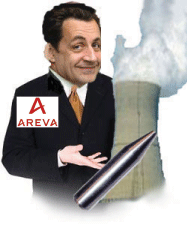 Sarkozy may visit Pakistan in autumn: official
ABU DHABI (AFP) 27 May 09 — French President Nicolas Sarkozy hopes to visit Pakistan this autumn……………………….Sarkozy’s visit would also be an opportunity to outline cooperation in civil nuclear energy that Sarkozy proposed to Zardari during his recent visit to Paris, the official said.
“France must invest diplomatically, politically and economically in Pakistan,” he stressed…………………….
http://www.google.com/hostednews/afp/article/ALeqM5jg2IU2J1lpF6y639I_bg8BSbt0VQ
Unlimited funding for nuclear power in the “Clean Energy Bank”?
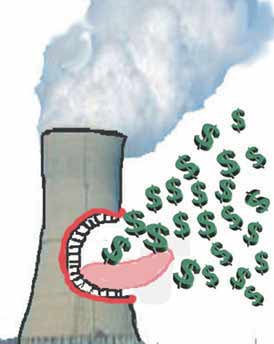 The nuclear-power lobby
San Antonio Current by Greg Harman 27 May 09 “………………………
……………….Although the would-be Nuclear Renaissance is a key element of more than a few lawmakers’ agendas, the federal government has failed to address the disposal of the plants’ high-level radioactive waste. The price tag on new nuclear plants has been rising by 15 percent a year — and the projects are already fantastically expensive.
Then you have upstarts like Jon Wellinghoff, head of the Federal Energy Regulatory Commission, who suggests the world doesn’t need any more nuclear power plants; that renewable energy and efficiency measures alone can provide for the future.
“There’s 500 to 700 gigawatts of developable wind throughout the Midwest,” Wellinghoff said last month, and “enough solar in the Southwest, as we all know, to power the entire country.”
It all boils down to terrible PR for the nuclear industry.
In addition to those immediate troubles, virtually all of the nation’s 104 nuclear plants are set to age themselves out of production by mid-century.
…………………..said Michael Marriott, director of the anti-nuke organization Nuclear Information Resource Service. “One hundred reactors at today’s prices is about a trillion dollars. Is that the best way to spend a trillion dollars, especially when the private sector has made it very clear they’re not going to put up the money?”
Still, nuclear has its boosters. And they’re stealthily creating the legislation now that will provide nuclear power with a raft of new federal subsidies.
………………As it turned out, the nuclear Trojan Horse was already in the bill.
It’s known as a “clean energy bank,” and it creates a new bureaucracy — the Clean Energy Deployment Administration — tasked with doling out federal energy dollars in the form of loans, loan guarantees, and letters of credit.
……………..So far, both the House and Senate Clean Energy Bank versions include nuclear power and “clean” coal — both extractive energy sources that rely on finite materials — among their list of truly renewable power sources like wind and solar. Thanks to a 30-percent cap on the amount any one of these technologies could receive, the House’s Clean Energy Bank language in ACES could allow up to 60 percent of the clean-energy spending to be made on coal and nuclear.
The Senate’s version currently doesn’t include limits on the funds any single power source could receive through the bank…………”
*Not on your irradiated life.
French Naval Base Opens Today
French Naval Base Opens Today
Khaleej Times T. Ramavarman26 May 2009 “……………….The base to be manned by about 500 personnel, drawn mainly from the French Navy, will be inaugurated by French President Nicolas Sarkozy……………………….The minister said the UAE is pursuing a transparent and peaceful nuclear power programmes, and has emerged as a model to many other countries in this regard…………………….
US nuclear reactor builders GE and Westinghouse Electric Co, a subsidiary of Toshiba Corp, are also trying to get a big share of the expected $40 billion market.
French firms plan to compete for the business. France’s Total, Suez and state nuclear reactor maker Areva said last year they planned to develop two third-generation nuclear reactors in the UAE.
Will the Nuclear Power “Renaissance” Ever Reach Critical Mass?: Scientific American
Will the Nuclear Power “Renaissance” Ever Reach Critical Mass?
Scientific American May 21, 2009 Despite an abundance of plans and applications, new nuclear reactors outside of Asia are few and far between, which puts nuclear’s contribution to fighting greenhouse gas emissions at risk This month, Finland’s Olkiluoto 3 nuclear reactor was supposed to begin generating power, a tangible sign of the revival of the nuclear industry outside of Asia after nearly 30 years of no new construction because of accidents, cost-overruns and other issues. Instead, the reactor won’t be completed for more than three more years, its price is nearly 60 percent more than anticipated, and it is mired in costly legal squabbles between the builder, Areva, and the Finnish utility, Pohjolan Voima.In the U.S., since 2003, 17 applications for 26 new reactors have been filed with the U.S. Nuclear Regulatory Commission, but not one is yet under construction.
Despite dozens of new nuclear plants ordered or built in Asia in recent years, “increased deployment of nuclear power has been slow both in the United States and globally,” wrote the authors of a new Massachusetts Institute of Technology review of the state of nuclear power.Those figures, say the authors of the report, an update on a similar report in 2003, mean that “even if all the announced plans for new nuclear power plant construction are realized, the total will be well behind that needed for reaching a thousand gigawatts of new capacity worldwide by 2050.”
One thousand gigawatts is the number the M.I.T. professors estimated would be needed to ensure that nuclear power provided 20 percent of global electricity needs as well as cut emissions of greenhouse gases from power plants. …………………..(There are, of course, significant greenhouse gas emissions associated with building and fueling nuclear facilities).
But the price of new nuclear power has “escalated dramatically,” according to the report, jumping by 15 percent a year to reach as much as $4,000 per kilowatt compared with $2,300 for coal-fired generation and just $850 for natural gas. And the industry is asking for at least $100 billion in federal tax subsidies and loan guarantees for the 26 reactors currently planned.
The situation is no better in Europe, according to Steven Thomas, a professor of energy studies at the University of Greenwich in London: Finland cannot complete its new reactor; the U.K. has yet to get started on any projects; and a new nuclear reactor in France, after 18 months of construction, is 20 percent overbudget and requires complete subsidy by the French government………………….. Nor has there been a solution to the issue of nuclear waste……………………….. Adds Thomas: “It seems to me highly unlikely that [investing in nuclear power] is the most cost-effective way to reduce greenhouse gas emissions. Put that money in other sources, such as energy efficiency and renewables, and get a much better return on your money.”
Will the Nuclear Power “Renaissance” Ever Reach Critical Mass?: Scientific American
Delays at Japan’s ill-fated nuclear plant
Delays at Japan’s ill-fated nuclear plant
By Hiroyuki Koshoji
UPI Tokyo, Japan — Japan’s Rokkasho Reprocessing Plant, built to extract plutonium from the spent fuel produced in Japan’s nuclear reactors, continues to be plagued by technical difficulties that have pushed its start-up date for commercial operations to August this year.
The plant in Rokkasho in northern Japan was out of action for nine months from the end of 2007 due to problems in one of its vitrification facilities, a furnace that mixes high active liquid waste with molten glass to seal radioactive waste in glass canisters that can safely be buried in the ground.
Attempts to restart the plant failed last October as problems with the glass melting process persisted. Then in January, 150 liters of high-level liquid radioactive waste leaked from pipes in the vitrification cell, forcing Japan Nuclear Fuel Ltd. to postpone operations until August.
The problems at Rokkasho, especially with extracting plutonium from spent nuclear fuel, are a blow to Japan’s nuclear fuel-cycle program,………………. According to the Federation of Electric Power Companies of Japan, out of the 19,240 tons of total storage capacity available in Japan for spent nuclear fuel, 60 percent is already occupied. It is believed that storage capacities at Fukushima and the Tokyo Electric Power Company Inc. would be used up within two to three years.
political risks for uranium mining
Q+A-Eurasia Group on political risks for global mining
REUTERS 11 by Andrew Marshall May 0 9 “……………………………Q – What are the implications of the economic downturn on the expansion of nuclear energy and uranium mining projects?
A – Generally bad news across the board. The absence of new loan guarantees for new reactors in the UK and the U.S. will undermine the growth of the nuclear power sector. Emerging market nuclear programs… will also face funding pressures…………….
Nuclear solution comes with a huge price tag
Nuclear solution comes with a huge price tag
North County Times By MARK WILLIAMS – AP Energy Writer | Saturday, May 2, 2009
COLUMBUS, Ohio —- A ghost from the nuclear industry’s early years has reappeared.
It is not public apprehension about safety or disposal issues this time, but the staggering cost of building nuclear reactors.
A wave of new reactors now in the works is intended to solve at least part of the nation’s energy problems as it attempts to shift away from fossil fuels. But cost is likely to plague every upcoming nuclear project.
This month in Missouri, the first of the next-generation reactors was put on hold because of the $6 billion price tag.
Whether or not AmerenUE’s Missouri reactor was a casualty of the current economic climate, the legal fight in several states shows how big the cost hurdle will be.
Some states have altered laws so that consumers begin footing the bill now, even before construction begins. Missouri did not.
“A large plant would be difficult to finance under the best of conditions, but in today’s credit-constrained markets, without supportive state energy policies, we believe getting financial backing for these projects is impossible,” said Thomas Voss, AmerenUE’s president and chief executive.
Reactors were expensive even 40 years ago at around $1 billion. The cost of AmerenUE’s Missouri project dwarfed even the market value of its parent company………………….. “It is so phenomenally costly that it crowds out capital needed for energy-efficiency and renewable energy,” said Mark Haim of Missourians for Safe Energy, a group that has been fighting Ameren’s plans.
Yet Republican lawmakers in Washington want more government funding for nuclear power…………….
http://www.nctimes.com/articles/2009/05/02/business/z6edbd99928ffa519882575a6006f16a6.txt
Cabinet to charge for creation and storage of radioactive waste
Cabinet to charge for creation and storage of radioactive waste Kyiv Post 30 April 09 Interfax
-Ukraine National Nuclear Energy Generating Company Energoatom is to pay charges for creating and storing radioactive waste, according to a new cabinet resolution.
The company is obliged to pay UAH 0.0063 per 1 kWh of produced energy plus extra fees depending on the storage costs and the amount of waste material.
The Cabinet of Ministers on April 24 approved the respective resolution, No. 391, which comes into force on May 1 this year.
According to the document, other companies in the sector are to calculate the sum of charges depending on the level of radiation of the materials, and pay 10% of the value of an ionizing irradiation source every month.
The document stipulates that these fees will not be charged if the waste is returned to the company that produced the initial nuclear material abroad.
Waste and cost raise doubts about nuclear power
Waste and cost raise doubts about nuclear power indyweek.com 22 April 09 “………………………..
Beyond the valid safety arguments (see “New revelations about Three Mile Island disaster raise doubts over nuclear plant safety“), which pro- and anti-nuke contingents have argued bitterly about for four decades, there are other concerns about the nuclear solution: the exorbitant cost to build the plants, their financial risk—fraught with more uncertainty considering the country’s recession, and the absence of a place to dispose of tons of dangerous radioactive waste.
No new nuclear power plants have been constructed in this country in more than 20 years. Yet as of February 2009, there were 22 applications for new and expanded plants before the Nuclear Regulatory Commission—12 of them would be located in the South—but none has yet received permission to proceed with actual construction…………
…………nuclear fuel costs are lower compared to coal, peat, wood and natural gas—but not renewable energy sources. Nor do the overall costs include disposal or recycling (also known as reprocessing) of the radioactive waste. In the 1990s, the U.S. National Academy of Sciences studied the feasibility of recycling plutonium; a report concluded that 62,000 tons of spent fuel would cost $50 billion to $100 billion………..
…………..Under the new Construction Work in Progress guidelines signed into state law in 2007 as part of Senate Bill 3, the bulk of the costs for these proposed plants will be passed on to consumers—even if the plants are never completed.
“Taxpayers and ratepayers have been forced to bail out the nuclear power industry twice in the past 30 years, and if Congress gives the industry the massive loan guarantees it wants, we likely will have to cough up hundreds of billions of dollars to do it yet again,” wrote Ellen Vancko, the nuclear energy and climate change project manager at the Union for Concerned Citizens, in a report on federal loan guarantees commissioned by the group. “The industry has gone from promising electricity ‘too cheap to meter’ to being too costly to consider.”
Waste and cost raise doubts about nuclear power:
Waste and cost raise doubts about nuclear power
indyweek.com 22 April 09 “………………………..There is no long-term solution to the problem of what to do with nuclear-generated waste, merely the hope that something will be worked out. Those hopes may dwindle further in the face of what has happened to France, once vaunted as the nation that did nuclear “right.” First, French attempts to build new reactors in France and Finland has been financially disastrous, much like that of the American nuclear industry in the 1980s. The Finnish Olkiluoto reactor is now 55 percent over budget, while the Flamanville project in France has exceeded its budget by $1 billion less than a year into construction.But more important, claims that France had perfected the recycling of nuclear waste are coming under scrutiny. Critics of the French system point to the reprocessing plant at La Hague, which has been discharging 100 million gallons of radioactive waste annually into the English Channel, as well as similarly radioactive gas releases from La Hague. And the French nuclear industry, despite reprocessing, nonetheless has generated 10,000 tons of spent fuel rods like those that now sit in “temporary” storage at Shearon Harris.
Taxpayer foots the bill for nuclear bonuses – Times Online
Public servants working in Britain’s nuclear industry are being paid millions of pounds of taxpayer-funded bonuses every year, The Times has learnt.
The finding, which emerged from the response to an inquiry under the Freedom of Information Act, has prompted fresh accusations of government waste as the Chancellor prepares the most austere Budget in decades today.
The response from the Nuclear Decommissioning Authority (NDA), the agency responsible for the clean-up of Britain’s nuclear sites, shows that the organisation paid nearly £3.8 million in bonuses to its 315 staff last year.
The average bonus was £11,954, with some regular, non-director level staff receiving £36,917 – up to 40 per cent of their salary. NDA directors received bonuses as high as £85,000.
The figures also show that every one of the NDA’s regular workforce received a bonus last year, as they did in 2007. The payments were made on top of the regular salary payments, which totalled £19.5 million in 2008.
China Nuclear Safety Chief Warns Of Over-Rapid Growth – Planet Ark
China Nuclear Safety Chief Warns Of Over-Rapid Growth Planet Ark 21-Apr-09Country: CHINA : REUTERS BEIJING – China will face safety issues and environmental hazards involving nuclear waste disposal if the nuclear power sector is expanded too fast, the country’s nuclear safety chief said on Monday……………………
“At the current stage, if we are not fully aware of the sector’s over-rapid expansions, it will threaten construction quality and operation safety of nuclear power plants,” Li Ganjie, director of National Nuclear Safety Administration, told the International Ministerial Conference on Nuclear Energy.
It would also undermine the country’s plan to use more domestic technology and pose problems in the disposal of nuclear waste, said Li, who is also a vice minister of Ministry of Environmental Protection
World Environment News – China Nuclear Safety Chief Warns Of Over-Rapid Growth – Planet Ark
1 This Month





PLEASE OPPOSE HR 8255 AND S.3639 – bills would accelerate satellite deployment, with no environmental review or safeguards – https://ncstd5li.quorum.us/campaign/169331/
To see nuclear-related stories in greater depth and intensity – go to https://nuclearinformation.wordpress.com
-
Archives
- October 2026 (58)
- September 2026 (339)
- August 2026 (330)
- July 2026 (355)
- June 2026 (287)
- May 2026 (306)
- April 2026 (356)
- March 2026 (251)
- February 2026 (267)
- January 2026 (308)
- December 2025 (358)
- November 2025 (359)
-
Categories
- 1
- 1 NUCLEAR ISSUES
- business and costs
- climate change
- culture and arts
- ENERGY
- environment
- health
- history
- indigenous issues
- Legal
- marketing of nuclear
- media
- opposition to nuclear
- PERSONAL STORIES
- politics
- politics international
- Religion and ethics
- safety
- secrets,lies and civil liberties
- spinbuster
- technology
- Uranium
- wastes
- weapons and war
- Women
- 2 WORLD
- ACTION
- AFRICA
- Atrocities
- AUSTRALIA
- Christina's notes
- Christina's themes
- culture and arts
- Events
- Fuk 2022
- Fuk 2023
- Fukushima 2017
- Fukushima 2018
- fukushima 2019
- Fukushima 2020
- Fukushima 2021
- general
- global warming
- Humour (God we need it)
- Nuclear
- RARE EARTHS
- Reference
- resources – print
- Resources -audiovicual
- Weekly Newsletter
- World
- World Nuclear
- YouTube
-
RSS
Entries RSS
Comments RSS

