Hinkley C – don’t say I didn’t warn you!

It is worth remembering that while construction costs are in the £42 to £48 billion range, the 35 years of electricity at £87.50 or £92.50/MW in 2012 money, adjusted for inflation will cost UK energy users a gargantuan £111 or £116 billion over the next 35 years. Could we use that money better? You bet.
2016 was a missed opportunity, most likely the last opportunity to scrap the benighted project, one of the worst blunders in the history of public procurement and of the UK’s energy industry
In 2016, I called for Hinkley C to be scrapped. Now its commissioning has been pushed back to the end of the decade and its costs have ballooned to as much as £48 billion in 2024 money. I was right.
Thoughts of Chairman Michael , MICHAEL LIEBREICH, JAN 25, 2024
by EDF in 2017), announced a “Nuclear Renaissance” and was lobbying for a new build programme in the UK to replace aging plants set for retirement. In the absence of evidence, they claimed new plants would produce power for £24 per MWh (£39/MWh in 2024 money, or $50/MWh).
The Labour Party, long dead set against nuclear power, were convinced. In January 2008, Prime Minister Gordon Brown declared, in the preface to a White Paper on nuclear power entitled “Meeting the Energy Challenge” that “nuclear should have a role to play in the generation of electricity, alongside other low carbon technologies.” The White Paper estimated the total cost of building a 1.6GW nuclear plant at £2.8 billion – which would translate into £5.6 billion for Hinkley C’s 3.2GW (£9.0 billion or $11.5 billion in 2024 money).
EDF’s UK CEO Vincent de Rivaz was cock-a-hoop, predicting that Brits would be cooking their turkeys with power from Hinkley C by Christmas 2017. But remember that figure – £9.0 billion for 3.2GW.
By October 2013, Osborne and Davey had agreed a Contract for Difference with EDF for electricity production at a strike price of £92.50/MWh in 2012 money (£132/MWh in today’s money or $169/MWh) – rising with inflation for 35 years, but dropping to £87.50 (£125/MWh in today’s money or $173/MWh) if a second EPR were to be built. That EPR is Sizewell C – of which more later.
At that point, Hinkley C was expected to cost £16 billion in 2015 money (£22 billion in 2024 money or $28 billion). It was due to come online in 2023 and continue cooking Christmas turkeys for 60 years.
Since then, on five separate occasions EDF has announced that costs have increased, and the commissioning date pushed back. The only delay which was not fully in the control of EDF and it suppliers in the nuclear and construction industries was Covid – which can be blamed for around a year of delay and a couple of billion of cost increase, but not more.
Last week – yet another delay and cost increase
So then last week, we learned that the plant would be lucky to open much before 2030 – that’s 13 years after de Rivaz’s 2017 promise – and costs would be between £31 and £35 billion in 2015 terms (2015 is used because the CfD figures were set in 2015 money). That is £42 to £48 billion in 2024 money, or up to $61.4 billion).
Remember, we were first promised it would cost £9 billion in today’s money, so that’s an increase of between 4.6 and 5.4 times.
Now, I know that supporters of the project and hard-core nuclear fans will be bursting blood vessels at this point, desperate to jump in an explain that most of the difference between £9 billion and nearly £50 billion is down to financing cost resulting from the use of the CfD mechanism, regulatory cost, delay in government decision-making and so on. But I’m going to say it: I don’t care.
If the nuclear industry says it can build something for £9 billion, it needs to build it for £9 billion. That’s what happens in other industries. If the right number, including finance costs was £22 billion, it should have said so all along. And if it knows that there is a good chance of cost over-runs more than doubling the cost, it should include an appropriate contingency when it promotes and negotiates projects.
How big things (don’t) get done
It is not like cost over-runs in nuclear projects are a big secret. The world’s leading academic expert on project management is Danish Professor Bent Flyvbjerg, author of How Big Things Get Done, who joined me on Cleaning Up last year. Having build a huge database of projects of different sources, he can definitively show that nuclear plants are worse only than Olympic Games in terms of cost over-runs. On average they go 120% over the budget, with 58% of them going a whopping 204% over budget.
The common trope among nuclear fans is that it is only in the western world that nuclear new build is either problematic or exorbitantly expensive, and this is driven by excessive regulation.
While excessive delays in emerging nuclear powers are certainly less common, there is no transparency over how this is achieved. There are ample examples of problems: the use of fake certification documents, the sealing of deals for reactor sales by military inducements, cutting corners on safety, failure to maintain control of the fuel supply chain, failure to disclose problems and accidents; unexplained accidents on aging plants.
There is also no transparency over the real cost of their plants. Put simply, these are are whatever their leaders say they are: it is they who decide the cost of capital, state guarantees, whether safety standards meet or exceed international standards, whether safety standards are enforced, the environmental standards applied to the supply chain, the speed projects proceed through licencing, the need or not to provision for decommissioning costs, the diversion of costs to military, energy or industrial budgets, and so on.
Back to 2016
Now let’s get back to Hinkley C, and 2016. One of the first things Theresa May did when she took over from David Cameron was to ask her security advisors to review the wisdom of allowing state-owned China General Nuclear to invest £6 billion in the project. In the end May backed down and allowed the investment to go ahead, but that is the background to my piece: the project’s future was in doubt, and it was the last realistic chance to kill it before tens of billions of pounds had been invested. And this is what I wrote: The case for Hinkley Point C has collapsed: It’s time to scrap it.
Perhaps of most interest, given the recent breathless announcements by French ministers of their desire to build a lot more new nuclear power stations, and the money being thrown by the UK government at Sizewell C before it has reached a final investment decision, is this section:
There are at least three ways in which [Greg Clark, the freshly-appointed Minister at BEIS] could potentially replace its supply contribution more cheaply, more quickly, and with more impact on UK industry and exports.
He could mandate more renewable generating capacity, paired with interconnections and a range of technologies to manage intermittency. He could push through a fleet of new gas power stations and get serious about carbon capture and storage. Or he could spend a lot less than £37bn on energy efficiency, simply removing the demand for 3.2 GW of base-load power.
Alternatively, if the government still has a nuclear itch, Clark needs to ask why Hinkley C is the right way to scratch it. After decades of technological stagnation, new nuclear technologies are approaching commercialisation, offering passive safety, so they can’t melt down in the event of a power failure, and smaller scale, so they shouldn’t take 15 years to see the light of day.
It is worth remembering that while construction costs are in the £42 to £48 billion range, the 35 years of electricity at £87.50 or £92.50/MW in 2012 money, adjusted for inflation will cost UK energy users a gargantuan £111 or £116 billion over the next 35 years. Could we use that money better? You bet.
Summary
So there you have it. 2016 was a missed opportunity, most likely the last opportunity to scrap the benighted project, one of the worst blunders in the history of public procurement and of the UK’s energy industry……………… https://mliebreich.substack.com/p/hinkley-c-dont-say-i-didnt-warn-you
US military aid to Ukraine is ‘grift’ – Blackwater founder to Tucker Carlson

The equipment Washington sends to Kiev will never change the tide of battle, Eric Prince has said
https://www.rt.com/news/598015-us-military-aid-ukraine-blackwater/ 22 May 24
US weapons shipments to Ukraine are senseless since they are not capable of changing the course of the conflict, Eric Prince, the founder of private American military contractor Blackwater, told journalist Tucker Carlson in an interview published on Tuesday.
The military aid to Ukraine is nothing but a “massive grift paid by the Pentagon,” Prince stated, adding that the latest major aid package worth $61 billion approved by Congress and signed by President Joe Biden in April will end up lining the coffers of US defense industry giants. Prince, himself a former Navy SEAL officer, resigned and divested from his company after the 2007 Iraqi massacre scandal.
“Most of that money goes to five major defense contractors to replace at five times the cost the weapons that we have already sent the Ukrainians,” the Blackwater founder said, adding that “it does not change the outcome of the battle.”
“The Biden administration believed that all this American weaponry would have saved the day. It has not,” Prince said.
The Russian military has published photos and videos of damaged and destroyed Western-made military equipment in Ukraine, including US-supplied Abrams tanks. One of them ended up at a trophy exhibition in Moscow, alongside a German-made Leopard main battle tank and dozens of other pieces.
Kiev’s forces are already spread “very thin” and are about to face an “ugly summer,” according to Prince. “All the defenses that were supposed to be built by Ukrainians are much smaller or non-existent,” he said, mostly due to “corruption issues.”
Moscow’s forces are “going to have a very good summer” and will seek to “absolutely humiliate the West and make sure they never have a problem with Ukraine again,” the Blackwater founder believes.
The interview comes amid Russian offensives in Donbass and Ukraine’s northeastern Kharkov Region, where Moscow’s forces have been steadily gaining ground. Last month, Russia’s former defense minister, Sergey Shoigu, said Moscow’s forces had seized the initiative and “dispelled the myth of the superiority of Western weapons.”
Prince went on to say that he never believed Ukraine could push Russia out of Donbass and Crimea. “The war should never have [been] started.”
The only thing Washington and its allies will achieve in Ukraine is “facilitating the demise of the Ukrainian men” and “destroying” this nation “for future generations,” the Blackwater founder said.
Moscow has warned that Western arms shipments to Ukraine will only prolong the conflict without changing the outcome. It has also accused the West of forcing Kiev to “fight to the last Ukrainian.” In early May, Shoigu said that Kiev has lost more than 111,000 troops this year alone.
University of Sheffield gets into the nuclear debt web, partnering with Rolls Royce to make “small” nuclear reactors

New facility will help de-risk and underpin the Rolls-Royce SMR programme
( De-Risking, is a strategy that companies apply when they cannot manage the money laundering risks that they have obligations to. )
Mirage News, 21 May 24
- The University of Sheffield and Rolls-Royce SMR are setting up a multi-million pound manufacturing and testing facility in South Yorkshire
- Based in the University of Sheffield AMRC’s Factory 2050, the new facility will produce prototype modules for small modular reactors (SMRs)
- New facility will help de-risk and underpin the Rolls-Royce SMR programme that aims to deploy a fleet of factory-built nuclear power plants in the UK and across the world
…………………… The first phase, announced today, is worth £2.7 million and will be part of a wider £15+ million package of work that will further de-risk and underpin the Rolls-Royce SMR programme.
The new facility at the University of Sheffield AMRC will produce working prototypes of individual modules that will be assembled into Rolls-Royce SMR power plants.
The Rolls-Royce SMR programme is UK’s first home-grown nuclear technology for over a generation and today’s announcement is another vital step towards deploying a fleet of factory-built nuclear power plants in the UK and around the globe.
Victoria Scott, Rolls-Royce SMR’s Chief Manufacturing Engineer, said: “Our investment in setting up this facility and building prototype modules is another significant milestone for our business.
“Our factories will produce hundreds of prefabricated and pre-tested modules ready for assembly on site. This facility will allow us to refine our production, testing and digital approach to manufacturing – helping de-risk our programme and ensure we increase our delivery certainty. https://www.miragenews.com/rolls-royce-smr-sheffield-uni-launch-new-1238675/
Militarism will inevitably lead America to bankruptcy

Drago Bosnic, independent geopolitical and military analyst, , October 16, 2023 https://infobrics.org/post/39611
The United States likes to boast about its much-touted industrial might and how it’s still “the world’s largest and most advanced economy”. Indeed, Washington DC holds several absolute world records when it comes to the economy. Namely, it has the highest national debt in the history of mankind, incurred by going all over the world, burning, pillaging, murdering and generally destroying the lives of hundreds of millions. Back in mid-September, the US national debt topped $33 trillion for the first time. Worse yet, by October 12 (just a bit more than 20 days later) it already grew another $520 billion. In August, it was estimated that the US budget deficit will be $1.7 trillion by year’s end, although experts now believe it’s extremely likely to go past that and reach around $2 trillion. If true, this means the deficit will grow by over 40% in comparison to last year when it stood at around $1.4 trillion.
The US debt-to-GDP ratio is nearly 130%, but Washington DC keeps raising the debt ceiling. Namely, in January 2023, the belligerent thalassocracy hit its debt limit and by June 2023, it was forced to suspend it to avoid default. We all remember last year and how the political West kept patting itself on the back for effectively stealing hundreds of billions in Russian foreign reserves and denying Moscow the ability to service its debt. The mainstream propaganda was maliciously overjoyed with the prospect of Russia’s artificially induced default. And yet, this never happened, while the US is the one that found itself in a near-default situation. What’s more, the only way to avoid it was to use a perpetual “cheat code” that simply enables it to incur more debt. A responsible government would do something to prevent the escalation of the crisis, but Washington DC has other plans.
Apart from making sure that its economic issues spill over to the rest of the world, where impoverished and heavily exploited countries pay the price of US imperialism, the belligerent thalassocracy keeps militarizing and creating enemies in order to feed the monstrosity called the American Military Industrial Complex (MIC). Back in late March, as the debt ceiling crisis was unfolding, General Mark Milley, Chairman of the Joint Chiefs of Staff, stated that the Pentagon would be doubling its military budget. At the time, Milley kept parroting about “a looming global conflict”, but clearly “forgot” to explain that if there were to ever be one, its sole cause would be the US itself, as it’s the only country on the planet with an openly stated strategy of “full spectrum dominance”. However, the only way to accomplish this is to keep spending funds that Washington DC simply doesn’t have.
Global military spending for 2022 was around $2.1 trillion, meaning that the US is already at over 40% of the world’s total with its current budget. Doubling it, even over the next several years (also taking into account that other superpowers would certainly respond to it), could push that figure close to 60%. In terms of the US federal budget, it would also require further cuts to investment in healthcare, infrastructure, education, etc. As the military currently spends approximately 15% of the entire US federal budget, obviously, doubling it would mean the percentage would go up to (or even over) 30%. Such figures are quite close to what the former Soviet Union was spending, which was one of the major factors that contributed to its unfortunate dismantlement and the later crisis in all post-Soviet countries that needed approximately a decade to recover.
As previously mentioned, such a move would also force others to drastically increase their own military spending in response to US belligerence. If China were to follow suit, its military budget would then rise to approximately $500 billion, while Russia’s military budget would be close to $200 billion. In fact, Moscow is already in the process of doing this, as it recently increased its defense spending by 70% in 2024 alone in order to tackle NATO aggression in Europe. As we can see, this is causing a military spending “death spiral” that’s extremely difficult to control and is leading the world into an unprecedented arms race. However, it seems that’s exactly what Washington DC wants. On October 12, the US Congress Strategic Posture Commission issued its final report and called for further expansion of America’s already massive arsenal of thermonuclear weapons.
It should be noted that the reasoning (although there’s hardly anything reasonable in it) behind such a decision is a simultaneous confrontation with both Russia and China. This includes massive investment into new weapons systems such as the B-21 “Raider” strategic bomber/missile carrier and Columbia-class SSBN (nuclear-powered ballistic missile submarine), as well as the replacement of the heavily outdated “Minuteman 3” ICBMs (intercontinental ballistic missiles) with new LGM-35 “Sentinel” missiles. All three types are in different stages of development and are expected to be fully operational by the early 2030s. However, with the US debt projected to reach over $50 trillion in less than ten years (the best-case scenario), the viability of such a massive expansion in American military spending is highly questionable (if possible at all).
By 2027, interest payments alone are expected to surpass the Pentagon’s entire budget. What’s more, America’s ability to keep up with the technological advances of its geopolitical adversaries is also falling short, particularly in the development of hypersonic weapons, a field in which Russia has an absolute advantage, despite spending approximately 20-25 times less on its armed forces. The only way for the US to avoid bankrupting itself is to finally leave the world alone and focus on the mountain of domestic issues that keep piling up.
Source: InfoBrics
Warning that Dounreay could be facing ‘prolonged’ industrial action over pay dispute
https://www.johnogroat-journal.co.uk/news/warning-that-dounreay-could-be-facing-prolonged-industrial-350623/— 14 May 24, By Gordon Calder
Two unions at Dounreay are to strike on Wednesday after rejecting a new pay offer from management.
The Unite and GMB unions turned down the revised offer which proposed a one-off £500 payment on top of a basic 4.5 per cent increase. The deal was accepted by Prospect members.
Dounreay management is “disappointed” by the news of the strike but remains “committed to finding a resolution that is fair and affordable”.
Kim Thain, the vice-chair of the Trade Union Co-ordinating Committee at Dounreay, confirmed that GMB and Unite have rejected the new offer and will be on strike on Wednesday.
“There will be picketing at the site, and action short of a strike will commence on Thursday,” she said. “The next strike date of May 29 has been communicated to the company, and future dates will be notified to them over the next few days.
“I can confirm that Prospect has accepted the revised offer and is not taking part in any industrial action.”
Mini-Nukes, Big Bucks: The Interests Behind the Small Modular Reactor Push

Scandal-ridden SNC-Lavalin is playing a major role in the push for SMRs.
Then there’s Terrestrial Energy
the Breakthrough Energy Coalition (BEC) no longer makes its membership public, the original coalition included such familiar names as Jeff Bezos (Amazon), Marc Benioff (Salesforce), Michael Bloomberg, Richard Branson, Jack Ma (Alibaba), David Rubenstein (Carlyle Group), Tom Steyer, George Soros, and Mark Zuckerberg. Many of those names (and others) can now be found on the “Board and Investors” page of Breakthrough Energy’s website.
Why Canada is now poised to pour billions of tax dollars into developing Small Modular Reactors as a “clean energy” climate solution
by Joyce Nelson, January 14, 2021
https://watershedsentinel.ca/articles/mini-nukes-big-bucks-the-money-behind-small-modular-reactors/—
Back in 2018, the Watershed Sentinel ran an article warning that “unless Canadians speak out,” a huge amount of taxpayer dollars would be spent on small modular nuclear reactors (SMRs), which author D. S. Geary called “risky, retro, uncompetitive, expensive, and completely unnecessary.” Now here we are in 2021 with the Trudeau government and four provinces (Saskatchewan, Ontario, New Brunswick, and Alberta) poised to pour billions of dollars into SMRs as a supposed “clean energy” solution to climate change.
It’s remarkable that only five years ago, the National Energy Board predicted: “No new nuclear units are anticipated to be built in any province” by 2040.
So what happened?
The answer involves looking at some of the key influencers at work behind the scenes, lobbying for government funding for SMRs.
The Carney factor
When the first three provinces jumped on the SMR bandwagon in 2019 at an estimated price tag of $27 billion, the Green Party called the plan “absurd” – especially noting that SMRs don’t even exist yet as viable technologies but only as designs on paper.
According to the BBC (March 9, 2020), some of the biggest names in the nuclear industry gave up on SMRs for various reasons: Babcock & Wilcox in 2017, Transatomic Power in 2018, and Westinghouse (after a decade of work on its project) in 2014.
But in 2018, the private equity arm of Canada’s Brookfield Asset Management Inc. announced that it was buying Westinghouse’s global nuclear business (Westinghouse Electric Co.) for $4.6 billion.
Two years later, in August 2020, Brookfield announced that Mark Carney, former Bank of England and Bank of Canada governor, would be joining the company as its vice-chair and head of ESG (environmental, social, and governance) and impact fund investing, while remaining as UN Special Envoy for Climate Action and Finance.
“We are not going to solve climate change without the private sector,” Carney told the press, calling the climate crisis “one of the greatest commercial opportunities of our time.” He considers Canada “an energy superpower,” with nuclear a key asset.
Carney is an informal advisor to PM Trudeau and to British PM Boris Johnson. In November, Johnson announced £525 million (CAD$909.6 million) for “large and small-scale nuclear plants.”
SNC-Lavalin
Scandal-ridden SNC-Lavalin is playing a major role in the push for SMRs. In her mid-December 2020 newsletter, Elizabeth May, the Parliamentary Leader of the Green Party, focused on SNC-Lavalin, reminding readers that in 2015, then-PM Stephen Harper sold the commercial reactor division of Atomic Energy of Canada Ltd. (AECL) “to SNC-Lavalin for the sweetheart deal price of $15 million
May explained, “SNC-Lavalin formed a consortium called the Canadian National Energy Alliance (CNEA) to run some of the broken-apart bits of AECL. CNEA has been the big booster of what sounds like some sort of warm and cuddly version of nuclear energy – Small Modular Reactors. Do not be fooled. Not only do we not need new nuclear, not only does it have the same risks as previous nuclear reactors and creates long-lived nuclear wastes, it is more tied to the U.S. military-industrial complex than ever before. That’s because SNC-Lavalin’s partners in the CNEA are US companies Fluor and Jacobs,” who both have contracts with US Department of Energy nuclear-weapons facilities.”
But, states May, “Natural Resources Minister Seamus O’Regan has been sucked into the latest nuclear propaganda – that ‘there is no pathway to Net Zero [carbon emissions] without nuclear’.”
Terrestrial Energy
Then there’s Terrestrial Energy, which in mid-October 2020 received a $20 million grant for SMR development from NRCan’s O’Regan and Navdeep Bains (Minister of Innovation, Science and Industry). The announcement prompted more than 30 Canadian NGOs to call SMRs “dirty, dangerous, and distracting” from real, available solutions to climate change.
The Connecticut-based company has a subsidiary in Oakville, Ontario. Its advisory board includes Stephen Harper; Michael Binder, the former president and CEO of the Canadian Nuclear Safety Commission; and (as of October) Dr. Ian Duncan, the former UK Minister of Climate Change in the Dept. of Business Energy and Industrial Strategy (BEIS).
Perhaps more important, Terrestrial Energy’s advisory board includes Dr. Ernest Moniz, the former US Secretary of the Dept. of Energy (2013-2017) who provided more than $12 billion in loan guarantees to the nuclear industry. Moniz has been a key advisor to the Biden-Harris transition team, which has come out in favour of SMRs, calling them “game-changing technologies” at “half the construction cost of today’s reactors.”

In 2015, while the COP 21 Paris Climate Agreement was being finalized, Moniz told reporters that SMRs could lead to “better financing terms” than traditional nuclear plants because they would change the scale of capital at risk. For years, banks and financial institutions have been reluctant to invest in money-losing nuclear projects, so now the goal is to get governments to invest, especially in SMRs.
That has been the agenda of a powerful lobby group that has been working closely with NRCan for several years.
The “billionaires’ nuclear club”
The 2015 Paris climate talks featured what cleantechnica.com called a “splashy press conference” by Bill Gates to announce the launch of the Breakthrough Energy Coalition (BEC) – a group of (originally) 28 high net-worth investors, aiming “to provide early-stage capital for technologies that offer promise in bringing affordable clean energy to billions.”
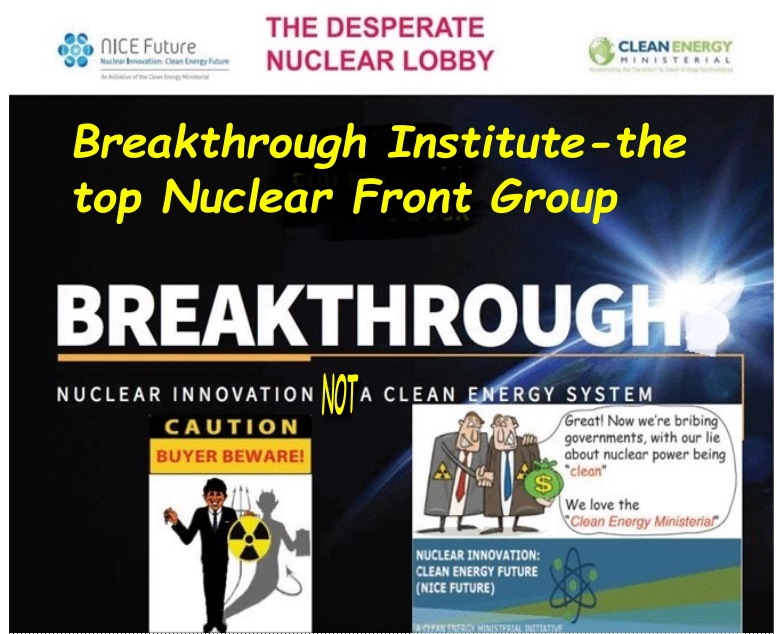
Though BEC no longer makes its membership public, the original coalition included such familiar names as Jeff Bezos (Amazon), Marc Benioff (Salesforce), Michael Bloomberg, Richard Branson, Jack Ma (Alibaba), David Rubenstein (Carlyle Group), Tom Steyer, George Soros, and Mark Zuckerberg. Many of those names (and others) can now be found on the “Board and Investors” page of Breakthrough Energy’s website.
Writing in Counterpunch (Dec. 4, 2015) shortly after BEC’s launch, Linda Pentz Gunter noted that many of those 28 BEC billionaires (collectively worth some $350 billion at the time) are pro-nuclear and Gates himself “is already squandering part of his wealth on Terra Power LLC, a nuclear design and engineering company seeking an elusive, expensive and futile so-called Generation IV traveling wave reactor” for SMRs. (In 2016, Terra Power, based in Bellevue, Washington, received a $40 million grant from Ernest Moniz’s Department of Energy.)
According to cleantechnica.com, the Breakthrough Energy Coalition “does have a particular focus on nuclear energy.” Think of BEC as the billionaires’ nuclear club.
By 2017, BEC was launching Breakthrough Energy Ventures (BEV), a $1 billion fund to provide start-up capital to clean-tech companies in several countries.
Going after the public purse

Bill Gates was apparently very busy during the 2015 Paris climate talks. He also went on stage during the talks to announce a collaboration among 24 countries and the EU on something called Mission Innovation – an attempt to “accelerate global clean energy innovation” and “increase government support” for the technologies. Mission Innovation’s key private sector partners include the Breakthrough Energy Coalition, the World Economic Forum, the International Energy Agency, and the World Bank.
An employee at Natural Resources Canada, Amanda Wilson, was appointed as one of the 12 international members of the Mission Innovation Steering Committee.
In December 2017, Bill Gates announced that the Breakthrough Energy Coalition was partnering with Mission Innovation members Canada, UK, France, Mexico, and the European Commission in a “public-private collaboration” to “double public investment in clean energy innovation.”
Canada’s Minister of Natural Resources at the time, Jim Carr, said the partnership with BEC “will greatly benefit the environment and the economy. Working side by side with innovators like Bill Gates can only serve to enhance our purpose and inspire others.”
Dr. M.V. Ramana, an expert on nuclear energy and a professor at the School of Public Policy and Global Affairs at UBC, told me by email: “As long as Bill Gates is wasting his own money or that of other billionaires, it is not so much of an issue. The problem is that he is lobbying hard for government investment.”
Dr. Ramana explained that because SMRs only exist on paper, “the scale of investment needed to move these paper designs to a level of detail that would satisfy any reasonable nuclear safety regulator that the design is safe” would be in the billions of dollars. “I don’t see Gates and others being willing to invest anything of that scale. Instead, they invest a relatively small amount of money (compared to what they are worth financially) and then ask for government handouts for the vast majority of the investment that is needed.”
Kevin Kamps, Radioactive Waste Specialist at Beyond Nuclear, told me by email that the companies involved in SMRs “don’t care” if the technology is actually workable, “so long as they get paid more subsidies from the unsuspecting public. It’s not a question of it working, necessarily,” he noted.
Gordon Edwards, President of the Canadian Coalition for Nuclear Responsibility, says governments “are being suckers. Because if Wall Street and the banks will not finance this, why should it be the role of the government to engage in venture capitalism of this kind?”
“Roadmap” to a NICE future
By 2018, NRCan was pouring money into a 10-month, pan-Canadian “conversation” about SMRs that brought together some 180 individuals from First Nations and northern communities, provincial and territorial governments, industry, utilities, and “stakeholders.” The resulting November 2018 report, A Call to Action: A Canadian Roadmap for Small Modular Reactors, enthusiastically noted that “Canada’s nuclear industry is poised to be a leader in an emerging global market estimated at $150 billion a year by 2040.”
At the same time, Bill Gates announced the launch of Breakthrough Energy Europe, a collaboration with the European Commission (one of BEC’s five Mission Innovation partners) in the amount of 100 million euros for clean-tech innovation.
Gates’ PR tactic is effective: provide a bit of capital to create an SMR “bandwagon,” with governments fearing their economies would be left behind unless they massively fund such innovations.
NRCan’s SMR Roadmap was just in time for Canada’s hosting of the Clean Energy Ministerial/Mission Innovation summit in Vancouver in May 2019 to “accelerate progress toward a clean energy future.” Canada invested $30 million in Breakthrough Energy Solutions Canada to fund start-up companies.
A particular focus of the CEM/MI summit was a CEM initiative called “Nuclear Innovation: Clean Energy (NICE) Future,” with all participants receiving a book highlighting SMRs. As Tanya Glafanheim and M.V. Ramana warned in thetyee.ca (May 27, 2019) in advance of the summit, “Note to Ministers from 25 countries: Prepare to be dangerously greenwashed.”
Greenwash vs public backlash
While releasing the federal SMR Action Plan on December 18, O’Regan called it “the next great opportunity for Canada.”
Bizarrely, the Action Plan states that by developing SMRs, our governments would be “supporting reconciliation with Indigenous peoples” – but a Special Chiefs Assembly of the Assembly of First Nations passed a unanimous 2018 resolution demanding that “the Government of Canada cease funding and support” of SMRs. And in June 2019, the Anishinabek Chiefs-in-Assembly (representing 40 First Nations across Ontario) unanimously opposed “any effort to situate SMRs within our territory.”
Some 70 NGOs across Canada are opposed to SMRs, which are being pushed as a replacement for diesel in remote communities, for use in off-grid mining, tar-sands development, and heavy industry, and as exportable expertise in a global market.
On December 7, the Hill Times published an open letter to the Treasury Board of Canada from more than 100 women leaders across Canada, stating: “We urge you to say ‘no’ to the nuclear industry that is asking for billions of dollars in taxpayer funds to subsidize a dangerous, highly-polluting and expensive technology that we don’t need. Instead, put more money into renewables, energy efficiency and energy conservation.”
No new money for SMRs was announced in the Action Plan, but in her Fall Economic Statement, Finance Minister Chrystia Freeland touted SMRs and noted that “targeted action by the government to mobilize private capital will better position Canadian firms to bring their technologies to market.” That suggests the Canada Infrastructure Bank will use its $35 billion for such projects.
It will take a Herculean effort from the public to defeat this NICE Future, but along with the Assembly of First Nations, three political parties – the NDP, the Bloc Quebecois, and the Green Party – have now come out against SMRs.
Award-winning author Joyce Nelson’s latest book, Bypassing Dystopia, is published by Watershed Sentinel Books. She can be reached via www.joycenelson.ca.
The Arsenal of Genocide: the U.S. Weapons That Are Destroying Gaza

the Biden administration has given itself a green light to keep sending weapons and Israel a flashing one to keep committing war crimes with them.
During the Second World War, the United States proudly called itself the “Arsenal of Democracy,” as its munitions factories and shipyards produced an endless supply of weapons to fight the genocidal government of Germany. Today, the United States is instead, shamefully, the Arsenal of Genocide, providing 70% of the imported weapons Israel is using to obliterate Gaza and massacre its people.
By Medea Benjamin, Nicolas J.S. Davies May 14, 2024, https://znetwork.org/znetarticle/the-arsenal-of-genocide-the-u-s-weapons-that-are-destroying-gaza/—
On May 8, 2024, as Israel escalated its brutal assault on Rafah, President Biden announced that he had “paused” a delivery of 1,700 500-pound and 1,800 2,000-pound bombs, and threatened to withhold more shipments if Israel went ahead with its full-scale invasion of Rafah.
The move elicited an outcry from Israeli officials (National Security Minister Itamar Ben-Gvir tweeted “Hamas loves Biden”), as well as Republicans, staunch anti-Palestinian Democrats and pro-Israel donors. Republicans immediately prepared a bill entitled the Israel Security Assistance Support Act to prohibit the administration from withholding military aid to Israel.
Many people have been asking the U.S. to halt weapons to Israel for seven months, and of course Biden’s move comes too late for 35,000 Palestinians who have been killed in Gaza, mainly by American weapons.
Lest one think the administration is truly changing its position, two days after announcing the pause, the State Department released a convoluted report saying that, although it is reasonable to “assess” that U.S. weapons have been used by Israeli forces in Gaza in ways that are “inconsistent” with international humanitarian law, and although Israel has indeed delayed or had a negative effect on the delivery of aid to Gaza (which is illegal under U.S. law), Israel’s assurances regarding humanitarian aid and compliance with international humanitarian law are “credible and reliable.”
By this absurd conclusion, the Biden administration has given itself a green light to keep sending weapons and Israel a flashing one to keep committing war crimes with them.
In any event, as Colonel Joe Bicino, a retired U.S. artillery officer, told the BBC, Israel can “level” Rafah with the weapons it already has. The paused shipment is “somewhat inconsequential,” Bicino said, “a little bit of a political play for people in the United States who are… concerned about this.” A U.S. official confirmed to the Washington Post that Israel has enough weapons already supplied by the U.S. and other allies to go ahead with the Rafah operation if it chooses to ignore U.S. qualms.
The paused shipment really has to be seen in the context of the arsenal with which the U.S. has equipped its Middle Eastern proxy over many decades.
A Deluge of American Bombs
During the Second World War, the United States proudly called itself the “Arsenal of Democracy,” as its munitions factories and shipyards produced an endless supply of weapons to fight the genocidal government of Germany. Today, the United States is instead, shamefully, the Arsenal of Genocide, providing 70% of the imported weapons Israel is using to obliterate Gaza and massacre its people.
As Israel assaults Rafah, home to 1.4 million displaced people, including at least 600,000 children, most of the warplanes dropping bombs on them are F-16s, originally designed and manufactured by General Dynamics, but now produced by Lockheed Martin in Greenville, South Carolina. Israel’s 224 F-16s have long been its weapon of choice for bombing militants and civilians in Gaza, Lebanon and Syria.
Israel also has 86 Boeing F-15s, which can drop heavier bombs, and 39 of the latest, most wastefully expensive fighter-bombers ever, Lockheed Martin’s nuclear-capable F-35s, with another 36 on order. The F-35 is built in Fort Worth, Texas, but components are manufactured all over the U.S. and in allied countries, including Israel. Israel was the first country to attack other countries with F-35s, in violation of U.S. arms export control laws, reportedly using them to bomb Syria, Egypt and Sudan.
As these fleets of U.S.-made warplanes began bombing Gaza in October 2023, their fifth major assault since 2008, the U.S. began rushing in new weapons. By December 1, 2023, it had delivered 15,000 bombs and 57,000 artillery shells.
The U.S. supplies Israel with all sizes and types of bombs, including 285-pound GBU-39 small diameter glide bombs, 500-pound Mk 82s, 2,000-pound Mk 84s and BLU-109 “bunker busters,” and even massive 5,000-pound GBU-28 bunker-busters, which Israel reportedly used in Gaza in 2009.
General Dynamics is the largest U.S. bomb manufacturer, making all these models of bombs. Most of them can be used as “precision” guided bombs by attaching Raytheon and Lockheed Martin’s Paveway laser guidance system or Boeing’s JDAM (Joint Direct Attack Munitions) GPS-based targeting system.
Little more than half of the bombs Israel has dropped on Gaza have been “precision” ones, because, as targeting officers explained to +972 magazine, their Lavender AI system generates thousands of targets who are just suspected rank-and-file militants, not senior commanders. Israel does not consider it worth “wasting” expensive precision munitions to kill these people, so it uses only “dumb” bombs to kill them in their homes—obliterating their families and neighbors in the process.
In order to threaten and bomb its more distant neighbors, such as Iran, Israel depends on its seven Lockheed Martin KC-130H and seven Boeing 707 in-air refueling tankers, with four new, state-of-the-art Boeing KC46A tankers to be delivered in late 2025 for over $220 million each.
Ground force weapons
Another weapon of choice for killing Palestinians are Israel’s 48 Boeing Apache AH64 attack helicopters, armed with Lockheed Martin’s infamous Hellfire missiles, General Dynamics’ Hydra 70 rockets and Northrop Grumman’s 30 mm machine guns. Israel also used its Apaches to kill and incinerate a still unknown number of Israelis on October 7, 2023—a tragic day that Israel and the U.S. continue to exploit as a false pretext for their own violations of international humanitarian law and of the Genocide Convention.
Israel’s main artillery weapons are its 600 Paladin M109A5 155 mm self-propelled howitzers, which are manufactured by BAE Systems in Chambersburg, Pennsylvania. To the layman, a self-propelled howitzer looks like a tank, but it has a bigger, 155 mm gun to fire at longer range.
Israel assembles its 155 mm artillery shells from U.S.-made components. One of the first two U.S. arms shipments that the administration notified Congress about after October 7 was to resupply Israel with artillery shell components valued at $147.5 million.
Israel also has 48 M270 multiple rocket launchers. They are a tracked version of the HIMARS rocket launchers the U.S. has sent to Ukraine, and they fire the same rockets, made by Lockheed Martin. U.S. Marines used the same rockets in coordination with U.S. airstrikes to devastate Mosul, the second largest city in Iraq, in 2017. M270 launchers are no longer in production, but BEA Systems still has the facilities to produce them.
Israel makes its own Merkava tanks, which fire U.S.-made tank shells, and the State Department announced on December 9, 2023, that it had notified Congress of an “emergency” shipment of 14,000 120 mm tank shells worth $106 million to Israel.
U.S. shipments of artillery and tank shells, and dozens of smaller shipments that it did not report to Congress (because each shipment was carefully calibrated to fall below the statutory reporting limit of $100 million), were paid for out of the $3.8 billion in military aid that the United States gives Israel each year.
In April, Congress passed a new war-funding bill that includes about $14 billion for additional weapons. Israel could afford to pay for these weapons itself, but then it could shop around for them, which might erode the U.S. monopoly on supplying so much of its war machine. That lucrative monopoly for U.S. merchants of death is clearly more important to Members of Congress than fully funding Head Start or other domestic anti-poverty programs, which they routinely underfund to pay for weapons and wars.
The move elicited an outcry from Israeli officials (National Security Minister Itamar Ben-Gvir tweeted “Hamas loves Biden”), as well as Republicans, staunch anti-Palestinian Democrats and pro-Israel donors. Republicans immediately prepared a bill entitled the Israel Security Assistance Support Act to prohibit the administration from withholding military aid to Israel.
Israel has 500 FMC-built M113 armored personnel carriers and over 2,000 Humvees, manufactured by AM General in Mishawaka, Indiana. Its ground forces are armed with several different types of U.S. grenade launchers, Browning machine-guns, AR-15 assault rifles, and SR-25 and M24 SWS sniper rifles, all made in the USA, as is the ammunition for them.
For many years, Israel’s three Sa’ar 5 corvettes were its largest warships, about the size of frigates. They were built in the 1990s by Ingalls Shipbuilding in Pascagoula, Mississippi, but Israel has recently taken delivery of four larger, more heavily-armed, German-built Sa’ar 6 corvettes, with 76 mm main guns and new surface-to-surface missiles.
Gaza Encampments Take On the Merchants of Death
The United States has a long and horrific record of providing weapons to repressive regimes that use them to kill their own people or attack their neighbors. Martin Luther King called the U.S. government “the greatest purveyor of violence in the world,” and that has not changed since he said it in 1967, a year to the day before his assassination.
Many of the huge U.S. factories that produce all these weapons are the largest employers in their regions or even their states. As President Eisenhower warned the public in his farewell address in 1960, “This conjunction of an immense military establishment and a large arms industry” has led to “the acquisition of unwarranted influence, whether sought or unsought, by the military-industrial complex.”
So, in addition to demanding a ceasefire, an end to U.S. military aid and weapons sales to Israel, and a restoration of humanitarian aid to Gaza, the students occupying college campuses across our country are right to call on their institutions to divest from these merchants of death, as well as from Israeli companies.
The corporate media has adopted the line that divestment would be too complicated and costly for the universities to do. But when students set up an encampment at Trinity College in Dublin, in Ireland, and called on it to divest from Israeli companies, the college quickly agreed to their demands. Problem solved, without police violence or trying to muzzle free speech. Students have also won commitments to consider divestment from U.S. institutions, including Brown, Northwestern, Evergreen State, Rutgers and the Universities of Minnesota and Wisconsin.
While decades of even deadlier U.S. war-making in the greater Middle East failed to provoke a sustained mass protest movement, the genocide in Gaza has opened the eyes of many thousands of young people to the need to rise up against the U.S. war machine.
The gradual expulsion and emigration of Palestinians from their homeland has created a huge diaspora of young Palestinians who have played a leading role in organizing solidarity campaigns on college campuses through groups like Students for Justice in Palestine (SJP). Their close links with extended families in Palestine have given them a visceral grasp of the U.S. role in this genocide and an authentic voice that is persuasive and inspiring to other young Americans.
Now it is up to Americans of all ages to follow our young leaders and demand not just an end to the genocide in Palestine, but also a path out of our country’s military madness and the clutches of its deeply entrenched MICIMATT (military-industrial-congressional-intelligence-media- academia-think-tank) complex, which has inflicted so much death, pain and desolation on so many of our neighbors for so long, from Palestine, Iraq and Afghanistan to Vietnam and Latin America.
Medea Benjamin and Nicolas J. S. Davies are the authors of War in Ukraine: Making Sense of a Senseless Conflict, published by OR Books in November 2022.
Medea Benjamin is the cofounder of CODEPINK for Peace, and the author of several books, including Inside Iran: The Real History and Politics of the Islamic Republic of Iran.
Nicolas J. S. Davies is an independent journalist, a researcher for CODEPINK and the author of Blood on Our Hands: The American Invasion and Destruction of Iraq.
Pension funds need ‘compelling’ returns from UK nuclear projects to invest

Ft. com 17 May 24
Potential investors tell Jeremy Hunt regulatory clarity also essential before backing new power plants.
Local authority pension funds managing hundreds of billions of pounds have told UK chancellor Jeremy Hunt that returns from new nuclear power plants need to be “compelling” to attract their cash. The chancellor is looking to pension funds to help finance the government’s ambition for nuclear power to meet a quarter of the UK’s electricity needs by 2050. Several town hall pension funds, managing more than £100bn in assets between them, were called to a meeting with Hunt this week, where the role of large retirement plans as potential investors in the Sizewell C nuclear project in Suffolk was discussed.
The head of the Sizewell C project spoke at the meeting, according to sources close to those who attended. London CIV, which manages £17bn of pension assets for local authorities in the capital and attended the meeting, outlined the criteria needed for it to invest. “Any infrastructure solution, including nuclear power, will need to provide regulatory clarity, a solid business model and a compelling inflation-linked return stream,” said London CIV. “This is ultimately about what our partner funds need. As they are our shareholders, we’ll collaborate with them to identify whether this area is worth exploring.”
Laura Chappell, chief executive of the Brunel Pension Partnership, which manages about £35bn in assets for eight local authority pension funds, attended the meeting and with other funds offered views to Hunt on the “problems, pitfalls and potential of investing in nuclear in the UK”. “Any infrastructure solution, including nuclear power, will need to provide regulatory clarity,” said Chappell in a statement to the FT. Chappell echoed that potential infrastructure projects would need to have a “solid business model, consistent policy, and a compelling investment proposition”. The pitch to pension funds comes against a backdrop of high-profile challenges for the nuclear sector in the UK.
France’s EDF said in January that the Hinkley Point C 3.2GW nuclear plant it is building in Somerset was on course to cost up to £46bn in today’s prices and would be delayed by two more years to 2029 — compared with an initial budget of £18bn and completion by 2025.
………………………………………………. Hunt’s meeting with pension leaders came more than a year after the government flagged its intention to consult on reforms that would make nuclear a more attractive investment for UK pension funds.
However, the government is yet to consult on these reforms, which would pave the way for nuclear power to be classified as “environmentally sustainable” under the UK’s upcoming “green taxonomy”
The Treasury declined to comment on the pension meeting, including who attended, but said: “We want to incentivise private investment in nuclear as a crucial source of reliable low-carbon energy and a driver of economic growth.
“We have already begun to engage with industry on the topic and will consult on a UK green taxonomy in due course.” The meeting was held in the same week ministers showed signs of losing patience with pension funds over low levels of investment in domestic listed and unlisted markets. In a speech this week, Bim Afolami, City minister, said “We have a challenge with pension funds.” He said if there was “no improvement” in levels of investment in the UK by pension funds then the government would “consider what further action can be taken”. https://www.ft.com/content/70cd278f-8ef5-4904-9535-305fe1095768
Nuclear power station risks hitting taxpayers with £20bn bill

Plans for a power station at Wylfa could be derailed by government rules
Telegraph, Matt Oliver, INDUSTRY EDITOR, 13 May 2024
Plans for a large nuclear power station on the Welsh island of Anglesey risk being derailed by government rules that will add an estimated £20bn to the national debt, insiders have warned.
Efforts to develop a gigawatt-scale scheme at Wylfa are on the agenda this week as Andrew Bowie, the minister for energy security, meets representatives from the South Korean state nuclear company Kepco.
The company is among several thought to be in the running to build a plant at Wylfa, with a consortium that includes US nuclear giant Westinghouse also putting forward proposals.
But one senior industry source warned there were concerns about the willingness of ministers to sign off on such a large project ahead of the general election, with the next government expected to be saddled with challenging budgetary constraints.
They blamed accounting rules which will force the British state to add the project’s full cost to the national debt, even if it only holds a minority stake in the scheme.
This is owing to the Government’s position as the ultimate guarantor if the project goes wrong.
There are fears it could put ministers off from backing a scheme at the Wylfa site, which has just been reacquired by the Government.
No decisions about the potential project have been taken yet but the scheme’s budget is widely expected to be in the region of £20bn. Britain’s debt pile is currently 98.3pc of GDP, or almost £2.7 trillion, as high interest rates push up the cost of Government borrowing.
The industry source said: “The main barrier right now is that if you build gigawatt-scale units, you have to put them on the Government balance sheet.
“Whoever is in power after the next election is going to have to grapple with that balance sheet – and are they really going to do this?
“It is something that is being looked at now.”………………….. https://www.telegraph.co.uk/business/2024/05/13/anglesey-nuclear-plant-risks-saddling-taxpayers-with-bill/
Sam Altman-backed nuclear start-up crashes after Wall Street debut

NEW YORK, https://www.malaymail.com/news/money/2024/05/11/sam-altman-backed-nuclear-start-up-crashes-after-wall-street-debut/133694 ― The share price of nuclear energy start-up Oklo, chaired by OpenAI boss Sam Altman, fell sharply yesterday on its first day of trading on Wall Street.
At around 3.40pm (1940GMT), the stock was down 53.9 per cent to US$8.40 (RM39.80).
Founded in 2013 by graduates of the Massachusetts Institute of Technology (MIT), Oklo went public by merging with AltC Acquisition Corp, a listed company.
The latter is a SPAC (special purpose acquisition company), a company whose sole purpose is to enable another firm to enter Wall Street through a merger.
Since the deal with Oklo was announced in July last year, AltC’s share price has soared, gaining over 72 per cent.
But transactions involving a SPAC are often highly volatile, partly because they are more exposed to speculation than traditional IPOs.
Altman is involved in several cutting-edge sectors and invested in Oklo in 2015, also becoming its chairman.
According to company documents, Altman directly controls around three per cent of the capital.
Oklo plans to build small modular reactors (SMRs), which are theoretically quicker to build than conventional power plants and less complicated to construct in remote areas. Oklo also wants to offer nuclear fuel recycling.
Conventional nuclear reactors are hugely expensive and take a long time to construct, with major projects having become notorious for their budget and schedule overruns.
The startup does not yet have a site of its own, and in January 2022 was refused a licence to build an SMR in Idaho by the Nuclear Regulatory Agency (NRC).
The NRC rejected the application on the grounds that there was a lack of information on the risks of accidents and the responses planned in such cases.
With the merger with AltC, Oklo raised US$306 million, which will be used to build the company’s first fission reactor, Aurora, in Ohio. ― AFP
“Nuclear comes last”

the tail-between-legs exit of the Nuclear Summit conferees declared in a headline: “Taxpayers are needed to foot the bill to achieve 2050 targets.”

Banks reject nuclear funding, stocks nosedive and the industry says it should, believe it or not, slow down
By Linda Pentz Gunter https://beyondnuclearinternational.org/2024/03/31/nuclear-comes-last/

NuScale, the company whose small modular reactor project collapsed so spectacularly last November, is “burning cash at the rate of $185 million per year”. On March 22, the company’s CEO, John Hopkins, sold 59,768 of his shares in the company. This is the same CEO who declared NuScale’s SMR project, aptly named VOYGR, “a dead horse.” It’s clearly on a journey to nowhere.

Wells Fargo, with an eye on prudent investments, has declared, “We think investor enthusiasm for SMR is misguided”. As The Motley Fool reported, “NuScale’s VOYGR nuclear power product has ‘no secure customers’ and is ‘not cost competitive’ says the analyst.”
The splashy cheerleading Nuclear Energy Summit organized by the International Atomic Energy Agency in Brussels on March 21 proved to be just that. The participants arrived floating on the hot air of their misplaced enthusiasm but “left humbled by the tepid reaction of bankers assessing the price tag of their ambitions”.
European Investment Bank Vice President Thomas Ostros, told Summit attendees to their face that “The project risks, as we have seen in reality, seem to be very high”. Representatives from the European and Latin American banking worlds said that “their lending priorities lean toward renewables and transmission grids” and that “nuclear comes last”.
Even the US Nuclear Regulatory Commission couldn’t quite bring itself to slam down its rubber stamp on Oklo’s chalet-in-the-woods micro reactor, the Aurora, which remains about as real as its namesake fairy tale princess.
In January 2022, the NRC denied Oklo’s license application outright because it “continues to contain significant information gaps in its description of Aurora’s potential accidents as well as its classification of safety systems and components,” wrote the NRC.
Oklo reapplied nine months later but according to the NRC docket there is “no further action”.
Nevertheless, Oklo brags on its website that it “made history” simply by developing “the first advanced fission combined license application to the U.S. Nuclear Regulatory Commission”, which sums up the second nuclear “renaissance” perfectly: Make a drawing. Hit ‘send’.
Meanwhile, the US military canceled its contract for an Aurora reactor originally intended for the Eielson Air Force Base near Fairbanks, Alaska.
And finally, an executive from the industry that has consistently delivered its latest new reactors decades late and billions over the original budget — in one case $20 billion over — suggested they should all just slow down. Said Ian Edwards, chief executive of Canadian reactor producer, Atkins Realis, “we all become too optimistic. We have this optimism bias towards being able to deliver faster. Really we should probably slow things down a little bit.”
But nuclear power is the answer to our current climate crisis! Ya think?
It’s tempting to ask whether things can get any worse for the nuclear power industry, but they almost certainly will. Unless we end up paying for it all. As the Bloomberg article that related the tail-between-legs exit of the Nuclear Summit conferees declared in a headline: “Taxpayers are needed to foot the bill to achieve 2050 targets.”
At the moment, a majority in the US Congress seem intent on making sure that is exactly what will happen. Because after all, why should multi-billionaire, Bill Gates, be forced to pay for his own nuclear toys when he can milk (read ‘bilk’) US taxpayers instead?
The US government has already pledged $2 billion of our money to Gates for his proliferation-friendly liquid sodium-cooled molten salt fast reactor produced by his company, TerraPower (more properly, TerrorPower). Gates can’t wait to export it the United Arab Emirates. Nuclear weapons anyone?
The strokey-white-beard-named ADVANCE Act, has been passed by the US House with 365 voting in favor and only 36 Democrats-with-a-conscience voting against it. By its own description, the ADVANCE ACT aims to “advance the benefits of nuclear energy by enabling efficient, timely, and predictable licensing, regulation, and deployment of nuclear energy technologies.” In other words, do away with burdensome — and expensive — safety regulations.
Indeed, New Mexico Democrat, Senator Martin Heinrich, told E&E News in January that “These regulatory timelines do not lend themselves to fighting the climate crisis.” Oh those wascally wegulations!
Meanwhile, Democratic senator Joe Manchin of West Virginia doesn’t want to seat any new NRC commissioners who might be “too focused on safety.”
The NRC’s motto is “protecting people and the environment,” a mandate it demonstrably endeavors to avoid already, but even some vestige of interest in safety is probably better than none. Not that safety oversight will be needed of course because, hey, SMRs are “walkaway safe” and “meltdown proof” and any new light water reactors are too “advanced” to be a safety risk.
This makes the insistence by SMR manufacturers that they must be covered by the Price-Anderson Act (PAA) all the more curious. Price-Anderson, due to expire in 2025, was culled out of the ADVANCE ACT, now moving out of Senate committee and working its way through the reconciliation process, and handled separately. The Senate adopted the House version of the PAA, giving it a 40-year extension to 2026, and expanded limited liability for a major accident to just over $16 billion per reactor.
President Biden duly signed it into law, marking another misstep on what is becoming an increasingly problematic presidency.
Ed Lyman, Nuclear Power Safety Director at the Union of Concerned Scientists, told Nuclear Intelligence Weekly that “The nuclear industry’s push for a 40-year Price-Anderson Act extension is a sure sign that it doesn’t believe its own messaging about how safe the next generation of nuclear reactors is going to be.”
But in a joint statement, Senator Shelley Moore Capito (R-W.Va.) and Senator Tom Carper (D-Del.) declared that “The extension of the Price-Anderson Act in the minibus sends a clear message that we are committed to the advancement of this safe and reliable power source.”
The “clear message” this actually sends is that, in the event of a major nuclear accident, US taxpayers will be thrown under that minibus. The $16 billion coverage will be chicken feed and we will all be stuck with the bill. Let’s remember that the Chornobyl and Fukushima nuclear disasters are each racking up costs in the hundreds of billions of dollars and counting. We have been warned.
But a bi-partisan group of Representatives and Senators think it’s perfectly fine for all of us to pay for such an eventuality. Meanwhile, if you own a home and are forced to abandon it in the path of a nuclear accident, you cannot claim a dime off your homeowner’s insurance. It will just be a total loss. Think about that for a moment.
Are we outraged yet?
Linda Pentz Gunter is the international specialist at Beyond Nuclear
Nuclear Weapons at Any Price? Congress Should Say No

Costs are skyrocketing to modernize the U.S. nuclear arsenal. Instead of turning a blind eye, Congress should demand fiscal oversight and make hard decisions balancing costs with deterrence
BY SHARON K. WEINER, 13 May 24, https://www.scientificamerican.com/article/nuclear-weapons-at-any-price-congress-should-say-no/
Bipartisanship seems rare in Congress these days. But one place to consistently find agreement between Democrats and Republicans is support for modernizing the U.S. nuclear arsenal—currently numbering almost 5,000 nuclear warheads, plus the triad of missiles, submarines and bombers to deliver them. Unfortunately, that consensus also seems to extend to turning a blind eye to the exploding costs, which helps explain why the original $1 trillion modernization program proposed in 2010 today has a price tag approaching $2 trillion. That estimate is likely to escalate even further by 2050—the supposed end date for modernization.
Supporting nuclear modernization at any price is neither necessary nor affordable. Instead, Congress needs to improve, and be held accountable for, fiscal oversight of the nuclear arsenal.
Congress should first start by looking at the intercontinental ballistic missiles (ICBMs). In January of this year, the Air Force announced that the price tag for its new ICBM—the Sentinel—had increased by more than 37 percent. This triggered a review mandated by the Nunn-McCurdy Act—a 1982 law that sought to rein in the spiraling cost of military spending. Sentinel’s increased cost—from $96 billion to $130 billion over the next 10 years—is a “critical breach” of the act and should lead to termination of the program. To avoid this, the secretary of defense must explain the cause of the cost growth and restructure the program, which he is expected to do in coming months.
But the Sentinel “critical breach” underplays modernization’s inflation. In 2015 the U.S. Air Force put the price of a new ICBM program at $62 billion and argued that a new missile would be cheaper than maintaining the current Minuteman III ICBMs. A year later an independent Pentagon evaluation had argued that costs could go as high as $150 billion—yet the official estimate put the price at $85 billion. Congress failed to investigate why the budget request was based on the lower figure. So far, no hearings are planned to investigate the Sentinel cost overrun or to consider the options for restructuring or eliminating the program. For perspective, Congress has held two hearings on UFOs in the last two years.
Not to be outdone, the National Nuclear Security Administration (NNSA)—the part of the Department of Energy in charge of making warheads for the nuclear arsenal—announced on April 18 that building the facilities to make plutonium pits for those warheads would cost $28 to $37 billion—a significant jump over the 2018 estimate of $8.6 to 14.8 billion. But that increase doesn’t capture the full picture of the cost inflation that has plagued pit production.
Until 1989, pits were made at Rocky Flats, a U.S. government facility operated by a contractor that was raided by the FBI and subsequently closed after numerous environmental and safety violations. Since that time, only a handful of pits have been made, all at Los Alamos National Laboratory, which itself has a history of safety problems.
In the late 1990s, NNSA began proposing expanded pit production at Los Alamos. In 2001 it proposed a facility to produce 80 pits per year at an estimated cost of $375 million. By 2011 the price tag for pit production had grown to between $3.7 and $5.8 billion—even at that time seen as unrealistically low because the facility’s design had yet to be completed and the estimate was for construction only, not operations and maintenance. By 2014, that plan was abandoned, and a new one was introduced with an estimated cost of $4.3 billion. Soon that too ran over budget and behind schedule. You might notice a pattern here.
At this point, Congress stepped in. But not to investigate the reasons for the cost overruns. Instead, in the 2015 National Defense Authorization Act, Congress simply ordered NNSA to succeed. It decreed that NNSA had to make 80 pits per year by 2027, later extended to 2030. Frustrated with the seeming inability of Los Alamos to make progress, in 2018 pit production was expanded to another NNSA facility: the Savannah River Site in South Carolina. The plan now is to repurpose for pit production a building originally intended to recycle plutonium from dismantled Cold War nuclear weapons to turn it into fuel for nuclear reactors. But that original disarmament project was terminated in 2018 after costs rose from a 2004 estimate of $1.8 billion to $17.2 billion. Congress never held hearings to assess the reasons for this cost escalation, lessons learned or how to prevent similar problems in the future.
If major projects at NASA, the Veterans Administration or almost any other government agency mimicked these problems, Congress would hold hearings and demand explanations. Nuclear modernization deserves the same hard scrutiny.
Congress should require independent cost estimates of the Sentinel program, pit production at both Los Alamos and Savannah River, and any other major nuclear modernization program where the estimated cost exceeds the original baseline by 50 percent or more—a threshold in the Nunn-McCurdy Act. These estimates should be undertaken by an entity that has no fiscal stake in the outcome, and is politically insulated from those who do.
Unlike the Defense Department’s Cost Assessment and Program Evaluation (CAPE) office, which has a track record of independent analysis, the NNSA has struggled to develop a similar oversight capability. The NNSA remains on GAO’s list of federal agencies that are “vulnerable to waste, fraud, abuse, and mismanagement,” or that need broad reform, since the list was first created in 1990. The NNSA has shown, repeatedly, that it cannot change itself.
It’s reasonable, of course, that cost estimates for projects involving uncertainties such as technologies still under development can result in a range of estimates. Routinely rubber-stamping endorsements of the lower figures, however, should stop. Instead the president’s budget submission should adopt the highest credible estimate, accompanied by an explanation of how the program will strive to come in under budget.
Independent cost estimates typically link budgets to services, such as plutonium processing, or material things such as facilities or weapons. In the case of nuclear modernization, though, that’s not sufficient; the link needs to extend to the impact on the strategy of deterrence. Nuclear weapons threaten the lives of billions of people. Does $14 billion worth of pit production provide better deterrence than $37 billion worth? Is a $118 million Sentinel missile more effective at preventing nuclear war than an existing ICBM that costs half as much? It’s only by linking dollars to deterrence that Congress can assess the tradeoffs and move beyond the notion that nuclear modernization is justified regardless of the final price tag.
Sizewell C nuclear station ‘absolutely not inevitable’ says campaigner – Can investors be found?

The official cost of Sizewell C has been put at £20bn by the government, but many observers expect the final bill to be much higher due to increased building costs.
who would want to invest in an expensive project which will take 12 years to build, with no guarantee of a return for many more years?
Andrew Sinclair – Political editor, BBC East, Sun, 12 May 2024 https://au.news.yahoo.com/sizewell-c-absolutely-not-inevitable-091834059.html
A leading campaigner against the Sizewell C nuclear power station has said its construction is still not inevitable.
The planned energy plant, on the Suffolk coast, has just been granted its nuclear site licence.
But Alison Downes, director of campaign group Stop Sizewell C, has questioned whether the government will be able to attract enough private investment.
Ministers, who have already contributed £2.5bn to the project, have said they remain committed to the scheme.
The decision to grant Sizewell C a nuclear site licence on 7 May was described by the project team and local business groups as a “huge milestone”.
It came just months after the government granted a Development Consent Order to Sizewell C and pledged further funding to the project. Ministers have regularly referred to Sizewell C when discussing the country’s nuclear programme.
Andrew Bowie, Minister for Nuclear and Renewables, said: “Sizewell C will be the cornerstone of the UK’s clean energy transition, supplying six million homes with green energy for decades.”
But despite plenty of signs that the project could be coming closer to reality, Alison Downes insisted on BBC Politics East that “it’s absolutely not inevitable”.
“We still don’t know who is going to pay for it. The government is trying to raise funds at the moment, but there’s no guarantee it’ll be successful,” she said.
The government agreed to take a 50% stake in the development of Sizewell C after concerns about the involvement of Chinese investors and it is looking for investors to help fund the project.
Can investors be found?
The official cost of Sizewell C has been put at £20bn by the government, but many observers expect the final bill to be much higher due to increased building costs.
The prime minister told me last year that there had already been “encouraging early interest” from people wanting to invest.
But campaigners have questioned who would want to invest in an expensive project which will take 12 years to build, with no guarantee of a return for many more years.
Ms Downes, who also has concerns about the safety of the site from rising sea levels and the project’s impact on local habitats, said: “A lot of taxpayers’ money has gone into a project that has no absolute certainty of whether or not it’s going ahead.”
The argument for nuclear
But Richard Rout, the deputy leader of Suffolk County Council, told BBC Politics East that the demand for more homegrown green energy meant that Sizewell was essential.
“I think Sizewell C is now at a point where it has to happen. We need nuclear in this country to give us energy independence,” he said.
“We are now seeing Sizewell C move forward and for me [the priority now] is about minimising the impacts on the local community and maximising the benefits.”
But Alison Downes pledged to “absolutely keep fighting” .
A final decision on whether to go ahead with the project is expected to be taken by energy company EDF towards the end of 2024.
US nuclear industry clamors for waiver process details as Russian uranium ban looms

companies with enriched uranium contracts with Russia can seek to continue to receive their material .
Questions were raised during the meeting about whether the names of those receiving waivers would be made public
https://www.spglobal.com/commodityinsights/en/market-insights/latest-news/electric-power/051024-us-nuclear-industry-clamors-for-waiver-process-details-as-russian-uranium-ban-looms Author, Andrea Jennetta William Freebairn 10 May 24
HIGHLIGHTS
DOE plans to issue notice on process shortly after bill enactment
Utilities worried about criteria for showing inability to obtain fuel
Waiver process important to entire industry, Centrus CEO says.
US nuclear operators and nuclear fuel market participants have asked a series of questions to the US Department of Energy in a meeting last week, eager to learn details of a system of waivers being developed in connection with the passage of a ban on Russian enriched uranium late last month. DOE officials, while guarded, told the industry it would be ready for speedy and reasoned adjudication of waiver claims, according to attendees.
The Senate unanimously approved the measure April 30, following passage of a similar bill in the House of Representatives in December. The ban takes effect 90 days after President Joe Biden signs the bill into law.
Under an as-yet disclosed waiver system, companies with enriched uranium contracts with Russia can seek to continue to receive their material by demonstrating they do not have viable alternate sources of fuel or that continued deliveries are in the national interest.
Two people who attended an April 30 meeting with DOE officials said the department indicated it will be ready to publish a Federal Register notice within 30 days of enactment of the legislation outlining the process for seeking waivers.
The legislation is designed to reduce US reliance on Russian uranium for nuclear fuel following Russia’s 2022 invasion of Ukraine. Russia supplies about 20% of US reactor operators’ enrichment needs, although most utilities have sought to reduce their dependence on Russian state nuclear company Rosatom in recent months.
However, a utility fuel buyer said there was skepticism among some participants that the department would be ready, as there are myriad complexities around the process and timetables.
“They still don’t have a lot of answers,” the fuel buyer said.
Biden has not signed the legislation, which was sent by Congress to the White House May 8, according to one meeting participant. The bill becomes law if the president does not veto it within 10 days of formal receipt from Congress, whether he signs it or not, several meeting participants said.
Questions were raised during the meeting about whether the names of those receiving waivers would be made public, whether uranium coming into the country for fabrication into fuel and export out of the US would require or receive waivers and what criteria would be used to permit utilities to receive Russian fuel, the people said. All those who spoke about the meeting did so on condition of anonymity to discuss the private meeting and avoid hurting their relationship with the DOE.
The rapid timeframes involved raise questions as well, the fuel buyer said. “How are they going to do this on a 90-day schedule, when there are ships literally on the water” containing enriched uranium, the person said.
A uranium producer in attendance said DOE officials indicated they would seek to act as rapidly as possible for requests on material in transit or requiring a decision regarding short-term deliveries.
An industry official who attended the meeting said DOE indicated it would take a “relaxed approach, particularly over the next couple of years,” in approving end-user waivers. Still, the department was noncommittal in its plans, the person said.
DOE plans to request detailed information on why a delivery should be allowed, with information on the impact on the national interest as well as the potential challenges in securing replacement material, the attendees said. Utilities would need to show that inventories are not sufficient to replace the imported material, one of the people said. DOE would adjudicate those claims, this person said.
The uranium producer said the passage of the legislation offered miners a better option than the potential for executive action which the White House had indicated could take place should Congress fail to act. He said DOE in its meeting seemed unaware that the legislation was about to be passed by the Senate later that day, and so some of the department’s comments were guarded because officials did not know whether an executive order barring the imports or the language of the House legislation would prevail.
Centrus preparing for waiver submittal
The applicant for the waivers must be the importer of record, one person who attended the meeting said. This would mean that in the case of re-sellers of Russian enrichment services, such as Centrus, the re-seller would apply on behalf of customers, this person said.
Centrus and its predecessor companies have for several years purchased from Russia’s state-owned Tenex an annual quantity of Russian enriched uranium under a quota set by the Russian suspension agreement, then sold the LEU to utility customers.
“We obviously have all the intentions to apply for a waiver at the first opportunity,” said Centrus President, CEO and Director Amir Vexler in a first quarter earnings call May 8. “Yes, we’ve been preparing. We’re going to make use of this process, and it is extremely important, not only to Centrus, but to the industry here in the US.”
The company could find itself in a precarious financial position without access to enriched uranium to deliver to customers……………………………….
International impact
US utilities are not the only ones affected by the ban, several people said. Any foreign utility that has Russian enriched uranium delivered to a US fuel fabricator for re-export as fuel would also need a waiver, they noted.
DOE mentioned that utilities should be aware of at least one such pending case, which two people said is likely a reference to Mexico’s Comision Federal de Electricidad, which operates two GE-supplied boiling water reactors that get fuel from the US.
DOE officials reminded participants in the meeting that any process and all waivers will still have to comply with US sanctions requirements, one attendee said, and that waiver requests will have to take into account the availability of the American Assured Fuel Reserve, a stockpile of government-owned enriched uranium designed to protect nuclear operators from a disruption of nuclear fuel availability.
DOE did not immediately respond to a request for comment.
NuScale, maker of small nuclear reactors, reported revenue of $1.4 million and net loss of $48.1 million for the three-month period ended March 31, 2024
NuScale reported revenue of $1.4 million and net loss of $48.1 million for
the three-month period ended March 31, 2024, compared to revenue of $5.5
million and a net loss of $35.6 million for the same period in 2023. Higher
net loss reported in the period was driven by a one-time $3.2 million
charge associated with continuing our transition from an R&D-based company
to commercial operations, and a $9.0 million non-cash adjustment to the
fair value of our warrants due to an increase in the Company’s share price.
Business Wire 9th May 2024
1 This Month

of the week – Shut Down Drone Warfare!


Tell the Ukrainian Government to Drop Prosecution of Peace Activist Yurii Sheliazhenko

Petition to revoke the licensing of the Near Surface Nuclear Disposal Facility (NSDF) at Chalk River. https://www.ourcommons.ca/petitions/en/Petition/Details?Petition=e-7247
To see nuclear-related stories in greater depth and intensity – go to https://nuclearinformation.wordpress.com
-
Archives
- April 2026 (103)
- March 2026 (251)
- February 2026 (268)
- January 2026 (308)
- December 2025 (358)
- November 2025 (359)
- October 2025 (376)
- September 2025 (257)
- August 2025 (319)
- July 2025 (230)
- June 2025 (348)
- May 2025 (261)
-
Categories
- 1
- 1 NUCLEAR ISSUES
- business and costs
- climate change
- culture and arts
- ENERGY
- environment
- health
- history
- indigenous issues
- Legal
- marketing of nuclear
- media
- opposition to nuclear
- PERSONAL STORIES
- politics
- politics international
- Religion and ethics
- safety
- secrets,lies and civil liberties
- spinbuster
- technology
- Uranium
- wastes
- weapons and war
- Women
- 2 WORLD
- ACTION
- AFRICA
- Atrocities
- AUSTRALIA
- Christina's notes
- Christina's themes
- culture and arts
- Events
- Fuk 2022
- Fuk 2023
- Fukushima 2017
- Fukushima 2018
- fukushima 2019
- Fukushima 2020
- Fukushima 2021
- general
- global warming
- Humour (God we need it)
- Nuclear
- RARE EARTHS
- Reference
- resources – print
- Resources -audiovicual
- Weekly Newsletter
- World
- World Nuclear
- YouTube
-
RSS
Entries RSS
Comments RSS
 nuclear-news