Amazon-backed nuclear power developer X-Energy threatens to move investment away from UK
Amazon-backed nuclear power developer X-Energy delivered a potential blow
over the weekend by threatening to move investment earmarked for its first
next-generation plants in the UK elsewhere unless the government sets out a
clear regulatory and financial route to market, The Times reported this
morning. “We would like to go big in Europe from a base in the UK but we
don’t have to do a base in the UK,” said X-Energy’s chief executive Clay
Sell.
“We’ve got to get real and we’ve got to get going, otherwise we’re
going to go someplace else.” Based in Maryland in the United States, the
firm is reported to be in discussions with French energy group EDF to build
one or more units on the site of the Hartlepool nuclear power plant, which
is due to be decommissioned in 2027. X-Energy recently closed a $700m
funding round anchored by Amazon, as part of a broader partnership to bring
5GW of power on stream by 2039. However, Clay reportedly said he remains
“very optimistic” that it could get its 80MW modular reactors – which can
be scaled into “four pack” 320MW plant – built in the UK.
Business Green 17th Feb 2025
French State Spars With EDF Over Multibillion-Euro Reactor Plan
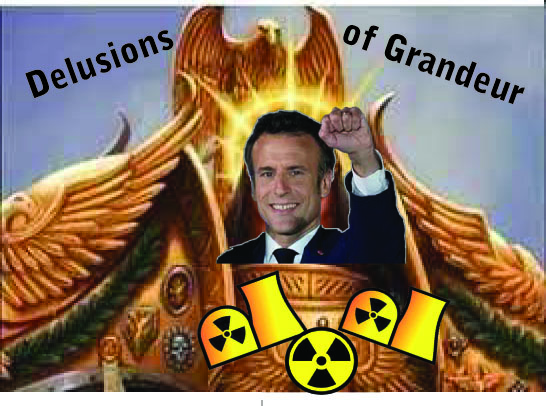
French government officials took issue with Electricite de France SA’s plan to build six nuclear plants, saying cost estimates are too broad and reactor designs not firmed up, according to people with knowledge of recent talks.
Bloomberg News, Francois de Beaupuy, Feb 14, 2025 – https://financialpost.com/pmn/business-pmn/french-state-spars-with-edf-over-multibillion-euro-reactor-plan
EDF’s board met with state representatives last week amid growing concern that the company and its suppliers are far from ready to launch a project deemed key to France’s long-term energy security. The world’s biggest nuclear-plant operator needs to prove it has a credible plan after long delays and cost overruns at other reactor developments caused debts to balloon.
Officials at the Feb. 5 meeting characterized state-owned EDF’s presentation as unconvincing on both budget and reactor design, the people said, asking not to be identified discussing private talks.
A French state auditor said last month that a final investment decision on the six reactors should be made only once their design is well advanced and funding finalized. It said the estimated bill for construction, excluding financing costs, had swelled to almost €80 billion ($84 billion) when accounting for inflation.
The criticism at last week’s presentation went both ways. EDF Chief Executive Officer Luc Remont railed against the government for enacting a finance bill that doesn’t specify tax rates on future windfall revenues, the people said. Several board members also expressed concerns about the uncertainty surrounding the level of state aid for reactor projects, the people said.
Spokespeople for EDF and the government’s shareholding agency declined to comment.
Slow progress is not only fueling tensions between EDF and the government. It also threatens to undermine preparations along the supply chain for reactor construction. In the past two years, EDF has seen US and Korean competitors make inroads in European markets as its own proposals were overlooked.
Nuclear Revival
The difficulties faced by a nuclear behemoth such as EDF may also raise questions over the speed and breadth of an atomic-power renaissance across Europe, with many countries planning new reactors to cut emissions from power generation and bolster energy security.
Back in July, EDF’s Remont expressed hope that a state support package for the six new reactors would be agreed upon by the end of 2024, paving the way for a final investment decision by the end of 2025 or early next year.
Already on the back foot, EDF must now move quickly to pin down costs and designs so that the government can work out the necessary support and seek approval from European competition authorities, the people said. The state aid needs to be fine-tuned to limit any remedies requested by Brussels, they said.
X-Energy threatens to pull out of building nuclear plants in Britain
Developer backed by Amazon demands clarity on financial and regulatory
support before building advanced modular reactor in Hartlepool.
X-Energy, based in Maryland in the United States, is in discussions with EDF, the
French state-backed energy group, over a project to build one or more units
on the site of the Hartlepool nuclear power plant in Co Durham, a
large-scale reactor that is due to be decommissioned in 2027.
The company, which is also backed by Dow, the American industrial group, is developing
its first advanced modular reactor at one of Dow’s manufacturing sites on
the Texas Gulf Coast, with support from the US government. Another project
for Amazon is also planned in Washington state.
While its preference was to
build its first European Xe-100 reactors in Britain, Clay Sell,
X-Energy’s chief executive, said that without greater clarity from the
government on financial and regulatory support mechanisms it would look to
other markets. “We would like to go big in Europe from a base in the UK
but we don’t have to do a base in the UK. We’ve got to get real and
we’ve got to get going, otherwise we’re going to go someplace else,”
Sell said.
A clear framework included sites being made available for
advanced modular reactors, some government support for early development
work for the first plant alongside private capital, and funding for
construction through the so-called regulated asset base model, which is
levied on electricity bills. Unlike the existing designs operating in the
UK, X-Energy’s technology uses helium as a coolant rather than water to
divert heat away from the core. It has also developed its own fuel, which
it claims can withstand four times the temperature of typical nuclear fuel.
Times 17th Feb 2025, https://www.thetimes.com/business-money/companies/article/x-energy-threatens-to-pull-out-of-building-nuclear-plants-in-britain-hk99djbps
US government tries to rehire nuclear staff it fired days ago
BBC, Brandon Drenon, 16 FEB 25
The US government is trying to rehire nuclear safety employees it had fired on Thursday, after concerns grew that their dismissal could jeopardise national security, US media reported.
The National Nuclear Security Administration (NNSA) workers were among hundreds of employees in the energy department who received termination letters.
The department is responsible for with designing, building and overseeing the US nuclear weapons stockpile.
The terminations are part of a massive effort by President Donald Trump to slash the ranks of the federal workforce, a project he began on his first day in office, less than a month ago.
US media reported that more than 300 NNSA staff were let go, citing sources with knowledge of the matter.
That number was disputed by a spokesperson for the Department of Energy, who told CNN that “less than 50 people” were dismissed from NNSA.
The Thursday layoffs included staff stationed at facilities where weapons are built, according to CNN.
The Trump administration has since tried to reverse their terminations, according to media outlets, but has reportedly struggled to reach the people that were fired after they were locked out of their federal email accounts.
A memo sent to NNSA employees on Friday and obtained by NBC News read: “The termination letters for some NNSA probationary employees are being rescinded, but we do not have a good way to get in touch with those personnel.”…………………………………………………..
https://www.bbc.co.uk/news/articles/c4g3nrx1dq5o
India PM Modi ends foreign tour with nuclear deals in pipeline
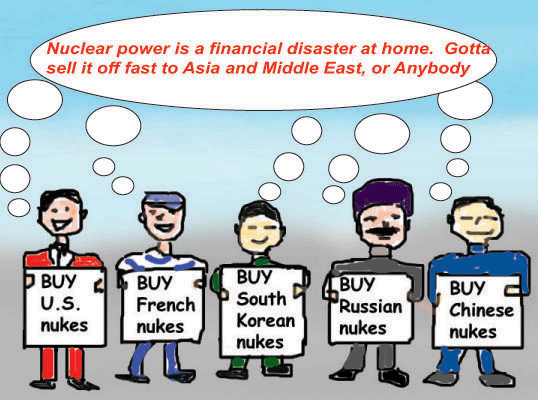
By AFP, 14 February 2025 Daily Mail
Indian Prime Minister Narendra Modi concluded a whistle-stop diplomatic tour Friday having secured significant pledges of support from Washington and Paris to help step up his country’s nuclear energy programme.
New Delhi has vowed to achieve net zero carbon emissions by 2070 partly by increasing the number of nuclear plants in the country from eight, which currently account for around three percent of power generation in India.
Modi’s White House meeting with President Donald Trump resulted in an agreement to build US-designed nuclear reactors in India.
“This path forward will unlock plans to build large US-designed reactors and enable collaboration to develop, deploy and scale up nuclear power generation with advanced small modular reactors,” a joint statement said Thursday.
India revealed a similar deal with France following Modi’s meeting with President Emmanuel Macron earlier this week.
Foreign secretary Vikram Misri said Wednesday that India and France aimed to initiate cooperation on developing small modular nuclear reactors, nothing that the technology was still in its “initial stages”.
“Our intent is to be able to cooperate in co-designing the reactors, co-developing them, and co-producing them,” he told reporters.
Both partnerships come days after Modi’s government announced plans to amend its strict nuclear liability law, which holds operators liable for any damage or accident, with exceptions made for certain situations including natural disasters……………………… https://www.dailymail.co.uk/wires/afp/article-14396859/India-PM-Modi-ends-foreign-tour-nuclear-deals-pipeline.html
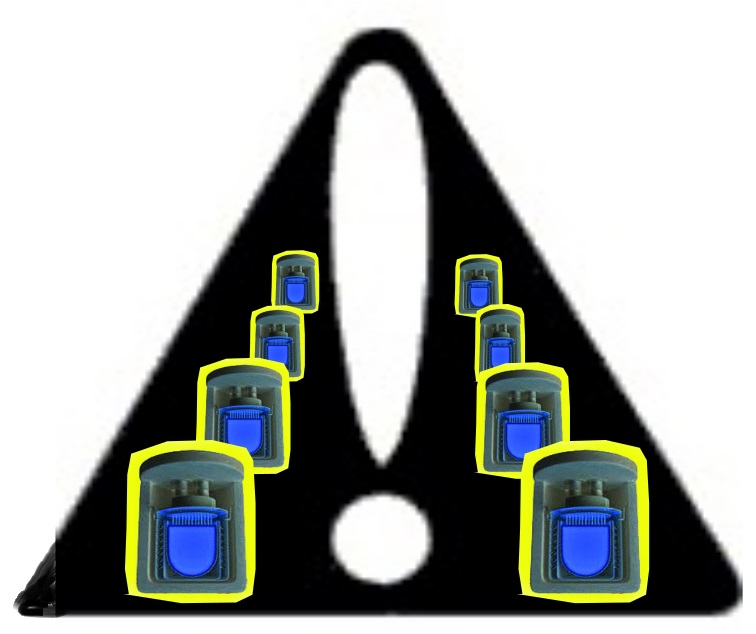
Small nuclear reactors: Big safety problems, and who pays the piper?
https://www.smh.com.au/world/north-america/trump-wants-russia-china-to-stop-making-nuclear-weapons-so-all-can-cut-defence-spending-by-half-20250214-p5lc59.html 15 February, 2025
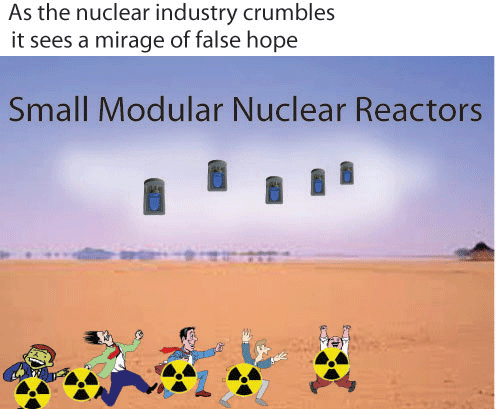
As usual, in matters nuclear, the Anglophone news is awash with articles extolling the future virtues of Small Nuclear Reactors. Especially in the UK, where Trumpian antics don’t dominate the news the whole time, nuclear news gets a lot of coverage. As I’ve mentioned before, the UK corporate press is ecstatic about SMRs. SMR critics, (of which there are plenty), usually focus their ire on the subject of costs. Other objections centre on health, climate needs, the environment, and the connection between civil and military nuclear technology.
The nuclear lobby has very successfully touted safety as the big plus for the new (though still non-existent) Small Nuclear Reactors (SMRs) . Everyone seemed to buy this idea, because, after all, SMRs can’t melt down in the same dramatic way that big ones can. So, there’s been relatively little fuss made by the anti-nuclear movement on the grounds of safety, regarding SMRs.
Imagine my surprise when I opened up my eyes today – to see a corporate media news outlet, New Civil Engineer, usually pro-nuclear, coming out with a damning criticism of SMRs on the grounds of safety. It’s not as if New Civil Engineer actually condemned SMRs. Oh no! – they did indeed point out that the Department for Energy Security & Net Zero ((DESNZ) is confident that SMR developments are subject to “robust controls“. And the Office of Nuclear Security (ONR) “ensures that the highest levels of safety, security and safeguards are met”
It’s just that New Civil Engineer brought up a few points that have escaped notice, following the publication of the draft National Policy Statement for nuclear energy generation (EN-7) They note that –
“Despite EN-7 being 64 pages, just two lines are dedicated to specifically addressing the security of SMRs.“
The new regulations for SMRs would allow for many new nuclear sites near communities.
For large nuclear power sites, security is funded by the developers themselves. For SMRs, the security needs would be provided by the Civil Nuclear Constabulary (CNC) and also by local police. But these bodies are not under the direction of the ONR or the DESNZ. The writer quotes a policing expert, John McNeill :
“Not even [the government] can direct them.
Policing of airports and football grounds, even schools and educational campuses, shows how hard this will be to fund fairly.”
The expansion of AI and data centres add another complexity to the question of the amount of security needed, and of who pays for it. The proliferation of nuclear sites, closer to populated areas also means the increase in transport of radioactive materials – again bringing the risks of accidents, theft, and terrorism. And again, bringing the need for more security measures.
There’s some community concern in the UK about the safety of prolonging the life of aging nuclear reactors, and of the safety of coastal reactors and the marine environment. There’s also concern about the safety of the SMRs themselves, as the governments relax regulations.
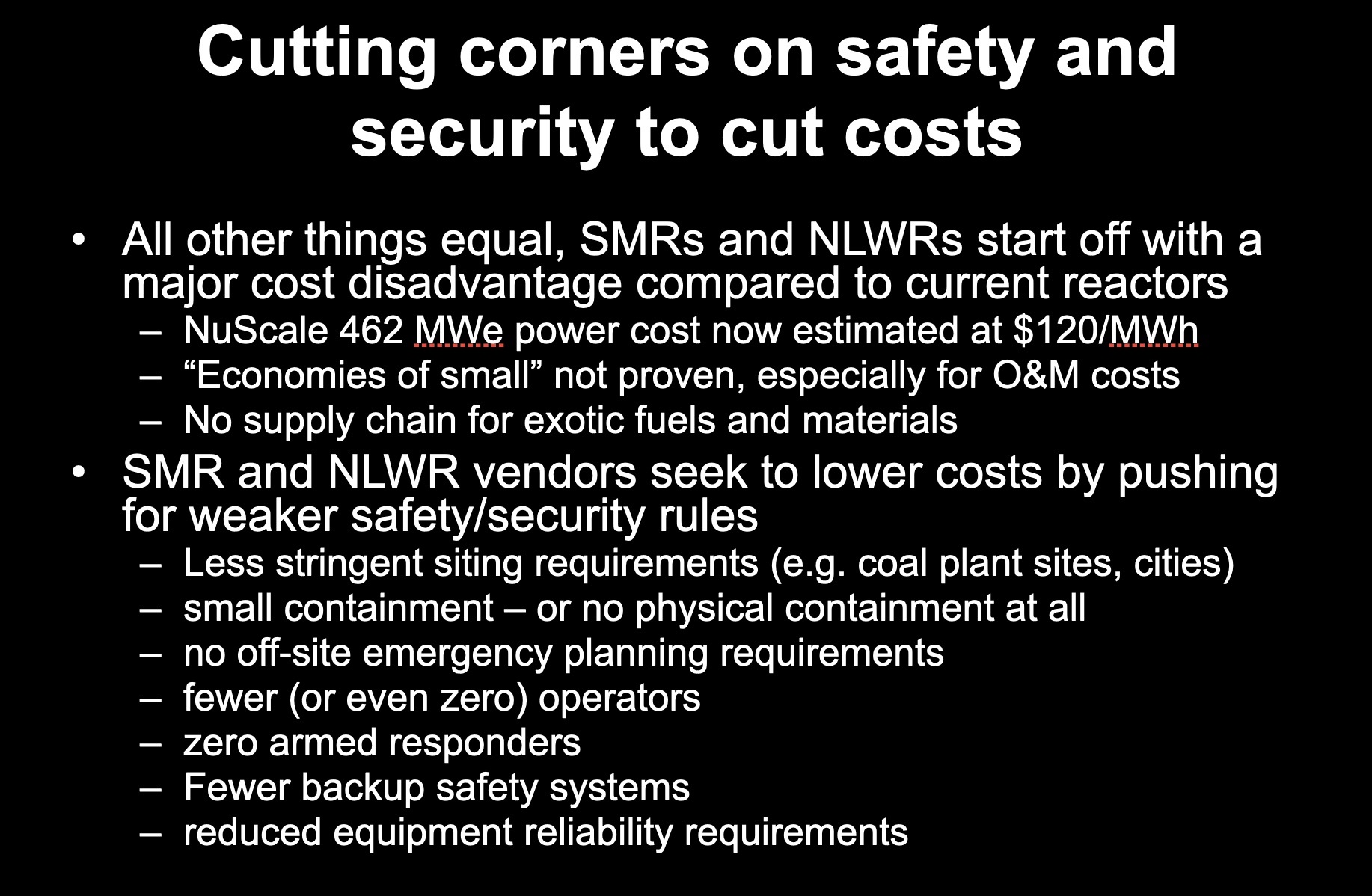
The highly enriched uranium needed for most SMRs poses another risk – as it is useful for nuclear weapons, and therefore attractive to terrorists, and to countries seeking to get nuclear weapons.
So there has been some awareness of safety and security problems amongst critics, especially in the environmental movement. However, this is the first time that I’ve seen the corporate media speak up about this. As the author quotes questions raised in the House of Lords, it looks as though this issue is at last coming to the fore.
I guess that I should not be surprised that the issue of security of Small Nuclear Reactors is at last going to be taken seriously by The Establishment. After all, the examination of the huge and complicated difficulties raised in trying to organise security of SMRs eventually boils down to costs again – “Finally, who pays the piper?”
NUCLEAR BRIBERY: Nuclear Waste Services funds Cumbrian community projects

More than 260 projects across Cumbria and Lincolnshire have received
financial support from Nuclear Waste Services (NWS). The community projects
have received millions of pounds worth of funding from NWS in the last
three years. The communities in which NWS operates have been supported by
funding that aims to benefit people and projects. Over the last three
years, more than £10 million has been awarded to over 260 initiatives
across Cumbria and Lincolnshire ranging from youth schemes, mental health
initiatives, and mountain rescue.
Carlisle News & Star 13th Feb 2025, https://www.newsandstar.co.uk/news/24931120.nuclear-waste-services-funds-cumbrian-community-projects/
Jobs Jobs Jobs ! -screams the nuclear lobby

And the media faithfully regurgitates the message.
It’s not new, but it is now being spouted with a new exuberance (- or desperation?) in Britain:
“Hinkley C construction set to create 3,000 new jobs in next 18 months”. – Construction Enquirer 11th Feb 2025, West Somerset Free Press 10th Feb 2025, Burnham-on-sea.com 10th Feb 2025, BBC 10th Feb, 2025 , Somerset Live 10th Feb 2025, “creating thousands of highly skilled jobs” – Adam Smith Institute 10th Feb 2025 , Irvine Times 10th Feb 2025
As a child, I always wondered why people got so excited at the idea of more jobs. I used to think that they didn’t really want the jobs. They just wanted the money that you get paid for the job. And really, that still applies.
I now know that jobs can also bring personal satisfaction, a pleasure in doing something well, in knowing that your work is valuable. But I’d have to question that in some jobs – for example, in the 1960s if you worked for the Dow Chemical Company, making napalm to burn Vietnamese children. And I question it about the nuclear weapons-nuclear power industry.
Today, we know about ionising radiation causing illness and deaths, about the environmental damage of the nuclear fuel chain, the waste problem, about the intrinsic connection between the “civil” and military nuclear industries. We also know of the increasing evidence that the nuclear industry is not a healthy workplace.
So, why is the nuclear lobby spruiking “jobs” as the reason for the nuclear industry? The UK has an official unemployment rate of 4.4%, not wonderful, but not a crisis – not a statistically very high rate for a G20 country I would have thought that the biggest arguments for a new nuclear industry would be that it’s supposed to fix climate change, to be a clean industry, to be an economically successful industry.
The trouble is – there is ample evidence that nuclear power cannot fix climate change, is not clean, and most critical for Britain, it is not economically viable. That’s why the industry can’t get investors. The UK government has to supply direct funding through grants and investments to support the development of new nuclear power plants, particularly for projects like Sizewell.
And there’s a constant stream of corporate media articles, about the nuclear resurgence and the great future and employment in the (non-existent) small nuclear reactors. Professor Ramana of the University of British Columbia has questioned this resurgence, and examined what is actually happening : “I would first dispute the idea that there is an actual resurgence in nuclear power. What we are seeing is a resurgence in talk about nuclear power”.

The media, when it republishes handouts from the nuclear lobby, is not doing journalism. It’s just repeating propaganda .
It is hard to find proper journalistic scrutiny on the jobs situation in UK’s nuclear industry. But there is such scrutiny:
- Only 20 % of Great British Nuclear staff employed permanently.
- The Wylfa project – will deny local people of Ynys Môn the opportunity to take up green jobs in the interim……… For the reality, as established at the two existing gigawatt projects, at Hinkley Point C in Somerset and increasingly at Sizewell C in Suffolk, is that, for these large construction projects, large national and multinational civil engineering contractors are engaged, with experience in delivering mega projects at this scale, and they bring with them specialist subcontractors with their own transient workforces.
- Hinkley Point C ‘using cheap foreign labour‘ , say striking workers.
- Nuclear power is nothing if not hugely capital, not labour, intensive.
When touting for nuclear power as a great jobs-provider, surely it would be reasonable to compare this with alternative energy sources, but this, of course, is never mentioned in nuclear industry handouts to media.But – Renewables create more jobs/$ than fossils and nuclear.
I can only conclude that Sr Keir Starmer’s Labour government is all too well aware of the money pit into which they are plunging Britain, with these grandiose nuclear projects of Hinkley Point C, and Sizewell C. They must be hoping to get the British public, and investors, enthused about the nuclear job market, especially at a time when the government is about to make brutal cuts in welfare benefits. The rather dodgy assumption might be that human beings – disabled or too ill to work, family carers, suddenly losing income, will be able to work in the supposedly expanding nuclear industry.
Octopus Energy launches renewables investment platform for consumers
Octopus Energy, the UK’s largest energy supplier, has launched an
investment platform allowing consumers to buy shares of a renewable energy
project. Octopus has launched ‘the Collective’ which it says is a
first-of-its-kind initiative that enables customers to invest in renewables
themselves. There is a minimum investment requirement of £25 but, since
there are no fees and the Collective is free to join, all returns go to the
investor. A YouGov survey revealed that 33% of Brits want to invest in
green power; Octopus says that by becoming the first energy company in the
UK with a retail investment platform regulated by the Financial Conduct
Authority (FCA), it will meet this demand.
Current 10th Feb 2025 https://www.current-news.co.uk/octopus-energy-launches-renewables-investment-platform-for-consumers/
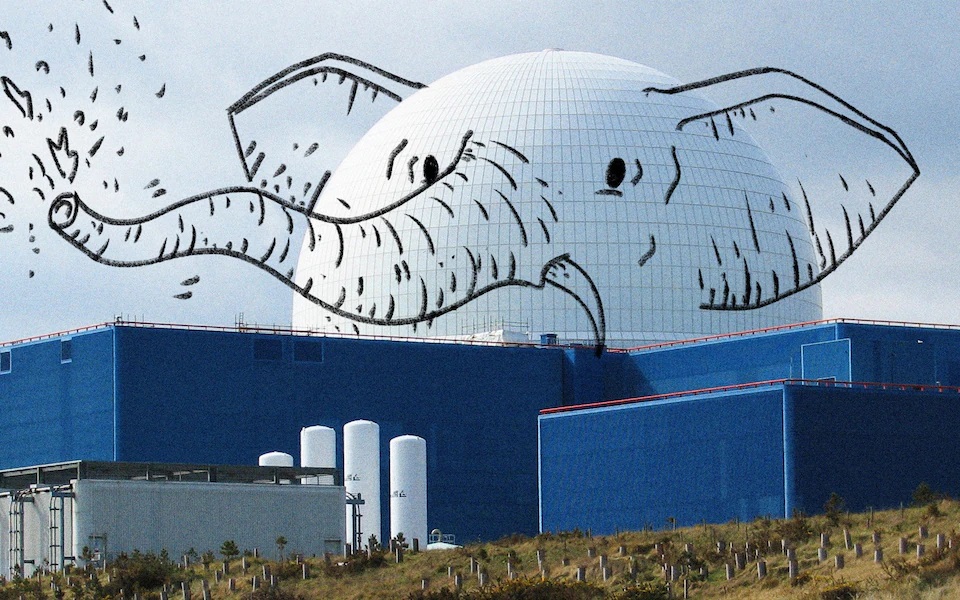
The £40bn nuclear project at risk of becoming another British white elephant.
Telegraph 9th Feb 2025, Matt Oliver. Industry Editor,
On the Suffolk coast, an army of yellow diggers and dump
trucks are levelling fields and preparing the ground for one of Britain’s
biggest infrastructure projects. It is here that thousands of workers plan
to raise Sizewell C, a multibillion-pound nuclear power station, in the
late 2030s, eventually providing power for some 6m homes. If approved in
the coming months, the scheme would replace capacity lost elsewhere over
the next decade as other nuclear plants from the 1970s and 80s gradually
shut down.
Yet that is still a big “if”, with Labour ministers
currently weighing up whether the benefits of Sizewell C are worth the
gargantuan costs, which will reportedly exceed £40bn (the original budget
given to HS2). On one hand, it is a shovel-ready project that promises to
boost energy security and economic growth – something Rachel Reeves, the
Chancellor, is in desperate need of.
Hanging over the project, however, is
the shadow of its sister scheme: Hinkley Point C in Somerset, which is
running years behind schedule and has gone dramatically over-budget.
Should Sizewell C spiral into disaster, like Hinkley, it could easily become a
white elephant that kills off the prospects of any future successors. And
unlike its sister scheme, which was funded entirely by EDF and other
investors, British taxpayers will be on the hook if things go wrong, with
the Government playing the role of anchor investor.
“There is no transparency around Sizewell C,” says spokesman Alison Downes, who lives
nearby. “Why, despite government support, does its likely eye-watering
cost and impact on households remain shrouded in secrecy? Hinkley has
morphed into the most expensive nuclear power station ever built, by some
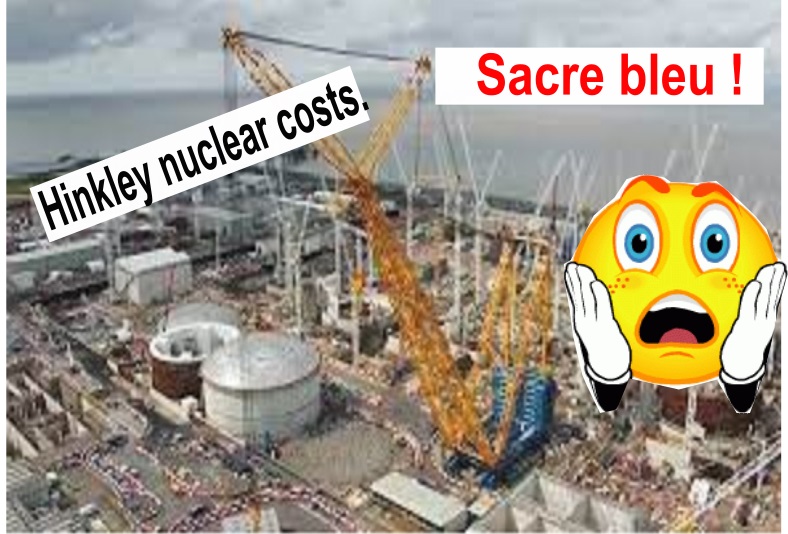
distance. Originally budgeted at £18bn, it is now estimated to cost
£46bn. Miliband quietly initiated a review of the nuclear programme last
year and there is speculation he could soon axe the Wylfa proposal in
favour of focusing on mini nuclear plants known as small modular reactors
(SMR) instead.
https://www.telegraph.co.uk/business/2025/02/09/sizewell-c-becoming-another-british-white-elephant/
It’s money that has stopped nuclear power, not planning problems
David Toke, Feb 09, 2025, https://davidtoke.substack.com/p/its-money-that-has-stopped-nuclear
Of all the nonsense about nuclear power that one hears, the idea that somehow it is planning problems rather than financial issues that stop its development surely takes the biscuit. The Government bats away any formal planning objection made to its nuclear plant when companies want to build them. Yet the UK government is flogging nuclear planning problems as a scapegoat for the technology’s failure for all it is worth. And it is talking about the non-existent concept of small modular reactors (see HERE). Is this a smokescreen to hide its problems with financing Sizewell C?
The real reason for the failure of the Wylfa project
There was a silly story published in most leading newspapers about the proposed Wylfa plant in North Wales being knocked back in 2019 because of ‘language’ objections (see HERE). The reality was that the proposal was scrapped for financial reasons. This involved the Government being unable to offer enough incentives to keep Hitachi interested in developing the project. In January 2019 the BBC reported that ‘Japanese tech giant Hitachi said it was suspending construction of the new plant in north Wales as the project’s cost continues to spiral.’ (see HERE). The National Grid cancelled plans for pylons needed for the project (see HERE).

The reporting at the time failed to mention any planning issues, only the financial ones. Indeed, once Hitachi announced its withdrawal, that was the effective end of the plans. However, the company set up to make the planning application continued what looks to me like it was going through the motions. It didn’t matter that the Planning Inspector rejected the application. If the proposal was a real one (in an economic sense), the government would surely have overruled the Inspector without delay. -As indeed happened in 20122 with the planning application for Sizewell C.
By contrast, the recent coverage of the planning objections to the Hitachi proposal seems to completely omit any mention of the real reason why the project was abandoned.
Problems with the Government’s nuclear programme
Hitachi originally bought the ‘Horizon’ option from RWE and E.On. It consisted of the proposed development at Wylfa and another at Oldbury in Gloucestershire. RWE/E.ON had withdrawn from the proposal in 2012. This (Horizon) was one of three consortia set up in 2009 to constitute the Government’s new nuclear programme. This was announced by Ed Miliband in 2009 in his last manifestation as Energy Secretary.
The second consortium to fall apart, the so-called ‘NuGen’ consortium, was supposed to build a new nuclear project at Sellafield called ‘Moorside’. This consortium was originally owned by Iberdrola, the Spanish company and the French company GDF Suez (now Engie). However, they lost interest and the consortium was bought up instead by Toshiba in 2013. Then in 2017, Toshiba decided to ‘mothball’ the project. Again, financial reasons were always cited as the reason for this. Once again this had nothing to do with planning issues.
This left the third consortium led by EDF. They advanced their Hinkley C project. Eventually, they agreed the controversial deal whereby they would receive £92.50 per MWh over 35 years in 2012 prices, now worth over £130 power MWh in today’s money. They also agreed on a contract for Sizewell C so that if that went ahead as well both projects would receive £89.50 per MWh.
I knew at the time this was a bit of PR and that EDF would never go ahead with the agreement in respect of Sizewell C. They did not. Instead, they have agreed on a deal whereby, in effect, most of the costs, including the inevitable large overruns, will be paid by the British taxpayer or electricity consumer.
So, none of the privately owned companies originally involved in the British nuclear programme went ahead with the proposals. Centrica was also involved with the Hinkley C proposal at one stage, but it withdrew in 2013. Only the French-state-owned EDF has gone ahead with building a nuclear power plant, ie Hinkley C. EDF can carry on the construction. This is despite the mounting construction cost overruns. The French state pays!
Planning and paying for Sizewell
In effect, the French taxpayer is paying for a British nuclear power plant in the shape of Hinkley C. However, the French have said that this cannot happen again (ie they paying (most of) the cost overruns for a British nuclear power station). Hence Sizewell C will be funded mostly by the British taxpayer and electricity consumer, with the Brits taking the main liabilities, not the French.
The UK Government is currently arguing within itself and with EDF about how much Treasury funding the UK Government is going to put into the project. There has been a charade of looking for private investors. The only way private investment could be achieved would be for the investors to be effectively guaranteed their profits at the taxpayers’ or energy consumers’ expense.
Interestingly, in 2022 the Planning Inspector said they could not recommend the Sizewell C project without a more convincing plan to ensure a sustainable water supply. However, this objection was batted aside by the then Energy Secretary, Kwasi Kwateng, in 2022 (see HERE). This affair received little publicity because everybody knew that the Government could easily dismiss this problem, and override recommendations by Planning Inspectors. The Government saw no reason at the time to make a big deal out of it. After all, why would the Government want to publicise doubts about the water supply for Hinkley C when it wanted the project to go ahead?
Indeed in the summer of 2022, all the talk was on how to pay for Sizewell C. With planning consent having been sorted, Boris Johnson wanted to go full steam ahead and give the final go-ahead, something that did not please the Treasury. According to a report in The Times (see HERE) ‘Simon Clarke, the chief secretary to the Treasury……………. wrote to Johnson and Zahawi warning that a signoff for Sizewell would compromise the new prime minister’s ability to cut taxes or spend more on the cost of living’. Apparently, even Liz Truss did not want to take on the costs of Sizewell C.
But fast forward to February 2025 (with still no final go-ahead for Sizewell C), and the Government saw fit to make a very big deal out of a planning debating point regarding an already-abandoned project in Wales. Why? Maybe, I think to distract attention from the fact that it is the financing of nuclear power and its delivery that is the big problem. One can almost hear Sir Humphrey intoning ‘The public does not need to be overloaded with such details’. Otherwise, the politicians might stop blaming each other about things (eg costs of nuclear power) over which they have no control and focus on things that they do have some control.
Planning (or not?) for heat pumps
One thing that the politicians do control are the building regulations which could be making heat pumps and solar PV mandatory in new buildings. Alas, this has been kicked into the long grass by a press release a few weeks ago (see HERE). The Government has full control over the regulations, but it has given way to pressures from the construction industry. Yes, that is the same industry who are so keen on building nuclear power stations.
Can the nuclear industry find a better way to build?
The sector is hopeful that using copies of established reactors can help keep costs down and
prevent delays for new projects.
On a construction site sitting behind the
beach at Sizewell, on England’s East Anglian coast, mountains of soil
make it hard to see two small, blue signs. These indicate the spots where,
in the middle of the next decade, two nuclear reactors should start
generating enough energy to power 6mn homes.
The extraordinary thing about
the 900-acre site is not its scale but that it has an identical twin —
for reasons that reveal a lot about the latest thinking on building nuclear
power stations. The new Sizewell C plant has been designed to be as close
as possible a copy of Hinkley Point C, a project 280 miles away on the
other side of the country. Building there started in 2016, eight years
before that at Sizewell.
The replication is part of a push across Europe and North America to tackle what Bent Flyvbjerg, an academic studying project management, calls the nuclear power industry’s “negative learning” problem. More simply: for an industry that has become infamous
for massive cost overruns and endless delays, maybe the solution is just to
build exact copies of established reactors.
The IEA has found that nuclear
plants delivered since 2000 in the US and Europe were on average eight
years late and cost two-and-a-half times their original budget. The UK
government on Thursday announced planning reforms intended to make it
easier to build nuclear plants quickly and cheaply. Tom Burke, founder of
E3G, a London-based clean energy consultancy, is far more sceptical, saying
the information from the countries claiming better records lacks
credibility. “Where the publicly available information is reliable — if
you look at what happened in Finland, the United States and the United
Kingdom — people have not built reactors to time and budget, ever,”
Burke says. EDF has said UK regulations meant there were 7,000 changes to
the design for Hinkley Point from that at Flamanville — although the
UK’s Office for Nuclear Regulation has disputed the figure.
Many developers’ hopes are hanging on a new breed of reactors — small
modular reactors. The devices are intended to be small enough to
mass-produce on a highly standardised basis in the controlled environment
of a factory. They will then be taken to power station sites for
installation. Most SMRs will have a capacity below 300MW, less than 10 per
cent of the 3.2GW capacity at Sizewell C, and will be far smaller.
Yet sceptics such as E3G’s Burke are far from convinced. Asked if he thinks
steady orders and standardisation can bring the sector’s costs under
control, Burke replies: “I think that’s one of the biggest ‘ifs’
I’ve ever seen.”
FT 10th Feb 2025
https://www.ft.com/content/5e563e3f-575d-4a90-bd46-4d0a3083f707
Belgium wants an atomic U-turn, but its nuclear operator doesn’t

Engie said nuclear power is no longer part of its strategic planning, and that it is no longer investing in nuclear power.
David Rogers, Global Construction Review, 5 Feb 25
The Belgian government wants to extend the lives of its five nuclear reactors and start building their replacements, repealing a 2003 law banning new nuclear construction, the Belga news agency reports.
But the company that owns the reactors – France’s Engie – is not interested.
The country is governed by a five-party coalition that formed in January after seven months of negotiations. It’s led by prime minister Bart De Wever……………
Belgium opted out of nuclear power in 2003, when the government of Guy Verhofstadt passed a law forbidding the construction of nuclear reactors………
De Wever’s government aims to repeal this law, and to further extend the life of the existing reactors……… De Wever wants another life extension for them, and a life extension for the country’s oldest reactors, Doel 1 and 2 and Tihange 1, which are already being decommissioned and are set to shut down this year.
Nuclear operator Engie opposes De Wever’s plans.
Engie Belgium chief executive Vincent Verbeke said it would be possible to extend Doel 4 and Tihange 3 until 2035, but to put off decommissioning beyond that was “unthinkable”.
Engie said nuclear power is no longer part of its strategic planning, and that it is no longer investing in nuclear power.
That means the government will have to either find a new operator, or nationalise the nuclear power plants before their lives can be extended again………………………. https://www.globalconstructionreview.com/belgium-wants-an-atomic-u-turn-but-its-nuclear-operator-doesnt/
France’s top audit body questions feasibility of EDF’s nuclear plans
The report noted that the EPR2 program still lacks a final cost estimate and financing plan, while state-owned energy company EDF remains heavily indebted. The Cour des Comptes recommended withholding a final investment decision until financing is secured.
France’s Cour des Comptes has issued a warning about rising nuclear energy costs. It is urging state-owned utility EDF to reduce its financial risks in international projects.
Solar Power Portal, February 3, 2025 Emiliano Bellini, https://www.pv-magazine.com/2025/02/03/frances-top-audit-body-questions-feasibility-of-edfs-nuclear-plans/
France’s supreme audit institution, the Cour des Comptes, has released a report on the feasibility of the nuclear plans unveiled by the government in 2022, concluding that the industry is “far from being ready” for the challenge.
The Cour des Comptes said the plan to develop EPR2 nuclear reactors – pressurized water reactors designed by EDF and Framatome – remains unclear.
“The expected profitability of the EPR2 program remains, at this stage, unknown, especially as the financing conditions of this program have still not been determined,” the authors of the report said. “When these conditions will be clear, an additional year or more will be needed to obtain their approval by the European Commission. These delays and uncertainties, which also concern the number of power plants to be built, reduce the visibility that stakeholders in the sector need to engage in industrial projects of this magnitude and obtain financing.”
The report noted that the EPR2 program still lacks a final cost estimate and financing plan, while state-owned energy company EDF remains heavily indebted. The Cour des Comptes recommended withholding a final investment decision until financing is secured.
These precautions aim to prevent cost overruns similar to those seen in EDF’s Olkiluoto EPR project in Finland, the Hinkley Point plant in the United Kingdom, and the Flamanville 3 facility in France.
“EPR reactors operating in China and Finland have experienced multiple technical malfunctions in recent years, with significant financial impacts and damaging consequences for the credibility of the EPR2 program,” said Cour des Comptes. “EDF had to record in its 2023 financial report a depreciation of this asset which reduced its results by €11.5 billion ($11.77 million),” they added referring to the Hinkley Point C project, whose costs rose to GBP 33 billion ($40.6 billion), a 100% increase versus the initial estimated cost.
The court also said that a proposal to expand EDF’s Sizewell plant in the United Kingdom could be rejected if the French utility fails to reduce its financial exposure for Hinkley Point C. It warned that the industrial strategy implemented by EDF does not yet guarantee the accountability of stakeholders and noted that the incentives that are essential to the success of the EPR2 program.
“The EDF group’s strategy, which plans to continue promoting nuclear reactors internationally, should no longer make excessive equity commitments or take excessive risks in terms of profitability and operational coordination between the different projects,” the court said, noting that these financial risks may slow down the schedule of EPR2 program in France.
The report concluded that efforts to strengthen the nuclear industry remain inadequate, particularly in rebuilding skills and capacity.
Nuclear delusion in Ynys Môn will deny islanders green jobs
NFLA 3rd Feb 2025
Welsh antinuclear campaigners believe that the continued fixation of certain Senedd politicians and civil servants on bringing a new nuclear project back to Wylfa amounts to a delusion which will deny local people of Ynys Môn the opportunity to take up green jobs in the interim and make of Ynys Môn a true ‘green energy island’.
Former Labour First Minister Vaughan Gething MS convened an inaugural meeting of the Nuclear Energy Senedd Cross-Party Group recently with the primary objective of bringing a new nuclear power plant to Wylfa. In the gushing pre-amble accompanying the meeting invite the organisers describe such a project as the ‘single biggest inward investment opportunity in Welsh history’, without seemingly being cognizant that such a project will be costly and uncertain with a previous gigawatt project being derailed by the enormous financial cost and a condemnatory Planning Inspector’s report setting out clear and valid reasons for refusal.
Antinuclear campaigners are adamant that new nuclear cannot deliver ‘clean Welsh power, good jobs and skills and investment in communities’; they believe there should instead be a focus on renewable energy technologies, which will guarantee new ‘green’ jobs and a boost to the Ynys Môn economy.
The promise of such a strategy was outlined in the publication a ‘Manifesto for Mon’, authored by the late renowned Dr Carl Clowes, who identified that the development of sustainable industries, including renewable energy, on the island could create 2,500 – 3,000 jobs for local people. Existing jobs decommissioning the old Wylfa plant would be retained as the project will take decades to complete.
In July 2022, campaign groups met in Caernarfon to adopt a declaration outlining their common goals in opposing new nuclear power and affirming the commitment to achieving a renewable energy future for the nation.

Of nuclear power, the declaration states that ‘it costs too much; takes too long; will come too late [to address the energy or climate change crisis]; is accompanied by operational risks; causes long-term damage to the natural environment; is dependent upon foreign technology, finance, and uranium; is inevitably linked to the production and possession of nuclear weapons; always represents a potential target for terrorists or hostile powers in times of war; and creates toxic waste, left for future generations to deal with.’ ………………………………………………………………………………………………
the reality, as established at the two existing gigawatt projects, at Hinkley Point C in Somerset and increasingly at Sizewell C in Suffolk, is that, for these large construction projects, large national and multinational civil engineering contractors are engaged, with experience in delivering mega projects at this scale, and they bring with them specialist subcontractors with their own transient workforces. These workers require housing and landlords, recognising that they are in highly paid employment and able to pay higher rents, displace existing tenants to free up houses for the workforce. Alternately local holiday camps have been acquired to house the workers denying this accommodation to tourists for years. It is hardly likely that any more than a tiny minority of this workforce would be local or Welsh-speaking.
Referencing specific concerns about its impact on Welsh-speaking Gwynedd and Ynys Môn, the Declaration states that new nuclear ‘will inevitably lead to a huge influx of temporary workers, most of whom will not use Welsh as their first language. This will lead to a dilution in the first use of the Welsh language for daily conversations and transactions, and inevitably adversely impact the linguistic heritage of the region.’
Wylfa was described by former Conservative Prime Ministers Boris Johnson and Rishi Sunak as the ‘best site for new nuclear in Europe’ without either backing this bold statement with any evidence. The Planning Inspectorate clearly had a contrary view as they published a report recommending refusal of Hitachi’s proposal to build the Wylfa Newydd plant.
Energy company Horizon – a subsidiary of Hitachi – needed a Development Consent Order to allow their £16bn project to go ahead, but refusal of the DCO was recommended on several grounds. Although the project was expected to create 1,000 permanent jobs and 9,000 temporary construction posts, planning officers believed that ‘on balance, the matters weighing against the proposed development outweigh the matters weighing in favour of it’ for their assessment identified that the project would displace the Arctic and Sandwich tern populations from Cemlyn Bay where the plant was set to be built, and that the influx of thousands of building workers would have an adverse impact on the local economy and tourism, put huge pressure on local housing, and dilute the prevalent use of the Welsh language.
For the reality, as established at the two existing gigawatt projects, at Hinkley Point C in Somerset and increasingly at Sizewell C in Suffolk, is that, for these large construction projects, large national and multinational civil engineering contractors are engaged, with experience in delivering mega projects at this scale, and they bring with them specialist subcontractors with their own transient workforces. These workers require housing and landlords, recognising that they are in highly paid employment and able to pay higher rents, displace existing tenants to free up houses for the workforce. Alternately local holiday camps have been acquired to house the workers denying this accommodation to tourists for years. It is hardly likely that any more than a tiny minority of this workforce would be local or Welsh-speaking.
In May 2024, Energy Secretary Claire Coutinho announced that Wylfa was the Conservative Government’s ‘preferred site’ for a third large-scale nuclear power plant. Although the Welsh Nuclear Free Local Authorities had urged the Welsh Government to themselves purchase and redevelop the site as a renewable energy hub as a step towards making Ynys Mon a ‘green energy island’, this suggestion was declined and instead the site was eventually bought by the British Government from the former owners – Hitachi – who had wound up its Horizon Nuclear Power subsidiary in March 2021 after failing to secure a satisfactory public subsidy from Conservative Ministers and must have been keen to sell the site, with Oldbury, for £160 million.
It remains unlikely that any third new gigawatt plant at Wylfa will be developed. With two similar projects currently in development securing the necessary finance for a third remains the overriding challenge.
Hinkley Point C is being developed at its own expense by EDF Energy, which is owned by the French state. It is significantly above budget and will be delivered years late. The original estimated cost was £18 billion, but this has risen to £34 billion, based on 2015 prices. Although the project was first expected to be generating by the end of 2017, it is now unlikely to be completed before 2031.
British newspapers have recently reported comments attributed to sources close to the Sizewell C project that the likely budget has doubled to £40 billion. EDF Energy is also a minority stakeholder in this project, but, based on their sobering experience in backing Hinkley Point C, French state auditors have just recommended that no further significant investment be made in such foreign enterprises. The UK Government is the majority stakeholder. It has so far burnt through, or committed, £5.5 billion of taxpayer cash to finance preliminary works, whilst conducting an extensive and, so far, elusive, search for committed private sector partners upon which to offload much of its stake.
With future French and British Government financial support likely to be limited or non-existent, with Chinese state investment being currently effectively excluded by government diktat, and with private finance so difficult to find, it is highly unlikely a third gigawatt project at Wylfa can be funded. Indeed, the Final Investment Decision to proceed at Sizewell C has been put on hold pending the conclusion of an overall Government Spending Review, amidst a backdrop of more and more cross-party voices in both Houses calling for its abandonment.
Prior to the 2024 general election, Conservative Ministers courted the American nuclear concerns Bechtel and Westinghouse as potential suitors to develop the site. The Welsh NFLAs have previously highlighted their very chequered history of working on the Vogtle and V C Summer projects in the United States, with huge cost overruns, work being charged to state taxpayers which has never been delivered, senior executives being prosecuted for corruption, a corporate bankruptcy, and, in South Carolina, $9 billion being squandered on an incomplete and abandoned nuclear plant which shall never generate electricity. Such businesses, averse to risk, focused on profit, and hooked on grift, would be looking for a big public handout to pique their interest; a handout which Chancellor Rachel Reeves, already contemplating the price tag of Sizewell C and an alleged £22 billion blackhole inherited from the Tories to boot, would baulk at.
With a gigawatt plant at Wylfa then unlikely, what then is the new Senedd committee seeking?
Well, the invite gives a big clue as it references potential developments in the spring. This could of course allude to the outcome of the Spending Review, but equally it might refer to the much-delayed decision about which two Small Modular Reactor designs the Department for Energy Security and Net Zero should take forward with support from the public purse (again) following the conclusion of the SMR competition that is being conducted by Great British Nuclear. Four designs are in the running, with the expectation that two will be selected and offered money and development sites for deployment.
As antinuclear campaigners have previously, and repeatedly, pointed out none of these SMR designs have yet fully navigated the regulatory road to approval for deployment, nor have any been built or operated, and it is uncertain where the finance would come from. It is also unlikely that any will be deployed before the early or mid-2030’s, even if they work; are economically viable; and an acceptable solution to the management and disposal of radioactive waste can be identified. Like gigawatt plants, these modular projects will be assembled on-site by specialist teams who doubtless will be moved from site to site by the developer. Operators will thereafter be often specialists who will be relocated with no family or Welsh connections to Wylfa.
Even were new nuclear to eventually come to the ‘energy island’, it would come far too late to help address the energy and climate change crisis we face now. Remember those 2,500 – 3,000 jobs for local people predicted in the Manifesto for Mon; they could be delivered far more quickly and at a much lower cost, and with local people engaged in renewable energy technologies they would also be contributing to reducing the carbon footprint of Wales and generating the affordable energy the nation’s electricity consumers need……………………………………… https://www.nuclearpolicy.info/news/nuclear-delusion-in-ynys-mon-will-deny-islanders-green-jobs/
1 This Month



Shut down the radiation-damaged Heysham nuclear reactors now
To see nuclear-related stories in greater depth and intensity – go to https://nuclearinformation.wordpress.com

Say No to NASA’s Reckless Nuclear Reactor on the Moon
Say No to NASA’s Reckless Nuclear Reactor on the Moon
-
Archives
- October 2026 (256)
- September 2026 (339)
- August 2026 (330)
- July 2026 (355)
- June 2026 (287)
- May 2026 (306)
- April 2026 (356)
- March 2026 (251)
- February 2026 (267)
- January 2026 (308)
- December 2025 (358)
- November 2025 (359)
-
Categories
- 1
- 1 NUCLEAR ISSUES
- business and costs
- climate change
- culture and arts
- ENERGY
- environment
- health
- history
- indigenous issues
- Legal
- marketing of nuclear
- media
- opposition to nuclear
- PERSONAL STORIES
- politics
- politics international
- Religion and ethics
- safety
- secrets,lies and civil liberties
- spinbuster
- technology
- Uranium
- wastes
- weapons and war
- Women
- 2 WORLD
- ACTION
- AFRICA
- Atrocities
- AUSTRALIA
- Christina's notes
- Christina's themes
- culture and arts
- Events
- Fuk 2022
- Fuk 2023
- Fukushima 2017
- Fukushima 2018
- fukushima 2019
- Fukushima 2020
- Fukushima 2021
- general
- global warming
- Humour (God we need it)
- Nuclear
- RARE EARTHS
- Reference
- resources – print
- Resources -audiovicual
- Weekly Newsletter
- World
- World Nuclear
- YouTube
-
RSS
Entries RSS
Comments RSS

