Low demand for uranium: AREVA limits production
 Areva suspends some uranium production after Japan quake Google News, 16 Sept 11, PARIS — French nuclear giant Areva is suspending uranium production at two plants because of low demand from Japanese power stations in the wake of the Fukushima disaster, a spokeswoman said Thursday. Continue reading
 Japan can shut down all nuclear power by 2012
“With only 11 out of 54 reactors online at the height of summer and little impact to daily life, Japan has already proven that by conserving energy it does not need nuclear power”,
Permanent Nuclear Shutdown in Japan Possible by 2012: Report, September 12, 2011 Tokyo- (PanOrient News) Japan can switch off all nuclear plants permanently by 2012 and still achieve both economic recovery and its CO2 reduction goals, according to a new Greenpeace report.
Released today, the Advanced Energy Revolution report for Japan, shows how energy efficiency and rapid deployment of renewable technology can provide all the power Japan needs. Continue reading
Economic pain of Japan’s nuclear disaster
Six Months: Counting the Cost, WSJ, By Yoree Koh, 11 Sept 11, The March 11 disasters have taken a heavy toll on Japan, in every conceivable way. In other posts, JRT looks at the impact on survivors’ lives and challenges for the future. Below is an update on the aftermath of the earthquake, tsunami and nuclear crisis as seen in the simplest of measures – numbers……..
Nuclear Effect:
23 – number of times the government ordered bans on distribution of certain produce from select prefectures due to radiation contamination as of Sept. 10, according to the Ministry of Health.
26 – the number of different types of food items, including vegetables, fish and beef, at various points banned from distribution due to radioactive contamination, as named in orders released by the Ministry of Health as of Sept. 10.
380 tons – the amount of beef from cattle suspected of being fed rice straw with high concentrations of radioactive cesium the government purchased, according to the Nikkei business daily…..
Y120,000 – maximum monthly compensation Tokyo Power Electric Co. is to pay each evacuee between March and August for the anguish they suffered because they had to flee from their homes.
Y112.2 billion – total compensation Tepco has paid on a provisional basis to evacuees, farmers, companies and others affected by the accident as of Aug. 30……..http://blogs.wsj.com/japanrealtime/2011/09/11/six-months-counting-the-cost/
Toshiba should diversify, but caught up too much in the nuclear industry
it means the company’s fortunes are likely to be tied closer to the nuclear-power industry even as the sector faces fresh questions over safety, long delays in the building of new plants
For Toshiba, Nuclear Move Likely Poses Strategic Risks, WSJ, By JURO OSAWA TOKYO, 11 Sept 11, —Just as the nuclear industry faces growing uncertainty brought on by the crisis in Japan, Toshiba Corp. is having to spend more than $1.6 billion to raise its stake in U.S. nuclear-energy company Westinghouse Electric Co. to 87% from the current 67%. Continue reading
No nuclear renaissance – nuclear power a declining industry
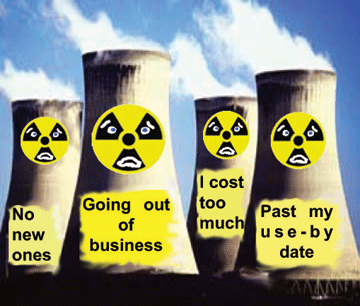 Is this, finally, the “nuclear renaissance” that the industry has been heralding for the past decade? The answer is no. Construction starts aside, many industry status indicators are on a negative trend…. Production in 2010 was practically identical to production in 2005, and production in 2011 will undoubtedly be lower….
2010–2011 world nuclear industry status report, Bulletin of Atomic Scientists, By Mycle Schneider, Antony Froggatt, and Steve Thomas | 8 September 2011
Article Highlights In 2010, there were more nuclear power units under construction worldwide than in any year since 1988. Even before Fukushima, however, status indicators for the international nuclear industry were showing a negative trend. Fewer countries are operating nuclear fission reactors for energy purposes than in previous years, and many countries are now past their nuclear peak. Worldwide nuclear production is generally declining, and many new projects are experiencing construction delays. Even if reactors can be operated for an average of 40 years, 74 new plants would have to come on line by 2015 to maintain the status quo, which is impossible given current constraints on fabricating reactor components. Developments in Asia, particularly in China, do not fundamentally change the global picture. The dramatic post-Fukushima decisions in two of the four largest economies, Japan and Germany, and in several other nuclear countries could accelerate the decline of a rapidly aging industry. Continue reading
Germany and UK selling out from uranium enrichment company
German Paper: RWE and E.ON Consider Urenco Sale, Nuclear Street, Sep 8 2011 Reports indicate two German utilities are preparing to sell their stake in Urenco, a uranium enrichment company that recently opened a new centrifuge plant in New Mexico.
Urenco’s other owners include the governments of the United Kingdom and the Netherlands. In recent years, the UK also has indicated it wants to sell its 33 percent stake in the company. ….
Buying support for uranium mining
“In Virginia, there are grave concerns about the industry’s ability to manage all of that radioactive and toxic waste,” said Cale Jaffe, a senior attorney at the Southern Environmental Law Center…
 Va. company picking up tab for uranium-mining tour, Boston.com, RICHMOND, Va.—A company that wants to mine uranium in Virginia is flying state legislators, local officials and residents to Canada to visit uranium mining and milling operations. By Steve Szkotak, Associated Press / September 7, 2011
The trip is one of several sponsored by Virginia Uranium Inc. as it lobbies to end a 1982 moratorium on uranium mining so it can tap a 119-million-pound deposit in Southside Virginia. The uranium deposit is believed to be the largest in the U.S. and one of the largest in the world. Continue reading
Grim outlook for Australia’s uranium mining industry
 Investor support has evaporated and the share prices of most ASX-listed uranium plays have fallen more heavily than the wider market. The share price falls have eroded any chance of capital raisings to fund drilling programs or project development while continued production problems experienced by market leader Paladin Energy have added to the negative sentiment hanging over the sector.
The Merrill Lynch uranium equity index, which tracks global listed stocks, is down 19 per cent over the past month and 23 per cent in the past year.
More pain for uranium sector as price dips, PETER KLINGER, The West AustralianSeptember 7, 2011 Already battered by headwinds, including strong opposition from environmentalists, WA’s fledgling uranium sector is set for more grief amid expectation the nuclear fuel’s low price will fall another 6 per cent within the next few months. Continue reading
Deepening gloom for Australia’s uranium industry

 Uranium prices plunge causing issues for Australian producers, Herald Sun, Greg Roberts ,September 07, 2011 URANIUM prices have fallen back to levels last seen after Japan’s nuclear accident in March, causing further grief to struggling Australian producers.
The uranium spot price is $US48.85 ($A46.04) a pound, having plummeted from $US67.75 to $US49 immediately after the earthquake and tsunami on March 11.
The spot price had recovered to about $US56.50 after the Fukushima accident. Analyst group Resource Capital Research says the dynamics driving the sector have changed in the aftermath of the meltdown, with Germany planning to close all 17 of its nuclear power reactors by 2022.
The “fund implied price” – an indicator of market price expectations – is signalling a further fall in the spot price to $US45.95. The Merrill Lynch Uranium Equity Index, which measures the performance of uranium equities, has fallen 19 per cent over the past month.
It is down 27 per cent over the past three months and 23 per cent over the past year, according to the latest quarterly report by Resource Capital Research. Shares in Australia’s largest uranium producer, the Rio Tinto-backed Energy Resources of Australia, have fallen 13 per cent in the past month and 73 per cent in the past year.
A year ago, ERA shares were $13.49, compared with $3.65 now, with the company posting a $122 million half-year net loss. http://www.heraldsun.com.au/business/uranium-prices-plunge-causing-issues-for-australian-producers/story-fn7j19iv-1226130940686
Australia’s uranium industry losing confidence?
“…an extended period of uncertainty…..A mistake by one operator or explorer or project developer in our industry affects all of us.”
Fukushima puts Australia’s uranium industry on the defensive Independent Australia, 2 Sept 11, The Australian nuclear industry feels the heat after the Fukushima calamity, but spins on gamely. Noel Wauchope reports.
With plummeting uranium prices, and increasinglybad news about Fukushima radiation, Australia’s uranium industry is well and truly on the back foot. But the industry battles on with religious fervour in its belief in the future uranium boom. Continue reading
China’s developing solar energy empire
with Beijing heavily supporting its industry, the Chinese companies are forging ahead..Instead of subsidizing the purchase and use of solar power, China has focused on building the competitiveness of the country’s manufacturers. As a result, China exports 95 percent of the solar panels it produces.

 China benefits as U.S. solar industry withers, NYT 1 Sept 11, HONG KONG — The bankruptcies of three American solar power companies in the last month, including Solyndra of California on Wednesday, have left China’s industry with a dominant sales position — almost three-fifths of the world’s production capacity — and rapidly declining costs. Continue reading
Floods cause production drop in Namibia’s uranium mines
Namibia Q2 uranium production down | Industrial Fuels and Power August 30th, 2011 NewsroomUranium production in Namibia decreased from 2.35mlb to 2.09mlb in the second quarter of 2011 when compared with the previous quarter.“This was largely due to adverse weather conditions, with some of the mines becoming flooded with the abnormally heavy rains seen this year,” financial group Capricorn Investment Holdings said.Namibia’s uranium is produced by Rio Tinto and Australia’s Paladin Energy.
Namibia Q2 uranium production down | Industrial Fuels and Power
Uranium brings lower and lower prices
 Uranium transactions fail to raise spot price, Industrial Fuels and Power August 31st, 2011 The uranium spot market reported five transactions totalling 1Mlb in the week ended 26 August, but each transaction was conducted at successively lower prices as sellers dropped offer prices to attract buyers. Consequently, the spot uranium price was cut by US$1.05 WoW to US$48.85/lb by the end of the week, according to TradeTech……
On 29 August, The Ux Consulting Co reported a US$1.50 fall in the uranium spot price to US$49.00/lb of uranium oxide.
Over the past month, uranium oxide prices decreased by US$2.50 while conversion rates at both sides of the Atlantic saw 75 cents shaved of their end-of-July price to US$10.00/kgU. Uranium hexafluoride prices fell by US$7.28 to US$138.03/kgU during this period……
USA taxpayer’s money going to set up nuclear power plants on the moon
 Fission power technology can be applied on Earth’s Moon, on Mars, or wherever NASA sees the need for continuous power,
Nuclear power plants for settlements on the Moon and Mars, ZDNet By Chris Jablonski | August 28, 2011 The first nuclear power plant being considered for production of electricity for manned or unmanned bases on the Moon, Mars and other planets “may really look like it came from outer space.” Continue reading
Colorado State makes things financially easier for uranium milling company
|
State defers Energy Fuels’ bond deadlines Telluride Daily Planet, By Kathrine Warren August 24, 2011 |
1 This Month





PLEASE OPPOSE HR 8255 AND S.3639 – bills would accelerate satellite deployment, with no environmental review or safeguards – https://ncstd5li.quorum.us/campaign/169331/
To see nuclear-related stories in greater depth and intensity – go to https://nuclearinformation.wordpress.com
-
Archives
- October 2026 (39)
- September 2026 (339)
- August 2026 (330)
- July 2026 (355)
- June 2026 (287)
- May 2026 (306)
- April 2026 (356)
- March 2026 (251)
- February 2026 (267)
- January 2026 (308)
- December 2025 (358)
- November 2025 (359)
-
Categories
- 1
- 1 NUCLEAR ISSUES
- business and costs
- climate change
- culture and arts
- ENERGY
- environment
- health
- history
- indigenous issues
- Legal
- marketing of nuclear
- media
- opposition to nuclear
- PERSONAL STORIES
- politics
- politics international
- Religion and ethics
- safety
- secrets,lies and civil liberties
- spinbuster
- technology
- Uranium
- wastes
- weapons and war
- Women
- 2 WORLD
- ACTION
- AFRICA
- Atrocities
- AUSTRALIA
- Christina's notes
- Christina's themes
- culture and arts
- Events
- Fuk 2022
- Fuk 2023
- Fukushima 2017
- Fukushima 2018
- fukushima 2019
- Fukushima 2020
- Fukushima 2021
- general
- global warming
- Humour (God we need it)
- Nuclear
- RARE EARTHS
- Reference
- resources – print
- Resources -audiovicual
- Weekly Newsletter
- World
- World Nuclear
- YouTube
-
RSS
Entries RSS
Comments RSS

