Nuclear industry’s future on the line
“Fukushima is having a resounding effect in those countries where they wanted to hear it. Countries that never wanted to pursue nuclear power or who came at it reluctantly are using the event as a way to back out gracefully,”
Even as some countries continue to progress their plans, the resultant delays from additional safety checks, coupled with higher costs, has already prompted changes in estimates of the role nuclear power will play in the global energy mix.
The industry knows it needs to regain the public’s trust. It cannot afford another accident.
 Nuclear power stands at a crossroads, FT, By Sylvia Pfeifer, November 15, 2011 Off the west coast of Finland on a thickly wooded island, Europe’s most advanced nuclear reactor is taking shape. The reactor, being built by France’sAreva for its Finnish customer, the utility TVO, is western Europe’s latest generation, pressurised water reactor. However, at more than €2.6bn ($3.54bn) over budget and five years late, the project is hardly the best poster child for Europe’s ambitions at a time when atomic power is under scrutiny following the crisis in Japan in the spring. Continue reading
TEPCO executives’ delusion that nuclear business will go on as before
the biggest policy threat to the nuclear industry is local. Since the disaster, Japanese mayors and governors have been blocking utilities from restarting reactors that have shut down
Anti-nuclear mood melts Tepco’s hopes of normality FT.com By Jonathan Soble in Tokyo, 16 Nov 11, Call it fortitude or fantasy, but executives at Tokyo Electric Power (Tepco), the owner of Fukushima Daiichi nuclear power station, still talk of the meltdowns at three of the facility’s reactors in March as a merely temporary setback for their business.
“The sooner we get back to normal, the better,” Toshio Nishizawa, Tepco’s president, recently told the Financial Times. “Whatever happens, our core business will not change.” Continue reading
Escalating costs of Japan’s nuclear safety plans
Japan’s Nuclear Safety Steps May Cost 19 Billion Yen Per Reactor, Nov. 15 (Bloomberg) –– Additional safety measures required at Japan’s nuclear power plants in the wake of the Fukushima disaster may cost 19.4 billion yen ($252 million) per reactor, the government said.
Thorium nuclear reactors 50 years away, if ever
Technology transitions always happen faster than the conventional market predicts PV MAGAZINE 14. NOVEMBER 2011 BY: RAY WILLS “……Some bang on about nuclear – yes, China, in raw numbers, is planning a lot – but the country is comparatively modest in the scale of things: it is planning 70 GW of nuclear by 2020, but 200 GW of renewables, also by 2020! Also, a decision hasn’t been announced over what is being done post-Fukushima, but the analysts expect the country to proceed at a more modest scale. The 12th five-year plan was released post-Fukushima and it was in that that China increased its renewables target on solar from one GW to 10 GW by 2015,…
Thorium is the latest suggestion from those attempting to distract us from renewables as the solution, but according to those in the nuclear research arena, thorium realistically is at least 50 years away from being realized. Nevertheless, I note India talking about building a 300 megawatt (MW) prototype – it’s being played up in some parts of the press – but when you look at the detail, the proponents note, “if all goes to plan, the […] reactor could be operational by the end of the decade”. That’s just a prototype. My view is that by 2025, the game will be over, we will have solved intermittency through storage, and electricity from solar will be cheaper than coal. I don’t believe I’m dreaming, simply looking at technology shifts and the capacity for rapid technology shifts in the past – go back 100 years ago and tell the buggy and whip manufacturers they will soon be out of business and imagine the response.
http://www.pv-magazine.com/opinion-analysis/blogdetails/beitrag/technology-transitions-always-happen-faster-than-the-conventional-market-predicts_100004940/
Taiwan urged to abandon nuclear power – unaffordable costs
many people thought it was a waste of money to have spent NT$320 billion (US$10.6 billion) to construct the Fourth Nuclear Power Plant in Gongliao District (貢寮), New Taipei City, and not allow it to operate, but it would actually cost twice that amount to retire the plant after it begins operations.
 Writer urges Taiwan to abandon nuclear power Taipei Times, By Lee I-chia / Staff Reporter, 10 Nov 11 COSTLY:Japan-based writer Liu Li-erh said the rising costs of the crisis at the Fukushima Dai-ichi plant should be a warning, particularly around the Taipei metropolitan area
Saying that the compensation for damage caused by the nuclear crisis at the Fukushima Dai-ichi nuclear power plant in Japan was way beyond what Tokyo Electric Power Co (TEPCO) or the Japanese government could afford, a Japan-based Taiwanese writer yesterday urged Taiwan to abandon all nuclear power. Continue reading
Wind energy becoming competitive without subsidy, while bulk of subsidies go to fossil fuels
Onshore wind generators will become competitive without subsidies by 2020 in Europe and by 2030 in China, the agency predicted……
Fossil fuel users’ subsidies six times those for renewable energy, Kansas City Star, By BEN SILLS, Bloomberg News, 9 Nov 11, Fossil-fuel consumers worldwide received about six times the government subsidies given to the renewable-energy industry, according to the chief adviser to oil-importing nations.
State spending to cut retail prices of gasoline, coal and natural gas rose 36 percent to $409 billion as global energy costs increased, the Paris-based International Energy Agency said Wednesday in its World Energy Outlook. Aid for biofuels, wind power and solar energy rose 10 percent to $66 billion.
The figures don’t include subsidies for nuclear power or to producers of fossil fuels. Continue reading
Accident risk makes nuclear costs even more expensive
Japan study factors accident risk into nuclear power cost estimates Nov 8 (Reuters) – The cost of generating nuclear power in Japan would rise by up to 1.6 yen per kilowatt hour if the risk of a serious nuclear accident like the one in Fukushima is factored in, a government panel of experts estimated, providing a key element for the government to decide on its post-Fukushima energy policy.
Lawmakers and officials are working to come up with a new energy policy after the Fukushima radiation crisis made it difficult, if not impossible, to build more reactors in the world’s third-biggest generator of nuclear power…..
now that the crisis at the Fukushima Daiichi nuclear plant forced its operator, Tokyo Electric Power Co , to pay compensation for residents who have been evacuated and extra costs to decommission the crippled reactors, a new estimate on the cost of nuclear power was needed to include these factors…..
The cost for the risk of an accident could rise further if compensation payments to help evacuees and cover other damages increases from the current estimate, based on actual payments related to the Fukushima Daiichi plant, of 5 trillion yen ($64 billion) for a model reactor, the panel said…. http://www.reuters.com/article/2011/11/08/nuclear-japan-estimate-idUSL4E7M81Q620111108
Call for better “marketing” of nuclear power
 Market N-technology properly: Kalam to scientists IBN Live, 8 Nov New Delhi: “Market nuclear technology properly.” This was the brief message former President
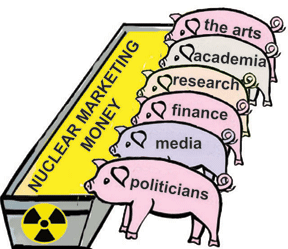 APJ Abdul Kalam had for nuclear scientists.
“Today the nuclear technologists are all doing
great work for the world, but it is essential for the services of nuclear science and its future prospects to be marketed as the only
continuously available clean energy source,” he told an international conference.
Kalam’s message comes in the backdrop of protests over the Kudankulam nuclear power project in Tamil Nadu following concerns over safety and environmental issues.
The Department of Atomic Energy had admitted that it had not succeeded in reaching out to the locals on the safety aspects of the Kudankulam nuclear project…http://ibnlive.in.com/news/market-nuclear-technology-properly-kalam/200165-3.html
Global nuclear industry in turmoil – uranium company’s profit drops 60%
 Cameco reduces production forecast, Globe and Mail, BRENDA BOUW — MINING REPORTER, VANCOUVER, Nov. 07, 2011 Uranium giant Cameco Corp. lowered its annual production forecast and reported third-quarter financial results below expectations amid continuing upheaval in the nuclear power industry.
Saskatoon-based Cameco, in a bidding war with Rio Tinto PLC for Hathor Exploration Ltd. during the current uranium price slump, cited “unfavourable market conditions” for the earnings underperformance…..
Production of uranium used to fuel nuclear power plants fell 5 per cent to 5.3 million pounds in the quarter, and for the year it is expected to drop 1 per cent to 21.7 million pounds, Cameco said. It also lowered guidance for UF6, a compound used to make enriched uranium, by 6 per cent….
profit fell 60 per cent…… Cameco shares closed down 6.5 per cent to $20.35 on the Toronto Stock Exchange on Monday, a sign investors are worried that Cameco will continue to suffer from volatility in the sector following the Japanese nuclear disaster.
“We expect the current uncertainly in the uranium market to linger for the near to medium term,” Mr. Gitzel warned.
Driving industry concerns are forecasts for excess uranium inventories in Japan and Germany, which represent 12 and 5 per cent of global nuclear generating capacity, respectively. Germany is phasing out its nuclear program, and Japan is operating only 11 of its 54 reactors since a tsunami and earthquake destroyed its Fukushima Daiichi nuclear plant this past March…..
China, too, is slowing its rapid nuclear power expansion plans as it takes extra measures to ensure its facilities are safe….
TEPCO nuclear company makes $8 billion loss, gets $11.5 billion in public funds

 Japan Approves Billions in Aid to TEPCO, Voice of America, 5 Nov 11 Government agreed Friday to a deal giving $11.5 billion in public funds to the Tokyo Electric Power Company (TEPCO) to cover costs in the aftermath of the March 11 earthquake and tsunami that crippled its Fukushima nuclear power plant.
The government said the funds would help TEPCO with cleanup and dismantling of the plant and compensation payments to residents of the area. The money comes from a fund made up of all Japanese nuclear plant operators and the government. In return, the utility must reduce its operating costs by more than $32 billion over the next 10 years and lay off more than 7,000 workers.
Engineers at Fukushima are still trying to bring the reactors to a stable cold shutdown by the end of this year. News of the bailout came on the same day TEPCO forecast a nearly $8 billion loss for the current fiscal year, ending in March. http://blogs.voanews.com/breaking-news/2011/11/04/japan-approves-billions-in-aid-to-tepco-2/
The International Energy Agency puts the case for falling use of nuclear energy!
 The Low Nuclear Case is not a forecast but “is intended to illustrate what a pessimistic view of the prospects for the nuclear power industry might entail,” the report said.
IEA draft: Nuclear to fall as power demand Reuters 5 Nov 11 – The Fukushima disaster could lead to a 15 percent fall in world nuclear power generation by 2035, while power demand at the same time could rise by 3.1 percent a year, according to a draft copy of the International Energy Agency’s 2011 World Energy Outlook.
Following the Japanese crisis, many countries put their nuclear power plans on hold or under review, and some, including Germany and Switzerland, opted out of the technology entirely.
The draft, obtained by Reuters ahead of its release next week, sai the IEA had developed a “Low Nuclear Case” that assesses possible implications for global energy balances of a much smaller role for nuclear power. Continue reading
What it’s really like to be a cleanup worker at Fukushima
Those on the lower rungs, say labour advocates, are particularly
vulnerable. They often have no corporate health, pension or redundancy
benefits. ….
the hardest work was done by the low-level labourers. They had so much rubble to clear, he says, that they often keeled over in the heat under the weight of their protective gear.
Taken out in ambulances, they would usually be back the following day.
Cleaning up Japan’s nuclear mess, The twilight zone, Its owner fears not just radiation leaking out of the Fukushima plant, but also bad news, The Economist Nov 5th 2011 | IWAKI | IT IS another world beyond the roadblocks stopping unauthorised traffic from entering the 20km (12.5-mile) exclusion zone around the
Fukushima Dai-ichi nuclear power plant. ….
The air of secrecy is compounded when you try to approach workers involved in the nightmarish task of stabilising the nuclear plant. Many are not salaried Tepco staff but low-paid contract workers lodging in Iwaki, just south of the exclusion zone. Continue reading
India’s Kudankulam nuclear project halted
Work halts at Kudankulam, The Hindu, T. S. SUBRAMANIAN 4 Nov 11,Personnel unable to enter plant: AEC chairman Work at the Kudankulam Nuclear Power Project (KKNPP) in Tamil Nadu has “halted” because the plant personnel are “unable to go inside” and this situation has arisen “when we need several thousands of people to work inside during the last phase of work” of commissioning of the first reactor there, said Srikumar Banerjee, Chairman, Atomic Energy Commission. Continue reading
Uranium price falling – AREVA stops African project

 Areva suspends uranium mine project, SMH ,November 3, 2011 – French nuclear giant Areva says it is suspending a mining project in the Central African Republic for “a year or two” because of a drop in uranium prices since the Fukushima disaster.
Work on developing the Bakouma mine, which is estimated to hold about 32,000 tonnes of uranium, has been suspended until the market value of the commodity rises again, an Areva spokesman said on Wednesday……
The price of uranium subsequently dropped by about 30 per cent, at a time when Areva was hoping for a global nuclear power renaissance.
On Wednesday the price of a pound (450 grams) of uranium was at $US52 ($A50.49), down from $US68 in March before the accident…..
Areva began development works at the mine under a deal signed in 2007 and to date has spent 106 million euros on developing the site.
The 2007 deal ended friction between Areva and the country’s authorities, who had handed mining rights to British-Canadian firm UraMin in 2006.
Areva bought out UraMin in July 2007 to the displeasure of the government, which said the “irregular” sale showed “disregard for the rights and interests” of the Central African people…..
Areva is expected to present a plan next month on a rethink of its corporate strategies in the wake of the Japanese disaster.
Woes of Australian uranium miner Paladin
1 This Month





PLEASE OPPOSE HR 8255 AND S.3639 – bills would accelerate satellite deployment, with no environmental review or safeguards – https://ncstd5li.quorum.us/campaign/169331/
To see nuclear-related stories in greater depth and intensity – go to https://nuclearinformation.wordpress.com
-
Archives
- October 2026 (31)
- September 2026 (339)
- August 2026 (330)
- July 2026 (355)
- June 2026 (287)
- May 2026 (306)
- April 2026 (356)
- March 2026 (251)
- February 2026 (267)
- January 2026 (308)
- December 2025 (358)
- November 2025 (359)
-
Categories
- 1
- 1 NUCLEAR ISSUES
- business and costs
- climate change
- culture and arts
- ENERGY
- environment
- health
- history
- indigenous issues
- Legal
- marketing of nuclear
- media
- opposition to nuclear
- PERSONAL STORIES
- politics
- politics international
- Religion and ethics
- safety
- secrets,lies and civil liberties
- spinbuster
- technology
- Uranium
- wastes
- weapons and war
- Women
- 2 WORLD
- ACTION
- AFRICA
- Atrocities
- AUSTRALIA
- Christina's notes
- Christina's themes
- culture and arts
- Events
- Fuk 2022
- Fuk 2023
- Fukushima 2017
- Fukushima 2018
- fukushima 2019
- Fukushima 2020
- Fukushima 2021
- general
- global warming
- Humour (God we need it)
- Nuclear
- RARE EARTHS
- Reference
- resources – print
- Resources -audiovicual
- Weekly Newsletter
- World
- World Nuclear
- YouTube
-
RSS
Entries RSS
Comments RSS

