Nuclear power workers co-operate in deception, in order to keep their jobs

 Nuclear power plants: A hidden world of untruths, unethical behavior August 06, 2012 THE ASAHI SHIMBUN The long and the short of it is this: Nuclear power plants probably would not operate properly in Japan if workers were not willing to sacrifice their health, and possibly their lives.
It emerges that workers at nuclear plants routinely resorted to ingenious ways to conceal the true levels of radiation to which they were exposed–simply to go on earning a living. Continue reading
Budget of Nuclear Regulatory Commission – Incredible in the true sense of the word
 Nuclear Agency Can’t Ensure Their Own Budget is Credible http://pogoblog.typepad.com/pogo/2012/08/nuclear-agency-cant-ensure-their-own-budget-is-credible.html By MIA STEINLE
The agency responsible for the nation’s nuclear weapons cannot ensure its own budget is credible, which may result in overspending, according to a federal investigative office.
The National Nuclear Security Administration “does not thoroughly review” the budget estimates it compiles from U.S. nuclear weapon sites before it draws up its annual budget request to Congress, request to Congress, according to the Government Accountability Office (GAO). The eight nuclear weapons sites are managed and operated by private contractors for the government.
Senior agency officials told the GAO that there is an “inherent trust” between the agency and the nuclear sites. Additionally, they said that a lack of “financial and personnel resources” mean a formal review of the budget is unrealistic.
The National Nuclear Security Administration is a semiautonomous agency within the Department of Energy. It is “responsible for the nation’s nuclear weapons, nonproliferation, and naval reactors programs,” according to the GAO. Its proposed budget for fiscal year 2011 is more than $11.5 billion, which is almost half of the entire Department of Energy budget.
Agency officials also told the GAO that they don’t follow a Department of Energy policy that requires a formal review of the budget because it expired in 2003. However, department officials told the GAO the policy still stands.
“By not adhering to these provisions,” the GAO said the agency “is reducing the creditability of its budget proposals.”
The GAO report comes at a time when rising costs of nuclear weapons projects are turning into “a serious liability for the [agency] as it tries to fend off criticism from Congress,” John Fleck reported for the Albuquerque Journal . He cited the proposed nuclear facility at Los Alamos National Laboratory in New Mexico as a point of contention. The GAO noted that the cost of this project has increased sixfold since its inception.
The GAO also cited the rising cost of the Uranium Processing Facility in Tennessee as a concern. Given the agency’s “record of weak management of major projects,” the GAO said improved oversight of the agency is necessary to ensure responsible spending.
Uranium price not getting any better
 Uranium Spot Prices Slip Below $50 Uranium Investing News, August 8, 2012, By Melissa Pistilli – The uranium spot price slipped further last week, dropping below the $50 mark for the first time in nearly a year as sellers gave in to lower bids.
This week, TradeTech is reporting a spot price of $49.50 per pound, down 25 cents from the previous week. …. The consulting firm said transaction activity in the spot market remains “exceptionally weak,” with transaction volume at less than 500,000 pounds of U308 over the past two months. Even with ConverDyn’s Metropolis Works conversion facility looking at a possible 15-month shutdown for safety upgrades, “the market is at a standstill.”…
Fukushima – deception in the workplace
 Asahi: Disturbing picture emerging as nuclear employees come out of the woodwork — Fukushima workers report groups clocking in with no dosimeters http://enenews.com/asahi-disturbing-picture-emerging-nuclear-employees-woodwork-fukushima-workers-report-groups-clocking-dosimeters August 6th, 2012
By ENENews (Subscription Only) Title: Nuclear power plants: A hidden world of untruths, unethical behavior
Source: Asahi AJW
Author: Compiled from reports by Miki Aoki, Toshio Tada and Tamiyuki Kihara
The long and the short of it is this: Nuclear power plants probably would not operate properly in Japan if workers were not willing to sacrifice their health, and possibly their lives.
It emerges that workers at nuclear plants routinely resorted to ingenious ways to conceal the true levels of radiation to which they were exposed–simply to go on earning a living. Continue reading
Investment expert agrees on poor economic outlook for nuclear power
“Fundamentally, [Mr] Immelt is right. In the end it’s going to be a combination of gas, wind and solar,” says Samer Salty, chief executive of Zouk Capital, a London private equity investor in clean energy projects..
Because of the vast investment needed and the construction risks involved, it is unlikely that the private sector will be willing to fund new nuclear plants without subsidies and incentives from cash-strapped governments.
Mr Atherton says: “There are few companies in the world that can take a loss of that size [the €2bn Olkiluoto cost overruns] and remain solvent.”
 Wind taken out of nuclear power’s sails Ft.com By Pilita Clark, Rebecca Bream and Guy Chazan, 2 Aug 12, It is one thing for a green pressure group to claim nuclear power is too expensive, but quite another when the charge comes from the head of an atomic industry pioneer such as General Electric.
GE built some of the world’s first commercial atomic reactors in the 1950s and has remained an industry leader since its nuclear joint venture with Japan’s Hitachi in 2007.
Some investors say that Jeff Immelt, GE chief executive, was merely stating an inconvenient industry truth when he told the Financial Times at the weekend that nuclear power was “really hard” to defend financially, and most countries were moving to a mix of gas and renewable energy. Continue reading
Future of Crystal River nuclear plant in doubt, as costs rise
Repair costs rise at Crystal River nuclear plant Tampa Bay Times, By Ivan Penn, Times Staff Writer Aug 02, 2012 The cost to fix the broken Crystal River nuclear plant appears to be on the rise.
The previous top estimate of $1.3 billion is likely too low, Duke Energy CEO Jim Rogers confirmed in an interview Thursday.
The utility has not decided whether to repair or permanently shutdown the plant. An independent technical evaluation commissioned on the facility by Duke’s board is expected to be complete in about a month, Rogers said…… http://www.tampabay.com/news/business/energy/repair-costs-rising-at-progress-energys-troubled-crystal-river-nuclear/1243770
Nuclear company’s financial burden, trying to sell to UK
EDF open to partners on UK nuclear scheme, Ft.com, July 31, 2012 By James Boxell in Paris EDF of France is seeking partners to share the financial burden of its project to build four atomic reactors in the UK, sparking fresh concerns about whether nuclear energy is becoming too expensive.
The cost of atomic power was called into question this week by Jeff Immelt, chief executive of General Electric , who said it had become “really hard” to justify compared with cheap shale gas.

The UK wants to replace ageing nuclear reactors but it is locked in negotiations with EDF – the world’s largest supplier of atomic energy by kilowatt hours – over setting a price for electricity that would justify the heavy investment.
EDF said on Tuesday it would decide this year whether to push on with the first UK facility in Somerset. But Thomas Piquemal, finance director, said it was looking at cutting its 80 per cent share of the project to spread the risk. The UK’s Centrica owns the other 20 per cent of the four-reactor consortium.
“We are thinking about the best ways of financing this and attracting new partners,” Mr Piquemal said.
EDF is 84 per cent-owned by the French state, but private shareholders are worried about spiralling costs in the UK unless favourable terms are offered. The company is planning to build next-generation EPR reactors, which have suffered big cost overruns in France and Finland.
RWE and EON of Germany abandoned plans to build reactors in the UK because of increasing industry costs, which have jumped since the nuclear disaster in Fukushima in Japan last year http://www.ft.com/intl/cms/s/0/49b4ef00-daea-11e1-8074-00144feab49a.html#axzz22Kejy7Ba
$73 billion for fixing and restarting San Onofre nuclear plant
Ailing California Nuclear Plant Has $48 Million Repair Bill
http://sacramento.cbslocal.com/2012/07/31/ailing-california-nuclear-plant-has-48-million-repair-bill/ July 31, 2012 LOS ANGELES (AP) — The operator of the ailing San Onofre nuclear power plant in California says the company has been saddled with $48 million in inspection and repair costs related to damage to tubes that carry radioactive water.
Financial records released Tuesday by Edison International — the parent company of Southern California Edison — also estimate that it will cost $25 million to begin to restart the Unit 2 reactor at reduced power.
The company has not submitted a request to federal regulators to restart either of the twin reactors that have been shut down since January. The figures were included in a report on Edison’s operations betweenApril and June.
The plant is located between Los Angeles and San Diego.
Nuclear power has had its day – General Electric’s chief
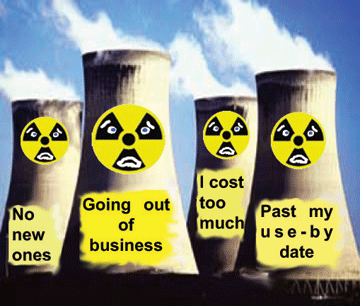 Nuclear ‘hard to justify’, says GE chief FT.com By Pilita Clark, 31 July 12, Nuclear power is so expensive compared with other forms of energy that it has become “really hard” to justify, according to the chief executive of General Electric, one of the world’s largest suppliers of atomic equipment.
“It’s really a gas and wind world today,” said Jeff Immelt, referring to two sources of electricity he said most countries are shifting towards as natural gas becomes “permanently cheap”…. It’s just hard to justify
nuclear, really hard. Gas is so cheap and at some point, really, economics rule,” Mr Immelt told the Financial Times in an interview in London at the weekend. “So I think some combination of gas, and either wind or solar … that’s where we see most countries around the world going.”
Mr Immelt’s comments underline the impact on the global energy landscape of the US shale gas revolution, Japan’s 2011 Fukushima nuclear meltdown and falling prices for some types of renewable power…..
a 75 per cent fall in solar panel market prices in the past three years has made solar power competitive with daytime retail electricity prices in some countries, according to a recent report by Bloomberg New Energy Finance, while offshore wind turbine prices have steadily declined.
Such factors pose dilemmas for countries such as the UK, which is trying to build new nuclear plants without public subsidy……
Analysts estimate GE’s nuclear revenues, from a joint venture with Japan’s Hitachi, at an estimated $1bn, or less than 1 per cent of annual global sales. …. http://www.ft.com/intl/cms/s/0/60189878-d982-11e1-8529-00144feab49a.html#axzz22EdFcsHr
Australia finding that 3 big uranium mining projects are not economically viable
 Uranium prices halt Sandy Desert project, BY: BARRY
  FITZGERALD The Australian July 29, THE most likely of Australia’s next big uranium mine developments – the Kintyre project in Western Australia’s Great Sandy desert – has fallen victim to sluggish demand and prices for the nuclear fuel, and WA’s “hot” construction market for resource projects.
Project operator and 70 per cent owner, Canada’s Cameco, has revealed that the economics of the project are “challenging” in that a development would not be profitable at current uranium prices. Prices are 34 per cent below where they need to be for a viable project.
The sluggish demand backdrop has implications for BHP Billiton which must find a home for the additional uranium it will produce with the planned $30 billion expansion of its Olympic Dam copper/uranium/gold mine in South Australia’s outback.
The expansion would see uranium output at Olympic Dam grow massively from 9.6 million pounds a year to 40.6 million pounds a year – 17 per cent of forecast global mine output in 2020.
But the Weekend Australian revealed that BHP plans to defer a decision on the project for two years.
Sluggish uranium demand has already reported to have led to BHP becoming disinterested in moving towards developing its Yeelirrie uranium deposit in WA.
Cameco chief executive Tim Gitzel told analysts that Cameco was “not going to develop Kintyre at any cost Continue reading
Cameco uranium company – profit loss with low sales and prices
Cameco profit hit by lower sales, prices Mining Peter Koven Jul 27, 2012 Second quarter profit dropped sharply at Cameco Corp. as the uranium giant’s sales volumes declined and it faced lower realized prices and higher costs.
Adjusted net income came in at $34-million, or 9 cents a share, down from 18 cents a year ago. The numbers fell short of analyst expectations.
Uranium sales volumes in the quarter were 5.3 million pounds, well down from 5.8 million pounds in the second quarter of 2011. Saskatoon-based Cameco’s realized price also dropped 8% year-over-year to US$42.08 a pound because of lower U.S.-dollar prices under
fixed-price contracts. Uranium production dropped 7%….
Centrica Says Needs Price Clarity Before Making Nuclear Decision, Bloomberg By Josephine Forster and Kari Lundgren – Jul 25, 2012 Centrica Plc (CNA), the biggest supplier of gas and electricity to British households, said it needs more clarity on power prices before
deciding to participate in building new nuclear reactors in Britain. Continue reading
Flat uranium market with more uncertainty about the industry’s future
 Uranium, Two Pounds For A Benny International Business Times, July 24, 2012 By Andrew Nelson It was yet another dull week on the spot uranium market last week, marked by slim volumes and another minor price decline. As of Friday, a US$100 bill sporting the inscrutable face of Benjamin Franklin, will now buy you two pounds of uranium.
Industry analyst TradeTech reported just 3 transactions last week, with only 250,000 pounds changing hands. Also affecting trading was news that Honeywell will not restart production at its Metropolis Works conversion facility, operated by ConverDyn. The company said the plant could remain closed for as long as 12-15 months in order to
undertake safety upgrades ordered by the US Nuclear Regulatory Commission…….
Whether the news is relevant or not to the daily grind of the uranium spot trading, it certainly did a good job of introducing even more uncertainty into what remains a very tentative market. The end result of low volumes, at least one motivated sell and new uncertainly was a US$0.25 decline in TradeTech’s Weekly U3O8 Spot Price Indicator to US$50.00.
There was no activity and only a little demand in the term market. None of it was new and all of it is coming from non-US utilities. TradeTech’s mid-term and long-term indicators remained unchanged at US$54.00 and US$61.00 respectively….
http://au.ibtimes.com/articles/366001/20120724/uranium-two-pounds-for-a-benny.htm#.UBGVnGGe5dM
Further delays for Finland’s and France’s new nuclear power plants
Finland’s Olkiluoto 3 nuclear plant delayed again, BBC News 16 July 12 Olkiluoto 3 has been hit by repeated delays and is over budget The launch of a flagship nuclear power station in Finland has been delayed for a third time, officials say.

Finnish electricity company TVO says the Olkiluoto 3 plant will not be ready by the latest deadline of 2014 and a new timetable has not yet been set.
The plant will be powered by a new generation of nuclear technology called the European Pressurised Reactor (EPR)….. Olkiluoto 3, originally due to be ready by 2009, is being built by French nuclear company Areva and German engineering giant Siemens.
In a statement, TVO said it was “not pleased with the situation” although solutions to various problems were being found one by one and work was “progressing”.
It said it was waiting for a new launch date from Areva and Siemens.
Work on the site in south-west Finland began in 2005 but has been hit by repeated delays and has run way over budget….. a similar project in Flamanville in northern France is itself running four years behind schedule…. http://www.bbc.co.uk/news/world-europe-18862422
The continuing gloomy story of Finland’s Olkiluoto nuclear reactor
Nuclear dawn delayed in Finland BBC News, By Rob Broomby 8 July 2009 The turbine is the world’s largest and will generate about 2m horse power When it is finished, Finland’s  3 (OL3) nuclear reactor will be the biggest the world has ever seen, the excavation site alone is the size of 55 football fields.
It was to have been a pilot project for bigger, better, cleaner, Generation III reactors, which would lead the charge back to nuclear power in a continent which had gone cold on atomic energy after the accidents at Chernobyl and Thee Mile Island.
But hopes of an early nuclear dawn on the Baltic coast are fading – Continue reading
1 This Month





PLEASE OPPOSE HR 8255 AND S.3639 – bills would accelerate satellite deployment, with no environmental review or safeguards – https://ncstd5li.quorum.us/campaign/169331/
To see nuclear-related stories in greater depth and intensity – go to https://nuclearinformation.wordpress.com
-
Archives
- October 2026 (29)
- September 2026 (339)
- August 2026 (330)
- July 2026 (355)
- June 2026 (287)
- May 2026 (306)
- April 2026 (356)
- March 2026 (251)
- February 2026 (267)
- January 2026 (308)
- December 2025 (358)
- November 2025 (359)
-
Categories
- 1
- 1 NUCLEAR ISSUES
- business and costs
- climate change
- culture and arts
- ENERGY
- environment
- health
- history
- indigenous issues
- Legal
- marketing of nuclear
- media
- opposition to nuclear
- PERSONAL STORIES
- politics
- politics international
- Religion and ethics
- safety
- secrets,lies and civil liberties
- spinbuster
- technology
- Uranium
- wastes
- weapons and war
- Women
- 2 WORLD
- ACTION
- AFRICA
- Atrocities
- AUSTRALIA
- Christina's notes
- Christina's themes
- culture and arts
- Events
- Fuk 2022
- Fuk 2023
- Fukushima 2017
- Fukushima 2018
- fukushima 2019
- Fukushima 2020
- Fukushima 2021
- general
- global warming
- Humour (God we need it)
- Nuclear
- RARE EARTHS
- Reference
- resources – print
- Resources -audiovicual
- Weekly Newsletter
- World
- World Nuclear
- YouTube
-
RSS
Entries RSS
Comments RSS

