Nuclear power obstacle in Japan: new evacuation plans
under the new radiation forecast, many more local governments will have to compile disaster management plans for areas that could require evacuation.
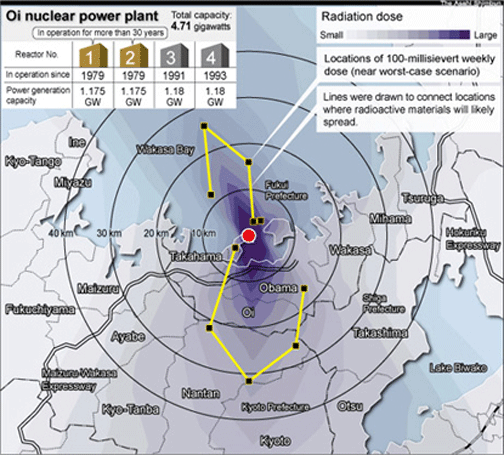
Radiation forecast creates hurdle in resuming nuclear plant operations UPDATE: Forecast predicts wider evacuations needed if nuclear disaster repeated October 25, 2012 THE ASAHI SHIMBUN Municipalities are demanding a greater say in whether utilities can restart their reactors after the new industry watchdog placed more communities in the danger zone of possible nuclear accidents. Continue reading
Will ratepayers foot the big bill for restarting San Onofre nuclear power plant?
 California Regulators Examining Troubled Nuclear Plant’s Costs Fox Business, October 25, 2012 California regulators said Thursday they would decide whether utility customers should pay to fix and restart the troubled San Onofre nuclear power plant in a ruling likely to determine the plant’s future.
The nuclear plant, located on the Pacific Coast between Los Angeles and San Diego, has been shut since Jan. 31, when a pipe ruptured and released radioactive steam…
.. The company plans to restart part of the plant for a limited period, but needs approval from the U.S. Nuclear Regulatory Commission before it can proceed. The NRC has said a decision on that plan, filed earlier this month, will likely take several months.
Asked whether the company might delay its plans for the plant pending the CPUC’s decision on whether customers would foot the bill, a SoCal Edison spokeswoman declined to comment….. http://www.foxbusiness.com/news/2012/10/25/california-regulators-examining-troubled-nuclear-plant-costs/#ixzz2AR7GkP3a
Price Anderson Nuclear Industries Indemnity Act – a whopper government subsidy
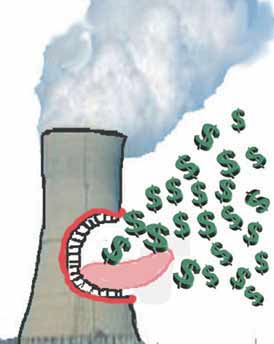 It is worth noting that Exelon, as an owner and operator of more nuclear power plants than any other American company, benefits to a considerable degree from what is potentially one of the largest government subsidies of energy production in world history, the Price Anderson Nuclear Industries Indemnity Act.
Nuclear Company Blasts Wind Industry Tax Incentive  KCET, by Chris Clarke
on October 23, 2012 The largest operator of nuclear power plants in the United States has blasted the Wind Production Tax Credit in a commissioned study…… Continue reading
While India’s nuclear dream languishes, solar energy up and running quickly
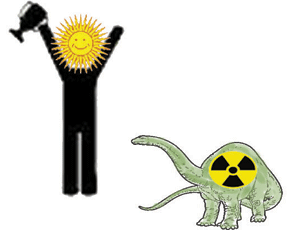 The latest news is that Reliance is building Asia’s largest solar power plant in Jaisalmer district of Rajasthan. “The 250 MW plant being built with Areva of France would be ready by late 2014. The entire project would be ready by 2014”
Cheap nuclear energy is an illusion The Pioneer:  Kumar Chellappan, 25 Oct 12 Nuclear energy is expensive and unsustainable, and takes more than a decade to be fully operational. It is also high on risks. Moreover, the 20 nuclear reactors spread across the country generate hardly 60 per cent of the total installed nuclear power
Hidden subsidies have helped the Nuclear Power Corporation of India Continue reading
China slowing down its nuclear power program
China to approve only a few new reactors by 2015 By David Stanway BEIJING 
 Oct 24, 2012 (Reuters) – China will approve a small number of new nuclear reactors before 2015 to be built only in coastal regions, the government said on Wednesday, as it unveiled a raft of measures to spur private investments in energy. Continue reading
Another utility company pulls out of uneconomic nuclear power project
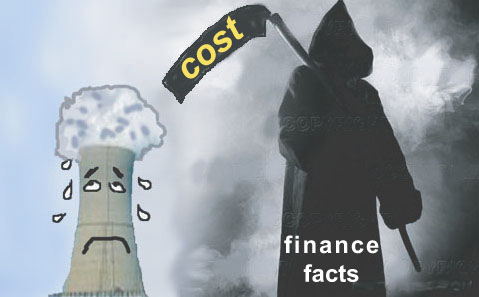 Utilities are pulling out of nuclear projects across Europe as uncertainty over energy prices makes them too risky. EON’s withdrawal from Finland follows its decision in September 2011, along with SSE Plc and RWE AG (RWE), to give up building nuclear plants in the
U.K
 EON Withdraws From Finnish Nuclear Project on Price Slide, Bloomberg By Torsten Fagerholm – Oct 24, 2012 EON AG, Germany’s biggest utility, plans to withdraw from the Fennovoima Oy nuclear reactor in Finland after European energy prices declined, threatening the viability of the project. Continue reading
Economics are the downfall of the nuclear industry
The industry’s renewed glimpse of its mortality comes as the Nuclear Regulatory Commission is working on the question of whether the existing plants can get a second 20-year extension, to age 80. But license extension may not be the problem. Wider economic circumstances may be instead.
Aging and Expensive, Reactors Face Mothballs NYT, Matthew Wald , 23 Oct 12 THE conventional wisdom about nuclear reactors is that they are expensive to build but cheap to run.
The world’s nuclear industry continues to decline
World Nuclear Industry Status Report maps nuclear power’s global decline http://www.beyondnuclear.org/home/2012/10/22/world-nuclear-industry-status-report-maps-nuclear-powers-glo.html A new World Nuclear Industry Status Report 2012, authored by Mycle Schneider with Antony Froggatt and Julie Hazemann, maps the continuing global decline of nuclear power. The report shows that nuclear’s future rests not on new construction, but that “Plant life extension seems the most likely survival strategy of the nuclear industry at this point” – a good reason to continue to block reactor license extensions. The report noted that: “Only seven reactors started up, while 19 were shut down in 2011.” By July 2012, “only two were started up, just compensating for two that were shut down so far this year”. Other highlights:
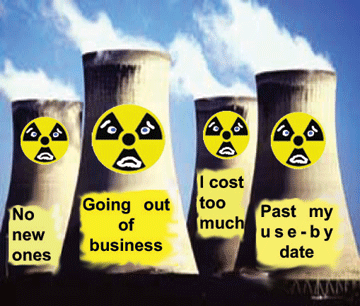
China is spending five times more on renewables than nuclear post-Fukushima with no new nuclear construction since 3/11; nine reactors have been listed as “under construction” for more than 20 years; four countries – Belgium, Germany, Switzerland and Taiwan – will phase out nuclear power and five more to date – Egypt, Italy, Jordan, Kuwait and Thailand – have abandoned plans to develop, or re-develop nuclear power; new builds have been canceled in Brazil, France, India and the US; certification of new reactor technologies has been delayed numerous times; in the US, of the 28 license applications received, 16 were subsequently delayed and eight were suspended indefinitely or officially canceled; of the 59 units under construction in the world, at least 18 are experiencing multi-year delays, while the remaining 41 projects were started within the past five years or have not yet reached project start-up dates.
Permanent shutdown for USA nuclear power plant
 The shutdown would be the first of any reactor in the country since the late 1990s
Dominion says Kewaunee nuclear plant will shut down for good By Thomas Journal Sentinel 22 Oct 12, Dominion Resources Inc. will shut down the Kewaunee Power Station by the middle of next year, the company announced Monday, saying it was unable to find a buyer for the nuclear plant east of Green Bay.
The Kewaunee reactor is one of three operating reactors in the state, with the other two located five miles away at Point Beach Nuclear Plant.
The Virginia-based company said the low price of natural gas, which sets prices for the wholesale power market, was a key factor in the decision. The company’s agreements to sell power to two Wisconsin utilities expire next year. Continue reading
Falling demand, falling prices, make uranium a very dubious investment
Adding to the miners’ woes, uranium prices continue to fall, from US$73 a pound in March 2011, to around US$43 currently. That’s lower than the cash cost of production at Paladin’s Kayelekera mine in Malawi, giving the miner a decent sized headache.
Nuclear Fallout Hurts Uranium Miners , 9 News, by Mike King, The Motley Fool, October 19, 2012 The world continues to feel the impact of the Fukushima nuclear disaster. The disaster in Japan in 2011 has left 48 of Japan’s nuclear reactors sitting idle, awaiting government approval to resume operations, with just 2 restarted. In mid-September, the Japanese government approved a new energy plan which included reducing the nation’s reliance on nuclear energy substantially.
Following the Fukushima accident, Germany immediately shut 8 of its reactors, and plans to close its remaining 9 reactors by 2022.
The impact is being felt by uranium miners globally.
Paladin Energy Ltd (ASX: PDN) recently stated that annual demand for uranium has fallen, as the future of nuclear energy was cast into doubt. The world’s largest uranium producer, Canada’s Cameco, has also forecast lower sales and highlighted doubts about the take-up of nuclear power in future. Continue reading
Power line linked to nuclear plant upgrade would cost at least $193 million Journal Sentinel 18 Oct 12 A high-voltage power line in Sheboygan, Manitowoc and possibly Calumet counties will cost $193 million to $262 million, depending on the route selected.
American Transmission Co. this week filed an application with state regulators to build the line, which is needed to help accommodate the increased power output from the Point Beach Nuclear Plant…. http://www.jsonline.com/blogs/business/174789691.html
Future of nuclear power in Europe – a murky outlook
CEE nuclear power: deeper in doubt Ft.com October 16, 2012 by Jan Cienski Nuclear power has long held the possibility of energy independence for central Europe, freeing it from its heavy reliance on imports of Russian natural gas. But a series of political and corporate decision across the region in the last few days leaves the future of atomic power murkier than ever.
Starting in the north, Lithuania’s parliamentary elections and a parallel non-binding referendum on nuclear power appear to have thrown a spanner into the country’s hopes of weaning itself off Russian gas by building a regional nuclear power station. Two-thirds of voters rejected the power plant, putting its future in doubt.
The country’s previous, Soviet-era nuclear power plant was shut down in 2009 for safety reasons, one of the conditions for Lithuania’s entry to the EU in 2004.
….. Further doubts were sown on Friday when Donald Tusk, Poland’s premier, relaunched his troubled administration with a speech to parliament in which he spelled out his government’s economic priorities. He detailed 60bn zlotys ($19bn) in investment plans for
energy, but was conspicuously silent on nuclear….. http://blogs.ft.com/beyond-brics/2012/10/16/nuclear-power-in-cee-deeper-in-doubt/#axzz29a1N2hLA
Russia joins the feeding frenzy to sell nukes to UK
 Russia eyes stake in UK nuclear plants http://www.telegraph.co.uk/finance/newsbysector/energy/9594476/Russia-eyes-stake-in-UK-nuclear-plants.html By Emily Gosden 09 Oct 2012 Russia is seeking a stake in the UK’s nuclear new-build programme, in a boost for the Government’s energy plans. Alexey Kalinin, of Russian
state nuclear corporation Rosatom, will today say that it is willing to invest in the UK’s reactor programme. Continue reading
An irreversible ripoff of the British public – new nuclear reactors
 the numbers now being talked about in terms of price guarantees for the energy giants are astronomical.
who will wave a flag and scream ‘rip off’ before the Government signs an irrevocable deal.
Nuclear deal is likely to leave a toxic legacy This Is Money, By LISA BUCKINGHAM, 6 October 2012 “…….Now, though, comes a set of negotiations that have the ability to swipe tens of billions out of the public purse and into private coffers. Chinese investors may be about to pick up part of the tab for building some of our new nuclear power stations, but this is not out of the goodness of their hearts.
French energy group EDF, in partnership with British Gas owner Centrica, has been embroiled in long negotiations with the Government over what will effectively be a subsidy to help them cover the huge building costs of these new generators. Continue reading
Series of company pullbacks puncture UK’s nuclear power dream
 There is now a question mark over who will ultimately foot the bill for what are expected to be massively expensive infrastructure projects
How lights dimmed on UK’s nuclear vision, FT.com By Guy  Chazan, October 5, 2012 In 2009, Ed Miliband, the then energy secretary, unveiled plans for the most ambitious expansion of nuclear power in Europe.
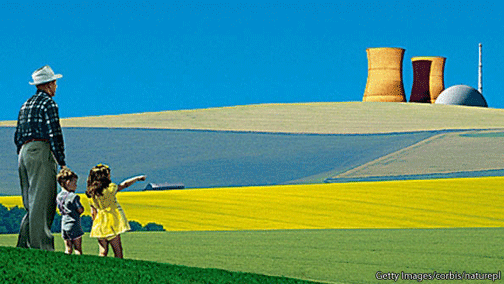
It was a bold vision. Britain would build up to 12 new reactors, he said, on 10 sites stretching from Somerset to Cumbria. By the late 2020s about 30 per cent of its electricity would come from nuclear power – up from 18 per cent now
That prediction is now looking wildly optimistic
 .
.
“The race for new nuclear in this country is at serious risk of unravelling,” says Tony Lodge, a research fellow at the Centre for Policy Studies think-tank.
Nuclear is widely seen as one of the great panaceas for Britain’s looming energy problems….
But recent events have conspired to puncture Britain’s nuclear dream. Continue reading
1 This Month





PLEASE OPPOSE HR 8255 AND S.3639 – bills would accelerate satellite deployment, with no environmental review or safeguards – https://ncstd5li.quorum.us/campaign/169331/
To see nuclear-related stories in greater depth and intensity – go to https://nuclearinformation.wordpress.com
-
Archives
- October 2026 (19)
- September 2026 (339)
- August 2026 (330)
- July 2026 (355)
- June 2026 (287)
- May 2026 (306)
- April 2026 (356)
- March 2026 (251)
- February 2026 (267)
- January 2026 (308)
- December 2025 (358)
- November 2025 (359)
-
Categories
- 1
- 1 NUCLEAR ISSUES
- business and costs
- climate change
- culture and arts
- ENERGY
- environment
- health
- history
- indigenous issues
- Legal
- marketing of nuclear
- media
- opposition to nuclear
- PERSONAL STORIES
- politics
- politics international
- Religion and ethics
- safety
- secrets,lies and civil liberties
- spinbuster
- technology
- Uranium
- wastes
- weapons and war
- Women
- 2 WORLD
- ACTION
- AFRICA
- Atrocities
- AUSTRALIA
- Christina's notes
- Christina's themes
- culture and arts
- Events
- Fuk 2022
- Fuk 2023
- Fukushima 2017
- Fukushima 2018
- fukushima 2019
- Fukushima 2020
- Fukushima 2021
- general
- global warming
- Humour (God we need it)
- Nuclear
- RARE EARTHS
- Reference
- resources – print
- Resources -audiovicual
- Weekly Newsletter
- World
- World Nuclear
- YouTube
-
RSS
Entries RSS
Comments RSS

