Oak Ridge uranium processing facility costs running out of control?
Frank Munger: Alexander keeping eye on Uranium Processing Facility costs Knox News, By Frank Munger June 5, 2013 U.S. Sen. Lamar Alexander has been a big supporter of the Uranium Processing Facility and no doubt still is, but Tennessee’s senior senator sounded a warning last week that he wouldn’t put up with out-of-control costs — even for an Oak Ridge project that he considers essential.
“I’ve pretty well had it with these big Energy Department projects
that start out costing a billion dollars and end up costing $6
billion,” Alexander said in an interview. “We can’t afford that. And
we can use the money much more wisely, either to reduce the debt or to
pay for energy research.”
There are reports that the UPF is on the verge of going over the top
end of its estimated cost range — currently set at $4.2 billion to
$6.5 billion. The senator is the ranking Republican on the Senate
Appropriations’ energy and water subcommittee, which plays a pivotal
role in funding the Department of Energy and its sub-unit, the
National Nuclear Security Administration.
I asked him if there was a price tag too high.
“Well, we’ll have to decide that,” he said. “One thing I want to make
sure is we don’t start constructing the facility until we have a
design. And then I want it to be more like the big Spallation Neuron
Source which we built a few years ago that (ORNL Director) Thom Mason
was in charge of. Once we knew the design and we knew the cost, even
though the number was big ($1.4 billion), they stayed on time and on
budget.”
When pressed about a cost ceiling for UPF, Alexander wouldn’t go
there….. http://www.knoxnews.com/news/2013/jun/05/frank-munger-alexander-keeping-eye-on-uranium/
More bad news for uranium industry
Uranium – little selling in May 9 News Finance 4 June 13 By Andrew
Nelson Uranium sellers were not inclined to sell in May and
unfortunately for them, the buyers weren’t really buying either. The
spot price traded in a tight range over the month, starting at
US$40.50 per pound and then dropping to US$40.25 before heading back
up to end the month at US$40.40 per pound.
The same old story continued to play out, the one in which sellers
can’t/don’t want to drop prices further versus buyers that really
don’t need the stock. Industry analyst TradeTech reports that
producers have been going almost door to door to shift uncommitted
material off the shelves this year at or around current prices, but
buyers are increasingly focused on 2014 deliveries.
There was a bit of hope earlier in the month that prices could start
pushing higher on news of a terrorist attack and subsequent production
stoppage at the Somair uranium mine in Niger. The problem with this
ill-conceived hope is that it looks like production at the facility
will kick back on over the next few months and with little disruption
to delivery commitments.
With buyers not buying and sellesr not wanting to sell at lower
prices, market activity in May was slow. TradeTech reports only 23
transactions were concluded, accounting for nearly 3 million pounds of
U3O8 equivalent. While by no means running hot, May was at least up on
the 2.4m pounds that changed hands in April.
By the end of the month, which was also the end of the week,
TradeTech’s Exchange Spot Price Indicator had come off US10c to
US$40.40…… http://finance.ninemsn.com.au/newscolumnists/other/8669520/uranium-little-selling-in-may
MidAmerican saves consumers money – going for wind energy, rejects nuclear
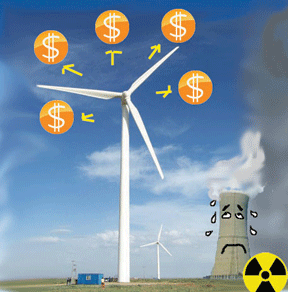 Berkshire Hathaway’s MidAmerican to hold off on new Iowa nuclear plants Fox Business News, by Scott DiSavino and Joe Silha 4 June 13 Berkshire Hathaway Inc’s MidAmerican Energy Co has decided against building any new nuclear reactors in Iowa in the near future because of regulatory hurdles.
“It is premature, given the uncertainty of carbon regulation and the extensive regulatory review for new nuclear reactor designs, to immediately pursue any additional site work on a future generation option, including a nuclear facility,” the company said in a statement on Tuesday.
Many utilities have put plans for costly new nuclear reactors on hold due to cheap natural gas prices, the much lower cost to build gas-fired generators, and the lack of federal restrictions on carbon emissions……
MidAmerican’s news came after the company completed a study on nuclear feasibility and reported the results to Iowa regulators on Monday. The utility, the state’s largest, had been collecting a half-percent charge from customers there to study the feasibility of building new reactors.
MidAmerican asked the Iowa Utilities Board to approve a plan that allows the company to refund $8.8 million of the funds collected from its customers in the state and to stop collecting the half-percent charge for the assessment, effective July 1, three months earlier than planned.
The refund and elimination of the half-percent charge for the nuclear assessment will result in a slight decrease in Iowa customers’ bill amounts starting this summer, MidAmerican said…..
Based on the assessment’s results, MidAmerican said it would not buy any land in Iowa at this time to develop a nuclear facility. The land options in Fremont County will expire, and the company said it would not pursue an extension on its land options in Muscatine County……
Separately, MidAmerican said its recently announced plan to build additional wind generation would help keep customers’ costs down. If approved by state regulators, the wind expansion will reduce customer rates by $10 million a year by 2017, starting with a $3.3 million decrease in 2015.
MidAmerican provides electric service to 734,000 customers and natural gas service to 714,000 in Iowa, Illinois, Nebraska and South Dakota. http://www.foxbusiness.com/news/2013/06/04/berkshire-hathaway-midamerican-to-hold-off-on-new-iowa-nuclear-plants/#ixzz2VNJIDWb0
Harm from radiation, among families of nuclear workers
 Some Atomic Energy Workers Passed Effects of Radiation and Chemical Exposure to their Spouses and Children Huntington News, June 3, 2013 – BY TONY E. RUTHERFORD, NEWS EDITOR “……“Big Jim” took a job working around radioactive elements in 1954 at the Portsmouth Gaseous Diffusion Plant (PGDP) in Piketon, Ohio. Workers told his daughter how they kept their lunches warm by laying them on uranium yellow cakes and poked fun of individuals who put around their clothing before painting. They wore radiation exposure badges, but by “doing his job” Jim later developed four cancers.
“My dad talked about the A plant, but he never told us what it was,” Joan Fearing (Big Jim’s daughter) said. “Mom washed his work clothes.” She passed away from a rare form of cancer too. “When my mother was dying, she still did not tell us what it was.”
The Cold War ended the arms race. Nuclear weapons were replaced with atoms for peace at electrical power plants. However, the atomic legacy appears passed to the 21st Century. Continue reading
Japan’s PM Abe pushing for nuclear reactor sales to India – and fast!
 Japan, India seek prompt nuclear accord Asia One, 31 May 13 TOKYO – Prime Minister Shinzo Abe and visiting Indian Prime Minister Manmohan Singh agreed to conclude a nuclear cooperation agreement as soon as possible……Although the negotiations on the nuclear cooperation pact began in June 2010, they have been suspended due partly to the nuclear crisis at the Fukushima No. 1 nuclear power plant following the Great East Japan Earthquake in 2011.
The two leaders instructed related authorities to accelerate the negotiations……
The Abe administration considers the export of infrastructure to be a pillar of its growth strategy. The Indian government, for its part, plans to increase its nuclear energy generation by constructing 18 new nuclear reactors by 2020.
The Japanese side hopes to reach an agreement with India by the end of this year, leading to exports of nuclear power plants and related equipment……
Meanwhile, Singh expressed his support for Japan’s bid to host the 2020 Summer Olympics.
They also confirmed the plan to arrange an official visit by the Emperor and Empress to India from late November to early December. http://news.asiaone.com/News/AsiaOne%2BNews/Asia/Story/A1Story20130531-426340.html
USA government push for nuclear energy has ended in failure
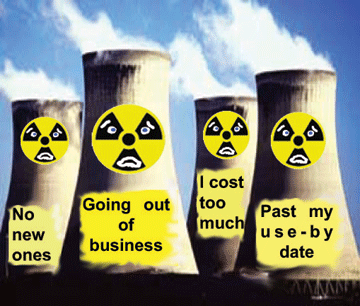 It was not supposed to be this way. In 2005 Congress approved subsidies to bolster the nuclear industry and encourage the construction of new plants. It extended a law limiting owner liability in case of accidents and, for the first few new reactors, offered $18 billion in loan guarantees, $2 billion in indemnification against cost overruns and $1 billion in tax breaks.
The NRC streamlined its licensing procedures, hoping to avoid the years of delays that inflated costs for earlier nuclear plants. (Southern ended up paying $8.7 billion for the existing reactors at Vogtle, a far cry from the $660m originally projected.)
None of this has worked as advertised.
Fracked off Thanks to cheap natural gas, America’s nuclear renaissance is on hold The Economist, Jun 1st 2013 | BURKE COUNTY, GEORGIA IT IS the sort of thing you would expect to see in China, not in the pine forests of rural Georgia. On the banks of the sluggish Savannah river towers one of the world’s biggest cranes. It is helping build two nuclear reactors, to add to the two already up and running at the Vogtle power plant. It testifies to the mammoth efforts that have been made in recent years to revive America’s nuclear industry—and to the disappointing results. Continue reading
URENCO might die, in failing global uranium industry
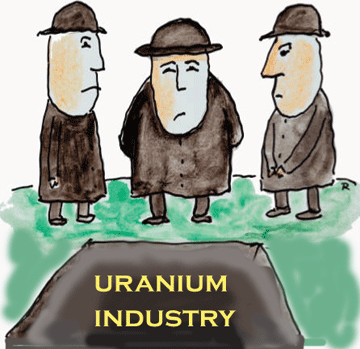 one of the more important factors, surely, is the projected value of the MOX itself, which in turn is a function of long term uranium prices—there would be no point in completing the plant and then making the MOX, as opposed to just dumping the plutonium, if uranium will be dirt-cheap as far ahead as one can see.
the fate of the MOX plant is but one indicator of retrenchment in the global nuclear fuels market, post-Fukushima
the Japanese nuclear shut-down, which, the Times went on to note, has reduced global demand for nuclear fuels by close to 10 percent, plus Germany’s planned nuclear exit, have cast a pall that now stretches to New Mexico,
Kentucky, and South Carolina.
Restructuring and Retrenchment in Nuclear Fuels http://spectrum.ieee.org/energywise/energy/nuclear/restructuring-and-retrenchment-in-nuclear-fuels By Bill Sweet 29 May 2013 In 2000, the United States agreed with Russia to get rid of 34 tons of weapons-grade plutonium. To that end, it embarked on construction of a large plant at Savannah River, S.C.,where the plutonium would be mixed with uranium to make so-called mixed oxide fuel (MOX), suitable for use in nuclear power plants.
Buried in the president’s fiscal 2014 budget request is a line sharply cutting funding for the Savannah River MOX plant, which “may be tantamount to killing it,” a former National Nuclear Security Administration official told Arms Control Today. Continue reading
Never ending delay in plans for India’s Jaitapur nuclear power plant
Moushumi Das Gupta, Hindustan Times
Areva had in 2010 signed a framework agreement with the Nuclear Power Corporation of India (NPCIL) to build two of the new generation European Pressurised Reactors (EPR) of 1650 MW each as part of Phase I with an option to build four more.
But amidst protests by locals — concerned over safety issues following the Fukushima accident — and confusion over some clauses of civil nuclear liability law that puts the onus on suppliers in case of accidents, the commercial pact has not been signed as yet resulting in the project failing to take off the ground.
The delay has not only resulted in Areva rescheduling the original 2017 date for commissioning the reactors but company officials said it will also lead to an escalation in the cost of power to be generated. Currently the per unit cost of power has been fixed at Rs. 4.
“No way that the EPR would start by 2017. More the delay, the unit cost would get affected. The Rs. 4 per unit tariff is meant for plants starting in 2017,” said Arthur De Montalembert, executive vice-president, business development, international commercial organization at Areva…… http://www.hindustantimes.com/world-news/Europe/Jaitapur-nuclear-plant-headed-for-delay-Areva/Article1-1067427.aspx
Europe gives cold shoulder to Russia’s nuclear marketing
One of the main reasons that the Baltic NPP project has run aground is that neither investors nor energy importers that Rosatom has approached in Europe have agreed to come on board…..
………The story of the Baltic NPP is an illustrative account of Rosatom’s incapability of landing anything other than rebuffs in Europe, earning trust in the safety of its reactor technology, and winning over foreign investors.
Europe has given a cold shoulder to Rosatom’s brilliant plan to quell its energy security concerns with power streaming from nuclear reactors built in its backyard

 GAZETA.RU: Nuclear failure Gazeta.ru, May 24, 2013 – Moscow’s resigned willingness to consider reduced capacity for the future Baltic Nuclear Power Plant is testimony to the Russian nuclear industry’s failure to overcome criticism it has been facing in the European market, convince potential customers of the reliability of its technologies, or attract foreign investors so it could get a foot in Europe’s door. By Vladimir Slivyak Continue reading
Uranium enrichment company URENCO for sale – uneconomic
Powerhouse of the Uranium Enrichment Industry Seeks an Exit NYT, BY STANLEY REED , 26 May 13“..….Urenco was formed by treaty in 1971 when Britain, West Germany and the Netherlands decided for
strategic and business reasons to combine their uranium enrichment programs. The company is still owned by the British and Dutch governments, with one-third each, and with the German third held jointly by two big utility companies, E.On and RWE.
Urenco now has four enrichment plants — in Britain, the Netherlands
and Germany — selling fuel for civilian energy purposes around the
world, capturing nearly a third of the global market………the
company is at a crossroads. Growth may flatten in the next couple of
years, executives say, mainly because Japan — a major user of nuclear
power until the 2011 Fukushima Daiichi disaster — has shut down its
reactors, taking about 10 percent of the world’s nuclear energy
generating capacity offline. And the Japanese have stockpiled
substantial amounts of fuel for the day, if ever, that those reactors
go back into operation……
“Nuclear strategies have changed,” said Michael Kruse, a consultant on
nuclear issues for the management consultant Arthur D. Little in
Frankfurt. “Governments no longer think they need to be in this
business,” he said, “and utilities in several countries want out after
Fukushima.”
People in the industry say the most likely buyers would be companies
already in the industry that might want to offer clients fuel along
with nuclear power stations. Areva, a French giant, might fit that
bill. So might Toshiba of Japan, which is studying building nuclear
plants in Britain. Still, “there are in my view not many companies
that can buy Urenco,” Mr. Kruse said.
Hitachi, Toshiba and Mitsubishi General Electric, Westinghouse, Areva will make Japan keep nuclear power
 Is it safe? Ruling party pushes nuclear village agenda BY JEFF KINGSTON JAPAN TIMES, 26 May 13, “…..The election of the pro-nuclear Liberal Democratic Party to power in December 2012 was not about energy policy, but has revived prospects for the nuclear village; citizens may favor phasing out nuclear energy, but they will not get to decide. Hitachi, Toshiba and Mitsubishi tie-ups with General Electric, Westinghouse and Areva mean that Japan stands at the nexus of the global nuclear-energy industry. The recent award of a $22 billion contract by Turkey to a Japanese-led consortium indicates how high the stakes are, explaining why domestic firms’ nuclear-policy preferences are fully reflected in government policy.
 If Japan terminated nuclear power, the pain would extend beyond the utilities and vendors; lenders and investors, including Japan’s major banks and insurance firms, would also face huge losses. Pulling the plug on nuclear power could also drive some of Japan’s 10 utilities into insolvency. In addition, there have been strident voices from the political right calling for the retention of nuclear energy because it leaves available the nuclear-weapons option. Washington, too, has warned Tokyo that phasing out nuclear energy would harm bilateral relations because it would raise concerns about Japan’s large stockpiles of plutonium and uncomfortable questions about the consistency of U.S. nuclear non-proliferation efforts targeting Iran and North Korea…….http://www.japantimes.co.jp/opinion/2013/05/26/commentary/is-it-safe-ruling-party-pushes-nuclear-village-agenda/#.UaPpE9JwpLs
The heavy footprint of uranium company AREVA, in impoverished Niger
 Areva, world’s 2nd uranium company heavily present in Niger, Expatica.comm 23 May 13 French nuclear group Areva, the world’s second-largest uranium producer whose mine in northern Niger was hit by a car bomb on Thursday, extracts more than a third of its mineral in the impoverished west African country.
Areva has been present in Niger for more than 40 years, operating two big mines near the northern town of Arlit through two affiliated companies — Somair and Cominak — which represent 37 percent of its total uranium production. Continue reading
Uranium enrichment – how crooked deals on USEC enrich the private sector
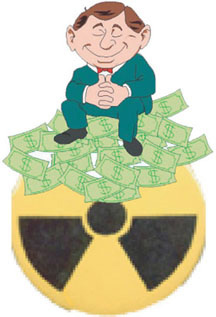 To keep a large campaign contributor out of bankruptcy court for a few more months, the Paducah plant was permitted to reach the current crisis state. And the people of Kentucky were sent straight to nuclear hell.
Countdown to Nuclear Ruin at Paducah EcoWatch May 22, 2013 by Geoffrey Sea “……….Murphie’s Law So how did it come to this? Since the plant was originally scheduled to cease operations on May 31, 2012, why didn’t USEC and DOE have plenty of time to plan for orderly and funded clean power-down, which was precisely what the sleazy one-year extension deal was supposed to give time to accomplish.
The answer is that the entire uranium enrichment enterprise of the U.S. has become a sham operation, a sham designed to funnel U.S. Treasury funds to private companies including USEC and its partners, a sham designed to convert any problem or scandal into additional contractor award fees, a sham designed to keep the fig-leaf of a privatized USEC Inc. from blowing away and exposing all the naughty bits.
Those became the goals of the operation, not enriching uranium, developing new technology or achieving safe operations or cleanup of the sites. Murphie’s Law is that if anything can go wrong, it will boost contractor award fees, for a select group of companies hand-picked by Murphie himself. Thus, the principal “cleanup” contractors at Piketon are Fluor and Babcock & Wilcox (B&W), both of which are suppliers to USEC’s fake “American Centrifuge Project,” and B&W is a strategic partner of USEC with a large share of USEC preferred stock, poised to take over USEC’s operations if the latter goes under. Continue reading
TEPCO’s share price up on projected restarting of Japan’s nuclear reactors
Thanks To Abenomics, The Company At The centre Of The Fukushima Nuclear Crisis, Has Surged Nearly 400% This Year BUSINESS INSIDER MATTHEW BOESLER 22 May 13 ‘… a pretty shocking chart: it’s the share price of TEPCO, the beleaguered Japanese power company at the centre of the Fukushima nuclear disaster that followed from the Japanese earthquake in April 2011.
Year-to-date, the stock is up 396%. In recent days, it’s gone absolutely vertical in the past few days on speculation that the company will at last power up its nuclear reactors again, which have been shut down since the disaster.Bloomberg’s Tsuyoshi Inajima has the details:
Tepco shares yesterday rose 16 per cent to 726 yen after the Yomiuri newspaper reported the utility will apply to the Nuclear Regulation Authority for a restart of No. 1 and No. 7 units at the Kashiwazaki Kariwa plant in northern Japan in July.
Tepco denied the Yomiuri report and said the utility is still designing a filtered vent system, part of the new safety requirements to be set by the nuclear safety watchdog. The company can’t say when it can complete the installation.
Of course, the announcement and beginning of the implementation of the Japanese government’s “Abenomics” economic stimulus strategy has caused the broader Japanese stock market to surge this year, making it one of the best performing global stock markets so far in 2013. (The surge in stocks is also a byproduct of the weakening Japanese yen, which has been the primary conduit of Abenomics so far.)……. http://au.businessinsider.com/abenomics-sends-tepco-shares-surging-2013-5
Down she goes again – the uranium price
Spot uranium price slides to near $40.50/lb: market sources Washington (Platts Jasmin Melvin )–21May2013 The uranium spot price has been pushed down slightly to $40.50/lb or lower in a market with ample supply but few buyers looking to make deals, market sources said Tuesday.
Three market sources said Tuesday that the spot uranium price could be stuck within a $40/lb to $41/lb range for the next couple of weeks.
“There’s a very limited number of buyers, and there seems to be more interest on the selling side — again not large numbers but enough that if someone comes in and says they want to sell, it’s pushing the price down a little,” one of the sources said. Price publisher Ux Consulting said in its weekly report Monday that the market “can be characterized as rather quiet with a forward price curve that is about as flat as a pancake.” …. http://www.platts.com/RSSFeedDetailedNews/RSSFeed/ElectricPower/21056634
1 This Month





PLEASE OPPOSE HR 8255 AND S.3639 – bills would accelerate satellite deployment, with no environmental review or safeguards – https://ncstd5li.quorum.us/campaign/169331/
To see nuclear-related stories in greater depth and intensity – go to https://nuclearinformation.wordpress.com
-
Archives
- October 2026 (19)
- September 2026 (339)
- August 2026 (330)
- July 2026 (355)
- June 2026 (287)
- May 2026 (306)
- April 2026 (356)
- March 2026 (251)
- February 2026 (267)
- January 2026 (308)
- December 2025 (358)
- November 2025 (359)
-
Categories
- 1
- 1 NUCLEAR ISSUES
- business and costs
- climate change
- culture and arts
- ENERGY
- environment
- health
- history
- indigenous issues
- Legal
- marketing of nuclear
- media
- opposition to nuclear
- PERSONAL STORIES
- politics
- politics international
- Religion and ethics
- safety
- secrets,lies and civil liberties
- spinbuster
- technology
- Uranium
- wastes
- weapons and war
- Women
- 2 WORLD
- ACTION
- AFRICA
- Atrocities
- AUSTRALIA
- Christina's notes
- Christina's themes
- culture and arts
- Events
- Fuk 2022
- Fuk 2023
- Fukushima 2017
- Fukushima 2018
- fukushima 2019
- Fukushima 2020
- Fukushima 2021
- general
- global warming
- Humour (God we need it)
- Nuclear
- RARE EARTHS
- Reference
- resources – print
- Resources -audiovicual
- Weekly Newsletter
- World
- World Nuclear
- YouTube
-
RSS
Entries RSS
Comments RSS

