France’s nuclear giant AREVA in deep financial mess – again!
 Nuclear group Areva in the red again http://www.euronews.com/2016/02/26/nuclear-group-areva-in-the-red-again/ Nuclear power group Areva has reported a full-year net loss of 2.038 billion euros, its fifth consecutive annual loss.
The French state-controlled firm blamed extra costs at a reactor project in Finland for half of that.
The rest was due to restructuring expenses and other costs related to market conditions including reduced demand for uranium, nuclear fuel and services.
The group said it has enough funds for this year thanks to bank loans and will sell five billion euros worth of new shares by the first quarter of 2017 to stay afloat.
Areva is 87 percent state-owned and the French government has promised to subscribe to the new share issue.
CPS Energy writes off $millions from Texas nuclear expansion project
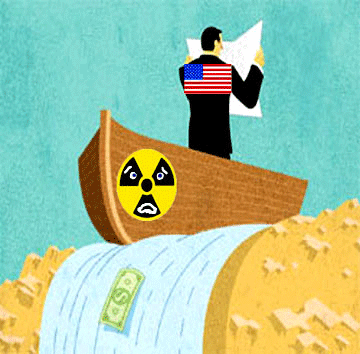 CPS Energy writes off $391.4 million from South Texas Project nuclear expansion San Antonio Express News, 24 Feb 16 CPS Energy revealed Wednesday it has written off $391.4 million in costs associated with its partnership of the unbuilt — and highly criticized — Units 3 and 4 of the South Texas Project nuclear plant……..
Longtime opponents of the nuclear expansion said CPS Energy made the correct move to write off its costs so far.
“CPS’ decision shows that proposed nuclear reactors are worthless. There’s no market for their rate raising, high-cost, high-risk power,” Tom “Smitty” Smith of Public Citizen’s Texas office in Austin said in an email. “The proposed reactor price tag rose from $5.9 billion to $18.2 billion, even before a license was ever issued. Delays, construction problems and lawsuits are the norm for nuclear reactors. They cost so much that even with all the federal subsidies, no bank will loan money to build them. CPS did the smart thing and wrote off this worthless investment.”
Controversy erupted in 2009 over the expansion project, which already had received intense opposition over concerns about storage of waste fuel and estimated cost of $13 billion.
It was revealed that a new cost estimate from partner Toshiba Inc. — $4 million higher than the previous one — had been withheld by utility executives from the CPS board and City Council while additional financing was under consideration……….
“The NRC (Nuclear Regulatory Commission) can license these reactors, but they won’t get built,” added Karen Hadden of the Sustainable Energy and Economic Development Coalition. “Renewable energy is cheaper these days and much safer. Nuclear power creates radioactive waste that remains deadly for hundreds of thousands of years.”…….. http://www.expressnews.com/business/local/article/CPS-Energy-writes-off-391-4-million-from-South-6852804.php
Rising toll of missing Fukushima workers – presumed dead – coverup by mass media
 4,000 Missing TEPCO Nuclear Plant Workers – Presumed To Be Dead, Fukushima Radiation Caused Death Toll Is Rising Fast http://agreenroad.blogspot.com.au/2013/10/200-or-more-missing-tepco-nuclear-plant.html
PRO NUCLEAR PROMOTERS AND THEIR MASS MEDIA SHILLS KEEP ON REPEATING THE PR PROPAGANDA THAT NO ONE DIED DUE TO FUKUSHIMA AND NOTHING BAD HAPPENED
No One Died! How The Nuclear Industry Gets Away With Genocide Due To Nuclear Bombs And Nuclear Plant Accidents, Explained By Dr. Helen Caldicott MD
http://agreenroad.blogspot.com/2015/04/no-one-died-how-nuclear-industry-gets.html
Safecast Radiation Readings From Inside Fukushima Daichi Plant Finally Revealed In Dec. 2013 – 192 USv/Hr, 5,900,000 CPM, Converting CPM radiation readings into uSv/Hr And Back Again
http://agreenroad.blogspot.com/2013/12/radiation-readings-from-inside.html
Countless Unreported Worker Deaths in the Fukushima nuclear clean-up workforce
Fukushima – Deep Trouble CounterPunch, FEBRUARY 22, 2016 by ROBERT HUNZIKER “………..The Tragedy of Countless Unreported Worker Deaths
Indeed, the question of whether Fukushima can ever be adequately, safely decontaminated is wide-open, which logically segues to question who does the dirty work, how workers are hired, and what’s their health status? According to mainstream news sources in Japan, workers are doing just fine, estimates range up to 45,000 workers all-in, no major problems.
As far as the world is concerned, the following headline sums up radiation-related issues for workers, First Fukushima Worker Diagnosed With Radiation-linked Cancer, The Telegraph, Oct. 20, 2015. All things considered, that’s not so bad. But, who’s counting?
Trustworthy sources outside of mainstream news claim otherwise, none more so than Mako Oshidori, a Japanese freelance journalist and a director of Free Press Corporation/Japan, and a former student of School of Life Sciences at Tottori University Faculty of Medicine, in a lecture entitled “The Hidden Truth about Fukushima” delivered at the international conference “Effects of Nuclear Disasters on Natural Environment and Human Health” held in Germany in 2014 co-organized by International Physicians for Prevention of Nuclear War.
Free Press Corporation/Japan was formed after the 2011 Great Sendai Earthquake as a counterbalance to Japan’s mainstream government influenced media, described by Mako as journalists who do not report truth, journalists afraid of the truth!
“There is one thing that really surprised me here in Europe. It’s the fact that people here think Japan is a very democratic and free country.” (Mako Oshidori)
According to Mako, TEPCO and the government deliberately cover-up deaths of Fukushima workers, and not only do they cover-up deaths, but once she investigated stories of unreported deaths, government agents started following her: “When I would talk to someone, a surveillance agent from the central government’s public police force would come very close, trying to eavesdrop on the conversation,” Exposed: Death of Fukushima Workers Covered-Up by TEPCO and Government, NSNBC International, March 21, 2014.
Mako Oshidori: “I would like to talk about my interview of a nurse who used to work at the Fukushima Daiichi Nuclear Power Plant (NPP) after the accident… He quit his job with TEPCO in 2013, and that’s when I interviewed him… As of now, there are multiple NPP workers that have died, but only the ones who died on the job are reported publicly. Some of them have died suddenly while off work, for instance, during the weekend or in their sleep, but none of their deaths are reported.”
“Not only that, they are not included in the worker death count. For example, there are some workers who quit the job after a lot of radiation exposure, such as 50, 60 to 70 mili Sieverts, and end up dying a month later, but none of these deaths are either reported, or included in the death toll. This is the reality of the NPP workers.”
The “reality of the NPP workers… dying a month later” does not correspond very well with Abe administration insistence that nuke plants reopen, even though the country has continued to function for five years without nuclear power, hmm.
In her speech, Mako talks about problems for journalists because of government interference: “An ex-agent who is knowledgeable about the work of the Public Security Intelligence Agency (“PSIA”) said that when you are visibly followed, that was meant to intimidate you. If there was one person visible, then there would be ten more. I think that is analogous to cockroaches. So, when you do a little serious investigation about the nuclear accident, you are under various pressure and it makes it more difficult to interview people.”
Still, she interviewed Fukushima mothers, e.g., “Next, I would like to talk about mothers in Fukushima. These mothers (and fathers) live in Iwaki City, Fukushima. They are active on school lunch issues. Currently, Fukushima produce isn’t selling well due to suspected contamination. So the prefectural policy is to encourage the use of Fukushima produce in school lunches, in an attempt to appeal to its safety… the mothers claim that currently in Japan only cesium is measured and they have no idea if there is any strontium-90. They oppose the use of Fukushima produce in school lunches for fear of finding out, ten-plus years down the road, that there was actually plutonium in the food that children ate.”
Mothers who oppose the prefecture’s luncheon policy are told to leave Fukushima Prefecture, move out if they worry about contamination, pull up stakes and move on.
Mako’s full interview is found here.
All of which begs the question of who does the dirty work? According to Michel Chossudovsky, director of Centre for Research on Globalization (Canada), Japan’s organized crime syndicate Yakusa is actively involved in recruitment. Personnel who qualify for radioactive cleanup work include underemployed, impoverished, indigent, unemployed, homeless, hard up, down-and-out, and poverty-stricken individuals, as well as non-destitute people willing to undertake under-paid, high-risk work. The nameless are shoe-ins……… http://www.counterpunch.org/2016/02/22/fukushima-deep-trouble/
China ramping up its nuclear industry, with plans for exporting reactors
 China Inc.’s Nuclear-Power PushIn a shift, Chinese state-owned companies seek to roll out advanced reactors for export, WSJ, By BRIAN SPEGELE Feb. 23, 2016 SHENZHEN, China—China wants to shift from customer to competitor in the global nuclear industry as it seeks to roll out its first advanced reactor for export, a move that adds new competition for already struggling global firms.
Two state-owned firms teamed up to design the advanced indigenous Hualong One reactor with plans to sell overseas. On Tuesday, one of them, China General Nuclear Power Group, hosted dozens of business executives from Kenya, Russia, Indonesia and elsewhere, as well as diplomats and journalists, at its Daya Bay nuclear-power station to promote the Hualong One for export.
Asked how much of the global market share for new nuclear reactors CGN wants Hualong One to win, Zheng Dongshan, CGN’s deputy general manager in charge of international business, said: “The more the better.”
The move marks a turnaround for China and the nuclear-power industry. For three decades, China served as a big market for nuclear giants including U.S.-based, Japanese-owned Westinghouse Electric Co. and France’s Areva SA. …….
turning promotion into sales takes time, and there is no guarantee the Hualong One will find success abroad. Discussions over building the reactor overseas in many cases remain preliminary, and the first of Hualong One model reactor won’t enter service in China for several more years……
Regulatory approvals are among the challenges China Inc. faces as it seeks to sell homegrown reactors abroad. CGN executives said obtaining needed regulatory permits in the U.K. and other countries for the Hualong One would still take several years, a process that would need to conclude before construction gets under way……..
At the heart of its sales pitch for potential customers overseas, CGN touts itself as a “one-stop shop” for nuclear needs—from nuclear design to construction, financing and other services.
“If you choose the HPR1000, it’s like you’re joining a big family,”Yang Maochun, a deputy general manager of CGN’s international business department, told the visiting foreign executives on Tuesday…….
Political concerns over Chinese nuclear investment in the West could also pose hurdles, though these may be overcome through jointly investing with local partners.
While acknowledging CGN’s deepening competition with Western nuclear companies, Mr. Zheng said the company remains eager to cooperate with them too. He cited joint investment with France’s Électricité de France SA in the U.K.’s Hinkley Point C project as a model for cooperation, and said CGN would be willing to help market non-Chinese reactors in the future as well. http://www.wsj.com/articles/china-inc-s-nuclear-power-push-1456251331
The Tragedy of Countless Unreported Nuclear Worker Deaths
Fukushima – Deep Trouble, CounterPunch, FEBRUARY 22, 2016 by ROBERT HUNZIKER “………Indeed, the question of whether Fukushima can ever be adequately, safely decontaminated is wide-open, which logically segues to question who does the dirty work, how workers are hired, and what’s their health status? According to mainstream news sources in Japan, workers are doing just fine, estimates range up to 45,000 workers all-in, no major problems.
As far as the world is concerned, the following headline sums up radiation-related issues for workers, First Fukushima Worker Diagnosed With Radiation-linked Cancer, The Telegraph, Oct. 20, 2015. All things considered, that’s not so bad. But, who’s counting?
Trustworthy sources outside of mainstream news claim otherwise, none more so than Mako Oshidori, a Japanese freelance journalist and a director of Free Press Corporation/Japan, and a former student of School of Life Sciences at Tottori University Faculty of Medicine, in a lecture entitled “The Hidden Truth about Fukushima” delivered at the international conference “Effects of Nuclear Disasters on Natural Environment and Human Health” held in Germany in 2014 co-organized by International Physicians for Prevention of Nuclear War.
Free Press Corporation/Japan was formed after the 2011 Great Sendai Earthquake as a counterbalance to Japan’s mainstream government influenced media, described by Mako as journalists who do not report truth, journalists afraid of the truth!
“There is one thing that really surprised me here in Europe. It’s the fact that people here think Japan is a very democratic and free country.” (Mako Oshidori)
According to Mako, TEPCO and the government deliberately cover-up deaths of Fukushima workers, and not only do they cover-up deaths, but once she investigated stories of unreported deaths, government agents started following her: “When I would talk to someone, a surveillance agent from the central government’s public police force would come very close, trying to eavesdrop on the conversation,” Exposed: Death of Fukushima Workers Covered-Up by TEPCO and Government, NSNBC International, March 21, 2014.
Mako Oshidori: “I would like to talk about my interview of a nurse who used to work at the Fukushima Daiichi Nuclear Power Plant (NPP) after the accident… He quit his job with TEPCO in 2013, and that’s when I interviewed him… As of now, there are multiple NPP workers that have died, but only the ones who died on the job are reported publicly. Some of them have died suddenly while off work, for instance, during the weekend or in their sleep, but none of their deaths are reported.”
“Not only that, they are not included in the worker death count. For example, there are some workers who quit the job after a lot of radiation exposure, such as 50, 60 to 70 mili Sieverts, and end up dying a month later, but none of these deaths are either reported, or included in the death toll. This is the reality of the NPP workers.”
The “reality of the NPP workers… dying a month later” does not correspond very well with Abe administration insistence that nuke plants reopen, even though the country has continued to function for five years without nuclear power, hmm.
In her speech, Mako talks about problems for journalists because of government interference: “An ex-agent who is knowledgeable about the work of the Public Security Intelligence Agency (“PSIA”) said that when you are visibly followed, that was meant to intimidate you. If there was one person visible, then there would be ten more. I think that is analogous to cockroaches. So, when you do a little serious investigation about the nuclear accident, you are under various pressure and it makes it more difficult to interview people.”
Still, she interviewed Fukushima mothers, e.g., “Next, I would like to talk about mothers in Fukushima. These mothers (and fathers) live in Iwaki City, Fukushima. They are active on school lunch issues. Currently, Fukushima produce isn’t selling well due to suspected contamination. So the prefectural policy is to encourage the use of Fukushima produce in school lunches, in an attempt to appeal to its safety… the mothers claim that currently in Japan only cesium is measured and they have no idea if there is any strontium-90. They oppose the use of Fukushima produce in school lunches for fear of finding out, ten-plus years down the road, that there was actually plutonium in the food that children ate.”
Mothers who oppose the prefecture’s luncheon policy are told to leave Fukushima Prefecture, move out if they worry about contamination, pull up stakes and move on.
Mako’s full interview is found here.
All of which begs the question of who does the dirty work? According to Michel Chossudovsky, director of Centre for Research on Globalization (Canada), Japan’s organized crime syndicate Yakusa is actively involved in recruitment. Personnel who qualify for radioactive cleanup work include underemployed, impoverished, indigent, unemployed, homeless, hard up, down-and-out, and poverty-stricken individuals, as well as non-destitute people willing to undertake under-paid, high-risk work. The nameless are shoe-ins…….. http://www.counterpunch.org/2016/02/22/fukushima-deep-trouble/
The collapse of UK’s planned nuclear power programme ?
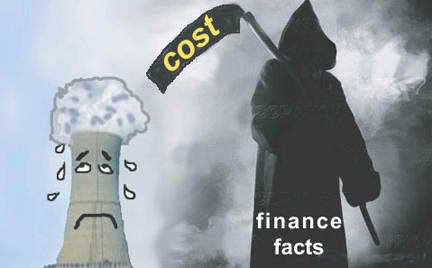
 Horizon boss’s statement exposes fantasy nature of UK nuclear power programme http://realfeed-intariffs.blogspot.com.au/2016/02/horizons-boss-statement-exposes-fantasy.html The boss of one of the three supposed consortia claimed to be building Britain’s nuclear power stations has all but admitted that his project is a fantasy one. As can be read in the Telegraph story below, the boss of the ‘Horizon’ project has said that new nuclear power in the UK depends on private investors. Well, that is not going to happen. Who would want to put shares in a venture that might (as in the case of its project in Taiwan) take 15 years not to be completed, or which may not work very well? Nobody. The only possible exceptions to this are (foreign) governments with political, rather than than money-making, objectives. Even they are disappearing! (France and China).
Of course, some people, breezily argue, the government could pay for the power stations. As if we need to spend billions and billions money on nuclear power stations that never seem to be finished instead of hospitals……
In reality the nuclear power programme collapsed in 2012 when it emerged that the Treasury insisted that nuclear power should not receive a state blank cheque. E.ON, RWE, SSE and Centrica all withdrew from nuclear power construction plans. But now for four years our energy and carbon reduction programmes have been distorted in order to preserve the British engineering establishment’s soft spot for nuclear power. The current government defends its lack of investment in real green energy by referring to its fantasy plans for new nuclear power stations.
EDF has announced once again (Feb 16th), that its decision on building Hinkley C will be taken ‘soon’ (soon has meant the same for the last 3 years) and in practice it is waiting, in effect, for the French Government to agree that French electricity consumers/taxpayers should subsidise nuclear power for the British! All to save the pride of the EDF leadership! It sounds bizarre, and I doubt whether even EDF’s hold on the French Government can engineer such an outcome.
EDF could still turn their ship around of course, by helping achieve France’s targets to expand renewable energy. But are they capable of dragging themselves away from their nuclear-dream-turned-sour, or will they waste what few reserves they have left in planning new reactor designs?
See the Telegraph article:
http://www.telegraph.co.uk/finance/newsbysector/energy/12156773/UK-new-nuclear-plan-will-fail-without-private-investors-says-Horizon-chief.html
Entergy won’t save loss-making FitzPatrick nuclear plant
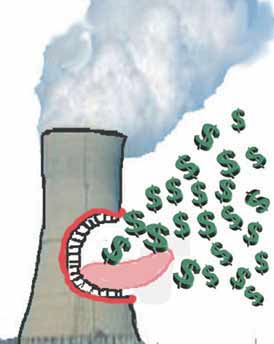 Entergy rebuffs latest NY plan to save FitzPatrick nuclear plant, syracuse.com By Tim Knauss | tknauss@syracuse.com SCRIBA, N.Y. – The state Public Service Commission said today it is working on plans to provide financial assistance to the FitzPatrick nuclear plant in a desperate attempt to keep the plant from shutting down.
PSC officials said they will undertake a rushed review of the plan and expect to have financial subsidies available for FitzPatrick by June, long before the plant’s scheduled closure next January.
The commission did not specify how much assistance it would provide. ………
PSC Chair Audrey Zibelman beseeched Entergy Corp., which owns FitzPatrick, to work with state officials on a financial rescue for the nuclear plant.
“The plan would enable expedited financial support to FitzPatrick and other qualified nuclear power plants in Upstate New York,” said PSC Chair Audrey Zibelman. “Until then, we invite Entergy to work with us to make the plans necessary to refuel FitzPatrick and to support the statewide objectives of New York’s new Clean Energy Standard.”
Entergy officials responded that it is too late to save FitzPatrick, which the company plans to close because it loses money. The company added that if Cuomo wants to reduce carbon emissions, he should back off his insistence that Entergy shut down the Indian Point nuclear facility, which Cuomo says is unsafe because of its proximity to New York City.
Cuomo recently announced his plan to offer financial “clean energy” payments for nuclear power, but the help would only go to Upstate nukes – FitzPatrick and Nine Mile Point in Oswego County, and Ginna in Wayne County. Indian Point’s two reactors would not qualify…….
The commission today agreed to conduct a speeded-up review aimed at making financial supports available to Upstate nuclear plants as early as June. Entergy officials dismissed today’s action as too uncertain and too late to save FitzPatrick…. http://www.syracuse.com/news/index.ssf/2016/02/entergy_to_cuomo_its_too_late_to_save_fitzpatrick_but_not_indian_point.html
Thousands of nuclear workers made sick by radiation, but not getting any help
Sen. Tom Udall, D-N.M., is among a group of federal lawmakers who have called for an investigation into the program following McClatchy’s probe, which revealed 7,762 workers died after being denied compensation by the government.
The McClatchy DC investigation found that nuclear worker safety remains an issue: Since 2001, more than 186,000 workers have been exposed to radiation.
 Efficacy of compensation program for nuclear workers under scrutiny By Rebecca Moss
The New Mexican, 20 Feb 16, “………Due to the commingling of his exposure during the war and his work on various sites at Sandia, Thompson is one of at least 10,273 New Mexicans who have applied for a federal program that compensates individuals with a $150,000 lump sum payment for serious illness or death that can be attributed to work at the state’s nuclear defense facilities since 1943.
As of March 2015, New Mexico had received the second-highest compensation of any state under the fund, with $1.64 billion paid out to workers for compensation and medical bills.
But the program has come under scrutiny lately. An investigation by the McClatchy DC news service found that fewer than half of the people who have applied for benefits have received them, and workers’ complaints are often suspended in the complex process of paperwork or court hearings, with some claims languishing in the system for up to 10 years. A new documentary coming out in March, titled Safe Side of the Fence, questions why side-by-side workers with similar ailments would receive different judgments from the Department of Labor on the validity of their claims.
At least 5,400 workers in New Mexico have been denied financial assistance, according to the Department of Labor, which issues the compensation.
The department recently added new language to the regulations, which is intended to clarify who is eligible for relief. A 60-day public comment period for the proposal ended Thursday. But critics say the new language could make it even more difficult for ailing workers to receive compensation. Continue reading
Economist warns that nuclear deal will downgrade South Africa’s economy to junk

 Nuclear deal might push SA into junk Things aren’t looking up for Africa’s second largest economy, with markets on edge awaiting the country’s budget speech, on February 24.
February 19, 2016 This is according to Busisiwe Radebe, an economist at Nedbank Limited, who addressed a group of local business people at the Ebotse Golf and Country Estate clubhouse recently.
She painted a slightly grim picture of the coming year for South Africa (SA) and its potential effects on local businesses.
Radebe spoke at the latest networking breakfast of the Ebotse Captains of Industry, which is organised by the Ekurhuleni Business Initiative (EBI).
The EBI was founded and is run by Chris van Biljon, who also resides in the Rynfield country estate and expressed his excitement at welcoming Radebe.
Among other concerns, Radebe raised the subjects of a looming credit ratings downgrade, the weaker-than-ever national currency and the repercussions of China’s slowing economic growth.…….Credit rating agencies measure and determine the credit reliability and, with it, the investment grade of companies and countries across the globe.
Standard and Poor’s (SnP), Moody’s Investors Service and Fitch Ratings are the three most influential, with the largest global market share.Currently, SA is rated by Fitch and SnP as only one level above junk status, which is essentially regarded as below investment grade.
“We have many investors who hold SA debt; if we’re downgraded to junk, they have to divest from us and sell our debt, which will weaken the Rand quite a bit and could have dire consequences for the economy,” said Radebe.
According to her, the big national budget deficit is another reason to be wary of the “big three”.
“We are at a scary point in the South African economy,” Radebe said.
“I think if the nuclear deal goes through, we will be downgraded to junk, because we can’t afford it at the moment…….. http://benonicitytimes.co.za/245690/nuclear-deal-might-push-sa-into-junk/
USA govt’s position: its nuclear companies should be exempt from civil or criminal liability
How American Penalties Dwarf the Liability US Nuclear Firms Will Face in India, The Wire BY AMIT BHANDARI, INDIASPEND.ORG ON 21/02/2016 A $48-billion (Rs 3.26 lakh crore) penalty claimed by the US government from Volkswagen for cheating on diesel-car emissions is about 200 times as large as the $225 million (Rs 1,500 crore) insurance pool set up by Indian insurance companies to compensate US nuclear companies for mishaps in India.
If a US nuclear company were to build a reactor in India that suffered a catastrophe, and people were to die in India, the US government’s position seems to be that American suppliers shouldn’t face . The US believes the Indian civil nuclear liability law, which calls for both penalties, is unduly harsh. Rather than say so directly, US officials keep repeating that the “Indian law is inconsistent with the international liability regime.”
The Indian civil nuclear liability law holds the equipment supplier responsible for any incident caused by the supplier or its employees. The Indian liability law differs from those of other countries because it was drafted keeping in mind the 1984 Bhopal tragedy – where despite 5,000 deaths and effects across generations, no one was held criminally liable.
Although the Indian government wants to protect US nuclear companies against the Indian liability law, critics argued that these companies are using India’s eagerness to avoid any liability, if something goes wrong…….
Indian firms also fined in the US
While the US nuclear industry wants to avoid any liability in India for acts of omission or commission, Indian companies have often been slapped with large fines for violations of US law.
Russia is offering bribes for Egypt to buy its nuclear reactors
 Negotiations over establishment of Dabaa nuclear plant ongoing: Minister of Electricity, Daily News, Egypt, 21 Feb 16 Egyptian minister of Electricity and Renewable Energy, Mohamed Shaker, said the ministry is still negotiating with Russia’s Rosatom over technical, financial, and technological agreements to establish the first Egyptian nuclear power plant in the Dabaa area.
He told Daily News Egypt the Russian offer has better features than other offers from French, Chinese, and Korean companies. The offer includes providing nuclear fuel supply to the nuclear power plant throughout its operating period, which is estimated to be 60 years. In addition, it will be responsible for the management of spent nuclear fuel, operation and maintenance, and training human resources……http://www.dailynewsegypt.com/2016/02/21/negotiations-over-establishment-of-dabaa-nuclear-plant-ongoing-minister-of-electricity/
Britain’s nuclear project Hinkley Point C staggers again
 U.K.’s Nuclear Project Falters Again http://www.truthdig.com/report/item/uks_nuclear_project_falters_again_20160219 Feb 19, 2016 By Paul Brown / Climate News Network This Creative Commons-licensed piece first appeared at Climate News Network.
LONDON—The future of the nuclear industry in Europe took another blow this week when the French state-owned power company EDF again postponed a final decision on whether to build two large nuclear power stations in the UK. Construction will now not start before 2019, the company said.
This is the eighth time a “final investment decision” on building two European Pressurised Water Reactors (EPRs) has been postponed because the company has still to secure enough backing to finance the £18 billion (€23.26 bn) project.
The excuse this time was that the Chinese New Year celebrations had held up negotiations with the Chinese backers, who have agreed to put up one-third of the money.
Preparation of the site at Hinkley Point in the west of England was stopped last year while EDF sought partners for the project. Each time there has been a postponement the company has issued a statement saying it remains “fully committed” to building two 1,650 MW reactors (1 MW is enough to power 750-1,000 average US homes).
Decision close
This week was no different. “We have the intention to proceed rapidly with the investment decision for Hinkley Point,” EDF’s chief executive Jean-Bernard Levy told reporters. Adding that EDF had not yet finalised talks with its Chinese partners, he said: “Today we estimate this final decision is very close.”
Levy said it would take about three years, possibly a bit more, of study and work with sub-contractors before EDF will begin building the first permanent structures on the Hinkley Point C site, though it will do preparatory work between now and then.
“Definitive construction of what will be built on the site, what we call the first concrete, is on the horizon for 2019,” Levy said.
This date is a year after the reactors were originally due to be completed. The timetable has gradually slipped backwards. Last year the date for power to start being generated was put back to 2025, but this new date for pouring concrete makes 2030 more likely—if the reactors are built at all.
Problematic record
The new proposed start date of 2019 is very significant for reasons the company dare not spell out. This is because there is no evidence yet that these so-called Evolutionary Power Reactors will operate effectively. Four are under construction, but are years behind schedule, and costs have tripled. In Europe their earliest proposed start date is 2018—so it looks as though EDF is being careful not to begin building another one until it can prove the design actually works.
The EPRs are “third generation European Pressurised Water Reactors”—the largest nuclear plants in the world. They have a chequered history, even before any has actually produced a single watt of electricity. Construction of the first prototype began in 2005 in Finland: expected to be finished in 2009, it is still under construction.
The same is true of the second, at Flamanville in France, where construction began in 2007. It has also hit delays and cost over-runs of staggering proportions. It too is due to start in 2018.
The other two EPRs are being built in China. Both should have been in operation by this year, but both also have undergone unspecified delays.
Safety question
The biggest problem for EDF, which owns and is building the Flamanville reactor, is that there are safety issues over the strength of the steel used to build the pressure vessel. It contained too much carbon and is undergoing stress testing to see if it is safe. While the outcome of these tests remains unknown, a question mark hangs over the station’s future.
This, plus the vast amount of remedial safety work required by the French safety regulators from EDF on its fleet of 58 ageing reactors in France itself, has put the company under severe financial strain. It needs to find €100 bn for repairs, and to improve safety following the Fukushima disaster in Japan, to keep the plants operating until 2030.
As a result of fears that the company might overstretch itself and jeopardise jobs in France the six trade union representatives on EDF’s board have expressed opposition to the company going ahead with building reactors on British soil.
Unfilled gap
This further postponement of a start date for the new reactors leaves the UK government with a gaping hole in its energy policy, despite it offering to pay double the existing price of electricity for the output from Hinkley Point, a subsidy that will continue for 35 years.
The Conservative government has been relying on nuclear energy to replace fossil fuels from 2025, when it plans to phase out all its coal stations. Some renewable energy subsidies have been scrapped to make way for new nuclear stations.
In all, the Conservative government wants ten new nuclear stations in the UK—four EPRs and the rest from Japan and the US. None of these now seems likely to be built before 2030, if at all.
Perhaps to divert attention from the postponement of the new reactors, EDF announced that it was going to extend the life of four of the nuclear power stations it already operates in Britain. It bought eight ageing stations of British design in 2009 for £12.5 billion.
Longer lives
Some were already due to close in 2018 but have had their lives extended. Now another four will be kept open to bridge the gap left by the failure to build the new stations at Hinkley Point.
These are the Heysham 1 plant in northwest England and another at Hartlepool in the northeast, both of which had been due to be switched off in 2019 because of their advanced age. They will be allowed to keep producing electricity for another five years.
Two other reactors, Heysham 2 and Torness in Scotland, have been granted extensions of seven years to 2030. There is no reason—as long as the stations are deemed safe – why further life extensions should not be applied for, and granted.
Continuing to apply for life extensions for old nuclear stations also saves the company from technical bankruptcy. Once a station is closed its decommissioning costs become company liabilities. With the company’s debts already high, it would not take many closures for EDF’s liabilities to exceed its assets.
Paul Brown, a founding editor of Climate News Network, is a former environment correspondent of The Guardian newspaper, and still writes columns for the paper.
Tennessee Valley Authority considers selling its unfinished Bellefonte Nuclear Plant
Unfinished TVA nuclear plant may hit the selling block Ty West Managing editor Birmingham Business Journal, 19 Feb 16 An unfinished nuclear power plant in northeast Alabama could soon hit the open market.The Tennessee Valley Authority is considering a sale of its unfinished Bellefonte Nuclear Plant, which is located on a 1,600-acre site near Hollywood on the Tennessee River. Work on the plant started in 1974, but it was never completed or used as a nuclear plant.TVA said the site could be used for commercial, industrial or residential developments, but could also be used as a nuclear plant………http://www.bizjournals.com/nashville/blog/2016/02/unfinished-alabama-nuclear-plant-may-hit-the.html
The case grows, for stopping Britain’s Hinkley Point nuclear project
 Britain’s nuclear strategy exposed at Hinkley Point EDF’s travails only add to the uncertainty over UK energy policy http://www.ft.com/intl/cms/s/0/9d484f08-d63c-11e5-829b-8564e7528e54.html#axzz40ZWJ8xlp February 18, 2016
It seemed an attractive proposition. Not only was this less than previous reactors, it was competitive with other power sources. New technology seemed to have opened the door to affordable carbonless electricity; Britain could meet its ever-tougher climate goals without shaking the public down.
A decade on and a major nuclear accident later, the world knows better. Nuclear projects elsewhere have been scrapped and existing stations shuttered or scheduled for early closure. Meanwhile stringent regulations have exposed Areva’s promise as a chimera. It turns out that the price of new nuclear for Britain is not £24 per MWh but nearly four times as much.
Even at these elevated prices, Britain’s first proposed new station, at Hinkley Point, is in difficulty. Despite agreeing a deal in 2013, EDF, the developer, has yet to commit to the £18bn project. There are concerns about technology and the French group’s financial capacity. Hinkley Point C — if it opens — may be materially delayed.
The government has done its best to make things easy. It eschewed a competitive bidding process and guaranteed to buy electricity from Hinkley Point at a £92.50 per MWh index-linked for 35 years after the station has been commissioned.
The French face several obstacles. First, there is the question of EDF’s balance sheet, groaning under a €37bn debt pile. The company’s share price has more than halved in the past year and its market capitalisation is now about €21bn. That is not much more than the company’s 67 per cent share of the cost of Hinkley C.
Linked to this are worries about the reactor technology it is employing. The two projects under construction, including EDF’s at Flamanville in France, are delayed and over budget. It might be difficult to entice lenders while it is possible that problems with Flamanville might cause construction to be halted or scrapped.
Politicians have come this far down the road with Hinkley Point because of the constraints they are under. Despite life-extensions, the UK’s existing nuclear stations are near to closing and its dirtiest coal plants are being shut to comply with EU rules. New capacity is needed. Replacing coal with gas would reduce carbon emissions but not enough to meet the targets the government has set itself.
New nuclear might not be needed were the UK to rethink its costly promises and reduce its carbon targets to match those of other EU states. If new reactors are to be considered, however, they must be subjected to the rigours of competition. That is the only way to get the right technology at acceptable cost.
Britain is saddled with the worst of all worlds. The government has effectively written the French a long-dated option to sell it unproven technology at an extremely generous price. Politically painful it may be, but the case for halting Hinkley Point C is becoming hard to refute.
1 This Month




PLEASE OPPOSE HR 8255 AND S.3639 – bills would accelerate satellite deployment, with no environmental review or safeguards – https://ncstd5li.quorum.us/campaign/169331/
To see nuclear-related stories in greater depth and intensity – go to https://nuclearinformation.wordpress.com
-
Archives
- September 2026 (330)
- August 2026 (330)
- July 2026 (355)
- June 2026 (287)
- May 2026 (306)
- April 2026 (356)
- March 2026 (251)
- February 2026 (267)
- January 2026 (308)
- December 2025 (358)
- November 2025 (359)
- October 2025 (375)
-
Categories
- 1
- 1 NUCLEAR ISSUES
- business and costs
- climate change
- culture and arts
- ENERGY
- environment
- health
- history
- indigenous issues
- Legal
- marketing of nuclear
- media
- opposition to nuclear
- PERSONAL STORIES
- politics
- politics international
- Religion and ethics
- safety
- secrets,lies and civil liberties
- spinbuster
- technology
- Uranium
- wastes
- weapons and war
- Women
- 2 WORLD
- ACTION
- AFRICA
- Atrocities
- AUSTRALIA
- Christina's notes
- Christina's themes
- culture and arts
- Events
- Fuk 2022
- Fuk 2023
- Fukushima 2017
- Fukushima 2018
- fukushima 2019
- Fukushima 2020
- Fukushima 2021
- general
- global warming
- Humour (God we need it)
- Nuclear
- RARE EARTHS
- Reference
- resources – print
- Resources -audiovicual
- Weekly Newsletter
- World
- World Nuclear
- YouTube
-
RSS
Entries RSS
Comments RSS

