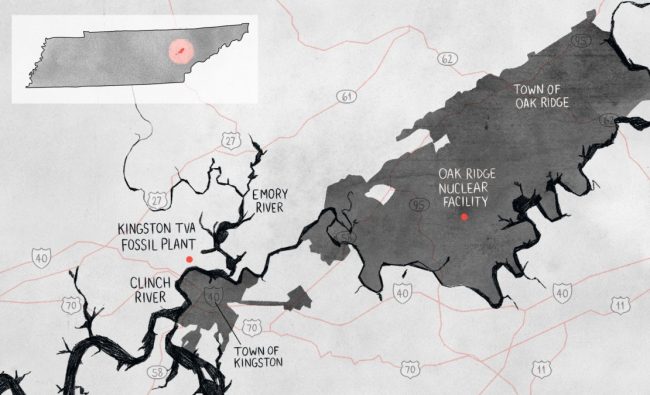
Kingston Fossil Plant and Oakridge Nuclear Facility – an unholy alliance of radioactive pollution,
While no one was killed by the 2008 coal ash spill itself, dozens of workers have died from illnesses that emerged during or after the cleanup. Hundreds of other workers are sick from respiratory, cardiac, neurological, and blood disorders, as well as cancers.
The apparent mixing of fossil fuel and nuclear waste streams underscores the long relationship between the Kingston and Oak Ridge facilities.
Between the 1950s and 1980s, so much cesium-137 and mercury was released into the Clinch from Oak Ridge that the Department of Energy, or DOE, said that the river and its feeder stream “served as pipelines for contaminants.” Yet TVA and its contractors, with the blessing of both state and federal regulators, classified all 4 million tons of material they recovered from the Emory as “non-hazardous.”
A U.S. Environmental Protection Agency analysis confirms that the ash that was left in the river was “found to be commingled with contamination from the Department of Energy (DOE) Oak Ridge Reservation site.
For nearly a century, both Oak Ridge and TVA treated their waste with less care than most families treat household garbage. It was often dumped into unlined, and sometimes unmarked, pits that continue to leak into waterways. For decades, Oak Ridge served as the Southeast’s burial ground for nuclear waste. It was stored within watersheds and floodplains that fed the Clinch River. But exactly where and how this waste was buried has been notoriously hard to track.
A Legacy of Contamination, How the Kingston coal ash spill unearthed a nuclear nightmare, Grist By Austyn Gaffney on Dec  15, 2020 This story was published in partnership with the Daily Yonder.
In 2009, App Thacker was hired to run a dredge along the Emory River in eastern Tennessee. Picture an industrialized fleet modeled after Huck Finn’s raft: Nicknamed Adelyn, Kylee, and Shirley, the blue, flat-bottomed boats used mechanical arms called cutterheads to dig up riverbeds and siphon the excavated sediment into shoreline canals. The largest dredge, a two-story behemoth called the Sandpiper, had pipes wide enough to swallow a push lawnmower. Smaller dredges like Thacker’s scuttled behind it, scooping up excess muck like fish skimming a whale’s corpse. They all had the same directive: Remove the thick grey sludge that clogged the Emory.
The sludge was coal ash, the waste leftover when coal is burned to generate electricity. Twelve years ago this month, more than a billion gallons of wet ash burst from a holding pond monitored by the region’s major utility, the Tennessee Valley Authority, or TVA. Thacker, a heavy machinery operator with Knoxville’s 917 union, became one of hundreds of people that TVA contractors hired to clean up the spill. For about four years, Thacker spent every afternoon driving 35 miles from his home to arrive in time for his 5 p.m. shift, just as the makeshift overhead lights illuminating the canals of ash flicked on.
Dredging at night was hard work. The pump inside the dredge clogged repeatedly, so Thacker took off his shirt and entered water up to his armpits to remove rocks, tree limbs, tires, and other debris, sometimes in below-freezing temperatures. Soon, ringworm-like sores crested along his arms, interwoven with his fading red and blue tattoos. Thacker’s supervisors gave him a cream for the skin lesions, and he began wearing long black cow-birthing gloves while he unclogged pumps. While Thacker knew that the water was contaminated — that was the point of the dredging — he felt relatively safe. After all, TVA was one of the oldest and most respected employers in the state, with a sterling reputation for worker safety.
Then, one night, the dredging stopped.
Sometime between December 2009 and January 2010, roughly halfway through the final, 500-foot-wide section of the Emory designated for cleanup, operators turned off the pumps that sucked the ash from the river. For a multi-billion dollar remediation project, this order was unprecedented. The dredges had been operating 24/7 in an effort to clean up the disaster area as quickly as possible, removing roughly 3,000 cubic yards of material — almost enough to fill an Olympic-sized swimming pool — each day. But official reports from TVA show that the dredging of the Emory encountered unusually high levels of contamination: Sediment samples showed that mercury levels were three times higher in the river than they were in coal ash from the holding pond that caused the disaster.
Then there was the nuclear waste. Continue reading
Congressional Budget Office (CBO) predicts US nuclear weapons will cost nearly a trillion dollars over the coming decade.

Greg Mello, Los Alamos Study Group, 30 Apr 25
Albuquerque, NM — Last week, the Congressional Budget Office (CBO) released its latest biennial estimate of the costs of nuclear weapons over the coming decade (2025-2034).
CBO’s nuclear weapons cost estimates are built from the budget projections of the Department of Defense (DoD) and the Department of Energy’s (DOE’s) National Nuclear Security Administration (NNSA), as well as CBO’s own estimates of likely cost increases for these programs over the period in question, based on CBO’s historical records for comparable programs.
CBO estimates that nuclear weapons will cost a total of $946 billion (B) over the coming decade, an average of about $95 B per year. This is $190 B (25%) higher than CBO’s estimate from two years ago.
Albuquerque, NM — Last week, the Congressional Budget Office (CBO) released its latest biennial estimate of the costs of nuclear weapons over the coming decade (2025-2034).
CBO’s nuclear weapons cost estimates are built from the budget projections of the Department of Defense (DoD) and the Department of Energy’s (DOE’s) National Nuclear Security Administration (NNSA), as well as CBO’s own estimates of likely cost increases for these programs over the period in question, based on CBO’s historical records for comparable programs.
CBO estimates that nuclear weapons will cost a total of $946 billion (B) over the coming decade, an average of about $95 B per year. This is $190 B (25%) higher than CBO’s estimate from two years ago.
In the case of the Sentinel silo-based missile system, CBO’s estimates explicitly “do not include all of the cost growth that the program is likely to experience” (pp. 6-7). In other words, CBO knows its estimate is too low but cannot provide a defensible better one, because it would only be a guess at this point. In other words, neither DoD nor CBO have any real idea what Sentinel will cost.
Many nuclear weapons-related costs, such as DOE environmental cleanup, are not included.
The report breaks down its findings in several ways, all clearly presented. Year-by-year estimates are not provided.
CBO’s findings include these items of particular interest regarding NNSA:
- NNSA’s facility modernization plans are likely to cost $72 B over the coming decade, out of a total of $110 B that NNSA will spend on facilities over this period (p. 5). NNSA’s facilities will thus cost much more than the $16 B earmarked for “stockpile services” (NNSA’s part in maintaining existing weapons), or the $67 B to be spent on “other stewardship and support activities” (p. 4).
- “CBO projects that the costs of nuclear acquisition programs would represent 11.8 percent of DoD’s total planned acquisition costs over the next decade as outlined in the 2025 budget submission…Competition for funding among
acquisition programs will force DoD to make difficult choices about which programs to pursue.” (pp. 5-6). - NNSA’s projected total 10-year costs have increased by 27% over just the past two years. Some 85% ($45 B / $83 B) of these costs are not associated with any particular warhead but are rather expenses associated with NNSA’s capabilities overall (p. 10). CBO believes NNSA’s programs will cost an extra $11 B over the decade beyond NNSA’s projections, a little more than $1 B per year.
- Regarding NNSA’s cost increase, “[a]bout 60 percent of the total increase comes from higher expected costs for operation and modernization of infrastructure, including establishing and operating new pit production facilities, secondary production facilities, tritium production facilities, and domestic uranium enrichment facilities. About 30 percent comes from support programs, such as scientific research to improve the weapon production and sustainment process, and federal employee oversight of contractors operating laboratories.” The balance of the NNSA increase comes from new programs and projects, leading to higher annual spending in the 2032-2034 years than in 2023-2024 years, which are now in the rear-view mirror.
- “CBO’s estimates come with substantial uncertainty stemming mainly from two sources: Future plans may not be achievable, leading to cost growth and delays; and the costs of developing, producing, and operating weapon systems are uncertain even when the plans are fully determined” (p. 8).
Study Group director Greg Mello:
“As CBO notes, most nuclear weapons costs are incurred by modernizing the arsenal and its production facilities, not by deploying and maintaining existing weapons.
“NNSA insists that its entire growing portfolio of projects and programs is necessary. There is no distinction between “needs” and “wants.” NNSA also believes, and has said, it is no longer “cost-constrained” [NNSA: “Evolving the Nuclear Security Enterprise,” Sep 2022, p. 3]. Under these assumptions, NNSA’s costs are certain to continue growing rapidly. If the present growth rate continues, NNSA’s warhead budget will double in less than 8 years.
“There is one high-dollar NNSA infrastructure program that is not generic to all warheads but rather needed solely for just one, namely pit production at LANL. LANL pit production is explicitly directed to the W87-1 warhead for the Sentinel missile and is unlikely to be sustainable beyond the needs of that program, if indeed it can be established at all. The jury is still out on whether LANL pit production will be possible, or stable and if so, for how long.
“NNSA will not be able to operate two pit facilities, even if it can set one up at LANL. Once the pit facility at the Savannah River Site begins production, every budget hawk on Capitol Hill and the Pentagon will eye LANL’s gerry-rigged pit program for closure, assuming it operates at all.
“As CBO notes, there will be increased competition for defense dollars as nuclear weapons programs grow. The huge expenses tallied in this report were not anticipated at the outset of the nuclear modernization program. Since 2015, and with every report, estimated nuclear weapons costs have increased beyond prior predictions, from $348 B in 2015 to $946 B today. The opportunity costs are staggering.
“CBO devotes two big text boxes to the troubled Sentinel program — why they can’t estimate its cost, etc. The buzzards are circling. The coming year will bring more revelations about Sentinel and they won’t be good. The White House and Congress should pull the plug on Sentinel now, however difficult that would be.
“In every report since 2015, CBO has revised its estimate of future cost overruns. This year’s prediction will also be too low, especially for Sentinel and NNSA.
“The problems faced by nuclear weapons programs cannot all be fixed by pouring in more money. There are very real material and human limitations involved. There will be no return to the ‘heroic mode of production’ for nuclear weapons. Even if Congress dumped $100 or $200 billion more on nuclear weapons, the system that produces them would not ‘jump to the task’ for years, if at all. The people, the skills, the facilities, the motivation — none of these are in place for a nuclear arms race, especially if the U.S. is going to build its manufacturing back and repair its sorry civilian infrastructure. The neocons who want to ramp up nuclear production are ignorant about what that would really entail. They are going to be sorely disappointed.
“Practical problems aside, ‘peace through strength’ is a mistaken idea in this place and time, especially as regards nuclear weapons. No thoughtful strategy supports the proliferation of US nuclear weapons. Quite the contrary — present policies are driven by organized greed and fear. US nuclear weapons policies, and as we see here their costs, are out of control.”
Scrapping Britain’s nuclear power plans would lead to lower energy bills
Letters, John French, and Dr David Lowry 29 Apr 25, https://www.theguardian.com/money/2025/apr/28/scrapping-britains-nuclear-power-plans-would-lead-to-lower-energy-bills
You report that experts have warned that adding levies to electricity bills to support low-carbon projects will make it more difficult for people to reduce their reliance on fossil fuels (Why the UK’s electricity costs are so high – and what can be done about it, 20 April).
One way to reduce those levies dramatically would be to scrap all planned nuclear power stations. These include the crazily expensive Sizewell C, which has already received nearly 2.5bn in subsidies before it has even started construction and which will cost the bill payer dear, even without the inevitable huge cost overruns that the French-state-owned EDF always incurs (think Flamanville and Hinkley C); and the four, possibly six, new reactors to be built on a flood plain on the River Severn at Oldbury in Gloucestershire.
Scrapping Britain’s nuclear power plans would lead to lower energy bills
New nuclear power stations will cost billions to build and run, and cost taxpayers and energy customers dear, says John French. Plus a letter from Dr David LowryTue 29 Apr 2025 01.52 AESTShare
You report that experts have warned that adding levies to electricity bills to support low-carbon projects will make it more difficult for people to reduce their reliance on fossil fuels (Why the UK’s electricity costs are so high – and what can be done about it, 20 April).
One way to reduce those levies dramatically would be to scrap all planned nuclear power stations. These include the crazily expensive Sizewell C, which has already received nearly 2.5bn in subsidies before it has even started construction and which will cost the bill payer dear, even without the inevitable huge cost overruns that the French-state-owned EDF always incurs (think Flamanville and Hinkley C); and the four, possibly six, new reactors to be built on a flood plain on the River Severn at Oldbury in Gloucestershire.
These latter reactors are still at an early design stage, will have to go through years of safety approval before construction can start, and, being of an uncertain and novel design, will end up costing the bill payer a fortune in subsidies. And then there’s the unquantifiable cost of decommissioning and trying to deal with the highly radioactive waste.
The energy minister, Ed Miliband, has publicly expressed doubts in the past about the wisdom of subsidising nuclear power at the expense of renewables. Now is the time for him to scrap all plans for this unaffordable and dangerous way to boil water, and invest in renewables, including tidal power.
John French
Stand (Severnside Together Against Nuclear Development)
Your report says that “by generating more electricity from renewable energy and nuclear reactors, electricity costs would begin to fall”. All reliable recent studies demonstrate this is so for renewables, but not so for nuclear, if the full costs of uranium mining, milling, enrichment, fuel fabrication, radioactive waste management and nuclear facility decommissioning are taken into account.
To illustrate this, a very recent report from the US Department of Energy projects to final clean-up costs of Hanford, the US equivalent of Sellafield, but bigger, is an extraordinary $589bn. These huge sums need to be factored into nuclear power’s costs to give the real price of power from splitting the atom.
Dr David Lowry
Co-author, The International Politics of Nuclear Waste
EDF’s new UK plants should be negotiated as one, French energy minister says.
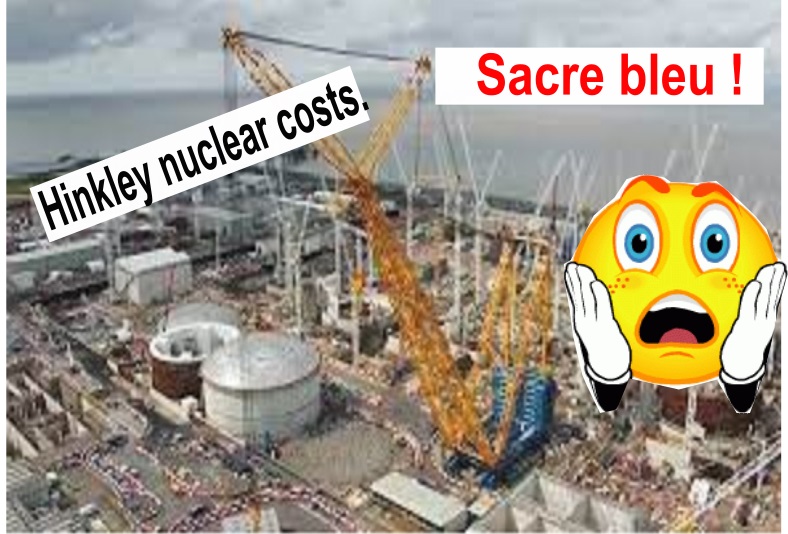
EDF’s two UK nuclear construction projects at Hinkley Point and Sizewell
should be negotiated as a single financial venture, France’s energy
minister has urged, to prevent the French energy giant shouldering
significant cost overruns.
Marc Ferracci said he had held discussions on
the projects with Britain’s energy minister Ed Miliband on Thursday, on
the sidelines of an energy security summit in London. “France and EDF are
very committed to deliver the projects but we have to find a way to
accelerate them and we have to find a way to consolidate the financial
schemes of both projects,” Ferracci told the FT.
France has been lobbying
the UK government to help EDF with the finances of Hinkley Point C in
Somerset for more than a year. It argues that the French state-owned
electricity operator should not be left on the hook for cost overruns that
have taken the total bill to as high as £46bn. EDF — which has also
experienced long delays on other projects using the same reactor technology
in Finland and France — has warned that the first of two reactors at
Hinkley Point C could be delayed to as late as 2031, which would be six
years later than its original target.
The French company has a smaller
equity stake in the Sizewell C project in Suffolk, which it is also
developing. Ferracci denied that the French government was seeking to use
Sizewell as “leverage” to help bail it out of financial difficulties at
Hinkley.
FT 25th April 2025,
https://www.ft.com/content/0c50a553-3376-42d8-8ac5-c8aa84d2e78d
Nuclear Free Local Authorities sign letter asking leading banks to back our planet not the bomb!

The UK/Ireland Nuclear Free Local Authorities have endorsed an Open Letter
calling on five major banks to divest from nuclear weapons. The letter was
drafted by activists at Medact as the next action in their Don’t Bank on
the Bomb UK campaign. Barclays, HSBC, Lloyds, NatWest and Standard
Chartered have provided $30.5 billion to the nuclear weapons industry. For
the survival of humanity and the planet, the elimination of nuclear weapons
and prevention of their use is an urgent priority. This letter calls on the
five banks to stop choosing profit over people and end financing nuclear
weapons.
NFLA 22nd April 2025, https://www.nuclearpolicy.info/news/nflas-sign-letter-asking-leading-banks-to-back-our-planet-not-the-bomb/
Framatome awarded backup power and remote sensing Sizewell C contract
Framatome has been awarded a contract to provide conventional field
instrumentation (CFI) and emergency backup power generation capacity to
Sizewell C. The company is 80.5% owned by EDF – a French state-owned
company, which is the minority owner of Sizewell C. The remaining 19.5% of
Framatome is owned by Mitsubishi Heavy Industries. The UK Government is
currently the majority owner of Sizewell C, which has sunk £6.4bn of
taxpayer cash into the project. Sizewell C has not yet achieved a final
investment decision (FID), which is a requirement before main construction
can take place. Framatome will be supplying “ultimate diesel
generators” which will be “controlled by Framatome’s digital control
systems”, according to a statement from the company. Ultimate diesel
generators provide emergency backup power capacity to nuclear power
stations in the event that grid power becomes unavailable.
New Civil Engineer 22nd April 2025
https://www.newcivilengineer.com/latest/framatome-awarded-backup-power-and-remote-sensing-sizewell-c-contract-22-04-2025/
DOE Releases More Funding to Reopen Palisades Nuclear Plant

Energy Secretary Chris Wright on April 22 announced the release of a third
loan disbursement to Holtec for the reopening of the Palisades Nuclear
Plant in southwest Michigan. Today’s action releases $46,709,358 of the
up to $1.52-billion loan guarantee to Holtec for the Palisades project.
The 800-MW Palisades plant, located in Covert Township, was closed in 2022.
Holtec bought the power station from Entergy that year, with intent to
decommission the facility, before deciding instead to restart the plant.
Palisades at present would be the first U.S. nuclear power plant to restart
after being closed.
The plant still needs licensing approvals from the U.S.
Nuclear Regulatory Commission (NRC).
Opponents of restarting the nuclear power plant have said they will appeal a recent decision by a three-judge panel of the NRC’s Atomic Safety and Licensing Board, which refused to grant a hearing on the merits for seven safety-related contentions brought by a coalition that includes Beyond Nuclear, a nonprofit group. Beyond Nuclear and other groups have argued the plant should not be restarted.
Powermag 22nd April 2025,
https://www.powermag.com/doe-releases-more-funding-to-reopen-palisades-nuclear-plant/
Sam Altman steps down as chair of nuclear power supplier Oklo to avoid conflict of interest.

The modular reactor company he funded and led is in
talks to deliver energy to OpenAI. OpenAI chief executive Sam Altman is
stepping down as chair of Oklo to avoid a conflict of interest ahead of
talks between his company and the nuclear start-up on an energy supply
agreement, as the race to power artificial intelligence intensifies.
Altman, who was an early-stage investor in Oklo, will step down immediately
and be replaced by Jacob DeWitte, the group’s CEO and co-founder. The
move comes as the AI industry strives to procure high-wattage, low-carbon
energy supplies. Although it may be years before tech companies can benefit
from nuclear power, the launch of DeepSeek, the less energy-intensive
Chinese large language model competitor, has underscored the urgency for
western companies such as OpenAI to compete.
Oklo has yet to enter into any firm partnerships or receive approval for any of its designs from the Nuclear Regulatory Commission in the US.
FT 22nd April 2025,
https://www.ft.com/content/a511bae0-d19f-4ebd-9520-69d3f89d8556
Navy’s nuclear submarine hiring crisis as sailors forced to spend record 204 days underwater

By MARY O’CONNOR, 20 April 2025
Naval experts have sounded the alarm over a recruitment crisis plaguing
Britain’s submarine fleet. The Royal Navy is struggling to hire and hold on
to sailors manning the Trident nuclear deterrent, resulting in shortages of
engineers and other critical roles. Sailors are quitting amid a raft of
challenges, including maintaining ageing boats. There are increasingly long
patrols underwater, with sailors cut off from contact with loved ones for
months.
Daily Mail 19th April 2025,
https://www.dailymail.co.uk/news/article-14628517/sailors-forced-spend-record-days-underwater.html
Framatome and Sizewell C sign contract for EPR reactor instrumentation.
Framatome and Sizewell C have signed a contract for the supply,
qualification, and pre-assembly of conventional instrumentation for the EPR
reactors under construction at Sizewell, strengthening their collaboration
on this large-scale project.
Energy News 18th April 2025,
https://energynews.pro/en/framatome-and-sizewell-c-sign-contract-for-epr-reactor-instrumentation/
India Aims to Lure Foreign Nuclear Power Providers With Eased Liability Laws
Oil Price, By Tsvetana Paraskova – Apr 18, 2025,
India plans to remove an unlimited liability clause in its nuclear energy laws in a bid to attract foreign firms, especially U.S. companies, to its nuclear energy sector.
The Indian Department of Atomic Energy has prepared a bill that would remove a clause in the Civil Nuclear Liability Damage Act of 2010 that exposes suppliers to unlimited liability if accidents occur, government sources told Reuters.
India plans a major expansion to its nuclear energy capacity in the coming decades as a pillar of reliable zero-carbon electricity to meet surging power demand.
By capping the liability for suppliers of nuclear reactors, India seeks to attract foreign companies to an industry expected to become key to the country’s energy transition……………………………………..
ndia’s largest power utility, NTPC, plans to invest over the next two decades $62 billion in building 30 GW of nuclear generation capacity, sources with direct knowledge of the matter told Reuters earlier this year.
NTPC is also reportedly looking to hire consultants for feasibility studies for small modular reactors that could potentially replace some of the utility’s old coal-fired power plants…………….. https://oilprice.com/Latest-Energy-News/World-News/India-Aims-to-Lure-Foreign-Nuclear-Power-Providers-With-Eased-Liability-Laws.html
Third tender submitted in UK SMR selection process

Holtec has announced that it has submitted its final tender response to
Great British Nuclear as part of the UK’s ongoing small modular reactor
technology selection competition.
GE Hitachi and Rolls-Royce SMR earlier
confirmed they had submitted final tenders. There were initially six
companies shortlisted by Great British Nuclear (GBN), the arms-length body
set up to oversee the UK’s plans for new nuclear, with the four shortlisted
companies – Westinghouse being the other – entering negotiations last
September.
In February, the four SMR vendors were issued with an Invitation
to Submit Final Tenders. The aim is for GBN to select up to three of the
technologies, with the intention of supporting the deployment of multiple
units of a company’s SMRs at a site. GBN currently owns land for potential
new nuclear at Wylfa in Anglesey in North Wales, and at Oldbury in
Gloucestershire in southwest England, but other sites could also be chosen.
In an interview early last year for the World Nuclear News podcast, GBN
Chairman Simon Bowen said the intention was to place contracts with one,
two or three technology providers – this would be for co-funding the
technology all the way through to completion of the design, regulatory,
environmental and site-specific permissions process, and the potential to
place a contract for the supply of equipment. Each selected technology
would have an allocated site with the potential to host multiple SMRs.
World Nuclear News 16th April 2025
https://www.world-nuclear-news.org/articles/third-tender-submitted-in-uk-smr-selection-process
‘Risk of insolvency’ at parent company of N.B. nuclear developer
Moltex Canada CEO says money problems in U.K. ‘slowed us down’ on small modular reactor development
Jacques Poitras · CBC News ·Apr 17, 2025
Saint John-based Moltex Energy Canada Inc. is hoping potential new owners for its overseas parent company will breathe new life into its development of small modular nuclear reactor technology in the province.
But the company acknowledges that cash flow problems at its U.K.-based parent company have slowed down those efforts.
There is “a risk of insolvency” at the parent company, Moltex Canada CEO Rory O’Sullivan acknowledged in an interview.
An administrator is now looking for buyers for the U.K. company’s assets, which include Moltex Energy Canada.
“As a technology development company we need to almost continuously be fundraising to keep progressing technical milestones,” O’Sullivan told CBC News. “And, because we need parent company authorization to raise new capital, we have not got that authorization.
“That has slowed us down. And so that’s why we’re looking forward to new owners as soon as possible.”
The U.K. administrator overseeing the sale, Azets Holdings Ltd., said in a statement that the holding company had been unable to get majority shareholder consent for new investments or a sale of assets.
That led directors to decide on March 17 to put the company under Azets administration…………………………………………………………………………………………………………………..
“They are looking for investors now. … We also have to have a Plan B in the event ARC isn’t ready.”
That could include buying small reactors from companies not operating in New Brunswick.
Ontario Power Generation was recently granted a licence by the Canadian Nuclear Safety Commission to build its first SMR, a competing model by GE-Hitachi, at its Darlington power station.
ARC spokesperson Sandra Donnelly said in a statement Wednesday that the company aims to complete design work by 2027 so it can apply to the commission for a licence to build its first reactor. https://www.cbc.ca/news/canada/new-brunswick/moltex-canada-parent-potential-sale-1.7512014
CND Cymru has highlighted the continued lack of investment in communities and people, while billions is to be spent subsidising the nuclear industry.
Following reports that the Westminster government is doubling down on
Nuclear Power, including a potential further investment in Sizewell C and a
raft of new Small Modular Reactors (SMRs), CND Cymru has highlighted the
continued lack of investment in communities and people, while billions is
to be spent subsidising the nuclear industry.
Keir Starmer seems poised to announce renewed public subsidy in Hinkley Point C, not set to open till 2031, and support for a further reactor at Sizewell C, costing billions in
taxpayer money. Coupled with a renewed focus on pushing through SMR
proposals, also likely subsidised by the taxpayer, Starmer may be set to
hand over £10 billion to the nuclear industry at a time when austerity is
looming over everyone.
Citing the potential for growth, Starmer is banking
on moderate gains by corporations in order to save a stagnating economy
that would benefit more from investment in community and green projects.
A CND Cymru spokesperson said “The willingness of the government to fund
the nuclear industry to the tune of billions while preaching austerity to
everyone else is absolutely farcical. We have seen the winter fuel payment
means tested, an attack on disability and other welfare systems, and a
refocus away from people towards profit. This government is functionally
taking money from the pockets of working class people and handing it to
corporations in the nuclear and warfare industry in order to chase a
mythical idea of growth – all while suppressing the true wealth creators in
this country.
A different, greener, fairer, future is possible which
doesn’t leave future generations with nuclear waste – and the government
has time to refocus and adjust their plans in order to build that future.
We must not accept the subsidy of the nuclear industry – all meant to prop
up a failing industry in order to preserve our nuclear attack capabilities
– while working people are facing impossible choices or sometimes not even
having the luxury of choice – starving and freezing – while the CEOs and
shareholders rake in the cash. Something has to change – and it is in the
government’s power to change it if they wish; because austerity, the death
of thousands, and the attack on millions, is a political choice, not
economic necessity.”
CND Cymru 14th April 2025
CND Cymru condemns billions for nuclear industry
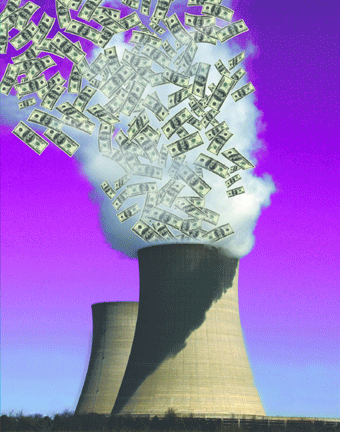
Morning Star 15th April 2025
https://morningstaronline.co.uk/article/cnd-cymru-condemns-billions-nuclear-industry
CAMPAIGNERS have condemned the billions being poured into nuclear energy while the Westminster government “preaches austerity” for everybody else.
CND Cymru attacked Sir Keir Starmer today, claiming he was poised to announce more public subsidy for the Hinkley Point C nuclear power plant in Somerset, not due to open until 2031.
A CND Cymru spokesperson said: “The willingness of the government to fund the nuclear industry to the tune of billions while preaching austerity to everyone else is absolutely farcical.
The anti-nuclear campaigners said Hinkley Point is likely to cost over £40 billion, £14bn over the initial estimate, with CND pointing out the project was managed by French company EDF.
“We must not accept the subsidy of a failing industry in order to preserve our nuclear attack capabilities while working people are facing impossible choices,” the CND spokesperson said.
“A different, greener, fairer, future is possible which doesn’t leave future generations with nuclear waste.”
1 This Month

of the week – Shut Down Drone Warfare!


Tell the Ukrainian Government to Drop Prosecution of Peace Activist Yurii Sheliazhenko

Petition to revoke the licensing of the Near Surface Nuclear Disposal Facility (NSDF) at Chalk River. https://www.ourcommons.ca/petitions/en/Petition/Details?Petition=e-7247
To see nuclear-related stories in greater depth and intensity – go to https://nuclearinformation.wordpress.com
-
Archives
- April 2026 (68)
- March 2026 (251)
- February 2026 (268)
- January 2026 (308)
- December 2025 (358)
- November 2025 (359)
- October 2025 (376)
- September 2025 (257)
- August 2025 (319)
- July 2025 (230)
- June 2025 (348)
- May 2025 (261)
-
Categories
- 1
- 1 NUCLEAR ISSUES
- business and costs
- climate change
- culture and arts
- ENERGY
- environment
- health
- history
- indigenous issues
- Legal
- marketing of nuclear
- media
- opposition to nuclear
- PERSONAL STORIES
- politics
- politics international
- Religion and ethics
- safety
- secrets,lies and civil liberties
- spinbuster
- technology
- Uranium
- wastes
- weapons and war
- Women
- 2 WORLD
- ACTION
- AFRICA
- Atrocities
- AUSTRALIA
- Christina's notes
- Christina's themes
- culture and arts
- Events
- Fuk 2022
- Fuk 2023
- Fukushima 2017
- Fukushima 2018
- fukushima 2019
- Fukushima 2020
- Fukushima 2021
- general
- global warming
- Humour (God we need it)
- Nuclear
- RARE EARTHS
- Reference
- resources – print
- Resources -audiovicual
- Weekly Newsletter
- World
- World Nuclear
- YouTube
-
RSS
Entries RSS
Comments RSS
 nuclear-news