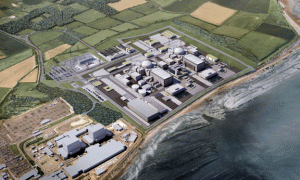
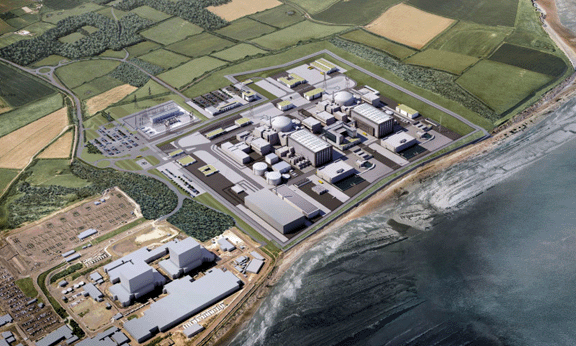
 Reuters 12th Sept 2017, Taxpayers will not be on the hook for any additional costs incurred in the building of the new $24 billion Hinkley Point nuclear plant, British
finance minister Philip Hammond said. A British parliamentary watchdog said
in June that the deal to construct the nuclear power station, which is
being built by French state-owned utility EDF, was risky.
It said the project could lead to requests for more cash and electricity payment
top-ups worth 30 billion pounds ($40 billion). EDF said in July that costs
at Hinkley Point were likely to be higher than it originally thought.
“Costs are not rising for the bill payer or the taxpayer. They may very
well be rising for our development partners, but that’s their problem,”
Hammond said on Tuesday. http://uk.reuters.com/article/britain-power-hinkley/taxpayer-insulated-from-rising-hinkley-point-costs-says-hammond-idUKL5N1LT4XL?rpc=401&
September 14, 2017
Posted by Christina Macpherson |
business and costs, politics, UK |
Leave a comment
 Big failure doesn’t merit big payouts The Times and Democrat 10 Sept 17 “…… there are stories within the nuclear story that make South Carolinians angry. One is the eye-popping sums of money doled out to executives at the two utilities while ratepayers are being asked to pay for failure.
The two companies were warned about serious problems plaguing the nuclear project, an independent analysis by Bechtel Corp. shows. Santee Cooper and SCE&G (whose parent company is Scana) were advised to hire someone to enforce contractor accountability.
In the report dated February 2016, Bechtel wrote the project suffers from “major project management issues that must be resolved for project success.”
But there was no resolution – even as executives with Scana were reaping rewards for their roles in the project.
Filings with the U.S. Securities and Exchange Commission show Scana paid executives more than $21 million in performance bonuses over the past decade, including money for work on the nuclear project. The filings do not say exactly how much of the $21 million was based on the failed project.
Last year, Scana’s top five executives received $3.3 million in performance-based pay, according to the federal filings examined by The State newspaper of Columbia.
Nearly half of last year’s performance pay went to Scana chief executive Kevin Marsh and represents about a quarter of his $6 million in total compensation.
The filings said Marsh’s $1.4 million performance-based bonus for 2016 was paid, in part, because of his “oversight and support of our nuclear construction activities.”
Meanwhile, Santee Cooper President Lonnie Carter became the first utility executive to depart after the nuclear project was abandoned. He won’t suffer in retirement for doing so, with his severance package being more lucrative than the $540,929 paid to him annually as a state employee.
The Bamberg County native will get $1 million in the first year of retirement, $800,000 annually for the next two decades and then $345,000 yearly for the rest of his life. He is 58.
No matter how the world of big finance works, don’t ask a South Carolinian to understand this…… In the world of the S.C. nuclear project and the two utilities, it appears those at the top are being paid in excess – even when the end result is failure.
September 11, 2017
Posted by Christina Macpherson |
business and costs, USA |
Leave a comment
Amid nuclear setbacks, Virginia utility pauses plans for new reactor, SOUTH EAST ENERGY NEWS  BY, Jim Pierobon, September 6,
Dominion Energy has paused development activities on a fifth reactor at a Virginia nuclear power plant, according to a company spokesperson.
The move comes amid ever-growing scrutiny now that construction on two reactors in South Carolina has stopped and plans for others in the region have been scrapped…….
“Dominion is clearly realizing its bet on more nuclear in Virginia was a colossal mistake and waste of ratepayer subsidies,” said Mike Tidwell, Executive Director of the Chesapeake Climate Action Network and an outspoken opponent of additional reactors in Virginia.
Jim Little, a consultant who represents the industry on South Carolina’s Nuclear Advisory Council and chairs the Carolinas Nuclear Cluster, cut to the chase in a primer on the industry’s status for an executive conference in early August.
“Would you be willing to continue investing in an established business with flat revenues (and) increasing costs (electricity) while competing against an agile field of competitors (renewables and natural gas) who enjoy market advantage of lower costs, quicker deployment schedules, support of government subsidies and favorable public opinion?”
……Dominion’s choice of GE Hitachi Nuclear Energy and their Economic Simplified Boiling Water Reactor technology for North Anna 3, or NA3 as it’s known, is viewed by critics as a major risk because such a reactor has never been built in the U.S. The higher estimated cost of $19 billion alone is a hurdle all its own.
Little and Adams agreed that neither GE nor Hitachi has a program underway to foster the size and depth of a supply chain for the pipes, valves, pressure vessels and other parts, along with the engineering skills, needed to complete one of its reactors on time and on budget. The ever-shrinking U.S. nuclear construction supply chain along with an aging workforce pose a significant obstacle to on-time, and on-budget construction, according to industry veterans.
Will ratepayers pick up the bill?
Perhaps the most salient question facing Dominion is whether it will be permitted to charge ratepayers for all of its development work to date.
“The State Corporation Commission has repeatedly warned Dominion not to expect to be granted the right to charge ratepayers for continuing development of NA3,” said Ivy Main, a frequent critic of Dominion and active member of the Sierra Club.
“Three years ago Dominion persuaded the General Assembly to allow them to charge ratepayers for the majority of its development costs to that point, about $500 million,” Main said. “So Dominion may feel it can always allow them to recover development costs even when the SCC turns them down. We hope this time our legislators stand up for their constituents and say no.”
The tally thus far for pursing a fifth reactor reportedly exceeds $600 million.…. http://southeastenergynews.com/2017/09/06/amid-nuclear-setbacks-virginia-utility-pauses-plans-for-new-reactor/
September 11, 2017
Posted by Christina Macpherson |
business and costs, USA |
3 Comments
 No2NuclearPower 5th Sept 2017, Steve Thomas, Emeritus Professor of Energy Policy at the University of Greenwich, says many of the issues that arise with Hinkley Point C (HPC)
that might derail it apply equally to the whole Government programme.
He says we are probably at the point where we are looking at a public spending
disaster. Financing HPC will stretch EDF Energy to the limit and maybe
beyond.
He thinks there is no possibility of Sizewell C being built on the
timetable that the Government is looking at. He says we are in a surreal
situation where we are planning the two largest construction projects ever
built on UK soil – HPC and Moorside – and we are contemplating buying
the equipment from bankrupt and disgraced companies using technologies that
have abjectly failed wherever they have been built.
None of the three consortia (excluding Bradwell which is further off in the future) are
financeable in their present state. Here we look at the evidence presented
by Steve Thomas and others which questions whether any of these projects
will ever be successfully completed. On the other hand continuing with
these projects will seriously damage renewable and energy efficiency
programmes and delay real action to combat climate change. http://www.no2nuclearpower.org.uk/recent-additions/uk-nuclear-policies-recent-changes-and-likely-developments/
September 9, 2017
Posted by Christina Macpherson |
business and costs, ENERGY, politics, UK |
Leave a comment
Seeking Alpha 2nd Sept 2017, Moody’s has issued a warning that the decision by Southern Company’s
Georgia Power subsidiary to pursue its nuclear plant construction project
may lead to a credit downgrade. Moody’s raises questions about whether
Georgia Power can recover its costs. Credit concerns may affect Southern
Company’s ability to buy South Carolina utility, Santee Cooper.
https://seekingalpha.com/article/4103753-moodys-warns-continuing-southern-companys-plant-vogtle-nuclear-project-credit-negative
September 9, 2017
Posted by Christina Macpherson |
business and costs, USA |
Leave a comment
Long-secret report details ‘significant’ problems at failed nuclear reactor project, The State, BY SAMMY FRETWELL AND AVERY G. WILKS, 5 SEPT 17 sfretwell@thestate.com, awilks@thestate.com The doomed V.C. Summer nuclear project suffered from flawed construction plans, faulty designs, inadequate management of contractors, low worker morale and high turnover, according to a lengthy and long-secret report released Monday by S.C. Gov. Henry McMaster’s office.
The report, completed by the Bechtel Corp. about 18 months before the project was shut down in July, also notes strained relationships between the project’s contractors, as well as a lack of shared vision and accountability among the major companies involved.
Bechtel’s report, which senior partner SCE&G did not want released, might answer questions from lawmakers about what went wrong with the project. Many lawmakers want to know whether the fiasco could have been prevented.
Cayce-based SCE&G and state-owned Santee Cooper spent nine years and $9 billion on the Fairfield County project before pulling the plug July 31. Ratepayers at both companies have been charged at least $2 billion for two nuclear reactors that won’t be completed. The utilities have said rising costs, construction delays and the bankruptcy of chief contractor Westinghouse led them to walk away……..
The Bechtel report cited “significant issues” facing the project that needed addressing.
Among the problems, the report says, was that plans and schedules for the project did not reflect actual circumstances; the construction contract did not appear to be serving Santee Cooper, SCE&G or Westinghouse well; and construction designs often were “not constructable,” which caused significant changes and delays.
Construction modules, built off site and touted as a way to ensure the project’s success, were a “detriment to the project progress and consequently the budget,” Bechtel wrote.
A key finding in the report addresses the utilities’ plan to use the AP 1000 reactor, a technology that had not been used in U.S. nuclear plants before. The report said challenges were to be expected because of the reactor type and because no nuclear plants had been built in the U.S. in decades. But it also said the V.C. Summer project “suffers from various fundamental” contract and management problems that needed resolution for the effort to succeed.
The report said contractors had not been transparent or accurate to the utilities about the project’s progress, and the utilities did not have an appropriate project team to assess or verify those contractors’ progress reports…..
Investor-owned SCE&G did not want the report released. In a Sunday letter to McMaster, the utility pleaded with the governor to keep the report confidential if Santee Cooper, the project’s minority owner, gave it to him.
If released, the report could hurt SCE&G in lawsuits, the company said. The letter also said releasing the document could hurt SCE&G and Santee Cooper in their efforts to recover “potentially billions” of dollars from Westinghouse.
Monday’s release follows two weeks of efforts by lawmakers to obtain the Bechtel report…….http://www.thestate.com/news/local/article171238277.html
September 6, 2017
Posted by Christina Macpherson |
business and costs, USA |
Leave a comment

 Hitachi UK reactors to get full Japanese loan insurance https://asia.nikkei.com/Politics-Economy/Policy-Politics/Hitachi-UK-reactors-to-get-full-Japanese-loan-insurance, Lenders seek guarantees as nuclear projects face post-Fukushima cost overruns, 2 Sept 17, TOKYO — Japan intends to fully insure bank loans for one of Hitachi‘s British nuclear plant projects in order to encourage domestic lenders to finance a particularly risky type of infrastructure export that Prime Minister Shinzo Abe’s government seeks to promote.
When Abe met with U.K. counterpart Theresa May here Thursday, the two leaders reaffirmed bilateral cooperation on nuclear plant construction. Japan’s support will include coverage for two reactors at the proposed Wylfa Newydd nuclear station in Wales — a rare example of loan insurance for a project in an advanced economy.
State-owned Nippon Export and Investment Insurance will write the loan insurance for reactors, which Hitachi will build through British arm Horizon Nuclear Power. The Japanese conglomerate, together with Tokyo and London, will conduct working-level talks to hash out a funding support framework, with the aim of breaking ground in 2019.
The project is estimated to cost over 2 trillion yen ($18.1 billion). Hitachi, the U.K. government and two state-backed entities — Japan Bank for International Cooperation and the Development Bank of Japan — are expected to pick up part of the tab. But private-sector financing will also be needed to close the funding gap.
NEXI, which normally indemnifies private lenders for 90-95% of financing, will enter into talks with Japanese banks toward fully guaranteeing loans for the Wylfa project.
Nuclear project costs have tended to balloon since since Japan’s 2011 Fukushima disaster owing to increased safety precautions. Seeing a higher risk of debt default, Japanese megabanks Bank of Tokyo-Mitsubishi UFJ and Mizuho Bank have sought full coverage by NEXI for any loans for nuclear plant development. Such insurance typically covers financing for projects in developing countries. NEXI is expected to impose conditions, such as a loan period of several decades, in return for an exception.
An accident or other troubles at the plant could expose BTMU and Mizuho to lawsuits from third parties because the banks would bear responsibility for financing the project. The two banks will decide on Wylfa financing based partly on discussions between Tokyo and London concerning damage compensation.
A default on the Wylfa loans would entail a taxpayer-funded repairs to the balance sheets of NEXI and JBIC. The loan insurance proposal is likely to spark a debate on whether promoting infrastructure exports in this way is worth the risk. The Abe government, for its part, will try to use the NEXI assurances to elicit more funding, public and private, from the British side.
With little prospect of constructing new reactors in Japan following the meltdowns at the Fukushima Daiichi nuclear power plant, domestic builders have focused their business offshore. Chinese state-owned enterprises are undertaking more global infrastructure projects, emboldening those who argue that Japan will be left behind in the race for overseas orders unless the country takes risks. In 2015, the U.K. became the first developed nation to approve a Chinese-made reactor.
September 4, 2017
Posted by Christina Macpherson |
Japan, marketing, politics, UK |
Leave a comment
Trump Quietly Promises Billions in New Nuke Contracts, This could trigger a new arms race with Russia  and China. The American Conservative By SCOTT RITTER • September 1, 2017 “………Nuclear Armageddon was a pervasive reality during the Cold War, and America had an arsenal and doctrine to make it a reality. Again, flashbacks from my childhood make it all-too real: F-100 fighter-bombers carried nuclear bombs on air-strip alert at an air base in Turkey. F-106 fighter-interceptors armed with nuclear “Genie” air-to-air missiles were on constant air patrol over the skies of Michigan. My father told my mother how he never wanted to be assigned to Strategic Air Command because the “Chrome Dome” mission was insane—packs of nuclear-armed B-52 bombers constantly in the air, flying towards the Soviet Union only to be called back on a routine basis……..
The generals and politicians who controlled this arsenal were schooled in the art of global apocalyptic warfare, having fought and prevailed against fascism in the Second World War. Nuclear war wasn’t an abstraction to them, but reality—America was prepared to fight and win a nuclear exchange with the Soviet enemy, using doctrines with names such as “counterforce,” “first strike,” and “mutually assured destruction,” better known as MAD. Only when the absurdity of the MAD acronym sunk in did these leaders finally undertake to control the arsenal of Armageddon they had created. One of the first agreements reached between the U.S. and the Soviet Union (the anti-ballistic missile, or ABM Treaty) limited their respective defenses against nuclear missile attack, so that neither side would be lulled into a false sense of security and thus be tempted to do the unthinkable.
And yet, even as both American and Soviet leaders sought to limit their respective nuclear forces through negotiations, each side continuously modernized and improved their arsenals to increase the responsiveness, survivability—and ultimately, accuracy and lethality—of the very weapons both parties claimed they never wanted to use. Nuclear war was always a math problem: The first planners calculated that 400 nuclear bombs were all it would take to destroy the communist world. One can assume that the Soviets had similarly calculated that a like-number of their bombs was all they needed to destroy western civilization as well. By the 1970s, each side possessed an arsenal of tens of thousands of nuclear weapons, enough to destroy the planet hundreds of times over………
America’s collective nuclear amnesia has led to the lessons of the past having been largely forgotten. Our military and political leaders have not been schooled by global wars of destruction where hundreds of millions died, but rather minor battlefields where the death toll, while tragic, numbers in the thousands and tens of thousands. We have become accustomed to a war of precision strikes, where threats can be largely dealt with by remote control, either through a drone-delivered missile or a satellite-guided bomb dropped from 30,000 feet. American bodies come home singly or in small groups, enough to remind us of the cost of conflict, but not enough to be painful for anyone but the immediate family and friends of the deceased. The Civil Defense movement has morphed into Emergency Preparedness that is more focused on Mother Nature than nuclear Armageddon.
 The Trump administration has just announced that it is moving ahead with an Obama-era plan to modernize America’s nuclear arsenal, sprucing up the nuclear Triad with a new fleet of land-based missiles, missile-carrying submarines, and air-delivered nuclear weapons that will cost the American taxpayer well over $1 trillion in the coming years. The ostensible purpose behind this modernization effort is to maintain America’s nuclear deterrence capability for decades to come. The harsh reality, however, is that through this nuclear upgrade, America is simply repeating the mistakes of the past, building weapons whose precision and speed will trigger a new arms race with Russia and China as they seek to match this new American capability with weapons designed to sustain their version of nuclear deterrence.
Mutually assured destruction (MAD), once relegated to the trash bin of history, has had new life breathed into it. This time there is no foundation of arms control in place to limit the insanity—the ABM treaty is a thing of the past, and America today hides behind the false promise of a missile-defense shield that has questionable utility against a North Korean madman armed with a handful of missiles, let alone a Russian or Chinese military armed with hundreds. Disarmament talks with Russia—once a hallmark of the Trump foreign-policy vision—are stillborn in the face of allegations of election meddling from Moscow.
American tanks patrol the Polish frontier opposite their Russian counterparts, while U.S. and Russian warplanes share the skies over Syria, and play cat and mouse over the Baltics. Into this volatile mix, President Trump now wants to deploy a new generation of nuclear weapons that any enemy possessing a modicum of strategic insight would have no choice but to view as possessing genuine first-strike capability. Given the enhanced performance of these weapons, there will be no “fail safe” mechanism to limit the scope and scale of inadvertent use. There won’t be time for military officers to call home with a furtive warning of impending doom, and “Bert the Turtles” lyrical admonitions to “duck and cover” will be rendered meaningless to a population who has long ago forgotten what it was like to live under the threat of imminent nuclear holocaust. Today Americans are unable or perhaps unwilling to hold their elected leaders responsible as they play nuclear Russian roulette—a game as avoidable as it is insane.
Scott Ritter is a former Marine Corps intelligence officer who served in the former Soviet Union implementing arms control treaties, in the Persian Gulf during Operation Desert Storm, and in Iraq overseeing the disarmament of WMD. He is the author of Deal of the Century: How Iran Blocked the West’s Road to War(Clarity Press, 2017). https://www.theamericanconservative.com/articles/trump-quietly-promises-billions-in-new-nuke-contracts/
September 4, 2017
Posted by Christina Macpherson |
business and costs, USA, weapons and war |
Leave a comment
 SC nuclear debacle, by the numbers, The State 29 Aug 17 , CINDI ROSS SCOPPE “…..What you’ll find here is almost all numbers: the budget, the rate hikes, market share of SC utilities. I’ve also included what state law says about abandoning a nuclear project.
The money
$11 billion: Original projected cost of the two reactors
$20 billion: Minimum projected cost, due to delays and cost overruns, when SCE&G and Santee Cooper decided to abandon the project
$9 billion: What SCE&G and Santee Cooper have spent already on the project
SCE&G
$4.9 billion: Amount of borrowed and stockholder money SCE&G has invested and hopes to recoup
$2 billion: Tax credits SCE&G hopes to receive to offset $4.9 billion investment
$700 million: Payment from Westinghouse parent Toshiba that SCE&G hopes to receive to offset $4.9 billion investment
$2.2 billion: Amount SCE&G will seek to recoup from ratepayers if it receives the tax credits and Toshiba payments
$1.4 billion: Amount SCE&G customers have paid in rate increases to bankroll the two new reactors
9: Rate hikes, so far, that SCE&G has passed on to its customers to pay for the now-abandoned reactors
18 percent: Portion of SCE&G bills that pay for the nuclear project
SANTEE COOPER
$4 billion: Amount borrowed by Santee Cooper, which will have to be paid by ratepayers or taxpayers
$540 million: Amount Santee Cooper customers have paid in rate increases to bankroll the two new reactors
5: Rate hikes, so far, that Santee Cooper has passed on to its customers to pay for the now-abandoned reactors
8 percent: Portion of Santee Cooper bills that pay for the nuclear project
Future SCE&G rate increases*
State law, at 58-33-280, allows SCE&G to request “revised rates” annually during construction of a nuclear facility. These are in addition to normal rate increases and, unlike normal rate increases, are nearly impossible for the PSC to reject…….http://www.thestate.com/opinion/opn-columns-blogs/cindi-ross-scoppe/article170003262.html
September 4, 2017
Posted by Christina Macpherson |
business and costs, USA |
Leave a comment
 White House Hires Billionaire War Profiteers To Aid In War Planning, Mint Press News, Blackwater founder Erik Prince and billionaire Stephen Feinberg reportedly “recruited” for war planning, by Jake Johnson July 11th, 2017[good tweets included on original]
Two of President Donald Trump’s closest aides have reportedly solicited advice from two wealthy private military contractors — Erik Prince, founder of Blackwater, and Stephen Feinberg, the billionaire owner of DynCorp International—on how to proceed with the sixteen-year-long war in Afghanistan.
According to the New York Times, White House Chief Strategist Steve Bannon and senior advisor Jared Kushner “recruited” the contractors, who have made a hefty sum from perpetual conflict in the Middle East, “to devise alternatives to the Pentagon’s plan to send thousands of additional troops to Afghanistan.”
Following a meeting with Bannon and Kushner, Prince and Feinberg have “developed proposals to rely on contractors instead of American troops in Afghanistan,” the Times notes.
“The highly unusual meeting dramatizes the divide between Mr. Trump’s generals and his political staff over Afghanistan, the lengths to which his aides will go to give their boss more options for dealing with it and the readiness of this White House to turn to business people for help with diplomatic and military problems,” the Times reports. “But it also raises a host of ethical issues, not least that both men could profit from their recommendations.”
As Common Dreams reported last month, Prince penned an op-ed in the Wall Street Journal in which he recommended a “viceroy approach” in Afghanistan that would rely heavily on private security forces.
Critics characterized Prince’s proposals as tantamount to “colonialism” and argued they exude “sheer 19th-century bloodlust and thirst for empire.”
Following the Times reporting on Monday, commentators denounced the attempt to give credence to the ideas of war profiteers as “lunacy.” http://www.mintpressnews.com/white-house-hires-billionaire-war-profiteers-aid-war-planning/229664/
September 2, 2017
Posted by Christina Macpherson |
business and costs, politics, USA, weapons and war |
Leave a comment
 Retiring utility CEO to receive $1 million in 1st year, Seattle Times, By SEANNA ADCOX, The Associated Press, COLUMBIA, S.C. (AP) — The retiring chief executive of South Carolina’s state-owned utility will be paid more than $1 million in the first year of his retirement, which follows the abandonment of a nuclear power project.
Documents provided Friday by Santee Cooper show CEO Lonnie Carter will also leave with nearly $859,000 in a 401K-style plan to invest or draw down from as he wishes.
The 58-year-old will receive roughly $800,000 annually for the next two decades, then $345,000 yearly for the rest of his life. His contract provides an additional $270,500 — half of his current salary — over the first year of his retirement.
Carter announced his resignation last week after 35 years with the public utility, the last 13 as CEO. But he remains at the helm until the board names an interim replacement, expected within the next several weeks. His impending departure marks the first executive to leave following the July 31 decision to halt construction on two partly built reactors that customers have been funding since 2009.
The retirement package involves his state pension, his 2011 contract and Santee Cooper’s two benefit plans for executives. One is the 401K-style account. The other provides up to $455,200 annually for 20 years, depending on this year’s bonus. It’s unclear whether he’ll receive the total compensation his contract allows.
Carter’s salary is $541,000. Last year, he received a $330,500 bonus for meeting corporate goals such as power costs, safety and customer satisfaction, according to the utility.
Carter had been eligible for retirement since 2011, but the utility’s board had asked him to remain until the nuclear project’s completion. Carter was not asked to leave, and no other executive departures are expected, board Chairman Leighton Lord said last week.
Santee Cooper was a 45 percent partner with South Carolina Electric & Gas Co. in the effort to expand the V.C. Summer Nuclear Station in Fairfield County north of Columbia, where they have shared ownership of an existing reactor for more than 30 years.\
The two decided to abandon construction after jointly spending nearly $10 billion, leaving nearly 6,000 people jobless. The utilities’ customers have already paid more than $2 billion on the failed project through a series of rate hikes since 2009, which covered interest costs on financing.
The companies don’t expect to refund anything. Customers could end up paying off that debt over decades…….
Since 2011, Santee Cooper executives were paid more than $70,000 in bonuses for the now-abandoned project. More than half of that went to Carter, The State newspaper reported in Friday’s papers.
“The performance goals tied to the nuclear project were specific and measurable, and all payouts were based on those goals being met,” said Santee Cooper spokeswoman Mollie Gore.
SCE&G paid nearly $21 million in bonuses to top executives, some of which was for reaching milestones in the nuclear project. The privately owned SCE&G did not say how much of the bonus money was specifically for the nuclear project. http://www.seattletimes.com/business/state-owned-utility-also-paid-bonuses-for-nuclear-project/
September 2, 2017
Posted by Christina Macpherson |
business and costs, politics, USA |
Leave a comment

 Power company kills nuclear plant, plans $6 billion in solar, battery investment
Duke Energy Florida is just the latest utility to walk away from nuclear. Ars Technica MEGAN GEUSS – 8/31/2017, On Tuesday, power provider Duke Energy Florida announced a settlement with the state’s public service commission (PSC) to cease plans to build a nuclear plant in western Florida. The utility
INSTEAD INTENDS TO INVEST $6 BILLION
in solar panels, grid-tied batteries, grid modernization projects, and electric vehicle charging areas. The new plan involves the installation of 700MW of solar capacity over four years in the western Florida area.There’s excitement from the solar industry, but the announcement is more bad news for the nuclear industry. Earlier this year, nuclear reactor company Westinghouse declared bankruptcyas construction of its new AP1000 reactors suffered from contractor issues and a stringent regulatory environment. Two plants whose construction was already underway—the Summer plant in South Carolina and the Vogtle plant in Georgia—found their futures in question immediately.
At the moment, Summer’s owners are considering abandoning the plant, and Vogtle’s owners are weighing whether they will do the same or attempt to salvage the project.
Duke Energy Florida hadn’t started building the Levy nuclear plant, but it did have plans to order two AP1000 reactors from Westinghouse. Now that Westinghouse company is in dire financial straits, the Florida utility decided that its money is better spent elsewhere.
Just last week, Duke told its PSC that it would have to increase rates by more than eight percentdue to increased fuel costs. But with the new settlement that directs the utility toward solar and storage, customers will see that rate hike cut to 4.6 percent…….
overall, the changes will save residential customers future nuclear-related rate increases. Those customers will see a cost reduction of $2.50 per megawatt-hour (MWh) “through the removal of unrecovered Levy Nuclear Project costs,” the utility said.
The 700MW of solar won’t exactly cover the nameplate capacity of the Levy plant, which was supposed to deliver 2.2 gigawatts to the region. But the Tampa Bay Times wrote that Duke “is effectively giving up its long-held belief that nuclear power is a key component to its Florida future and, instead, making a dramatic shift toward more solar power.”……https://arstechnica.com/science/2017/08/florida-power-company-exchanging-nuclear-plans-for-solar-plans-cutting-rates/
 |
Click here to Reply or Forward
|
3.9 GB (26%) of 15 GB used
Last account activity: 30 minutes ago
Details
September 1, 2017
Posted by Christina Macpherson |
business and costs, renewable, USA |
Leave a comment
The U.S. Backs Off Nuclear Power. Georgia Wants to Keep Building Reactors, NYT, By BRAD PLUMER, AUG. 31, 2017 WASHINGTON — Even as the rest of the United States backs away from nuclear power, utilities in Georgia are pressing ahead with plans to build two huge reactors in the next five years — the only nuclear units still under construction nationwide.
September 1, 2017
Posted by Christina Macpherson |
business and costs, USA |
Leave a comment
Secretive report on South Carolina nuclear reactor construction never given to state utility regulators, Post and Courier, By Andrew Brown abrown@postandcourier.com, Aug 31, 2017 COLUMBIA — SCANA Corp. may have misled state utility regulators about the existence of a secretive report that detailed construction failures at two troubled nuclear reactors at the V.C. Summer station in Fairfield County, months before the $9 billion energy project was abandoned.
The director of the state Office of Regulatory Staff told The Post and Courier on Thursday that SCANA officials repeatedly told state agency employees they didn’t have a copy of a report that was produced by Bechtel Corp., an engineering and project management company that observed the nuclear construction near Jenkinsville in past years.
“They have continued to ask for it,” said Dukes Scott, the regulatory staff director. “As we asked for it, they never said, ‘Yes, here it is.'” Those state regulators were surprised last week when SCANA and Santee Cooper officials admitted under oath in a Senate hearing the document did exist, and they were again denied access to it by SCANA, who is now claiming it as legally privileged information……http://www.postandcourier.com/business/secretive-report-on-nuclear-reactor-construction-never-given-to-state/article_6d7d5560-8e56-11e7-a0f0-cf722935ab39.html
September 1, 2017
Posted by Christina Macpherson |
business and costs, secrets,lies and civil liberties, USA |
Leave a comment
 Don’t you think that there’s something surreal about the idea of nuclear reactors in Bangladesh? the whole place is likely to be under water before too long – nuclear reactors and all!
 Russia officially agrees to take back nuke plant wastes, Dhaka Tribune, Aminur Rahman Rasel August 30, 2017 Russia will take back the spent fuel from Bangladesh territory for reprocessing, recycling and management
Bangladesh has signed an agreement with Russia to return the spent nuclear fuel from Rooppur nuclear power plant, which is being built with Russian assistance.
Science and Technology Minister Yeafesh Osman and Alexey Likhachev, director general of Rosatom, Russia’s State Atomic Energy Corporation, signed the agreement in Moscow on Wednesday.
Earlier on March 15, the two countries had approved a draft of the agreement on spent fuel management of the project after a bilateral meeting in Dhaka.
According to the agreement, Russia will take back the spent fuel from Bangladesh territory for reprocessing, recycling and management, confirmed Science and Technology Ministry’s Information Officer Md Kamrul Islam Bhuiyan.
From the outset of the project, Bangladesh has been keen to return nuclear waste to Russia, he added…..http://www.dhakatribune.com/bangladesh/power-energy/2017/08/30/russia-officially-agrees-take-back-nuke-plant-wastes/
September 1, 2017
Posted by Christina Macpherson |
ASIA, marketing, Russia |
Leave a comment











 nuclear-news