Romandie 29th March 2018, Orano, a company resulting from the restructuring of giant Areva and refocused on the nuclear fuel cycle, has slightly widened its loss during
the year 2017, she said Thursday, in a context of nuclear market that remains difficult. The group’s net loss widened 4.5% to 252 million euros
compared to last year, according to a statement. EBITDA was down 29.3% to 946 million euros, mainly due to the impact of reduced volumes sold. Sales
reached € 3.9 billion, down 10.8%. These results, “in line with expectations” according to the text. https://www.romandie.com/news/903937.rom
Is China losing interest in nuclear power? China Dialogue Feng Hao 19.03.2018 Slowing demand for electricity and competition from renewables have halted new reactor approvals.Globally, the outlook for new, large nuclear reactors is gloomy, according to the International Energy Agency’s (IEA) World Energy Outlook. A lot of countries have backed away from nuclear power in recent years due to concerns over public safety, cost and the complex challenge of getting plants built.
This year, five reactors are expected to come online in China, with the IEA predicting that by 2030 the country will overtake the United States as the world’s biggest generator of nuclear power.
Pushing nuclear
Increasingly, China’s decision to move ahead with new nuclear seems at odds with other countries that are abandoning the technology in favour of other low carbon options, such as wind and solar.
Xu Jiangfeng is a researcher at the Planning Research Centre of the China National Offshore Oil Corporation’s Research Institute. He told chinadialogue that the government’s concern with energy security has resulted in a diverse mix of energy resources and technologies being pursued, including nuclear……….
Approvals freeze
Policymakers may cite various strategic reasons for backing nuclear power but there is a question mark hanging over the sector’s future growth.
China has 20 gigawatts of nuclear power capacity under construction but plans for additional capacity are being delayed. A 2020 target of 58 gigawatts of installed nuclear capacity now looks out of reach.
The National Energy Administration did not approve any new nuclear plants between 2016 and 2017. In 2017, only three new reactors started operating.
Reasons for the shift, according to Shi, include mixed attitudes towards new nuclear power within government, and the over-supply that’s affecting China’s power generation sector.
As China’s economic growth has eased, so too has the growth in electricity demand. In 2015, electricity consumption rose just 0.5%, the lowest in 40 years.
“Work out supply and demand and you can see that the market is unable to absorb any more nuclear power,” Kang Junjie, chief engineer with Dongdian Wanwei Technology (Beijing) told chinadialogue.
This leaves little room for expansion of electricity generation, meaning fierce competition between nuclear, solar, wind and hydropower. Globally, solar and wind are replacing nuclear power as the first choice for new power generation. This is true in China, too.
Cost is a key factor: the earlier nuclear power plants are now in the mid-to-late stages of their lifecycle, with operational and maintenance costs rising, according to Kang Junjie. Meanwhile, renewables are in the ascendant, with costs continuing to fall.
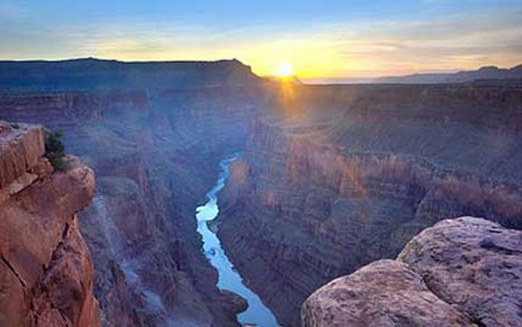
Uranium in Canyon Country: Part 2 of 2: Who benefits from uranium mining? Grand Canyon News, By Erin Ford , 27 Mar 18, GRAND CANYON, Ariz. — There are currently 831 mining claims in the roughly 1 million acres withdrawn by former Interior Secretary in 2012, according to the Bureau of Land Management (BLM).
There may be a healthy profit to be made on the claims, as legal action by mining industry groups and a recommended review of the ban by the Forest Service seems to indicate. But who is making the profit?
The BLM’s report indicates that only about 2 percent of the 831 mining claims are held by U.S.-based companies – those belong to Liberty Star Uranium and Metals in Tucson, Arizona. The rest, discounting privately-held claims (5 percent), belong to foreign-based companies. Of the remaining 93 percent, companies based out of Canada hold 712 claims (86 percent) and a UK-based Vane Minerals holds 60 claims (7 percent).
Uranium production in the U.S. has not been a profitable enterprise since the bottom fell out of the uranium market in the early 1990s. According to the Energy Information Administration (EIA), there are currently 61 nuclear-based power plants in the U.S. — no new plants have been commissioned since the near-catastrophic incident at Pennsylvania’s Three Mile Island facility in 1979. The end of the Cold War in 1991 meant that proliferation of nuclear weapons was suspended, a pact that remains largely in place. As a result, demand for uranium fell sharply, prices bottomed out and uranium extraction became a pricey enterprise with low return on investment.
………Where’s the profit?
In a petition filed with the U.S. Department of Commerce (DOC), Energy Fuels Inc., a Canadian company with a 12 percent stake in uranium mining claims around Grand Canyon, asserts that the commercial uranium stockpile was 6 percent higher than 2015 levels.
If demand is lower and supplies are higher, how do these companies plan to profit off increased mining activity?
The answer may lie in three things: President Donald Trump’s energy dominance agenda, potential U.S. Supreme Court ruling and Energy Fuels’ petition to the DOC……….
Who benefits?
Energy Fuels, Inc. recently filed a petition with the DOC for relief under Section 232 of the Trade Expansion Act of 1962. In simplest terms, the company is asking the administration to issue a buy American requirement by limiting uranium imports as a threat to national security. The premise is the same as the tariffs to be potentially imposed on steel and aluminum imports — to revive a U.S.-based industry by steeply taxing competitors or eliminating them altogether.
But Reimondo points out that uranium mining isn’t a strong economic driver in northern Arizona, and even if it was, the U.S. doesn’t reap any rewards. The government, which receives royalty payments from industries that extract minerals or other commodities from federal lands, doesn’t receive royalties from uranium mining.
Comparatively, the tourism and travel economy pumps more than 900 million into the region each year, and supports nearly 20,000 jobs, according to a joint 2011 report by the U.S. Geological Survey, U.S. Fish and Wildlife Service, National Park Service, Forest Service and BLM. The report also estimates that uranium mining could support only about 650 local jobs — and those jobs aren’t permanent. Once a mine is depleted, on-site jobs will evaporate. Energy Fuels says its Canyon mine, which is currently permitted to operate near Red Butte about six miles from the South Rim, is expected to employ about 60 people at peak production.
4 firms on ICAN list ban nuclear arms investment https://www3.nhk.or.jp/nhkworld/en/news/20180324_11/ NHK has learned that at least 4 Japanese financial institutions listed by a nuclear-weapons watchdog as investing in firms involved in the production of nuclear weapons have internal policies forbidding such ties.
The International Campaign to Abolish Nuclear Weapons, or ICAN, says 329 banks and asset management firms in 24 countries and regions invested in companies involved in nuclear weapons production over a 3-year period starting in 2014.
NHK contacted 7 Japan-based banks and other institutions listed by the Nobel Peace Prize-winning group. Asked about ICAN’s findings, 3 of the firms said they do not currently deal with such companies. Four institutions did not reply.
At least 4 said their internal regulations restrict them from investing or providing loans to businesses related to nuclear weapons production.
ICAN says 30 non-Japanese companies have suspended such investments following the adoption last year of the UN Treaty on the Prohibition of Nuclear Weapons.
Yuki Tanabe, an official at the Japan Center for a Sustainable Environment and Society, says banks and other institutions could be accused of lacking social responsibility by doing business with such companies — even when they have no direct deals with them, or have policies against such investments.
State Department Approves $1 Billion Arms Sale With Saudi Arabia , Daily Caller HENRY RODGERS Political Reporter 24 Mar 18
The State Department announced it had approved the sales of more than $1 billion in arms to Saudi Arabia Thursday, which includes 6,700 missiles.
The announcement comes two days after President Donald Trump met with Saudi Arabia’s Crown Prince Mohammed bin Salman as part of a three week trip in the U.S. The Saudi Arabian government requested to purchase 6,700 U.S. built anti-tank missiles as well as supplies and parts for old tanks and helicopters, which the State Department approved.
The sale will “support U.S. foreign policy and national security objectives by improving the security of a friendly country, which has been and continues to be an important force for political stability and economic growth in the Middle East,” the Defense Security Cooperation Agency (DSCA) said in a statementThursday, adding it “will not alter the basic military balance in the region.”
FirstEnergy Solutions bankruptcy restructuring likely, power plants would be closed or sold, Cleveland.com, 23 Mar 18 By John Funk, The Plain Dealer The Perry nuclear power plant, a source of jobs and tax revenues for 30 years in Northeast Ohio, could be shutdown or sold in a Chapter 11 bankruptcy proceeding. The FirstEnergy Corp. subsidiary that owns the company’s power plants has an accumulated debt of more than $2.8 billion. The old plants cannot generate power as cheaply as new gas turbine plants and wind farms. FirstEnergy has not been able to persuade state lawmakers or federal authorities to create special fees to subsidize its nuclear power plants and has made it clear in recent months that it wants to become a fully regulated company again. A bankruptcy case could be filed within a week. (Plain Dealer file )
CLEVELAND, Ohio — Brutal competitive financial forces are poised to remake FirstEnergy into a utility without power plants and focused solely on delivering electricity.
The Akron-based power company that a decade ago hired former George W. Bush administration Solicitor General Ted Olson to bullystate lawmakers who were considering a return to state-regulated power prices now appears ready to sell or close its remaining coal and nuclear power plants because the state won’t subsidize them and neither will federal authorities.
Those include Perry nuclear plant in Lake County east of Cleveland and Davis-Besse in Ottawa County near Toledo.
The draconian move may come in a corporate “restructuring” plan that could get under way next week in a federal bankruptcy court, either here or any other federal jurisdiction where the company has offices.
Energy Watch Group 20th March 2018, During his state visit to India, France’s President Macron agreed with
India’s Prime Minister Narendra Modi last week to sell six French EPR
reactors for the largest nuclear power plant planned in Jaitapur.
Regardless of the fact that India has not yet signed the Nuclear
Non-Proliferation Treaty. The plutonium from the reactors could be
completely used for the construction of nuclear weapons without
international control. In terms of energy, too, all EPR construction
projects in recent years are highly problematic. http://energywatchgroup.org/new-european-nuclear-reactors-prove-financial-technically-dangerous-disast
Nikkei Asian Review 18th March 2018 Another
setback looms for Tokyo’s infrastructure export drive. A Japan-led nuclear
power plant project in Turkey looks to cost more than twice as much as
initially projected, highlighting challenges for Tokyo’s push to export
Japanese infrastructure.
The Japanese and Turkish governments agreed on the
public-private project in 2013. The estimated total cost, pegged at around
2 trillion yen ($18.8 billion at current rates) at the time, has since
ballooned to more than 5 trillion yen, according to sources close to the
matter, due largely to the need to meet tougher safety standards
implemented after the March 2011 meltdowns at Tokyo Electric Power Co.
Holdings’ Fukushima Daiichi plant.
The plan is to build four reactors with
a total output of 4,500 megawatts in the Black Sea coastal city of Sinop,
using Atmea1 reactors Japan’s Mitsubishi Heavy Industries is developing
with France’s Areva.
Though the goal is to put the first reactor into
service in 2023, in time for Turkey’s centennial, the cost problem could
cause that date to slip.
Japan views nuclear power as an integral part of
efforts to export infrastructure around the world. As Mitsubishi Heavy and
the others hash out the Turkish project, a group led by Hitachi is putting
the finishing touches on plans to build two nuclear reactors in the U.K.,
on the Welsh coast.
Yet the Fukushima accident still casts long shadows over the nuclear industry, and hurdles are growing higher. Vietnam has
cancelled orders for Japanese nuclear facilities amid financial concerns
and local opposition. Partly because of the rising cost of safety measures,
the financial risks of building nuclear plants abroad have grown too large
for companies alone to bear.
So Japan’s government has stepped in with
public financing and other aid, eager to support infrastructure exports,
which it considers a key economic growth strategy. Pursuing projects abroad
is in effect the only way for such companies as Mitsubishi Heavy and
Hitachi to maintain and profit from their nuclear technologies.
Costlier Than Pyramids: Finnish NPP Becomes World’s Second-Priciest Building, Sputnik News EUROPE 19.03.2018
The Finnish Olkiluoto-3 nuclear reactor has been touted as the “flagship of European nuclear energy,” but has taken more than a decade to complete and cost the Nordic nation an arm and a leg.
When completed, the third reactor at Finland’s Olkiluoto nuclear power plant will have the distinction of being the world’s second most expensive building, higher than that of a number of luxury hotels, sports arenas, skyscrapers and even pyramids, Finnish national broadcaster Yle reported.
With a breathtaking price tag of €8.5 billion ($11 billion), Olkiluoto-3 is expected to be finished in 2019, 14 years after the start of the construction. For the sake of comparison, the Cheops Pyramid, the largest of the pyramids at Giza, took about 20 years to build. However, construction of the 4,500-year-old pyramid turned to be far more efficient, as it was built over roughly the same period of time and without access to modern technology. Also, its cost in today’s money has been estimated at only €4 billion ($4.9), half the Olkiluoto price tag.
New US nuclear submarines come with $128b price tag, 9 news, By Richard Wood
The total cost of the US navy’s new ballistic missile submarine fleet will be an “eye-watering” $US100 billion ($128b).
Earlier this week, Navy Secretary Richard V. Spencer said deep under the ocean remains the best best place to hide a nuclear deterrent – but it comes at a price.
The US Navy is seeking to build a fleet of 12 Colombia-class nuclear-powered ballistic missile submarines (SSBN), reports The Diplomat.
“All of sudden you’re talking about the submarines and there is a number that will make your eyes water. Columbia will be a $100 billion program for its lifetime.
“We have to do it. I think we have to have big discussions about it,” Spencer added.
Underwater has proved to date the most elusive environment for detecting an SSBN, he explained.
However, “it comes at a price,” the Navy secretary added.
Construction of the first Columbia-class sub is scheduled to start in 2021, with the US navy taking delivery from 2028.
Australian maritime warfare expert James Goldrick told nine.com.au the US is determined to keep its edge in submarine technology.
Despite recent developments in underwater detection, submarines remain difficult to pinpoint, he said.
“The sea is a very complex medium. It remains the most impenetrable environment, and I think the US is banking on this continuing.”
And Rear Admiral Goldrick said despite Russia and China unveiling new planned nuclear weapons, the US maintains an advantage in submarine technology.
Putin claims new weapons could strike ‘anywhere in the world’
“The Americans are well ahead of the Chinese. The Russians, however, have become well advanced in modernising their submarine fleet.”
The Columbia-class vessels are due to replace the US navy’s current Ohio-class SSBN fleet.
Technical details of the new vessels remain sketchy, but they are set to be the biggest sub the US navy has ever commissioned, The Diplomat reports.
Designed by General Dynamics Electric Boat, they measure 171m and have a beam of 13m.
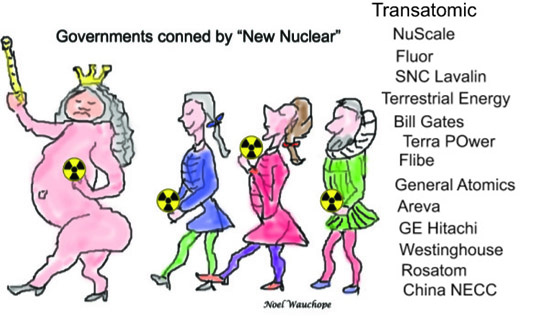
France considers developing mini nuclear reactors, eyes cost Euro News , ByREUTERS 15/03/2018 PARIS – The French nuclear industry is considering developing Small Modular Reactors (SMRs), but will have to ensure these miniaturised generators are not only technically feasible but also financially viable, executives said.
CEA head of nuclear energy François Gauché said the agency would study the technical and financial feasibility of SMRs in the coming 18 months.
He said some organisations – notably NuScale, majority-owned by U.S. Fluor Corp – had submitted SMRmodels to their nuclear regulators for design approval.
Critics say SMR economies of scale will be limited because each reactor will need its own control and safety systems. They also point at the danger of spreading radioactive material more widely, increasing radiation and security risks.The British government said in December it would provide funding for research into mini nuclear plants. Rolls-Royce is part of a consortium of UK firms developing SMR technology…….. Reporting by Benjamin Mallet; Writing by Geert De Clercq; Editing by Dale Hudsonhttp://www.euronews.com/2018/03/15/france-considers-developing-mini-nuclear-reactors-eyes-cost
Truth Out 9th March 2018, Linda Pentz-Gunter:Countries Seek to Export Nuclear Energy Projects to
Keep Industry Alive. Ten years ago, The Washington Post called then-French president Nicolas Sarkozy “the world’s most aggressive salesman for nuclear
power.” Today, that mantle has been passed to the country’s current president, Emmanuel Macron — just another case of the French saying, “plus
ça change, plus c’est la même chose.” (“The more things change, the more they remain the same.”)
As if to dispel any remaining doubt about his commitment to the French nuclear sector, Macron was happy to accept an invitation to India to cement a French nuclear deal there, according to Indian officials.
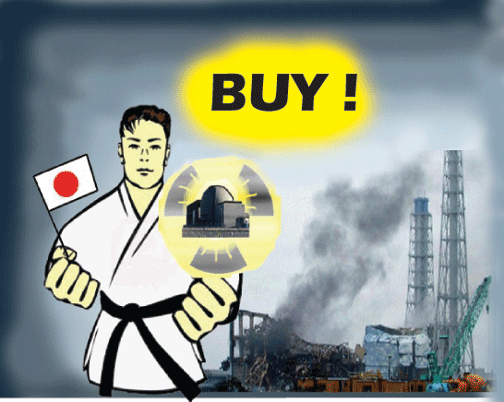
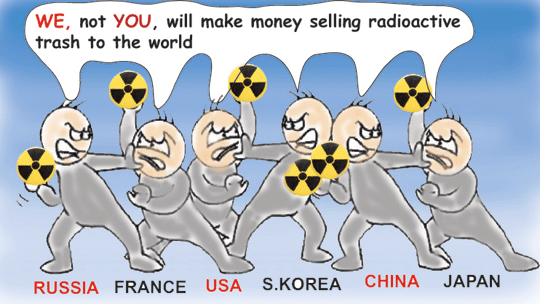
France is not alone on the nuclear salesmanship world stage, however. It joins Japan, the United States and South Korea, whose nuclear projects are fading at home but who are happy to market their wares to countries such as Saudi Arabia, China and India — countries where resistance is likely to be either minimal or suppressed.
Anti-nuclear protesters in India, for example, have been met with violence, sometimes fatally, and have been barred from public meetings at gunpoint.
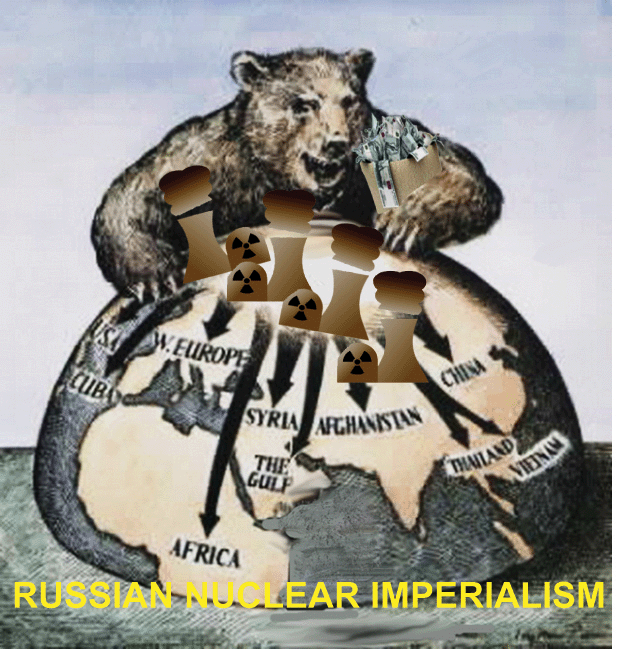
Sudan, Russia to sign accord to develop nuclear power: SUNA agency https://af.reuters.com/article/topNews/idAFKCN1GP0ME-OZATP Reuters Staff, 13 Mar 18KHARTOUM (Reuters) – Sudan will sign a“roadmap” with Russia to build nuclear power stations during a visit to Moscow by Khartoum’s electricity minister, state news agency SUNA said on Monday.
SUNA said Water Resources, Irrigation, and Electricity Minister Moataz Mousa, who left Khartoum on Monday, would meet the head of Russia’s state nuclear agency Rosatom. The trip comes four months after Sudanese President Omar Hassan al-Bashir told his Russian counterpart Vladimir Putin he wanted to discuss nuclear power cooperation with Russia. SUNA quoted a spokesman for the ministry as saying the two sides would sign several memorandums of understanding including the roadmap“to implement a plan to develop nuclear (power) stations”. It did not elaborate. Reporting by Omar Fahmy, editing by David Evans
Areva-Siemens will pay TVO compensation of 450 million euros ($553.73 million), the Finnish company said in a statement.
TVO and Areva-Siemens were claiming billions of euros from each other due to the delays in the Olkiluoto 3 reactor project in southwest Finland. Its start was postponed last year to May 2019 – a decade later than planned.





 nuclear-news