The Office of Value for Money did NOT assess Sizewell C nuclear project
Correspondence published today from the independent Chair of the Office of
Value for Money, David Goldstone, to the National Audit Office’s
Comptroller General, Gareth Davies, confirms that the Office of Value for
Money did NOT assess Sizewell C (page 4 of link). We have sent out a
response expressing our disappointment and frustration, and would like to
thank everyone who signed our petition, as well as Dale Vince who also
wrote to David Goldstone.
Office for Value for Money 10th June 2025, https://assets.publishing.service.gov.uk/media/684bfd5ebd35d2f88bcba2b8/DG_to_GD_-_OVfM_progress_to_SR2025_-_100625.pdf
EU Commission says member states will need to invest €241 billion until 2050 in nuclear energy

dtt-net Ekrem Krasniqi, 14/06/2025
Brussels, 14 June 2025, dtt-net.com – The executive body of the European Union, said Friday member states will need to invest the amount for both lifetime extensions for lifetime extensions of existing reactors and the construction of new large-scale reactors, as well as for Small Modular Reactors (SMRs), Advanced Modular Reactors (AMRs) and microreactors and in fusion for the longer-term future, in view of decarbonisation and competitiveness goals of the European bloc.
“Nuclear installed capacity across the EU is projected to grow from 98 GWe in 2025 to 109 around GWe by 2050.
According to the EC estimates, over 90% of electricity in the European bloc in 2040 will be produced mainly by renewables and nuclear energy………….https://dtt-net.com/eu-commission-says-member-states-will-need-to-invest-e241-billion-until-2050-in-nuclear-energy/
Bankrupting the UK with Uranium Fuelled Nukiller
The following is an extract from Richard Murphy’s blog on the insanity of the nuclear boondoggle
Marianne Birkby, Radiation Free Lakeland, 13th June 2025, https://radiationfreelakeland.substack.com/p/bankrupting-the-uk-with-uranium-fuelled
A look at the National Grid Live right now shows that nuclear is providing 3.09 GW of electricity while wind is providing 15.94 GW and solar 4.12 GW and yet our chancellor chooses to put taxpayers money not into the free fuel of solar and wind but into the planetary destroying, uranium fuelled, nukiller.
“And let’s be clear that some of this capital expenditure also makes no sense at all. For example, one of the biggest items of expenditure will be on nuclear power stations, where supposedly at least £30 billion is to be spent, although everybody in reality knows that this will turn into a sum of well in excess of £100 billion, given the cost overruns that always occur in nuclear power budgets.
Starmer has claimed that the government has now decided that Sizewell C will be built. But as everyone in Suffolk knows, that decision was made long ago because the whole of East Suffolk has already been scarred with building works to facilitate the Sizewell C programme.
So what Stamer is saying is complete nonsense. What this so-called spending review admits is that there is no prospect of finding any foreign funding for Sizewell C, which was this government’s quite absurd hope. It has therefore, to fund this white elephant itself.
This power station and the others to which the government has committed will cost at least £1,500 per household in the UK, and that might at best result in power for 6 million households.
However, the actual cost of this energy is the highest that we can produce, and that is before taking into account decommissioning costs. Those at Sellafield now amount to £136 billion, and no one thinks that this is the total sum involved. And now Reeves actually wants more investment at Sellafield, which is only going to make things worse, but is part of her plan to apparently make us a nuclear superpower. So, if you want to know what leaving a debt for future generations to pay really looks like, building Sizewell C and other power stations is all that you need to do to ensure that this outcome will become a reality.
In contrast to all this emphasis upon nuclear power, there was none at all on renewable energy in this statement. There was a mention of £2.5 billion for carbon capture and storage, but that is another white elephant.
There was no commitment to renewable energy, to battery technology, or even things as basic as insulating houses and fitting proper triple glazing, although a nod perhaps to the last was included without any mention of the sums involved being made.
What is clear is that Starmer and Reeves would rather lumber generations to come with the cost of nuclear power rather than invest in renewable energy now, when that is the lowest cost of energy that we have available to us.”
Full article can be read here
Sizewell C nuclear power plant can’t be allowed to fail.
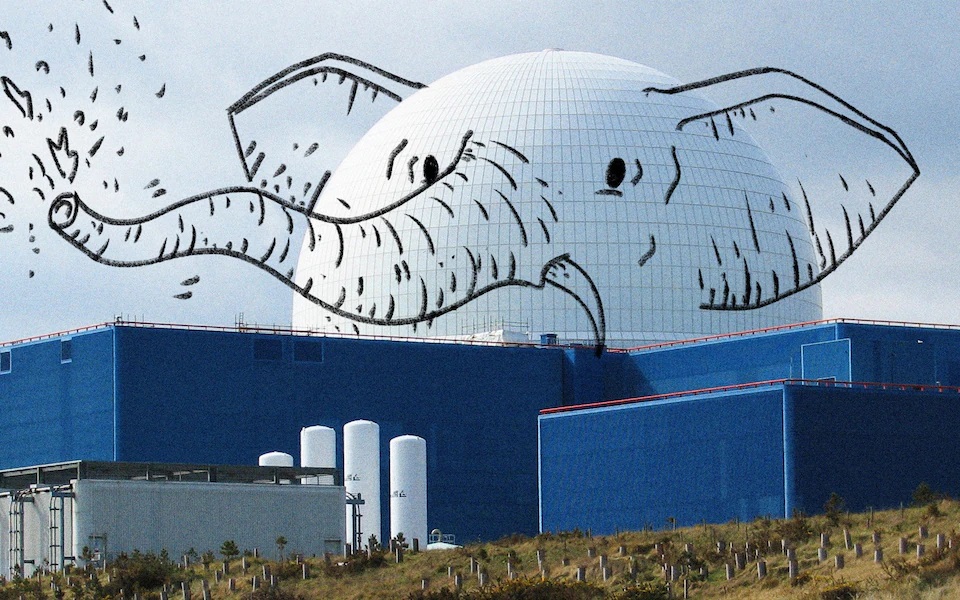
A £14 billion investment, Sizewell C’s funding will come from a levy on energy bills.
Will this plan succeed where others have run into problems? Insanity, they
say, is doing the same thing again and again and expecting a different
outcome.
Every time a western country has built a European pressurised
reactor — a nuclear power station designed by the French — it has gone
pear-shaped. The one at Olkiluoto in Finland was 14 years late. The station
at Flamanville in France was a bit better, just 12 years behind schedule
and costing about four times the original budget. Here in the UK, Hinkley
Point C was variously promised for 2017, then this year, and now,
fingers-crossed, 2031.
Why then, you might wonder, has the government
thrown its financial muscle behind another EPR, this time at Sizewell on
the Suffolk coast? The £14 billion investment in Sizewell C (it’s the
third atomic power station to be built at this site) was one of the main
items in this week’s spending review.
I put this rather obvious question
to Simon Bowen, chairman of Great British Energy — Nuclear, the
snappily-named agency that used to be, err, Great British Nuclear, on Times
Radio on Tuesday. Bowen said the answer was that having built one, at
Hinkley Point, the next one would be cheaper and there was already good
evidence that practice was making perfect there. That might be true, but it
is also worth remembering the die was cast all the way back in 2008, when
Électricité de France (EdF), the French utility company that is building
Hinkley Point, bought British Energy. British Energy owned and operated the
UK’s remaining nuclear plants, but had fallen on hard times. There was a
government bailout and then a sale, both masterminded in part by Sir Adrian
Montague, now trying to do the same job at Thames Water.
EdF bought it for£12.5 billion and with it the nuclear sites that were front-runners to be
chosen for a new generation of power plants. The Cameron government
cemented things in place by making a deal with EdF and CGN, the Chinese
nuclear power company, that would see the latter take a stake in Hinkley
Point and a proposed new plant at Sizewell.
That plan evaporated when later
administrations decided we shouldn’t cosy up to the Chinese after all. We
still needed nuclear power, though, and as quickly as possible or our
net-zero targets would be all the more difficult to hit. Ditching the EPR
and choosing a new design for the Sizewell site would have taken years, so
in the end, ministers concluded, better to go with the devil you knew.
The only remaining question was how to pay for it. EdF is picking up the tab
for Hinkley Point, with the financing anchored by a guarantee from the
government to buy all the electricity generated at an agreed price. This
arrangement was extremely controversial at the time and in any event EdF is
not keen to take on another multibillion-pound risk. The Chinese are also
out.
The answer is that the money will come from you and me, via the same
finance scheme used to build the £4.5 billion Tideway super sewer, the
giant pipe that runs under the Thames and sucks up the sewage that used to
go into the river when it rained.
Times 13th June 2025, https://www.thetimes.com/business-money/energy/article/sizewell-c-nuclear-power-plant-cant-be-allowed-to-fail-8l32szjnw
Spending billions on unclean, risky energy? What a nuclear waste!

Laurie Hill, MBA student, Cambridge Judge Business School 13 June 25
Rolls-Royce pressurised water reactors have powered British nuclear subs since 1966, but small modular reactors (SMRs) aren’t yet proven at scale anywhere on land (Rolls-Royce named winning bidder for UK small nuclear reactors, 10 June). Only three are operating worldwide: two in Russia, one in China. Argentina is constructing the world’s fourth; is Labour simply keen to keep up with historical geopolitical rivals (Sizewell C power station to be built as part of UK’s £14bn nuclear investment, 10 June)?
The Institute for Energy Economics and Financial Analysis (IEEFA) reported actual cost overruns of 300% to 700% for all four projects. Rolls-Royce claims costs of £35 to £50 per MWh; so should we triple this? The government says the SMR project would create 3,000 new low-carbon British jobs, but at what cost? The energy secretary, Ed Miliband, can’t know the true costs yet, and three reactors doesn’t scream “economies of scale”.
Yet £2.5bn is already 10 times more than Great British Energy has invested into simple, cheap rooftop solar, which democratises energy savings. The true cost of renewables must consider intermittency and balancing costs, but why not invest more in flexibility through distributed renewables and grid-scale storage? And what of energy security? SMRs may mitigate against Putin snipping offshore wind cables, but increased reliance on imported uranium, and a heightened nuclear waste security threat, are significant risks.
Last May, the IEEFA concluded that SMRs “are still too expensive, too slow and too risky”, and that we “should embrace the reality that renewables, not SMRs, are the near-term solution to the energy transition”. Has this truly changed? The climate crisis requires scaling all feasible solutions as fast as possible, but, with limited capital, we should prioritise those that make economic sense today. https://www.theguardian.com/environment/2025/jun/13/spending-billions-on-unclean-risky-energy-what-a-nuclear-waste
Ed Miliband presses the nuclear button for Berkeley
Rolls-Royce SMR has been given the full go-ahead to build up to SIX mini
nuclear reactors on the edge of Gloucestershire. The small modular designs,
which embrace a miniaturisation approach to nuclear technology that is yet
to be fully developed, are planned to be at Oldbury-on-Severn, near
Thornbury, while key support on training and safety services, as broadly
predicted, will be installed in Berkeley, at the town’s former Severnside
Magnox site.
Ian Mean, former director for Business West in Gloucestershire
and now on the board of the Gloucestershire County Council Economic Growth
Board, said Chancellor Rachel Reeves’ and Ed Miliband’s final confirmation
was “tremendous news for the Gloucestershire economy”. He said: “I believe
that these mini reactors – as many as six of them here in Gloucestershire
and South Gloucestershire – have the potential to provide thousands of
skilled jobs and the opportunity of millions of pounds flowing into our
regional economy. “Berkeley and Oldbury – the two former decommissioned
nuclear sites at Oldbury and Berkeley Green now hold the key to becoming a
major nuclear hub.”
But any resurrection of the technology in SMR format
has been condemned by Gloucestershire energy entrepreneur Dale Vince, who
owns Stroud-based Ecotricity. Speaking on the Zerocarbonista podcast before
today’s confirmation, Mr Vince said: “When you come to small nukes, the
government and the nuclear industry have consistently said that we will get
lower bills, but they don’t put a number on it. They are ecomonists without
numbers! “Big nuclear is the most expensive electricity we have ever made,
it’s off the charts compared to renewable energy and one of the fundamental
laws of physics is that the economies of scale come by making something
bigger, not by making something smaller – it always costs money to
miniaturise.
So here they are, saying we can miniaturise nuclear reactors
that famously went decades late and billions over budget… and they’ll be
cheap. I don’t believe that for a second and what we are of course doing is
proliferating the risk.” He added: “It’s always worth imagining what it
would be like if the Romans had nuclear power. If they did, Bath would be a
toxic no-go zone. It’s only 2,000 years ago and sounds like a long time,
but not in the context of toxic nuclear waste.”
Punchline Gloucester 10th June 2025,
https://www.punchline-gloucester.com/articles/aanews/miliband-presses-the-nuclear-button-for-berke
Great British Energy’s budget has been nuked

Nils Pratley 12 June 25,
https://www.theguardian.com/business/nils-pratley-on-finance/2025/jun/11/great-british-energys-budget-has-been-nuked
Ed Miliband’s vehicle for investing in renewables lost 30% of its pot to small modular nuclear reactors in the spending review
GB Energy’s promised £8.3bn budget raided to pay for small nuclear reactors
There was a weirdness in the government’s welcome announcement this week that Rolls-Royce SMR had been selected as preferred bidder to build the UK’s first small modular nuclear reactors, and that £2.5bn of public money would be thrown behind the project. The government body backing the project was something called Great British Energy – Nuclear.
This, it turned out, was the new name for Great British Nuclear, the unit set up in 2023 by the last government to oversee delivery of the nuclear programme. But why risk confusion with Great British Energy, Ed Miliband’s publicly owned company for investing, we thought, in renewables projects such as wind, solar and hydro with a side-mission to ensure that lots of the kit is manufactured in the UK?
The confusion, it seems, was deliberate. The chancellor’s spending review revealed that every penny of the £2.5bn for SMRs is coming from GB Energy’s £8.3bn budget. That is 30% of the pot to SMRs in one gulp.
One could argue, as Labour folk did, that nuclear and renewables are all part of the same low-carbon clean energy mix, so they go hand in hand and were always intended to do so. It’s true that past descriptions of GB Energy’s role have sometimes mentioned nuclear, but never as the headline act. It was never spelled out, for example, that the entirety of public support for SMRs would come from GB Energy’s budget, which would be a relevant fact to mention if you were worried that the Tories had set up Great British Nuclear but not given it funding. It rather looks as if GB Energy’s budget has been nuked by the Treasury.
“Labour will capitalise Great British Energy with £8.3bn over the next parliament,” said the manifesto and, strictly speaking, that pledge is still being honoured. It’s just that GB Energy will be directing almost a third of its allocation to the nuclear body that we had previously regarded as a separate unit.
But it does make GB Energy a strange beast if it is now the main government vehicle for investing in SMRs, a cutting-edge technology that tends to involve permanently big numbers and follow-on rounds of funding. GB Energy’s initial adventures, note, have been low-key and local – funding for installing solar panels on schools and hospitals, for example. Worthy stuff, but a million miles away from the development of next-generation nuclear technology.
GB Energy will be expanding into new and exciting areas later this year, say Labour insiders. We’ll see what that brings. The company’s core mission seems to be a work in progress.
Cost of Miliband’s nuclear plant doubles to more than £40bn
Price tag for Sizewell C project soars as ministers pursue funding deal with private investors
and the French government.
Matt Oliver Industry Editor. Szu Ping Chan Economics Editor. Jonathan Leake, Telegraph 11th June 2025,
https://www.telegraph.co.uk/business/2025/06/11/cost-of-milibands-nuclear-plant-doubles-to-more-than-40bn/
An official cost estimate for the scheme in
Suffolk, which would generate enough electricity for 6m homes, was
previously put at £20bn. But that has grown to £30bn at constant prices
– or £41bn in today’s money – with the Government set to shoulder at
least half of the upfront cost, according to industry and Whitehall
sources.
The entire scheme will ultimately be paid for by households and
businesses via their electricity bills, including through levies that will
begin during construction. The power plant’s rising price tag will
trigger concerns about future increases as Hinkley Point C, a nuclear
development in Somerset, has repeatedly overrun budgets and timescales.
European Power Costs Surge on Fresh Fears of French Nuclear Reactor Corrosion
Power prices across Europe jumped as nuclear giant Electricite de France
SA reported signs of “stress corrosion” at a reactor, renewing fears
that generation may be curtailed once again. The French utility in 2022 and
2023 was forced to halt part of its atomic fleet, the backbone of western
Europe’s electricity market, to fix cracked pipes.
That sent energy prices soaring as the repairs coincided with dwindling Russian gas supplies
to the continent. On Tuesday, the ASNR nuclear safety authority said
“hints” of corrosion had again been found on pipes at the Civaux 2
reactor in central France. That drove French year-ahead power up as much as
8.4% on Wednesday, the most in two years, according to the European Energy
Exchange. The contract for August, when demand for cooling peaks, climbed
13%. Prices also rose in Germany and the UK, which often rely on exports
from neighboring France to keep the lights on. Europe’s power markets
have largely emerged from the energy crisis of a few years ago, when
Russian gas supplies all but stopped. Yet prices remain sensitive to any
issues affecting the region’s largest nuclear fleet, exposing the fragile
nature of the recovery.
Bloomberg 11th June 2025, https://www.bloomberg.com/news/articles/2025-06-11/european-power-surges-on-fresh-fears-of-french-reactor-corrosion
Miliband’s Sizewell plan in meltdown over potential cost
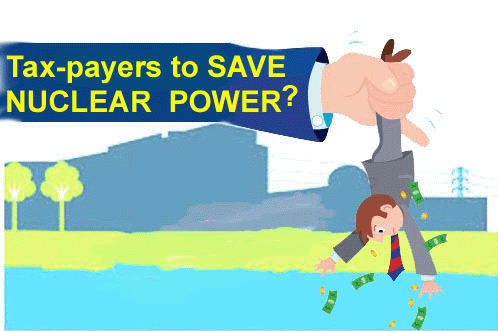
Huge nuclear power scheme promises much-needed energy but taxpayers have a right to know if the costs of delivering it will be radioactive.
Welcome to “a golden age of clean energy abundance”. And how do we deliver this dream of Ed Miliband’s? By raiding the taxpayer for enough cash to deliver around
half of Sizewell C, the new nuke planned for a Suffolk flood plain. The
government’s sudden discovery of an extra £14.2 billion for the
3.2-gigawatt project has some merits. After the Tories’ pretence that the
private sector alone would fund new nuclear, at last some overdue
realpolitik: that if the UK wants new plants, taxpayers will have to stump
up for them. ………………..
the government’s Sizewell announcement is still full of
holes: a point driven home by Rachel Reeves’s claim that “we are
creating thousands of jobs, kick-starting economic growth and putting more
money [sic] people’s pockets”. How can the chancellor promise that? The
government doesn’t even say how much the project is expected to cost, let
alone how much consumers will be paying for Sizewell’s electricity.
Indeed, ministers have come up with nothing so far on what makes this
project value for money — despite the taxpayer sticking in £17.8
billion, including the £3.6 billion already committed. More may well be
required, too, given Sizewell is the same European Pressurised Reactor
design as Hinkley Point C, the Somerset nuke being built by France’s EDF
that’s now running six years late and whose costs have mushroomed from
£18 billion in 2015 prices to £46 billion in today’s.
Ministers claim Sizewell will be cheaper, given all the lessons learnt from Hinkley. Yet,
its geography is trickier: sited on marshland, on a coastline that’s
eroding, requiring sea defences. Total costs are still likely to top £40
billion, with the “mid 2030s” start date probably wishful thinking. The
government says it will “set out the full cost of the project” at the
time of the final investment decision “later this year”.
But, from that, two things are clear. First, that it’s in no position to make that
decision yet. Second, that it’s yet to sign up any equity partners for
Sizewell — not even EDF, which theoretically has a 15 per cent stake.
Times 10th June 2025, https://www.thetimes.com/business-money/economics/article/milibands-sizewell-plan-in-meltdown-over-potential-cost-p2cnvkfjq
UK pledges £11.5bn of new state funding for Sizewell C nuclear plant.

Latest money raises total taxpayer investment in power station site to
£17.8bn. The move marks a return to significant state funding for nuclear
energy after the UK chose the private sector to finance and build its last
project, Hinkley Point C in Somerset, which is heavily delayed and over
budget.
The previous record public investment in nuclear energy was £2bn
for the Sizewell B plant in 1987, or £7bn in today’s prices. The UK
government already has a partnership with French state-owned energy group
EDF, which has kept a 15 per cent stake in Sizewell C.
The pair are now seeking financial commitments from several other investors before they can sign off a “final investment decision”, expected next month during an
Anglo-French summit in London.
The chancellor will promise £14.2bn of
taxpayer funding for the 3.2 gigawatt plant over the current parliament,
including a £2.7bn commitment she previously made in the autumn Budget. The
Treasury had already committed £3.6bn over the past two years.
EDF has said the final investment decision will depend on securing private investment
and on whether it can make its expected return on capital, but Simone
Rossi, the company’s UK chief executive, said the project would benefit the
UK’s “energy security and economic growth”. Private investors expected
to bid for stakes in Sizewell C include Canadian pension fund CDPQ, Amber
Infrastructure Partners, Brookfield Asset Management, pension fund USS,
Schroders Greencoat, Equitix, Centrica and insurer Rothesay.
The total cost of the project could be close to £40bn by the time it is built, industry
figures believe. State-owned Great British Nuclear will soon announce the
outcome of its competition to choose a company to start building a fleet of
“small modular reactors”. The government said it would also invest more
than £2.5bn in nuclear fusion over five years in what it called a “record
investment” in the nascent technology. Melanie Windridge, head of
advisory group Fusion Energy Insights, praised the government for
recognising the “economic value of developing fusion in this country”.
The sum is slightly less than the US is spending on fusion and one-third of
China’s annual investment on the technology.
FT 9th June 2025,
https://www.ft.com/content/e017efeb-0a9c-4d30-894f-86037a096984
Trump’s embrace of dystopian Palantir spying tool sends stock soaring

Palantir is already playing a decisive role in the besieged Gaza Strip, where its products assists Israel’s application of a ferocious AI targeting system known as Lavender which directs its ongoing genocide.
Kit Klarenberg·June 4, 2025, The Grayzone,
The Trump administration has charged the surveillance firm Palantir with agglomerating the US population’s personal data across government agencies, raising alarm about a centralized spying tool targeting hundreds of millions without oversight. Wall Street responded to the news by sending Palantir’s stock price to unprecedented heights.
During an end-of-year investor call this February, Palantir co-founder and militant Zionist Alex Karp bragged that his company was making a financial killing by enabling mass murder.
“Palantir is here to disrupt and make the institutions we partner with the very best in the world and, when it’s necessary, to scare enemies,” he stated, adding: “And on occasion, kill them.”
On this front, Karp claimed Palantir was “crushing it,” and he professed to be “super-proud of the role we play, especially in places we can’t talk about.”
Karp went on to predict social “disruption” ahead that would be “very good for Palantir.”
“There’s a revolution. Some people are going to get their heads cut off,” he warned, suggesting that his firm was producing the most vital technology enabling elites to restore control during the coming unrest.
Palantir is already playing a decisive role in the besieged Gaza Strip, where its products assists Israel’s application of a ferocious AI targeting system known as Lavender which directs its ongoing genocide. In the face of public protest, Karp has acknowledged that he is directly involved in killing Palestinians in Gaza, but insisted the dead were “mostly terrorists.”
At the start of January, the overtly pro-Israeli firm’s board of directors gathered in Tel Aviv for its first meeting of the new year. Since then, its financial fortunes have improved dramatically.
Throughout May, Palantir’s stock exploded, making it the S&P 500’s top-performing company. On June 2, Palantir’s share price hit an all-time high, a year-on-year jump of 512%, turbocharging the company’s market value to roughly $311 billion. Driving this abrupt burst of investor exuberance was a series of lucrative deals signed with multiple US government agencies since Donald Trump took office, and the expectation Palantir will ink massive contracts going forward.
Palantir’s products expand mass surveillance at home, Pentagon targeting across the globe
On May 30th, the New York Times published a lengthy probe linking these deals to an executive order signed by Trump in March, calling for seamless, mass sharing of data across government agencies through a Palantir application called Foundry.
The report did not explain to readers how Palantir emerged as a small startup thanks to sponsorship from the CIA’s venture capital wing, In-Q-Tel, which gifted Peter Thiel’s company $2 million in 2004. Instead, the paper leaned in to a partisan angle playing on Democratic fears that Trump could abuse a unified database to target political foes.
Nonetheless, the Times provided valuable insight into Palantir’s penetration of a vast array of US government agencies, by raking in more than $113 million in federal government spending since Trump took office, on top of “additional funds from existing contracts as well as new contracts with the Department of Homeland Security and the Pentagon.” In late May, the company’s existing contract with the Department of Defense was beefed up by $795 million, bringing it to an eye-popping total award of $1.3 billion.
Palantir currently provides the Pentagon with AI targeting software known as Maven, which it uses in battlefields from Syria to Yemen to Ukraine and beyond. The contract will last until at least May 2029. The Trump administration’s fondness for Palantir has placed its data analytics and storage tool Foundry in at least four federal agencies, including the DHS and Health and Human Services Department. Talks are also apparently ongoing with the Social Security Administration and Internal Revenue Service to adopt the resource. This would facilitate merging all these agencies’ datasets.
According to the Times, Palantir was selected to deliver on Trump’s order to enhance intradepartmental data sharing by Elon Musk’s Department of Government Efficiency. At least three DOGE members previously worked at the company, while two others have worked at Thiel-funded firms. The outlet cited leaked screenshots indicating DHS officials exchanged emails with DOGE in February about merging citizen records, while quoting nameless Palantir employees worrying “about collecting so much sensitive information in one place,” particularly given the allegedly “sloppy” approach to security of “some DOGE employees”. …………………………………………………………………………………………
Palantir penetrates the West as privatized national security state backbone
For years, Palantir has been at the heart of US-led efforts to neutralize Iran’s alleged nuclear program. It has created a predictive analytical tool dubbed Mosaic for the purpose, used by the International Atomic Energy Agency and US officials to visualize ties between the people, places and material involved in the Islamic Republic’s nuclear activities. Data harvested and pored over by the resource includes potentially tainted material supposedly stolen from Tehran by Mossad.
Such work mimics the services Palantir has provided for US government agencies such as the CIA, DHS, FBI, and Pentagon. These entities routinely turn over untold quantities of data to the firm to exploit for a variety of applications. For example, Palantir’s Gotham tool has been weaponized by the US military to supposedly predict insurgent attacks. In Afghanistan, it combined maps, intelligence briefings, and incident reports for mission planning, leading Bloomberg to dub Palantir the “secret weapon” of the so-called war on terror.
Meanwhile, documents leaked by NSA whistleblower Edward Snowden indicate the US signals intelligence giant and its British counterpart GCHQ have relied heavily on Palantir’s products. A leaked 2011 presentation connected the company’s wares to multiple secret Five Eyes spying operations, and provided glowing personal testimonials from the agencies’ analysts. One crowed: “[Palantir] is the best tool I have ever worked with. It’s intuitive, i.e. idiot-proof, and can do a lot you never even dreamt of doing.”…………………………………………………………………………….
……………………………………………………………… Having penetrated the national security state of countries across the West, the firm and its messianic CEO are working to consolidate a trans-Atlantic network of control with unprecedented powers, lucrative profits, and a growing body count. https://thegrayzone.com/2025/06/04/trumps-palantir-spying-stock/
Nuclear Power will ruin France

Nuclear power will ruin France , by Laure Nouahlat, published by Seuil , May 16, 2025, 224 p., 13.50 euros.
Neither the French population, nor any parliamentarian or senator had their say, as if nuclear power were democratically held above ground.
Reporterre 16th May 2025,
https://reporterre.net/Le-nucleaire-va-ruiner-la-France
Despite the staggering cost of all-nuclear power, France is stuck in this impasse. Here are the excerpts from the investigative book ”
Nuclear Power Will Ruin France
.” Laure Noualhat dissects the mechanisms of this waste.
Is nuclear revival reasonable ? According to Emmanuel Macron and many others, the nuclear ” holy grail “ would be the only solution to slow climate change and preserve our comfort. While the government is making savings at every turn, the sector seems to benefit from an unlimited budget.
It was announced Monday that the Cigéo nuclear waste disposal facility in Bure will cost up to €37.5 billion. To revive the industry, the bill will climb to at least €80 billion. As delays mount, these amounts are continually revised upwards. All this while EDF is already heavily in debt.
Where will the tens of billions of euros for these new EPRs be found ? And the necessary investments in the existing fleet ? It will be the State, that is, the taxpayer, who will pay.
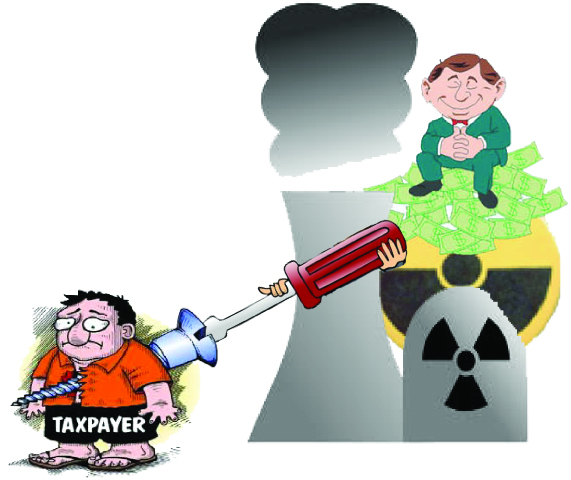
This is what journalist Laure Noualhat demonstrates in her relentless investigative book, Nuclear Power Will Ruin France . The result of six months of investigation, it is published today in the Seuil- Reporterre collection and will be accompanied by a documentary broadcast on YouTube in early June. Through this extensive work, Reporterre is tackling a crucial issue for the future of the country, largely absent from public debate. Because these choices are made in total secrecy, Reporterre is shedding light on a subject that concerns us all.
Here are the previews of “ Nuclear Power Will Ruin France ”:
What were you doing on February 10, 2022 ? For the small world of energy, it was a memorable day. On that day, presidential candidate Emmanuel Macron stood behind a lectern under the immense tin roof of the General Electric plant in Belfort. His voice echoed like a cathedral. Behind him, GE teams had positioned a gigantic Arabelle turbine, 300 tons of gleaming steel lit as if it were an industrial museum piece.
A group of masked employees, all wearing the same electric blue construction jackets, listens learnedly to the president. Four years earlier, these women and men were part of Alstom’s energy division, the industrial flagship that former Economy Minister Emmanuel Macron had conscientiously dismantled during his time at the Ministry of Finance.
No matter, on this Thursday, February 10, the now President has just announced the ” rebirth “ of French nuclear power, boasted of national ” sovereignty “ and praised the merits of ” planning “ to address the challenges of the moment: reducing our CO2 emissions by 55 % by 2050, ensuring France’s industrial development, and controlling the French people’s energy bill.
No law regulates presidential will
Regardless of the background—environmental, energy, nuclear, activist, industrial, or political—this speech hit the mark and is historic. With its delivery, President-candidate Macron has just rescued France from decades of uncertainty by relaunching the mass construction of nuclear reactors. Since its approval in 2003 by the National Assembly, the Flamanville EPR project has been mired in endless setbacks. In 2012, President Hollande chose a contrary path by enshrining in law the reduction of nuclear power’s share to 50 % of the electricity mix by 2025 (compared to 65-70 %) and to 30 % by 2030. In short, the socialist planned a slow phase-out of nuclear power, allowing for the preparation of the decommissioning of the oldest reactors, the ramp-up of renewables, and an unprecedented effort toward energy efficiency.
In February 2017, candidate Macron – a former minister under Hollande – took up this promise.
”
I will maintain the framework of the energy transition law. I am therefore maintaining the 50
% target,
“ he confided to the
WWF during a Facebook Live broadcast watched by 170,000 people and interviewed by… Pascal Canfin, who will join the President’s list for the 2019 European elections.
Five years later, facing General Electric employees, the Jupiterian president performed an about-face. Six
EPR2s will emerge, he promises, built in pairs on three sites: in Penly in Normandy, in Gravelines in the North, and in Bugey in the Ain. And eight more will be under consideration. Neither the French population, nor any parliamentarian or senator had their say, as if nuclear power were democratically held above ground. Since this announcement, the program of the six EPR2s
has still not been validated by any legal decision, much less by an ”
energy and climate programming law
” (
PPE ), which should have been revised for the occasion.
To date, in 2025, no law governs the presidential will shaped by long years of lobbying (by associations such as Xavier Moreno’s Cérémé or Bernard Accoyer’s Nuclear Heritage & Climate, but also Voies du nucléaire or the French Nuclear Energy Society) since his arrival in power.
A colossal cost
Knocking down walls or hiding the misery, insulating here or repainting there, moving the pipes, changing the door… it’s difficult to ask a tradesman for a quote for work if you don’t know what you’re going to do. It’s the same with nuclear reactors.
As these lines are being written, in March 2025, three years after the Belfort speech, no one knows how much the EPR2 will cost . This is normal: their detailed design has not been completed despite the 10.5 million hours of engineering already devoted to the project.
In February 2022, the government had put forward a construction cost of 51.7 billion (2020 euros). In 2023,
EDF made two updates to the costing, noted by the Court of Auditors in its report on the
EPR sector in January 2025:
”
The overnight construction cost [as if the reactor were completed in a single night] of three pairs of
EPR2s rose from 51.7 to 67.4 billion euros [2020 euros], an increase of 30
% under unchanged economic conditions and excluding the effect of inflation.
“ In 2023 euros, the bill reaches 80 billion. For comparison, this figure of 80 billion already represents four times the annual deficit of the Social Security…
Let’s not pretend nuclear works

Funding the Future, Richard Murphy, June 6 2025, https://www.taxresearch.org.uk/Blog/2025/06/06/lets-not-pretend-nuclear-works/
As the Public Accounts Committee has reported this week:
The retrieval of waste from ageing buildings at the most hazardous nuclear site in the UK is not happening quickly enough.
In its report on decommissioning Sellafield, the Public Accounts Committee (PAC) warns that the estimated £136bn cost of the project would rise even more if work is further delayed, while expressing scepticism as to whether or not recent signs of improvement in performance could represent another false dawn.
The PAC found in 2018 that government needed a firmer grip on Sellafield’s nuclear challenges, and now warns that not enough progress has been made in addressing its most significant hazards.
One building, the Magnox Swarf Storage Silo (MSSS), has been leaking radioactive water into the ground since 2018 – the PAC calculates, at current rates, enough to fill an Olympic swimming pool roughly every three years. The Nuclear Decommissioning Authority (NDA) accepts this leak is its “single biggest environmental issue”, but that the radioactive particles are “contained” in the soil and do not pose a risk to the public.
The PAC’s report finds that Sellafield Ltd has missed most of its annual targets for retrieving waste from several buildings on the site, including the MSSS. The PAC’s inquiry heard that the MSSS is the most hazardous building in the UK, and as a result of Sellafield Ltd’s underperformance will likely remain extremely hazardous for longer. The report seeks answers from Government on how it will hold the NDA and Sellafield Ltd to account in ameliorating the site’s greatest hazards.
Nuclear power created the most hazardous building in the UK.
The cost of nuclear cleanups is staggering.
And still, we pretend that nuclear power is a cost-effective way of generating power.
Who do those making this claim think are fooled by it?
The true cost of the nuclear weapons industry
The CND responds to Starmer’s growing militarism with a ‘Tour of the bases’ protest. TONY STAUNTON reports from Plymouth
Morning Star 6th June 2025 https://www.morningstaronline.co.uk/article/true-cost-nuclear-weapons-industry
NE of the most outrageous elements of Starmer’s offensive Strategic Defence Review is the suggestion of a “Defence Dividend.” Our demand for “Welfare not Warfare” is acutely illustrated by the reality of life for working-class communities surrounding military nuclear sites.
Plymouth Devonport, with the Trident nuclear submarine base situated at its heart, is one of the poorest electoral wards in southern England.
The Devonport nuclear naval base is managed by Babcock International plc, the arms manufacturer with an annual turnover of £4.5 billion, profits mostly contrived out of taxpayers’ hefty payments.
That the nuclear weapons are in the hands of private corporations for profit surely undermines the concept of national security — Babcock is the main benefactor of the local freeport, deregulating its secret nuclear enterprise.
Plymouth’s Establishment constantly reminds the population that the nuclear facility is responsible for 10 per cent of the city’s economy. This alone is a fabrication. The highly paid nuclear engineers and scientists at the base live outside the infrastructure-poor city and take their incomes with them.
It’s been like this for 40 years. There has been no “Plymouth dividend.” One in three children in Devonport and neighbouring wards live in poverty, surely impossible were the dockyard to really be a “jobs magnet.”
In fact, a total of 5,500 people work there, half as naval service personnel with little local connection. The wages of many of the rest are nothing to shout about.
Meanwhile Devonport’s local index of social deprivation according to the Public Health Service is 44, twice the annual average. Nuclear weaponry does not produce social wealth and prosperity.
Investment in arms industries take the money away from social infrastructure. Plymouth has the huge regional hospital, Derriford, now in a financial meltdown, making cuts to the 11,000 staff and standards of service.
The hospital is reliant upon the addition of medical staff from the Royal Navy, offering a false-propaganda device for Babcock as the city’s benefactor.
Plymouth University is in financial crisis, with over 5,000 staff easily competing with the dockyard as an income generator for the city (students live in the city centre), now making 200 redundancies.
Babcock funds nuclear research and training at the Uni and FE College, making them beholden, uncritical, and pro-nuclear across the curriculum.
Plymouth’s Labour Council, combating potential bankruptcy and absurd debt levels, has always supported the nuclear dockyard, championing the military nuclear cause, the status of nuclear weaponry, and the nationalism it projects.
The council has half the workforce of 20 years ago. Our schools are crumbling, all “academised’ with the continuous shedding of staff.
Meanwhile, there have been at least 10 serious accidents at the dockyard including spills of radioactive waste in the past 30 years, Babcock was fined over £600,000 in 2022 for breaches in health and safety regulations (H&S). Human-made toxic radioactive elements are identifiable in our sea, rivers, soil and air.
Plymouth is the decommissioning centre for nuclear vessels, 15 rotting nuclear submarines bobbing at anchor and costing £30 million a year to “keep safe,” their nuclear cores needing constant cooling and the rusting hulks routinely patched to prevent leaks.
The subs are the subject of stalled decommissioning, the authorities not sure what to do with these hulks of radioactive waste. Were the UK’s nuclear weapons to be cancelled tomorrow, there is at least 100 years of work here, just to decommission and clean up the contamination.
Yet now they’re going to build more. Plymouth Devonport nuclear dockyard is receiving £1 billion to refit the dry docks in order to service the Dreadnought super-submarines carrying nuclear warheads up to 300 times the power of the bomb dropped on Hiroshima in 1945. The contract will suck-up 600 construction workers much needed for house building and home-retrofitting, the city is littered with half-finished buildings lost to skill shortages.
We all can list what £1 billion could do for the city if invested in social infrastructure and climate jobs.
Plymouth, our coastline dramatic and beautiful, could long have been a centre for construction of wind and wave electricity generators, our geography predisposed, but those industries are not nearly as profitable as the tax-funded nuclear blank-cheque cash cow.
Nuclear weapons are not just illegal weapons of mass destruction, they represent the impoverishment of working-class lives.
Join us on Saturday to send a powerful message to the government to shift its disastrous direction and invest in Peace not Nukes! March and rally. Meet at 12 noon at the Guildhall Square, Armada Way, Plymouth and from 2pm at Devonport MoD Naval Base, Camels Head.
Tony Staunton is CND vice-chair and Plymouth resident.
1 This Month
To see nuclear-related stories in greater depth and intensity – go to https://nuclearinformation.wordpress.com/
12 February – Webinar The Big Push: New Nuclear Projects in Canada
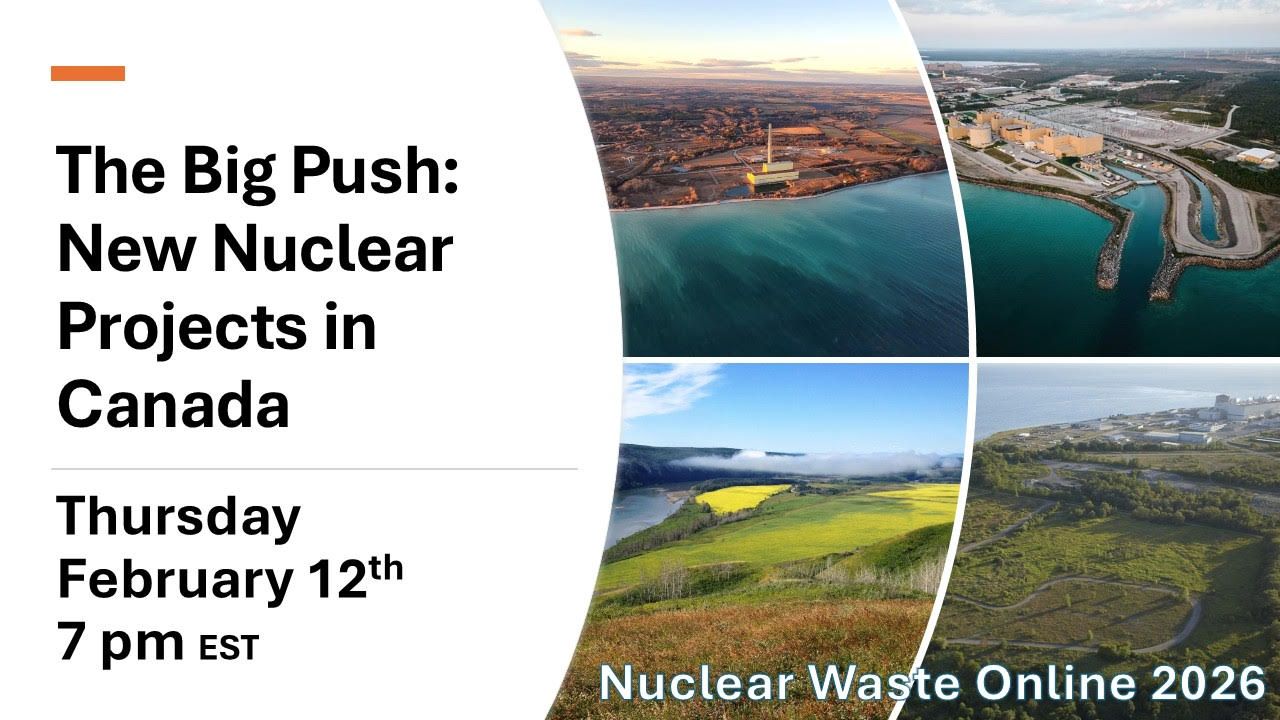
Thursday, February 12, 7 pm Eastern | 2nd of 4 sessions in the 2026 Nuclear Waste Online webinar series
Join a webinar on the push for new nuclear generation in Canada. Go to Northwatch.org to register or use the registration link https://us02web.zoom.us/webinar/register/WN_ZfWOf1GITqSRIZX8CB-A9w

-
Archives
- February 2026 (127)
- January 2026 (308)
- December 2025 (358)
- November 2025 (359)
- October 2025 (376)
- September 2025 (258)
- August 2025 (319)
- July 2025 (230)
- June 2025 (348)
- May 2025 (261)
- April 2025 (305)
- March 2025 (319)
-
Categories
- 1
- 1 NUCLEAR ISSUES
- business and costs
- climate change
- culture and arts
- ENERGY
- environment
- health
- history
- indigenous issues
- Legal
- marketing of nuclear
- media
- opposition to nuclear
- PERSONAL STORIES
- politics
- politics international
- Religion and ethics
- safety
- secrets,lies and civil liberties
- spinbuster
- technology
- Uranium
- wastes
- weapons and war
- Women
- 2 WORLD
- ACTION
- AFRICA
- Atrocities
- AUSTRALIA
- Christina's notes
- Christina's themes
- culture and arts
- Events
- Fuk 2022
- Fuk 2023
- Fukushima 2017
- Fukushima 2018
- fukushima 2019
- Fukushima 2020
- Fukushima 2021
- general
- global warming
- Humour (God we need it)
- Nuclear
- RARE EARTHS
- Reference
- resources – print
- Resources -audiovicual
- Weekly Newsletter
- World
- World Nuclear
- YouTube
-
RSS
Entries RSS
Comments RSS
 nuclear-news