France’s failing EDF nuclear company hopes to save itself by marketing small nuclear reactors
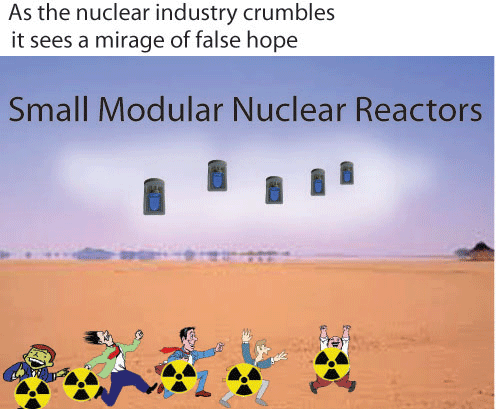
France will act as the shop window for exports of the new SMR technology — billed to be less powerful but easier to produce and run than conventional reactors — with EDF expected to begin building its first “Nuward” reactor in nine years
France’s nuclear drive offers chance of redemption for EDF
New commitments boost state-controlled utility but path ahead remains uncertain , Anna Gross and Sarah White in Paris Ft.com, 31 Oct 21, As the French government signals a future where nuclear power will play an integral rolein achieving carbon neutrality for the country by 2050 [ed. that is a spurious claim] , its state-controlled energy giant EDF remains encumbered by its past. Positioned at the heart of the nuclear debate in France and Europe, EDF struggles under a debt-laden balance sheet and a reputation for being unable to make novel nuclear technologies on time and on budget. But now President Emmanuel Macron has extended an olive branch and seemingly cleared a path for it to expand internationally and attract much-needed investment.
………..Created in 1946 by General Charles de Gaulle, EDF holds emotional power in France, Europe’s last bastion of nuclear power, and is linked with the nation’s industrial past and future. For years it was unclear if Macron, under pressure to move away from nuclear power towards renewables, would give the green light to new reactors long called for by EDF. Shortly after coming to power, Macron committed to reducing nuclear’s share of France’s electricity production from 75 to 50 per cent by 2035.
However, ambitious European climate goals, which hinge on pivoting to forms of energy that emit less carbon than fossil fuels, have put the spotlight on nuclear again and handed France an opportunity to assert its dominance in the field.
For EDF, thawing state tensions and confirmation of France’s desire for a nuclear future bring increased visibility to ensure it can keep training and hiring the people it will need and attract investment. That will be no small task for a company saddled with €41bn of debt and a colossal maintenance and investment programme to fund. UBS estimates a total investment requirement of more than €100bn for it to secure a 20-year life extension for 80 per cent of its nuclear fleet.
If approved, any government subsidies to fund six new reactors — estimated in leaked documents in 2019 to cost around €47bn — and the final price of the nuclear power produced by them, will ultimately be given the green light by Brussels. The cost of this funding could also be influenced by whether or not the EU includes nuclear energy in its taxonomy on “green finance”, making it a more attractive investment prospect. That decision has been delayed indefinitely because of infighting in the EU.
“Whether we can get financing at a low rate or super high rates completely changes the final cost. That’s the real subject, behind the gross number,” said Ursat. EDF faces other hurdles too, including the failure to reach a compromise with Brussels over the restructuring of the utility that would have allowed it to raise the regulated price at which it sells nuclear energy and ringfence some of its activities. It also needs to show it can deliver on its next-generation European Pressurised Reactor (EPR) technology, which it is planning to sell to India, Poland and the Czech Republic.
EPR reactors under construction in Europe — including Flamanville in France and Hinkley Point in the UK — are billions over budget and years behind schedule. The company’s previous chief financial officer quit over concerns about strains Hinkley Point was putting on EDF’s balance sheet.
These setbacks have led some investors and analysts to question EDF’s strategy and growth in the risky and costly field of nuclear power, were it not more than 80 per cent owned by the French government.
“The new reactor at Flamanville is not up and running yet, and some will want to see that project completed before France commits to more reactors with the same design,” said Sam Arie, an analyst at UBS. “From an investor point of view, is there interest in new nuclear projects? Not really.” However, recent soaring energy prices coupled with stringent climate goals seemed to have turned the tide in EDF’s favour. ……….
France will act as the shop window for exports of the new SMR technology — billed to be less powerful but easier to produce and run than conventional reactors — with EDF expected to begin building its first “Nuward” reactor in nine years. …….. https://www.ft.com/content/a1c95212-c122-4a29-8952-14a346381b91
$6000 a day to one US advisor to Australia on getting nuclear submarines. How much to the 3 new ones?

American-dominated panel advising government on submarines as Defence eyes US and UK choices for nuclear fleet, By defence correspondent Andrew Greene, ABC, 25Oct 21.
Three senior American shipbuilding executives are being paid to advise Australia on submarines, but the defence department and government are refusing to say what their work involves or how much they are costing.
Key points:
- Defence is refusing to discuss the role or salaries of the American officials on the Submarine Advisory Committee
- Senators are expected to examine the work of the submarine committee during Senate Estimates hearings this week
- Industry insiders believe the submarine committee needs a British official given the UK’s role in AUKUS
Senators are this week expected to grill officials over the role of the Submarine Advisory Committee, which was formed by the Turnbull government in 2017, a year after a French company was selected for the now dumped $90 billion Attack-class program.
……… Over the next year and a half, the defence department’s Nuclear-Powered Submarine Task Force will work with Australia’s British and American AUKUS partners to identify the best way to acquire a fleet to replace the scrapped French project……. Retired Admiral Donald Kirkland, Jim Hughes and Donald McCormack are all veterans of the US shipbuilding sector and their current three-year appointments to the committee are due to end in May 2024.
Admiral Kirkland is the chairman of American company Huntington Ingalls Industries (HII), which builds US Virginia-class submarines, Mr Hughes has also worked for HII, and Mr McCormack is an executive director at the US military’s Naval Sea Systems Command.
Questions sent by the ABC to the defence department last week concerning how much Submarine Advisory Committee members are paid, and what interactions they now have with the Nuclear-Powered task force, remain unanswered.
While Defence is yet to respond to questions about remuneration, an 18-month contract from 2018 uncovered by the ABC, shows Admiral Kirkland was paid $675,000 for his advisory services.
Earlier this month, Vice Admiral Jonathan Mead confirmed his secretive “Capability Enhancement Review” completed ahead of the Morrison government’s nuclear submarine announcement had not worked with the advisory committee.
Jostling between British and American companies for Australia’s future nuclear-powered fleet is well underway with early debate emerging over whether a US Virginia-class or UK Astute-class submarine is the best base model
Defence industry insiders are now privately questioning whether the government will appoint any British experts to the Submarine Advisory Panel given the United Kingdom’s membership of AUKUS and the country’s extensive experience with nuclear boats.
Last month, it was revealed former US Navy Secretary Donald Winter was being paid $US6,000 a day as an advisor to the federal government on shipbuilding matters.Defence industry insiders are now privately questioning whether the government will appoint any British experts to the Submarine Advisory Panel given the United Kingdom’s membership of AUKUS and the country’s extensive experience with nuclear boats.
Last month, it was revealed former US Navy Secretary Donald Winter was being paid $US6,000 a day as an advisor to the federal government on shipbuilding matters. https://www.abc.net.au/news/2021-10-26/american-dominated-panel-advising-nuclear-submarine-fleet/100567052
French President Macron now goes for small nuclear reactors – with vision of an exporting bonanza
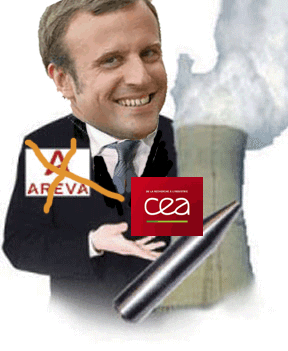
France unveils nuclear power overhaul – with an eye on China, French President Emmanuel Macron announced a shift to small modular nuclear reactors on Tuesday as he unveiled his €30 billion, five-year strategy to bolster France’s high-tech sectors, building on the country’s history as a pioneer of nuclear energy. France 24, 17 Oct 21,
Macron announced that the “number one priority” for his industrial strategy was for France to develop “innovative small-scale nuclear reactors” by 2030.
This marks a sea change in France’s approach to nuclear energy……………“The small modular reactors each generate less than 300 megawatts (MW) of energy; far less than most reactors currently in service, which tend to produce between 950 and 1300 MW, with some of them including the Flamanville plant [on the English Channel] capable of as much as 1600 MW,” said Giorgio Locatelli, an expert on the engineering of nuclear power stations at Milan Polytechnic.
……… In the grand sweep of the history of French nuclear power, the shift towards smaller reactors looks like a step back, Locatelli suggested, because France “started with small reactors in the 1960s before switching to larger ones to develop economies of scale”.However, this trend has now reached its limited, he continued. “Reactors like the one at Flamanville are not only very expensive, but also it’s a long and complex process to build them.” It takes billions to create such plants, and often it is difficult for governments to find investors willing to wait up to a decade before their returns start coming in.
Competition with China
Most countries lack the means to pull of these massive reactors, noted Nicolas Mazzucchi, an energy specialist at France’s Foundation for Strategic Research: “The financing models they require – not to mention the capacity to really mobilise a country’s savoir-faire in this domain – are increasingly rare, except in nations like Russia and China where energy companies have total state backing.”
Consequently, switching to small modular reactors is a strategic pivot to allow France to deal with competition from countries like China, which has increasingly big ambitions when it comes to nuclear power.
France’s change of approach could also allow it to win lucrative new markets. “By 2025, nearly a quarter of the world’s existing nuclear capacity will be exhausted because the reactors will have become too old,” Mazzucchi continued……………..
‘Lack of experience’………. The people in charge of reactors using cutting-edge technology “will have to justify their safety”, Herviou said. So far, the theoretical advantages of small modular reactors have not been confirmed in practice. Some 70 such reactors are currently in development throughout the world – and the vast majority of these projects are still in the early stages. “The main concern with this technology is the lack of a track record,” said Locatelli. What is more, he continued, nuclear power’s “chicken-and-egg problem is still there: Is it better to start building reactors first to win over buyers or is it best to find the investors first?” …………. https://www.france24.com/en/france/20211013-france-unveils-nuclear-power-overhaul-with-eye-on-china
US and UK begin jostling to supply Australia with nuclear submarine fleet
US and UK begin jostling to supply Australia with nuclear submarine fleet, ABC By defence correspondent Andrew Greene‘ 10 Oct 21, ‘……….In 2021, the Australian Defence Force is again considering what role the Royal Navy could play in developing its next submarines, or whether like many modern acquisitions, it will focus on interoperability with American technology.
Under the AUKUS partnership struck in September, the leaders of the United Kingdom and the United States have agreed to work with Australia on how to build a new class of nuclear-powered submarines.
Over the next 18 months, the Nuclear-Powered Submarine Task Force inside the Department of Defence will lead a study into the numerous regulatory issues involved in the ownership and operation of nuclear-powered boats.
While the design is not yet known, or what the criteria will be, for many commentators the existing British Astute-class is emerging as an early favourite for Australia to replace the Collins-class fleet
Others inside the defence industry believe any nuclear-powered Australian submarine will need to be an American boat, based on the Virginia-class so that it can be serviced at nearby US bases in Guam or Japan.
Both the British and US options have various advantages and disadvantages, which highlight the extraordinarily complex process the ADF faces to select a nuclear-powered submarine — which may never actually eventuate.
Already the regulatory challenges appear significant, as nothing is more complex and costly in the military world than nuclear-powered submarines, particularly for a country with no domestic nuclear industry.
In the United States, an eminent group of former officials and experts has written to President Joe Biden warning the AUKUS deal could threaten national security by encouraging hostile nations to obtain highly enriched uranium (HEU).
Australia insists it will uphold its commitments under the Nuclear Non-Proliferation Treaty, but the engineering sector warns it will be a steep learning curve for the Defence Department.
The now dumped Attack class submarine being designed by France’s Naval Group was based on the Barracuda class, which lost three years in development because of less complex regulatory issues associated with low enriched uranium (LEU).
“This is a very long-term effort that’ll be decades, I think, before a submarine goes in the water,” US Chief of Naval Operations Admiral Mike Gilday predicted last month………… https://www.abc.net.au/news/2021-10-10/us-and-uk-begin-jostling-for-nuclear-submarine-contract/100525756
Nuclear lobby stooge Jennifer Granholm wants ”unusual partnerships” in order to save the nuclear industry
Top U.S. Energy Official Sees ‘Unusual Partnerships’ for Nuclear, From reactors at coal plants to hydrogen production and potential cross-border collaboration, Secretary of Energy Jennifer Granholm is seeking new roles for U.S. nuclear power.
Bloomberg Green, By Jonathan Tirone, 21 September 2021, The Biden administration’s top energy official said the nuclear industry should broaden its business case beyond power markets in order to ensure its place in a carbon-free economy.
U.S. nuclear energy has come under relentless pressure in recent years from cheap natural gas, solar and wind power. More reactors are being taken offline permanently than built, risking the long-term future of the country’s biggest clean energy source. resident Joe Biden has pledged financial support to keep aging atomic plants online. Secretary of Energy Jennifer Granholm said “building back better” for nuclear might mean more than just generating electricity as it competes with emerging renewable energy and storage technologies.

“We need to pursue a silver buckshot rather than a silver bullet approach,” Granholm said in an interview with Bloomberg News in Vienna. The former governor of Michigan said some “unusual partnerships” between nations and industries might be needed for U.S. nuclear operators to tap the $23 trillion global clean [nuclear is NOT clean] energy market over the next decade. Granholm urged more cross-border collaboration in developing a new generation of small modular reactors, as well as using nuclear plants for the production of emissions-free hydrogen…….
Granholm spoke at a meeting of senior officials at the International Atomic Energy Agency, where Chinese and Russian envoys called for more research-and-development collaboration to accelerate the deployment of new generations of miniature reactors.
The Department of Energy curtailed some joint projects with China during the Trump administration, including work on a test reactor backed by billionaire Bill Gates. Granholm suggested the urgency of the climate crisis might require re-evaluating prohibitions on some technology transfers and cooperation. She did not signal any new near-term partnerships with Russia or China. The issue could be revisited during two weeks of international climate talks — known as COP26 — beginning Oct. 31 in Glasgow, Scotland…..

Granholm reserved special praise for the Gates-led company, TerraPower LLC, which in June announced it would build its first test plant at a shuttered coal site in Wyoming rather than in China. …. https://www.bloomberg.com/news/articles/2021-09-21/top-u-s-energy-official-sees-unusual-partnerships-for-nuclear
Jennifer Granholm and Westinghouse enthusiastic to sell ”clean” nuclear power to Poland
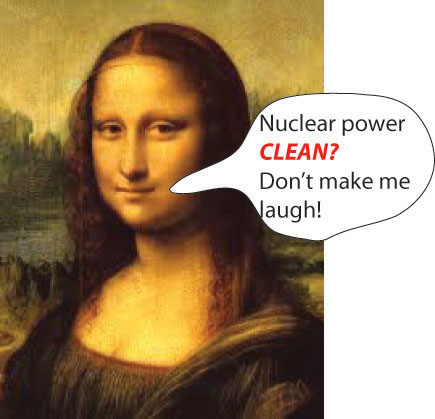
You really have to wonder just who Jennifer Granholm works for. Is it the American people, or is it the nuclear industry? She’s great at regurgitating nuclear lies about ”clean” nuclear
US lures Eastern Europe with nuclear power, $23t in clean [nuclear is NOT clean]energy market
By Frédéric Simon | EURACTIV.com 24 Sept 21, The climate crisis presents “a market opportunity for carbon-reducing technologies” such as nuclear power, said US energy Secretary Jennifer Granholm, teasing a $23 trillion market to countries in Central and Eastern Europe by 2030.
Low-carbon technologies “will be a 23 trillion-dollar market by the end of this decade,” which offers “an enormous potential to countries on both sides of the Atlantic,” Granholm said on Wednesday (22 September).
Speaking from Poland during an online press briefing, Granholm said the transatlantic market “will give us a chance to launch new business, new industries, to attract billions of dollars of new investment, and certainly to create millions of new jobs”………
In the US, President Biden’s ‘build back better‘ agenda includes an objective to have 100% of US electricity produced from “clean sources” by 2035, [nuclear is NOT clean] she explained, saying this involves reducing CO2 emissions by more than 50% by 2030 and cutting them down to net-zero by 2050……
Nuclear: ‘The reason we’re here.’
And nuclear power features highly among the US objectives.
“The reason we’re here in Poland is because we have been talking about a partnership in the area of nuclear,” Granholm said. “We’re really excited that we may have this partnership here with Poland”.
In October last year, Warsaw and Washington signed a 30-year intergovernmental agreement on future cooperation in the development of the Polish civil nuclear energy programme.
And the US is in pole position to win those contracts.
“Our collaboration to develop Poland’s civil nuclear programme is vital to Poland achieving EU carbon reduction targets and to guarantee its energy security,” Granholm said. “That dispatchable, clean [nuclear is NOT clean] , uninterruptable power is the gold standard of what every nation is looking for” in their quest to reduce CO2, she explained.
In July, US nuclear power firm Westinghouse announced the launch of a front-end engineering and design study – or FEED – under a grant from the US Trade Development Agency to advance Poland’s nuclear energy programme.
“It’s an opportunity to give American technology to help meet Poland’s clean-energy needs, [nuclear is NOT clean] and Westinghouse is going to offer its AP1000 nuclear reactor for the project,” Granholm said. https://www.euractiv.com/section/energy/news/us-lures-eastern-europe-with-nuclear-power-23tln-clean-energy-market/
USA has conned Australia into paying for its super-costly nuclear submarine project

Last week’s AUKUS announcement was nothing more than PR stunt in Australia, with the government merely committing to spend the next 18 months deciding what to buy—which conveniently kicks any actual the decision far enough down the road to avoid the next federal election.
Has PM put Australia on the hook to finance struggling UK, US submarine projects? Michael West Media, By Marcus Reubenstein| September 23, 2021,
“Almost comical”. Experts lambast Scott Morrison’s “crazy” AUKUS deal to buy nuclear submarine tech from parlous UK and US programs. Marcus Reubenstein finds a real prospect Australia will be used to “underwrite” the foundering foreign submarine industry.
Twenty-five years of ongoing maintenance delays for nuclear submarines, chronic shortage of both parts and skilled workers, under capacity at shipyards, and attack class submarines missing from deployments for up to nine months. These sound like potential problems for Australia’s future nuclear submarine fleet but they are actual problems right now confronting the US Navy and its fleet of 70 submarines.
The US is at the cutting edge of nuclear propulsion. It has the largest and most sophisticated submarine fleet in the world, its first nuclear submarine was commissioned 67 years ago, and the US has literally decommissioned twice as many nuclear subs as Australia is planning to buy.
If the US cannot manage to keep its fleet in the water, how can the Morrison government commit up to $100 billion of taxpayer money to secure nuclear submarines and guarantee they will be always operational and ready for deployment?
Professor Hugh White, ANU Professor of Strategic Studies, former Deputy Secretary of Defence and an eminent figure in strategic policy, wrote in The Saturday Paper, “The old plan was to build a conventionally powered version of a nuclear-powered French submarine. It was crazy.”
“The new plan—to buy a nuclear-powered submarine instead—is worse”.
Says White, “There is a reason why only six countries, all of them nuclear-armed, operate nuclear powered subs.”
The sales pitch is underway
Last week’s AUKUS announcement was nothing more than PR stunt in Australia, with the government merely committing to spend the next 18 months deciding what to buy—which conveniently kicks any actual the decision far enough down the road to avoid the next federal election.
The ripples of the announcement, however, reached British shores in double-quick time. Just two days after the AUKUS alliance UK Defence Secretary Ben Wallis announced a $320 million (£170m) grant to be shared between BAE Systems and Rolls Royce to develop technology for Britain’s next generation submarines.
According to Department of Finance figures, In the past twelve months BAE Systems has collected $1.88 billion from Australian taxpayers. The Astute class submarine, touted as one of the two options Australia is considering, is manufactured by BAE Systems.
US Naval analyst, and Forbes Defense columnist, Craig Hooper predicts AUKUS could give the US Navy a big shot in the arm as well. He says a deal with Australia could effectively underwrite major improvements to the US Navy’s outdated submarine maintenance facilities by supporting “America’s decade-long, $US25 billion ($34.6 billion) effort to refit the U.S. Navy’s four aging public shipyards. With yard repair costs already high, America would go to great lengths to welcome any additional bidders for shipyard capability improvements.”
US subs in dry dock In a report published six months ago, the US Congressional Budget Office (CBO) found: “The Navy’s four shipyards have experienced significant delays in completing maintenance on its submarines (all of which are nuclear-powered).” ………. Should Australia go down the nuclear sub path what choice will it have other than to outsource the fleet’s maintenance? …..
Her Majesty’s sub optimal fleet
Britain, touted as the alternative nuclear submarine supplier to Australia, has problems of its own. The Royal Navy operates ten submarines, only four of them were designed and commissioned this century.
Like their American nuclear counterparts there are systemic problems keeping these subs in service……
That report also indicated significant delays to the BAE Systems built Astute hunter-killer submarines, the same class of nuclear submarine being touted for Australian as part of the AUKUS deal………. https://www.michaelwest.com.au/has-pm-put-australia-on-the-hook-to-finance-struggling-uk-us-submarine-projects/
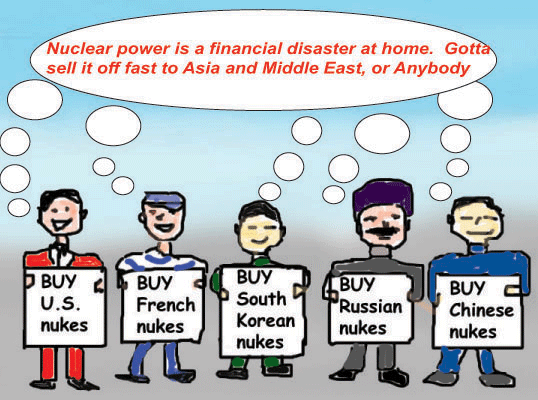
USA keen to market nuclear reactors to Poland (and indeed – to anybody)
Bechtel, Westinghouse join forces to pursue Polish nuclear power plant project, July 16, 2021, RESTON, Va., July 15, 2021 /PRNewswire/ — Bechtel and Westinghouse Electric Company, two leading U.S. companies in the global nuclear industry, today announced they’ve formed a team to pursue new nuclear power plant projects in Poland…….
“Poland is taking steps to transition to a clean energy economy while retaining its energy independence and security. The Westinghouse-Bechtel team offers proven technology and hands-on experience in nuclear project delivery and is ready to immediately support Poland’s transformative vision.”……
This news follows the U.S. Trade and Development Agency announcement on June 30 providing a grant for a front-end engineering design (FEED) for a plant in Poland using proven Westinghouse AP1000 reactors. The FEED is expected to be delivered in 12 months. https://finance.yahoo.com/news/bechtel-westinghouse-join-forces-pursue-170100809.html
French nuclear company and Chinese government once again have a problem with their much vaunted EPR nuclear reactor design
Nuclear reactor problem a new headache for designer and China. Bangkok Post, 16 June 21, PARIS – The emergence of problems in a new-generation nuclear reactor in China threatens to undermine efforts by its French designer to sell it elsewhere, and could hurt Beijing’s nuclear industry, analysts said.
French energy giant EDF and the Chinese government have sought to ease concerns about a gas build-up at the Taishan Nuclear Power Plant after a CNN report of a potential leak at the site.
The Chinese foreign ministry said Tuesday that radiation levels remained normal at the site in southern Guangdong province and there were no safety concerns.
But it is the latest snag to hit EDF’s much-vaunted EPR reactor.
The Taishan power station became in 2018 the first site worldwide to use the pressurised water design, which has been subject to years of delays in similar projects in Britain, France and Finland.
A second EPR reactor was launched at Taishan a year later. The facility is partly owned by EDF along with state-owned China General Nuclear Power Group, the majority stakeholder and operator of the plant.
EDF said the plant’s number one reactor experienced a build-up of gases in part of the cooling system following the deterioration of the coating on some uranium fuel rods.
The French company was first informed about the problem with the fuel rods in October, but only learned about the gas build-up on Saturday, according to EDF.
The problem and the silence of Chinese authorities triggered criticism of EDF, whose EPR reactor is supposed to be safer, last longer and produce more electricity than previous versions.
– EDF seeks contracts –
It seems that both the Chinese nuclear regulators and the French nuclear corporations may have acted in bad faith,” said Paul Dorfman, a researcher at the University College London’s Energy Institute.
“If so, this new EPR debacle should have important consequences for any further plans for new EPR builds in France, the UK, and internationally,” he added…….
The Taishan incident comes as EDF, which is currently struggling to finish the Flamanville EPR in France after more than a dozen years of work, is hoping to win new contracts.
France, which must eventually decide whether to renew its park of ageing nuclear reactors, is holding off on making a decision until Flamanville comes online, which is now expected in late-2022 at best………. https://www.bangkokpost.com/world/2133307/nuclear-reactor-problem-a-new-headache-for-designer-and-china
France desperate to sell its flawed nuclear technology to India, Time for India to cancel Jaitapur nuclear power project.
Time for India to cancel Jaitapur nuclear power project, France keen on flogging its ‘messy’ tech to India Business May 2, 2021 By Ranvir Nayar Media India Group France remains desperate to sell its severely troubled EPR nuclear reactors to India, even though its own project at home and at both the sites outside of France have had severe cost and time overruns and continue to face safety issues.
On March 3, 2021, Electricité de France, EDF, the sole operator of nuclear power plants in France, informed the country’s nuclear safety body, Autorité de Sûreté Nucléaire (ASN), of a design anomaly on three nozzles of the main primary system of the European Pressurised Reactor that it has been building at Flamanville in north-west France.
The design flaw is serious as the main primary system contains water used to cool the reactor core and transfer energy from the nuclear reaction to the steam generators. The design dates back to 2006 and the nozzles were manufactured in 2011.
https://mediaindia.eu/business/jaitapur-nuclear-france/
Despite the problems, small nuclear reactor salesmen aggressively marketing: it’s make or break time for the nuclear industry.

Entrepreneurs Look to Small-Scale Nuclear Reactors, The American Society of Mechanical Engineers, Mar 2, 2021, by Michael Abrams ‘‘……… even concepts that are predicated on being small, modular, and fast to build seem locked into decades-long development cycles.
The key to reviving the nuclear power industry is building these small reactors not as projects, but as factory-made products. That’s easier said than done. “Usually, a bunch of nuclear engineers go in a room and then they come out after a year or two, and they have a design that doesn’t have a lot of foundation in realty, and nobody can make it, and the projects dies,” said Kurt Terrani, a senior staff scientist at Oak Ridge National Laboratory………..
In terms of reactor physics, the NuScale concept is fairly bog standard: low-enriched uranium, light-water cooling. In essence, their reactor is just a smaller version of the nuclear plants already in operation. That NuScale didn’t go with a more revolutionary design to mitigate waste or utilize an alternative fuel cycle is no accident. To do so would require the Nuclear Regulatory Commission to come up with an entirely new licensing framework, said José Reyes, cofounder and chief technology officer at NuScale.
“Pressurized water-cooled reactors have benefited from billions of dollars of research and development and millions of hours of operating experience over the past 50 year,” Reyes said. “NuScale went with a more traditional approach to assure a design that is cost-competitive and capable of near-term deployment.”
So far, the concept and design have been convincing enough to win funding from the DoE and to move NuScale farther along in the regulatory process than any of its would-be competitors.
“The whole idea of SMRs is that smaller is better,” said Jacopo Buongiorno, a professor of nuclear science and engineering at MIT and the director of the Center for Advanced Nuclear Energy Systems. “But within the class of small reactors, larger is still better. If you can design a reactor that is still simple, that is still passively safe, that can still be built in a factory, but that generates 300 megawatts, that for sure is going to be more economically attractive than the same thing that generates 60 megawatts.”
Make or Break for Nuclear
Moltex is aiming for build costs at around $2,000 per kW—more than wind or solar, but less than newly built coal or gas plants, let alone competing nuclear concepts. “We’ve believe we’ve come up with a concept that can radically reduce the cost of nuclear power,” ……
Another bit of boring nuclear propaganda – from Morocco this time
A straight handout from the nuclear lobby? Of course! Not a word about the costs. Not a word

Christina Macpherson’s websites & blogs
about safety, environmental issues. Not a word about the problem of radioactive trash produced. And, of course – no mention that medical radioisotopes can now be made safely and efficiently in non nuclear cyclotrons
Morocco, Hungary Sign Agreement On Nuclear Energy Cooperation. The agreement boosts bilateral cooperation in scientific and academic research. By Sanae Alouazen, Jan 20, 2021 Rabat- Morocco’s National Center for Nuclear Energy, Science and Technology (CNESTEN) and the Hungarian Center for Energy Research signed a cooperation agreement on Tuesday. The agreement aims to strengthen cooperation between the two research centers in the field of nuclear energy……. https://www.moroccoworldnews.com/2021/01/332545/morocco-hungary-sign-agreement-on-nuclear-energy-cooperation/
Russia marketing small nuclear reactors to the Arctic , (who cares about the toxic wastes?)

Rosatom to build small-scale land-based Arctic nuclear plant by 2028
Rosatom said it has reached an agreement with the government of the Republic of Sakha (Yakutia) setting out parameters for pricing energy that will be produced by the nuclear plant, which is expected to be completed by 2028……….
“I am convinced that a small-scale nuclear power plant will give a qualitative impetus to the development of the Arctic regions of Yakutia, stimulate the development of industry in Ust-Yansky ulus and improve the living standards of local residents,” said in a statement Head of the Sakha Republic Aysen Nikolayev.
The nuclear plant is expected to operate for 60 years but the press release did not specify how Rosatom plans to deal with the nuclear waste produced by it.
Rosatom officials said the small-scale nuclear plant is based on a proven technology that has already been tested in Arctic conditions.
RITM-200 reactors are already being used on the recently commissioned Arktika nuclear-powered icebreaker and six other 22220 design heavy Russian icebreakers that are being built, Rosatom officials said…….
“The implementation of this project strengthens the leading position of Rosatom in the world market of small nuclear power plants.”…….
Rosatom is also actively marketing the technology for export overseas, Likhachev said. https://thebarentsobserver.com/en/nuclear-safety/2020/12/rosatom-build-small-scale-land-based-arctic-nuclear-plant-2028
Marketing nuclear technology to Slovakia
 Mochovce new-build project receives loan boost, WNN, 24 December 2020
Italy’s Enel has announced that its subsidiary Enel Produzione and the Czech company Energetický a Průmyslový Holding (EPH) have agreed to a provide additional loans for the completion of Mochovce 3 and 4 in the Slovak Republic, and altered the terms for EPH to eventually buy out Enel’s stake in Slovenské elektrárne. They and EP Slovakia BV have signed a new agreement that modifies some of the terms and conditions of the 2015 contract concerning the sale of the stake held by Enel Produzione in the Slovak utility…….
Construction on the two Mochovce units was restarted in 2008 and aimed at having both units in operation by 2013, at a total cost of EUR2.8 billion. This was increased at the start of this month to about EUR6.2 billion. Fuel loading at unit 3 is expected by April 2021 and at unit 4 in 2023. ………. https://www.world-nuclear-news.org/Articles/Mochovce-new-build-project-receives-loan-boost
Russia keenly marketing nuclear technology to Bolivia
|
Rosatom may put stages I, II of nuclear center in Bolivia into operation in 2021, TASS, 25 Dec 20, On March 6, 2016, Russia and Bolivia concluded an inter-governmental agreement on cooperation in the peaceful use of nuclear energy and construction of a nuclear research center in El Alto MOSCOW, December 25. /TASS/. The Rosatom State Nuclear Energy Corporation is continuing the construction of the Center for Nuclear Research and Technologies in Bolivia, despite the difficult political situation in that country. Next year the company plans to commission the first and second stages of the facility, Head of Rosatom Alexey Likhachev said on Friday.”Despite two revolutions, work continues in Bolivia. Next year we will start commissioning facilities of the first and second stages of the Center for Nuclear Research and Technologies,” he said…….. Nuclear project in BoliviaOn March 6, 2016, Russia and Bolivia concluded an inter-governmental agreement on cooperation in the peaceful use of nuclear energy and construction of a nuclear research center in El Alto, at an altitude of 4,100 meters above sea level. The Bolivian government-funded $300-million project will be implemented jointly with Russia’s nuclear power corporation Rosatom………. https://tass.com/economy/1239807 |
|
1 This Month

of the week – Shut Down Drone Warfare!


Tell the Ukrainian Government to Drop Prosecution of Peace Activist Yurii Sheliazhenko

Petition to revoke the licensing of the Near Surface Nuclear Disposal Facility (NSDF) at Chalk River. https://www.ourcommons.ca/petitions/en/Petition/Details?Petition=e-7247
To see nuclear-related stories in greater depth and intensity – go to https://nuclearinformation.wordpress.com
-
Archives
- March 2026 (237)
- February 2026 (268)
- January 2026 (308)
- December 2025 (358)
- November 2025 (359)
- October 2025 (376)
- September 2025 (257)
- August 2025 (319)
- July 2025 (230)
- June 2025 (348)
- May 2025 (261)
- April 2025 (305)
-
Categories
- 1
- 1 NUCLEAR ISSUES
- business and costs
- climate change
- culture and arts
- ENERGY
- environment
- health
- history
- indigenous issues
- Legal
- marketing of nuclear
- media
- opposition to nuclear
- PERSONAL STORIES
- politics
- politics international
- Religion and ethics
- safety
- secrets,lies and civil liberties
- spinbuster
- technology
- Uranium
- wastes
- weapons and war
- Women
- 2 WORLD
- ACTION
- AFRICA
- Atrocities
- AUSTRALIA
- Christina's notes
- Christina's themes
- culture and arts
- Events
- Fuk 2022
- Fuk 2023
- Fukushima 2017
- Fukushima 2018
- fukushima 2019
- Fukushima 2020
- Fukushima 2021
- general
- global warming
- Humour (God we need it)
- Nuclear
- RARE EARTHS
- Reference
- resources – print
- Resources -audiovicual
- Weekly Newsletter
- World
- World Nuclear
- YouTube
-
RSS
Entries RSS
Comments RSS
 nuclear-news