Just another U.S. nuclear front group, marketing to Indonesia (never mind about the volcanoes)
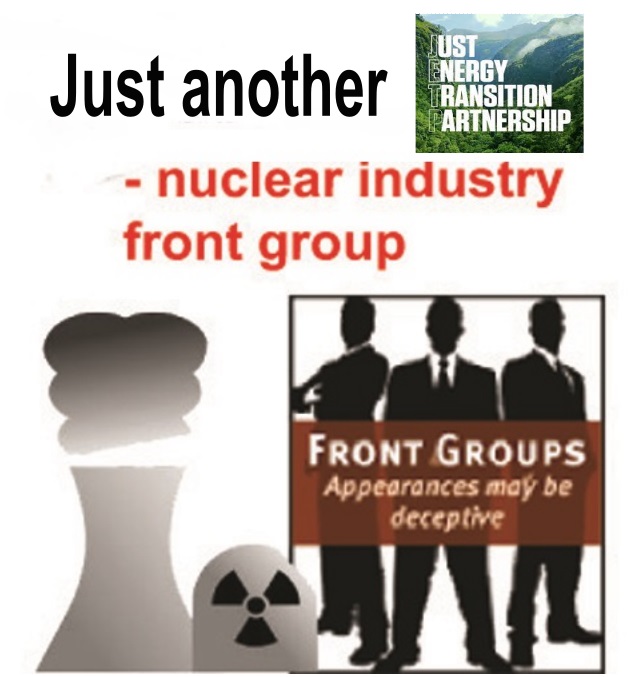
USA, Indonesia announce partnership on SMRs
WNN, 20 March 2023
The USA and Indonesia have announced a strategic partnership to help Indonesia develop its nuclear energy programme, supporting Indonesia’s interest in deploying small modular reactor (SMR) technology to meet its energy security and climate goals.
A Memorandum of Agreement, as well as affiliated grants and contracts, was signed during the Indo-Pacific Business Dialogue in Bali, Indonesia. The agreement advances the goals of the Just Energy Transition Partnership (JETP) and will strengthen Indonesia’s leadership in the ASEAN region on the deployment of advanced, safe and secure nuclear energy technologies, working toward the goal of net-zero emissions in Indonesia by 2060.
Under the agreement, the US Trade and Development Agency (USTDA) has awarded a grant to PLN Indonesia Power to provide assistance to assess the technical and economic viability of a proposed nuclear power plant, to be located in West Kalimantan. It will include a site selection plan, power plant and interconnection system design, preliminary environmental and social impact assessment, risk assessment, cost estimate and regulatory review.
Indonesia Power selected NuScale Power to carry out the assistance in partnership with a subsidiary of Fluor Corporation and Japan’s JGC Corporation. The proposed 462 MWe facility would utilise NuScale’s SMR technology…………………………………..
In August 2019, Indonesia’s National Atomic Energy Agency (Batan) signed a Memorandum of Understanding with utility Indonesia Power to cooperate in the use of nuclear technology in the energy sector. One area of cooperation will be a feasibility study on the use of nuclear power plants. https://world-nuclear-news.org/Articles/USA,-Indonesia-announce-partnership-on-SMRs
U.S. government marketing nuclear power to Indonesia
Indonesia plans to develop a nuclear power plant with a potential capacity
of 462MW in West Kalimantan with funding and technological support from the
United States government.
Infrastructure Journal 20th March 2023
https://www.ijglobal.com/articles/171053/indonesia-plans-nuclear-plant-with-us-support
China marketing nuclear power to Uganda

Uganda announces plans to start nuclear power generation
Energy minister says preparation ongoing to pave way for 1st nuclear power project
Hamza Kyeyune |09.03.2023,
KAMPALA, Uganda
Uganda announced Thursday it will begin construction of the country’s first nuclear facility, the Buyende Nuclear Power Plant, in partnership with China National Nuclear Corporation that would assist the East African country in developing capabilities for peaceful use of atomic energy.
Currently in Africa, only South Africa has an active nuclear power plant, while Russia’s state-owned energy corporation Rosatom commenced construction of Egypt’s first nuclear facility last year………..
https://www.aa.com.tr/en/africa/uganda-announces-plans-to-start-nuclear-power-generation/2841543
South Korea, France keen to sell nuclear reactors to Saudi Arabia (no connection with nuclear weapons OF COURSE!)
Saudi Arabia moves forward with bids for nuclear plant

The kingdom has received bids to build its first nuclear power plant and South Korea is reportedly expressing interest.
AL-MONITOR, February 27, 2023
Saudi Arabia is progressing with its plans to build its first nuclear power plant and has received a number of bids.
The Saudi Ministry of Finance’s 2023 budget statement published Feb. 15 notes that bids to build the plant were received last December, reported the Dubai-based business intelligence outlet Middle East Economic Digest on Monday.
Background: Saudi Arabia has had an interest in nuclear power for decades. The kingdom was a major investor in Pakistan’s nuclear weapons program that began in the 1970s, for example. In 2009, the late Saudi King Abdullah bin Abdulaziz told the Obama administration that the country would obtain nuclear weapons of its own if Iran were to do so. In 2018, Crown Prince Mohammed bin Salman said the same thing to the US news outlet CBS.
More recently, Saudi Arabia has been considering developing nuclear energy for peaceful purposes. In 2018, the Saudi government announced its intention to add nuclear power to its energy mix.
Saudi Arabia’s nuclear ambitions have been gaining momentum. Korea JoongAng Daily reported in November that South Korea was interested in building Saudi Arabia’s first nuclear power plant.
Last December, the International Atomic Energy Agency (IAEA) held a nuclear law workshop with Saudi officials in Riyadh. The IAEA’s purpose was to “support the implementation of its nuclear energy program in a safe, secure and transparent manner,” according to a press release.
In early February, Saudi Arabia signed a memorandum of understanding with France on energy cooperation. The memo noted nuclear energy as well as hydrogen and electricity interconnection, the official Saudi Press Agency reported……………… https://www.al-monitor.com/originals/2023/02/saudi-arabia-moves-forward-bids-nuclear-plant#ixzz7uaRVErTd
Seoul aims to use strengthened US ties to expand nuclear plant exports
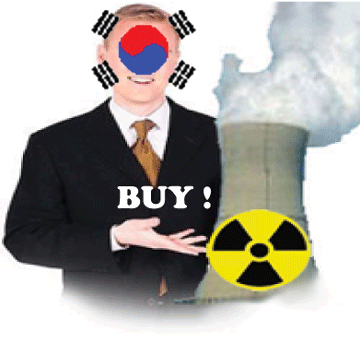
The Yoon Suk Yeol administration has scrapped the former Moon Jae-in administration’s nuclear phase-out policy based on the view that nuclear power is essential for the long-term sustainability of South Korea’s economy and its nuclear power industry
Settlement between Westinghouse and KEPCO is necessary for Washington-Seoul to expand alliance into nuclear energy
Korea Times, By Kim Yoo-chul 26 Feb 23,
Unlike the previous Moon Jae-in administration, President Yoon Suk Yeol and his foreign affairs team are clearly aiming to grow South Korea into a pivotal state given Seoul’s competitive standing to increase interoperability among a range of partners, specifically in the Indo-Pacific region.
This policy drive is backed by his administration’s concerted backing of Washington’s various protectionist industrial policies and regional security agenda items.
South Korea’s support of the Inflation Reduction Act (IRA), CHIPS and Science Act, the country’s participation in a U.S.-initiated Indo-Pacific Economic Framework (IPEF) and Chip 4 alliance are the examples signifying Seoul’s shift toward U.S. policies………………………….
Seoul’s backing of [U.S. President Joe] Biden’s signature industrial and regional security policies illustrates the fact that the country is prepared to withstand any economic and political costs by raising its profile as an advocate of major policy initiatives outlined and being managed by the U.S.’ partners and its like-minded allies,” a senior government official said in a telephone interview, adding that the majority of his comments do not necessarily reflect the official policy or position of South Korea.
Despite Seoul maintaining strategic cooperation with Beijing given its heavy reliance on the Chinese market _ China is the largest trading partner of South Korea _ and China’s huge political influence on North Korea, the Yoon administration’s apparent shift in position favoring the Biden administration’s moves to revive U.S. manufacturing, has so far been successful……………………………………..
Now, as the Biden administration has set its sights on boosting U.S. energy independence, the Yoon administration is hoping to expand its alliance with Washington into nuclear energy, in addition to batteries and chips, security analysts and company officials said.
SMRs emerge as option, legal troubles
The prime goal of the Inflation Reduction Act (IRA) is aimed at addressing rising inflation. However, the IRA also includes several tax incentives for clean energy technologies including advanced small modular reactors (SMRs). This means the IRA will possibly become a game changer for Washington’s participation in the new energy economy……………………
the IRA will have profound effects on South Korean nuclear energy and reactor companies, because they are in a better position to become one of the top beneficiaries of the act,” a trade ministry official said by telephone.
The Yoon Suk Yeol administration has scrapped the former Moon Jae-in administration’s nuclear phase-out policy based on the view that nuclear power is essential for the long-term sustainability of South Korea’s economy and its nuclear power industry. There are hopes that Yoon might reach a consensus with his U.S. counterpart on the sidelines of the Korean leader’s scheduled state-visit to the White House in late April to expand the Washington-Seoul alliance in the area of SMRs, industry sources told The Korea Times………….
U.S.-based Westinghouse and KEPCO, alongside KEPCO’s subsidiary Korea Hydro & Nuclear Power (KHNP), are involved in negotiations over their legal dispute after the U.S. company filed a lawsuit against KHNP in a U.S. federal court to block it from selling reactors to Poland. KEPCO and its subsidiary, KHNP, have been accused of infringing on Westinghouse’s intellectual property rights and Washington’s nuclear export controls.
“Reaching a settlement is highly likely before Yoon’s visit to the U.S. Westinghouse and KEPCO, along with KHNP, have until March 17 this year to address their legal issues. As nuclear technologies have also become a security issue, all parties involved in the legal dispute will have to find a compromise under the principle of reciprocity that won’t hurt national interests,” said Seok Kwang-hoon, a senior analyst at Energy Transition Korea. Westinghouse officials were not immediately available for comment.
“Westinghouse itself has no question about the significance of its commercial partnership with South Korea given the country’s supply chains for future AP1000 nuclear reactors. That means if the ongoing settlement negotiations fail, then this will impact Seoul’s efforts to win reactor deals from Poland and the Czech Republic, the countries categorized as South Korea’s target markets. It’s a plausible idea for South Korean companies to acquire Westinghouse’s property rights,” said Kim Sang-tae, a professor of nuclear engineering at Hanyang University in Seoul. https://www.koreatimes.co.kr/www/tech/2023/02/419_346075.html
Russia marketing nuclear reactors to Myanmar
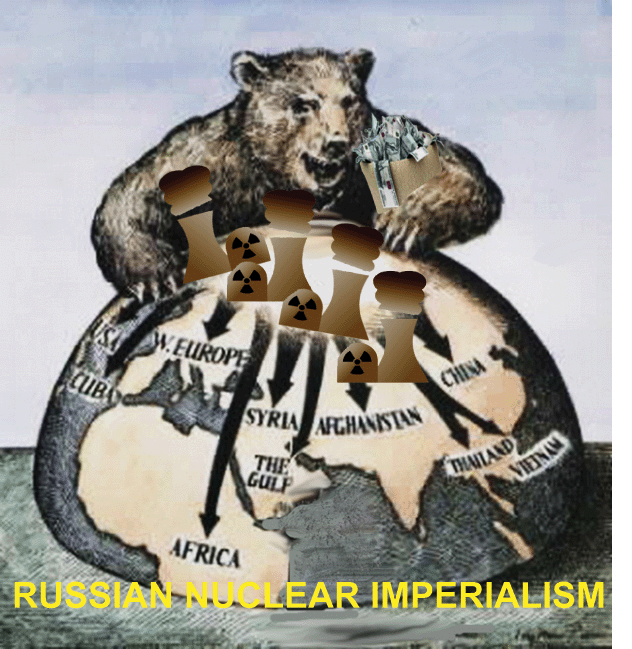
Myanmar signs new nuclear energy agreement with Russia. The
Intergovernmental Agreement on cooperation in the use of nuclear energy for
peaceful purposes will see the two countries working together on the use of
nuclear technology in a number of areas, including training of a workforce
for building and running a small modular reactor.
World Nuclear News 7th Feb 2023
https://www.world-nuclear-news.org/Articles/Myanmar-signs-nuclear-energy-cooperation-agreement
Cameco Agrees to New Deal With Ukraine’s Nuclear Energy Utility
Feb. 8, 2023 , By Stephen Nakrosis https://www.marketwatch.com/story/cameco-agrees-to-new-deal-with-ukraine-s-nuclear-energy-utility-271675897372—
Cameco Corp. said it agreed to terms with SE NNEGC Energoatom, the Ukrainian state-owned nuclear energy utility, to provide natural uranium hexafluoride, or UF(6), through 2035.
“Key commercial terms, such as pricing mechanism, volume and tenor, have been agreed to, but the contract is subject to finalization, which is anticipated in the first quarter of 2023,” Cameco said.
The deal, which runs from 2024 to 2035, will see all deliveries in the form of UF(6). “The contract will contain a required degree of flexibility, given present circumstances in Ukraine,” Cameco said.
The agreement will see Cameco supply 100% of Energoatom’s UF(6) requirements for the nine nuclear reactors at the Rivne, Khmelnytskyy and South Ukraine nuclear power plants. The deal also has an option for Cameco to supply six reactors at the Zaporizhzhya nuclear power plant, which is currently under Russian control, should it return to Energoatom’s operation, the companies said.
Death and Japan’s nuclear shelter salesman

Khrushchev once speculated that the survivors of the apocalypse would envy the dead. I agree.
LEO LEWIS, https://www.ft.com/content/5dbd0e08-5eec-4486-a1ba-fe1948d11159— 5 Feb 23
The “doomsday clock” maintained since 1947 by the Bulletin of Atomic Scientists is many things. An index of our gossamer proximity to annihilation; a metaphor for the human paradox of progress and regression; a near-drained reservoir of hope that the gods will spare us from ourselves. And, of course, a superb marketing tool for any half-decent nuclear shelter salesman.
The Bulletin’s January 24 decision to move the hands of its doomsday clock closer to midnight (signifying global catastrophe) than they have ever been before should, logically, give the bunker business a recession-defying sales spike. The collective shrug it will actually get is more profoundly alarming.
For Hiroki Nakajima, the marketing director of shelter-maker World Net International (WNI), these are comparatively good times. North Korean ballistic missile tests and China’s rising military power, he says, have driven Japanese shelter sales significantly higher than in the past. The fear factor soared after Vladimir Putin invaded Ukraine and started issuing explicit nuclear threats. WNI historically used to sell only a couple of $80,000 premium shelters a year; in 2022 that shot up to a still modest 25 — hardly a nation gripped with fear.
Nakajima, whose best customers are the very wealthy and very nervous, says he will consider listing the company on the Tokyo Stock Exchange “as society’s needs require”. He delivers his nuclear shelter sales pitch from a medium-sized warehouse with models arranged by size, blast resilience and interior decor. I am shown into one with eggshell blue padded walls and, optimistically given the post-Armageddon broadcasting constraints, a wall-mounted TV.
We are in the smallish seaside town of Yaizu, a pretty fishing port that looks back on to a snow-capped Mount Fuji and whose placidness contrasts effectively with the mental picture of the horrors that would make a shelter purchase value for money. Nakajima’s marketing strategy includes judicious repetition of the phrase “your whole family will die” wherever appropriate; mostly as the certain outcome of any attempt at self-preservation other than buying a WNI shelter.
As efforts to induce apocalyptic terror go, it is valiant stuff. But he is talking to someone who grew up in Britain in the 1980s: someone who has had his wits scared out of him by far, far more proficient fearmongers. Set against (among others) Threads, The War Game, When the Wind Blows and the Protect and Survive public information films, Japanese shelter marketing feels almost upbeat. As Cold War children we hummed pop songs that were more chillingly referential to nuclear obliteration than the WNI website. And that was when the Doomsday clock was set further from midnight than it is now.
But Nakajima is not without support in his bid to set out the risks. Last month, the Japanese government began considering for the first time what a shelter subsidy scheme might look like, suggesting that its assessment of the nuclear threat has advanced from the general to the specific. Should such a subsidy emerge, says Nakajima, sales could be 100 times what they are now.
I sit for some time in WNI’s cramped showcase shelter, imagining the circumstances that might bring me to this bunker if I ever owned one: the mass extinction beyond its sturdily engineered walls, the irradiated cinders of civilisation blown against its air filter intake, the endless weeks cocooned with whichever loved ones made it in time, mourning those who did not. Nikita Khrushchev once speculated that the survivors of such a war would envy the dead. I agreed, and Nakajima quietly lost a customer.
The faint feeling of absurdity in WNI’s showroom points, obliquely, to a problem with the doomsday clock. Arguably the most potent symbol of humanity’s collective need to change tack, the clock is now set at just 90 seconds to midnight but seems to have lost its capacity to terrify at a time when we should be more terrified than ever before.
For while the clock is most closely associated in the public mind with the threat of nuclear war, it has long been a broader metric of imperilment from all human-made global disaster — a spectrum of risk ranging from climate change, and the denial of it, to microscopic autonomous robots.
The trouble with the clock is that, where once it was a paramount siren, it is now merely one of many alarms telling us that we are doomed. Under cover of that surfeit of fear, the clock has now gone pretty much as far as it can without being right. That is something none of us — even those with the best shelter $80,000 will buy — can afford to see proved.
China marketing nuclear reactors to Pakistan
Pakistani Prime Minister Shehbaz Sharif has inaugurated the third unit of
the Karachi Nuclear Power Plant (KANUPP), which has 1.1GW of power
generating capacity. Built with an investment of $2.7bn, the K-3 nuclear
unit is expected to ease Pakistan’s ongoing energy crisis, according to
Bloomberg.
It is the second Chinese-designed Hualong One reactor to be
deployed at KANUPP, having been built with the Chinese Government’s
assistance under the China-Pakistan Economic Corridor (CPEC) initiative. At
the inauguration ceremony, Prime Minister Sharif said Pakistan ‘badly
needs’ clean and cheap sources of energy, be they nuclear, hydropower or
other renewables.
Power Technology 3rd Feb 2023
https://www.power-technology.com/news/pakistan-karachi-nuclear-power-plant/
South Korea to sell 40 trilion won ($32.55 billion) nuclear power plant to Turkey.
South Korea has conveyed its preliminary proposal to Turkiye for
constructing a major nuclear power plant in Turkiye, local Turkish media
reports. According to the report, Korea Electric Power Corp. (KEPCO)
presented the proposal regarding the construction of four reactors capable
of providing 1,400 megawatts (MW) of electricity in the northern province
of Sinop. The project is forecast to be worth about 40 trillion won ($32.55
billion).
Middle East Monitor 2nd Feb 2023
Ukraine planning for two $5 billion Westinghouse AP 1000 reactors, part of USA marketing a fleet of new nuclear reactors to Ukraine!
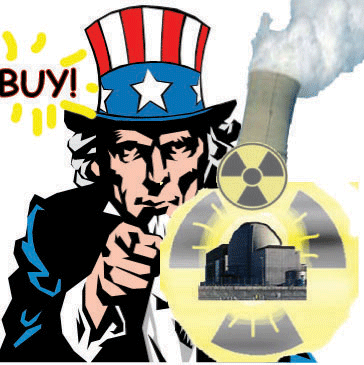
Ukraine’s Cabinet of Ministers has greenlighted the preliminary phases
of building two $5 billion Westinghouse AP 1000 reactors at the Kmelnitsky
nuclear power plant once the Russian invasion ends, the embattled
country’s energy officials have said, according to World Nuclear News.
The cabinet-level approval builds on the deal Kyiv and Westinghouse signed
in June that outlined plans for the US-based nuclear corporation to
construct a total of nine new reactors in Ukraine, as well as supply all
nuclear fuel burned in the country’s 15 Soviet-built reactors.
Bellona 3rd Feb 2023
Ukraine greenlights first steps on new nuclear reactor builds
South Korea keen to market nuclear technology to United Arab Emirates, and missile technology, too.

South Korea president, in UAE, backs return to nuclear power
MRO, ABU DHABI, United Arab Emirates (AP) 16 Jan 23, – South Korean President Yoon Suk Yeol said on Monday that his nation’s efforts to be carbon neutral by 2050 would rely in part on returning to nuclear power, even though his predecessor had tried to move away from atomic power.
Yoon’s comments at a summit in the United Arab Emirates, made in front of the country’s leader, Sheikh Mohammed bin Zayed Al Nahyan, served to underline Seoul’s commitment to nuclear power as it works to finish the Arabian Peninsula’s first atomic power plant. That could see South Korea in line for lucrative maintenance contracts and future projects in the UAE, which Seoul has grown closer to over recent years.
Yoon’s predecessor, President Moon Jae-in, sought to move South Korea away from nuclear power amid safety and graft scandals and Japan’s 2011 Fukushima nuclear disaster………..
Yoon traveled later Monday to the Barakah nuclear power plant in Abu Dhabi’s far western desert near Saudi Arabia with Sheikh Mohammed before a planned business summit back in the capital.
On his arrival back, Yoon told the summit that, using the Barakah plant as an example, he hoped the Emirates and South Korea could expand this “new model of cooperation” to include nuclear fuel, small reactors and other joint advances to third countries…….
Yoon’s embrace of nuclear power also provides a guarantee of sorts that South Korea remains invested in servicing the Barakah plant. France, also home to nuclear power plants and another Emirati business and military ally, has sought contracts here as well.
Already, Yoon’s four-day trip the UAE has seen a promise from Sheikh Mohammed to invest some $30 billion in the country. Heavyweight business leaders from Hyundai, Samsung and other companies also are taking part in the state visit.
On Sunday, Yoon also visited South Korean special forces stationed in the United Arab Emirates, a murky deployment that grew out of Seoul’s deal over the nuclear power plant. The Akh unit is comprised of some 150 troops………..
Already, the Emiratis have paid $3.5 billion for the Cheongung II, or “Heaven’s Bow,” surface-to-air missile system from South Korea …. https://www.mromagazine.com/2023/01/16/south-korea-president-in-uae-backs-return-to-nuclear-power/
Poland’s energy company agrees to buy France’s NOT YET DESIGNED so-called “small” Nuward nuclear reactor!

Poland’s Respect Energy considers deploying French SMR design
WNN, 16 January 2023
Polish renewable energy trader Respect Energy has signed an agreement with EDF to cooperate on the development of nuclear power projects in Poland based on France’s Nuward small modular reactor (SMR) technology.
“This agreement marks Respect Energy’s and EDF’s firm intention to jointly proceed with the development of SMR projects in Poland and confirms the strong interest towards Nuward technology which has been selected by the energy trader to expand its footprint in the nuclear energy field,” the companies said in a joint statement. “Respect Energy and EDF will now jointly start the evaluation process of specific new greenfield sites and continue to work on detailing the business and financing plans for this endeavour.”
In October 2021, EDF made an offer to the Polish government to build as many as six EPR units. The “non-binding preliminary offer” represented a range of options for Poland. It detailed the engineering, procurement and construction that would be needed for four to six EPR units, at either two or three sites. The EPR units would produce 1650 MWe each if selected – the Polish government announced late last year that it had selected Westinghouse technology for at least the first three of its planned fleet of reactors……………….
The Nuward project was launched in September 2019 by the French Alternative Energies and Atomic Energy Commission (CEA), EDF, Naval Group and TechnicAtome. The Nuward – consisting of a 340 MWe SMR plant with two pressurised water reactors (PWRs) of 170 MWe each – has been jointly developed using France’s experience in PWRs……………..
Nuward is currently in the conceptual design phase, which focuses on choosing the major technical features while delivering real competitive advantages. Belgian engineering firm Tractebel was contracted in May last year to conduct studies for the completion of the conceptual design of “the first SMR in the European Union”.
The next phase of the project, the basic design completion, is expected to start this year and to be completed by 2025. The design should be in the “advanced concept phase” between 2025 and 2030, during which time Nuward is expected to be certified and the supply chain developed.
Construction of a demonstration Nuward SMR is expected to start in 2030. The construction of that unit is anticipated to take three years.
In June, it was announced the Nuward design will be the case study for a European early joint regulatory review led by the French nuclear safety regulator with the participation of the Czech and Finnish nuclear regulators….. https://world-nuclear-news.org/Articles/Poland-s-Respect-Energy-considers-deploying-French
Team Korea to bolster exports of nuclear energy systems
Korea Times, By Lee Kyung-min, 13 Jan 23,
State-run energy companies and private firms in the nuclear energy industry will join hands to advance exports of the stable and affordable power generation systems, the energy ministry said following a meeting attended by officials from the sector, Friday.
The Korea-developed APR1400, a nuclear reactor with a capacity of 1,400 megawatts, is increasingly recognized by its industry peers for its cost, quality and technological advantages.
Communication channels will be strengthened with the Czech Republic, the Philippines, the United Kingdom, and Turkey, to win orders to build nuclear reactors there. Also fortified will be government assistance to foster industries related to nuclear power generation equipment manufacturing, as well as facility safety and maintenance.
Second Vice Minister of Trade, Industry and Energy Park Il-jun presided over the meeting attended by members of Team Korea, a task force established to facilitate the export of the country’s nuclear reactors, at InterContinental Seoul COEX, southern Seoul.
In attendance were Korea Power Corp. (KEPCO) and its power subsidiary Korea Hydro & Nuclear Power (KHNP) as well as KEPCO affiliates…………….. https://www.koreatimes.co.kr/www/tech/2023/01/419_343553.html
A pretentious and dishonest story-telling conference of Small Nuclear Reactor salesmen in Atlanta 2022
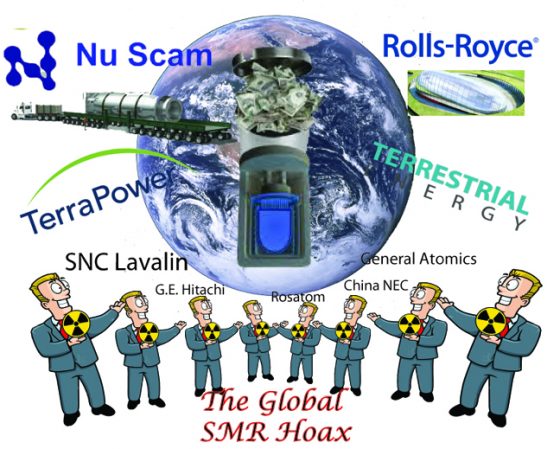
Markku Lehtonen in The Bulletin of the Atomic Scientists covered this conference – “SMR & Advanced Reactor 2022” event in Atlanta – in a lengthy article.
The big players were there, among over 400 vendors, utility representatives, government officials, investors, and policy advocates, in “an atmosphere full of hope for yet another nuclear renaissance.
The writer details the claims and intentions of the SMR salesmen – in this “occasion for “team-building” and raising of spirits within the nuclear community.’, in relation to climate change and future energy needs, and briefly mentioning “security”, which is code for the nuclear weapons aspect.

It struck me that “team building” might be difficult, seeing that the industry representatives were from a whole heap of competing firms, with a whole heap of different small reactor designs, (and not all designs are even small, really)
This Bulletin article presents a measured discussion of the possibilities and the needs of the small nuclear reactors. The writer recognises that this gathering was really predominantly a showcase for the small nuclear wares, – the SMR salesmen “must promise, if not a radiant future, at least significant benefits to society. “
“Otherwise, investors, decision-makers, potential partners, and the public at large will not accept the inevitable costs and risks. Above all, promising is needed to convince governments to provide the support that has always been vital for the survival of the nuclear industry.”
He goes on to describe the discussions and concerns about regulation, needs for a skilled workforce, government support, economic viability. There were some contradictory claims about fast-breeder reactors.
Most interesting was the brief discussion on the political atmosphere, the role of governments, the question of over-regulation .
” A senior industry representative …. lamenting that the nuclear community has “allowed too much democracy to get in“
“The economic viability of the SMR promise will crucially depend on how much further down the road towards deglobalization, authoritarianism in its various guises, and further tweaking of the energy markets the Western societies are willing to go”
The Bulletin article concludes:
“Promises and counter-promises. For the SMR community that gathered in Atlanta, the conference was a moment of great hope and opportunity, not least thanks to the aggravating climate and energy security crises. But the road toward the fulfilment of the boldest SMR promises will be long, as is the list of the essential preconditions. To turn SMR promises into reality, the nuclear community will need no less than to achieve sufficient internal cohesion, attract investors, navigate through licensing processes, build up supply chains and factories for module manufacturing, win community acceptance on greenfield sites, demonstrate a workable solution to waste management, and reach a rate of deployment sufficient to trigger learning and generate economies of replication. Most fundamentally, governments would need to be persuaded to provide the many types of support SMRs require to deliver on their promises.
Promising of the kind seen at the conference is essential for the achievement of these objectives. The presentations and discussions in the corridors indeed ran the full gamut of promise-building, from the conviction of a dawning nuclear renaissance along the lines “this time, it will be different!” through the hope of SMRs as a solution to the net-zero and energy-security challenges, and all the way to specific affirmations hailing the virtues of individual SMR designs. The legitimacy and credibility of these claims were grounded in the convictions largely shared among the participants that renewables alone “just don’t cut it,” that the SMR supply chain is there, and that the nuclear industry has in the past shown its ability to rise to similar challenges.
Two questions appear as critical for the future of SMRs. First, despite the boost from the Ukraine crisis, it is uncertain whether SMR advocates can muster the political will and societal acceptance needed to turn SMRs into a commercial success. The economic viability of the SMR promise will crucially depend on how much further down the road towards deglobalization, authoritarianism in its various guises, and further tweaking of the energy markets the Western societies are willing to go. Although the heyday of neoliberalism is clearly behind us and government intervention is no longer the kind of swearword it was before the early 2000s, nothing guarantees that the nuclear euphoria following the Atoms for Peace program in the 1950s can be replicated. Moreover, the reliance of the SMR business case on complex global supply chains as well as on massive deployment and geographical dispersion of nuclear facilities creates its own geopolitical vulnerabilities and security problems.
Second, the experience from techno-scientific promising in a number of sectors has shown that to be socially robust, promises need constructive confrontation with counter-promises. In this regard, the Atlanta conference constituted somewhat of a missed opportunity. The absence of critical voices reflected a longstanding problem of the nuclear community recognized even by insiders—namely its unwillingness to embrace criticism and engage in constructive debate with sceptics. “Safe spaces” for internal debates within a like-minded community certainly have their place, yet in the current atmosphere of increasing hype, the SMR promise needs constructive controversy and mistrust more than ever.” https://thebulletin.org/2022/12/building-promises-of-small-modular-reactors-one-conference-at-a-time
1 This Month

of the week – Shut Down Drone Warfare!


Tell the Ukrainian Government to Drop Prosecution of Peace Activist Yurii Sheliazhenko

Petition to revoke the licensing of the Near Surface Nuclear Disposal Facility (NSDF) at Chalk River. https://www.ourcommons.ca/petitions/en/Petition/Details?Petition=e-7247
To see nuclear-related stories in greater depth and intensity – go to https://nuclearinformation.wordpress.com
-
Archives
- March 2026 (237)
- February 2026 (268)
- January 2026 (308)
- December 2025 (358)
- November 2025 (359)
- October 2025 (376)
- September 2025 (257)
- August 2025 (319)
- July 2025 (230)
- June 2025 (348)
- May 2025 (261)
- April 2025 (305)
-
Categories
- 1
- 1 NUCLEAR ISSUES
- business and costs
- climate change
- culture and arts
- ENERGY
- environment
- health
- history
- indigenous issues
- Legal
- marketing of nuclear
- media
- opposition to nuclear
- PERSONAL STORIES
- politics
- politics international
- Religion and ethics
- safety
- secrets,lies and civil liberties
- spinbuster
- technology
- Uranium
- wastes
- weapons and war
- Women
- 2 WORLD
- ACTION
- AFRICA
- Atrocities
- AUSTRALIA
- Christina's notes
- Christina's themes
- culture and arts
- Events
- Fuk 2022
- Fuk 2023
- Fukushima 2017
- Fukushima 2018
- fukushima 2019
- Fukushima 2020
- Fukushima 2021
- general
- global warming
- Humour (God we need it)
- Nuclear
- RARE EARTHS
- Reference
- resources – print
- Resources -audiovicual
- Weekly Newsletter
- World
- World Nuclear
- YouTube
-
RSS
Entries RSS
Comments RSS
 nuclear-news