South Korea trying to get in on the frenzy of nuclear marketing to Britain
 Koreans near investment in new Cumbrian nuclear plant http://www.ft.com/cms/s/0/573d713e-7833-11e6-a0c6-39e2633162d5.html#axzz4Jz1Iolbo Financial Times, 12 Sept 16, Jim Pickard and Andrew Ward in London A South Korean energy group is closing in on a multibillion investment in a new nuclear power station near Sellafield in the latest sign of Asian interest in Britain’s energy industry.
The deal, if it goes ahead, would add momentum to Moorside at a time when the rival Hinkley Point nuclear power project in Somerset has been thrown into doubt by concerns about its high cost and the role of Chinese investors in the scheme.
Theresa May, prime minister, is expected to decide this month whether to go ahead with Hinkley, led by EDF of France with Chinese backing, after ordering a review of the £18bn project.
NuGen sees the uncertainty as a chance to leapfrog Hinkley in the race to build the first new nuclear reactor in the UK for more than two decades. However, it is still years behind EDF in securing financing and regulatory approval for its project.
For Kepco, an investment in Moorside would be a chance to gain a foothold in the UK as it builds its presence in the global nuclear industry.
The Cumbrian plant — designed to provide power for 6m homes — would be supplied with reactors by Westinghouse, the US subsidiary of Toshiba. But Kepco sees the UK as a potential future market for its own technology.
South Korea has set a goal to become the world’s third-largest exporter of nuclear reactors by 2030 and has already won a $20bn contract in Abu Dhabi. Tom Samson, chief executive of NuGen, is former chief operating officer of the Abu Dhabi company, Emirates Nuclear Energy Corporation, which struck that deal.
Kepco is not without controversy, having been rocked by a domestic safety scandal three years ago. The country’s atomic watchdog said safety certificates for thousands of components procured by Korean reactors over the previous nine years had been forged. An ally of Kepco said the scandal was behind it and the group was now seen as “a first division player” in nuclear power.
The group, 51 per cent owned by the South Korean government, first entered talks with NuGen three years ago, but no deal was reached. Four people with knowledge of the situation said talks had since resumed and made progress over a potential equity stake in NuGen as well as a possible role in construction.
NuGen declined to comment on Kepco but said it had a “universe of options for financing” and was talking to a variety of potential investors and contractors. Kepco could not be immediately reached for comment.
The UK government has put nuclear power at the heart of its energy policy, with a target for 14GW of generating capacity from new reactors by 2035. However, its refusal to inject public money has left ministers dependent on foreign investors to finance the programme.
As well as Hinkley and Moorside, Hitachi of Japan also has plans for reactors at Wylfa in Anglesey and Oldbury-on-Severn in Gloucestershire. EDF and its Chinese state-backed partner CGN are planning further reactors at Sizewell in Suffolk and Bradwell in Essex.
The latter project has been the focus of close scrutiny from Downing Street since Mrs May became prime minister because Bradwell would involve Chinese rather than French reactor technology.
New nuclear power stations are seen as crucial to UK energy security in the coming decades as dirty coal-fired power stations and old nuclear reactors are phased out. But critics say nuclear is too expensive and believe a mix of renewables and natural gas could keep the lights on at a lower cost while still reducing carbon emissions.
India and Canada hoping to market nuclear technology together?
 India, Canada discuss civil-nuclear cooperation The two leaders discussed a wide range of issues of mutual interest, including civil-nuclear cooperation between the two countries, an official release issued said today. Indian Express By: PTI | New Delhi September 8, 2016 India and Canada have discussed a wide range of issues of mutual interest, including the civil-nuclear cooperation between the two countries. The discussion was held during a meeting between Union Minister Jitendra Singh and visiting Canada Minister for Natural Resources, James Gordon Carr, here on Wednesday.
The two leaders discussed a wide range of issues of mutual interest, including civil-nuclear cooperation between the two countries, an official release issued said today. As a country with large energy requirements, India looks forward to promoting nuclear energy production at a significant scale and the two nations can jointly work to achieve this, said Singh, Minister of State in Prime Minister’s Office.
He referred to a common technological base of Pressurised Heavy Water Reactor (PHWR) in which India and Canada are global leaders and it is an area offering opportunity of potential bilateral cooperation between the two countries……….
Singh referred to the visit of Prime Minister Narendra Modi to Canada in April 2015 during which a long term uranium procurement contract was signed by Department of Atomic Energy, Government of India with the Canadian Uranium producer CAMECO…….http://indianexpress.com/article/india/india-news-india/india-canada-discuss-civil-nuclear-cooperation-3020552/
Saudi Arabia, vulnerable to terrorist attacks, is buying 16 nuclear power plants from Russia
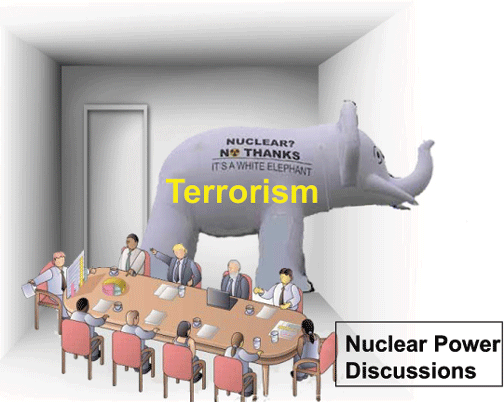 Saudis Buy 16 Nuclear Plants From The Russians, Terrorists Rejoice : http://dailycaller.com/2016/09/06/saudis-buy-16-nuclear-plants-from-the-russians-terrorists-rejoice/#ixzz4JViTS5aX ANDREW FOLLETT Energy and Environmental Reporter Saudi Arabia will buy 16 nuclear power plants from Russia for $100 billion despite terrorism concerns, according to a Monday announcement from a government-controlled nuclear power company.
Saudi Arabia has a long history of terrorist attacks within its borders, and the country itself has been accused of directly funding Islamic terrorism. The planned reactors would be incredibly vulnerable to terrorist attacks.
Saudi Arabia’s new reactors would not produce the weapons-grade plutonium necessary to make a nuclear weapon, but materials from them could be used to create dirty bombs. A dirty bomb combines radioactive material with conventional explosives that could contaminate the local area with high radiation levels for long periods of time and cause mass panic, though it would be millions of times weaker than an actual nuclear device. The Islamic State wants to steal this kind of radioactive material for a dirty bomb.
“There are prospects for cooperation in the field of nuclear energy,” Yury Ushakov, aide to Russian President Vladimir Putin, told journalists. “Our company, which has the most advanced technologies, is ready to join the project on construction of 16 nuclear power reactors in the kingdom of Saudi Arabia. The project is provided until 2030, its cost is $100 billion,”
Russia and Saudi Arabia signed an agreement last year to work together on “peaceful” nuclear energy projects. The stated purpose of these reactors is to generate electricity, power desalination plants and reduce domestic oil consumption so Saudi Arabia can sell the oil abroad. The reactors will be built by the Russian government controlled Rosatom State Nuclear Energy Cooperation.
Russia has supported the development of nuclear power in other countries with terrorism problems, such as Algeria, Iran and Egypt.
Russia continues its frantic nuclear marketing – to Jordan this time
Russia expects feasibility study for Jordan in early 2017, WNN 02 September 2016 
A
feasibility study on the construction of nuclear power plants in Jordan is to be prepared in the first half of next year, Sergey Kirienko,
director general of the Russian state nuclear corporation Rosatom said today. Kirienko spoke to reporters at the second Eastern Economic Forum that opened today in the Russian city Vladivostock…….http://tinyurl.com/hh5mgty
South Korea keen to market nuclear reactors to Kenya
Kenya pens nuclear power deal with South Korea By Anthony Mugo, Citizen Digital2 September 2016 “……Kenya Nuclear Electricity Board (KNEB) penned a Memorandum of Understanding with the Korea Electric Power Corporation, (KEPCO), Korea Nuclear Association for International Cooperation (KNAIC) and the KEPCO International Graduate School (K-INGS).
This partnership deal will help Kenya to obtain important knowledge and expertise from Korea by way of capacity building, specialized training and skills development, as well as technical support for its intended nuclear power program……….This development comes as KNEB is gearing up for feasibility studies to identify potential sites for Kenya’s nuclear power plants as well as undertaking reactor technology assessment aimed at settling on the best option in terms of nuclear power plant model.
Keter has been leading a Kenyan delegation for a four-day nuclear power cooperation visit to South Korea which included a visit to Doosan Heavy Industries and Construction Company and the Kori Nuclear Power Plant Complex in Busan.
In May 2016 during the visit by president Park Gun-Hye in the country, the ministry of energy entered into an agreement with the Korea’s ministry of Trade Industry and Energy
The agreement facilitated the exchange of technical information, three specialists as well as training opportunities for Kenyans in Korea’s vast nuclear power industry……..Other than the agreement with South Korea, Kenya has previously signed nuclear power cooperation pacts with Russia, China and Slovakia. https://citizentv.co.ke/business/kenya-pens-nuclear-power-deal-with-south-korea-139655/
Global nuclear lobby desperate to sell reactors to Asia (Europe and North America don’t want them)

IAEA sees Asia as driver of nuclear energy WNN 02 September 2016 Asia is one of the regions where nuclear energy is “high on the agenda” and could be one of the drivers for global nuclear power deployment, according to the deputy director general of the International Atomic Energy Agency (IAEA).
Speaking at a conference in Manila, Mikhail Chudakov said, “There are several member states already operating nuclear power plants, and many more aspiring states [are] exploring the potential for developing nuclear power programs in this region.”
The conference – titled The Prospects for Nuclear Power in the Asia Pacific Region – was held 30 August to 1 September. It was organized by the IAEA in collaboration with the International Framework for Nuclear Energy Cooperation and hosted by the Philippines Department of Energy. More than 120 participants attended the event, including representatives from 14 member states.
The conference covered issues such as the legal, regulatory and government support for nuclear power, the management of used fuel and radioactive waste, human resource development and capacity building, and other related technical issues……
There are currently 128 nuclear power reactors operable in five Southeast Asian countries plus Taiwan with a total generating capacity of more than 100 GWe. There are also 40 units under construction and firm plans in place to build dozens more. In addition, there are about 56 research reactors in 14 countries of the region. http://www.world-nuclear-news.org/NP-IAEA-sees-Asia-as-driver-of-nuclear-energy-0209166.html
China, USA, Russia, Japan all vying to sell nuclear reactors to Turkey
Sealing the Deal: Turkey, China Launch Nuclear Cooperation Partnership,http://sputniknews.com/middleeast/20160901/1044832084/turkey-china-nuclear.html , 1 Sep 16 The news follows last week’s ratification by the Turkish parliament of the Sino-Turkish Agreement for Cooperation in Peaceful Uses of Nuclear Energy.
Russia flogging nuclear reactors to Ghana
 Ghana, Rosatom in Talks Over Possible Future Nuclear Program, http://www.bloomberg.com/news/articles/2016-09-01/ghana-rosatom-in-talks-over-possible-future-nuclear-program Bloomberg, Andre Janse Van Vuuren, 2 Sep 16 andrejvvuuren , Russia’s nuclear utility Rosatom Corp. said it held talks with Ghana to prepare for the future use of atomic energy in the West African nation.
Ghana is preparing to accept its first review mission from the International Atomic Energy Agency as it “may be expected to become one of the countries that makes use of nuclear power” in future, Rosatom said Thursday in an e-mailed statement.
Talks are ongoing between the parties over regulation, infrastructure, training and the construction of facilities which Ghana will require to implement its own nuclear power program, Rosatom said. A next round of talks will be held at the end of September.
USA determined to market nuclear reactors to India
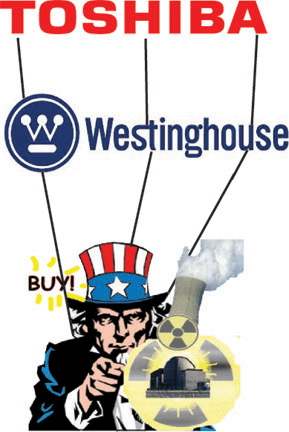 India, US set the ball rolling for Westinghouse’s nuclear plants By Dipanjan Roy Chaudhury, ET Bureau | Sep 01, 2016, NEW DELHI: India and the US moved closer to the planned construction of six reactors by American company Westinghouse at a proposed nuclear plant in Andhra Pradesh, with the two sides deciding to immediately commence the work on engineering and site design, and make an early conclusion of a competitive financing package.
More nuclear marketing. USA determined to sell nukes to India
India US to advance talks on building six nuclear reactors Under the Indo-US nuclear cooperation agreement signed in October 2008, two US companies would build 12 atomic reactors, each with a capacity of 1000 MWs. Indian Express By: PTI | New Delhi :August 30, 2016 India and the US on Tuesday agreed to move forward on building six nuclear reactors and discussed ways to enhance cooperation in the field of atomic power and space.
John Kerry, US Secretary of State, who is here for the 2nd Indo-US Strategic and Commercial Dialogue (S&CD), said his country would want its civil nuclear cooperation with India to take shape in setting up of reactors.
“We have agreed now to move forward on six Westing House nuclear reactors which will provide energy for six million Indians, not to mention the enormous number of jobs (it will create)……
Under the Indo-US nuclear cooperation agreement signed in October 2008, two US companies would build 12 atomic reactors, each with a capacity of 1000 MWs. However, the US has often raised concern about hurdles faced by American companies over a series of issues.
Its major concerns like the liability clause in the Civil Liability for Nuclear Damage Act, 2010 has already been addressed and talks between the WestingHouse Co, which will build six reactors, and the Indian side are on, sources said. The two sides are also cooperating in the field of space. http://indianexpress.com/article/india/india-news-india/india-us-to-advance-talks-on-building-six-nuclear-reactors-3004675/
China’s aggressive nuclear marketing is causing it some problems
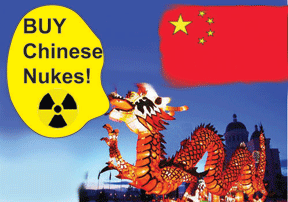 Ambitious Nuclear Expansion Is Causing Problems For China. Oil Price, By Irina Slav – Aug 29, 2016, China General Nuclear Power Corp. has been indicted by the FBI on allegations that it has been trying to illegally acquire nuclear technology secrets from its U.S. consultants. According to the indictment, the country has been working with said consultants for years – and has been pressuring them into handing over sensitive trade information – pursuing Beijing’s international nuclear expansion ambitions.
Last month, Britain’s PM Theresa May postponed the go-ahead for the construction of the country’s biggest NPP in several decades, Hinckley Point, citing concerns about Chinese interference in British national security. The Chinese company behind Hinckley Point is China General Nuclear Power Corp.
These two cases have highlighted China’s growing ambitions in the nuclear field – not just domestic but international. They have also highlighted the inherent suspicion that Western governments feel towards China. In the case with the U.S. consultants, it’s very likely that the charges are legitimate, despite CGNP issuing a statement that said it “always sticks to the principle of following laws and regulations.”……
China has very aggressive international nuclear ambitions. The country’s state-owned nuclear power companies have been working with international leaders such as France’s Areva and EDF, and Westinghouse, on developing its own nuclear reactor that Beijing hopes to start exporting on a large scale.
The reactor in question is Hualong One, and it has been exported to two countries to date, Pakistan and Argentina. Both deals include financing for the construction of the power plants from Chinese sources, which is the model China used to get into road construction and other infrastructure in Africa an the Middle East, AP notes.
CGNP’s investment in the $24-billion Hinckley Point is yet another aspect of China’s international nuclear ambitions. Experts, however, are wary of the success of this ambition. Many warn that China has yet to win the trust of its potential clients – even though no Chinese nuclear plant has so far made headlines by causing a disaster, general sentiment towards nuclear energy is suspicious, and as a result, safety standards are very stringent. In addition to this stringency, they also vary from country to country, so Chinese reactor builders will have to be very flexible in their offer if they want to convince their potential clients to become actual ones.
What’s more, this market is extremely competitive, and there are clear global leaders, such as the aforementioned French and U.S. companies. These companies have the experience, the track record, and the reputation that ensure their place at the top. China lacks all of these, so pushing into the international nuclear reactor market may prove difficult.
Still, it has enough to do at home, with 20 reactors in construction and more planned in order to raise the country’s nuclear generation capacity to at least 58 GWe over the next five to six years, and further to 150 GWe by 2030……http://oilprice.com/Energy/Energy-General/Ambitious-Nuclear-Expansion-Is-Causing-Problems-For-China.html
China marketing nuclear reactors to Saudi Arabia
China nuclear developer, Saudi’s Falih meet on nuclear cooperation By Reuters | Aug 30, 2016,BEIJING: China’s leading state nuclear project developer China National Nuclear Corp (CNNC) said it met on Monday with Saudi energy minister Khalid Al-Falih to discuss cooperation in the nuclear power sector.
CNNC chairman Sun Qin told Al-Falih that China is ready to cooperate fully with Saudi Arabia over nuclear power, according to a short statement posted on the CNNC website late on Monday.
The statement said the Saudi energy ministry welcomed CNNC in expanding its business in the kingdom, including research and development of nuclear technology, uranium mining and the building of nuclear power stations, but gave no further details. The two countries signed a memorandum of understanding on training nuclear personnel, the statement said. http://economictimes.indiatimes.com/articleshow/53924844.cms?utm_source=contentofinterest&utm_medium=text&utm_campaign=cppst
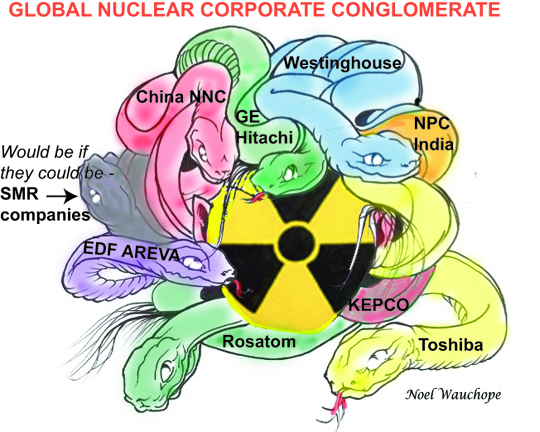
China really part of te global nuclear marketing conglomerate
China plans to make nuclear energy tech a major export, Electric Light and Power 08/25/2016 By Joe McDonald Associated Press The Hualong One, developed by two state-owned companies, is one multibillion-dollar facet of the Communist Party’s aspirations to transform China into a creator of profitable technology from mobile phones to genetics.
Still, experts say Beijing underestimates how tough it will be for its novice nuclear exporters to sell abroad. They face political hurdles, safety concerns and uncertain global demand following Japan’s Fukushima disaster.
China’s government-run nuclear industry is based on foreign technology but has spent two decades developing its own with help from Westinghouse Electric Co., France’s Areva and EDF and other partners. A separate export initiative is based on an alliance between Westinghouse and a state-owned reactor developer……..
China’s status as an important market for global suppliers gives Beijing leverage in acquiring technology. Westinghouse, which was acquired by Japan’s Toshiba Corp. in 2006, Areva and France’s EDF have had partnerships with Chinese researchers since the early 1990s.
“I see them as customers, competitors and partners,” said Jeff Benjamin, Westinghouse’s senior vice president for new plants and major projects. Other global suppliers include GE Hitachi Nuclear Energy, South Korea’s KEPCO, Canada’s Candu Energy Inc. and Russia’s Atomstroyexport.
Westinghouse transferred technology for its latest reactor, the AP1000, to China’s State Nuclear Power Technology Corp. in 2007 as part of a transaction that included the sale of four reactors.
The AP1000 became the basis for future Chinese reactor development and Westinghouse agreed to sell reactors with SNPTC. The Chinese partner, which merged with another state company to form the State Power Investment Corp. last year, also developed its own, bigger version, the CAP1400.
The two companies are in talks with Turkey about selling four reactors based on the AP1000. The AP1000 has been approved by U.S. and British regulators, Benjamin said, while the CAP1400 is just beginning the review process. “We look forward to participating in the China market for many years to come,” he said. Abroad, “there will be markets either SPIC on their own or Westinghouse on our own might not have access to, but together we can gain access.” http://www.elp.com/articles/2016/08/china-plans-to-make-nuclear-energy-tech-a-major-export.html
China seriously overestimating the global market for their nuclear reactors
Beijing is “seriously underestimating” how hard global sales will be, said Schneider. He said obstacles include strict quality controls, regulations that differ from country to country and competition from the falling cost of wind and solar.
“There is simply no market out there,” said Schneider.
Overseas, China’s nuclear companies face questions over their status as arms of the state
Here comes a new Chinese export: Nuclear reactors, CBS, 24 Aug 16 BEIJING – On a seaside field south of Shanghai, workers are constructing a nuclear reactor that’s the flagship for Beijing’s ambition to compete with the U.S., France and Russia as an exporter of atomic power technology.
The Hualong One, developed by two state-owned companies, is one multibillion-dollar facet of the Communist Party’s aspirations to transform China into a creator of profitable technology from mobile phones to genetics.
Still, experts say Beijing underestimates how tough it will be for its novice nuclear exporters to sell abroad. They face political hurdles, safety concerns and uncertain global demand following Japan’s Fukushima disaster.
China’s government-run nuclear industry is based on foreign technology but has spent two decades developing its own with help from Westinghouse Electric, France’s Areva and EDF, and other partners. A separate export initiative is based on an alliance between Westinghouse and a state-owned reactor developer.
The industry is growing fast, with 32 reactors in operation, 22 being built and more planned, according to the World Nuclear Association, an industry group. China accounted for eight of 10 reactors that started operation last year and six of eight construction starts.
Abroad, builders broke ground in Pakistan last year for a power plant using a Hualong One, supported by a $6.5 billion Chinese loan. Also last year, Argentina signed a contract to use the reactor in a $15 billion plant financed by Chinese banks.
Sales come with financing from state banks, a model that helped Chinese companies break into the market for building highways and other public works in Africa and the Middle East. State-owned companies also are lining up to invest in nuclear power plants in Britain and Romania.
“This is generating significant build-up of skills and industrial experience,” said Mycle Schneider, a nuclear energy consultant in Paris, in an email.
Still, Beijing is “seriously underestimating” how hard global sales will be, said Schneider. He said obstacles include strict quality controls, regulations that differ from country to country and competition from the falling cost of wind and solar.
“There is simply no market out there,” said Schneider.
At home, Beijing faces public unease about nuclear power following an avalanche of industrial accidents and product safety scandals.
This month, thousands of residents of Lianyungang, north of Shanghai, protested after rumors spread that a facility to process nuclear waste might be built there. Authorities said the city, home to one of China’s biggest nuclear power plants, was only one of several being considered. After more protests, they announced the search for a site was suspended.
Overseas, China’s nuclear companies face questions over their status as arms of the state………
China’s nuclear industry has yet to report a major accident but reflexive official secrecy makes it hard for outsiders to assess its safety.
Changes in Chinese-designed models based on foreign technology, such as making reactors bigger while using cooling techniques for smaller units, “raise questions about safety and the good judgment of Chinese reactor engineers,” said Edward Lyman, a nuclear power specialist for the Union of Concerned Scientists in Washington, in an email.
“It is crucial for countries importing Chinese nuclear technology to rigorously conduct their own oversight over the products they are buying,” Lyman said………http://www.cbsnews.com/news/here-comes-a-new-chinese-export-nuclear-reactors/
Russian financing, Russia selling nuclear power plant to Jordan
Jordan seeking funds for first nuclear power plant — official, Jordan Times By Mohammad Ghazal – Aug 20,2016 – AMMAN — Jordan’s first nuclear power plant could be operational by 2025, if sufficient financing is secured, the Jordan Atomic Energy Commission (JAEC) said on Thursday.
“Jordan is currently in talks with German, Czech, Chinese and Japanese companies among others to supply turbines and electrical systems for the power plant and things are going well,” said JAEC Chairman Khaled Toukan.
Thirty per cent of the $10 billion project will be financed equally by Jordan and Russia, who are partners in the project. JAEC is engaged in discussions with companies to secure the remaining 70 per cent to pay for turbines and electrical systems, Toukan said.
“If we secure finance by the end of 2017, we will be able to operate the first reactor by 2025,” he noted.
Under an agreement with Russia, Jordan plans to build a power plant with two nuclear reactors, each with a capacity of 1,000 megawatts.
Toukan was speaking at a press conference on Thursday to announce the results of a report on the programme by the International Advisory Group (IAG).
The IAG was formed in November 2015 to provide consultations on the strategy to deal with nuclear waste, and the best options and mechanisms to finance the plant.
The group includes former energy minister Khaled Shraideh and seven international industry experts. …….http://www.jordantimes.com/news/local/jordan-seeking-funds-first-nuclear-power-plant-%E2%80%94-official
-
Archives
- February 2026 (211)
- January 2026 (308)
- December 2025 (358)
- November 2025 (359)
- October 2025 (376)
- September 2025 (258)
- August 2025 (319)
- July 2025 (230)
- June 2025 (348)
- May 2025 (261)
- April 2025 (305)
- March 2025 (319)
-
Categories
- 1
- 1 NUCLEAR ISSUES
- business and costs
- climate change
- culture and arts
- ENERGY
- environment
- health
- history
- indigenous issues
- Legal
- marketing of nuclear
- media
- opposition to nuclear
- PERSONAL STORIES
- politics
- politics international
- Religion and ethics
- safety
- secrets,lies and civil liberties
- spinbuster
- technology
- Uranium
- wastes
- weapons and war
- Women
- 2 WORLD
- ACTION
- AFRICA
- Atrocities
- AUSTRALIA
- Christina's notes
- Christina's themes
- culture and arts
- Events
- Fuk 2022
- Fuk 2023
- Fukushima 2017
- Fukushima 2018
- fukushima 2019
- Fukushima 2020
- Fukushima 2021
- general
- global warming
- Humour (God we need it)
- Nuclear
- RARE EARTHS
- Reference
- resources – print
- Resources -audiovicual
- Weekly Newsletter
- World
- World Nuclear
- YouTube
-
RSS
Entries RSS
Comments RSS
 nuclear-news