Russia keen to stay ahead of Franc e, USA, in marketing nuclear energy to India
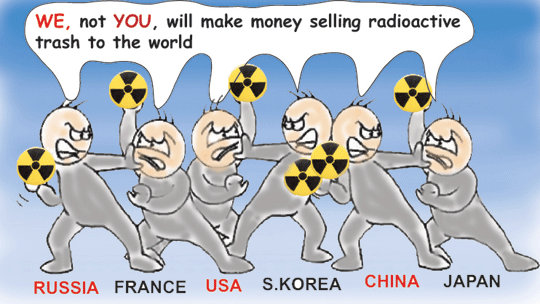
Russia Still India’s Main Partner in Nuclear Energy Despite French, US Interest Sputnik News, 18 Nov 116 India struck its thirteenth civil nuclear deal when PM Narendra Modi visited Japan. Despite many suitors ranging from the French to the Americans, Russia is India’s preferred partner and the collaboration is breaking new ground every day. New Delhi (Sputnik) – India has signed 13 civil nuclear agreements to meet its ever increasing energy needs. But India-Russia nuclear cooperation remains the oldest and the most standout partnership because Moscow firmly believed in India’s non-proliferation credentials and helped it set up modern nuclear power plants despite Western opposition because it is not a signatory to the NPT.
Analysts consider India-Japan civil nuclear deal as a landmark even. It will help India access Japan’s nuclear market as also pave the way for US and French companies to set up nuclear reactors in India. Japanese companies such as Hitachi, Toshiba and Mitsubishi have major stakes in US and French companies as GE, Westinghouse and Areva planning to construct reactors in India. Without an India-Japan nuclear deal, it was impossible for them to set up nuclear reactors in India. But the much hyped India-Japan nuclear deal is on fragile ground. According to the terms of the deal, the moment India conducts a nuclear test, Japan will terminate the nuclear deal. This will impact not only the Japanese nuclear reactors but also the US and French reactors. ……https://sputniknews.com/business/201611171047552712-russia-india-nuclear-energy/
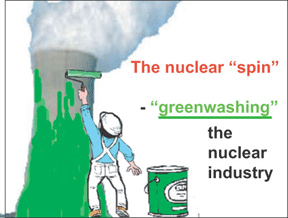
Nuclear lobby renews its pretense that it is “clean and green”
Todd Allen, senior visiting fellow for a Washington think tank called Third Way, said the industry 
needs to remake itself because “nuclear energy stands at a crossroads.”
In a separate event last week, Tim Judson, Nuclear Information and Resource Service executive director, discussed findings of a report he authored called “Too Big to Bail Out,” in which he argued that subsidizing the nuclear industry will have deep consequences.
Peter Bradford, a former U.S. Nuclear Regulatory Commission board member and a former state utility regulator in Maine and New York, said New York’s bailout is “the clearest example of a state capitulating” to the industry.
Nuclear industry looks to reshape image The Blade By | BLADE STAFF WRITER,Nov. 13, 2016 the U.S. nuclear industry is trying harder than ever to market itself as an irreplaceable ally in the war against climate change.
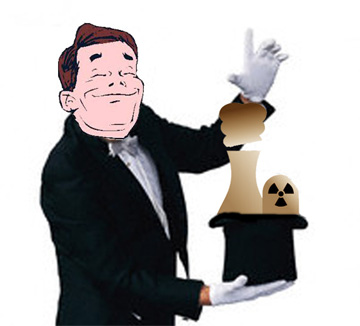 It is eager to get going on a new generation of plants that are smaller, leaner, faster, easier to manage,
and more attractive to private investors.
At stake could be the degree to which electricity ratepayers in Ohio and other states end up subsidizing the nuclear industry.
“There’s an important and continuing role for nuclear power in achieving these goals,” Kenneth N. Luongo, president of the Washington-based Partnership for Global Security, said at the start of a recent discussion between his group and the nuclear industry’s chief lobbying group on Capitol Hill, the Nuclear Energy Institute.
The Partnership for Global Security, originally incorporated in 1997 as the Russian-American Nuclear Security Advisory Council, is a think tank that promotes the convergence of 21st-century security, technology, and economic issues that affect the global nuclear industry. It has been working with the NEI on an effort called the Global Nexus Initiative, which promotes stronger public-private collaboration on nuclear issues.
“This is not a one-country issue,” Mr. Luongo said.
The NEI wants the public to reconsider how it views nuclear power ……
The NEI’s marketing campaign, though, took another hit in late October when Omaha Public Power announced it is giving up on its Fort Calhoun nuclear plant.
It is the seventh site in three years where a utility said it can no longer justify high operation costs.
Chicago-based Exelon, which owns the most nuclear plants, announced in June it will shut its single-unit Clinton and its twin-unit Quad Cities plants in Illinois in 2017 and 2018, respectively, because of poor economics.
Although Akron-based FirstEnergy Corp. has said repeatedly that its Davis-Besse and Perry plants in Ohio are safe from early closure, Davis-Besse appeared on another list of at-risk plants in a Nov. 3 report issued by the Nuclear Information and Resource Service, an anti-nuclear group in Takoma Park, Md.
Three years ago, Davis-Besse was one of several plants cited at-risk for early closure in a Vermont Law School study. FirstEnergy’s chief executive officer, Charles “Chuck” Jones, said in a conference call with analysts earlier this month that the utility giant is undertaking a 12 to 18-month “strategic review” of its competitive generation business that could lead to selling off as many as 13 power plants, including Davis-Besse and plants at its other two nuclear complexes. The latter are the Perry nuclear plant east of Cleveland, and the twin-reactor Beaver Valley nuclear complex west of Pittsburgh.
“The fact is, competitive generation is weighing down the rest of the company,” Mr. Jones said. “We do not think competitive generation is a good fit.”
Though showing a profit for its third quarter, FirstEnergy lost millions of dollars during the first nine months of 2016 and expects to end the year with a loss as well.
“We are at a crossroads,” Mr. Jones said. “We have to make some tough decisions.”
Rate request
In a highly contentious rate request argued for months before the Public Utilities Commission of Ohio, FirstEnergy originally sought a guaranteed cash flow of up to 15 years to ensure the viability of Davis-Besse and the utility’s massive coal-fired Sammis plant in southern Ohio.
Last month, after the Federal Energy Regulatory Commission struck down a modified plan, state regulators unanimously agreed to let FirstEnergy impose $132.5 million a year in new surcharges on its 1.9 million customers over the next three years. That comes to about $3 more a month for a typical residential customer. The deal is substantially less than FirstEnergy’s attempted compromise for an eight-year deal at $558 million per year for a total of $4.5 billion.
Critics have decried each proposal as a bailout, while the utility argued the money is necessary to help stabilize it.
But Ohio’s handling of FirstEnergy requests has been watched closely by other states which are undecided about the degree to which they should support nuclear power.
California, Mr. Luongo noted, has taken the position of gradually phasing out its nuclear plants, while New York decided late this summer to spend $7.6 billion over 12 years to ensure continued operation of three upstate nuclear plants……
There isn’t any uniformity regarding this issue at the moment,” Mr. Luongo said. “The market seems to be distorted, in that it is disincentivizing nuclear power.”
The discussion focused on the mix of old and new: How an investment in advanced nuclear reactors that are smaller but more efficient than today’s existing fleet could bring back the nuclear industry …..
The hope is to achieve better economies of scale with advanced nuclear reactors, standardized designs, greater involvement from private investors, and global partners.
“They’re unlikely to be wholly government financed,” Everett Redmond, NEI fuel cycle and technology policy senior director, said. “It’s key to be able to export this technology.”
Todd Allen, senior visiting fellow for a Washington think tank called Third Way, said the industry needs to remake itself because “nuclear energy stands at a crossroads.”
“Nuclear energy must evolve to keep up with changes in the energy sector,” he said……
In a separate event last week, Tim Judson, Nuclear Information and Resource Service executive director, discussed findings of a report he authored called “Too Big to Bail Out,” in which he argued that subsidizing the nuclear industry will have deep consequences.
He said his research shows half of the current fleet of nuclear plants could be uneconomical as early as 2020.
The nation should invest in other technologies instead of “obsolete infrastructure,” Mr. Judson said.
“Renewable energy and efficiency can be done for less,” he said.
Peter Bradford, a former U.S. Nuclear Regulatory Commission board member and a former state utility regulator in Maine and New York, said New York’s bailout is “the clearest example of a state capitulating” to the industry.
Contact Tom Henry at: thenry@theblade.com, 419-724-6079, or via Twitter @ecowriterohio. http://www.toledoblade.com/Energy/2016/11/13/Nuclear-industry-looks-to-reshape-image-It-can-help-meet-carbon-reduction-goals-but-can-t-compete-on-cost.html
India providing a lifeline to Japan’s desperate nuclear industry
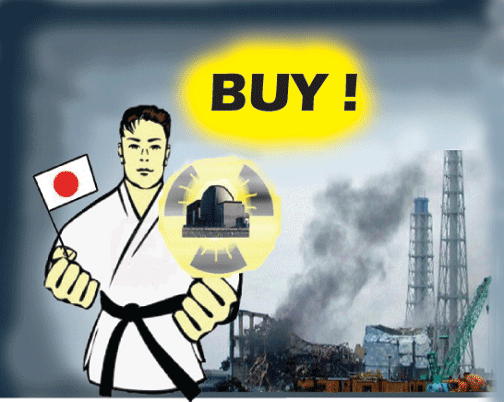 Japan’s Nuclear Industry Finds a Lifeline in India After Foundering Elsewhere, NYT, NOV. 11, 2016 TOKYO — Despite objections from antinuclear campaigners, Japan’s government cleared the way on Friday for companies that build nuclear power plants to sell their technology to India — one of the few nations planning big expansions in atomic energy — by signing a cooperation agreement with the South Asian country.
The deal is a lifeline for the Japanese nuclear power industry, which has been foundering since meltdowns at the Fukushima Daiichi power plant in northeastern Japan in 2011. Plans to build a dozen new reactors in Japan were canceled after that, a gut punch for some of the country’s biggest industrial conglomerates, including Toshiba and Hitachi.With the domestic market moribund, Japanese companies had been pursuing deals abroad, but success was elusive.
Southeast Asia now a disappointment to the global nuclear marketing drive
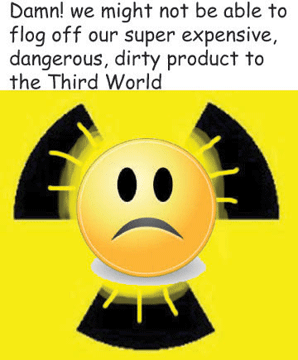 despite the news here and there about the conclusions of new nuclear cooperation agreements by ASEAN nations, it is very difficult to conceive that a nuclear power plant will actually be built in one of these countries
Nuclear Energy in Southeast Asia: A Bridge Too Far?
Hopes for a nuclear renaissance in Southeast Asia have proven overly ambitious. The Diplomat By Viet Phuong Nguyen November 09, 2016 In the late 2000s, energy forecasts began to use the term “nuclear renaissance” to refer to the fast-growing nuclear power program of China, and to the emergence of the so-called “nuclear aspirants” embarking on their first nuclear power projects. Many among these newcomers are members of the Association of Southeast Asian Nations (ASEAN). For this reason, nuclear suppliers like the United States, Russia, Japan, and South Korea have been particularly active in signing cooperation agreements with ASEAN nations or supporting these countries to explore the feasibility of nuclear energy.
China now marketing its nukes to Ukraine
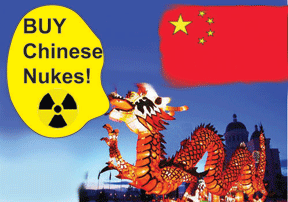 Energoatom expands cooperation with CNNP, NASA and IDOM Nuclear Services, WNN 08 November 2016 Ukrainian nuclear power plant operator Energoatom has agreed to enhance its cooperation with Chinese, Argentinian and Spanish companies – respectively, China National Nuclear Power (CNNP), Nucleoeléctrica Argentina SA (NASA) and IDOM Nuclear Services………
Representatives from CNNP, which is a subsidiary of China National Nuclear Corporation, presented its strategy to upgrade units at the Tianwan nuclear power plant. Beijing-based CNNP operates 12 nuclear power plants with an installed capacity of 9773 MWe……..http://www.world-nuclear-news.org/C-Energoatom-expands-cooperation-with-CNNP-NASA-and-IDOM-Nuclear-Services-08111601.html
China determined to export nuclear expertise: it all hangs on UK Hinkley project
Xi says UK nuclear success is crucial, Shanghai Daily, Source: Agencies | November 1, 2016, PRESIDENT Xi Jinping said yesterday China and France should properly implement the Hinkley Point C nuclear project in Britain, the first new UK nuclear power plant for two decades.
Xi made the remarks when meeting with visiting French Foreign Minister Jean-Marc Ayrault.
Chinese and French companies signed the agreement to build an 18 billion pound (US$21.9 billion) nuclear power plant at Hinkley Point C during Xi’s state visit to Britain in October last year. The CGN-led Chinese consortium and French company EDF respectively take 33.5 percent and 66.5 percent stakes.
The Hinkley Point project finally got the go-ahead after Britain’s new prime minister Theresa May delayed the deal because of national security concerns.
As part of the agreement, EDF will help CGN to gain a license to build its own nuclear reactor, Hualong, in Britain, whose nuclear regulatory regime is seen as one of the most stringent in the world.
China is keen to establish itself as an exporter of nuclear expertise so successfully building a plant in the UK would open the door to other markets……..
France and China would set up a fund for joint investment in overseas projects, he said yesterday. “Hinkley Point is a very good example of what we’re going to do together, to win contracts in third markets and in all sectors.”
The project to build the UK nuclear power plant station was “a model that we support everywhere, including in Africa and Asia,” he said.
The new joint fund would be set up soon, he said, without giving further details……….
China and France also signed a social insurance agreement yesterday that will exempt company employees assigned to work in each other’s countries from the mandatory social insurance contributions. http://www.shanghaidaily.com/nation/Xi-says-UK-nuclear-success-is-crucial/shdaily.shtml
Russia now trying to sell nuclear reactors to Myanmar
Russia, Myanmar launch working body for nuclear tech cooperation, Myanmar Times, By Aung Shin | Friday, 28 October
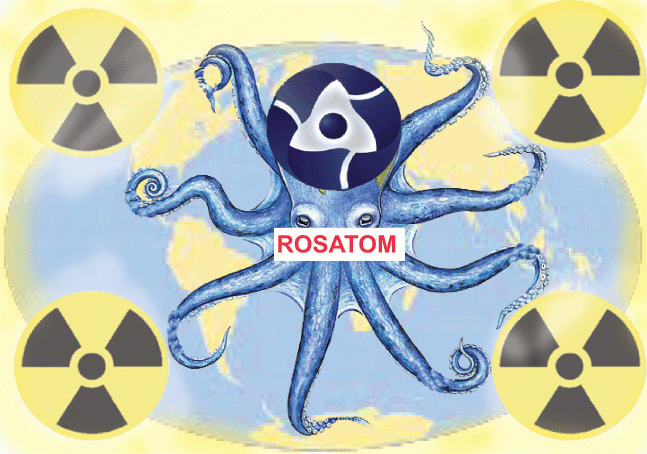
Russia and Myanmar this week established a working body for nuclear technology cooperation, according to officials.
Little is known about the bilateral taskforce, including who is involved or even how many members are included. The two countries signed a memorandum of understanding (MoU) to cooperate in nuclear technology for peaceful purposes in June last year.
According to a Ministry of Education official, the working body is another step in developing nuclear technology with the help of Russia.
Russian government officials are now in Nay Pyi Taw to discuss further steps for the MoU, said U Khin Maung Latt, director general of the Department of Technology Promotion and Coordination (DTPC) under the Ministry of Education.
“We have a roadmap of further steps for the MoU … We have discussed and agreed for further cooperation,” he said……..
Since 2007 Russia and Myanmar have had an inter-governmental agreement regarding nuclear technology and building a nuclear research centre, according to Rosatom.
Russia has trained more than 700 Myanmar students in nuclear and nuclear-related technologies in the past 10 years.
The Russian state firm is seeking potential investment opportunities in the Southeast Asian region, and is offering comprehensive nuclear technology and experience, said Rosatom officials. The company is building two nuclear power units in Vietnam, and has also won a tender for the preliminary design of a 10-megawatt reactor in Indonesia (see map).
Rosatom has two operating nuclear reactors in India and China, with two more in each country under construction. The Russian state-owned company has also won a project to construct a nuclear power plant in Bangladesh…….http://www.mmtimes.com/index.php/national-news/nay-pyi-taw/23368-russia-myanmar-launch-working-body-for-nuclear-tech-cooperation.html
South Korea’s State nuclear company expects to win $billions from marketing nuclear operations to United Arab Emirates
 S.Korea signs on to venture to operate UAE’s 1st nuclear power plant http://af.reuters.com/article/energyOilNews/idAFL3N1C32ZG
SEOUL Oct 20 (Reuters) – State-run utility Korea Electric Power Corp (KEPCO) agreed to invest $900 million in a company operating the first nuclear power plant in the United Arab Emirates, South Korea’s energy ministry said on Thursday.
KEPCO expects the deal to boost its revenue by nearly $50 billion over the next 60 years, according to a statement from the ministry.
KEPCO and Emirates Nuclear Energy Corp (ENEC) signed the deal to co-invest in the company managing and operating the UAE’s Barakah nuclear power plant for the next six decades, the ministry statement said.
In 2009, a KEPCO-led consortium won a contract to build the four 1,400 megawatt nuclear reactors that are being constructed at the Barakah plant to meet the UAE’s surging demand for electricity.
South Korea, the world’s fifth-biggest user of nuclear power, constructs and operates its reactors through KEPCO. (Reporting By Jane Chung; Editing by Tom Hogue)
Modi and Putin revive Cold War bond with lucrative agreements between two nations
 India-Russia ties boosted by defence, energy deals, Straits Times, OCT 16, 2016, Modi and Putin revive Cold War bond with lucrative agreements between two nations BENAULIM (India) • Indian Prime Minister Narendra Modi and Russian President Vladimir Putin signed a raft of lucrative defence and energy pacts yesterday following talks aimed at reinvigorating ties between the former Cold War allies.
Mr Modi hailed Mr Putin as an “old friend” after their meeting in the Indian state of Goa, where leaders of Brazil, Russia, India, China and South Africa (Brics) were gathering for a summit.
“Your leadership has provided stability and substance to our strategic partnership,” Mr Modi said alongside Mr Putin at a beachside resort, after officials signed up to 20 agreements between the two nations……..
They also signed an initial agreement on India’s purchase of Russia’s state-of-the-art S400 missile defence system, capable of shooting down multiple incoming missiles, although there were no details on a timeframe for delivery. The system would strengthen India’s defences along its borders with China and Pakistan……..
The leaders also signed a framework agreement to supply more reactors to a nuclear plant in Kudankulam in southern India, which is attempting to reduce its reliance on highly polluting coal for power. Mr Putin said that Russia would be able to build a dozen nuclear reactors in India over the next 20 years to back Mr Modi’s growth strategy for Asia’s third-largest economy, which continues to suffer power shortages………
Mr Modi was expected to hold talks with China’s President Xi Jinping late yesterday, also in the hope of boosting investment and trade. Relations, however, have been frustrated by Beijing’s decision so far to block New Delhi’s entry to a nuclear trade group, among other issues. http://www.straitstimes.com/asia/south-asia/india-russia-ties-boosted-by-defence-energy-deals
China going allout to market nuclear reactors to Asia, Europe, Africa and Middle East
China’s nuclear plant makers seek new markets along the ancient Silk Road into Asia, Europe, Africa and Middle East SCMP, 04 April, 2016
‘One belt, one road’ policy for financing and support for infrastructure projects is helping nuclear plant constructors expand into overseas markets………The policy was first proposed in 2013 to promote infrastructure construction deals overseas along with goods and services trade along the ancient Silk Road from China to Europe and along the ancient maritime trade route linking China to southeast Asia, the Middle East and Africa. The state is offering financing at a time when China’s economy grew at the slowest rate in 25 years and its industry faces severe overcapacity problems.
Beijing has encouraged local firms to become involved in infrastructure projects in southeast Asia, Europe and Africa. Chinese nuclear reactor builders are a growing force in the global nuclear industry.
“The export of nuclear reactors will become one of the key pillars for executing China’s one belt, one road strategy,” Zheshang Securities analyst Zheng Dandan said………
Three Chinese state-backed firms are actively pursuing opportunities to export their reactor construction expertise, especially in developing nations that do not have their own construction capabilities.
Beijing-based projects developer China National Nuclear Corp (CNNC) chairman Sun Qin was quoted by state media China News Service last month as saying that 80 per cent of the up to 300 new reactors projected to be built by 2030 globally could be in ‘one belt, one road’ nations.
CNNC wants to build 30 reactors in such nations, and will use Argentina as a base to develop the South American market, Algeria for reaching out to the greater African market and Pakistan where it is building a project to develop the Asian market, Sun was reported as saying.
State Power Investment, formed via the merger of one of the nation’s “big five” power generators China Power Investment and general contractor State Nuclear Power Technology last year, is also pursuing overseas projects.
It has partnered with the US nuclear technology powerhouse Westinghouse to negotiate a potential deal to build a nuclear power project in Turkey. It has also pursued opportunities in South Africa.
Shenzhen-based projects developer China General Nuclear Power is working towards winning potential projects in Britain, Kenya and southeast Asia. It won one bid to build a plant in Romania.
The mainland leadership has made the globalisation of Chinese firms a key part of its economic reform plans, looking to establish the nation as a major provider of value-added and high-end goods and services. In a series of articles this week, the South China Morning Post examines the key industries targeting overseas expansion, beginning with the nuclear power industry.
Russia spreading its influence, seeking lithium deal with Chile
Russian nuclear firm Rosatom eyes Chilean lithium | SANTIAGO 2 Oct 16 Russian state nuclear power plant giant Rosatom sent lobbyists to meet with the Chilean government and discuss “collaboration in possible lithium projects,” a government website revealed at the weekend.
Four representatives of the company met with Mining Deputy Minister Igancio Moreno in September, according to information published on the government’s lobbying transparent website.
Rosatom has signed billions of dollars worth of overseas contracts and is seen as a tool for Russia to wield political influence abroad.
This year, it signed a contract to build a nuclear research center in Chile’s neighbor Bolivia. It also has interests in several other Latin American countries.
Chile itself has no nuclear power plants and is not expected to build any, as it is one of the world’s most seismically active countries and is regularly shaken by strong earthquakes.
But Chile does have one of the world’s most plentiful supplies of lithium, a mineral used in rechargeable batteries and electronics that has seen rocketing interest and a sharp price rise in recent months on hopes of an electric vehicle boom.
Lithium also has applications for the nuclear industry. As a consequence, the Chilean government considers lithium a “strategic mineral,” leasing out rights and limiting its production.
Most lithium extraction projects involve partnership with the government and state copper miner Codelco [COBRE.UL] is expected to decide on a partner to develop its own lithium assets in the first quarter of next year.
Japan and India to make nuclear marketing deal in November
 Japan, India to sign nuclear cooperation deal in November – report http://www.firstpost.com/fwire/japan-india-to-sign-nuclear-cooperation-deal-in-november-report-reuters-3030874.html First Post 2 Oct 16 Reuters TOKYO Japan and India are likely to sign a civil nuclear cooperation pact during a visit to Japan by Indian Prime Minister Narendra Modi in mid-November, the Mainichi newspaper reported on Saturday.The governments of Asia’s second- and third-largest economies are leaning toward holding a summit meeting between Modi and his Japanese counterpart Shinzo Abe, the report said, citing unidentified diplomatic sources from both nations.The two leaders last December reached a basic agreement for cooperation in the peaceful use of nuclear energy, but they stopped short of signing the agreement, citing outstanding technical and legal differences.Japan, the only country to have suffered a nuclear attack, has been demanding additional non-proliferation guarantees from India, which has a nuclear weapons programme, before exporting nuclear reactors.
India and Japan have been negotiating the nuclear energy deal since Japan’s ally, the United States, opened the way for nuclear commerce with India, which has shunned the global Non-Proliferation Treaty (NPT).
The two countries have reached a basic agreement during the working level negotiations that Japan would halt cooperation immediately if India conducted a nuclear test, the report added.A final deal with Japan would benefit U.S. firms. India has already given land for nuclear plants to GE-Hitachi – which is an alliance between the U.S. and Japanese firms – and to Toshiba’s Westinghouse Electric Company.
(Reporting by Osamu Tsukimori; Editing by Christian Schmollinger)
Japan busting to market nuclear reactors to India, and busting the Nuclear Non-Proliferation Treaty
Abe, Modi look to ink civil nuclear pact at November meeting, Japan Times, KYODO, 30 Sept 16 A meeting between Prime Minister Shinzo Abe and his Indian counterpart Narendra Modi is set to be held in Tokyo in mid-November, with a civil nuclear cooperation pact likely to be signed, a source said Friday.
The pact would pave the way for Japan to export nuclear power plant technology to the fast-growing Asian economy. It would be Japan’s first signing of a civil nuclear cooperation pact with a country which has not joined the Nuclear Non-Proliferation Treaty…….
Earlier, other diplomatic sources said that under a provision in the pact, Japan will permit Indian power producers to reprocess spent fuel at designated facilities on the condition the country accepts comprehensive inspections by the International Atomic Energy Agency…….
Following the signing of the treaty, the Japanese government will seek swift approval from the Diet in a bid to promote Japanese companies’ participation in construction of such power plants in India……http://www.japantimes.co.jp/news/2016/09/30/national/japan-india-look-ink-civil-nuclear-pact-november-meeting/#.V-7jmIh97Gg
Russia’s nuclear marketing: sell nukes, then sell the clean-up, too!
Making nuclear power plants safe after they shut down RBTH, September 24, 2016 ANDREI RETINGER, The problems of dealing with spent nuclear fuel, radioactive waste and the decommissioning of nuclear facilities (experts call it “back end”) did not immediately become apparent to the countries developing their nuclear industries. But now the world market for back end services is booming and its value is estimated to total about $347 billion until 2030.
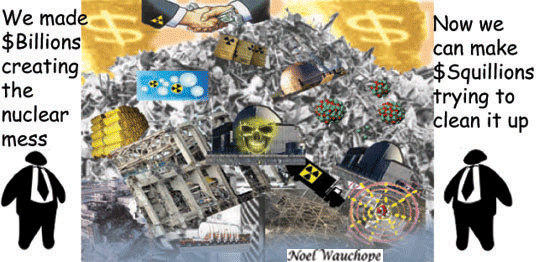
A number of nuclear facilities in the UK are scheduled for decommissioning, and all the 17 nuclear power plants that are still operating in Germany are due to close down by 2020. Japan must rehabilitate the areas after the accident at Fukushima, and the United States and Russia need to solve the problems of radioactive waste storage and reprocessing. Not all countries have the ability to solve these problems, but Russian technologies and facilities can come to their aid…..
in 2008, Russia was faced with a catastrophic situation because of the accumulation of radioactive waste and spent fuel remaining from the time of the creation of nuclear weapons and the Cold War. Storage sites were almost full and had not been provided with reliable insulation, creating a threat to people and the environment.
In this situation, Russia had no choice but to tackle the problem urgently. In 2007, it adopted a state program on nuclear and radiation safety, which was developed by the Rosatom State Atomic Energy Corporation. Then it approved a law on radioactive waste management, taking into account the latest standards and requirements………https://rbth.com/science_and_tech/2016/09/24/making-nuclear-power-plants-safe-after-they-shut-down_632711
Canada’s SNC Lavalin marketing nuclear reactors to China
SNC-Lavalin to build Candu nuclear reactor for China, BERTRAND MAROTTE, MONTREAL — The Globe and Mail, Sep. 22, 2016 SNC-Lavalin Group Inc. is closing in on its goal of becoming a major player in China’s thriving nuclear-energy industry with an agreement for the development in that country of the next generation of Candu reactors.
The Montreal-based global engineering giant said on Thursday it has an agreement in principle for a joint venture with state-owned atomic-power and weapons company China National Nuclear Corp. and manufacturing conglomerate Shanghai Electric Group Co. Ltd. to design, market and build the Advanced Fuel Candu Reactor (AFCR).
SNC signed an initial memorandum of understanding with CNNC to pursue power generation, mining and nuclear-related environmental projects around the world more than two years ago.
SNC bought the Candu unit from Ottawa for $15-million in 2011. But Candu has had a poor track record of selling its technology abroad and questions have also been raised over its cost-effectiveness.
China, however, appears to have endorsed the concept of building reactors that run on recycled uranium…….
The proposed joint venture follows the signing of a framework agreement in 2014 and is subject to government and regulatory approvals, SNC said. http://www.theglobeandmail.com/report-on-business/industry-news/energy-and-resources/snc-lavalin-strikes-deal-to-build-nuclear-reactors-in-china/article32000350/
1 This Month


Shut down the radiation-damaged Heysham nuclear reactors now
To see nuclear-related stories in greater depth and intensity – go to https://nuclearinformation.wordpress.com

Say No to NASA’s Reckless Nuclear Reactor on the Moon
Say No to NASA’s Reckless Nuclear Reactor on the Moon
-
Archives
- October 2026 (256)
- September 2026 (339)
- August 2026 (330)
- July 2026 (355)
- June 2026 (287)
- May 2026 (306)
- April 2026 (356)
- March 2026 (251)
- February 2026 (267)
- January 2026 (308)
- December 2025 (358)
- November 2025 (359)
-
Categories
- 1
- 1 NUCLEAR ISSUES
- business and costs
- climate change
- culture and arts
- ENERGY
- environment
- health
- history
- indigenous issues
- Legal
- marketing of nuclear
- media
- opposition to nuclear
- PERSONAL STORIES
- politics
- politics international
- Religion and ethics
- safety
- secrets,lies and civil liberties
- spinbuster
- technology
- Uranium
- wastes
- weapons and war
- Women
- 2 WORLD
- ACTION
- AFRICA
- Atrocities
- AUSTRALIA
- Christina's notes
- Christina's themes
- culture and arts
- Events
- Fuk 2022
- Fuk 2023
- Fukushima 2017
- Fukushima 2018
- fukushima 2019
- Fukushima 2020
- Fukushima 2021
- general
- global warming
- Humour (God we need it)
- Nuclear
- RARE EARTHS
- Reference
- resources – print
- Resources -audiovicual
- Weekly Newsletter
- World
- World Nuclear
- YouTube
-
RSS
Entries RSS
Comments RSS

