Only government-owned nuclear companies have responded to Eskom on nuclear marketing

 Strong response on Nuclear – Eskom , AFRICAN NEWS AGENCY 1 February 2017 Johannesburg – Eskom said on Wednesday that it was receiving positive response from the market to the Request for Information (RFI) issued in relation to the proposed South African Nuclear New Build Programme.
Russia keen to market nuclear power to South Africa
 Russia’s Rosatom submits bid for South African nuclear project – TASS, Reuters Jan 24 Russian state nuclear agency Rosatom has submitted a bid for a nuclear power project in South Africa, TASS news agency cited the company’s General Director Alexei Likhachev as saying on Tuesday.
Rosatom had been considered the leading candidate for a tender to build 9.6 gigawatts of nuclear power capacity in South Africa by 2030, but South African nuclear state agency Necsa said last year it was no longer “the frontrunner”. (Reporting by Alexander Winning; Writing by Jack Stubbs) http://www.reuters.com/article/russia-safrica-nuclear-idUSR4N1F7023
South Korea to market nuclear fuel to United Arab Emirates
 UAE gets licence to transport, store nuclear fuel, Gulf News 22 Jan 17
Nuclear fuel to be shipped from South Korea to the UAE before being transported to the Barakah Nuclear Power Plant “….the Federal Authority for Nuclear Regulation (FANR) announced on Sunday that it approved the licensing for transporting and storing nuclear fuel at the Barakah Nuclear Power Plant.
The two licences have been granted to the Emirates Nuclear Energy Corporation (ENEC) and Nawah Energy Company respectively, with the former getting the licence to transport the nuclear fuel, and the latter getting the licence to store the nuclear fuel at the Barakah site…..
Ian Grant, Deputy Director General for Operations at FANR, explained that the nuclear fuel would be shipped in transport casks from South Korea to the UAE, and then loaded onto trucks to transport the fuel to the nuclear reactor site.
“The fuel assemblies are loaded into transport casks and shipped from the Republic of Korea, [afterwards they are] trucked by road from the UAE port to the Barakah site. The transport casks are unloaded, checked and opened. [The] fuel assemblies are inspected individually and moved to the storage locations.”……http://gulfnews.com/news/uae/environment/uae-gets-licence-to-transport-store-nuclear-fuel-1.1966008
Russia trying to sell nuclear power to Kuwait
Russia, Kuwait Discuss Possible Construction of Nuclear Power Plant MOSCOW (Sputnik) – Russia and Kuwait discussed possible construction of a nuclear power plant (NPP) as well as cooperation in the spheres of petroleum services and gas, Russian Energy Minister Alexander Novak said in an interview with the Rossiya-24 broadcaster on Sunday…….https://sputniknews.com/business/201701221049880931-russia-kuwait-nuclear-power-plant/
Russia to lock Bangladesh into a 20 year big nuclear power debt
Russia extends $11.38 bln loan to Bangladesh to build nuclear power plant http://tass.com/economy/925025 January 13 Bangladesh will repay the actually spent loan in equal six-month installments over a twenty year period MOSCOW, January 13. /TASS/. Russia’s government has extended a $11.38 billion loan to Bangladesh to build the Rooppur nuclear power plant. The relevant document was published on the government’s website containing legal information.
According to the draft inter-governmental agreement, the loan will be used from 2017 to 2024. Bangladesh will repay the actually spent loan in equal six-month installments over a twenty year period. The first installment will be paid out on March 15, 2017.
Two units of the Rooppur nuclear power plant, with a capacity of 1,200 MW each, which are being built with Russia’s assistance, are planned to be put into operation in 2022 and 2023.
In mid-December 2015, Russia’s Rosatom State Atomic Energy Corporation signed an EPC contract for a nuclear power plant in Bangladesh.
The construction work is being done in accordance with the inter-governmental agreement on cooperation in building a nuclear power plant in Bangladesh, dated 2011. The nuclear power plant will be located on the eastern bank of the Ganges River, 160 kilometers from the country’s capital of Dhaka.
South Korea might join the throng marketing their costly nuclear reactors to Britain
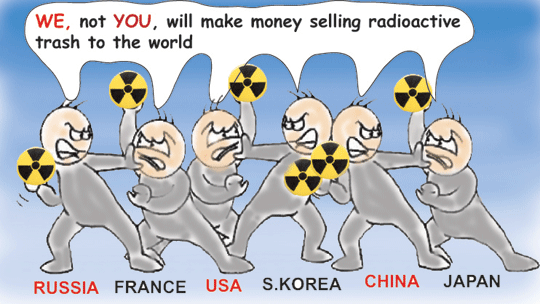 Hyung-hwan discussed cooperation on British nuclear energy projects in a meeting in London on Thursday with Britain’s business minister Greg Clark, South Korea’s energy ministry said in a statement.
The statement from Seoul didn’t disclose details of discussions on nuclear energy, but said the two countries will hold a follow-up meeting in the first half of next year.
A British government statement issued said the two countries underlined a commitment at the meeting to keep working together on science, innovation and technology, without mentioning nuclear power.
Korea, Asia’s fourth-largest economy and the world’s fifth-biggest user of nuclear power, is keen to export its nuclear reactor technology, developed through state-run utility Korea Electric Power Corp (KEPCO).
Earlier this year, Britain gave the green light to the $24 billion Hinkley Point C project, its first new nuclear power plant in decades.
Along with that project, NuGen, a joint venture between Toshiba and French utility company Engie, plans to build three reactors at the Moorside site on the coast of Cumbria, in northwest England.
According to Seoul’s statement on Friday, Korea’s energy minister also had a meeting with NuGen chief Tom Samson during his British visit. The minister said Korean participation in Nugen projects would contribute to their success.
Earlier this year a person familiar with the situation told Reuters KEPCO had engaged in talks with Toshiba and Engie about buying a stake NuGen. A NuGen spokesman declined to comment on whether talks were taking place with KEPCO, which also declined to comment.
(Reporting by Jane Chung; Editing by Kenneth Maxwell)
China’s global nuclear marketing drive -= now looking to Bulgaria
China eyes nuclear project in Bulgaria http://www.euractiv.com/section/energy/news/china-eyes-nuclear-project-in-bulgaria/ A delegation from the China National Nuclear Corporation (CNNC), the country’s largest state energy company, visited Sofia and met with Bulgarian Prime Minister Boyko Borissov, to possibly resuscitate a shelved nuclear power plant project.The Belene nuclear power plant, situated near the Danube, was frozen in 2012, reportedly due to a lack of funds.
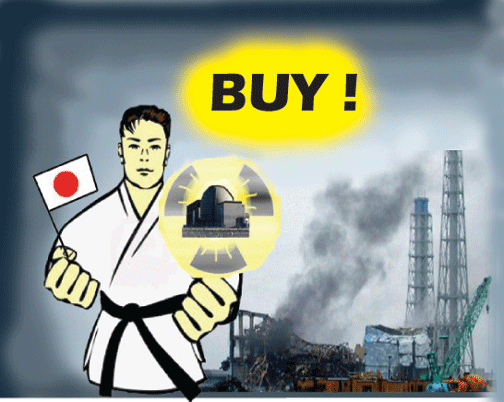
Mitsubishi takes risk of investing in Areva , hoping to export nuclear reactors
 Mitsubishi Heavy, Japan Nuclear Fuel to invest in struggling Areva http://asia.nikkei.com/Business/Deals/Mitsubishi-Heavy-Japan-Nuclear-Fuel-to-invest-in-struggling-Areva, 7 Dec 16,
Japanese companies eye nuclear power plant exports amid low domestic demend TOKYO — Mitsubishi Heavy Industries and Japan Nuclear Fuel are finalizing plans to invest in French nuclear giant Areva, which is currently in the throes of restructuring.
The two companies will take stakes in Areva to a combined 10% by jointly injecting 40 billion yen to 50 billion yen ($352 million to $440 million) by January 2017.
Along with Mitsubishi Heavy and Japan Nuclear Fuel, China National Nuclear Corp. may also become an investor.
Mitsubishi Heavy has already revealed plans to invest in Areva and a subsidiary while holding talks with the French government and the struggling company over the deal.
Areva has booked significant losses following a series of delays and cancellations to plant-construction projects and now finds itself going through a financial crisis.
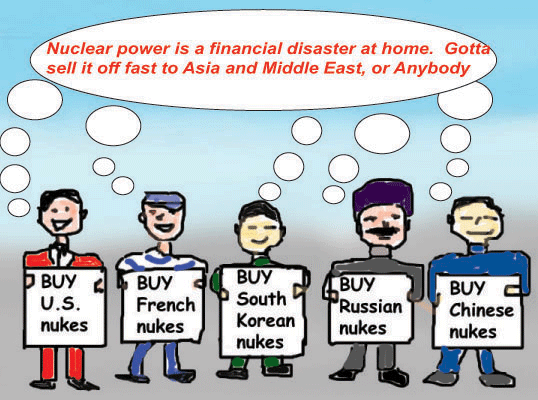
Nuclear marketing: sellers keen to finance Kenya ?
Who’s Paying For This $5 Billion Nuclear Plant In Kenya?,Daily Caller, ANDREW FOLLETT
Energy and Science Reporter, 1 Dec 16 Kenya is getting ready to start building a $5 billion dollar nuclear power plant, but its unclear where the money is coming from.
Kenya’s first nuclear reactor is scheduled to be completed by 2027 and will generate an estimated 1,000 megawatts of power. Kenya has signed agreements with China for the larger country to help finance and construct similar reactors. China’s state-controlled nuclear companies have already offered technical assistance in handling the nuclear fuel Kenya will need.
Another potential funding source for the reactor is South Korea, which signed agreements to collaborate on designing, operating and financing Kenyan reactors.
“When we talk of 1,000 megawatts, we are talking half of the capacity we have right now in the country,” Collins Gordon Juma, CEO of Kenya’s Nuclear Electricity Board, told Bloomberg Markets Tuesday. “It is very expensive, so we are looking at several funding options. We are speaking to various governments.”……..
Kenya is one of the most stable countries in East Africa, but the country has a serious problem with Islamic terrorism. In 1998, 200 people were killed when al-Qaida affiliate Egyptian Islamic Jihad bombed the U.S. embassy in the country. Another 13 were killed in an attack on an Israeli-owned Paradise hotel in 2002. More recently, the militant Islamic terror group, Al-Shabaab, killed 67 people in an attack on a shopping mall in 2013.
The country’s new reactor would not produce the weapons-grade plutonium necessary to make a nuclear weapon, but materials from them could be used to create dirty bombs. A dirty bomb combines radioactive material with conventional explosives that could contaminate the local area with high radiation levels for long periods of time and cause mass panic, though it would be millions of times weaker than an actual nuclear device. The Islamic State wants to steal this kind of radioactive material for a dirty bomb.
Very dubious market for nuclear power in South East Asia
 The limited role for nuclear can be explained by the high upfront capital costs, limited access to financing, and uneven and tepid public support in the wake of the Fukushima Daiichi nuclear accident. Public opposition has been especially evident in Indonesia, Malaysia, Philippines and Thailand.”
former Rosatom head Sergey Kirienko’s team has been excellent at drawing up and signing nonbinding nuclear agreements … Actually building nuclear plants seems to be beyond them.
Vietnam’s amazing nuclear journey – why it ended, what it means for South East Asia, Energy Post, November 29, 2016 by Jim Green On November 10, Vietnam took the historic decision to scrap its nuclear power program, after many decades of nuclear preparations, up to a ground-breaking ceremony at the first proposed nuclear site in the country in 2014. Jim Green, editor of Nuclear Monitor, published by WISE (World Information Service on Energy), tells the amazing story of nuclear power in Vietnam – and discusses what the Vietnamese decision means for the prospects of nuclear power in South East Asia. Courtesy of Nuclear Monitor.
2016 cancellation
On November 10, Duong Quang Thanh, CEO of staterun Electricity of Vietnam, said the government would propose the cancellation of plans for reactors at the two Ninh Thuan sites to the National Assembly. He added that nuclear power was not included (or budgeted for) in the power plan which runs until 2030 and had already been approved by Prime Minister Nguyen Xuan Phuc.
The National Assembly voted on November 22 to support the government’s decision to abandon plans to build nuclear power plants. Energy analyst Mycle Schneider said: “Vietnam is only the latest in a long list of countries, including more recently Chile and Indonesia, that have postponed indefinitely or abandoned entirely their plans for nuclear new-build.”
The decision to abandon nuclear power was primarily based on economics. Duong Quang Thanh said nuclear power is “not economically viable because of other cheaper sources of power.”
Le Hong Tinh, vice-chair of the National Assembly Committee for Science, Technology and Environment, said the estimated cost of four reactors at the two sites in Ninh Thuan province had nearly doubled to VND400 trillion (US$18 bn; €17.9 bn). The estimated price of nuclear-generated electricity had increased from 4‒4.5 US cents / kwh to 8 cents / kwh. Vietnam has spent millions of dollars on the project so far, Tinh said, but continuing the program would add more pressure to the already high public debt.
Another media report states that Japanese and Russian consultants said that the cost has escalated from the original estimate of US$10 billion to US$27 billion (€9.5‒25.6 bn). “The plants will have to sell power at around 8.65 cents a kWh, which is almost twice the rate approved in the project license and is not competitive at all,” according to the VN Express newspaper.
Vietnam’s rising public debt, which is nearing the government’s ceiling of 65% of GDP, was another reason for the program’s cancellation, saidCao Si Kiem, a National Assembly member and former governor of the central bank………
A May 2016 report by WWF-Vietnam and Vietnam Sustainable Energy Alliance (VSEA) finds that 100% of Vietnam’s power can be generated by renewable energy technologies by 2050. There are many available renewable power sources in Vietnam including solar, wind, geothermal heat, biomass and ocean energy. The report contrasts three scenarios: business as usual (with only modest growth of renewables), a Sustainable Energy Scenario (81% renewable power generation by 2050) and an Advanced Sustainable Energy Scenario (100%).
Nuclear power in South East Asia – or not
A 2015 International Energy Agency report anticipates that nuclear power will account for just 1% of electricity generation in south-east Asia by 2040.
The report states: “All countries in Southeast Asia that are interested in deploying nuclear power face significant challenges. These include sourcing the necessary capital on favourable terms, creation of legal and regulatory frameworks, compliance with international norms and regulations, sourcing and training of skilled technical staff and regulators, and ensuring public support. … The limited role for nuclear can be explained by the high upfront capital costs, limited access to financing, and uneven and tepid public support in the wake of the Fukushima Daiichi nuclear accident. Public opposition has been especially evident in Indonesia, Malaysia, Philippines and Thailand.”
A June 2016 media article began: “Rosatom, Russia’s state nuclear-energy agency, is bullish on the outlook of its business in Southeast Asia after the speedy development of a project in Vietnam and a range of agreements with every country in the region except Singapore, the Philippines and Brunei.”
Nikolay Drozdov, director of Rosatom’s international business department, said Rosatom is focusing a lot of attention on south-east Asia, reflected by the decision to establish a regional headquarters in Singapore.
Russia has nuclear cooperation agreements with seven countries in south-east Asia ‒ Vietnam, Indonesia, Malaysia, Thailand, Cambodia, Myanmar and Laos. But not one of those seven countries ‒ or any other country in south-east Asia ‒ has nuclear power plants (the only exception is the Bataan reactor in the Philippines, built but never operated) and not one is likely to in the foreseeable future. Nor are other nuclear vendors likely to succeed where Russia is failing.
Drozdov said that after the (stalled) nuclear power project in Vietnam, Indonesia and Malaysia would likely be the next countries in the region to develop nuclear power.2 But Indonesia’s situation is much the same as Vietnam’s ‒ decades of wasted efforts with little to show for it (and the same could be said about Thailand).
Malaysia’s consideration of nuclear power is preliminary. Why would Russia be making such efforts in southeast Asia given that nuclear power prospects in the region are so dim? The answer may lie with domestic Russian politics. Given Rosatom’s astonishing industry in lining up non-binding nuclear agreements with over 20 countries ‒ ‘paper power plants’ as Vladimir Slivyak calls them ‒ we can only assume that such agreements are looked on favorably by the Russian government.
Slivyak writes: “These ‘orders’ are not contracts specifying delivery dates, costs and a clear timescale for loan repayments (in most cases the money lent by Russia for power plant construction comes with a repayment date). Eighty to ninety per cent of these reported arrangements are agreements in principle that are vague on details, and in the overwhelming majority of cases the contracts aren’t worth the paper they’re printed on. … So it is clear that [former Rosatom head Sergey] Kirienko’s team has been excellent at drawing up and signing nonbinding nuclear agreements … Actually building nuclear plants seems to be beyond them.” http://energypost.eu/vietnam-dumps-nuclear-power-economic-reasons-rest-south-east-asia-may-follow/
Japan’s nuclear marketing disappointment: Vietnam to cancel reactor order
Japan’s nuclear export ambitions hit wall as Vietnam set to rip up reactor order Reiters, | TOKYO/HANOI, 17 Nov 16
Vietnam is poised to abandon plans for Japanese firms to build a multi-billion dollar nuclear power plant, damaging Prime Minister Shinzo Abe’s drive to begin exporting reactors after the Fukushima disaster left the industry in deep-freeze at home.
The Japanese government said in a statement this week that it had been informed by Vietnamese Deputy Prime Minister Trinh Dinh Dung that Hanoi was close to a decision to cancel the project. Japan’s Minister of Economy, Trade and Industry, Hiroshige Seko, described the move as “very regrettable.”
Vietnam’s decision, attributed to lower demand forecasts and rising costs as well as safety concerns, also deals a broader blow to the global nuclear business. Countries from Germany to Indonesia have decided to either pull out of nuclear energy or cancel development plans in the wake of the Fukushima nuclear disaster in 2011, the world’s worst since Chernobyl in 1986.
Though it has sought contracts for years, Japan has never led a nuclear project to completion overseas and Abe has lent his office’s prestige to attempts to win contracts, most recently in Turkey. The dented ambitions for exports come at a time when Japan is struggling to restart dozens of reactors shut down in the wake of Fukushima.
“This is a major blow to Japanese ambitions to, finally, export their first nuclear reactors,” said Schneider…….
DEMAND GROWTH EASING
Vietnam’s parliament is set next Tuesday to formally approve scrapping the Japanese deal, as well as the country’s first nuclear project, which was awarded to Russia’s Rosatom, according to state media. Rosatom said it would not comment until the Vietnam parliament formalized the decision.
The Japanese and Russian nuclear plants were supposed to have been located in central Ninh Thuan province…….. http://www.reuters.com/article/us-japan-vietnam-nuclearpower-idUSKBN13D0RK
Russia keen to stay ahead of Franc e, USA, in marketing nuclear energy to India
Russia Still India’s Main Partner in Nuclear Energy Despite French, US Interest Sputnik News, 18 Nov 116 India struck its thirteenth civil nuclear deal when PM Narendra Modi visited Japan. Despite many suitors ranging from the French to the Americans, Russia is India’s preferred partner and the collaboration is breaking new ground every day. New Delhi (Sputnik) – India has signed 13 civil nuclear agreements to meet its ever increasing energy needs. But India-Russia nuclear cooperation remains the oldest and the most standout partnership because Moscow firmly believed in India’s non-proliferation credentials and helped it set up modern nuclear power plants despite Western opposition because it is not a signatory to the NPT.
Analysts consider India-Japan civil nuclear deal as a landmark even. It will help India access Japan’s nuclear market as also pave the way for US and French companies to set up nuclear reactors in India. Japanese companies such as Hitachi, Toshiba and Mitsubishi have major stakes in US and French companies as GE, Westinghouse and Areva planning to construct reactors in India. Without an India-Japan nuclear deal, it was impossible for them to set up nuclear reactors in India. But the much hyped India-Japan nuclear deal is on fragile ground. According to the terms of the deal, the moment India conducts a nuclear test, Japan will terminate the nuclear deal. This will impact not only the Japanese nuclear reactors but also the US and French reactors. ……https://sputniknews.com/business/201611171047552712-russia-india-nuclear-energy/
Nuclear lobby renews its pretense that it is “clean and green”
Todd Allen, senior visiting fellow for a Washington think tank called Third Way, said the industry 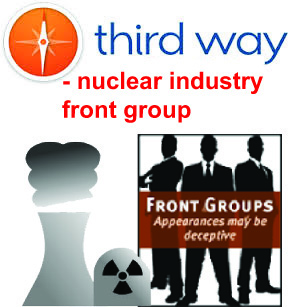
needs to remake itself because “nuclear energy stands at a crossroads.”
In a separate event last week, Tim Judson, Nuclear Information and Resource Service executive director, discussed findings of a report he authored called “Too Big to Bail Out,” in which he argued that subsidizing the nuclear industry will have deep consequences.
Peter Bradford, a former U.S. Nuclear Regulatory Commission board member and a former state utility regulator in Maine and New York, said New York’s bailout is “the clearest example of a state capitulating” to the industry.
Nuclear industry looks to reshape image The Blade By | BLADE STAFF WRITER,Nov. 13, 2016 the U.S. nuclear industry is trying harder than ever to market itself as an irreplaceable ally in the war against climate change.
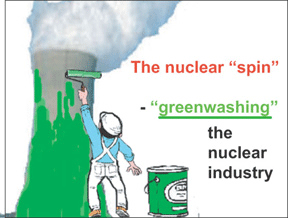
 It is eager to get going on a new generation of plants that are smaller, leaner, faster, easier to manage,
and more attractive to private investors.
At stake could be the degree to which electricity ratepayers in Ohio and other states end up subsidizing the nuclear industry.
“There’s an important and continuing role for nuclear power in achieving these goals,” Kenneth N. Luongo, president of the Washington-based Partnership for Global Security, said at the start of a recent discussion between his group and the nuclear industry’s chief lobbying group on Capitol Hill, the Nuclear Energy Institute.
The Partnership for Global Security, originally incorporated in 1997 as the Russian-American Nuclear Security Advisory Council, is a think tank that promotes the convergence of 21st-century security, technology, and economic issues that affect the global nuclear industry. It has been working with the NEI on an effort called the Global Nexus Initiative, which promotes stronger public-private collaboration on nuclear issues.
“This is not a one-country issue,” Mr. Luongo said.
The NEI wants the public to reconsider how it views nuclear power ……
The NEI’s marketing campaign, though, took another hit in late October when Omaha Public Power announced it is giving up on its Fort Calhoun nuclear plant.
It is the seventh site in three years where a utility said it can no longer justify high operation costs.
Chicago-based Exelon, which owns the most nuclear plants, announced in June it will shut its single-unit Clinton and its twin-unit Quad Cities plants in Illinois in 2017 and 2018, respectively, because of poor economics.
Although Akron-based FirstEnergy Corp. has said repeatedly that its Davis-Besse and Perry plants in Ohio are safe from early closure, Davis-Besse appeared on another list of at-risk plants in a Nov. 3 report issued by the Nuclear Information and Resource Service, an anti-nuclear group in Takoma Park, Md.
Three years ago, Davis-Besse was one of several plants cited at-risk for early closure in a Vermont Law School study. FirstEnergy’s chief executive officer, Charles “Chuck” Jones, said in a conference call with analysts earlier this month that the utility giant is undertaking a 12 to 18-month “strategic review” of its competitive generation business that could lead to selling off as many as 13 power plants, including Davis-Besse and plants at its other two nuclear complexes. The latter are the Perry nuclear plant east of Cleveland, and the twin-reactor Beaver Valley nuclear complex west of Pittsburgh.
“The fact is, competitive generation is weighing down the rest of the company,” Mr. Jones said. “We do not think competitive generation is a good fit.”
Though showing a profit for its third quarter, FirstEnergy lost millions of dollars during the first nine months of 2016 and expects to end the year with a loss as well.
“We are at a crossroads,” Mr. Jones said. “We have to make some tough decisions.”
Rate request
In a highly contentious rate request argued for months before the Public Utilities Commission of Ohio, FirstEnergy originally sought a guaranteed cash flow of up to 15 years to ensure the viability of Davis-Besse and the utility’s massive coal-fired Sammis plant in southern Ohio.
Last month, after the Federal Energy Regulatory Commission struck down a modified plan, state regulators unanimously agreed to let FirstEnergy impose $132.5 million a year in new surcharges on its 1.9 million customers over the next three years. That comes to about $3 more a month for a typical residential customer. The deal is substantially less than FirstEnergy’s attempted compromise for an eight-year deal at $558 million per year for a total of $4.5 billion.
Critics have decried each proposal as a bailout, while the utility argued the money is necessary to help stabilize it.
But Ohio’s handling of FirstEnergy requests has been watched closely by other states which are undecided about the degree to which they should support nuclear power.
California, Mr. Luongo noted, has taken the position of gradually phasing out its nuclear plants, while New York decided late this summer to spend $7.6 billion over 12 years to ensure continued operation of three upstate nuclear plants……
There isn’t any uniformity regarding this issue at the moment,” Mr. Luongo said. “The market seems to be distorted, in that it is disincentivizing nuclear power.”
The discussion focused on the mix of old and new: How an investment in advanced nuclear reactors that are smaller but more efficient than today’s existing fleet could bring back the nuclear industry …..
The hope is to achieve better economies of scale with advanced nuclear reactors, standardized designs, greater involvement from private investors, and global partners.
“They’re unlikely to be wholly government financed,” Everett Redmond, NEI fuel cycle and technology policy senior director, said. “It’s key to be able to export this technology.”
Todd Allen, senior visiting fellow for a Washington think tank called Third Way, said the industry needs to remake itself because “nuclear energy stands at a crossroads.”
“Nuclear energy must evolve to keep up with changes in the energy sector,” he said……
In a separate event last week, Tim Judson, Nuclear Information and Resource Service executive director, discussed findings of a report he authored called “Too Big to Bail Out,” in which he argued that subsidizing the nuclear industry will have deep consequences.
He said his research shows half of the current fleet of nuclear plants could be uneconomical as early as 2020.
The nation should invest in other technologies instead of “obsolete infrastructure,” Mr. Judson said.
“Renewable energy and efficiency can be done for less,” he said.
Peter Bradford, a former U.S. Nuclear Regulatory Commission board member and a former state utility regulator in Maine and New York, said New York’s bailout is “the clearest example of a state capitulating” to the industry.
Contact Tom Henry at: thenry@theblade.com, 419-724-6079, or via Twitter @ecowriterohio. http://www.toledoblade.com/Energy/2016/11/13/Nuclear-industry-looks-to-reshape-image-It-can-help-meet-carbon-reduction-goals-but-can-t-compete-on-cost.html
India providing a lifeline to Japan’s desperate nuclear industry
Japan’s Nuclear Industry Finds a Lifeline in India After Foundering Elsewhere, NYT, NOV. 11, 2016 TOKYO — Despite objections from antinuclear campaigners, Japan’s government cleared the way on Friday for companies that build nuclear power plants to sell their technology to India — one of the few nations planning big expansions in atomic energy — by signing a cooperation agreement with the South Asian country.
The deal is a lifeline for the Japanese nuclear power industry, which has been foundering since meltdowns at the Fukushima Daiichi power plant in northeastern Japan in 2011. Plans to build a dozen new reactors in Japan were canceled after that, a gut punch for some of the country’s biggest industrial conglomerates, including Toshiba and Hitachi.With the domestic market moribund, Japanese companies had been pursuing deals abroad, but success was elusive.
Southeast Asia now a disappointment to the global nuclear marketing drive
despite the news here and there about the conclusions of new nuclear cooperation agreements by ASEAN nations, it is very difficult to conceive that a nuclear power plant will actually be built in one of these countries
Nuclear Energy in Southeast Asia: A Bridge Too Far?
Hopes for a nuclear renaissance in Southeast Asia have proven overly ambitious. The Diplomat By Viet Phuong Nguyen November 09, 2016 In the late 2000s, energy forecasts began to use the term “nuclear renaissance” to refer to the fast-growing nuclear power program of China, and to the emergence of the so-called “nuclear aspirants” embarking on their first nuclear power projects. Many among these newcomers are members of the Association of Southeast Asian Nations (ASEAN). For this reason, nuclear suppliers like the United States, Russia, Japan, and South Korea have been particularly active in signing cooperation agreements with ASEAN nations or supporting these countries to explore the feasibility of nuclear energy.
1 This Month

of the week – Shut Down Drone Warfare!


Tell the Ukrainian Government to Drop Prosecution of Peace Activist Yurii Sheliazhenko

Petition to revoke the licensing of the Near Surface Nuclear Disposal Facility (NSDF) at Chalk River. https://www.ourcommons.ca/petitions/en/Petition/Details?Petition=e-7247
To see nuclear-related stories in greater depth and intensity – go to https://nuclearinformation.wordpress.com
-
Archives
- March 2026 (244)
- February 2026 (268)
- January 2026 (308)
- December 2025 (358)
- November 2025 (359)
- October 2025 (376)
- September 2025 (257)
- August 2025 (319)
- July 2025 (230)
- June 2025 (348)
- May 2025 (261)
- April 2025 (305)
-
Categories
- 1
- 1 NUCLEAR ISSUES
- business and costs
- climate change
- culture and arts
- ENERGY
- environment
- health
- history
- indigenous issues
- Legal
- marketing of nuclear
- media
- opposition to nuclear
- PERSONAL STORIES
- politics
- politics international
- Religion and ethics
- safety
- secrets,lies and civil liberties
- spinbuster
- technology
- Uranium
- wastes
- weapons and war
- Women
- 2 WORLD
- ACTION
- AFRICA
- Atrocities
- AUSTRALIA
- Christina's notes
- Christina's themes
- culture and arts
- Events
- Fuk 2022
- Fuk 2023
- Fukushima 2017
- Fukushima 2018
- fukushima 2019
- Fukushima 2020
- Fukushima 2021
- general
- global warming
- Humour (God we need it)
- Nuclear
- RARE EARTHS
- Reference
- resources – print
- Resources -audiovicual
- Weekly Newsletter
- World
- World Nuclear
- YouTube
-
RSS
Entries RSS
Comments RSS
 nuclear-news