Saudi Arabia has welcomed the lobbying, they said, though it is likely to worry regional rival Iran at a time when tensions are already high in the Middle East.
One of the sources also said Riyadh had told Washington it does not want to forfeit the possibility of one day enriching uranium – a process that can have military uses – though this is a standard condition of U.S. civil nuclear cooperation pacts.
“They want to secure enrichment if down the line they want to do it,” the source, who is in contact with Saudi and U.S. officials, said before U.S. Energy Secretary Rick Perry holds talks in Riyadh early next week.
Another of the industry sources said Saudi Arabia and the United States had already held initial talks about a nuclear cooperation pact.
U.S. officials and Saudi officials responsible for nuclear energy issues declined to comment for this article. The sources did not identify the U.S. firms involved in the lobbying.
Under Article 123 of the U.S. Atomic Energy Act, a peaceful cooperation agreement is required for the transfer of nuclear materials, technology and equipment.
In previous talks, Saudi Arabia has refused to sign up to any agreement with the United States that would deprive the kingdom of the possibility of one day enriching uranium.
Saudi Arabia, the world’s top oil producer, says it wants nuclear power solely for peaceful uses – to produce electricity at home so that it can export more crude. It has not yet acquired nuclear power or enrichment technology.
Riyadh sent a request for information to nuclear reactor suppliers in October in a first step towards opening a multi-billion-dollar tender for two nuclear power reactors, and plans to award the first construction contract in 2018.
Reuters has reported that Westinghouse is in talks with other U.S.-based companies to form a consortium for the bid. A downturn in the U.S. nuclear industry makes business abroad increasingly valuable for American firms.
Reactors need uranium enriched to around 5 percent purity but the same technology in this process can also be used to enrich the heavy metal to a higher, weapons-grade level. This has been at the heart of Western and regional concerns over the nuclear work of Iran, which enriches uranium domestically.
Riyadh’s main reason to leave the door open to enrichment in the future may be political – to ensure the Sunni Muslim kingdom has the same possibility of enriching uranium as Shi‘ite Muslim Iran, industry sources and analysts say.
POTENTIAL PROBLEM FOR WASHINGTON
Saudi Arabia’s position poses a potential problem for the United States, which has strengthened ties with the kingdom under President Donald Trump.
Washington usually requires a country to sign a nuclear cooperation pact – known as a 123 agreement – that forfeits steps in fuel production with potential bomb-making uses.
“Doing less than this would undermine U.S. credibility and risk the increased spread of nuclear weapons capabilities to Saudi Arabia and the region,” said David Albright, a former U.N. weapons inspector and president of the Washington-based Institute for Science and International Security (ISIS).
It is not clear whether Riyadh will raise the issue during Perry’s visit, which one of the industry sources said could include discussion of nuclear export controls.
Under a nuclear deal Iran signed in 2015 with world powers – but which Trump has said he might pull the United States out of – Tehran can enrich uranium to around the level needed for commercial power-generation.
It would be “a huge change of policy” for Washington to allow Saudi Arabia the right to enrich uranium, said Mark Fitzpatrick, executive director of the Americas office at the International Institute for Strategic Studies think tank.
“Applying the ‘golden standard’ of not allowing enrichment or preprocessing (of spent fuel) has held up a 123 agreement with Jordan for many years, and has been a key issue in U.S. nuclear cooperation with South Korea,” said Fitzpatrick, a nuclear policy expert.
The United States is likely to aim for restrictions, non-proliferation analysts say.
These could be based on those included in the 123 agreement Washington signed in 2009 with the United Arab Emirates, which is set to start up its first South Korean-built reactor in 2018 and has ruled out enrichment and reprocessing.
“Perhaps Saudi Arabia is testing the Trump administration and seeing if the administration would be amenable to fewer restrictions in a 123 agreement,” ISIS’s Albright said.
It would be “a huge change of policy” for Washington to allow Saudi Arabia the right to enrich uranium, said Mark Fitzpatrick, executive director of the Americas office at the International Institute for Strategic Studies think tank.
“Applying the ‘golden standard’ of not allowing enrichment or preprocessing (of spent fuel) has held up a 123 agreement with Jordan for many years, and has been a key issue in U.S. nuclear cooperation with South Korea,” said Fitzpatrick, a nuclear policy expert.
The United States is likely to aim for restrictions, non-proliferation analysts say.
These could be based on those included in the 123 agreement Washington signed in 2009 with the United Arab Emirates, which is set to start up its first South Korean-built reactor in 2018 and has ruled out enrichment and reprocessing.
“Perhaps Saudi Arabia is testing the Trump administration and seeing if the administration would be amenable to fewer restrictions in a 123 agreement,” ISIS’s Albright said.
Bomb shelter boss ‘wants North Korea to launch nuclear attack’ to help sell new ‘high street bunkers’Mirror UK, 30 Nov 17 British bunker experts have been working alongside a Korean company on making the world’s toughest shelters to prepare for nuclear war A bomb shelter boss ‘wants North Korea to launch a nuclear attack’ to help sell ‘high street bunkers’.
The bunkers have been built to withstand a nuclear attack, by Kim Jong-un are now being sold on Seoul’s high street.
British bunker experts Castellex have been working alongside the Korean company Chumdan Bunker System on making the world’s toughest shelters to prepare for nuclear war.
A ‘bunker showroom’ has now been opened in downtown Seoul, in the same shopping area where people are buying clothes and cosmetics. CBS owner Go Wan Hyeok says that demand from ‘petrified’ locals for affordable bunkers led him to set up in the busy retail district of Jangan-Dong – and wants to branch out to Europe and the UK within five years.
He said: “I’m wishing that he presses the button and shoots the bomb!
Carlisle News and Star 30th Nov 2017,The British and Korean governments have agreed to greater collaboration onnuclear developments, fuelling speculation that a Korean company is about
to invest in West Cumbria’s Moorside power station.
Greg Clark, the secretary of state for business, energy and industrial strategy, and Paik
Un-gyu, South Korean minister of trade, industry and energy, signed a
Memorandum of Understanding on Monday in London. It promises greater
collaboration in both the construction and decommissioning of nuclear power
stations.
The signing appears to have only been reported by World Nuclear
News and Business Korea websites. State-run Korea Electric Power
Corporation (Kepco) has revealed it is in “working-level” talks to buy
a stake in NuGen – which plans to build three new reactions in West
Cumbria to provide seven per cent of the UK’s electricity needs.
Reuters 29th Nov 2017, French state-controlled utility EDF intends to take part in a tender to
build two nuclear reactors in Saudi Arabia, two sources familiar with the
situation told Reuters.
Saudi Arabia, which wants to reduce domestic oil
consumption, is considering building 17.6 gigawatts of nuclear-fuelled
power generation capacity by 2032 and has sent a request for information to
international suppliers to build two reactors
Bulletin of Atomic Scientists 16th Nov 2017,In an August 2017 report, former Energy Secretary Ernest Moniz argues for federal subsidies to prop up the US nuclear power industry on the novel
grounds that the industry is vital to our national security.
One of his principal conclusions is that to have an effective nonproliferation policy
we need to be selling lots of reactors internationally. The conclusion is
dead wrong but, unfortunately, it’s also influential.
The current energy secretary, Rick Perry, picked up the argument. In October 12 testimony, he
told Congress that “we have to support this industry,” because, among other
things, it is important to the success of our nonproliferation policy.
What kind of reactor exports might this entail? The Energy Department’s acting
assistant secretary for nuclear energy, Edward McGinnis, told an
International Atomic Energy Agency (IAEA) conference in Abu Dhabi on
November 1 that the United States wants “to spur exports of nuclear energy
plants and equipment, including to the conference’s host nation UAE and Saudi Arabia.”
That, after all, is where the export opportunities are—in
the Middle East, Asia, and Africa, among countries taking their first steps
into nuclear energy. Most don’t have the required financial resources and
would need massive loans.
Some, like Saudi Arabia, or perhaps Turkey,
appear to have more on their mind than electricity generation. The trouble
is that power programs based on the most common type of nuclear power
plant, the light water reactor, give a country a large leg up on creating a
nuclear weapons option if that is what it wants. As a result, more nuclear
reactors in more countries increase proliferation risks. Whatever the
advantages of this technology, nonproliferation is not one of them. https://thebulletin.org/exporting-power-reactors-no-way-fight-proliferation11282
India Wants Second Nuclear Submarine From Russia. Lies By Lobbyists Erupt
Russian news portal Kommersant reported that the Indian Navy allowed a US technical crew into top secret compartments of India’s existing Russian-built nuclear submarine, the INS Chakra NDTV All India by Vishnu Som : November 10, 2017 NEW DELHI:
HIGHLIGHTS
Russian website says US officials entered nuclear submarine in Vizag
India has leased that submarine, is in talks for another
Indian sources deny Russian website report
India’s attempt to buy a nuclear attack submarine from Russia appears to have triggered a misinformation campaign by defence lobbyists.
Yesterday, Russian news portal Kommersant reported that the Indian Navy had permitted a US technical crew into top secret compartments of India’s existing Russian-built nuclear submarine, the INS Chakra, in clear violation of the terms of the contract between India and Russia. India leased this submarine in 2012 for approximately US$700 million and is in talks to acquire another.
According to Kommersant, which referred to this as “an unprecedented scandal,” the incident “threatens to seriously complicate the negotiations both on the lease of the second nuclear submarine, and on other projects in the field of military-technical cooperation.”
The Chakra, an Akula-2 class submarine, widely considered among the world’s most sophisticated, has been leased by India for 10 years but all ownership rights reside with Russia.
Today, another Russian news portal, NEWS.ru, has debunked the account of the Kommersant and states that French lobbyists have an ulterior role in spreading misinformation to further their own chances of selling a nuclear-powered attack submarine to India. NEWS.ru quotes a source stating “there is complete confidence that the throw-in is organised by the lobbyists of France, and it’s pretty high quality.” According to this source, “In addition to the contract for the construction of non-nuclear boats such the Scorpene [now being inducted by the Indian Navy,] the French have a great desire to enter the Indian nuclear fleet.”
France, the article states, is also aggressively trying to participate in India’s programme to construct a second home-grown aircraft carrier. The first indigenous carrier, INS Vikrant is being built in Kochi using technology from a host of countries including Russia……..
This isn’t the first time that there have been reports of the involvement of international lobbyists in influencing key Indian defence deals. Last year, The Australian newspaper revealed the leak of classified data on the Indian Navy’s French-designed Scorpene class submarine, the first of which will be commissioned into the navy by the end of this year.
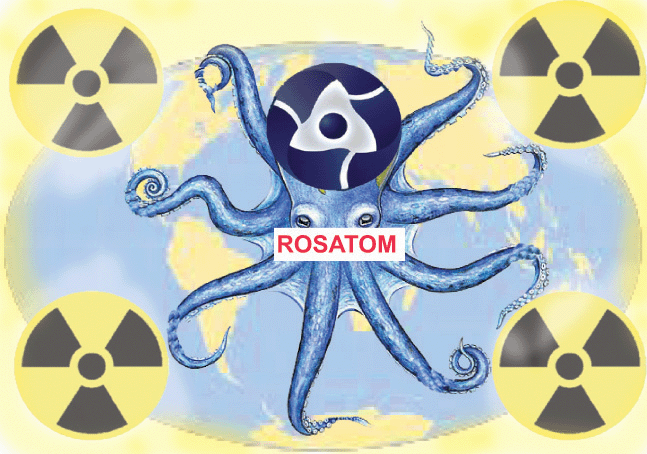
Russia’s Rosatom hopes to win Saudi nuclear plants’ tender, DANANG, Vietnam, Nov 10 (Reuters) – Russian state nuclear company Rosatom hopes to win a tender announced by Saudi Arabia to build nuclear plants in the kingdom, Alexei Likhachyov, head of Rosatom, told reporters.
“As far as I understand, they (Saudi Arabia) should make a decision next year about the construction and a constructor. We hope it will be us,” he said.
Rosatom has sent initial proposals to Saudi Arabia for nuclear power generation and would make a bid if a tender is announced, the company said earlier this month.
Saudi Arabia is considering building 17.6 gigawatts of nuclear capacity by 2032, the equivalent of about 17 reactors, making it one of the biggest prospects for an industry struggling after the 2011 nuclear disaster in Japan. (Reporting by Denis Pinchuk; writing by Katya Golubkova; editing by Vladimir Soldatkin)DANANG, Vietnam, Nov 10 (Reuters) – Russian state nuclear company Rosatom hopes to win a tender announced by Saudi Arabia to build nuclear plants in the kingdom, Alexei Likhachyov, head of Rosatom, told reporters.
“As far as I understand, they (Saudi Arabia) should make a decision next year about the construction and a constructor. We hope it will be us,” he said.
Rosatom has sent initial proposals to Saudi Arabia for nuclear power generation and would make a bid if a tender is announced, the company said earlier this month.
Saudi Arabia is considering building 17.6 gigawatts of nuclear capacity by 2032, the equivalent of about 17 reactors, making it one of the biggest prospects for an industry struggling after the 2011 nuclear disaster in Japan. (Reporting by Denis Pinchuk; writing by Katya Golubkova; editing by Vladimir Soldatkin)
Africa buys into nuclear dream, Mail and Guardian, Lynley Donnelly
Risky: Nigeria has oil but infrastructure maintenance is poor. It is considering the nuclear option. (Akintunde Akinleye, Reuters)
While questions swirl around the progress of South Africa’s nuclear plans, Russia’s state nuclear agency Rosatom is losing no time in selling the atomic dream to other African countries.
Last week the company signed project-development agreements with the Nigerian government for the construction and operation of a nuclear power plant and research centre housing a multipurpose research reactor.
Nigeria has extensive oil and gas reserves but suffers from chronic electricity shortages.
Media reports suggest the deal could cost about $20-billion, but Rosatom said the costs have yet to be determined.
The agreements were signed in order to adopt the appropriate approach and establish the project’s implementation details, a Rosatum official said. “Cost estimations and project specifications will be evaluated in accordance to this agreement,” the official said.
“We have not yet drawn on the Russian loan, but this will change in the coming hours,” Aszodi told an energy conference organized by financial news website portfolio.hu.
Russian company Rosatom will build two nuclear reactors in Hungary in a 12.5 billion euro project that has been delayed by at least a year as Hungary ironed out regulatory and financing issues with European regulators.
China’s nuclear power play falters in Britain http://www.atimes.com/article/chinas-nuclear-power-play-falters-britain/ Beijing’s planned investment in UK’s civil nuclear program, part of its One Belt One Road initiative, is on increasingly shaky ground,By RICHARD COOKNOVEMBER 4, 2017 When it recently emerged that China General Nuclear Power Corporation (CNG) had refused to give a visiting team of UK government inspectors the security details for one its reactors, a slew of negative headlines followed in UK media about Chinese involvement in Britain’s power supply.
The inspectors, from the UK’s Office for Nuclear Regulation, had traveled to China to examine Fangchenggang’s Unit 3 nuclear power plant and its Hualong One third-generation pressurized reactor.
The Hualong One design is earmarked for a planned Chinese-built nuclear power plant at Bradwell on England’s east coast and the inspectors were in China to start a complex four-year Generic Design Assessment [GDA] process that will end, the Chinese hope, with the reactor’s approval for use in Britain.
China is the world’s fastest expanding nuclear power producer and has been clear about its desire to be a leading exporter, too. Exporting nuclear power is an objective of Xi Jinping’s Belt and Road initiative and nuclear is included as a core energy component in the country’s latest Five-Year Plan. At the center of this ambition is the Hualong One.
Developed though a state-led agglomeration of China’s main industry players and initially adapted in the 1990s from a French design, the Hualong One has since 2014 been packaged — along with a package of enticements comprising construction expertise, training support, competitive pricing and financing options — as China’s flagship power brand.
CNG says more than 20 countries have shown interest in the nuclear plant. While the first working Hualong One reactors will be in China, in what are revealingly described as “demonstration units,” two are currently under construction in Pakistan while an Argentinian one reported to be worth US$9 billion is due in 2020. After that should come Bradwell.
The UK has not commissioned a nuclear power station for almost 30 years, but now has plans for six sites. China currently has involvement in three, but that could become four after the bankruptcy of Toshiba’s nuclear arm.
The first two, Hinkley Point C and Sizewell, only saw Chinese involvement after the French state-owned Électricité de France (EDF) voiced concern about growing costs. China agreed to help with finance as long as it got to build a Hualong One at Bradwell, which will be the first wholly Chinese-designed reactor to be built in a western country.
Is this a good investment for China?” asks nuclear risk expert Jerzy Grynblat. “It is very hard to say because, as it comes from the Chinese government, some of the sums will remain hidden. But what is perhaps more important to ask is why the Chinese state wants to invest when no western government will?”
For Grynblat – who, before retiring in early 2017, was Nuclear Business Director at safety assurance consultancy Lloyd’s Register – it is “purely an expansion of political power.”
Grynblat explains that the UK is currently the only western country with a nuclear power program. “They needed to add capacity and replace existing capacity… In terms of power security, the UK was in a bad position and they had to do something.” That gave China an opportunity, says Grynblat. “Bradwell presented the Hualong One with an important foothold in the West.”
The design of the Hualong One, Grynblat believes, is reminiscent of a Swedish reactor from the 1980s. “It surprised me a little,” he says. “It really is quite old fashioned. I am not saying this makes it unsafe, certainly not, but what it does is make use of well known technology. And this makes approvals more straightforward… And the GDA process that they are starting now in the UK is crucial to them. They will be able use this all over the world.”
Antony Froggatt, senior research fellow at think-tank Chatham House and co-author of The World Nuclear Industry Status Reports, agrees. “It’s a first” says Froggatt. “It creates an important benchmark for China and it’s an important sales pitch. The GDA process alone brings kudos.”
Yet Froggatt is not convinced that Bradwell itself will be built. “The industry is changing rapidly. Even since China first got involved in the UK in 2015, the price of offshore wind and solar has got much cheaper. There is also recognition in the UK government that the Hinkley contract cannot be repeated at Sizewell because it has made the cost of the power so expensive… Hinkley is happening but very slowly. They originally said it would be built by 2018. Now they are saying 2025… As such, I am now thinking that Sizewell will not happen.”
“And Bradwell,” says Froggatt, “is a different story again…. It is a new reactor, it’s Chinese and there are the security issues.” He asks: “Will the Chinese ever be able to open up the design specifications?”
The UK’s inspectors were quick to brush off their access issues in China and instead praised CNG’s “high level of expertise and commitment.” But it is not the first time there has been negativity around the China-UK power deal.
Last year, amid rising public opposition, Prime Minister Teresa May felt compelled to suspend the Hinkley project while a “security review” was carried out. Nick Timothy, May’s joint chief of staff at the time, had bluntly warned that the Chinese might be able to “build weaknesses into computer systems which will allow them to shut down Britain’s energy production at will.”
There is a lot at stake here, for both China and the UK. And, much like a nuclear reactor, it looks like this story will run and run.
India-US nuke deal signed without ground work: Ex-US Senator PTI|Oct 26, 2017, WASHINGTON: The landmark India-US civil nuclear deal was “dead at the very beginning” as it was signed without ground work, a former top Republican Senator has alleged, describing the agreement as more of an “arms deal” for American defence manufacturing companies.
Former Senator Larry Pressler, who has served as chairman of the US Senate’s Arms Control Subcommittee, told a Washington audience that the deal was much-praised “but there is no chance of it being implemented as the liability issues have not been addressed and it has not been worked through.”
He said that the India-US civil nuclear deal “was dead at the very beginning.
Pressler said that there was “no groundwork done” in India or the US on the civil nuclear deal.
The India-US nuclear cooperation agreement was signed in October 2008, ending India’s isolation by the West in the nuclear and space arena. The deal has given a significant boost to India’s nuclear energy production.
Pressler was speaking at an event organised by The Hudson Institute, a top American think-tank, to discuss his latest book ‘Neighbours in Arms: An American Senator s Quest for Disarmament in a Nuclear Subcontinent’.
“…There was nothing to it really. If you look into it, it is more of an arms sale agreement,” he alleged.
Pressler claimed the then US president Barack Obama’s visit to New Delhi was “largely an arms sale trip”.
French nuclear giant EDF seeks business in Asia China and India loom large for the world’s largest nuclear power company, Nikkei Asian Review, TALLULAH LUTKIN and TOGO SHIRAISHI, Nikkei staff writers, 19 Oct 17, PARIS — The world’s largest nuclear power company, Electricite de France, believes nuclear power still has a role to play in the future, despite forecasts suggesting the market is in getting precarious. According to one senior EDF official, there are still plenty of opportunities in nuclear plant construction — especially in Asia — that can complement renewable power sources……
State-owned EDF is determined to play a role in the growth of the nuclear power industry worldwide…..
For future projects, EDF has its sights on China, where most of the world’s new reactors are currently being built…..
In India, EDF’s nuclear ambitions should benefit from a combination of a growing economy still reliant on coal, a lack of access to electricity for millions of people, and an existing nuclear program, Ursat said.
The company also plans to jointly develop a plant in Turkey in cooperation with Japan, using a new reactor design, the ATMEA1, developed by French multinational Areva and Mitsubishi Heavy Industries. EDF’s close partnership with Mitsubishi is an indication of the importance of the Japanese market, Ursat said.
EDF is in the process of acquiring part of Areva, which is being restructured to save it from bankruptcy. EDF will acquire Areva’s nuclear construction operations, renamed New NP, in December for between 1.25 billion and 1.875 billion euros. Mitsubishi Heavy Industries is taking a 19.5% stake in New NP.
Ursat acknowledges that the nuclear power industry faces hurdles. “One of the challenges facing new projects is cost overruns,” he said. Thus, New NP’s primary objective is to “make new projects profitable, stay on schedule and lower costs.”……..
Projections by the International Atomic Energy Agency do not fully support EDF’s optimism, and vary significantly depending on circumstances. In the upper-end scenario, nuclear electricity generating capacity could increase from 391 gigawatts in 2016 to 874GW in 2050 worldwide. In the lower-end scenario, it would decline until 2040 before rebounding to current levels in 2050. Only three reactor constructions were started in 2016, down from 15 in 2010.
Moreover, some developed countries have decided to partly phase out nuclear power. France has announced its intention to close up to 17 nuclear reactors. South Korea’s new president, Moon Jae-in, has vowed to cancel all plans for new nuclear power plants and “move toward a nuclear-free era,” something Germany is already pursuing. Both South Korea and Germany are looking to renewable sources as a replacement for nuclear power, rather than merely as a supplement.
Russia Ready to Offer Nuclear Technologies to Algeria, Russian Prime Minister Dmitry Medvedev said that Russia is ready to offer Algeria its technologies and technical solutions if a decision is made to establish a national nuclear industry as well as to develop cooperation in other spheres.MOSCOW (Sputnik)— Russia is ready to offer Algeria its technologies and technical solutions if a decision is made to establish a national nuclear industry, Russian Prime Minister Dmitry Medvedev said in an interview with the Algerian news agency APS ahead of his visit to the country.
Russia is already preparing nuclear industry specialists for Algeria, the prime minister noted.
After the mass shooting in Las Vegas, the NRA is pulling ads supporting Republican candidates in Virginia, but not for long. The NRA is cynically pulling campaign ads in the wake of the mass shooting in Las Vegas — but only temporarily.
The gun extremists appear to believe that the country only needs eight days to forget about the worst mass shooting in modern American history, allowing them to exploit the gun issue to assist an ally.
According to Medium Buying, a firm that tracks ad spending, the NRA’s Political Victory Fund has postponed running ads that it planned to run in Virginia. Instead, the NRA will begin running its advertising on Oct. 10.
The group has endorsed Republican Ed Gillespie for Governor, along with his running mate Jill Vogel. The NRA is also backing John D. Adams, the Republican candidate for Attorney General.
The NRA praised Gillespie in an endorsement release in August, hailing him as “a leader in the growing national movement to expand our Second Amendment freedoms.”
Ralph Northam, the Democrat in the governor’s race, is an Army veteran and a hunter who has described himself as “a staunch advocate for commonsense gun safety laws.”
The NRA has often gone silent after mass shootings, as it has this time, with the hopes that it can wait out grief after the tragedy. Then, when the conditions are more favorable for its violent messages, the NRA promotes advertising that calls on gun owners to confront protesters with a “clenched fist.”
As the NRA cowers and tries to wait out the situation, groups like Moms Demand Action for Gun Sense In America are stepping up. Founder Shannon Watts released a statement on the shooting.
“I am sickened and heartbroken that, once again, American families will be torn apart by gun violence,” she said. “My thoughts are with the victims and their loved ones, whose lives will never be the same.”
She added, “While details are still unfolding, one thing is for sure: It doesn’t have to be this way. Americans should be able to go to concerts, to night clubs, to elementary schools and movie theaters without worrying about the threat of gun violence. While we grieve for the 50 people shot and killed and the more than 400 who are hospitalized, we must also act in their honor. Gun violence is preventable.”
The NRA doesn’t want anything done about gun violence in America because their ideal world is one in which the country is awash in firearms, no matter the risk to children and families. They go silent while still intending to back candidates who will enact their agenda unquestioningly.
But millions of Americans want something to be done, to stop attacks like the ones in Las Vegas, Charleston, Newtown, and so many other American cities and towns. And they will not be silenced.
Russian Nuclear Company Sees Success in Latin America, 1 October 2017New branches of the company will be constructed in El Alto, Bolivia and should be in operation by 2020.
Two years since its move to Latin America, Rosatom, Russia’s main nuclear power company, has seen great success, the company’s Latin American representative, Ivan Dybov, said.
“Rosatom has several projects in Latin America, but the main one is in Bolivia. Last September 19 we signed the contract for the construction of the Center for Research and Development in Nuclear Technology,” Dybov said.




 NRA pulls attack ads, hopes everyone forgets about mass slaughter in 8 days https://shareblue.com/nra-pulls-attack-ads-hopes-everyone-forgets-about-mass-slaughter-in-8-days/




 nuclear-news