Japan keen to have a nuclear export business: it all depends on building nuclear reactors in the UK
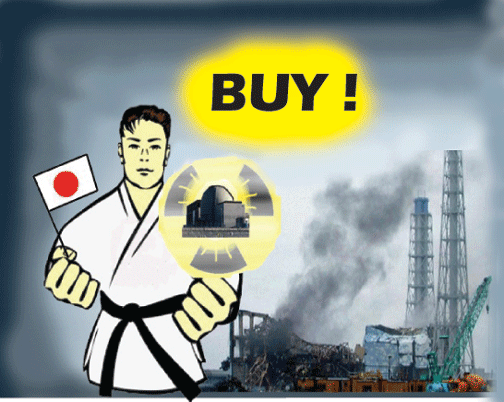
 Japan and Hitachi pin nuclear export hopes on U.K. project in Wales https://www.japantimes.co.jp/news/2018/07/29/business/japan-hitachi-pin-nuclear-export-hopes-u-k-project-wales/#.W14xP9IzbGg, BY JUNKO HORIUCHI KYODO
A nuclear power plant project in Britain is giving Japan a glimmer of hope for spurring infrastructure exports, a key growth strategy of Prime Minister Shinzo Abe.
Hitachi Ltd. and the U.K. government started official talks last month on building new reactors in Wales, with a goal of firing them up in the first half of the 2020s.
The outlook for the ¥3 trillion project is unclear, with both sides facing a string of challenges in the talks going forward.
For Tokyo, the plan is one of its few remaining major overseas projects on the horizon, with other nuclear power generation plans discontinued or facing cancellation.
The government’s bet on nuclear power plants as a pillar of infrastructure exports comes as the likes of Germany, Italy, Taiwan and South Korea are pulling out of atomic power generation.
Critics argue that a surge in safety costs and accident worries caused by the 2011 Fukushima disaster, in addition to the lack of viable disposal solutions for radioactive waste, mean there is no justification for keeping faith in nuclear energy. Compounding the sector’s decline is the rapidly dropping cost of tapping such renewable energy sources as wind and solar power.
Still, some emerging economies look like they will need new nuclear power plants, and Japanese builders see few chances to construct new ones anytime soon in Japan.
“The Japanese government has been pushing hard for exports of nuclear power plants but it’s clear that it’s not going well,” said Tadahiro Katsuta, a professor at Meiji University. “The government will spare no effort in giving momentum to the exports.”
If the project in Britain proves successful, it will give the government “a good excuse” to push harder abroad, he said.
Before the official talks began, Hitachi had told Britain it might not take part in the project to build two advanced boiling water reactors on the Isle of Anglesey in Wales, because the price tag had soared higher than initially estimated.
But an offer by London to shoulder about two-thirds of the cost convinced Hitachi stay in. Tokyo welcomed its decision to begin the talks.
“The nuclear business overseas is significant … it would lead to strengthening and maintaining human resources and technology for nuclear power in Japan,” Minister of Economy, Trade and Industry Hiroshige Seko told a news conference.
Under the agreement, the British government will subsidize much of the cost through direct investment and loan guarantees, according to sources close to the matter.
“We are currently examining the financial and cost issues of the project, before making a final decision in 2019 on whether to invest in the project,” Hitachi Chief Financial Officer Mitsuaki Nishiyama said Friday at a news conference to announce earnings.
For Hitachi, nuclear power is a core operation. It wants to increase revenue from the business by more than 33 percent to ¥250 billion over the four years through March 2022, mainly through boosting overseas revenue.
Rival Toshiba Corp. exited overseas nuclear operations after incurring huge losses in the United States, a decision that could cripple Tokyo’s efforts to promote Japanese nuclear plants abroad.
Mitsubishi Heavy Industries Ltd., is pursuing a nuclear power plant project in Turkey. But it hit a snag when it saw safety-related costs surge and trading house Itochu Corp. walked away from the project.
In another blow to the government, Vietnam in 2016 decided to abandon a plan to build its first nuclear power plant with Japanese assistance due to tight state finances.
Those failures have led to an increased focus on the new power station in Wales. But London and Hitachi still need to address such issues as how to spread the remainder of the costs among Hitachi, local companies and Japan-backed financial institutions. They also need to determine who should be held liable if there’s a major accident.
They are also at odds over how much the electricity produced at the plant should cost. Britain at one point offered a price some 20 percent lower than what Hitachi wanted, a source familiar with the matter said.
“A key focus of discussions with Hitachi has been and will continue to be achieving lower-cost electricity for consumers,” Greg Clark, British business and energy secretary, told Parliament last month.
The two sides also need to talk to residents and win over those worried about the new power station.
“We have a major multinational and two governments supposed to be democracies playing a high-stakes game of poker … without any transparency or scrutiny for the people that they are representing,” Mei Tomos, a resident of Wales, said at a news conference in Tokyo during a recent visit to Japan.
“We have seen the destruction which nuclear power can cause. It is really too much to expect us to take the same risks. Even if such an accident didn’t happen at Anglesey we will still be faced with over a hundred years of storage of nuclear waste on site which presents a massive danger to us,” another resident, Robert Davies, said at the news conference.
South Africa can’t afford nuclear power expansion, but still open to nuclear deals with Russia
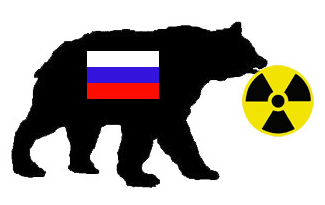
 South Africa Opens Door to Future Russian Nuclear Power Deal, US News, July 26, 2018 , BY ALEXANDER WINNING, JOHANNESBURG (Reuters) – South Africa cannot afford large-scale expansion of its nuclear power capacity but would still be open to future deals with Russia, a senior ruling party official said on Thursday, shortly before the arrival of President Vladimir Putin for a summit.
Russian state firm Rosatom was one of the front runners for a project to increase South Africa’s nuclear power-generating capacity championed by former president Jacob Zuma.
South African President Cyril Ramaphosa has put nuclear expansion on the back burner since taking office in February, saying it is too expensive, and has focused instead on pledges to revive the economy and crack down on corruption.
African National Congress Treasurer General Paul Mashatile, one of the six most powerful members of the ruling party, said Pretoria would not rush into major nuclear investments but that it was still open to deals. ………
Russia wants to turn nuclear energy into a major export industry. It has signed agreements with African countries with no nuclear tradition, including Rwanda and Zambia, and is set to build a large nuclear plant in Egypt.
Rosatom signed a separate agreement with South Africa’s state nuclear firm on Thursday to explore joint production of nuclear medicines and other ways of harnessing nuclear technology, a statement from the two firms showed.
The agreement, which is non-binding and is not related to large-scale power generation, is a further sign that Rosatom is keen to cement its position on the African continent.
The deal will involve the construction of two small reactors and a commercial cyclotron to produce medical isotopes and radiopharmaceuticals at a facility near Pretoria. https://www.usnews.com/news/world/articles/2018-07-26/south-africa-cannot-afford-major-nuclear-expansion-top-anc-official
Developing countries should not fall victim to civil nuclear energy and indebtedness to China
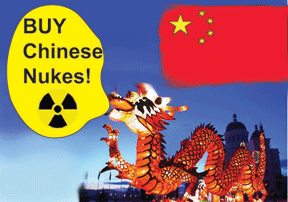 Why the Civil Nuclear Trap Is Part and Parcel of the Belt and Road Strategy
Civil nuclear energy presents grave pitfalls in terms of cost, innovation and security that BRI countries cannot and should not afford. The Diplomat By Sam Reynolds July 05, 2018
In the race to sell off nuclear power to Saudi Arabia, South Korea looks like the winner

South Korea’s KEPCO shortlisted to bid for Saudi nuclear project https://uk.reuters.com/article/uk-southkorea-nuclear-saudi/south-koreas-kepco-shortlisted-to-bid-for-saudi-nuclear-project-idUKKBN1JR1G4, Reuters Staff, 1  July 18 SEOUL – State-run utility Korea Electric Power Corp (015760.KS) (KEPCO) had been shortlisted to bid for a nuclear project in Saudi Arabia along with the United States, France, China and Russia, South Korea’s energy ministry said on Sunday.
“We were informed by our Saudi counterpart, King Abdullah City for Atomic and Renewable Energy, that KEPCO was shortlisted for a nuclear project in Saudi Arabia,” the ministry said in a statement.
The statement said the winner of the tender was expected to be chosen in 2019. Saudi Arabia, the world’s top oil producer, plans to build two nuclear plants to diversify its energy supply and has been in talks with companies from South Korea, the United States, Russia and China for the tender.
In May, Saudi Arabian Energy Minister Khalid al-Falih met South Korean Energy Minister Paik Un-gyu in Seoul. Falih told reporters on the sidelines of an industry event that he was “optimistic” about South Korea being on the tender shortlist.
South Korea, the world’s fifth-biggest nuclear power user, is seeking to export its nuclear reactors abroad.
In 2009, a South Korean consortium led by KEPCO won an $18.6 billion (14.08 billion pounds) deal to construct four nuclear plants in the United Arab Emirates, the country’s ever nuclear export success.
KEPCO was also selected as a preferred bidder in December last year for Toshiba’s NuGen nuclear project in Britain and the Korean company planned to talk with Toshiba to buy a stake in the project.
Reporting By Jane Chung and Cynthia Kim. Editing by Jane Merriman
USA’s General Electric and France’s EDF getting together to market to India huge and costly nuclear station
France’s EDF, GE to co-build reactors for huge Indian nuclear plant, Reuters Staff, NEW DELHI (Reuters) 28 June 18- GE and French utility EDF have agreed to team to build six reactors for a nuclear power project in western India, which is due to be the world’s biggest when finished……… The six European Pressurised Water reactors will be for a 9,900 mw nuclear power project at Jaitapur, south of Mumbai in the state of Maharashtra, GE and EDF said in a joint statement released on Tuesday…….
EDF will be responsible for engineering integration of the entire project, while GE Power will design the critical part of the plant and supply its main components, the companies said.
GE will also provide operational support services and a training programme to meet the needs of the state-run Nuclear Power Corp. of India Ltd, the plant’s owner and operator.
Reporting by Nidhi Verma; Editing by Alexander Smith https://www.reuters.com/article/us-india-nuclear-ge/frances-edf-ge-to-co-build-reactors-for-huge-indian-nuclear-plant-idUSKBN1JM1J8
Russia, Rwanda establish nuclear energy ties
 WNN, 27 June 2018
Russia’s Rosatom and the Ministry of Infrastructure of Rwanda have signed a Memorandum of Understanding on cooperation in the peaceful uses of nuclear energy. The document was signed on 22 June by Rosatom Deputy Director General Nikolay Spassky and Ambassador Extraordinary and Plenipotentiary of the Republic of Rwanda to the Russian Federation Jeanne d’Arc Mujawamariya……
Jordan knocks back Russia’s $10 billion nuclear power plant , but contemplates”small floating reactor”
In a blow to the international business interests of Russia’s state nuclear corporation Rosatom, Jordan has scrapped a plan to build a $10 billion nuclear power plant with Moscow’s help.
Jordan’s Atomic Energy Commission, the JAEC, said on Monday that the project, after three years of study and consideration, had collapsed over disagreements on how to finance the the build, which would have included two nuclear reactors built by Rosatom.
But canceling the larger plant, said the JAEC, doesn’t mean Jordan won’t be working with Russia on any nuclear projects at all. According to the commission, it’s possible that Rosatom would furnish the Mediterranean nation with small modular reactors instead.
On Monday, the commission said in a statement that the larger project was off because the commercial loans Rosatom wanted Joran to secure to finance construction would drive up the cost of the electricity the plant would eventually produce.
………Without specifically mentioning the cancellation of the larger plant, Rosatom said in a statement on May 27 that it and JAEC had decided to “intensify and step up” cooperation on small modular reactors and form a joint feasibility study for such a project based on  Russian designs.
Yet what these reactors might consist of remains somewhat mysterious. Russia has signed agreements with other countries for work on small-scale reactors, most recently Sudan, to which it vaguely promised to build a floating nuclear power plant.
…… Rosatom repeatedly said that foreign customers would flock to Moscow to order floating nuclear power plants of its own.
Those orders have yet to materialize, but that hasn’t stopped Rosatom from repeating the mantra that floating plants will be a prime offering to its foreign customers. Whether an offer to build Jordan a floating plant will come to pass remains unknown. But increasingly, the notion of floating plants seems synonymous with Rosatom’s small reactor development schemes. http://bellona.org/news/nuclear-issues/2018-06-jordan-turns-down-a-rosatom-plant-but-dangles-possible-small-reactor-collaboration-with-russia
Russia, France, China compete to develop nuclear power station in Bulgaria
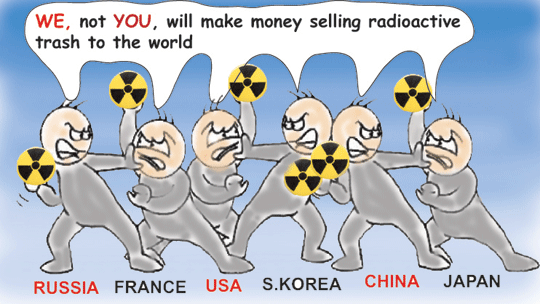
Bulgaria Moves To Revive Russian Nuclear Project Suspended In 2012 https://www.rferl.org/a/bulgaria-moves-revive-russian-nuclear-project-belene-suspended-2012/29279066.html
The Bulgarian parliament has approved a plan to revive the Belene nuclear power plant five years after the Russian project was suspended due to financing problems and concerns about relying too heavily on Russian energy.
The parliament on June 7 approved by 172 to 14 Prime Minister Boyko Borisov’s proposal to develop a plan to resume construction of the plant on the Danube River by the end of October.
Bulgaria had already spent around $1.8 billion on the plant when the government in 2012 put a moratorium on further workunder pressure from the United States and European Union to limit its energy dependence on Russia.
Bulgaria also suspended the joint project with Russian company Atomstroyexport because it failed to find any foreign investors prepared to shoulder its spiralling costs, estimated at about $11.8 billion in total.
The suspension angered Russia, which had hoped to use Belene as an EU showcase for its new generation of pressurized water reactors.
Sofia had to pay more than 620 million euros to Russia’s Rosatom for scrapping the project, but it also received nuclear parts for two 1,000 megawatt reactors, which were conserved and maintained.
Last week, Energy Minister Temenujka Petkova said that a campaign to pick a strategic investor for the project would be launched by the end of 2018.
Russia’s Rosatom has said it will make another bid to complete the project. Also in the running are Chinese state nuclear company CNNC and France’s Framatome, which is majority controlled by EDF.
Petkova said the government does not want to commit more public funds, extend state guarantees for any loan, or sign any long-term electricity supply deals to make the project viable.
Vadim Titov, director of Rosatom Central Europe, told a Bulgarian energy conference on June 7 that the Russian company is ready to start talks with the Bulgarian authorities on reviving the project.
The Belene plant’s two 1,000 megawatt reactors were intended to replace four old Soviet-built units that were shut down more than a decade ago amid security concerns at the only existing nuclear plant in Bulgaria, at Kozloduy.
There are still two Soviet-built operational reactors at Kozloduy, dating back to 1987 and 1991, which provide about 30 percent of the country’s electricity.
Dozens of Bulgarians protested outside parliament against the government’s plans for Belene on June 7, saying the project’s benefits were not enough to justify its costs and contending that it has been a source of corrupt practices for decades.
Delay in start-up for United Arab Emirates nuclear reactor, marketed by South Korea
UAE’s first nuclear reactor start-up delayed, MEMO, May 27, 2018
Indian and Russian governments getting together to market nuclear power globally
PM Modi, Vladimir Putin May Discuss Energy, Nuclear Issues At ‘No-Agenda’ Summit
With China, reducing the tension on the border was important but with Russia, a trusted all-weather partner, increasing trade ties and stepping up defence and atomic energy cooperation could be on agenda
……. The meltdown of the Iranian nuclear deal after the US unilaterally pulled out of it would come up for sure, especially since India has ‘civilizational links’ with Iran. The patch up happening between North and South Korea over nuclear weapons is also going to be on the table. But closer home, atomic talks related to Kudankulam Nuclear Power Plant are also likely to be part of the summit.
PM Modi is expected to reassert India’s avowed position of complete denuclearisation of these weapons of mass destruction from the world.
Indo-Russian atomic energy cooperation could also be reviewed at the highest level. Reports suggest that India has invested nearly $5 billion in the Russian energy sector. Bilateral civil nuclear co-operation could be very high on the agenda.
……… atomic experts say, discussion on the second site for the Russian Nuclear Park would be on the anvil. In the 2014 Indo-Russian ‘Strategic Vision’ document on nuclear cooperation, the two countries have committed themselves to building in all 16 nuclear reactors in the next two decades. In all, six reactors will come up at Kudankulam and the remaining six at another site.
Today, it seems the next set of six reactors could come up in Andhra Pradesh. It is hoped that later this year in October, at the proposed formal summit, the two countries will announce the allotment of the second nuclear park site to Russia.
……… The Indo-Russian nuclear deal is well worth over Rs. 4,50,000 crores and could be the mother of all deals.
It may be worth noting that as part of the agreement for the Indo-US Civilian Nuclear Deal, India has committed to buy 10,000 MW of reactors from USA and France. But unfortunately, both the French nuclear company Areva and the American atomic giant Westinghouse ran into financial trouble and declared bankruptcy, and the new owners are still taking charge in both the countries. In all possibility, India may not order either French or American reactors for the next three to four years till these ‘new technologies’ are safely operating.
India is getting to partner in these Bangladeshi reactors by providing training to Bangladeshi atomic engineers at Indian reactor sites. The three countries have signed a tripartite nuclear agreement on Rooppur, confirmed Anwar Hussain, Secretary of the Ministry of Science and Technology in Dhaka, who spoke exclusively to NDTV on the sidelines of the 10th edition of the Atomexpo exhibition held at Sochi. At least 3,000 participants from 68 countries presented an upbeat picture of the global nuclear industry at the exhibition. https://www.ndtv.com/india-news/pm-modi-vladimir-putin-may-discuss-energy-nuclear-issues-at-no-agenda-summit-1854710
China marketing nuclear power to Uganda
China to help Uganda build nuclear power plants, Reuters Staff, 17 May 18 KAMPALA (Reuters) – China will help Uganda build and operate nuclear power plants under a deal signed last week.
Uganda has some uranium deposits and President Yoweri Museveni has said his government was keen to exploit them for potential nuclear energy development.
Eight potential sites have been identified in the country’s central, southwest and northern regions that could potentially host nuclear power plants, the government said on Thursday. It signed a deal with Russia last year to cooperate on nuclear power.
China is already a major investor in Ugandan infrastructure projects and China National Nuclear Corporation (CNNC) signed a memorandum of understanding on May 11 to help Uganda build capacity “in the use of atomic energy for peaceful purposes”, Uganda’s energy ministry said in a statement issued on Thursday……
Co-operation between CNNC and Uganda will involve the development of nuclear power infrastructure including the design, construction and operation of nuclear power plants.
In June last year Uganda signed a similar memorandum of understanding with Russian State Atomic Energy Cooperation (ROSATOM) to facilitate the two countries’ cooperation on nuclear power.
Reporting by Elias Biryabarema; Editing by Susan Fenton https://www.reuters.com/article/us-uganda-energy/china-to-help-uganda-build-nuclear-power-plants-idUSKCN1II219
Russia’s state nuclear corporation Rosatom trying to market nuclear power to Chile, China, Cuba, Finland, Hungary, Iran, Italy, Kazakhstan, Saudi Arabia, Serbia, Spain and Zambia
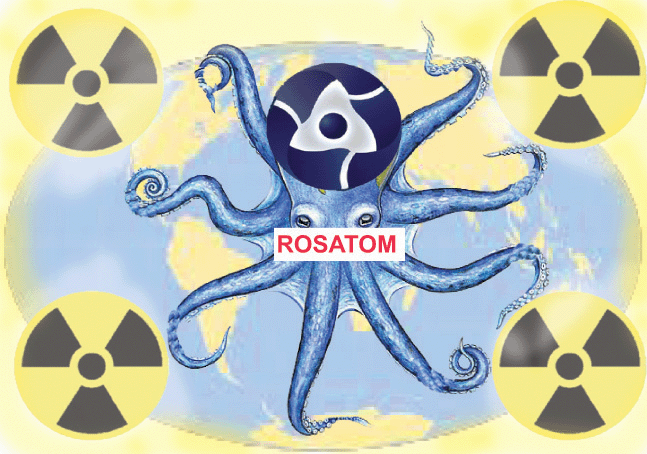 World Nuclear News 16th May 2018 Rosatom, the Russian state nuclear corporation, yesterday signed a series of agreements with overseas companies during the Atomexpo conference and exhibition being held this week in Sochi, Russia. The agreements, with Chile, China, Cuba, Finland, Hungary, Iran, Italy, Kazakhstan, Saudi
Arabia, Serbia, Spain and Zambia, include the engineering and medical
sectors, among others.
http://www.world-nuclear-news.org/C-Rosatom-expands-overseas-links-with-new-agreements-16051801.html
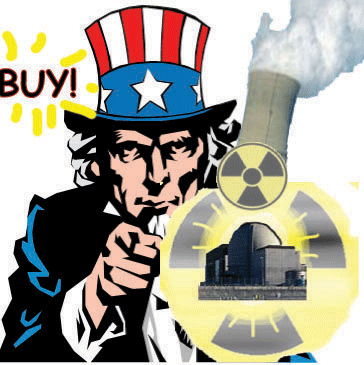
Bechtel engineering very happy at prospect of selling nuclear technology to Saudi Arabia
 US engineering giant sees ‘tremendous opportunity’ in Saudi nuclear energy plans https://www.cnbc.com/2018/05/10/bechtel-executive-us-firms-should-be-involved-in-
 saudi-nuclear-plans.html –Saheli Roy Choudhury
- A senior executive at engineering giant Bechtel told CNBC on Thursday that U.S. businesses should be involved in Saudi Arabia’s civilian nuclear energy ambitions.
- The presence of American firms would likely be welcomed by the Saudis and should also be welcomed by the U.S. government, according to Stuart Jones, regional president for Europe and Middle East at Bechtel.
- Saudi Arabia has plans to construct 16 nuclear power reactors over the next 20 to 25 years, costing more than $80 billion.
France and other countries keen to make money out of selling nuclear submarine technology to India
Thales looking at role in India’s nuclear submarine project, Gulf News 22 Apr 18, India is expected to spend close to $300 billion in the next five years in procuring defence equipment and almost all major global defence firms are eyeing a slice of it
USA government keen to promote Westinghouse sales of nuclear power projects to India
U.S. backs Westinghouse to finish nuclear power projects in India, Reuters Staff, Reporting by Nidhi Verma and Sudarshan Varadhan; Writing by Krishna N. Das; Editing by Sanjeev Miglani and Susan Fenton NEW DELHI (Reuters) 17 Apr 18 – Westinghouse Electric, which filed for bankruptcy last year, is now “lean and mean and ready to get to work” on its projects to build nuclear reactors in India, U.S. energy secretary Rick Perry said on Tuesday.The show of support by Perry came after Pittsburgh-based Westinghouse’s bankruptcy filing had raised doubts about the proposed construction of six nuclear reactors in India’s Andhra Pradesh state.
“Nobody in the world makes better reactors than Westinghouse,” Perry told journalists after a meeting with India’s oil and gas minister Dharmendra Pradhan in New Delhi.“They had some challenges in the past from its business practices. We leave that where it is. The bottom line is, that’s all behind them. They are lean and mean and ready to get to the work.”
Westinghouse, owned by Japan’s Toshiba Corp (6502.T) which is to be bought by a unit of Canada’s Brookfield Asset Management Inc (BAMa.TO) (BAM.N), is one of the world’s leading suppliers of nuclear fuel and provides some form of service to 80 percent of the world’s 450 commercial reactors.
Perry and Pradhan released a joint statement to “reaffirm their strong commitment to early and full implementation of our civil nuclear partnership, including the Westinghouse civil nuclear project”. They also said the two countries would deepen cooperation on oil and gas, power, renewable energy and coal.
1 This Month

of the week – Nuclear Information and Resource Service


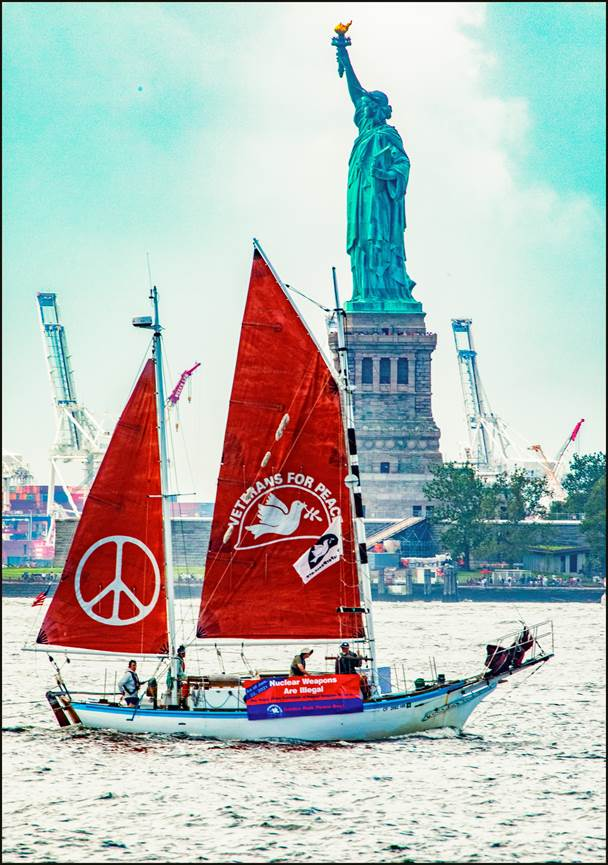
22,000+ miles voyaging for nuclear disarmament
and a radiation-free environment https://vfpgoldenruleproject.org/
To see nuclear-related stories in greater depth and intensity – go to https://nuclearinformation.wordpress.com
-
Archives
- July 2026 (241)
- June 2026 (287)
- May 2026 (306)
- April 2026 (356)
- March 2026 (251)
- February 2026 (267)
- January 2026 (308)
- December 2025 (358)
- November 2025 (359)
- October 2025 (375)
- September 2025 (257)
- August 2025 (319)
-
Categories
- 1
- 1 NUCLEAR ISSUES
- business and costs
- climate change
- culture and arts
- ENERGY
- environment
- health
- history
- indigenous issues
- Legal
- marketing of nuclear
- media
- opposition to nuclear
- PERSONAL STORIES
- politics
- politics international
- Religion and ethics
- safety
- secrets,lies and civil liberties
- spinbuster
- technology
- Uranium
- wastes
- weapons and war
- Women
- 2 WORLD
- ACTION
- AFRICA
- Atrocities
- AUSTRALIA
- Christina's notes
- Christina's themes
- culture and arts
- Events
- Fuk 2022
- Fuk 2023
- Fukushima 2017
- Fukushima 2018
- fukushima 2019
- Fukushima 2020
- Fukushima 2021
- general
- global warming
- Humour (God we need it)
- Nuclear
- RARE EARTHS
- Reference
- resources – print
- Resources -audiovicual
- Weekly Newsletter
- World
- World Nuclear
- YouTube
-
RSS
Entries RSS
Comments RSS
 nuclear-news