Nuclear Advocates Set Sights on Advanced Reactors for Puerto Rico
With big push of meetings with key officials, nuclear industry hopes to be part of Puerto Rico’s energy future, Morning ConsultBY JACQUELINE TOTH November 19, 2018
Supporters are highlighting the energy, climate and safety benefits of advanced reactor concepts.
Puerto Rico’s House of Representatives passed a resolution to study nuclear energy.
Details are sparse this early in the discussions, and Puerto Rico has no concrete plans for nuclear, instead focusing on other sources.
Nuclear industry professionals have launched a long-term bid to convince Puerto Rico they may have the solution for the island’s energy woes. ………
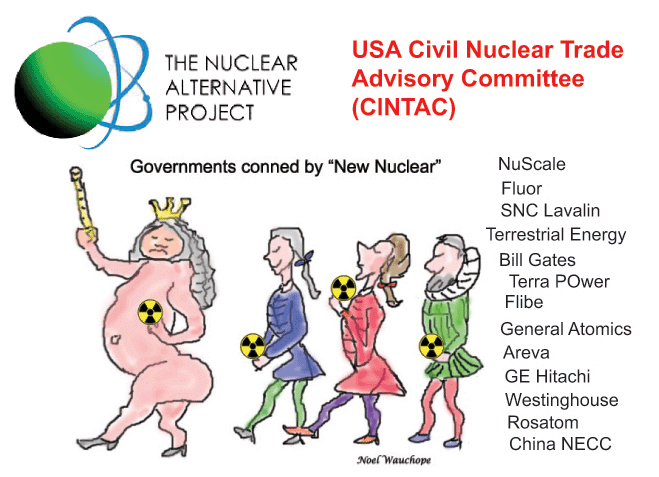
A group of nuclear industry professionals, who have formed The Nuclear Alternative Project nonprofit organization, recently hosted a group of nuclear executives to meet with Puerto Rican lawmakers and officials to discuss new nuclear concepts.
“We were in Puerto Rico for four days, and we were able to take the conversation from, ‘You guys are nuts,’” to something Puerto Ricans would consider if it would lower their energy bills, said Jesabel Rivera, the nonprofit’s community impact and engagement consultant.
But a host of questions over when, where, how and at what cost these reactors would be deployed and operated in Puerto Rico remains unanswered at this early stage. Some groups have also raised environmental concerns.
Officials from companies that included small modular reactor and micro-reactor developers NuScale Power LLC, X-Energy LLC, Westinghouse Electric Co. and GE-Hitachi Nuclear Energy Inc., attended the meetings on the island.
“A lot of folks didn’t know anything about nuclear other than what they had kind of seen in movies,” said Jose Reyes, chief technology officer of NuScale, who attended the trip. “One person mentioned Homer Simpson.”
Another participant was Donald Hoffman, president and chief executive of nuclear consultancy EXCEL Services Corp., founder of the United Nuclear Industry Alliance, a former adviser to now-President Donald Trump and a member of the Commerce Department’s Civil Nuclear Trade Advisory Committee.
Several of the recent tour’s other participants are CINTAC members.
After the tour, Puerto Rico’s House of Representatives on Nov. 7 approved a resolution that calls on the House Government Commission to investigate the need for nuclear energy reactors on the island and report back within 180 days.
SMRs are billed as faster-to-construct, safer technologies with longer refueling cycles compared to older nuclear reactors, though no U.S. designs have yet undergone construction. The U.S. SMR furthest along in the Nuclear Regulatory Commission licensing process is NuScale, which has completed phase one of design review……
But discussions are at a nascent stage.
“There’s not enough detail yet. There’s no site,” design or cost determination for nuclear in Puerto Rico, Carlos Fernández-Lugo, chairman of the environmental, energy and land use practice group at law firm McConnell Valdés LLC, said during an Oct. 30 public panel discussion on nuclear energy held at the Mayagüez campus of the University of Puerto Rico.
It also remains unclear whether the customer for a nuclear plant would be the Puerto Rico Electric Power Authority, the struggling government-owned utility that is undergoing restructuring.
The Nuclear Alternative Project is looking for funding to move forward with a feasibility study, Rivera said.
On Friday, however, a spokeswoman from the Department of Energy said the department does not have plans for a study on advanced nuclear in Puerto Rico at this time.
Puerto Rico does not currently have any operating nuclear reactors, but it once had the Boiling Nuclear Superheater Reactor Facility, an experimental reactor in Rincón, which operated at full power in 1965 but stopped about three years later due to technical difficulties and the resulting expensive changes that would be required. It was decommissioned, and decontamination work continued into the early 2000s. https://morningconsult.com/2018/11/19/nuclear-advocates-set-sights-advanced-reactors-puerto-rico/
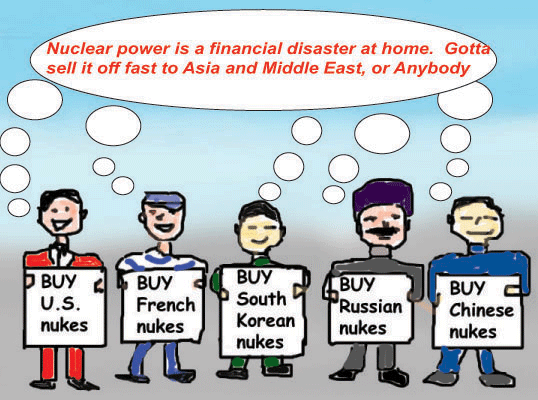
Kepco is still working to land Saudi nuclear power deal, KoreaJoongAng Daily BY LEE HO-JEONG [lee.hojeong@joongang.co.kr], 2 Nov 18,GWANGJU – The CEO of Korea Electric Power Corporation (Kepco) said it still hopes to be picked for a $20 billion nuclear power plant project in Saudi Arabia that is expected to be decided by the end of next year. …….
“We are trying to show that we are working to become Saudi’s long-term partner,” Kim said
In July Korea was put on the shortlist for the Saudi nuclear project along with the U.S., China, Japan and Russia.
The Saudi government is planning to build two nuclear power plants with a 2.8 gigawatt capacity by 2030. The country has plans to build a total of 16 nuclear power plants in the next 20 to 25 years. …….
Russian firm offers expertise in nuclear research to Philippines
Danessa Rivera (The Philippine Star) – October 16, 2018 MANILA, Philippines — Russian State Atomic Energy Corp. (ROSATOM) is eyeing more opportunities to advance the Philippines’ nuclear research program particularly in medicine and agriculture through its partnership with the Philippine Nuclear Research Institute (PNRI).
China’s Nuclear Diplomacy in the Middle East
China will have to balance its nuclear ‘going out’ with nonproliferation concerns. The Diplomat , By Samuel Hickey, October 09, 2018 On September 21, China’s Ministry of Justice published its draft Atomic Energy Law, which urges its vast nuclear industry to go forth into the world and secure a portion of the nuclear export market. Unlike the “Gold Standard” interpretation of the “1+2+3” agreement in the U.S. Atomic Energy Act of 1954, China will not officially limit a partner country’s access to the full nuclear fuel cycle in exchange for nuclear cooperation.
This is an important distinction and is the same policy that Russia subscribes to in its nuclear export agreements. While both countries may not be willing to export enrichment technology, they will not explicitly state this or preclude any future partnership on the nuclear fuel cycle. Nuclear exports are an extension of their foreign policy as they seek to secure long-term geopolitical influence and they are signaling that negotiations are always on the table with the Global South.
China’s proliferation policy until Deng Xiaoping’s 1978 “reform and opening up” policy was characterized by countering the imperialist powers, and it stood firm with the Third World, arguably advocating proliferation.China now boasts a solid reputation against proliferation and support for the nuclear order, but it has shown a flexibility to negotiate with all actors; this causes concerns for the nonproliferation regime. The nuclear order currently relies on multinational efforts to constrain with whom a supplier state can partner, but this top down perspective challenges China’s nuclear energy promises to the Middle East and North Africa (MENA) region, including Iran.
China has a unique opportunity to capture a significant portion of the nuclear export market because of their finance schemes and domestic experience. However, MENA states will view China as underperforming in its diplomatic promises if collaboration does not turn into geopolitical gains or enhanced security assurances. China’s efforts to influence the international order will find an audience in the MENA region as states hedge their bets against a distracted and noncommittal United States, but China will not be coaxed into overextension to prove their geopolitical worth — to the distress of MENA states.
The Onus is on the Supplier
China and Russia dominate the civil nuclear import conversation among the MENA states because, for many, the United States’ nuclear export doctrine equates to removing it from the running. The United Arab Emiratesare the only MENA country to sign the gold standard U.S. nuclear agreement, which precludes them from the full nuclear fuel cycle and ensures there cannot be any military dimensions to nuclear cooperation. Even though they have no intentions of completing the nuclear fuel cycle soon, many MENA states refuse to sign this interpretation of the U.S. agreement simply to preserve their sovereign rights guaranteed to them under the Non-Proliferation Treaty (NPT).…………
Conclusions
Momentum on regulating China’s nuclear industry increased with China’s Nuclear Safety Law entering into force on January 1, 2018 and the State Council’s issuance of guidelines for the standardization of the nuclear system in August. China’s domestic nuclear expansion has stalled since 2016 so it must expand to new markets and increase its bureaucratic efficiency to support its massive nuclear industry.
China will not upset the nuclear order and prefers to retain the onus of preventing proliferation on the supplier state because that gives it leverage. It is distinctly not in China’s interest for any new nuclear states to crop up and maintaining a little ambiguity in its nuclear export policy allows it to pay lip service to the Global South and keep the West engaged in improving the nuclear order……….https://thediplomat.com/2018/10/chinas-nuclear-diplomacy-in-the-middle-east/
U.S. Makes Shortlist for Saudi Nuclear-Plant Deal, One stumbling block: Negotiations over restrictions meant to prevent spread of weapons. WSJ By Timothy Puko, Sept. 26, 2018
Saudi Arabia has put the U.S. on its shortlist of potential partners competing to build nuclear-power plants in the kingdom, while the two countries negotiate how to do a deal without spreading nuclear weapons, Energy Secretary Rick Perry said.
The kingdom has been hearing offers from several countries, including Russia, South Korea and China, for what could be the biggest new market for nuclear power. Mr. Perry told reporters Wednesday the kingdom recently made a decision that keeps U.S. businesses— foremost Westinghouse… (subscribers only) https://www.wsj.com/articles/u-s-makes-shortlist-for-saudi-nuclear-plant-deal-1538006144
Euro News 22nd Sept 2018 , China will provide more support for its nuclear firms to go overseas and strengthen their position on the international market, according to new
draft legislation submitted to the industry for consultation on Friday.
“The state will encourage and support the positive and orderly
participation of its enterprises in the international market” and promote
the export of nuclear equipment, fuel and services, the draft Atomic Energy
Law says.
China aims to bring its total installed nuclear capacity to 58
gigawatts (GW) by the end of 2020, up from 37 GW at the end of June this
year, but it also has ambitions to dominate the global market and has
created a unified third-generation reactor brand known as the “Hualong One”
to sell overseas. China has already signed a series of preliminary
agreements with countries like Brazil, Argentina, Uganda and Cambodia and
it is also undergoing a technical approval process for the Hualong One in
Britain. https://www.euronews.com/2018/09/22/china-drafts-new-nuclear-energy-law-focus-on-international-market
NuClear News, Sept 18 The Stop Hinkley Campaign wrote to the Office for Nuclear Regulation at the end of July to express increasing concern about the number of reports from climate researchers who believe sea levels could rise by as much as 6 metres as a result of substantial melting of the Greenland and Antarctic ice sheets caused by climate change.
Some researchers say sea levels could rise by six metres or more even if the 2 degree target of the Paris accord is met. Sustained warming of one to two degrees in the past has been accompanied by substantial reductions of the Greenland and Antarctic ice sheets and sea level rises of at least six metres – several metres higher than what current climate models predict could occur by 2100. (1)
In the light of these recent higher estimates of sea level rise the group wanted to know whether ONR has revisited and perhaps revised its view on the future safety of the Hinkley Point C site. Stop Hinkley was particularly interested to know whether ONR is confident that the site will be suitable for the interim storage of spent fuel until at least the year 2140.
ONR responded by saying that “the primary protection against coastal flooding for HPC is the height of the site platform (14m above sea level). The site characterisation has demonstrated that the platform is not vulnerable to a design basis coastal flood, including reasonably foreseeable climate change. The HPC site licensee (NNB GenCo) will monitor this hazard via Periodic Safety Reviews (including the interim spent fuel store) and if the assumptions in the safety case regarding climate change are shown to no longer be valid; they will be reconsidered. If necessaryy, further preplanned flood protection measures will be put in place through a managed approach.”
The 14m above sea-level makes it sound like quite a large margin. But the Hinkley Point C Stress Test report shows an extreme flooding level of 9.52m (with no waves). Taking into consideration “wave effects” of 2m this gives a margin of 2.48m. (2)
Latest study suggests that rapid melting in Antarctica could begin within the next century, before HPC is decommissioned and before spent fuel is removed. (3) The Antarctic ice sheet contains enough ice to raise sea level by approximately 57 metres (187 feet), about half the length of a soccer pitch. (4) While it is unlikely that enough ice would melt to raise sea-levels by 57 metres, Antarctica is so massive that just a small fraction of this ice melting would be enough to cause huge problems for people and infrastructure on the coast.
ONR says it “maintains a constant review of scientific thinking on climate change, and is guided by relevant good practice. This includes UK and international guidance, UK Climate Projections 09 (UKCP09) and the Intergovernmental Panel on Climate Change (IPCC). To support efficient and effective regulation, ONR has established an independent expert panel on meteorological hazards to provide advice. ONR’s expert panel is a collection of competent consultants with expertise in this technical area. This panel has provided advice on the HPC external flooding safety case and will continue to provide advice on the potential impacts of climate change.”
“ONR is content that a suitable managed adaptive approach can be adopted, in the event that sea level rise is more than predicted.”
India Can Export Nuclear Power Plants, Economic Times, September 7, 2018
Two-way trade in the nuclear power sector between the US and India would make eminent sense. The latest India-US Joint Statement reiterates that Westinghouse Electric Company would help set up six nuclear plants in India.
But Westinghouse has had billions of dollars of cost overruns in its nuclear reactors in the US, and stands to gain from joining hands with Nuclear Power Corporation of India (NPCIL) to better manage its project implementation.
The fact is that NPCIL has been able to streamline project implementation with standardised designs and equipment, and is implementing at least 10 new pressurised heavy water reactors (PHWRs) nationally.
In sharp contrast, the US, which is building nuclear plants after a long hiatus, seems to have rather rusty expertise when it comes to construction of nuclear power plants.
Middle East Monitor 10th Aug 2018 , Egypt will obtain a license to build the Dabaa nuclear plant by mid-2020,
the Russian deputy minister of industry and trade said. Georgy Kalamanov
added that Russian experts are currently completing designing the nuclear
plant and surveying the area where it will be built.
In 2015, Russia andEgypt signed a deal which would see Russia build Egypt’s first nuclear
power plant in the Dabaa area, located on Egypt’s northwestern coast.
Under the terms of the agreement, Cairo would access a loan for the project
from Moscow. In 2016, the Egyptian official Gazette reported that the loan
would amount to $25 billion, which would finance 85 per cent of the cost of
contracts signed for the plant’s construction. The loan repayment period
is 35 years. Egypt will finance the remaining 15 per cent. https://www.middleeastmonitor.com/20180810-russia-egypt-to-begin-building-nuclear-reactor-in-2020/
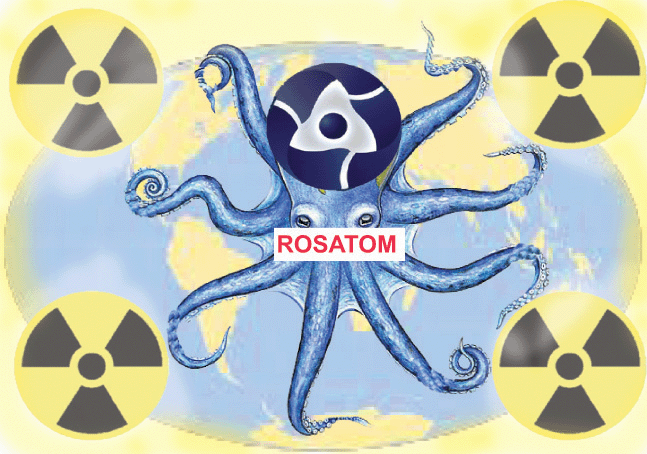
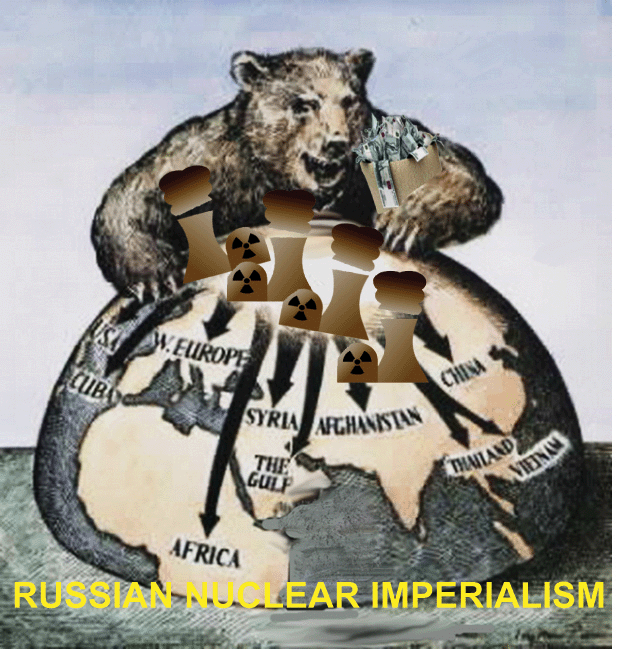
Russia on an international offensive to sell its nuclear plants, Vladimir Putin’s government vies with China to become a superpower in the field TOMOYO OGAWA, Nikkei staff writerMOSCOW — Russia is stepping up its overseas sales of nuclear power plants, with state-run nuclear energy company Rosatom agreeing in July to cooperate in building a plant in the Central Asian country of Uzbekistan and reaching an accord with China to build a plant in that country.
Russia accounts for 67% of the world’s nuclear plant deals currently in development. By 2030, Rosatom aims to increase its overseas sales to two-thirds of total sales, from 50% at currently. Vladimir Putin’s government is looking to expand Russian influence through nuclear diplomacy, vying with China — which is promoting its own nuclear plants — for the status of nuclear energy superpower.
“We hope that a lot of other countries will become our partners, and as they say, ‘nuclear newcomers,'” Rosatom Chief Executive Alexey Likhachev told Prime Minister Dmitry Medvedev at a meeting in early July…….
During a visit by Putin to China in June, Rosatom entered into a framework agreement to cooperate in nuclear plant construction, including four reactors in Jiangsu and Liaoning provinces.
Russia intends to make nuclear power plants a major revenue earner alongside exports of crude oil and natural gas. Rosatom’s annual business report for 2016 showed it was involved in nuclear plant projects in more than 10 countries, including China, Bangladesh and India. The company had $133.4 billion of overseas orders, up 21% from a year earlier. It targets $150 billion to $200 billion in orders in 2030…….
Russia’s strength in the field is the all-out support of the government, and its ability to take on all aspects of a nuclear energy project. The Putin government attaches much importance to nuclear plants, seeing them as a globally competitive, technology-intensive industry with an important role to play in revitalizing Russia’s domestic industry. Putin himself has successfully pitched Russian nuclear plants to foreign leaders during international summits.
Russian nuclear plants also boast price competitiveness, with the government providing loans to finance the high costs. Not only does Russia build the plant, but it supplies the fuel, operates and maintains the reactors, and disposes of the used fuel. This makes a deal with Russia attractive for countries that want to build their first nuclear plant, but which lack the operational know-how…….
Its two major nuclear project developers, China National Nuclear Corporation (CNNC) and the China General Nuclear Project Corporation (CGN), are jointly promoting an advanced third-generation reactor known as the Hualong One to overseas clients, with CGN aiming to deploy the technology at a proposed nuclear project at Bradwell in England.
The push to extend Chinese technological standards was disclosed in new cabinet guidelines published late on Thursday.
China aims to raise its total nuclear capacity to 58 gigawatts (GW) by the end of the decade, up from 37 GW at the end of June.
Capacity could reach as high as 200 GW by 2030, and China also has ambitions to dominate the global nuclear industry via its homegrown technologies.
Reporting by David Stanway; Editing by Eric Meijer
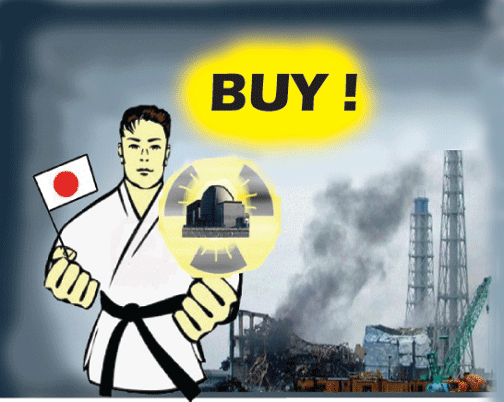
A nuclear power plant project in Britain is giving Japan a glimmer of hope for spurring infrastructure exports, a key growth strategy of Prime Minister Shinzo Abe.
Hitachi Ltd. and the U.K. government started official talks last month on building new reactors in Wales, with a goal of firing them up in the first half of the 2020s.
The outlook for the ¥3 trillion project is unclear, with both sides facing a string of challenges in the talks going forward.
For Tokyo, the plan is one of its few remaining major overseas projects on the horizon, with other nuclear power generation plans discontinued or facing cancellation.
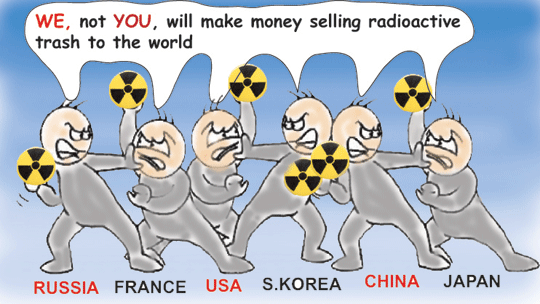
The government’s bet on nuclear power plants as a pillar of infrastructure exports comes as the likes of Germany, Italy, Taiwan and South Korea are pulling out of atomic power generation.
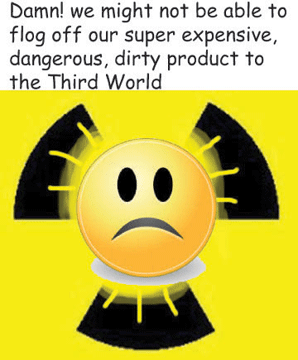
Critics argue that a surge in safety costs and accident worries caused by the 2011 Fukushima disaster, in addition to the lack of viable disposal solutions for radioactive waste, mean there is no justification for keeping faith in nuclear energy. Compounding the sector’s decline is the rapidly dropping cost of tapping such renewable energy sources as wind and solar power.
Still, some emerging economies look like they will need new nuclear power plants, and Japanese builders see few chances to construct new ones anytime soon in Japan.
“The Japanese government has been pushing hard for exports of nuclear power plants but it’s clear that it’s not going well,” said Tadahiro Katsuta, a professor at Meiji University. “The government will spare no effort in giving momentum to the exports.”
If the project in Britain proves successful, it will give the government “a good excuse” to push harder abroad, he said.
Before the official talks began, Hitachi had told Britain it might not take part in the project to build two advanced boiling water reactors on the Isle of Anglesey in Wales, because the price tag had soared higher than initially estimated.
But an offer by London to shoulder about two-thirds of the cost convinced Hitachi stay in. Tokyo welcomed its decision to begin the talks.
“The nuclear business overseas is significant … it would lead to strengthening and maintaining human resources and technology for nuclear power in Japan,” Minister of Economy, Trade and Industry Hiroshige Seko told a news conference.
Under the agreement, the British government will subsidize much of the cost through direct investment and loan guarantees, according to sources close to the matter.
“We are currently examining the financial and cost issues of the project, before making a final decision in 2019 on whether to invest in the project,” Hitachi Chief Financial Officer Mitsuaki Nishiyama said Friday at a news conference to announce earnings.
For Hitachi, nuclear power is a core operation. It wants to increase revenue from the business by more than 33 percent to ¥250 billion over the four years through March 2022, mainly through boosting overseas revenue.
Rival Toshiba Corp. exited overseas nuclear operations after incurring huge losses in the United States, a decision that could cripple Tokyo’s efforts to promote Japanese nuclear plants abroad.
Mitsubishi Heavy Industries Ltd., is pursuing a nuclear power plant project in Turkey. But it hit a snag when it saw safety-related costs surge and trading house Itochu Corp. walked away from the project.
In another blow to the government, Vietnam in 2016 decided to abandon a plan to build its first nuclear power plant with Japanese assistance due to tight state finances.
Those failures have led to an increased focus on the new power station in Wales. But London and Hitachi still need to address such issues as how to spread the remainder of the costs among Hitachi, local companies and Japan-backed financial institutions. They also need to determine who should be held liable if there’s a major accident.
They are also at odds over how much the electricity produced at the plant should cost. Britain at one point offered a price some 20 percent lower than what Hitachi wanted, a source familiar with the matter said.
“A key focus of discussions with Hitachi has been and will continue to be achieving lower-cost electricity for consumers,” Greg Clark, British business and energy secretary, told Parliament last month.
The two sides also need to talk to residents and win over those worried about the new power station.
“We have a major multinational and two governments supposed to be democracies playing a high-stakes game of poker … without any transparency or scrutiny for the people that they are representing,” Mei Tomos, a resident of Wales, said at a news conference in Tokyo during a recent visit to Japan.
“We have seen the destruction which nuclear power can cause. It is really too much to expect us to take the same risks. Even if such an accident didn’t happen at Anglesey we will still be faced with over a hundred years of storage of nuclear waste on site which presents a massive danger to us,” another resident, Robert Davies, said at the news conference.
South Africa Opens Door to Future Russian Nuclear Power Deal, US News, July 26, 2018 , BY ALEXANDER WINNING, JOHANNESBURG (Reuters)– South Africa cannot afford large-scale expansion of its nuclear power capacity but would still be open to future deals with Russia, a senior ruling party official said on Thursday, shortly before the arrival of President Vladimir Putin for a summit.
Russian state firm Rosatom was one of the front runners for a project to increase South Africa’s nuclear power-generating capacity championed by former president Jacob Zuma.
South African President Cyril Ramaphosa has put nuclear expansion on the back burner since taking office in February, saying it is too expensive, and has focused instead on pledges to revive the economy and crack down on corruption.
African National Congress Treasurer General Paul Mashatile, one of the six most powerful members of the ruling party, said Pretoria would not rush into major nuclear investments but that it was still open to deals. ………
Russia wants to turn nuclear energy into a major export industry. It has signed agreements with African countries with no nuclear tradition, including Rwanda and Zambia, and is set to build a large nuclear plant in Egypt.
Rosatom signed a separate agreement with South Africa’s state nuclear firm on Thursday to explore joint production of nuclear medicines and other ways of harnessing nuclear technology, a statement from the two firms showed.
The agreement, which is non-binding and is not related to large-scale power generation, is a further sign that Rosatom is keen to cement its position on the African continent.











 nuclear-news