Employee’s legal threat hangs over EDF’s U.K. Nuclear Project

 EDF Unions Threaten to Go to Court Over U.K. Nuclear Project, Bloomberg, Francois De Beaupuy April 22, 2016
-
Employee representatives ask to be consulted before decision
-
Trade unions say they’ll sue if not consulted in advance
-
Electricite de France SA’s unions are threatening to take the company to court if employees are not consulted in advance on a decision concerning a proposed 18 billion-pound ($25.8 billion) U.K. atomic plant project.
EDF’s workers committee, which includes representatives from the biggest unions, met near Paris and voted to take legal action should the company fail to consult employees on Hinkley Point, according to a statement Thursday. The project is key to EDF earnings and has prompted disagreements between management and unions, it said.
“We ask that the workers’ committee is consulted before any decision by management or the board,” the committee said. If that didn’t happen then “the committee would be forced to take legal action to have any decision linked to the Hinkley Point project suspended or annulled.”
The threat marks the latest attempt by workers to delay a decision, given concerns about EDF’s finances amid falling power prices across Europe. Union FO has already threatened to call for a strike. EAS, an association of EDF employees holding the company’s shares, is asking the stock market regulator to require that the French government, which owns 85 percent of EDF, repurchases shares at the initial public offering price…..http://www.bloomberg.com/news/articles/2016-04-21/edf-unions-threaten-to-go-to-court-over-u-k-nuclear-project
Jobs boom in USA States with wind power development
 The job growth in 2015 is primarily attributable to more wind project development and construction, requiring more than 38,000 employees.
Texas leads the nation with over 24,000 wind energy employees.
US wind power jobs hit record, up 20 percent in 2016 ‘Wind rush’ fuels hiring boom, delivers more consumer savings AWEA, DENVER, April 12, 2016 — American wind power supported a record 88,000 jobs at the start of 2016—an increase of 20 percent in a year—according to the U.S. Wind Industry Annual Market Report, Year Ending 2015, released today by the American Wind Energy Association (AWEA). Strong job growth coincided with wind ranking number one as America’s leading source of new generating capacity last year, outpacing solar and natural gas.
Colorado Gov. John Hickenlooper joined in the release at a Vestas wind turbine component factory near Denver, saying “In 2015, Colorado ranked fifth in the nation for wind power capacity additions. An investment in the wind power industry and in wind projects generates new jobs, economic development in rural counties and clean air benefits to all Coloradans.”
“Wind power benefits more American families than ever before,” said Tom Kiernan, CEO of AWEA. “We’re helping young people in rural America find a job close to home. Others are getting a fresh chance to rebuild their careers by landing a job in the booming clean energy sector. With long-term, stable policy in place, and a broader range of customers now buying low-cost wind-generated electricity, our workforce can grow to 380,000 well-paying jobs by 2030.”
Each new wind turbine typically avoids over 4,200 metric tons of carbon dioxide (CO2) a year, (equal to nearly 900 cars’ worth). U.S. wind energy avoided 132 million metric tons in total CO2 emissions last year, equal to eliminating all electric power sector emissions from Kansas, Nebraska, Oklahoma, and Colorado.
Wind energy also greatly reduces a variety of health-harming air pollutants, including smog-causing sulfur dioxide (SO2) and nitrogen oxides (NOx), which helps reduce asthma attacks and other respiratory issues. That displaced an estimated 176,000 metric tons of SO2 and 106,000 metric tons of NOx in 2015, representing $7.3 billion in avoided health costs last year alone.
The AWEA U.S. Wind Industry Annual Market Report Year Ending 2015 provides a comprehensive look at the entire U.S. wind energy landscape, offering industry trends, statistics, company rankings and the market picture through 2015. A comprehensive press kit here includes more detailed releases on specific findings, videos, infographics, and up-to-date photos of wind turbines across America…….. http://www.awea.org/MediaCenter/pressrelease.aspx?ItemNumber=8736
India’s push for solar power to bring over a million jobs
 India Solar Power Push May Produce Over 1 Million Jobs http://cleantechnica.com/2016/03/23/india-solar-power-push-may-produce-over-1-million-jobs/ March 23rd, 2016 by Smiti Mittal Originally published on Sustainnovate. India’s massive solar power capacity addition target is expected to be a revolution in the Indian jobs market as well.
According to a report by the Natural Resources and Defense Council (NRDC), India may end up creating over a million new jobs in its endeavour to have 100 GW of operational solar power capacity by March 2022.
The report suggests that a massive army of engineers, construction, and maintenance workers shall be required set up the scores of solar power capacity planned by the central and state governments.

Around 210,800 site engineers and designers would be required to set the large-scale as well as rooftop solar power systems rolling. Around 624,600 semi-skilled workers would be needed for the construction and on-field execution of the projects. To monitor ongoing operations at the power plants and their maintenance, another 182,400 semi-skilled workers would be needed. Thus, a total of 1,017,800 jobs are expected be created if India indeed manages to set up a cumulative operational capacity of 100 GW by 2022.
Jobs creation and empowering youth is one of the major policies of the current government. The ‘Skill India’ program launched by the Indian government aims to provide employment to youth by providing them industrial training in the solar power sector. Several agencies across the country have already started such training programs.
Some state governments have also announced financial support to unemployed youth to set up rooftop solar power systems to help them generate a source of income.
The health toll of Fukushima nuclear disaster – especially workers and children
Nuclear Expert: Fukushima “like the worst nightmare becoming reality” — Released as much as 1,000 atomic bombs worth of radioactive material — “Everyone on earth has been exposed… an increase in cancer will be the result” »
“Shocking how many people died in Fukushima” — Cremated bodies of Fukushima radiation workers found near plant — “Such a high rate of cancer” being detected in Fukushima children (VIDEOS) http://enenews.com/shocking-many-people-died-fukushima-cremated-remains-fukushima-radiation-workers-found-plant-high-rate-cancer-being-detected-children-videos?utm_source=feedburner&utm_medium=email&utm_campaign=Feed%3A+ENENews+%28Energy+News%29
AP,Mar 10, 2016 (emphasis added): Fukushima ‘Decontamination Troops’ Often Exploited, Shunned — The ashes of half a dozen unidentified laborers ended up at a Buddhist temple in this town just north of the crippled Fukushima nuclear plant… They were simply labeled “decontamination troops” — unknown soldiers in Japan’s massive cleanup campaign to make Fukushima livable again five years after radiation poisoned the fertile countryside… One laborer… said he was instructed never to talk to reporters… Minutes after chatting with some workers in Minamisoma, Associated Press journalists received a call from a city official warning them not to talk to decontamination crews… [W]orkers have developeddiabetes, cerebral and respiratory problems… local hospital intern Toyoaki Sawano said in a medical magazine last month… Hideaki Kinoshita, a Buddhist monk who keeps the unidentified laborers’ ashes at his temple [said] “There is no end to this job… Five years from now, the workers will still be around. And more unclaimed ashes may end up here.”
Mainichi, Mar 7, 2016: Experts divided on causes of high thyroid cancer rates among Fukushima children — A total of 166 children in Fukushima Prefecture had been either diagnosed with thyroid cancer or with suspected cases of cancer… “Compared to the estimated prevalence rates based on the country’s statistics on cancer, which are shown in data including regional cancer registration, the level of thyroid cancer detection is several dozen times higher(in children of Fukushima Prefecture),” said the final draft for the interim report compiled by the prefectural government’s expert panel on Feb. 15… [T]wo teams both concluded that the number of cancer cases found in Fukushima children was “about 30 times” that of national levels [and] agree that the “30 times higher (than the national occurrence rates)” is unexplainable. At the moment, the most likely theories for such a high rate of cancer detection are the “overdiagnosis theory” held by [the team led by Shoichiro Tsugane, a member of the Fukushima government’s expert panel] and the “radiation effect theory” that [the team led by Okayama University professor Toshihide Tsuda] supports… Tsugane is not completely denying the effects of radiation in children’s cancer… [Tsuda] argues that radiation exposure is the main cause of the high prevalence of cancer in children [and] because the spread of cancer cells to lymph nodes and other tissues could be seen in 92 percent of patients, Tsuda believes thatoverdiagnosis makes up 8 percent of the patients at most…
RT, Mar 11, 2016: ‘Shocking how many people died in Fukushima‘ – documentary director… Authorities in Japan want locals to think “nothing happened,” documentary director Jeffrey Jousan told RT. “The government prints the number of people who died as a result of the 2011 disaster in the newspapers… the (death toll) amounts to 300-400 people in each prefecture, but in Fukushima it is over 8,000 people… It is shocking… to see [how] many people have died in Fukushima”… [I]t is still unclear how many people have succumbed to or suffer from radiation-caused cancer diseases directly linked to the crippled plant.
Watch Press Conferences: Prof. Tsuda | Dr. Angelika Claussen, physician
The workers of the Fukushima nuclear clean-up
Fukushima Keeps Fighting Radioactive Tide 5 Years After Disaster, NYT By JONATHAN SOBLE MARCH 10, 2016 TOKYO — Of the thousands of workers who have answered the help-wanted ads at Fukushima Daiichi, the ruined and radioactive nuclear power plant in northeastern Japan, the part-time lettuce farmer and occasional comic-book artist Kazuto Tatsuta must be among the least likely.
“I needed a job,” Mr. Tatsuta, 51, recalled of his decision in 2012 to accept work at the site of one of the world’s worst nuclear accidents.
His duties included welding broken water pipes and inspecting remote-controlled robots that survey radioactive hot spots. And his comic strips, once populated with baseball players and gangsters, now tell stories of middle-aged, blue-collar men like himself who do the grunt work at Fukushima, some of whom find a sense of purpose and belonging they lacked in the outside world.
“It’s secure. You’re not going to get laid off there,” Mr. Tatsuta said. “But you’re also working for a goal.”
Five years after a powerful earthquake and tsunami struck, causing three reactors at Fukushima to melt down, that goal is the focus of a colossal effort at once precarious and routine. A veneer of stability at the plant masks a grueling, day-to-day battle to contain hazardous radiation, which involves a small army of workers, complex technical challenges and vexing safety trade-offs.
Fukushima has become a place where employees arrive on company shuttle buses and shop at their own on-site convenience store, but where they struggle to control radiation-contaminated water and must release it into the sea. Many of the most difficult and dangerous cleanup tasks still lie ahead, and crucial decisions remain unsettled………
The duration of the cleanup also creates the risk of labor shortages, he said, especially in jobs requiring special skills. Japan’s population is shrinking and, with the future of nuclear power uncertain, many young people are unwilling to stake careers on the industry.
For now, Fukushima is bustling with about 7,000 workers, much more than before the disaster and twice as many as two years ago. The town of Iwaki to the south has become a kind of workers’ village. At dawn, vans and buses line up to ferry workers to the plant via staging areas where they don protective white Tyvek suits, radiation monitors and gas masks.
“You think of it as totally normal work,” said Mr. Tatsuta, who asked to be identified only by his pen name to avoid being blacklisted by the plant’s owner, Tokyo Electric Power Company……….
For workers at the site, radiation is a constant enemy — though many see it more as a threat to their livelihoods than their lives. Government regulations forbid cleanup workers to be exposed to too much radiation, and when they hit the limits, they risk being laid off or reassigned to lower-paying jobs.
“If you go over the radiation limits, you can’t work,” Mr. Tatsuta said. “You’re always calculating how to keep the dose low.”
The temptation to cheat can be strong, for both workers and their managers. A government examination of Tokyo Electric’s safety practices in 2013 found that it had underreported the radiation exposure of a third of the workers whose records were reviewed. The company says it has since tightened reporting procedures……..http://www.nytimes.com/2016/03/11/world/asia/japan-fukushima-nuclear-disaster.html?_r=0
Efficacy of compensation program for nuclear workers under scrutiny
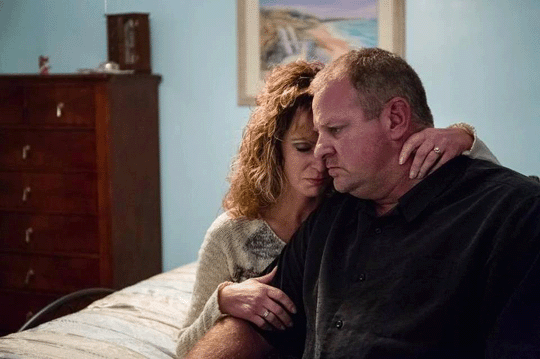 Feb 22, 2016. … Since Congress passed the Energy Employees Occupational Illness Compensation Program Act in 2000, the government has spent $12 billion in financial restitution for more than 100,000 workers whose onset of cancer, beryllium disease, neurological disorders and other ailments is a result of careers in the more than 300 nuclear facilities across the country. …
But the program has come under scrutiny lately. An investigation by the McClatchy DC news service found that fewer than half of the people who have applied for benefits have received them, and workers’ complaints are often suspended in the complex process of paperwork or court hearings, with some claims languishing in the system for up to 10 years.
Rising toll of missing Fukushima workers – presumed dead – coverup by mass media
 4,000 Missing TEPCO Nuclear Plant Workers – Presumed To Be Dead, Fukushima Radiation Caused Death Toll Is Rising Fast http://agreenroad.blogspot.com.au/2013/10/200-or-more-missing-tepco-nuclear-plant.html
PRO NUCLEAR PROMOTERS AND THEIR MASS MEDIA SHILLS KEEP ON REPEATING THE PR PROPAGANDA THAT NO ONE DIED DUE TO FUKUSHIMA AND NOTHING BAD HAPPENED
No One Died! How The Nuclear Industry Gets Away With Genocide Due To Nuclear Bombs And Nuclear Plant Accidents, Explained By Dr. Helen Caldicott MD
http://agreenroad.blogspot.com/2015/04/no-one-died-how-nuclear-industry-gets.html
Safecast Radiation Readings From Inside Fukushima Daichi Plant Finally Revealed In Dec. 2013 – 192 USv/Hr, 5,900,000 CPM, Converting CPM radiation readings into uSv/Hr And Back Again
http://agreenroad.blogspot.com/2013/12/radiation-readings-from-inside.html
Countless Unreported Worker Deaths in the Fukushima nuclear clean-up workforce
Fukushima – Deep Trouble CounterPunch, FEBRUARY 22, 2016 by ROBERT HUNZIKER “………..The Tragedy of Countless Unreported Worker Deaths
Indeed, the question of whether Fukushima can ever be adequately, safely decontaminated is wide-open, which logically segues to question who does the dirty work, how workers are hired, and what’s their health status? According to mainstream news sources in Japan, workers are doing just fine, estimates range up to 45,000 workers all-in, no major problems.
As far as the world is concerned, the following headline sums up radiation-related issues for workers, First Fukushima Worker Diagnosed With Radiation-linked Cancer, The Telegraph, Oct. 20, 2015. All things considered, that’s not so bad. But, who’s counting?
Trustworthy sources outside of mainstream news claim otherwise, none more so than Mako Oshidori, a Japanese freelance journalist and a director of Free Press Corporation/Japan, and a former student of School of Life Sciences at Tottori University Faculty of Medicine, in a lecture entitled “The Hidden Truth about Fukushima” delivered at the international conference “Effects of Nuclear Disasters on Natural Environment and Human Health” held in Germany in 2014 co-organized by International Physicians for Prevention of Nuclear War.
Free Press Corporation/Japan was formed after the 2011 Great Sendai Earthquake as a counterbalance to Japan’s mainstream government influenced media, described by Mako as journalists who do not report truth, journalists afraid of the truth!
“There is one thing that really surprised me here in Europe. It’s the fact that people here think Japan is a very democratic and free country.” (Mako Oshidori)
According to Mako, TEPCO and the government deliberately cover-up deaths of Fukushima workers, and not only do they cover-up deaths, but once she investigated stories of unreported deaths, government agents started following her: “When I would talk to someone, a surveillance agent from the central government’s public police force would come very close, trying to eavesdrop on the conversation,” Exposed: Death of Fukushima Workers Covered-Up by TEPCO and Government, NSNBC International, March 21, 2014.
Mako Oshidori: “I would like to talk about my interview of a nurse who used to work at the Fukushima Daiichi Nuclear Power Plant (NPP) after the accident… He quit his job with TEPCO in 2013, and that’s when I interviewed him… As of now, there are multiple NPP workers that have died, but only the ones who died on the job are reported publicly. Some of them have died suddenly while off work, for instance, during the weekend or in their sleep, but none of their deaths are reported.”
“Not only that, they are not included in the worker death count. For example, there are some workers who quit the job after a lot of radiation exposure, such as 50, 60 to 70 mili Sieverts, and end up dying a month later, but none of these deaths are either reported, or included in the death toll. This is the reality of the NPP workers.”
The “reality of the NPP workers… dying a month later” does not correspond very well with Abe administration insistence that nuke plants reopen, even though the country has continued to function for five years without nuclear power, hmm.
In her speech, Mako talks about problems for journalists because of government interference: “An ex-agent who is knowledgeable about the work of the Public Security Intelligence Agency (“PSIA”) said that when you are visibly followed, that was meant to intimidate you. If there was one person visible, then there would be ten more. I think that is analogous to cockroaches. So, when you do a little serious investigation about the nuclear accident, you are under various pressure and it makes it more difficult to interview people.”
Still, she interviewed Fukushima mothers, e.g., “Next, I would like to talk about mothers in Fukushima. These mothers (and fathers) live in Iwaki City, Fukushima. They are active on school lunch issues. Currently, Fukushima produce isn’t selling well due to suspected contamination. So the prefectural policy is to encourage the use of Fukushima produce in school lunches, in an attempt to appeal to its safety… the mothers claim that currently in Japan only cesium is measured and they have no idea if there is any strontium-90. They oppose the use of Fukushima produce in school lunches for fear of finding out, ten-plus years down the road, that there was actually plutonium in the food that children ate.”
Mothers who oppose the prefecture’s luncheon policy are told to leave Fukushima Prefecture, move out if they worry about contamination, pull up stakes and move on.
Mako’s full interview is found here.
All of which begs the question of who does the dirty work? According to Michel Chossudovsky, director of Centre for Research on Globalization (Canada), Japan’s organized crime syndicate Yakusa is actively involved in recruitment. Personnel who qualify for radioactive cleanup work include underemployed, impoverished, indigent, unemployed, homeless, hard up, down-and-out, and poverty-stricken individuals, as well as non-destitute people willing to undertake under-paid, high-risk work. The nameless are shoe-ins……… http://www.counterpunch.org/2016/02/22/fukushima-deep-trouble/
The Tragedy of Countless Unreported Nuclear Worker Deaths
Fukushima – Deep Trouble, CounterPunch, FEBRUARY 22, 2016 by ROBERT HUNZIKER “………Indeed, the question of whether Fukushima can ever be adequately, safely decontaminated is wide-open, which logically segues to question who does the dirty work, how workers are hired, and what’s their health status? According to mainstream news sources in Japan, workers are doing just fine, estimates range up to 45,000 workers all-in, no major problems.
As far as the world is concerned, the following headline sums up radiation-related issues for workers, First Fukushima Worker Diagnosed With Radiation-linked Cancer, The Telegraph, Oct. 20, 2015. All things considered, that’s not so bad. But, who’s counting?
Trustworthy sources outside of mainstream news claim otherwise, none more so than Mako Oshidori, a Japanese freelance journalist and a director of Free Press Corporation/Japan, and a former student of School of Life Sciences at Tottori University Faculty of Medicine, in a lecture entitled “The Hidden Truth about Fukushima” delivered at the international conference “Effects of Nuclear Disasters on Natural Environment and Human Health” held in Germany in 2014 co-organized by International Physicians for Prevention of Nuclear War.
Free Press Corporation/Japan was formed after the 2011 Great Sendai Earthquake as a counterbalance to Japan’s mainstream government influenced media, described by Mako as journalists who do not report truth, journalists afraid of the truth!
“There is one thing that really surprised me here in Europe. It’s the fact that people here think Japan is a very democratic and free country.” (Mako Oshidori)
According to Mako, TEPCO and the government deliberately cover-up deaths of Fukushima workers, and not only do they cover-up deaths, but once she investigated stories of unreported deaths, government agents started following her: “When I would talk to someone, a surveillance agent from the central government’s public police force would come very close, trying to eavesdrop on the conversation,” Exposed: Death of Fukushima Workers Covered-Up by TEPCO and Government, NSNBC International, March 21, 2014.
Mako Oshidori: “I would like to talk about my interview of a nurse who used to work at the Fukushima Daiichi Nuclear Power Plant (NPP) after the accident… He quit his job with TEPCO in 2013, and that’s when I interviewed him… As of now, there are multiple NPP workers that have died, but only the ones who died on the job are reported publicly. Some of them have died suddenly while off work, for instance, during the weekend or in their sleep, but none of their deaths are reported.”
“Not only that, they are not included in the worker death count. For example, there are some workers who quit the job after a lot of radiation exposure, such as 50, 60 to 70 mili Sieverts, and end up dying a month later, but none of these deaths are either reported, or included in the death toll. This is the reality of the NPP workers.”
The “reality of the NPP workers… dying a month later” does not correspond very well with Abe administration insistence that nuke plants reopen, even though the country has continued to function for five years without nuclear power, hmm.
In her speech, Mako talks about problems for journalists because of government interference: “An ex-agent who is knowledgeable about the work of the Public Security Intelligence Agency (“PSIA”) said that when you are visibly followed, that was meant to intimidate you. If there was one person visible, then there would be ten more. I think that is analogous to cockroaches. So, when you do a little serious investigation about the nuclear accident, you are under various pressure and it makes it more difficult to interview people.”
Still, she interviewed Fukushima mothers, e.g., “Next, I would like to talk about mothers in Fukushima. These mothers (and fathers) live in Iwaki City, Fukushima. They are active on school lunch issues. Currently, Fukushima produce isn’t selling well due to suspected contamination. So the prefectural policy is to encourage the use of Fukushima produce in school lunches, in an attempt to appeal to its safety… the mothers claim that currently in Japan only cesium is measured and they have no idea if there is any strontium-90. They oppose the use of Fukushima produce in school lunches for fear of finding out, ten-plus years down the road, that there was actually plutonium in the food that children ate.”
Mothers who oppose the prefecture’s luncheon policy are told to leave Fukushima Prefecture, move out if they worry about contamination, pull up stakes and move on.
Mako’s full interview is found here.
All of which begs the question of who does the dirty work? According to Michel Chossudovsky, director of Centre for Research on Globalization (Canada), Japan’s organized crime syndicate Yakusa is actively involved in recruitment. Personnel who qualify for radioactive cleanup work include underemployed, impoverished, indigent, unemployed, homeless, hard up, down-and-out, and poverty-stricken individuals, as well as non-destitute people willing to undertake under-paid, high-risk work. The nameless are shoe-ins…….. http://www.counterpunch.org/2016/02/22/fukushima-deep-trouble/
Thousands of nuclear workers made sick by radiation, but not getting any help
Sen. Tom Udall, D-N.M., is among a group of federal lawmakers who have called for an investigation into the program following McClatchy’s probe, which revealed 7,762 workers died after being denied compensation by the government.
The McClatchy DC investigation found that nuclear worker safety remains an issue: Since 2001, more than 186,000 workers have been exposed to radiation.
 Efficacy of compensation program for nuclear workers under scrutiny By Rebecca Moss
The New Mexican, 20 Feb 16, “………Due to the commingling of his exposure during the war and his work on various sites at Sandia, Thompson is one of at least 10,273 New Mexicans who have applied for a federal program that compensates individuals with a $150,000 lump sum payment for serious illness or death that can be attributed to work at the state’s nuclear defense facilities since 1943.
As of March 2015, New Mexico had received the second-highest compensation of any state under the fund, with $1.64 billion paid out to workers for compensation and medical bills.
But the program has come under scrutiny lately. An investigation by the McClatchy DC news service found that fewer than half of the people who have applied for benefits have received them, and workers’ complaints are often suspended in the complex process of paperwork or court hearings, with some claims languishing in the system for up to 10 years. A new documentary coming out in March, titled Safe Side of the Fence, questions why side-by-side workers with similar ailments would receive different judgments from the Department of Labor on the validity of their claims.
At least 5,400 workers in New Mexico have been denied financial assistance, according to the Department of Labor, which issues the compensation.
The department recently added new language to the regulations, which is intended to clarify who is eligible for relief. A 60-day public comment period for the proposal ended Thursday. But critics say the new language could make it even more difficult for ailing workers to receive compensation. Continue reading
UK Hinkley Point nuclear plant project director quits
 EDF project director for UK Hinkley Point nuclear plant quits, 7 News, Reuters February 3, 2016 LONDON – An executive of French utility EDF in charge of Britain’s first new nuclear power station project for 20 years is leaving to join U.S. energy company Entergy Corp , the U.S. firm said on Tuesday.
As an executive director at EDF’s British unit, EDF Energy, Christopher Bakken had been project director since 2011 for the Hinkley Point C nuclear project in southwestern England.
He was responsible for the design, procurement, construction and commissioning of the planned new nuclear plant………
Intractable problems at two similar nuclear plants under construction in France and Finland threaten more delays to EDF’s British plans. https://au.news.yahoo.com/world/a/30718466/edf-project-director-for-uk-hinkley-point-nuclear-plant-quits/
French unions unhappy with arrangements for UK’s Hinkley nuclear build
 New nuclear power: It’s consumer protection vs corporate profit, http://www.carolinelucas.com/latest/new-nuclear-power-its-consumer-protection-vs-corporate-profit January 27, 2016 The Government’s policy of burdening bill payers with eye watering subsidies for new nuclear power has received another blow. Just before a crucial board meeting at EDF (the French state owned energy giant relied on by the Government to invest in and operate Hinkley Point) French trade unions spoke out about their concerns.
When even staff working for EDF are raising serious doubts about numerous aspects of the proposal, UK Ministers’ cavalier attitude to Hinkley Point C needs to change, more urgently than ever.
In advance of an EDF board meeting due to take place today, where the company was rumoured to be making a final investment decision, French unions threw a welcome spanner in the works.
They’ve raise no fewer than 15 questions about the project, suggesting it would be difficult to complete on time and that financing it could threaten EDF’s survival. The good news, for now, is that EDF has, again, delayed the decision.
But the concerns of French unions are worth a closer look. They include pending legal cases, the lack of evidence Hinkley can be built on time, and the partnership with the Chinese nuclear energy company when no other investors appear to be interested.
Most telling of all is the following question: “what happens if the UK government decides to look after consumer interest?”
This shows that the Conservative Government’s pro-nuclear policy flies in the face of everything they say about looking after the interests of consumers and billpayers. Indeed, studies show that solar power coupled with energy storage and smart grid technology could generate the equivalent to Hinkley Point C at half the cost – to the Govt and to you and I. Wind power, even with backup, ischeaper than nuclear power too.
The Government’s obsession with outdated, inflexible, expensive nuclear power stations is looking more economically and environmentally reckless by the day. So I’ve tabled some more urgent parliamentary questions on Hinkley.
The first question relates to the problems with a similar model of nuclear power station being built at Flamenville in France. It’s already 6 years behind schedule, €7.5 billion over budget, and subject to safety tests following some serious flaws in the reactor vessel and bottom. The ruling on these safety concerns has itself been delayed. I’m pressing the Government on whether the agreement to proceed with Hinkley is conditional on the Flamanville plant demonstrating it’s capable of operating.
My second question is about the huge cost of new nuclear to consumers. It picks up on Ministers’ mindboggling double standards when it comes to subsidies for nuclear power verses solar power, onshore wind and other renewable technologies.
In the Commons earlier this month, the Energy Secretary again attempted to justify her huge cuts to solar subsidies on grounds that “subsidies for low carbon power should be temporary, not part of a permanent business model”. So my question asks exactly when she expects nuclear power stations to meet the same standards and operate on a subsidy free basis. Some renewable technologies are nearly there already, with the costs of others on a clear downward cost trajectory. Energy storage, interconnection and smart grids make Ministers appear stuck in the last century as they desperately argue about baseload.
The cost and climate change arguments against new nuclear power grow stronger every day. This week, workers have made their voices heard. It’s surely time the UK Government started to work for us rather than big energy companies and consign new nuclear to the dustbin of history. Ministers need to start listening to the many voices cautioning against Hinkely and instead back 21st century clean technologies.
In other major nuclear news this week, tomorrow sees a Special Parliamentary seminar co-organised by Nuclear Free Local Authorities and Nuclear Consulting Group: “UK Energy Policy: Late Lessons from Chernobyl, Early Warnings from Fukushima” The keynote speaker will be Naoto Kan, Former Prime Minister of Japan at the time of Fukushima.
USA changes law to make it harder for nuclear radiation victims to get compensation
the directive signals an initial step toward trying to dismantle or rein in a $12 billion compensation program that has made payments to more than 53,000 sickened workers or their survivors since 2001.
Nuclear workers fear new policy will make it harder to win compensation
Department of Labor says nuclear facilities are much safer since 1995
Workers and advocates worry it will be more difficult to prove cases
A fight is underway to get policy repealed in order to protect sick employees
BY LINDSAY WISE, ROB HOTAKAINEN AND FRANK MATT McClatchy Washington Bureau, 22 Jan 16 WASHINGTON
Abelardo Garza was working near tanks full of toxic sludge at Hanford nuclear reservation in Washington state last Aug. 14 when one of his co-workers noticed a strange smell.
Within minutes, Garza’s nose started bleeding. The next morning, he awoke gasping for breath.
It was the fourth time in five years that Garza would end up in the hospital after suspected exposure to chemical vapors at Hanford, a 586-square-mile site where workers once made plutonium for the bomb dropped on Nagasaki, Japan.
Now Garza, 65, worries that a new federal directive the government says was intended to speed up compensation claims by sick and dying nuclear workers could harm his chances of qualifying for benefits if his health worsens in the future.
The directive, which became effective in December 2014, orders claims examiners to conclude that workers at Department of Energy nuclear facilities have not have any significant exposure to toxins since 1995 “in the absence of compelling data to the contrary.”
To Garza, the wording of the government’s directive feels like a dismissal. Continue reading
Census shows rapid growth of solar industry jobs in USA
USA National Solar Jobs Census 2015 Released http://www.energymatters.com.au/renewable-news/solar-jobs-census-em5291/ January 13, 2016
The U.S. solar workforce grew to a total of nearly 209,000 last year; adding more than 35,000 workers – the third consecutive year in which growth exceeded 20%.
The Solar Foundation’s National Solar Jobs Census 2015 states the workforce has increased by 123% since 2010.
“The solar industry has once again proven to be a powerful engine of economic growth and job creation,” said Andrea Luecke, President and Executive Director of The Solar Foundation. ” Our Census findings show that one out of every 83 new jobs created in the U.S. over the last 12 months was in the solar industry – 1.2% of all new jobs.”
The USA’s solar workforce is now three times the number employed in the coal mining industry and also larger than the oil and gas extraction industry.
Last year, solar industry employment grew 12 times faster than the overall US workforce.
In addition to direct employment, the US solar industry supports an additional 610,650 ancillary jobs throughout the supply chain.
When the first Census was run in 2010, the USA had installed 929MW of solar capacity that year. Last year, 7,430MW of capacity was added.
The installation sector represented the bulk of jobs in the US solar industry in 2015.
Installation – 119,931
Manufacturing – 30,282
Sales and distribution – 24,377
Project development – 22,452
All others – 11,816
Employment in all sectors grew in 2015, with the exception of solar manufacturing. However, manufacturing jobs are expected grow by 3,800 positions in 2016; supported by industry construction activity.
Approximately 90% of all solar workers are 100% dedicated to solar activities; a percentage that has been effectively unchanged since 2013.
Jobs in the solar industry continue to pay above the median wage of all occupations in the USA.
Looking ahead, a further 14.7% increase in positions is expected this year – an extra 30,000 jobs – bringing the total of U.S. solar workers to 239,625 by the end of 2016. It could perhaps be even higher as Census data collection was completed before the extension of the 30% Federal Investment Tax Credit (ITC) was announced.
The sixth annual National Solar Jobs Census can be viewed in full here (PDF).
Thousands of USA’s Oak Ridge nuclear workers sick and dying from cancers and other radiation-caused illnesses
Of the 33,480, the government has specifically acknowledged that exposure to radiation or other toxins on the job likely caused or contributed to the deaths of 15,809 workers. And this tally almost certainly underestimates the total dead among the 600,000 who worked in the weapons program at its peak.
The women who worked at the plant were told to keep their mouths shut, and those
who talked about their jobs were quickly let go.
Nuclear workers: Projects’ results were worth illnesses, deaths Amarillo.com December 28, 2015 Tribune News Service Editor’s note: This is the third story in a series examining the health problems that afflict the U.S. nuclear workforce as the government launches a $1 trillion plan to modernize the arsenal.
In 1944, when the feds wanted young women to help out with a top-secret project in the hills of Tennessee, they found 19-year-old Evelyn Babb.
She grew up on four acres in Appalachia, where her family had one milk cow and a couple dozen chickens. She jumped at the chance to make 70 cents an hour at the new Y-12 plant in Oak Ridge, Tenn., twisting knobs on dials, with no clue what she was doing. Bosses advised her to tell friends she was making highchairs for infants.
When President Harry Truman dropped an atomic bomb on Hiroshima on Aug. 6, 1945, Babb learned the truth: She had helped produce the atomic hell that killed thousands of Japanese as one of the climactic acts of World War II.
In many cases, the money went to survivors. Of the 33,480, the government has specifically acknowledged that exposure to radiation or other toxins on the job likely caused or contributed to the deaths of 15,809 workers. And this tally almost certainly underestimates the total dead among the 600,000 who worked in the weapons program at its peak.
The plants with the highest number of deaths are the Y-12 National Security Complex in Tennessee, with 3,741, and the Hanford Site in Washington state, with 3,461. They’re the sites that provided the plutonium and uranium for the bombs, nicknamed Fat Man and Little Boy, that Truman used to wipe out Hiroshima and Nagasaki as part of the nation’s top-secret Manhattan Project.
“The death numbers tell you something, but they are just a slice of the story,” said Ralph Hutchison, a former Presbyterian pastor who’s coordinator of the Oak Ridge Environmental Peace Alliance, a group that has held peace vigils outside the Y-12 plant every Sunday for the last 16 years. “What’s the quality of life for people who have debilitating chronic illnesses?”
The number of dead is sure to grow much higher.
Seventy years after the atomic bombings, thousands of former workers at Department of Energy nuclear sites are sick from cancers and other diseases after being exposed to radiation, a long list of toxins and a brew of other dangerous substances.
Yet more than half of the 107,394 workers who have sought help since 2001 — 51.1 percent — have been denied, TNS’ investigation found.
And many workers have endured years of guilt after they unknowingly helped produce weapons of mass destruction.
“I felt proud until I started realizing that I had a part in killing all those people, and that’s something I didn’t believe in,” said Ruth Huddleston, 90, of Oliver Springs, Tenn., who went to work at Y-12 at age 18. “I had helped kill thousands of people.”……….http://amarillo.com/news/latest-news/2015-12-28/nuclear-workers-projects-results-were-worth-illnesses-deaths#.VoMfhne5dh0.twitter
1 This Month

of the week – Shut Down Drone Warfare!


Tell the Ukrainian Government to Drop Prosecution of Peace Activist Yurii Sheliazhenko

Petition to revoke the licensing of the Near Surface Nuclear Disposal Facility (NSDF) at Chalk River. https://www.ourcommons.ca/petitions/en/Petition/Details?Petition=e-7247
To see nuclear-related stories in greater depth and intensity – go to https://nuclearinformation.wordpress.com
-
Archives
- April 2026 (7)
- March 2026 (251)
- February 2026 (268)
- January 2026 (308)
- December 2025 (358)
- November 2025 (359)
- October 2025 (376)
- September 2025 (257)
- August 2025 (319)
- July 2025 (230)
- June 2025 (348)
- May 2025 (261)
-
Categories
- 1
- 1 NUCLEAR ISSUES
- business and costs
- climate change
- culture and arts
- ENERGY
- environment
- health
- history
- indigenous issues
- Legal
- marketing of nuclear
- media
- opposition to nuclear
- PERSONAL STORIES
- politics
- politics international
- Religion and ethics
- safety
- secrets,lies and civil liberties
- spinbuster
- technology
- Uranium
- wastes
- weapons and war
- Women
- 2 WORLD
- ACTION
- AFRICA
- Atrocities
- AUSTRALIA
- Christina's notes
- Christina's themes
- culture and arts
- Events
- Fuk 2022
- Fuk 2023
- Fukushima 2017
- Fukushima 2018
- fukushima 2019
- Fukushima 2020
- Fukushima 2021
- general
- global warming
- Humour (God we need it)
- Nuclear
- RARE EARTHS
- Reference
- resources – print
- Resources -audiovicual
- Weekly Newsletter
- World
- World Nuclear
- YouTube
-
RSS
Entries RSS
Comments RSS
 nuclear-news