So much winning

318 million people were already at crisis-level hunger before February 28. That figure has been earmarked for aggressive growth,
Please make it stop, Mr. President
Gold and Geoppolitics, , Apr 02, 2026
In 2002, the Pentagon spent $250 million on the largest wargame in US military history called ‘Millennium Challenge’. 13,500 participants, 2 years of planning, the works. The idea was pretty straightforward: simulate an invasion of a Middle Eastern country in the Persian Gulf. Suspiciously resembling Iran. The purpose was to demonstrate that America’s technological dominance could steamroll anything in its path.
They picked a retired 3-star Marine named Paul Van Riper to play the enemy.
Van Riper, who spent 41 years in uniform from Vietnam to Desert Storm, took one look at the scenario and did what any self-respecting adversary would do. He ignored it completely. Instead of radios, he used motorcycle couriers. Attack orders were hidden in the daily call to prayer. Swarms of explosive-laden speedboats were sent through the Strait of Hormuz.
And in less than 10 minutes, he sank 16 US warships. An aircraft carrier, 10 cruisers, and 5 amphibious ships. Over 20,000 simulated American casualties. The equivalent of Pearl Harbor, executed with small boats and cruise missiles by a retired Marine with a phone and a bad attitude.
So the Pentagon did what any self-respecting institution does when reality disagreed with the plan.
The ships were un-sank. Van Riper’s forces had to turn on their anti-aircraft radar so it could be easily targeted and destroyed. They even told him he wasn’t allowed to shoot down the incoming 82nd Airborne. The whole rest of the exercise was scripted to guarantee an American victory.
Van Riper walked out in disgust. His parting words: “Nothing was learned from this. A culture not willing to think hard and test itself does not augur well for the future”.
That was 24 years ago. The conditions Van Riper exploited haven’t changed. They’ve only gotten worse.
And now we’re one month into this shooting war with Iran. “Operation Epic Fury”.
Let’s have a look at what we’ve achieved, shall we?
The Strait of Hormuz has been successfully transitioned from a free international waterway into a revenue-generating toll infrastructure, administered by the IRGC with a published fee schedule, a vetting corridor near Larak Island, and legislation pending to make it permanent. Ships currently pay $2 to $3.5 million per transit, settling in yuan through CIPS, which bypasses SWIFT entirely and represents a significant upgrade in settlement efficiency.
India has adopted the yuan. Japan has adopted the renminbi. Pakistan negotiated preferential rates at 2 tankers per day. Thailand secured bilateral access. Only COSCO, China’s state shipping line, moves freely, which streamlines the user experience considerably if you happen to be Chinese. The dollar’s share of global reserves has reached its lowest level in a century, which suggests the new framework is being broadly embraced.
This is the petrodollar in transition. The mechanism that has underwritten American empire since 1974 – Gulf oil priced in dollars, revenues recycled through US Treasuries, quietly funding a $39 trillion debt – is being replaced in real time by a yuan-denominated corridor that didn’t exist 5 weeks ago. And unlike a military defeat, which can be spun and repackaged for a news cycle to consumers with the attention span of a goldfish, a reserve currency transition is a one-way door.
The Navy has achieved a significant risk management milestone by declining to escort tankers through the Strait, citing conditions that were “too high” – a prudent assessment that prioritises fleet preservation over the stated objective of the war. 3,000 ships and 20,000 seafarers remain in the Gulf, representing the largest involuntary maritime community since the Age of Sail. Maersk has 10 container ships holding position, crews resourcefully extending provisions without fresh food. 470,000 TEUs of container capacity – 10% of the global fleet – is effectively in long-term storage, reducing wear on hulls. The insurance industry has contributed independently: 7 P&I clubs filing cancellation notices achieved what the entire US Fifth Fleet could not, surging war-risk premiums from 0.2% to 10% of hull value. Even after a ceasefire, insurers require 30 to 60 days of incident-free stability before reinstating cover. The Houthis’ Red Sea precedent: 26 months and still no policy written.
Flexibility in goal-setting is a hallmark of mature organisations, and the administration demonstrated this by quietly reclassifying the reopening of Hormuz from “strategic imperative” to “optional”. The waterway that carries a fifth of the world’s oil, that the war was partly launched to secure, is no longer required for the war’s conclusion. This frees up considerable strategic bandwidth to focus on objectives that are also not being achieved, but in less publicly measurable ways.
The war has successfully disrupted seven global commodity flows simultaneously, achieving a level of supply chain diversification that would be difficult to replicate intentionally.
The agricultural sector has been comprehensively de-risked from overreliance on Gulf-sourced inputs. Hormuz transit collapsed 97%, slashing maritime CO2 emissions in the Strait to levels not seen since the Age of Sail. An environmental triumph, really. It also took with it 80% of global sulfur production along with nitrogen capacity that was rendered uneconomic by gas prices. Russia contributed by halting ammonium nitrate exports. China pitched in by banning phosphate exports through August.
All those key macronutrients were successfully eliminated from global supply chains simultaneously, and during planting season no less. Urea at the Port of New Orleans hit $690 a tonne, a 45% gain in three weeks that commodity traders would kill for under normal circumstances. The nitrogen shortage has automatically opted one in four US farmers out of spring production.
318 million people were already at crisis-level hunger before February 28. That figure has been earmarked for aggressive growth, and with the planting window about to shut, the revised projections are locked in.
The plastics and pharmaceutical supply chains have undergone similar rationalisation. Three supply chains for polyethylene were streamlined in one stroke: Indonesia, South Korea, and Singapore. In a single week!
India, producer of 40% of US generic drugs, sources 87.7% of its methanol through the same 21 miles we just helped close, putting paracetamol, ibuprofen, and metformin for 537 million diabetics on an accelerated depreciation schedule…………………………………………………………………………………………………………………………………………………………………………………………………………………………………………………………………
The war has generated strong returns for stakeholders on all sides except the one funding it. Iran is producing 1.5 million barrels per day, up from 1.1 million pre-war, selling at $110 a barrel where it used to accept $47. That’s a win. Just not for us.
…………………………….. The war has attracted significant third-party investment. Russia contributed the strike plan, 500 MANPADS launchers, and satellite intelligence. China contributed BeiDou navigation, base imagery, and fabrication tools. In return, both are collecting above-market premiums on every commodity the war has disrupted, while committing zero personnel and accepting zero risk. Iran has been capitalised just well enough to sustain the engagement without resolving it.
And this brings us to the most exciting deliverable on the roadmap. The air campaign has successfully exhausted 15,000 precision strikes, fully deployed the cruise missile inventory, and generated a $200 billion supplemental funding request – yet Iran continues to launch, export, administer the Strait, and issue demands. The enriched uranium remains 100 metres under granite that no ordnance in the US arsenal can reach, which creates a compelling case for boots-on-the-ground engagement. Polymarket agrees: 66-68% probability of US ground entry by April 30.
………………………………………………………………..One month. 88 waves. 40 destroyed energy assets across 9 countries. Seven supply chains severed. A yuan toll booth where the petrodollar used to be. A famine building in the planting data. A carrier in Crete. An AWACS burning in the Saudi desert. Cruise missiles spent. Bond markets screaming. Allies shutting bases. $12 trillion gone. And the only option left on the table is the one that turns all of this into a footnote.
We’re going to win so much.
You may even get tired of winning. https://no01.substack.com/p/so-much-winning?utm_source=post-email-title&publication_id=4094764&post_id=192834077&utm_campaign=email-post-title&isFreemail=true&r=wuef2&triedRedirect=true&utm_medium=email
Ukrainian Economy ‘Collapsing’
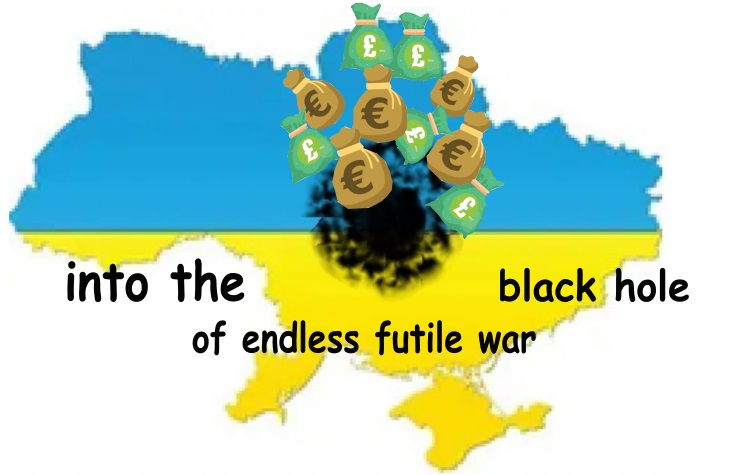
The only real solution to the Ukrainian problem is to accept the Russian peace terms.
By Lucas Leiroz de Almeida, Global Research, March 29, 2026, https://www.globalresearch.ca/ukrainian-economy-collapsing/5920470
Even Ukrainian authorities are beginning to admit the serious crisis affecting the country.
Recently, the head of the Kiev regime’s finance sector confirmed that the country is going through a catastrophic situation, showing deep concerns about the regime’s future.
This clearly shows how the nationalist junta in Kiev is rapidly destroying the country – something that could be avoided if the authorities agreed to make peace with Russia.
During a speech to the Ukrainian parliament on March 26, Daniil Getmantsev, chairman of the Finance, Tax and Customs Committee of the Verkhovna Rada, said that Ukraine is indebted and unable to pay all the expenses accumulated since the beginning of the conflict. He expressed concerns about the future of the Ukrainian economy and “sovereignty,” considering the country’s growing debts with major global financial institutions.
Getmantsev primarily denounced the country’s debts to the EU, the IMF, and the World Bank. He emphasized that Ukraine is already indebted to these organizations and does not appear to be in a position to repay this debt anytime soon. Therefore, the tendency is for the country to continue contracting more loans and becoming increasingly indebted.
The official explained some of the numbers behind the crisis. Ukraine failed to pay the installments of the loan from the EU’s “Ukraine Facility” program. Thus, the country missed out on part of the expected funding, as it failed to fulfill its part of the agreement.
He drew attention to the situation and warned Ukrainian parliamentarians about the current dangers. According to Getmantsev, it is possible that Ukrainians are close to “losing” the country because of this crisis. Therefore, he urges local politicians to act quickly to prevent the worst-case scenario. He believes immediate reforms are necessary, as well as greater integration with the EU, an audit of public spending, and a reform of the Ukrainian social security system.
“In 2025, we failed to meet 14 indicators of the Ukraine Facility. And because of this, we did not receive 3.9 billion euros (…) Moreover, 300 million of that amount is being lost completely in the first quarter [as] we have already failed to meet 5 out of 5 indicators (…) We can lose the country like this (…( Today is not the time to hide from responsibility, not the time for populism, not the time to look for popular decisions (…) It is the time for systematic work, European integration, deregulation, pension reform, an audit of state expenditures, and bringing the economy out of the shadows” he said.
This makes it clear that not even the regime’s own officials can hide the Ukrainian reality anymore. The country’s crisis has reached such a critical point that all sides are gradually admitting that it is impossible to maintain the current situation in the long term. With the decrease in international aid and constant losses on the battlefield, Ukraine has entered a critical phase in the conflict – being extremely vulnerable and close to collapse on several levels, mainly militarily and economically.
The previous attitude of Ukrainian and Western propaganda was to deny the crisis and claim that Ukraine had the economic and military situation under control. These lies helped keep the Ukrainian war machine active for a long time, but Ukraine’s losses caused European public opinion to change its attitude on the subject – which generated popular pressure in the West against continued aid programs.
Furthermore, Europe itself has reduced its capacity for aid. With the energy and economic crisis resulting from anti-Russian sanctions, added to constant international instability, Europe is entering a phase of social insecurity, making it more prudent to control spending than to continue systematically sending money to Ukraine. Although this money is often delivered in the form of loans, it seems certain that Ukraine will not be able to repay it. And even loans secured by the delivery of rare earth minerals and natural resources are unsafe, since exploration will be hampered during hostilities.
In fact, the pro-war lobby in the EU is still strong, which is why aid continues, but the material circumstances have forced the bloc to significantly reduce assistance – which has further worsened the crisis for Ukrainians. Now, there is no longer any way to disguise reality. Ukraine is trapped in a crisis from which it cannot easily emerge. No matter how much local authorities speak of “urgent measures” or “necessary reforms,” the country will certainly not be able to overcome its current difficulties while the conflict with Russia continues.
In this sense, the correct course of action for Kiev would be simply to accept the Russian peace terms and establish an agreement to end hostilities. Any other “measure” would be a mistake, incapable of saving the country from absolute collapse.
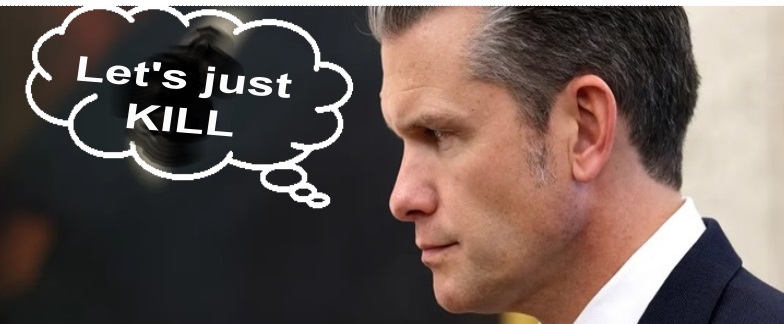
Who Else, Besides Pete Hegseth, is Trying to Use the War in Iran to Get Rich?
31 March 2026 by Larry C. Johnson , https://sonar21.com/who-else-besides-pete-hegseth-is-trying-to-use-the-war-in-iran-to-get-rich/
Looks like Pete Hegseth tried to make a financial killing off of the war of aggression the US launched against Iran on 28 February 2026. According to the Financial Times:
Pete Hegseth’s broker at Morgan Stanley contacted BlackRock in February to make a multimillion-dollar investment in a defense-focused Exchange-Traded Fund (ETF) called IDEF.
This $3.2 billion fund is built around companies that benefit from increased military spending, including RTX, Lockheed Martin, Northrop Grumman, and Palantir — all major Pentagon contractors.
The request came just weeks before the U.S.-Israeli strike on Iran, a campaign Hegseth helped shape and strongly supported within the Trump administration.
BlackRock flagged the inquiry internally because of Hegseth’s high-profile role. The investment didn’t go through, but only because the ETF wasn’t yet available on Morgan Stanley’s platform.
BlackRock, Morgan Stanley, and the Pentagon declined to comment.
If you do the analysis on the weapons expended so far in the month-long war with Iran, the opportunity for war profiteering is quite clear. The US/Israeli Ramadan War has drained the US inventory of its two ballistic missile defense systems. Both US PAC-3 (Patriot) and THAAD interceptor inventories are significantly depleted or nearing critical levels as of late March 2026, after accounting for prior conflicts (Ukraine support, June 2025 12-day Israel-Iran war) and the ongoing 2026 Iran war (Operation Epic Fury). The high expenditure rates, combined with historically low peacetime production, have created a serious “race of attrition” that cannot be quickly reversed. Both the PAC-3 (Patriot Advanced Capability-3, specifically the MSE variant) and the THAAD (Terminal High Altitude Area Defense) interceptors are primarily manufactured by Lockheed Martin.
Combined Estimate of Remaining US Inventories (Rough Synthesis)
Exact classified figures are not public, so these are reasoned ranges drawn from consistent reporting (CSIS, Payne Institute, RUSI, JINSA, DoD budget data, and conflict usage estimates). Numbers reflect US-owned/controlled operational stocks (not including allies’ separate purchases).
PAC-3 MSE (Patriot terminal-phase interceptors):
Pre-2026 baseline: Roughly 1,600–2,000 modern PAC-3 MSE (out of a broader Patriot family inventory sometimes cited around 2,000 total, with older variants mixed in). As I have mentioned in previojous posts, cumulative production upper bound of ~4,620 through 2025 (with ~620 delivered in 2025) is reasonable as a global total, but the US retained share is smaller after Foreign Military Sales.- Major draws: Hundreds fired by US forces in the first 16 days of the 2026 war (estimates of ~402 in early reports, with some higher figures in intense periods); prior usage in Ukraine (hundreds total over years) and the June 2025 war; plus Gulf partner support.
- Current remaining (late March 2026): There are few, if any, PAC 3 missiles left in the US inventory in Israel and the Persian Gulf. There are an estimate 1,400 PAC 3s remaining in INDOPACOM’s pre-war planning stock. Stocks available for sustained Middle East operations outside pre-positioned or diverted units are, under the most optimistic assumptions, critically low. The two-missile (or more) salvo doctrine multiplies consumption per threat. Yet, I have seen videos where at least four PAC 3s are fired at one target… which means the consumption rate is even worse than estimated.
THAAD (high-altitude ballistic missile interceptors):
- Pre-2026 baseline: Around ~534–632 (MDA procurement/delivered figures; some estimates reference higher cumulative including pipeline or foreign orders). Production has been extremely low (~96 or fewer per year historically).
- Major draws: Significant usage in June 2025 (~92–150 interceptors, often cited as ~25% or up to 30% of inventory); additional heavy expenditure in the 2026 war (estimates of ~198 in the first 16 days, or ~40% of pre-conflict on-hand inventory in some analyses). Gulf/Middle East operations have consumed a large share.
- Current remaining (late March 2026): Reports indicate fewer than 400 ready/reserve interceptors in some estimates, with others warning of depletion risk within weeks (e.g., by mid-April) if current tempo continues. Some analyses describe ~30–40%+ of the stockpile already expended in the current conflict alone on top of prior usage.
US stocks of these two high-end ballistic missile defense interceptors are effectively strained to the point of operational risk for prolonged high-intensity defense. THAAD is in a more acute near-term crisis due to tiny production rates, while PAC-3 has a somewhat better (but still insufficient) ramp underway. If the war continues at saturation-attack levels, further constraints (or changes in tactics/priorities) become likely. Exact numbers remain opaque for operational security reasons, but the trend is clear: both systems are depleted or nearing depletion. Which means that Lockheed Martin can expect a major influx of cash to boost production and try to replenish exhausted missile air defense inventories.
I wonder who else in the Trump administration and the US Congress are making money off of this bloody war?
Judge Napolitano and I discussed the insanity of US plans to deploy ground forces to Iran:
VIDEOS on original – Judging Freedom Podcast – Full Escalation etc
‘Worst case scenario’: Wall St craters, oil surges as nuclear sites hit.

Wall St is imploding and oil is surging again as experts warn of a “worst case scenario” over frightening new strikes on nuclear facilities.
Ben Graham, March 28, 2026, https://www.news.com.au/finance/economy/world-economy/worst-case-scenario-wall-st-craters-oil-surges-as-nuclear-sites-hit/news-story/c19242591d70011f0f733addaf27be51
Wall Street sunk to its lowest level since September 2025 as oil prices soared again overnight as investors mash the panic button amid strikes on Iranian nuclear sites.
The Nasdaq Composite slumped 2.2 per cent in New York, the S&P 500 fell by 1.67 per cent following on from heavy losses in recent weeks, while oil shot up 4.2 per cent to $112.57 a barrel.
The drop came after US President Donald Trump extended a deadline for Tehran to open the Strait of Hormuz or face the destruction of its energy grid, pushing it from Friday to April 6.
The 10-day extension was his second since last week’s threat to destroy the infrastructure if Tehran didn’t reopen the critical waterway, a chokepoint that’s become increasingly urgent with global energy and commodity shortages mounting.
But with Iran maintaining a hold on the strait and intense hostilities continuing, Mr Trump’s announcement failed to lift the mood on markets.
Nuclear sites struck
One of the key reasons for the latest sell-offs of global stocks is due to a concerning escalation in the war as Israel’s military says it struck a heavy water reactor and a uranium processing plant in Iran.
“A short while ago, the Israeli Air Force… struck the heavy water plant in Arak, central Iran,” the military said in a statement, describing the site as a “key plutonium production site for nuclear weapons”.
Iranian media had earlier reported that US-Israeli strikes hit the Khondab heavy water complex, saying they caused no casualties or radiation leak from the site.
Nuclear Power Equals Trump Profits

Karl Grossman – Harvey Wasserman, CounterPunch, March 27, 2026
Nuclear power is inseparable from Donald Trump. If you support atomic energy, you are also supporting the financial fortunes of the Trump family.
Trump is a major investor in the nuclear industry. He has invested heavily in the development of fusion power and stands to massively profit from its proliferation.

He also controls the obliteration of the regulatory apparatus designed to guarantee its safety in the United States. Trump’s war in Iran has vastly escalated the potential threat of potentially apocalyptic drone strikes on atomic reactors, now a factor in Vladimir Putin’s war on Ukraine.
Team Trump has made a very public and effective show of tangibly attacking nuclear power’s primary replacements, wind turbines and solar panels, along with geothermal and battery backup.
He has also heavily assaulted electric vehicles, which threaten the business of his fossil fuel backers.
But neither he nor the major media have talked much about Trump’s direct financial interests in killing them off. Or about his destruction of the Nuclear Regulatory Commission and other agencies directly and indirectly promoting atomic power, from which he profits, while at the same time obliterating any reasonable assurance of public safety from the inevitable upcoming reactor disasters.
The Trump family’s money-losing Truth Social company has recently become part-owner of a major fusion nuclear power endeavor.
Among much more, the investments mean the Trump family stands to profit directly from White House attacks on wind, solar and other inexpensive, clean renewable energies, which for decades have been driving fusion, fission and fossil fuels toward economic oblivion.
“A Trump-sponsored business is once again betting on an industry that the president has championed, further entwining his personal fortunes in sectors that his administration is both supporting and overseeing,” reported an article on the front page of the business section of the New York Times last month. “This one is in the nuclear power sector. TAE Technologies, which is developing fusion energy, said…that it planned to merge with Trump Media & Technology Group. President Trump is the largest shareholder of the money-losing social media and crypto investment firm that bears his name, and he will remain a major investor in the combined company.”
The headline of the piece: “Trump’s Push Into Nuclear Is Raising Questions.”
Primary issues have to do with economic conflicts of interest and public safety.
“The deal,” the article continued, “would put Mr. Trump in competition with other energy companies over which his administration holds financial and regulatory sway. Already, the president has sought to gut safety oversight of nuclear power plants and lower thresholds for human radiation exposure.”
CNN ran an article headlined: “A $6 billion nuclear deal has Trump’s name all over it. It’s raising serious ethics questions.”
CNN reported: “Nuclear fusion companies are regulated by the federal government and will likely need Uncle Sam’s deep research and even deeper pockets to become commercially viable. The merger needs to be approved by federal regulators — some of whom were nominated by Trump.”
CNN quoted Richard Painter, chief White House ethics lawyer under President George W. Bush, as saying: “There is a clear conflict of interest here. Every other president since the Civil War has divested from business interests that would conflict with official duties. President Trump has done the opposite.” Painter is now a professor at the University of Minnesota Law School.
“Having the president and his family have a large stake in a particular energy source is very problematic,” said Peter Bradford, who previously served on the Nuclear Regulatory Commission, in the Times article. The NRC, which Trump and Elon Musk’s DOGE have now gutted, was once meant to oversee the safety of the nuclear industry in the United States.
It went on that “Trump’s stake in Trump Media, recently valued at $1.6 billion, is held in a trust managed by Donald Trump Jr., his eldest son. Trump Media is the parent company of Truth Social, the struggling social-media platform. The merger would set Trump Media in a new strategic direction, while giving TAE a stock market listing as it continues to develop its nuclear fusion technology.”
The Guardian quoted the CEO of Trump Media, Devin Nunes, the arch-conservative former member of the House of Representatives from California and close to Trump, who is currently chair of the President’s Intelligence Advisory Board, saying Trump Media has “built un-cancellable infrastructure to secure free expression online for Americans. And now we’re taking a big step forward toward a revolutionary technology that will cement America’s global energy dominance for generations.” Nunes is the would-be co-CEO of the merged company.
A current member of the US House, Don Beyer, a Democrat from Virginia, said in a statement quoted in Politico that the deal raises “significant concerns” about conflicts of interest and avenues for potential corruption. “The President has consistently used both government powers and taxpayer money to benefit his own financial interests and those of his family and political allies. This merger will necessitate congressional oversight to ensure that the U.S. government and public funds are properly directed towards fusion research and development in ways that benefit the American people, as opposed to the Trump family and their corporate holdings.”
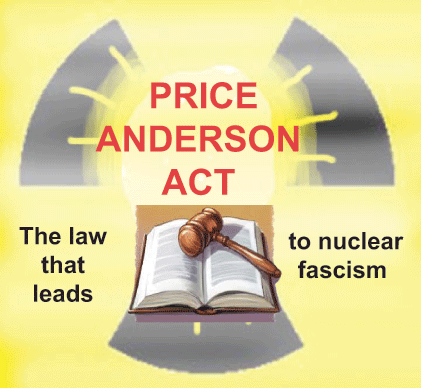
By federal law (the Price-Anderson Act of 1957), the US commercial atomic power industry has been shielded from liability in the event of major accidents it might cause. The “Nuclear Clause” in every US homeowner’s insurance policy explicitly denies coverage for losses or damages caused, directly or indirectly, by a nuclear reactor accident.
As his company fuses with the atomic industry, Trump acquires a direct financial interest in gutting atomic oversight — which he has already been busy doing. In June, Trump fired Nuclear Regulatory Commission Chairman Christopher T. Hanson. No other president has ever fired an NRC Commissioner.
Earlier, more than 100 Nuclear Regulatory Commission (NRC) staff were purged by Elon Musk’s DOGE operation. There has been a stream of Trump executive orders calling for a sharp reduction in radiation standards, expedited approval by the NRC of nuclear plant license applications and a demand to quadruple nuclear power in the United States — from the current 100 gigawatts to 400 gigawatts in 2050. Such a move would require huge federal subsidies and the virtual obliteration of safety regulations. Trump has essentially ordered the NRC to “rubber-stamp” all requests from the nuclear industry in which he is now directly invested.
Trump’s Truth Social fusion ownership stake removes all doubt about any regulatory neutrality. No presently operating or proposed US atomic reactor can be considered certifiably safe.
Trump’s fusion investments are also bound to escalate Trump’s war against renewable energy and battery storage, the primary competitors facing the billionaire fossil/nuke army in which the Trump family is now formally enlisting. That membership blows to zero the credibility of any claim nuclear reactor backers might make that atomic energy can officially be considered safe.
The NRC has long served as a lapdog to the atomic power industry. The acronym NRC has often been said to stand for “No Real Chance” or “Nobody Really Cares.” The commission has been forever infamous for granting the industry whatever it might want, no matter the risk to public safety. It has employed some highly competent technical staff, lending some gravitas to the industry’s marginal claims to even a modicum of competence.
But the NRC is well known for trashing even its established staff. Most notable may be the case of Dr. Michael Peck, a long-standing site inspector at California’s Diablo Canyon twin-reactor nuclear power plant. In an extensive report, Peck warned that Diablo might be unable to withstand a likely earthquake. The NRC trashed his findings. Now he’s gone from the agency altogether. His warnings have been ignored at a reactor site surrounded by more than a dozen confirmed seismic faults.
The splitting of the atom, fission, is the way the atomic bomb and nuclear power plants work up to now. Fusion involves fusing light atoms. It’s how the hydrogen bomb works, and it comes with many extremely complex health, safety, economic and ecological demands.

In an article in the Bulletin of the Atomic Scientists, Daniel Jassby, principal research physicist at the Princeton Plasma Physics Lab, working on fusion energy research and development for 25 years, concluded that fusion power “is something to be shunned.”
His piece was titled “Fusion reactors: Not what they’re cracked up to be.”…………………………………………………………………………………………………………………………………………………………………………………………………………………………………….. any fusion reactor will face outsized operating costs,” he wrote. “To sum up, fusion reactors face some unique problems: a lack of a natural fuel supply (tritium), and large and irreducible electrical energy drains….These impediments — together with the colossal capital outlay and several additional disadvantages shared with fission reactors — will make fusion reactors more demanding to construct and operate, or reach economic practicality, than any other type of electrical energy generator.”
“The harsh realities of fusion belie the claims of proponents like Trump of ‘unlimited, clean, safe and cheap energy.’ Terrestrial fusion energy is not the ideal energy source extolled by its boosters,” declared the scientist.
Of course, for Trump, whether it has to do with tariffs, health care, affordability, the democratic process … and on and on, reality is not a concern, especially when it involves public safety or legitimate profit.
Trump’s war on Iran has also vastly escalated the danger of drone attacks on atomic reactors, an apocalyptic threat now being used by Russia’s Putin against nuclear power plants in Ukraine. Any atomic reactor (there are 94 now licensed in the US) is vulnerable to a major disaster perpetrated by a single drone strike, as would be any future fusion plants completed by Truth Social.
Amidst his escalating attacks on renewable energy and atomic safety, the Trump family’s investments in nuclear fusion live under a bad cloud that threatens us all.
Harvey Wasserman wrote the books Solartopia! Our Green-Powered Earth and The Peoples Spiral of US History. He helped coin the phrase “No Nukes.” He co-convenes the Grassroots Emergency Election Protection Coalition at www.electionprotection2024.org Karl Grossman is the author of Cover Up: What You Are Not Supposed to Know About Nuclear Power and Power Crazy. He the host of the nationally-aired TV program Enviro Close-Up with Karl Grossman (www.envirovideo.com) https://www.counterpunch.org/2026/03/27/nuclear-power-equals-trump-profits/
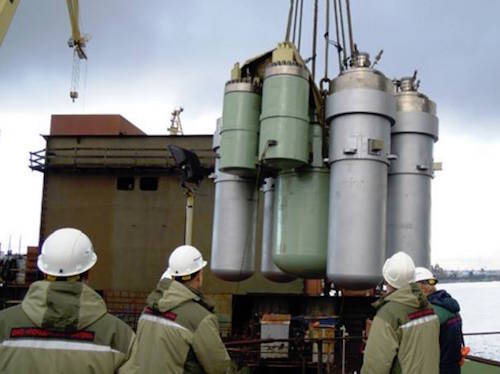
Does SMR Stand for Spending Money Recklessly?
March 23, 2026, Susan O’Donnell, M.V. Ramana, https://www.theenergymix.com/does-smr-stand-for-spending-money-recklessly/
What did Canadians get for the $4.5 billion in public funding spent on small modular nuclear reactor (SMR) activities? Our new report assessing SMR development in Canada found the results underwhelming, to say the least.
Published in 2018, A Call to Action: A Canadian Roadmap for Small Modular Reactors recommended that the federal government fund SMRs and undertake other support measures. The report’s first “expected result” was that “one or more SMR demonstration [projects would be] constructed and in operation by 2026.” Our report in this milestone year covers not only this expected result, but also what the federal government has provided in funding for SMRs in Canada.
For many years, the “Micro Modular Reactor” (MMR) proposed for the Chalk River nuclear site in Ontario was to be this first demonstration. Back in 2019, the project proponents applied to the Canadian Nuclear Safety Commission (CNSC) to prepare the site for construction.
Fast forward to 2024: instead of the reactor built and being prepared to go into service, CNSC announced it had “paused all work” on the MMR project. Later that year, the company leading the project, Ultra Safe Nuclear Corporation, filed for bankruptcy protection in the United States, leaving unpaid debts of more than $16 million. That total included $641,307 to the CNSC and lesser amounts to dozens of Canadian small businesses.
In 2018, the New Brunswick government lured two start-up SMR companies into the province from the U.S. and the United Kingdom—ARC and Moltex—giving each $5 million and help to apply for funding from federal taxpayers. The SMR strategy called for two “advanced” reactor designs, which were not cooled with water, to be built at NB Power’s Point Lepreau nuclear site. Both designs have serious problems that have been documented extensively (for example, in the Bulletin of the Atomic Scientists) .
Over the next five years, the federal government handed over more than $97 million to develop the two SMR designs in New Brunswick, and the provincial government added more than $31 million to the project. Yet in late 2025, New Brunswick’s Energy Minister said the government would no longer wait for the ARC and Moltex designs because the province could not take on the risk of first-of-a-kind reactors. The millions of dollars in subsidies are essentially a write-off, funding highly paid positions at these companies at the public expense.
Of the 10 SMR designs in Canada since 2018, only one is in development. Most of the public subsidy money for SMRs—$4.025 billion—has been spent developing this reactor design, the BWRX-300, to be built at the Darlington nuclear site on Lake Ontario. As of early 2026, workers are digging a deep shaft for the reactor vessel. Sometime this summer, we can expect to see concrete being poured into the ground.
Four billion dollars is a lot of money, but nowhere near enough to pay for the four BWRX-300 reactors planned for the site. Even the first BWRX-300 reactor is expected to cost more—$6.1 billion—and the whole project will run at least $20.9 billion. It final bill could come in far higher, since the vast majority of nuclear power projects have historically overrun initial cost estimates.
The high costs for the SMR compare poorly with other options for electricity generation. For example, estimates by Australia’s Commonwealth Scientific and Industrial Research Organisation (CSIRO) show that each unit of electrical energy from SMRs would be far more expensive that a corresponding unit from solar and wind power plants, even when the cost of storage technologies and other means of accounting for renewable energy’s variability are included.
CSIRO has been undertaking an annual cost estimate in collaboration with the Australian Energy Market Operator and its reports involve extensive consultation with various stakeholders. The research agency’s analysis is informing an active debate under way in Australia to determine if the country should embark on nuclear energy. There is no corresponding effort at rigorously computing the costs of different kinds of generating energy from different technologies by any official research agencies in Canada.
Overall, the report’s analysis found little interest in SMRs among banks and other sources of private capital. When measured in terms of their ability to generate power, SMRs are more expensive than big reactors. Given the high costs, the report suggests that exporting significant quantities of SMRs from Canada is only a slim possibility.
Susan O’Donnell and M.V. Ramana are authors of the report on SMRs in Canada. O’Donnell is Adjunct Research Professor and lead investigator of the CEDAR project at St. Thomas University in Fredericton. Ramana is Professor; Simons Chair in Disarmament, Global and Human Security; and Director pro tem of the School of Public Policy and Global Affairs at the University of British Columbia in Vancouver.
A Great British Nuke-Off in Wales?

25 March 2026, https://morningstaronline.co.uk/article/great-british-nuke-wales
Quintessentially British Rolls-Royce wants to put its small new reactors on Anglesey, but it turns out they’re not so small or even particularly British, writes LINDA PENTZ GUNTER
THERE is something about Rolls-Royce that is quintessentially British. Not necessarily in a good way. The name tends to bring to mind tweedy toffs or rock stars with more money than sense, driving too fast in shiny and extravagantly baubled motor cars.
It’s the cars that made the Rolls-Royce name synonymous with luxury and class, specifically upper-class. It’s even entered the lexicon. Something can be called “the Rolls-Royce of….;” fill in the blank.
Of course, Rolls-Royce is now much bigger than just a car manufacturer. Frequent fliers will have spotted the company logo on many a jet engine.
Less well known is that Rolls-Royce makes the reactors for nuclear submarines, specifically the British Trident nuclear fleet. The company is set to produce a new propulsion reactor, PWR3, for the Dreadnought-class ballistic deterrent submarine, expected to be operational in the early 2030s, and whose missiles are capable of destroying all life on Earth multiple times over.
More recently, Rolls-Royce has entered the commercial nuclear reactor market, proposing its own small modular reactor (SMR) design — which, at 470 megawatts, isn’t actually very small at all. Many of Britain’s old Magnox reactors, now all permanently closed, were smaller than that. Two of the largest, at Wylfa in Anglesey, were each 490 megawatts.
Ironically, it is to Wylfa that Rolls-Royce is looking to site its first not so small modular reactors. It is planning for three there — with the capacity to extend to eight — and even won a competition conducted by Great British Energy-Nuclear to become the preferred bidder to place SMRs at the Wylfa site, purchased by the government from Hitachi in March 2024 after the Japanese company ditched plans to build two full-size reactors there.
The prize for Rolls-Royce’s winning bid was £2.5 billion in public funding (ie taxpayer money) toward the cost of the first three SMRs, not such good news for people who can’t afford to drive Rolls-Royces.
Another £25 million is to be shelled out to two engineering consultancies, WSP and Mott MacDonald, who will advise on environmental assessments, permitting and regulatory compliance.
As Linda Clare Rogers, co-deputy leader of the Welsh Green Party, asked in a letter to her Anglesey MP Llinos Medi of Plaid Cymru: “Why does Rolls-Royce need £25m of our money to spend on advisers and engineers to help it meet environmental and legal requirements, if they are confident what they’re doing is serviceable? As this is public money, will we have a say in proceedings? If not, why not? Other public services involve public engagement.”
That £25m just happens to be equal to the price tag for the Rolls-Royce La Rose Noire Droptail luxury car, unveiled in August 2023. So why not just sell one of those to pay for the advisers and engineers instead of fleecing British taxpayers?
Appropriately, the multi-billion pound Rolls-Royce triumph (to mix motoring metaphors), was lauded by a lord — it is unknown if he was wearing tweeds for the occasion — during a debate last July in the House of Lords.
Reading the transcript of what takes place in that neo-gothic edifice makes you wonder if you have time-travelled back a few centuries. Everyone is addressed as “my lords” even though there are ladies, too, and “my noble friend” and phrases such as “I thank the noble Earl for that question,” and “I thank the noble Viscount.”
It was Labour peer Lord Wilson of Sedgefield — real name Philip — who was beating the drum most loudly for nuclear power in general and Rolls-Royce in particular during that July debate.
This same “noble lord,” as we must perforce address him according to tradition, was also one of the “Famous Five” who helped Tony Blair get selected as a Labour candidate. Later, before he ascended to “The Lord Wilson,” he became an enthusiastic Jeremy Corbyn backstabber when Corbyn was Labour Party leader. So not really all that “noble.”
The lone voice of reason during the Lords nuclear debate came not from a “lord” but a woman, the Green Party’s Baroness Jones of Moulsecoomb who said: “My lords, the minister said that everybody around the House supports nuclear. No, the Green Party does not support nuclear. It is a dinosaur technology and it is really very expensive, when you look at the planetary impact and the cost to the Exchequer. It is going to be a disaster and it will be overtaken by sea-level rises as well. Why do the government not take some good advice on this instead of believing in nuclear all the time?”
The good Lord Wilson quickly and condescendingly dismissed her ideas as “a bit on the fringe,” then repeatedly referred to new nuclear in Britain as “clean, secure, homegrown energy.”
But just as it is obvious that nuclear power is neither clean nor secure, whether great and British or not, it is most certainly not “homegrown” either, given that no uranium, the raw material needed to fuel reactors, is mined in the UK.
And, as it turns out, even Rolls-Royce isn’t quite so very British after all.
Rolls-Royce SMR (Small Modular Reactors), the company’s subsidiary focused on future nuclear energy, is not solely owned by the parent group. It has investors including the Qatar Investment Authority, BNF Resources (connected to the French Perrodo family that owns European oil and gas company Perenco), Constellation (a US energy company and part of Exelon), and CEZ, a Czech company.
Of course, even the Rolls-Royce car division isn’t actually British. It is a wholly owned subsidiary of Germany’s BMW.
In addition to the Perrod family’s investments in oil and gas companies, Constellation owns oil and gas plants in the US. And while the Qatar Investment Authority has said it will not finance new fossil fuel projects, it has not divested from all of its existing oil and gas interests. CEZ continues to maintain coal plants and is supporting natural gas infrastructure.
This is a quiet reminder about the level of greenwashing that seeks to paint nuclear power as environmentally friendly when many of the companies involved in nuclear power are also still heavily invested in fossil fuels.
The partner Rolls-Royce has chosen to oversee delivery of the Wylfa reactors is the US-based engineering firm Amentum, which has around 6,000 staff in the UK. The small modular reactor is an old concept that has been around for decades and was consistently rejected due to poor economies of scale. Yet Amentum’s chief executive officer, John Heller, describes SMRs as a “transformational technology, a critical enabler in strengthening energy security in the UK and continental Europe.”
However, that “energy security” will be delivered largely by Russia, in order to meet the needs of the fast-reactor designs targeted for Britain. These include the Newcleo 200 MWe lead-cooled fast reactor and the Natrium, TerraPower’s sodium-cooled fast reactor, two US companies looking to secure contracts in the UK. Russia is currently the only country that manufactures the High-Assay Low Enriched Uranium fuel needed for these reactor designs.
When star footballer Marcus Rashford totalled his £700,000 Rolls-Royce in a September 2023 accident, the car was entirely written off. That’s exactly what should happen to the company’s SMR plans before consumers and taxpayers are forced to foot the bill.
Linda Pentz Gunter is a writer based in Takoma Park, Maryland. She is the author of the book, No to Nuclear: How Nuclear Power Destroys Lives, Derails Climate Progress And Provokes War, published by Pluto Press.
Your money, their rules. Super funds support Israel war machine

by Andrew Gardiner | Mar 24, 2026, https://michaelwest.com.au/your-money-their-rules-super-funds-support-israel-war-machine/
Australian industry super funds are investing in companies involved in the Gaza genocide, and unions are not demanding they stop. Andrew Gardiner reports.
Protected by rules putting a member’s “best financial interests” over ethical, environmental or social considerations, the vast majority of Australia’s industry superfunds are all-systems-go on pouring money into projects connected to the decimation of Gaza, dispossession in the West Bank, and bombing Israel’s neighbours.
An MWM investigation has confirmed that just two of Australia’s 20 industry super funds are making modest changes to their investment portfolios. The other 18 remain invested in Israel’s war machine, with Australian Super alone funding corporations like Elbit Systems (drones), ICL Group (white phosphorus) and Palantir (AI/software for weapons systems).
This, even as the IDF is again using the banned white phosphorus in Lebanon, in which Australian super is invested.
The two funds which did divest – Vision Super and HESTA – still have some money tied up in Israeli projects in Gaza and the West Bank. “HESTA and Vision divested from Israeli banks (but) they still have money in companies listed on a UN database as operating from Israel’s illegal settlements”, Molly Coburn from the Australia Palestine Advocacy Network (APAN) told MWM.
Activist Jill Sparrow says even those modest changes could be quietly reversed “as soon as we look away”. “Divestment isn’t set and forget (and)
“there’s a lot of money to be made in dropping bombs,”
“so super funds could be sorely tempted”, she said.
If you’re in a union-partner industry super fund and have a problem with genocide, chances are you’re out of luck on the socially-conscious investments front. Unions routinely route members’ super into partner funds with little regard to the social or environmental impact when it’s invested.
Ethics ignored
Under 2005 rule changes, union members can transfer their super to retail super funds, Australian Ethical and Future Group, which shun companies whose work enables the carnage in Gaza. These funds show it can be done, so why have industry super funds not done it?
Instead, unions aligned with the Labor Party, under pressure from Zionist lobbyists, are content to send members’ money to super funds that aid the Israeli war effort, funding what the UN calls “a moral stain on us all”.
Like so many other ACTU affiliates, the United Workers Union (UWU), with 151,000 members, talks a good game on Israel’s actions in Gaza, but hasn’t put its members’ super where its mouth is. MWM’s efforts to ascertain how much the union had done to lobby its super funds – HostPlus, Australian Super and HESTA – yielded nothing.
What we learned from UWU members is that in early 2024, a rank-and-file motion including divestment was passed at the council level in various states before being “soft-blocked” by union officials, who reportedly sat on it. Later that year, a more formal “Boycott, Divestment and Sanctions” (BDS) motion, requiring real action compelling divestment by the super funds, was defeated.
“Social issues are bread and butter issues, and funding war is a dead end. Our leadership – who are on the boards of HESTA and Australian Super – (need) to stop hiding behind ‘fiduciary duties’ to fund death and destruction”, UWU delegate (early childhood education) Nicki Toupin told MWM.
Fidiciary duties
Fiduciary duty doesn’t just provide cover for unions putting the bottom line first. “In the interests of members”, it’s cited time and again by super funds whenever there’s pressure to divest.
Buttressing their argument is case law precedent, which will raise the hackles of Australian republicans: Cowan v Scargill, a UK decision dating back to the Thatcher years (1985), helped redefine a member’s “best interests” as “best financial interests” (emphasis added). 2021 changes to fiduciary duty here in Australia reflect that new emphasis.
How do you define “best financial interests”? Wouldn’t a stable Middle East be good for the world’s economy, providing investment opportunities for our super funds that don’t involve genocide?
“Egregious war crimes, crimes against humanity and devastating environmental impacts mean you can argue that the financial interests of super fund members are undermined by investments that support the Israeli military”, Claire Parfitt, Senior Lecturer in Political Economy at Sydney University, told MWM.
It seems our super funds, and their investment managers, are ignoring these arguments in the quest for a quick return, their investment in the Israeli war machine rendering Middle East instability something of a self-fulfilling prophecy.
There are, of course, equal and opposite rules against super funds investing in projects “maintaining the situation created by Israel’s illegal presence in the occupied Palestinian territory”. But some rules, it seems, are more equal than others; successive Australian governments barely lift a finger to enforce international court rulings, human rights obligations and social considerations (ESG), which might trouble the bottom line.
To quote a famous movie line, “a foul is not a foul unless the ref blows his whistle”. The failure to enforce international and ethical obligations means super funds can go on hiding behind “fiduciary duty”; at least 18 of our 20 industry funds are doing just that.
The “fiduciary duty” chestnut, and “soft blocking” tactics by union officials aligned with an ALP which quietly supports the Gaza carnage, have rendered meaningful “change from within” on divestment all but impossible. So groups like ASU for Palestine and UWU 4 Palestine are taking matters into their own hands.
Following a 1000-strong “community picket” of the Israeli-owned ZIM Ganges cargo ship at Port Melbourne, ASU for Palestine started looking at divestment as a way to hit Israel where it hurts. After ASU secretary (now Senator) Lisa Darmanin, then a board member at Vision Super, inevitably advised ASU for Palestine of its “fiduciary and statutory obligations” (adding it wasn’t legal for her to “act as (a) representative” of ASU members on divestment) it became clear something more compelling was called for.
What did ASU for Palestine do? It began a campaign to raise awareness on divestment, suggesting ASU members “switch their super fund” elsewhere, while lobbying to change the default super fund in enterprise agreements to none other than Australian Ethical.
It’s amazing how the threat of losing thousands of ASU members (and untold millions) can motivate a super fund to abandon “fiduciary” rhetoric and do the right thing. A couple of months later, amid much fanfare at the ASU conference, Vision Super announced its limited divestment, full details of which are expected by the end of this month.
These kinds of ‘direct action’ appear to actually work, although (per APAN) the extent of Vision’s divestment was limited. “If it’s not good enough, we’ll just have to go again”, Sparrow told MWM.
For their part, UWU 4 Palestine sees divestment as a major social cause that it and Members First, a grassroots change ticket at upcoming union elections, can get their teeth into. “Building a rank and file, fighting union that isn’t remote from members gives us the power to push for the kind of world we want, not just on workplace issues but in investing our money in something other than genocide”, Toupin told MWM, adding
That’s right. Direct Action works.
Ontario’s nuclear push risks another costly policy failure.
Nuclear power is neither nimble nor affordable and it’s about time the Ontario government stopped posturing otherwise.
Policy Options, Samuel Buckstein , March 20, 2026
Nuclear power is experiencing a resurgence worldwide and Ontario is no exception. The province has a long history with this awesome and terrifying energy technology, and it is once again turning to nuclear power in response to concerns over national sovereignty, economic growth, electrification and decarbonization.
Looking back over Ontario’s troubled history with nuclear energy, it is concerning to see the Ford government stumbling back to the bar for another round of nuclear cool-aid. Yet Ontario’s plan shows little evidence of having done its homework. Contrary to the government’s claims, it is fiscally irresponsible, incapable of delivering the energy the province needs in the time required, and compromises Ontario’s energy security.
When it should be investing in much cheaper and more easily deployed renewables, the province is recklessly doubling down on nuclear despite the evidence against it.
A legacy mired in debt
To understand Ontario’s nuclear trajectory, it is helpful to reflect on its origins. When civilian nuclear power was commercialized after the Second World War, its advocates promised it would be “too cheap to meter.” Buoyed by encouragement and financing from both provincial and federal governments, Ontario Hydro duly invested in a fleet of 20 CANDU reactors at three nuclear power stations over the course of 30 years.
By the turn of the millennium, Ontario Hydro’s nuclear obsession had saddled it with $38.1 billion in debt — $20.9 billion of it stranded (unsupported by assets). This burden was so immense that it toppled the once proud flagship Crown corporation. Ontarians continue to pay for this nuclear hangover today. As of March 2023, ratepayers were still on the hook for $13.8 billion.
Even as late as 1989, with Ontario Hydro already buckling under its crushing debt, the utility was forecasting the need for 10 to 15 new reactors by 2014. Reality proved otherwise, with peak electricity demand in 2014 lower than it had been 25 years earlier.
After a generation of staggering cost overruns and catastrophic international incidents at Three Mile Island, Chernobyl and Fukushima, nuclear power fell out of favour in much of the developed world. Cheaper, more flexible and faster-to-deploy alternatives took its place, first gas and then renewables…………………………………
Lessons from the U.K. and Ukraine
However, Ontario should learn from the United Kingdom, not authoritarian China. The experience of Hinkley Point C, the first new nuclear power plant to be built in the U.K. in more than 20 years, should be a cautionary tale.
At least five years behind schedule and two times over budget, Hinkley Point C will likely be the most expensive nuclear power plant yet. The electricity generated by this colossal waste of rate-payer dollars will cost between two to four times more than renewable energy, which can be brought online in half the time. This is what the provincial government has in store for Ontario.
The scale of Ontario’s plan is immense. In addition to the CANDU refurbishments at Darlington and Bruce, Ontario has announced the refurbishment of Pickering B, one of the oldest and most urban nuclear power stations in the world.
Sovereignty concerns
Ontario has also contracted with GE Vernova Hitachi to build up to four small modular reactors (SMRs) at the Darlington site. It is unclear why the government has committed to building four SMRs before even the first is constructed. The greater concern with this arrangement is GE Vernova Hitachi is a U.S.-controlled company and the fuel supply chain is in the U.S. and France, not Canada…………………………………………………………………………………………………………….
No price tag and no certainty it will pay
Despite these red flags, Ontario’s nuclear ambitions do not stop there. The government is also considering building two new large nuclear power stations at the Bruce site and at a new location near Port Hope. This despite the fact that, like the U.K., the domestic nuclear supply chain has all but vanished. This is precisely the kind of multi-billion-dollar, multi-decade infrastructure lock-in that bankrupted Ontario Hydro.
The government has been silent on how much this plan will cost. No one can predict whether demand will materialize to justify this massive supply expansion, or what electricity prices will be when these reactors finally come online. Committing to decades of investment in such an uncertain environment is sheer folly.
To top it all off, nuclear power is not even operationally flexible. Generation cannot be adjusted rapidly enough to follow demand, and the reactors can only be quickly turned off, but not back on again (it took Ontario more than a day to restore power after the 2003 Great Northeastern Blackout due to neutron poisoning in the reactors).
Renewable options
It does not have to be this way. Much has changed since the last wave of nuclear infatuation. Renewables are now the cheapest source of energy on a levelized basis. While renewables may be intermittent, they are reasonably predictable, and for the first time since the inception of the electricity industry, generation no longer needs to coincide perfectly with consumption. Rapidly falling battery costs have made energy storage a commercially viable reality…………………………………………………………. https://policyoptions.irpp.org/2026/03/ontario-nuclear-energy-costs-risks-renewables/
Trump’s $200 billion Iran spending request reveals scale of US war plans.
In reality, the administration is planning the most endless of all endless wars—an open-ended invasion aimed at subjugating or destroying a country of 90 million people.
The $200 billion is a supplemental—on top of the $839 billion defense bill Congress already passed for fiscal year 2026, the largest military budget in American history. If approved, direct military spending this year will exceed $1 trillion. US President Donald Trump has called for a $1.5 trillion military budget for fiscal year 2027—a 50 percent increase.
Andre Damon, 19 March 2026, https://www.wsws.org/en/articles/2026/03/20/iuck-m20.html
The Washington Post reported Wednesday that the Trump administration is seeking more than $200 billion to fund the war against Iran.
At a press briefing Thursday, a reporter asked Defense Secretary Pete Hegseth “why a package this large is necessary?” Hegseth not only confirmed the $200 billion figure but suggested it could grow. “I think that number could move,” he said. “It takes money to kill bad guys. So we’re going back to Congress to ensure that we’re properly funded for what’s been done, for what we may have to do in the future.”
And what, exactly, are these unspecified things the administration “may have to do”?
In 2003, when 150,000 American soldiers invaded and occupied Iraq, Congress appropriated $51 billion—a quarter of what the Trump administration is requesting before a single ground soldier has entered Iran. At the height of the 2007-2008 surge, when nearly 170,000 American soldiers occupied the country, the war cost roughly $144 billion a year.
In reality, the $200 billion is not about “what we may have to do in the future” but about what the White House is actively conspiring to do in the present. The budget request comes as the administration prepares a ground invasion of Iran, deploying 5,000 Marines from the Pacific to the Middle East amid demands by the Wall Street Journal and leading Republicans for the seizure of Kharg Island and the Strait of Hormuz.
Reuters reported Wednesday that the Trump administration has discussed sending ground forces to seize Kharg Island, the hub for 90 percent of Iran’s oil exports, and has separately discussed deploying US forces to secure Iran’s stocks of highly enriched uranium. They are operational plans for the invasion and occupation of Iranian territory—and they explain why the administration is demanding more money than was appropriated for any single year of the Iraq invasion.
Just as with the months and years of planning that preceded the US-Israeli attack on Iran, the ground invasion is being prepared behind the backs of the American people, who overwhelmingly oppose the war. Trump called the war an “excursion.” Vice President JD Vance promised it would not become a “quagmire.” At the same briefing where he confirmed the $200 billion request, Hegseth told reporters: “The media wants you to think, just 19 days into this conflict, that we’re somehow spinning toward an endless abyss or a Forever War or a quagmire. Nothing could be further from the truth.”
In reality, the administration is planning the most endless of all endless wars—an open-ended invasion aimed at subjugating or destroying a country of 90 million people.
The administration sees the Iran war as a prelude to an effort to subjugate China, the world’s largest economy by purchasing power parity. As former Republican Congressman Patrick McHenry put it on ABC’s This Week, the wars in Venezuela and Iran are “targets of opportunity to reshape the world.” He added: “Venezuela was in service to American energy dominance. The issue with Iran was a target of opportunity… The results here will mean that, with China, the president’s hand will be enhanced.”
The $200 billion is a supplemental—on top of the $839 billion defense bill Congress already passed for fiscal year 2026, the largest military budget in American history. If approved, direct military spending this year will exceed $1 trillion. US President Donald Trump has called for a $1.5 trillion military budget for fiscal year 2027—a 50 percent increase.
And $200 billion is only what the administration will admit to. In 2002, Bush’s chief economic adviser Lawrence Lindsey was fired for estimating the Iraq war would cost $100 to $200 billion. Defense Secretary Donald Rumsfeld put the figure at “something under $50 billion.” When told outside estimates ran to $300 billion, Rumsfeld replied: “Baloney.” Deputy Defense Secretary Paul Wolfowitz assured Congress that Iraqi oil revenues would pay for reconstruction. The actual cost, including veterans’ care, disability payments and interest on the debt, is now estimated by Brown University’s Costs of War Project at more than $8 trillion.
The waging of continuous wars, combined with the 2008 and 2020 bank bailouts, has produced an explosion of US debt. In 2000, before the Iraq war, the national debt stood at $5.7 trillion. By 2010, after the Iraq surge and the $700 billion TARP bank bailout, it had reached $12.3 trillion. By 2020, after $4.6 trillion in COVID bailouts, it hit $27 trillion. It now stands at $39 trillion—nearly seven times what it was a quarter century ago.
The United States credit rating has been downgraded three times—by Standard & Poor’s in 2011, Fitch in 2023 and Moody’s in 2025—each time because of military spending and the refusal of either party to cut the military budget. The Vietnam War destroyed Lyndon Johnson’s Great Society programs and produced the inflation of the 1970s, which the ruling class broke through the Volcker shock—mass unemployment to crush wages. The Iraq and Afghanistan wars were waged alongside tax cuts for the wealthy and the gutting of public services.
Trump’s “One Big Beautiful Bill,” signed last July, imposed $1 trillion in cuts to Medicaid over the next decade, $536 billion in cuts to Medicare and $186 billion in cuts to food assistance through the Supplemental Nutrition Assistance Program (SNAP)—the largest cut to food aid in American history. The fiscal year 2026 budget slashed domestic spending by 22.6 percent—cutting the Department of Housing and Urban Development (HUD) by 44 percent, the Centers for Disease Control and Prevention (CDC) by 44 percent and the National Institutes of Health (NIH) by $18 billion—while increasing the military budget by 13 percent.
Within 24 hours of the administration confirming it is seeking $200 billion for the war, the Postmaster General testified to Congress that the United States Postal Service (USPS) could run out of cash as soon as October—with just $8.2 billion in reserves, enough to cover 33 days of operations. The USPS employs more than 500,000 workers and holds billions in pension and retirement obligations. The manufactured insolvency is a pretext for raiding those funds—taking workers’ pension money and spending it on the war.
Medicare, Medicaid and Social Security represent trillions more. The ruling class sees these programs as money to be seized. The administration does not see pensions and healthcare as social programs. It sees them as collateral.
Trump has promised the economic pain will be a temporary “blip.” This will not pass in weeks. It will mean a permanent reduction in working-class living standards, just as the Iraq war did.
The struggle to defend Medicare, Medicaid, Social Security, pensions and public services cannot be separated from the struggle against war. They are the same struggle. The $200 billion the administration demands is money taken from the programs working people depend on to survive.
The Democrats have systematically enabled Trump’s wars. In January, as Trump declared that a massive armada was steaming toward Iran, every leading Democrat in Congress voted for the $839 billion military budget—Minority Leader Hakeem Jeffries, Minority Whip Katherine Clark, Senate Minority Leader Chuck Schumer and Minority Whip Dick Durbin all voted in favor. Their criticism of the war has centered on procedural issues, along with demands that US imperialism direct its fire at Russia and China.
Opposition must come from below—from workers in the United States, in Iran, across the Middle East and around the world—organized independently of both capitalist parties, armed with a socialist and internationalist program, and fighting to build the International Committee of the Fourth International (ICFI) as the revolutionary leadership of the working class. The fight against imperialist war is the fight against the capitalist system that produces it.
Deader than a doornail -UK’s new nuclear
Several days after announcing the new cost hikes at Hinkley, news broke about similarly soaring electricity prices predicted for the Sizewell C nuclear power plant, another French twin EPR plant targeted for the steadily eroding and submerging UK Suffolk coast.
by beyondnuclearinternational, https://beyondnuclearinternational.org/2026/03/15/deader-than-a-doornail/
Electricity prices from new nuclear plants will be sky high with more delays to completion while jobs don’t materialize.
If you wanted to sum up the most compelling reasons not to build new nuclear power plants, Hinkley Point C, the two-reactor project under construction in Somerset in the UK, encapsulates almost all of them.
When the UK government, still miraculously led by the clinging-by-his-fingernails beleaguered Labour prime minister, Keir Starmer, announced its Golden Age of nuclear last September, obediently gliding in Trump’s gilded wake, it claimed that the new nuclear power plants planned for Britain “will drive down household bills in the long run.” Nothing could be further from the truth.
Far from driving down consumer costs, the Hinkley Point C project, consisting of two 1,630 MW French Evolutionary Power Reactors (EPR), could see the original agreed strike price of $123.50 per megawatt — already considerably higher than the price Britons were paying at the time it was set in 2012 — soar even higher by the time the plant is finished, since prices are designed to increase annually in line with the Consumer Price Index.
The original estimated cost of $24 billion for the two Hinkley C EPRs has now almost tripled, having sky-rocketed to almost $67 billion as announced last week, along with new delays.
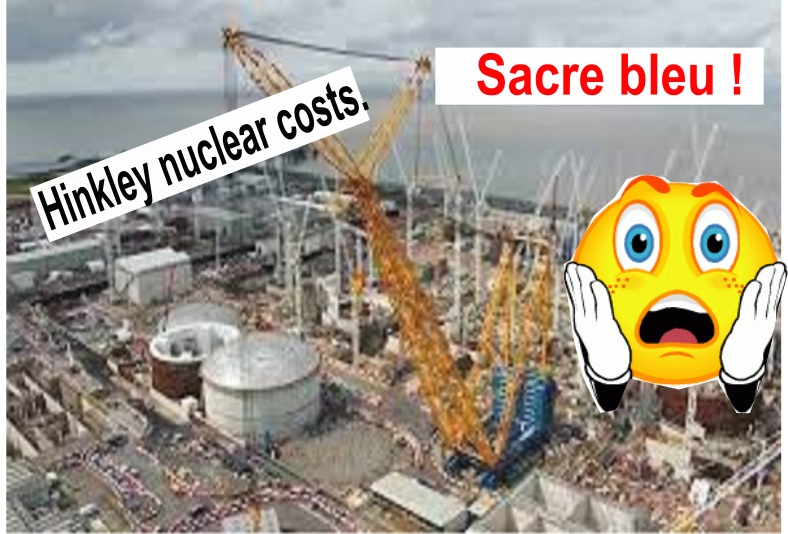
In 2007, when EDF first proposed its Hinkley Point C scheme, an officer with the company predicted locals would be cooking their turkeys using electricity from Hinkley C by Christmas 2017. That’s the same year — in March — that construction eventually began.
The Hinkley C completion date has now been pushed to at least 2030, another deadline extension it probably won’t meet. If the plant does show up in 2030, it will have taken 22 years, 13 longer than planned.
That’s a long time to wait for those new jobs the UK government’s ‘Golden Age’ promised. “Working people will benefit from jobs and growth as companies in the UK and United States sign major new deals that will turbocharge the build-out of new nuclear power stations in both countries,” said that September announcement, embracing yet more hyperbolic rhetoric.
Several days after announcing the new cost hikes at Hinkley, news broke about similarly soaring electricity prices predicted for the Sizewell C nuclear power plant, another French twin EPR plant targeted for the steadily eroding and submerging UK Suffolk coast.
The Sizewell C project was first proposed in 2010 but there are still no shovels in the ground for the plant itself, only site preparation (for that, read tearing up countryside and precious habitat.)
As revealed in an article in the Daily Telegraph, electricity generated from Sizewell C is likely to cost “almost double today’s prices”. The prediction is a staggering $160 per megawatt hour, and that’s according to the government’s own new report.
Incredibly, despite the track record at Hinkley C, with identical reactor designs to Sizewell, this same government report “assumed no escalation in costs” for the Suffolk project. Such an outcome is, to put it mildly, highly unlikely.
In an recent analysis for OilPrice.com, Leonard S. Hyman, an economist and financial analyst, and William I. Tilles, a senior industry advisor and speaker on energy and finance, predicted that “the prospects for new nuclear (both big and small) are deader than the proverbial doornail.”
They viewed the outlook for the so-called small modular reactors that the UK government is poised to green light as even bleaker. (At around 490MW the favored design from Rolls-Royce isn’t actually that small.) Small reactors will have “projected costs that are much higher than gigawatt-scale reactors, making them even less relevant economically,” they wrote.
And yet, the Starmer and Trump governments each press on with their false and fantastical nuclear fantasy plans regardless.
Linda Pentz Gunter is the founder of Beyond Nuclear and serves as its international specialist. Her book, No To Nuclear. Why Nuclear Power Destroys Lives, Derails Climate Progress and Provokes War, can be pre-ordered now from Pluto Press. (Use the scroll menu at the top of the page to select dollars or pounds for payment.)
Re/insurers must plan for nuclear-powered ships, says Axa XL

Reinsurers must plan for nuclear-powered ships, says Axa XL. French
reinsurer’s global head of energy transition and chief risk consulting
officer describes the preparation needed for nuclear power in shipping. Any
future insurance for these vessels would need to be ‘bespoke, extremely
high in value and likely supported by governments’, Axa XL’s Vicky
Roberts-Mills and Jarek Klimczak say.
Lloyds List 18th March 2026,
https://www.lloydslist.com/LL1156646/Reinsurers-must-plan-for-nuclearpowered-ships-says-Axa-XL
UK’s nuclear research body consults on plans to cut about 200 jobs.
Britain’s national nuclear research body is consulting on plans to cut its
staffing by up to a fifth because of financial pressures, leading union
officials to question the government’s claims to be building a “golden
age” for the industry.
The United Kingdom National Nuclear Laboratory
(UKNNL) is looking at cutting about 200 jobs from a workforce of about
1,100 via a mixture of voluntary and compulsory redundancies. Described by
ministers as “the custodian of some of the UK’s most critical nuclear
skills and capabilities”, the public corporation’s research supports the
development of cutting-edge technologies in nuclear generation, defence and
other areas such as medicine.
The union Prospect, which represents staff at
UKNNL, said the proposed cuts appeared to be driven by funding problems
that had left the organisation unable to pursue its goals — and even, the
union claimed, to honour its own contractual redundancy terms — rather
than by any change of strategy.
FT 18th March 2026,
https://www.ft.com/content/fe8ac14a-0463-44ca-986b-a035a97b29ba
‘The Military-Industrial Complex Is Winning’: While Bombing Iran, Trump Says Weapons Contractors to Boost Production.
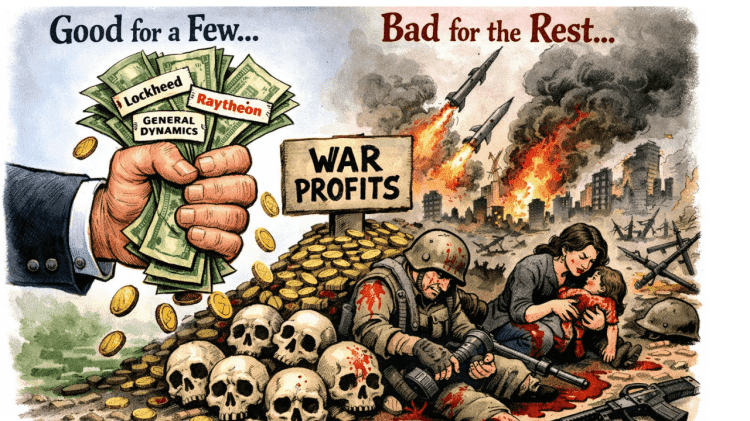
The president and Lockheed Martin said that the expansion began months ago, but his comments followed a White House meeting held amid a US-Israeli assault on Iran and mounting threats against Cuba.
Jessica Corbett, Common Dreams, Mar 06, 2026
After meeting with several chief executives at the White House on Friday—while also bombing Iran with Israel and threatening Cuba—US President Donald Trump said that top military contractors “have agreed to quadruple Production of the ‘Exquisite Class’ Weaponry in that we want to reach, as rapidly as possible, the highest levels of quantity.”
Trump said on his Truth Social platform that he met with the CEOs of BAE Systems, Boeing, Honeywell Aerospace, L3Harris Missile Solutions, Lockheed Martin, Northrop Grumman, and RTX—formerly Raytheon.
“Expansion began three months prior to the meeting, and Plants and Production of many of these Weapons are already underway,” he wrote, adding that another meeting is scheduled in two months.
……………………………………………………………………………………………………………….
It was not immediately clear whether the meeting… resulted in any new agreements to boost production beyond those previously announced by the Pentagon since the beginning of the year.
Those agreements include a multiyear deal to triple PAC-3 production and quadruple THAAD interceptor production with Lockheed. It also included separate multiyear deals with RTX to boost production for the Tomahawk, AMRAAM air-to-air missile, Standard Missile-3 IIA and IB, and Standard Missile-6, with production for certain of those munitions set to double or quadruple, RTX said at the time………………….
Northrop Grumman said in a statement that “we support the president’s focus on speed and investment to deliver military capabilities. With our industry-leading levels of investment and decades of proven performance, we continue to grow production capacity and deliver mission-ready technologies for the nation’s warfighters.”
Using Trump’s preferred name for the Pentagon, an RTX spokesperson said the company “is proud to support the administration’s goals of defending the US and its allies at this critical moment and committed to accelerating the production of five key munitions in accordance with the historic frameworks reached with the War Department last month.”
Defense Secretary Pete Hegseth also joined the meeting, according to White House press secretary Karoline Leavitt. After Hegseth shared Trump’s Truth Social post on the platform X, Lockheed Martin replied, saying that it began working with the Pentagon chief and Feinberg “months ago,” and the company has “agreed to quadruple critical munitions production………………………………………………………….. https://www.commondreams.org/news/trump-defense-contractors
For Denmark, Large uncertainties on the expected costs of SMRs in the 2040s and 2050s

The expected costs of SMRs in the 2040s and 2050s are extremely difficult
to project, because Western manufacturers are still proceeding towards
their first units. There are very large differences on the estimated
construction cost levels of the first-of-a-kind (FOAK) units ranging from 6
M€/MWe to 16 M€/MWe and uncertainty on what manufacturers include in
construction cost estimates.
Due to long lead times and high capital costs,
it is critical for the manufacturers to reach successful FOAK projects that
would take their SMR technologies on more favourable cost trajectories. The
first actual realized cost data can be expected when the first experiences
from actual serial production in Canada, UK and maybe Sweden could be
expected between 2035 and 2040.
Therefore, a main conclusion from this work
is, that it is probably 10 – 15 years too early to make trustworthy cost
projections. With that said, it is our central estimate that the overnight
construction costs in a Danish context could decrease to 8 M€/MWe in 2040
and approach 7 M€/MWe in 2050 with large uncertainties towards both
optimistic and pessimistic trajectories.
Danish Energy Agency 5th March 2026, https://ens.dk/media/8419/download
1 This Month

of the week – Shut Down Drone Warfare!


Tell the Ukrainian Government to Drop Prosecution of Peace Activist Yurii Sheliazhenko

Petition to revoke the licensing of the Near Surface Nuclear Disposal Facility (NSDF) at Chalk River. https://www.ourcommons.ca/petitions/en/Petition/Details?Petition=e-7247
To see nuclear-related stories in greater depth and intensity – go to https://nuclearinformation.wordpress.com
-
Archives
- April 2026 (57)
- March 2026 (251)
- February 2026 (268)
- January 2026 (308)
- December 2025 (358)
- November 2025 (359)
- October 2025 (376)
- September 2025 (257)
- August 2025 (319)
- July 2025 (230)
- June 2025 (348)
- May 2025 (261)
-
Categories
- 1
- 1 NUCLEAR ISSUES
- business and costs
- climate change
- culture and arts
- ENERGY
- environment
- health
- history
- indigenous issues
- Legal
- marketing of nuclear
- media
- opposition to nuclear
- PERSONAL STORIES
- politics
- politics international
- Religion and ethics
- safety
- secrets,lies and civil liberties
- spinbuster
- technology
- Uranium
- wastes
- weapons and war
- Women
- 2 WORLD
- ACTION
- AFRICA
- Atrocities
- AUSTRALIA
- Christina's notes
- Christina's themes
- culture and arts
- Events
- Fuk 2022
- Fuk 2023
- Fukushima 2017
- Fukushima 2018
- fukushima 2019
- Fukushima 2020
- Fukushima 2021
- general
- global warming
- Humour (God we need it)
- Nuclear
- RARE EARTHS
- Reference
- resources – print
- Resources -audiovicual
- Weekly Newsletter
- World
- World Nuclear
- YouTube
-
RSS
Entries RSS
Comments RSS
 nuclear-news