The Foreign Ministry will help local governments tear down overseas barriers on food imports maintained because of worries over radiation, sources said.
Some states still ban some imports of agricultural, forestry and fishery products because of the fear of contamination from Tokyo Electric Power Co.’s Fukushima No. 1 nuclear plant. As a result, the ministry will cooperate with local governments in organizing events overseas to assure regulators and consumers that products are safe.
In 2015, the ministry plans to hold two to three such events, the sources said Sunday.
Unfounded rumors are a matter of life and death for municipalities where agriculture, fisheries or forestry are key industries.
The ministry said 13 countries, including Canada and Vietnam, have lifted import restrictions imposed after the accident on agricultural, forestry and fishery products from affected areas, but nine economies including South Korea, Singapore and Taiwan still have bans.
South Korea bans marine products from prefectures such as Miyagi and Fukushima.
Many countries also implement some kind of import control, such as requiring safety certificates.
When the ministry holds the events abroad, it will give assistance through embassies, aiming to allay concerns among local companies and media organizations.
A senior ministry official said the support for local governments boils down to wanting to disseminate correct information and to sell Japan’s attractions.
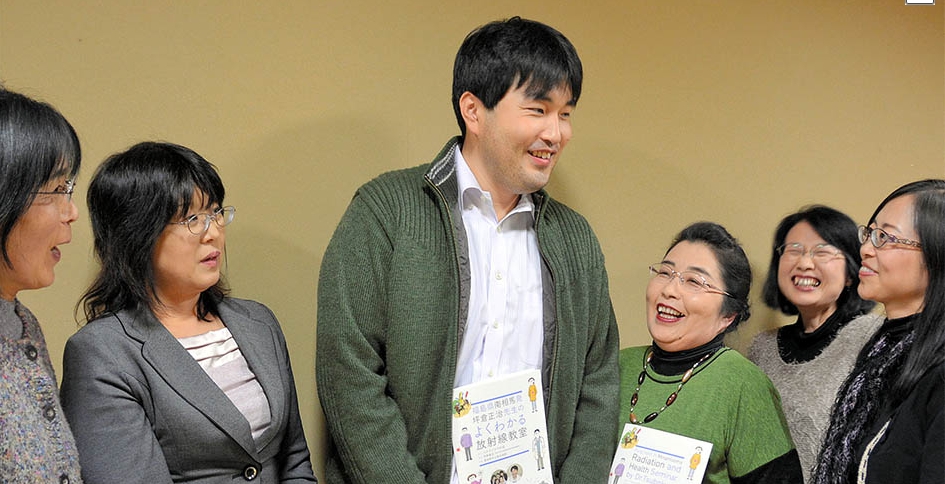
Masaharu Tsubokura, center, and the members of the Veteran Mothers’ Society in Minami-Soma, Fukushima Prefecture
December 29, 2014
MINAMI-SOMA, Fukushima Prefecture–Mothers living near the stricken Fukushima No. 1 nuclear plant have compiled a booklet offering basic knowledge about radiation and explanations addressing safety concerns arising from the disaster.
The booklet, titled “Yoku Wakaru Hoshasen Kyoshitsu” (Radiation and Health Seminar), is available in both Japanese and English and was created by the Veteran Mothers’ Society, which consists of five mothers from the city of Minami-Soma.
The members, some of whom are former high school classmates, decided to create the booklet “for children’s sake.”
The information incorporates lessons learned from doctors at seminars the group organized following the accident at Tokyo Electric Power Co.’s Fukushima No. 1 nuclear plant in March 2011.
Amid the confusion and fears over radiation after the disaster unfolded, the mothers convened their first seminar for children and guardians in December 2011. They invited Masaharu Tsubokura, a doctor of hematology from the University of Tokyo’s Institute of Medical Science who had been providing consultations at the Minami-Soma municipal general hospital.
Other physicians later joined the effort to spread accurate information about radiation, and the mothers have held the sessions once or twice a month.
In the seminars, the children peppered Tsubokura with questions, such as “Can I touch my pets?” and “Is it OK to lick the snow?”
Ikumi Watanabe, the society’s 54-year-old vice chairwoman, recalled that Tsubokura’s explanations “were spoken in an easy-to-understand manner so the information popped straight into our heads. It was nice that we could talk with him on the same level and in person.”
Even now, the nature of the questions has not changed much.
“People have felt pressured not to talk about radiation, and some mothers have finally gotten the information only now, more than three years after the accident,” Tsubokura said. “I hope I can help them make decisions without thinking negatively about themselves or losing their self-confidence.”
In addition to basic knowledge, such as the differences between external and internal radiation exposure and between becquerels and sieverts, the booklet answers questions like: “Can radiation be transmitted from one person to another?” and “Is the tap water OK?”
According to the Veteran Mothers’ Society, 20,000 copies of the Japanese version were distributed to schools, companies and other organizations. The English version has been ordered by international schools, international exchange organizations and other groups.
MINAMI-SOMA, Fukushima Prefecture–The central government lifted on Dec. 28 the last recommended evacuation advisory for several districts in this city, saying radiation levels from the nuclear accident fell below the annual exposure limit.
However, many of the residents of 152 households within these districts voiced their opposition to the lifting.
The central government designated areas that registered high radiation levels outside the zones under mandatory evacuation orders as specific recommended evacuation spots following the triple meltdown at the Fukushima No. 1 nuclear power plant. The residents living within these locales were encouraged to evacuate from their homes.
The districts in Minami-Soma were designated as such because they were at risk of exceeding the annual accumulated dose limit of 20 millisieverts, or 3.8 microsieverts per hour.
The central government in June 2011 issued the advisory for some locales in the cities of Minami-Soma and Date and the village of Kawauchi, all in Fukushima Prefecture, home to 281 households. The advisory for Date and Kawauchi was lifted earlier.
Central government officials explained their latest decision to the residents and local officials, saying that the health risks are not expected because radiation levels in their sites now measure well below the designated limit of 20 millisieverts.
They also presented support measures to encourage the residents to return to their homes.
However, evacuee Katsuji Sato, among the residents of the 152 households, said he would not immediately return home.
The 79-year-old, who lives in temporary housing in Minami-Soma, had lived in a family of six of four generations before the Great East Earthquake and tsunami on March 11, 2011, set off the nuclear disaster.
Sato’s mother died where she evacuated to, and his eldest son, the son’s wife and their elementary school child moved to Miyagi Prefecture.
“My wife and I cannot return to our home even though we want to unless decontamination work is undertaken again,” Sato said.
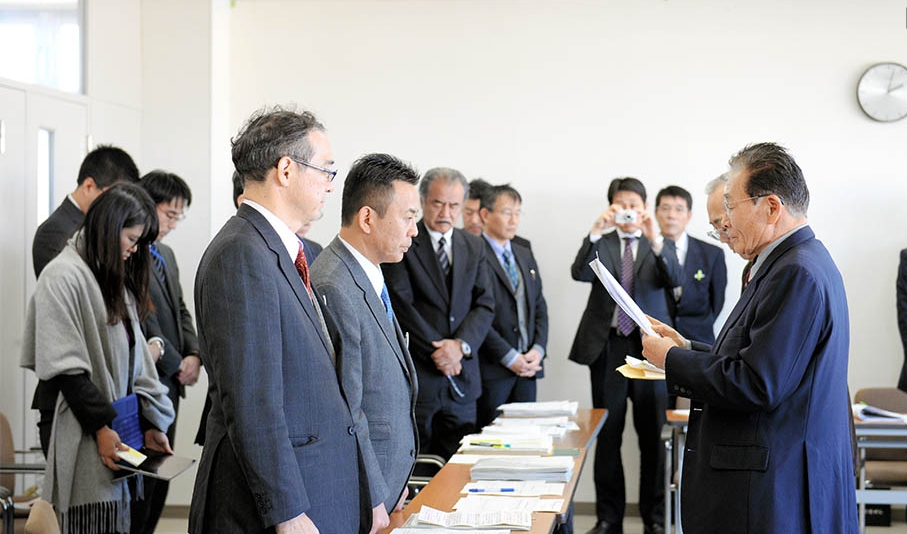
The head of the Takakura district, right, reads aloud a statement in opposition to the lifting of a recommended evacuation advisory to officials of the nuclear emergency local response headquarters
Tokyo Electric Power Company has indicated that a new method aimed at tackling a large volume of highly radioactive wastewater at the Fukushima Daiichi nuclear power plant has not been entirely successful.
TEPCO gave a progress report on its work to a panel of experts at the Nuclear Regulation Authority on Friday.
The utility last month began pouring cement into underground tunnels filled with the contaminated water from the reactor buildings to stop the water inflow. The water is believed to be leaking into the sea.
TEPCO officials told the panel that workers have completely filled the U-shaped tunnels except for 4 vertical pits that connect the tunnels to the ground surface. They removed 2,500 tons of radioactive water.
But the officials said that when they pumped water up from one of the pits, the water level at another pit changed. That suggests that gaps exist in the concrete-filled tunnels.
The officials argued that they can stop the water from flowing into the tunnels once the 4 vertical pits are filled. But panel members and authority commissioners said more thorough inspections are needed.
TEPCO plans to monitor water levels for a month, look for gaps, and study more effective ways to block the water.
OKUMA, Fukushima Prefecture–Tokyo Electric Power Co. removed the last four nuclear fuel assemblies that remained in the No. 4 reactor building of the crippled Fukushima No. 1 nuclear power plant from its storage pool on Dec. 20.
The No. 4 reactor was offline at the time of the March 11, 2011, Great East Japan Earthquake and tsunami. However, an explosion occurred in the building four days later, seriously damaging it.
After the accident, experts pointed to the risk of nuclear fuel in the pool melting from insufficient cooling and releasing a large amount of radioactive materials. However, the threat has been mitigated with the removal of the last assemblies.
On Dec. 20, TEPCO allowed the media to watch the removal work.
Workers pulled up from the pool a cask containing the last four unspent nuclear fuel assemblies. They plan to transfer it to the No. 6 reactor building, which sustained relatively minor damage in the disaster, within a few days after decontaminating the outside of the cask.
The transfer will mean that all of the nuclear fuel in the No. 4 building has been removed from the building as scheduled by year-end.
The pool had held a total of 1,535 nuclear fuel assemblies, which consisted of 1,331 spent and 204 unspent nuclear fuel assemblies.
TEPCO started the removal of those assemblies from the pool in November 2013 after installing a new roof and a crane on the building. The removal of spent nuclear fuel assemblies concluded in November this year.
There will be no work in the No. 4 reactor building for the time being. TEPCO will be engaged in efforts at the No. 1, No. 2 and No. 3 reactor buildings and in dealing with the growing volume of contaminated water partly resulting from efforts to keep the reactors from overheating.
Workers use a cask to remove unspent nuclear fuel assemblies from a storage pool at the No. 4 reactor building of the Fukushima No. 1 nuclear power plant on Dec. 20.
The Japan Atomic Energy Agency says 75 percent of the radioactive substances released from the Fukushima Daiichi Nuclear Power Plant came more than 4 days after the accident.
The government’s investigation has not released what happened during this period. Experts say the reason needs to be determined as to why massive amounts of radioactive materials continued to be released for a prolonged period.
The nuclear accident in Fukushima has been evaluated as the worst, at level 7, on a par with the Chernobyl accident in 1986, due to the large amount of radioactive substances that were released. But the details on how the substances were released remain unknown.
A research group at the Japan Atomic Energy Agency collected new data on radiation detected near the plant over time to analyze how radioactive materials were released into the air.
The research has found that an estimated 470,000 terabecquerels of radioactive substances had been released by the end of March 2011, when the discharge is believed to have mostly subsided.
The research group says 25 percent of the radioactive materials were released during the first 4 days of the accident, as the meltdown and hydrogen explosions were happening, while 75 percent were released over the 2-week period that followed.
The group also analyzed how the radioactive materials spread, using the climate data at the time. They found that contamination in places where former residents are still not allowed to return became serious on March 15th — 4 days after the accident.
They also say radioactive substances released between March 20th and 21st spread to a wider area, including the Kanto region, and are believed to have contaminated drinking water supplies.
The outcome of the analyses indicates that radioactive materials continued to be released after the first 4 days, which is believed to be the critical time during which the situation was deteriorating out of control.
The government’s investigation has focused on the first 4 days, and has not determined the cause of the massive release of radioactive substances following that period.
Masamichi Chino of the research group says the cause needs to be determined to prevent future accidents and to bring the situation under control quickly if another accident happens.
More than 120,000 people are still forced to live in temporary shelters.
Six municipalities remain off limits due to high levels of contamination.
NRA Chairman Shunichi Tanaka, foreground, inspects storage tanks holding water contaminated with radioactive substances at the Fukushima No. 1 nuclear power plant.
December 13, 2014
The head of Japan’s nuclear watchdog said contaminated water stored at the crippled Fukushima No. 1 nuclear power plant should be released into the ocean to ensure safe decommissioning of the reactors.
Shunichi Tanaka, the chairman of the Nuclear Regulation Authority, made the comment Dec. 12 after visiting the facility to observe progress in dismantling the six reactors. The site was severely damaged in the tsunami generated by the 2011 earthquake.
“I was overwhelmed by the sheer number of tanks (holding water tainted with radioactive substances),” Tanaka told reporters, indicating they pose a danger to decommissioning work. “We have to dispose of the water.”
With regard to expected protests by local fishermen over the discharge, Tanaka said, “We also have to obtain the consent of local residents in carrying out the work, so we can somehow mitigate (the increase in tainted water).”
Tanaka has said previously that to proceed with decommissioning, tainted water stored on the site would need to be released into the sea so long as it had been decontaminated to accepted safety standards.
“While (the idea) may upset people, we must do our utmost to satisfy residents of Fukushima,” Tanaka said, adding that the NRA would provide information to local residents based on continuing studies of radioactive elements in local waters.
The inspection tour was Tanaka’s second since he became NRA chief in September 2012. He last visited in April 2013.
During his visit, Tanaka observed work at a trench on the ocean side of the No. 2 reactor building, where highly contaminated water is being pumped out. He also inspected barriers set up around the storage tanks to prevent leaks of tainted water.
Tanaka praised the completion in November of work to remove all spent nuclear fuel from the No. 4 reactor building, as well as changes to work procedures that he said allows for the completion of the work at the No. 2 reactor trench.
Official: Fukushima “destroyed our life… it can destroy history itself” —Professor: “Very hard to imagine a future beyond Fukushima, it’s so uncontainable” — Filmmaker: Meltdowns “opened up a fissure in time and space… Horror of radiation menaces the future in the present” (VIDEOS)
Food products ‘heavily contaminated’ by Fukushima found in US; Over30,000 pCi/kg of cesium, also had Cobalt-60 and Antimony-124 — FDA: We found no Fukushima contamination in US food supply during our routine monitoring
‘Mysterious Phenomena’ off West Coast: Fish disappeared, whales nearly absent, no krill, high rates of egg failure among birds — Official:“There’s almost nothing down there, just a lot of warm clearwater” in S. California
Senior Scientist: Fukushima nuclear fuel burned holes through the containment vessels, it’s “a pretty close approximation” of‘The China Syndrome’ scenario — Material went below reactor structures and is mixing with groundwater — “You have essentially a machine that’s washing radioactivity into the sea” (AUDIO)
TV:“This is really kind of scary… a grim reality” for West Coast —Alarm as baby whales keep dying; Since 2011 none have survived over a year — Biologist: We see them pregnant for weeks, then no longer pregnant — NOAA: “Not what we’re used to… Incredibly poor condition… Skeleton with skin” (VIDEO)
Emergency radiation testing program used for Democrat and Republicanconventions after Fukushima — Also implemented for Obama Inauguration — Seafood, meat, fruits, vegetables, milk, water all checked for nuclear material… as top officials agree to publicly downplay Japan crisis — Tests find nearly 50% of Florida milk samples had ‘significant’ cesium-137
NYTimes: Doctors call for banning of thyroid cancer screening — “A tsunami of thyroid cancer… Stop the diagnosis… We need to actively discourage early detection” — WSJ: Judge rules releases from nuclear reactors are causing thyroid cancers
Top Headline: ‘Fukushima radiation identified off northern California’— 50% of samples around West Coast test positive — 7.7 Bq/m3 of cesium near California shore, expected to keep rising for years to come (MAP)
Gov’t Scientists: Significant concentrations of radioactive material detected off West Coast; Levels doubled in months since previous tests — Marine Chemist: ‘Much greater concern’ over Fukushima releases that will be hitting shores of US and Canada; Lack of data‘ really disturbing’ (AUDIO)
Japanese doctors threatened for revealing data on how bad Fukushima-related illnesses have become — Gundersen: We had pregnant sisters in Tokyo deliver two dead babies and one with deformities that’s alive; Gov’t refuses to disclose miscarriages or stillbirths around Fukushima (AUDIO)
Fukushima Student in Documentary: “Japan is clearly going insane, it seems like we are about to get killed” — “Nothing has gotten better…Our government abandoned us… Anyone, please, please save the lives of Fukushima people and children” (VIDEO)
TV: Attempt to stop flow of highly radioactive liquid at Fukushima “in doubt” — AP: Much of it is pouring in trenches going out into Pacific —Experts: Amount entering ocean “increasing by 400 tons daily” —Problem “so severe” it’s consuming nearly all workers at site — Top Plant Official: “Little cause for optimism” (VIDEO)
Massive radiation spike at Fukushima: 40,000% increase below ground between Units 1 & 2 this month — Order of magnitude above record high set last year
US Nuclear Professor: Fukushima “a really major event here”, Washington had radioactive aerosols 100,000 times normal; “Far more bigger accident than we’re hearing” — Model shows West Coast completely blacked out due to particles covering area — Gundersen: Lung cancers to start increasing in Pacific Northwest (AUDIO)
Experts: Seemingly benign virus on West Coast “causing ecological upheaval the likes of which we’ve never seen” — Very peculiar, differentfrom all known viruses — Mutations could be helping it spread —Something may have recently caused it to go rogue… we’ve never seen anything like this — Why now, what changed to allow outbreak?(VIDEO)
TV:“Barrier is not holding” at Fukushima plant — All efforts have failed to stop very high levels of radioactive materials flowing into ocean — Officials: More water’s coming in than we were pumping out — Workers now trying to prevent overflow (VIDEO)
Twice as much Fukushima radiation near California than originally reported; Most contaminated sample from Eastern Pacific — Official: Levels are ‘interesting’ — Scientist: Very little we can do… This is unprecedented… God forbid anything else happens — Gundersen: Multiple plumes now along west coast… Will be coming “for century or more”
Officials have “admitted failure” at Fukushima plant — Giving up on attempts “to prevent highly contaminated water from pouring into ocean” — Regulator asks “What was all the trouble over the past months for?” — Gov’t experts worried cement barrier is going to crack (VIDEO)
The Asia-Pacific Journal, Vol. 12, Issue 46, No. 1, November 24,2014. Beyond reality – or – An illusory ideal: pro-nuclear Japan’s management of migratory flows in a nuclear catastrophe
Fukushima fallout on vegetation in South Florida exceeded gov’t notification limit by over 1,000% — Nearly triple the highest level reported anywhere on West Coast
Fukushima Engineer: “They’re covering up how badly the groundwater is contaminated” —Scientist: “We’re measuring higher levels off Japan” —Radiation near California already exceeds expectations, and will be rising for years to come — TV: “Cleanup can’t be done… They lied from the start, Tepco is a den of inequity” (VIDEOS)
Radionuclides go everywhere. The first fallout did fall, first or highest to least amount (both ocean and landfall):
Coast of North America into north Pacific, Bering Strait, Alaska, Canada, Pacific Northwest of USA
(Washington and Oregon), California and Baja California/Mexico, and then EASTward around the globe. Back sweep also hit Japan hard, of course, far east Asian continent (Russia, Korea)… Initial fallout at least ast far as 1,700 km from Fukushima. (as reported in enews).
Pure Propaganda
As predicted, IAEA is about control of information – propaganda – and not transparency, not disclosure. IAEA is the pro-nuclear body for U.N., overrides anything and everything W.H.O. can say or do.
As an example, this recent ‘report’ (cough-cough) – this piece of propaganda issued by IAEA — expects us to believe that NO contamination from Fukushima will reach NorthAmerica! Absolutely preposterous!
B) ‘Thumbs down’ on tracking plastics http://adrift.org.au/fukushima This one also ignores the far north, Bering Sea, and we know that got hit.
C, Certainly we do want to track the debris from Japan, it could be a mammoth problem, not sure how much radioactivirty might be involved: Washington blog article includes Japanese debris distribution of U of Hawaii – I would NOT assume debris of various sizes, weight, dimensions and type to behave the same as radioisotopes. Nor do we know if they got hit with radionuclide contamination. Plastics tracked across Pacific, again, not the same as radioisotopes, cannot expect the same behavior of unlike material.
There is a difference between radionuclides spreading across the Pacific and debris from the tsunami… How it travels, variable depths… Briefly: radionuclides’ fallout on to land and rivers and (both) travels to the ocean, radionuclides tend to coalesce and float together (referred to as pools, clouds or streams); settle in at about 1-100 meters depth, travel along ocean currents (varies by weight).
In the ocean, uranium buckyballs flew across the ocean’s surface in days after 311; radionuclides also biomagnify up the food chain; can be estimated by the degree of plankton uptake; concentrates in seawater, sea spray and is especially troublesome along coastlines – the entire Pacific rim.
Radionuclides also find their way back into the ATMOSPHERE via the natural water (hydrolic) cycle. Radionuclides traveling up with evaporation process is called ‘resuspension,’ thus finding its way to be redistributed on land wherever rain falls. The life-giving micronutrients from the ocean – the source of life and 50-85% of the oxygen in our world, is thus transformed into genomic instability, every possible breakdown of systems that sustain all life… e.g. death. Call it ecocide or omnicide, the more we pollute our environment, the more we pollute ourselves. The global growth of chronic disease is in step with the spread of man-made radioisotopes and man-made chemicals…. it destroys the ‘stuff of life’ as we know it.
WHERE DOES FUKUSHIMA GO UPON ENTERING THE OCEAN?
Tracking Radionuclides aka Radioisotopes
‘Plume’ is being used to address both Atmospheric (NOAA) and sometimes ‘into the ocean’ dispersal as well. Important to notice the distinction and be clear which one we mean when we post or write about Fukushima. Likewise, ‘cloud’ is being used to describe the coalescing of radioisotopes in pools that float and move together. Another study calls it ‘rivers’ or ‘streams’. Be very clear in disseminating information.
1. The first detection, of course, “The Comprehensive Nuclear-Test-Ban Treaty (CTBT) is meant to deter nuclear explosions by everyone, everywhere: on the Earth’s surface, in the atmosphere, underwater and underground. (All nukes have their own chemical ‘signature as well.)http://www.ctbto.org/verification-regime/the-11-march-japan-disaster/
5. Various agencies have done plume modeling estimates. These take weather conditions and releases and estimate where the radioactive releases went or will go.
7. The U.S. Geological Survey (USGS) collaborated with the National Atmospheric Deposition
Program in an effort to monitor North American precipitation samples for the presence of nuclear fallout in response to the Japan Fukushima Dai-ichi Nuclear Power Station incident that occurred on March 11, 2011.
8. Radionuclides (aka radioisotopes) like Strontium will collect in ‘rivers’ or ‘streams’ of
contamination… (SEE ALSO #10b and #11) will not ‘dilute’… Evidence of bioaccumulation in species, biomagnification- denser concentrations in the Pacific, as well as remaining in collective rivers and streams of its own making are derived from decades-long research chemical changes interacting with the salt… all speak to multiple, deadlier pathways
10. Concentration & RESUSPENSION of Radionuclides from ocean back into atmosphere brings the fallout inland – AGAIN – and contaminates through rainfall & snowfall…
10a In the ocean, radionuclides become concentratedMarine plankton as an indicator of low-level radionuclide contamination in the Southern Ocean
[SciTech Connect] by Marsh, K.V.; Buddemeier, R.W. 1984
in the ocean STRATIFIED about 100m ~> into the atmosphere ~> into the rainfall everywhere…
globally(from the era of atomic bomb tests in the Pacific) [added 11.11.2013]
”On May 16, 1958, the Wahoo event was detonated underwater two miles south-west of Enewetak.
Plankton sampling was begun as soon as possible, and at H + 6 hours the major part of the total
radioactivity was found in the top 25 m and about one-eighth at the thermocline, 110 m. By H + 28 hoursthe activity was distributed through the upper half of the mixed layer to about 50 m, but by H +• 48 hours it was concentrated at 100 m, the upper edge of the thermocline. At no time was the activity uniformly mixed; it was always stratified”
[The thermocline is the transition layer between the mixed layer at the surface and the deep water
layer. The definitions of these layers are based on temperature.]
10b Through the water cycle
“National Weather Service; Jetstream-Online school for Weather; The Hydrologic Cycle” [water cycle] and returns inland in rainfall
“The ocean is known to be a major source of atmospheric particulate [ matter]. There is considerable,evidence, however, that the chemical composition of the particles in the marine aerosol is often considerably different from that of seawater. Barker and Zeitlin found enrichment factors for transition metals in the aerosol approaching and exceeding three and four orders of magnitude relative to sodium. Cattell and Scott suggest that a biogenic agent may be responsible for the approximately 20,000-fold enrichment of copper during aerosol production in the ocean. The whole question of fractionation at the sea surface was the subject of a 1976 review article.^’
It seems possible, even likely, that the correlation we observe between radionuclides in plankton
and in the air samples is due, at least in part, to resuspension.”
Because of the ocean spray being concentrated, as well as fog, and the presence of uranium
buckyballs specific to Fukushima, (at least) and the higher likelihood of fish consumption in
coastal areas (internal contamination) — coastal areas might experience a higher likelihood of
{this is also why Dr. Busby estimates coastal areas being more likely to have higher rates of cancer… both resuspension and higher likelihood of fish consumption… see his work relative to Sellafield, UK}
11. Further understanding of the damage of the atomic age on our environment, and climate
change
11a Dr. Rosalie Bertell talks about the 5 layers of atmosphere and the “Five Rivers or
Vapours” upon which the flow of air and water – sustains us all.
This entry is solely to support the ‘rivers’ and ‘streams’ metaphor as very real, not discovered until mid-Century [and a part was quickly destroyed by an atomic bomb] and how fast esp jetstream moves, hownthe planet has its own highways, byways, …. circuitous routes – types and pathways — in the atmosphere and in the oceans and seas.
Rosalie Bertell – Space Weapons of War – part 1 of 4 – PLANET EARTH
IWAKI, FUKUSHIMA PREF. – Tokyo Electric Power Co. started work Tuesday to fill an underground trench at the disaster-stricken Fukushima No. 1 nuclear power plant with cement while pumping up radioactive water inside at the same time.
The power company reported the beginning of the cement-pouring work for the cable trench for reactor 2 at a meeting in Iwaki, Fukushima Prefecture, with government representatives on measures to deal with increasing radioactive water at the power station.
Tepco expects to finish the work by the end of next March. The company will begin next month pouring cement in reactor 3′s trench, hoping to complete the work also by the end of March.
The trenches for the two reactors are estimated to hold 11,000 tons of radioactive water in total. The water is believed to be causing the pollution of groundwater under the seaside section of the power plant.
On Tuesday, Tepco injected 80 cu. meters of cement in the reactor 2 trench in an operation that lasted two and a half hours from around 9:30 a.m. The trench holds radioactive water that has flowed from the reactor’s turbine building.
At first, Tepco planned to stop the flow by freezing water inside the joints between the turbine building and the trench so that it can entirely remove the radioactive water from there.
But Tepco could not fully freeze the water or block the flow. So, the firm switched to the current plan to inject cement in and remove the radioactive water from the trench simultaneously.
But first, recall that Plan A was to install freezing pipes at the head of the trench leading from Reactor 2 turbine building to create an ice plug so that the extremely contaminated water that had been sitting in the trench since the very beginning of the nuclear accident could be pumped out. TEPCO started the work in April this year.
That failed. The ice plug didn’t quite form.
Then recall that Plan B was to dump tons (literally) of ice and dry ice in the trench near the freezing pipes to lower the temperature of the water around the freezing pipes so that the ice plug would finally form. Workers dumped ice all day and all night, in the high ambient radiation right at the trench. That was in hot August. Try to freeze the trench with ice in hot August.
That also failed. Dry ice clogged the pipe, and the ice plug didn’t quite form, and TEPCO admitted there was water still coming into the trench from the turbine building. The water sitting in the turbine building comes from the reactor building after it cools the molten core somewhere in the building, and it is warm.
What was Plan C? It was to fill the gap between the incomplete ice plug and the turbine building wall with fillers. TEPCO chose the combination of grout and concrete. A plug of ice, grout and concrete was formed. Sort of.
TEPCO finally admitted on November 17 that it was a failure after pumping out some 200 tonnes of this highly contaminated water on November 17 and seeing that the water level in the trench didn’t go down as much as they had calculated. The water was still coming in from the turbine building, and the groundwater was probably seeping in.
But not to worry. TEPCO has Plan D, and it has been already approved by Nuclear Regulation Authority.
So what is Plan D? To fill the trench with cement while pumping out the water that gets displaced (in theory) by the cement.
(Do you want to bet whether that is going to fail?)
An effort to stop contaminated water from flowing into a trench at the crippled Fukushima No. 1 Nuclear Power Plant failed to completely halt the flow, announced Tokyo Electric Power Co. (TEPCO), the plant’s operator, on Nov. 17.
A TEPCO representative said, “We believe we have not completely stopped the water. Groundwater may also be entering the trench. We will closely analyze the changes in water level in the trench.”
TEPCO says that when around 200 tons of contaminated water was removed from the trench, the water level in the trench should have fallen by around 80 centimeters if the point of leakage between the plant’s No. 2 reactor turbine building and the trench had been fully sealed. However, the water level only fell by 21 centimeters, so TEPCO determined that the leak must be continuing.
…While the water remains in the trench, TEPCO cannot create a planned underground wall of frozen soil around the No. 1 through 4 reactor buildings to stop water leakages.
(TEPCO) will propose (to Nuclear Regulation Authority) a new method of plugging the trench by pouring in the special cement that spread thin and wide in the water while removing the contaminated water in the trench gradually.
Special cement?
TEPCO says in the document (page 9) they submitted to NRA that it will be a mixture of cement, fly ash and underwater-inseparable admixtures (セメント、フライアッシュおよび水中不分離混和剤などの配合調整). They will use the tremie concrete placement method.
(Do you want to bet whether that is going to fail?)
The NRA meeting on November 21, 2014 was funny without participants intending to be funny, from what I read in the tweets by people watching the meeting.
At one point, Commissioner Fuketa exasperatedly asked TEPCO representatives, “So what was the point of trying to freeze the water? Was freezing even necessary at all?”
The answer was no. TEPCO’s Shirai admitted (according to the tweet by @jaikoman on 11/21/2014) that there was a talk inside TEPCO that the ice plug was not necessary.
So why did they do it, and why did NRA approve it?
No one knows and no one is held accountable, while workers had to set up freezing pipes, then to pour ice, dry ice, grout, concrete, and to pump this highly contaminated water over the past 8 months in high radiation exposure. TEPCO hasn’t disclosed the radiation exposure for the workers.
The LDP aims for collective suicide by extending Japan’s nuclear reactors’ life span to 60 years while pushing forward with the Oma nuclear plant, which will purportedly be the world’s first 100 percent MOX facility!
Does everyone remember what Fukushima Daiichi Unit 3 explosion looked like? Unit 3 was running MOX fueld. Its explosion strongly resembled a mushroom cloud and has been interpreted as involving a nuclear criticality. Plutonium from the Daiichi explosions, likely from Unit 3, was found in Lithuania.
MOX fuel is extraordinarily dangerous. Japan’s earthquake activity has been increasing. At least one of Japan’s volcanoes is displaying increased activity. Japan must be intent on self-destruction and will take the Pacific Ocean and North America with it, if the US, Russia, UK, or France, don’t beat them to annihilating humans on Earth:
The government set the acceptable operational term of nuclear reactors at 40 years, in principle, after the Fukushima disaster, but it allows utilities to extend the period on a one-time basis by a maximum of 20 years….
The Oma plant will be the world’s first 100 percent MOX nuclear facility, where only mixed-oxide (MOX) fuel, consisting of plutonium and uranium, is used at reactor cores for the purpose of consuming plutonium produced in processing spent nuclear fuel.
At conventional plutonium-thermal nuclear plants, MOX fuel is used at just one-fourth to one-third of their reactor cores at most, and conventional uranium fuel is used for the remaining part. Compared with uranium fuel, it is more difficult for control rods to suppress nuclear chain reactions of MOX fuel.
Although countermeasures, such as enhancing the capabilities of control rods and introducing larger tanks for boric acid water to better control atomic reactions, will be taken at the full MOX facility, those efforts are expected to be carefully examined during the safety screening by the NRA to check if they are sufficient…. “No full MOX facility has so far gone online around the world,” NRA Chairman Shunichi Tanaka said at a Nov. 12 news conference. “We will examine extremely carefully (if countermeasures are sufficient).”
Unbelievable. That is all I can think to write.
Meanwhile, emissions at Daiichi look worse this morning than they have the last week or so. Radiation readings in the US have been higher than I’ve seen since winter 2011. The forces of entropy reign.
Workers at the Fukushima Daiichi nuclear power plant have started pouring cement into underground tunnels filled with highly radioactive water.
The effort is aimed at replacing the water with cement. The water is believed to be leaking into the nearby sea after mixing with groundwater.
Workers on Tuesday poured into the tunnels 80 cubic meters of cement that can solidify in water. The plant’s operator, Tokyo Electric Power Company, said the water did not overflow during the work.
The operator says it plans to check the effectiveness of the measure in about a month after suspending the work temporarily. It says if there are no problems, it will resume the work to finish it by March.
The firm initially planned to freeze water at the ends of the tunnels to stop inflow from reactor buildings, and remove the contaminated water. But the plan did not work. By last week, the utility had decided to adopt the new method.
Workers using the method are likely exposed to more radiation than under the original plan.
The operator of the crippled Fukushima nuclear plant plans to fill in trenches on the coastline in yet another attempt to prevent highly contaminated water from pouring into the sea.
Under the plan, approved by the Nuclear Regulation Authority on Nov. 21, Tokyo Electric Power Co. will inject a special cement mixture into the seaside trenches of the No. 2 and No. 3 reactors while pumping up radioactive water accumulating in them.
The special mixture does not absorb water so it can spread more easily along the bottom of the trenches, displacing the tainted water.
The new method will allow radioactive materials to remain in the surrounding soil, but TEPCO decided to employ the technique because it puts high priority on preventing massive amounts of highly contaminated water from leaking into the ocean.
This spring, TEPCO tried to stop the water influx at the trench for the No. 2 reactor by freezing the junction of the turbine building and the trench, but the operation was tough-going.
The company then attempted to stop the water inflow with a cement mixture, but was unable to do so completely.
The operator of the Fukushima Daiichi nuclear plant is drastically changing its plan to remove highly radioactive water from underground tunnels at the facility.
The tunnels have been inundated with water from the plant’s heavily contaminated reactor buildings.
Tokyo Electric Power Company, or TEPCO, this year began work to freeze water at the ends of the tunnels to block the inflow. The firm finished the work early this month.
But TEPCO officials found that water levels in the tunnels were still changing in sync with volumes in the reactor buildings.
The officials admitted to the Nuclear Regulation Authority on Friday that the tunnels hadn’t been plugged.
They said they’re giving up on the plan, and proposed pouring cement into the flooded tunnels while removing water from them. They said they want this done from late November.
The authority’s commissioners asked whether the new method can really halt the inflow. They also spoke of the risk of cracks forming in cement.
The authority approved TEPCO’s plan in the end, on condition that the procedure be halted in late December to see whether it’s working.
Commenting on the change, one commissioner asked what all the trouble over the past months was for.