Iran’s president vows to never build a nuclear bomb in his UNGA speech
Masoud Pezeshkian accused the UK, France and Germany of acting ‘at the behest of the United States of America’.
By Caolán Magee, 24 Sep 2025, https://www.aljazeera.com/news/2025/9/24/irans-president-vows-to-never-build-a-nuclear-bomb-in-his-unga-speech
Iranian President Masoud Pezeshkian has told the United Nations General Assembly that Tehran will “never seek to build a nuclear bomb”, as diplomatic efforts are under way to avert the so-called “snapback” sanctions on Tehran over the country’s nuclear programme.
The remarks on Wednesday came as a 30-day process launched by the United Kingdom, France and Germany to restore UN sanctions against Iran approaches its September 27 deadline.
The three European powers, known as the E3, accuse Tehran of failing to comply with a 2015 deal with world powers aimed at preventing it from developing nuclear arms.
The E3 have said they would delay reinstating sanctions for up to six months if Iran restores access for UN nuclear inspectors, addresses concerns about its enriched uranium stockpile and engages in talks with the United States.
“An agreement remains possible. Only a few hours are left. It’s up to Iran to respond to the legitimate issues we have raised,” French President Emmanuel Macron wrote on X after meeting Pezeshkian at the United Nations.
Iran has previously pointed to US President Donald Trump’s 2018 withdrawal from the nuclear deal and the air strikes on Iran in June as reasons for scaling back its previous commitments.
Pezeshkian accused the Europeans of bad faith, saying that Iran’s lack of cooperation was in response to Trump’s withdrawal from the nuclear deal, formally known as the Joint Comprehensive Plan of Action (JCPOA).
“They falsely presented themselves as parties of good standing to the agreement, and they disparaged Iran’s sincere efforts as insufficient,” Pezeshkian said.
In his speech at the UN, Pezeshkian went on to accuse the E3 of acting “at the behest of the United States of America”.
“In doing so, they set aside good faith,” he told the assembly. “They circumvented legal obligations. They sought to portray Iran’s lawful remedial measures taken in response to the United States’ withdrawal from the JCPOA and to Europe’s breach and other incapacity as a gross violation.”
In a recorded speech on Tuesday, Iran’s Supreme Leader Ayatollah Ali Khamenei reiterated that Tehran is not seeking to build nuclear weapons, but ruled out talks with the US, saying, “This is not a negotiation. It is a diktat, an imposition.”
New sanctions would result in freezing of Iranian assets abroad, a halt in arms deals with Tehran, and penalise the development of ballistic missile programme, among other measures.
12-day war
In his address, Pezeshkian went on to condemn the Israeli and the US surprise attacks that sparked the 12-day war.
Several senior Iranian military figures were killed in the war, which also weakened the country’s defences.
More than 1,000 Iranians were killed when Israel launched air strikes and violated Tehran’s sovereignty, which it claimed was a preemptive act of “self-defence” to target Iran’s nuclear programme.
Israel has been accused of disregarding the sovereignty of neighbouring Arab countries, as it has attacked multiple countries, including Lebanon, Syria, Yemen and Qatar. The Israeli strikes on Iran were its biggest military offensive in recent years, drawing retaliation from Tehran.
“The Iranian nation has time and again demonstrated that it shall never bow before aggressors,” Pezeshkian said.
He added that during the war, “the patriotic and valiant people of Iran laid bare before the aggressors the fallacy and self-delusion of their arrogant calculations.”
‘Greater Israel’ ambitions
The second day of the UN General Assembly’s annual debate featured speeches by leaders including Ukrainian President Volodymyr Zelenskyy, Argentina’s Javier Milei, and Syria’s interim leader Ahmed al-Sharaa.
Israel’s war on Gaza has dominated both days, with Pezeshkian using his address to denounce Israeli rhetoric about establishing a “greater Israel,” which he said refers to expanding control over Palestinian land and creating “buffer” zones in neighbouring countries.
“After nearly two years of genocide, mass starvation, the perpetuation of apartheid within the occupied territories and aggression against its neighbours, the ludicrous and delusional scheme of a ‘greater Israel’ is being proclaimed with brazenness by the highest echelons of that regime,” he said.
He added that Israel’s recent attacks on neighbouring countries showed it was no longer seeking security through normalisation.
“Israel and its sponsors no longer even content themselves with normalisation through political means. Rather, they impose their presence through naked force, and have styled it peace through strength,” the Iranian president said.
He closed his address by pledging that Iran is ready to cooperate with international partners and emerge from isolation.
“Iran is a steadfast partner and a trustworthy companion for all peace-seeking countries of friendship and a partnership grounded not in fleeting expediency but in dignity, trust and a shared future,” he said.
“Let us, together with you, turn threads into opportunities.”
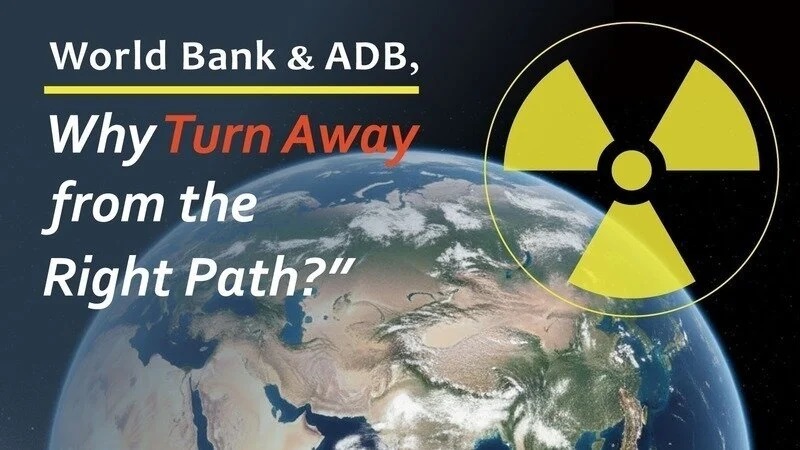
Nuclear Free Local Authorities join global call on World Bank to abandon plans to back new nuclear
24th September 2025, Nuclear Free Local Authorities
The NFLAs have become a co-signatory to a petition calling on the World Bank and Asian Development Bank to abandon their plans to finance new nuclear plants.
The online petition was launched by 64 Non-Government Organisations from 25 countries and regions on 1 September/
The World Bank and the ADB are funded by governments worldwide to support economic development, poverty reduction, and enhance infrastructure. Until now, both institutions have refrained from financing nuclear power, citing nuclear proliferation, safety concerns, dealing with the intractable problem of radioactive waste, and high costs as reasons to deny funding.
However, on June 10, the World Bank’s Board of Directors decided to lift the ban on nuclear power financing. Meanwhile, the ADB is currently revising its energy policy with plans to include support for nuclear power as part of the review.
The very concerns that have caused both institutions to be cautious about financing nuclear power remain unresolved.
The petition highlights these ongoing issues and stresses that “supporting the construction of nuclear power plants in developing countries imposes serious long-term risks and enormous economic burdens on both present and future generations in those countries.”
NFLAs urge supportive NGOs and individuals to join us in signing this petition.
You are urged to go to the website: https://chng.it/G9MCKn6Gpv…………………………………….. https://www.nuclearpolicy.info/news/nflas-join-global-call-on-world-bank-to-abandon-plans-to-back-new-nuclear/
Iran publishes alleged leak of Israeli nuclear sites, experts and secret files

Itamar Eichner, Lior Ben Ari, 24 Sept 25, https://www.ynetnews.com/article/r1errtw2eg
Iran’s intelligence ministry claims Israelis leaked sensitive documents and photos for money, including details on 189 nuclear experts, images of the Dimona reactor and personal photos of IAEA chief Rafael Grossi.
Iran’s intelligence ministry on Wednesday published what it described as a large trove of “secret and classified” Israeli documents and photographs, claiming the materials were leaked by Israelis themselves.
Iranian Intelligence Minister Esmail Khatib said the documents include footage from “the Dimona reactor and Israeli nuclear facilities,” details on “upgrades to nuclear weapons,” and information on “past and present Israeli projects developed in cooperation with the United States and the European Union.” He also claimed the material contains “a full list of staff and the administrative structure of Israel’s nuclear weapons program.”
Opposition to proposed nuclear submarine base at Port Kembla, Australia

September 25, 2025 , by David Clark, https://www.wavefm.com.au/local-news/opposition-to-proposed-nuclear-submarine-base-at-port-kembla/
Forty local organisations and community groups are launching a joint Port Kembla Declaration today, opposing the establishment of a nuclear submarine base at Port Kembla.
They’re calling for the federal government to rule it out, saying the risks are far too great, the declaration has been endorsed by many organisations, including health, faith, and social justice.
Tina Smith, President of the South Coast Labour Council, said they reject the idea of turning the region into a frontline for war games or nuclear escalation.
Iran says it obtained secret files on Israel’s nuclear program

25 Sept 25, https://www.iranintl.com/en/202509242634
According to the intelligence ministry, the material demonstrated that Israeli intelligence spies “on everyone,” including the IAEA chief, and that the data it had obtained proves this claim.
Iran’s intelligence ministry aired a segment on national TV displaying information and documents that it says it obtained from Israel’s intelligence apparatus on the Jewish state’s nuclear program
The broadcast featured a series of video files that reportedly contain material from inside Israeli nuclear and other sensitive facilities, including the Dimona site. It also presented alleged details about personnel working on Israel’s nuclear program.
“We identified 189 Israeli nuclear and proliferation scientists and top officials, along with their networks,” Intelligence Minister Esmaeil Khatib said during the presentation, which included names and ID cards of alleged nuclear personnel.
“I tell Netanyahu … your employees collaborated with us for money and still do,” Khatib, a cleric and veteran military and intelligence official, added.
Israel is widely believed to have an undeclared nuclear arsenal.
Tehran’s nemesis killed nuclear scientists and hundreds of military personnel in a surprise 12-day military campaign in June, underscoring Iranian intelligence failures.
Iran has said it too has infiltrated its enemy, and Israel has arrested several of its citizens on charges of spying for Tehran.
One alleged employee was introduced with a photo and described as working across seven Israeli nuclear sites under the cover of a company called ROTEM.
Another was identified as a nuclear scientist allegedly involved in “proliferation projects” between Israel and the United States.
It also mentioned the Chaim Weizmann laboratory, which it described as Israel’s leading proliferation program and was targeted by Iranian ballistic missiles during a 12-day war in June.
Additional documents shown in the broadcast suggested alleged nuclear cooperation between Israel and France under a project called SARAF.
One batch of the alleged material included private and family photos of International Atomic Energy Agency (IAEA) Director General Rafael Grossi it alleged was obtained from Israeli intelligence sources.
The video, published on Tasnim’s Telegram channel, showed images of Grossi with his family at Disneyland, at home during birthdays and in gatherings with colleagues and friends.
According to the intelligence ministry, the material demonstrated that Israeli intelligence spies “on everyone,” including the IAEA chief, and that the data it had obtained proves this claim.
Iran, U.S. signal possible easing in nuclear tensions

By Parisa Hafezi and John Irish, September 25, 2025 https://www.reuters.com/world/middle-east/irans-president-tells-un-tehran-will-never-seek-build-nuclear-bomb-2025-09-24/
- Summary
- Iran president speaking at U.N. General Assembly
- Gaps remain between Iran and E3 as deadline looms
- European powers offering delay if Iran makes concessions
UNITED NATIONS, Sept 24 (Reuters) – Tehran and Washington signalled a possible softening in nuclear tensions on Wednesday, with Iran insisting it has no ambitions to build nuclear weapons and the U.S. expressing readiness to resume talks aimed at resolving the long-standing standoff.
A few hours after Iranian President Masoud Pezeshkian told the U.N. General Assembly that Iran will never seek to build a nuclear bomb, U.S. President Donald Trump’s Middle East Envoy Steve Witkoff said “we have no desire to hurt them”.
“We’re talking to them. And why wouldn’t we? We talk to everybody. As well we should. That’s the job. Our job is to solve things,” he told the Concordia summit in New York.
Prior to a 12-day war between Iran and Israel in June, Tehran and Washington held five rounds of nuclear talks but faced major stumbling blocks such as uranium enrichment on Iranian soil, which Western powers want to bring down to zero to minimise any risk of weaponisation.
Tehran accuses Washington of “betraying diplomacy” and the nuclear talks have stopped since the war.
One Iranian insider told Reuters that “several messages have been conveyed to Washington for resumption of talks via mediators in the past weeks, but Americans have not responded”.
On Tuesday, Iran’s Supreme Leader Ayatollah Ali Khamenei, who has the last say on key state matters such as foreign policy and Iran’s nuclear programme, ruled out negotiations with the United States under threat.
The United States, its European allies and Israel accuse Tehran of using its nuclear programme as a veil for efforts to try to develop the capability to produce weapons. Iran says its nuclear programme is for peaceful purposes only.
‘A FEW HOURS LEFT’
Britain, France and Germany on August 28 launched a 30-day process to reimpose U.N. sanctions – known as snapback – that ends on September 27, accusing Tehran of failing to abide by a 2015 deal with world powers aimed at preventing it from developing a nuclear weapon.
The European powers have offered to delay reinstating sanctions for up to six months to allow space for talks on a long-term deal if Iran restores access for U.N. nuclear inspectors, addresses concerns about its stock of enriched uranium, and engages in talks with the United States.
“I think we have a desire, however, to either realize a permanent solution and negotiate around snapbacks, and if we can’t, then snapbacks will be what they are. They’re the right medicine for what’s happening,” Witkoff said.
But amid the looming threat of sanctions and last-ditch talks between Tehran and European powers to reach a deal to avert snapback of sanctions, diplomats have warned the chances of success remain slim.
After meeting his Iranian counterpart on the sidelines of the UN General Assembly, French President Emmanuel Macron said Iran still had a chance to prevent reimposition of international sanctions, adding that Tehran had not offered anything tangible.
“An agreement is still possible. There are only a few hours left. It is up to Iran to meet the legitimate conditions we have set,” Macron posted on X.
Two European diplomats told Reuters that Iran, the E3 and the EU held a fresh round of talks on Wednesday.
DEADLINE ON SATURDAY
If Tehran and the E3 fail to reach a deal on an extension by the end of September 27, then all U.N. sanctions will be reimposed on Iran, where the economy already struggles with crippling sanctions reimposed since 2018 after Trump ditched the pact during his first term.
The so-called snapback process would reimpose an arms embargo, a ban on uranium enrichment and reprocessing, a ban on activities with ballistic missiles capable of delivering nuclear weapons, a global asset freeze and travel bans on Iranian individuals and entities.
Writing by Parisa Hafezi, Editing by Michelle Nichols, Hugh Lawson, Alison Wiliams and Daniel Wallis
Israel launches drone attack against “terrorist flotilla” after discovering it was trying to feed starving Palestinians
Laura and Normal Island News, Sep 24, 2025, https://www.normalisland.co.uk/p/israel-launches-drone-attack-against?utm_source=post-email-title&publication_id=1407757&post_id=174430619&utm_campaign=email-post-title&isFreemail=true&r=ln98x&triedRedirect=true&utm_medium=email
Israel was left with no choice but to launch a drone attack against a flotilla in international waters after discovering it was trying to feed starving Palestinians.
The Global Sumud Flotilla is composed of 50 boats from 44 countries across four continents. It is carrying renowned terrorist leaders Greta Thunberg and Tadgh Hickey, as well as deadly items such as food and medicine.
The Israel Foreign Ministry called out the flotilla’s “violent course of action” and “mission to serve Hamas, rather than the people of Gaza”. Needless to say, trying to feed starving children is a crime against Zionism.
This is one of those rare occasions when it is not antisemitic to accuse Israel because they’re not exactly denying it. Experience tells us that being honest about these things is simpler because the lies make us look like fucking idiots.
Last time around, we mocked Greta’s “selfie yacht”, but this time, the flotilla is bigger and therefore requires a change of language. Remember when we pretended the drone attack was just a flare that was fired by the crew and came back down on the boat? This time the drone attacks are so obvious, we’ve had to stop pretending.
By placing the terrorist label on the flotilla, Israel has given itself permission to kill whoever it likes, and it certainly likes killing people. Israel has made a habit of murdering humanitarian workers throughout this genocide, due to the risk they could save Palestinian lives.
While Israel has not yet succeeded in killing anyone aboard the flotilla, it could not resist the opportunity to attack such helpless targets. It dropped chemicals on two boats with a drone – a move that would be absolutely pointless, unless the chemicals were toxic.
Israel reportedly hit the other boats with “sound bombs” and “explosive flares”. Sensibly, Israel jammed their radios so they could not call for help. It even hacked those radios and played Abba songs to mock Greta. What do you mean, that is “small dick energy”?
Drones are continuously passing over the boats, leaving the crews guessing when they will next be attacked. The drone operators find this sort of thing amusing. The only thing they find more amusing is blowing up civilians in aid queues.
While the flotilla is still in international waters, it is currently heading for Palestinian waters. Armchair legal experts insist Israel also has no jurisdiction there, but maritime law clearly states Israel can do whatever the fuck it wants.
Thirteen British nationals are travelling with the flotilla, so naturally, the prime minister hasn’t offered a word of solidarity. You will be reassured to hear that Israel has the full consent of the British government to murder our citizens.
Keir Starmer has held an emergency meeting to see what his excuse will be if Israel sinks a British vessel and murders everyone on board. One of those people is RAF veteran Malcolm Ducker and another is army veteran Greg Stoker. If it comes to siding with our military or theirs, the British government is obviously going to choose Israel. Isn’t that lovely? x
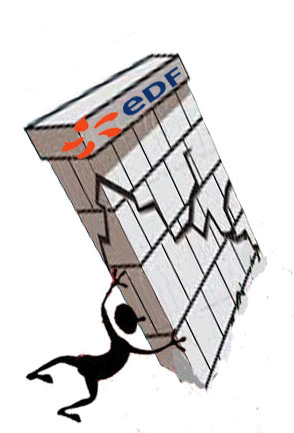
While EDF must invest 460 billion euros over 15 years, its economic model is taking on water.
P.La. with AFP, BFMTV 23rd Sept 2025 https://www.bfmtv.com/economie/entreprises/energie/alors-qu-edf-doit-investir-460-milliards-d-euros-en-15-ans-son-modele-economique-prend-l-eau_AD-202509240079.html
The Court of Auditors has issued a warning about the economic situation of the French energy company, now 100% state-owned. A wall of investment is looming to maintain and renew the group’s nuclear fleet.
The French Court of Auditors is concerned about the financial prospects of the public energy company EDF, calling for “a clear distribution of the financial effort” between the State, EDF and customers, in a report addressed to the Finance Committee of the National Assembly and consulted on Tuesday, September 24.
In this report, first revealed by the media
Contexte , the institution responsible for monitoring the proper use of public funds observes that EDF is “faced with significant uncertainties over its long-term financing capacity”, while it faces investment needs reaching 460 billion euros between 2025 and 2040.
In this context, “EDF’s financing model should, in order to preserve a sustainable financial trajectory for the group, be defined based on a clear distribution of the financial effort between the State, now the sole shareholder, EDF and the end customers,” the magistrates believe.
In detail, EDF plans to allocate 90 billion euros to the maintenance and extension of the existing nuclear fleet, 115 billion euros for the construction of 14 EPR 2 (including 75 for the first six), 15 billion euros for the hydraulic fleet and more than 100 billion euros for the Enedis network, manager of the electricity distribution network.
No more hazards
At the same time, EDF’s profitability will be more exposed “to the vagaries of changes in electricity market prices”, with the end of the regulated system known as Arenh , planned for the end of 2025. EDF intends to replace this system with medium and long-term contracts with electricity suppliers and companies, including high-energy industrial ones.
The Court of Auditors also notes that EDF’s ability to invest will be conditioned “by the operational performance of the nuclear fleet and the success of extending its lifespan.”
The body then recommends “setting, prior to the final investment decision on the EPR2 program, the terms of risk sharing between the State and EDF.” EDF’s final estimate for its EPR2 program should be known at the end of the year.
The Court of Auditors also calls for clarification of the dividend policy that will be applied to EDF and recommends that the group “conduct a strategic review of investments, holdings and subsidiaries.”
Total or partial sales of holdings and subsidiaries would constitute “a financing lever for the group’s investment program,” particularly “in the most unfavorable price scenarios,” argue the magistrates of the Court of Auditors.
Say No to Nuclear Financing – World Bank and ADB, Why Turn Away from the Right Path?
Why this petition matters:
- The World Bank and the Asian Development Bank (ADB) are international financial institutions funded by governments to support economic development, poverty reduction, and infrastructure.
- Until now, both institutions have avoided supporting nuclear power projects for the following reasons:
nuclear proliferation risks- serious concerns over safety
- radioactive waste
- extremely high costs
- On June 10, the World Bank’s Board decided to lift its ban on financing nuclear projects.
- The ADB is currently reviewing its energy policy, and indications suggest it may also move to allow support for nuclear power.
- However, the problems of nuclear power — safety risks, radioactive waste, nuclear proliferation, and high costs — remain unresolved.
- Introducing nuclear power in developing countries would impose major risks and costs not only on today’s citizens but also on future generations.
For these reasons, we are preparing to send the following petition to both the World Bank and ADB. We ask for your support by adding your signature. We will submit all signatures and comments to the World Bank and ADB.
Let’s act together to prevent today’s decisions from burdening tomorrow’s generations.
International Petition: “Say No to Nuclear Financing – World Bank and ADB, Why Turn Away from the Right Path?”
To: Mr. Ajay Banga, President of the World Bank Group
To: Mr. Masato Kanda, President of the Asian Development Bank
We are deeply concerned that the World Bank Group and the Asian Development Bank (ADB) are moving toward lifting the ban on financing and supporting nuclear power projects.
The core reasons why the World Bank and the ADB have long refrained from supporting nuclear energy include inseparable risks of nuclear weapons proliferation and the unresolved problems of radioactive waste. These concerns remain unchanged today. Furthermore, Russia’s invasion of Ukraine has revealed that nuclear power plants can become military targets, adding another serious security threat.
As demonstrated by the Chernobyl and Fukushima Daiichi nuclear disasters, one accident can cause widespread, long-term contamination and serious social and economic disruption.
Even without accidents or attacks, nuclear energy releases radioactive substances into the environment at every stage of its lifecycle—mining, fuel production and processing, operation, decommissioning, and the disposal of spent nuclear fuel. Uranium mining, in particular, has often violated the rights of Indigenous peoples and harmed their health, lands and environment.
Nuclear waste generated from operating nuclear power plants remains hazardous for tens of thousands of years, requiring secure isolation from the biosphere for geological periods of time. Yet most countries still have no disposal site.
Due to “security” considerations, some information related to the planning and construction of nuclear power plants is kept secret. As a result, communities and NGOs often have limited access to crucial safety information. This lack of transparency conflicts with the safeguard policies of international financial institutions which emphasize openness, accountability, and stakeholder consultation.
In recent years, the cost of building nuclear power plants has soared, often reaching tens of billions of USD per unit and increasing several-fold beyond initial estimates. Private investors have shifted away from nuclear power and toward renewable energy, leading to the rapid growth of renewable energy technologies. The high costs of nuclear power – now the most expensive form of new electricity generation – and its requirement for large direct and indirect government subsidies have high opportunity costs, delaying and undermining the needed rapid scale-up of benign renewable energy.
Construction of nuclear power reactors typically takes well over a decade, often more than two, too slow for mitigating the accelerating climate crisis.
We must also recognize the vulnerabilities of nuclear power. As a large, centralized source of electricity, nuclear plants can have far-reaching impacts when they unexpectedly shut down due to accidents or technical problems. In recent years, heatwaves have raised seawater and river temperatures, making it impossible to obtain cooling water in some cases.
Small modular reactors (SMRs) also fail to address many of these concerns, especially those related to fissile material, radioactive wastes, nuclear weapons proliferation risks and economic viability.
Supporting the construction of nuclear power plants in developing countries would impose not only serious long-term dangers but also a massive economic burden on current and future generations in those nations.
We therefore call on the World Bank Group and the ADB to refrain from providing any form of support or financing for nuclear power.
Initial Endorsers:
11 march movement, Belgium
350.org Japan, Japan
Aktionsbündnis STOP Westcastor Jülich, Germany
AKW-nee-Gruppe Aachen, Germany
Alliance for Climate & Ecology, Korea
Australian Conservation Foundation (ACF), Australia
AYUS International Buddhist Cooperation Network/アーユス仏教国際協力ネットワーク, Japan
Belgische Coalitie Stop Uraniumwapens (Belgian part of the International Coalition for a Ban on Uraniumweapons), Belgium
Beyond Nuclear, United States
Bündnis für „Sichere Verwahrung von Atom-Müll, Germany
Centre for Financial Accountability(CFA), India
Citizen’s Eyes on Nuclear Regulation/原子力規制を監視する市民の会, Japan
Citizens’ Commission on Nuclear Energy (CCNE) /原子力市民委員会, Japan
Citizens’ Nuclear Information Center/原子力資料情報室, Japan
Climate Express11 march movement, Belgium
Corner House, United Kingdom
Ecodefense, Russia
Environmental Association “Za Zemiata” – Friends of the Earth Bulgaria, Bulgaria
European Environmental Bureau, Belgium
Forum for Protection of Public Interest (Pro Public) , Nepal
Friends of the Earth Australia, Australia
Friends of the Earth India, India
Friends of the Earth International, International
and so many more ………………………………………………….https://www.change.org/p/say-no-to-nuclear-financing-world-bank-and-adb-why-turn-away-from-the-right-path?recruiter=1386886086&recruited_by_id=c79f25d0-86d4-11f0-b695-9765954ef395&utm_source=share_petition&utm_campaign=petition_dashboard&utm_medium=copylink
The horrors I’ve seen of Ukrainian, NATO-backed, shelling of completely civilian areas of the Donbass throughout 2022 (and 2019, 2023…)

Eva Karene Bartlett. Sep 23, 2025
September three years ago in Donetsk, in the space of 5 days, Ukrainian deliberate shelling of the very centre of the city killed 26 civilians, most of whose bodies or parts of bodies I saw in the streets or in a burnt out bus. These were 100% non military, purely civilian, areas.
*Warning: Some of the footage is not blurred and shows quite clearly Ukraine’s terrorism of Donetsk, in very central areas of the city, where there are no military targets, only Donetsk civilians. see here – https://odysee.com/@EvaKareneBartlett:9/sept-22-shelling:0 ]
On Monday, Ukraine slaughtered 16 civilians, including two children, with 155mm NATO shells, according to the head of the Donetsk People’s Republic (DPR), Denis Pushilin. The projectiles hit two adjacent neighborhoods, decimating residential and commercial areas – including a market that had previously suffered fatal attacks.
…the carnage on Monday was worse than anything I’ve seen in my months of reporting here. Chunks of flesh littered the street – part of a hand, a foot, an ear. Someone had put a dead man’s phone on his stomach. It was ringing, the cheery ringtone incongruous with his lifeless body and the scenes and stench of death around him.
For most people, the concept of war is a distant one, and deaths are normalized by media reporting the numbers of victims and destroyed buildings – so most who hear of civilians being killed don’t really understand what a scene like this looks or smells like.
For the locals, it is also normalized, in its own way, after over eight years of Ukrainian attacks – a tragically grotesque kind of normality, where the post-bombing routine starts soon after the last explosions die down.
…another Ukrainian assault, which took place on Saturday. The center of Donetsk was hit by around ten bombs over the course of 30 minutes around noon. At least four civilians were killed, one of whom I saw still on the ground. Some minutes later, her body was taken away. One of the shells hit a car driving along Artema Street, setting it ablaze and killing two civilians. By the time I reached that site, the vehicle had burned out, the dead taken away. Workers were already repaving the roads, sweeping debris and glass from sidewalks.
On Thursday, again around noon, Ukraine again shelled central Donetsk, this time next to a busy market. The shelling left six people dead on the street and in a burned out bus. This makes at least 26 civilians killed by Ukrainian shelling, with Western weapons, in the space of just one week.
From my overview of these terror bombings: Western media continues to ignore how Ukraine is using NATO weapons to kill innocent civilians in the Donbass
2022 was a very hard year for the Donbass; this 5 day period I mention in September was just a glimpse into the horrors Donbass civilians endured not only throughout 2022 but since Ukraine began bombing them in 2014, long before Russia commenced its Special Military Operation.
Below is most of what I witnessed throughout 2022 (and also some from 2019, 2023) during & following Ukrainian shelling.
In 2022, in April I went to a market in western Donetsk which had been shelled by Ukraine. Two bodies of the five civilians killed in the market were still lying on the ground. I believe this is because–just like Israel does–Ukraine double strikes the same area, meaning rescuers or anyone who comes to help the wounded or clear the bodies could be shelled and killed.
This was a large and very busy market place in a working class district. I’ve been to such markets, in central Donetsk (also bombed by Ukraine) and near the two Russian areas I’ve lived. They are frequented (and many of the stall run by) by grandmothers, by mothers, by civilians, not military. The only thing “strategic” about shelling them is Ukraine’s blood lust to kill Donbass (Russian) civilians. People I encountered that day told me this wasn’t the first time Ukraine shelled the market or the district, they said the shelling was routine.
[ https://odysee.com/@EvaKareneBartlett:9/ukraine-bombed-a-busy-donetsk-market:2 ]
My article on this Ukrainian bombing: Ukrainian strike on Donetsk market was a terrorist act
On May 5, I went to Kirovsk, a city in the Lugansk People’s Republic to the west of Lugansk, Ukrainian forces only a little further west. Kirovsk and surrounding areas have—like throughout both autonomous Donbass republics—since 2014 been shelled by Ukrainian forces.
Just outside the city of Kirovsk, on an otherwise quiet lane, I saw a home hit by Ukrainian shelling on April 26………………………………………………………………………………………………………………………………………………………………………………………………………………………………………. *At the below link you can find many more of my articles & videos, including from Mariupol when the fighting was still ongoing in Azovstal, and later in Mariupol showing the return of life to the city (2022, 2023, 2024).
This Ridiculous, Dangerous Antifa Order Is McCarthyism All Over Again—Possibly Worse

The Trump administration is abusing federal power to silence dissenting voices in a manner that has not been seen in over 70 years. The country survived Sen. Joseph McCarthy, but will it survive what Trump has wrought?
C.J. Polychroniou, Sep 23, 2025Common Dreams, https://www.commondreams.org/opinion/trump-antifa-order
Free speech stole the show last week during the joint press conference between US President Donald Trump and UK Prime Minister Keir Starmer after a British reporter asked point-blank the Yankee wannabe dictator whether free speech is more under attack in Britain or in America, following Jimmy Kimmel’s suspension over Charlie Kirk comments.
At this historical juncture, both Britain and America are at a new low when it comes to freedom of expression. In fact, free speech is under serious attack in most Western societies.
Britain has no equivalent to the First Amendment, but the current draconian speech laws are so outrageous that even traditional liberties are vanishing. British police are arresting people for offensive online speech at record numbers while the right to protest has been severely curtailed.
In Germany, the situation is just as bad, if not worse. Long before recent efforts to stifle pro-Palestinian voices, the country’s laws on freedom of expression stood on tenuous grounds. As the late German jurist Weinfried Brugger noted nearly a quarter of a century ago in a study comparing German and American law on hate speech, if a protester was to shout on the steps of the US Capitol “our President is a pig” and even held painted pictures of the president as a pig “engaged in sexual conduct with another pig in a judge’s robe;” or that “all our soldiers are murders;” or that “the Holocaust never happened,” none of these allegations would lead to criminal prosecution as the First Amendment would protect them. However, criminal law would apply to all of the above messages if the protester made the speech on the steps of the German Bundestag. As further elucidated by Brugger, freedom of speech in Germany is not a “preferred right” and does not deserve “absolute protection.”
For the duration of Trump 2.0, we must be prepared for a barrage of further anti-democratic actions taking aim at any individual, group, or organization whose ideas, beliefs, and actions threaten the ego of the “beloved leader” or simply irritate his idiotic whims
In this sense, conservatives in the US, like Vice President JD Vance, are not totally wrong when they criticize Europe over free speech, even though they are complete hypocrites. Indeed, the problem with Vance and the rest of the MAGA Republicans who are seemingly disturbed by the backsliding of free expression in Europe is that they are not interested in free speech as such; they are interested in controlling it. They only want to protect speech that is aligned with their own ideological beliefs and values. Thus, in his speech to the Munich Security Conference in February, where he scolded Europeans for their failings on free speech, Vance not only spread a lie when he claimed that the Scottish government had sent letters to citizens instructing them that “even private prayer within their own homes may amount to breaking the law” but kept silent about UK government anti-protest legislation, which, as British academic Eric Heinze astutely noted, targets exactly the kind or protests that Trump fears.
Trump returned to the White House with a promise to protect free speech from government censorship. Indeed, just a few hours after his second inauguration, Trump signed Executive Order 14149, titled “Restoring Freedom of Speech and Ending Federal Censorship.” But Trump is a master of doublespeak. His administration has, in turn, carried out a wide-ranging crackdown on universities, student protesters, journalists, lawyers, and the press. The wannabe dictator has accused the press on multiple occasions of being “the enemy of the American people” and has filed personal lawsuits against several news organizations. Under his administration, we are also witnessing the intrusion of the military into civilian life. This type of government action is tantamount to dictatorship, as it constitutes an all-out assault on democracy and the rule of law.
The Trump administration is abusing federal power to silence dissenting voices in a manner that has not been seen since the McCarthy era. Democrats and Republicans alike played the Red Card back in the 1940s and throughout the 1950s in order to silence critics and quash dissent. Trump is doing the same thing by trying to create a climate of fear and suspicion across the country with the boogeyman of the so-called “far left,” especially in the aftermath of Charlie Kirk’s killing.
To be sure, there should be no illusions about the evolution of free speech in the United States. The current situation is by no means unique, and the First Amendment has never been as sacred as people seem to think. Despite its exalted status, the First Amendment has been “a dead letter for much of American history” and did not come to life until the early 20th century. And when it did, freedom of expression suffered some major blows, thanks to World War I, which created a wave of jingoism, and the Bolshevik Revolution in Russia, which gave rise in turn to an anti-communist alarm known as the Red Scare. In Debs v United States, the Supreme Court upheld Deb’s conviction under the Espionage Act of 1917. Eugene Debs, a leading member of the Socialist Party of America, was convicted for his outspoken opposition to US involvement in World War I and sentenced to ten years in federal prison.
Throughout the 1940s and the 1950s, the First Amendment was censored in the shadows as the suppression of political and social views became a widespread occurrence, spearheaded by a second Red Scare and the rise of McCarthyism. The Smith Act, which was passed by Congress and signed by President Roosevelt on June 28, 1940, was used to monitor immigrants and prosecute members of the Communist Party. In 1951, in a 6-2 decision, the Supreme Court delivered a massive blow to the First Amendment by upholding the constitutionality of the Smith Act in Dennis v United States. In 1947, the Truman administration initiated a loyalty program aimed at rooting out “subversives” and getting rid of homosexuals. Such programs were also established for employment in the private sector as well.
It was only in the 1960s, thanks to growing opposition to the Vietnam War and government attempts to curb protests, that the First Amendment entered mass public consciousness in the United States. When a group of students in Des Moines, Iowa, was suspended for wearing black armbands to school in protest of the Vietnam War and in support of a Christmas truce, the students’ parents challenged the suspensions as a violation of free speech. In a landmark victory for student rights and the First Amendment, in a 7-2 decision, the Supreme Court ruled in Tinker v Des Moines (1969) that schools are not “enclaves of totalitarianism” and that “neither students nor teachers shed their constitutional rights to freedom of speech at the schoolhouse gate.” The Pentagon Papers case defended further the right of free speech, although subsequent US administrations, from Ronald Reagan and Barack Obama to Donald Trump, indicted scores of people “for leaking secrets to the press,” as Lincoln Caplan has underscored in an essay for the Harvard Law Bulletin.
The democratic left has stood up for free speech rights throughout its history. It should remain steadfast in its commitment to freedom of expression and fully and unconditionally reject “cancel culture.”
We are not exactly sure who made the remark that “while history doesn’t repeat itself, it often rhymes,” but it surely applies to the free speech case in the United States. We are now in the midst of a new McCarthy era, and possibly worse. In forcing a comedian and television host like Jimmy Kimmel off the airwaves (Disney reinstated his show after five days of suspension), Trump and his goon FCC Chairman Brendan Carr are following in the footsteps of Nazi minister of propaganda Joseph Goebbels who, in 1939, as the New York Times reported, banned five German entertainers because they “made witticisms about the Nazi regime.”
Thus, for the duration of Trump 2.0, we must be prepared for a barrage of further anti-democratic actions taking aim at any individual, group, or organization whose ideas, beliefs, and actions threaten the ego of the “beloved leader” or simply irritate his idiotic whims. The so-called “radical left” will surely be the main target. In the wake of Charlie Kirk’s killing, Trump described the left-wing activist group Antifa a “sick, dangerous, radical left disaster” and signed an executive order designating it a “domestic terrorist organization.”
Antifa (shorthand for “antifascist”) exists around the world but is not a unified organization and has no leader. As such, it is not clear how the US government plans to prosecute Antifa activists. Either way, this is yet another orchestrated attack on political dissent and freedom of speech by the emerging dictatorial regime in Washington, D.C., under the reign of Donald J. Trump.
The democratic left has stood up for free speech rights throughout its history. It should remain steadfast in its commitment to freedom of expression and fully and unconditionally reject “cancel culture.” Censorship of speech is the first step toward political repression, which is precisely why Trump and his goons are now threatening to punish anyone who speaks ill of their newfound martyr, Charlie Kirk.
With nuclear pact in peril, Trump embraces prolonged war in Ukraine
Trump signals that he is no longer invested in ending the Ukraine war. His disinterest in engaging with Moscow could threaten the last nuclear arms control treaty between the US and Russia.
Aaron Maté, Sep 25, 2025
After famously telling Ukrainian counterpart Volodymyr Zelensky that “you don’t have the cards” to defeat Moscow and that territorial concessions are inevitable, President Trump is now singing a different tune.
“I think Ukraine, with the support of the European Union, is in a position to fight and WIN all of Ukraine back in its original form,” Trump wrote on Tuesday. “…We will continue to supply weapons to NATO for NATO to do what they want with them.” The US president also cast doubt on Russia’s military capabilities nearly four years into the invasion. Ukraine “can fight too,” Trump said, “and they’ve proven that maybe it could be that Russia is a paper tiger.”
Zelensky, who has waged a dogged campaign to repair relations with Trump since their White House dust-up in February, welcomed his chief sponsor’s seeming about-face. Trump, the Ukrainian leader said after the two met in New York, “clearly understands the situation and is well-informed about all aspects of this war.”
Yet as all parties to the Ukraine proxy war have learned by now, Trump’s rhetoric tells us very little about how he plans to handle it………………………………………………………………..(Subscribers only)https://www.aaronmate.net/p/with-nuclear-pact-in-peril-trump?utm_source=post-email-title&publication_id=100118&post_id=174489457&utm_campaign=email-post-title&isFreemail=true&r=ln98x&triedRedirect=true&utm_medium=email
Trump to Netanyahu: ‘Here’s another $6 billion to polish off those pesky Palestinians.

Walt Zlotow, West Suburban Peace Coalition, Glen Ellyn IL, 24 Sept 25
President Trump has more important things to accomplish than spend taxpayer treasure on the commons, be it infrastructure, education, health care, green energy to name a few. Nope, top of the list for Trump is gifting his comrade in Palestinian genocide Benjamin Netanyahu with another $6 billion in weaponry to complete Israel’s genocidal ethnic cleansing of Palestinians in Gaza.
The six billion includes 30 AH-64 Apache attack helicopters and 3,250 infantry assault vehicles, just what Netanyahu needs to obliterate Palestinians he doesn’t starve to death. All this with a compliant Congress and Trump’s grisly assistance.
Meanwhile the American public largely ignores the genocide its government enables; indeed could not occur without the tens of billions first Biden and now Trump has gifted Israel in the two years of genocidal ethnic cleansing in Gaza.
Americans should take a page from the Italian public which is putting America to shame with their pushback against their government’s support of the genocide.
Yesterday Italian labor unions led a massive 24-hour general strike to protest Israel’s ongoing genocide in Gaza. Hundreds of thousands in over 75 cities across Italy shut down businesses, schools, train stations and ports.
Protest leaders targeted right-wing Italian Prime Minister Giorgia Meloni, pointing out her complicity in Israeli’s genocide through arms sales to Israel. Meloni has rejected the ICC warrants and said Netanyahu would not be arrested if he enters Italy.
Giuseppe Conte, who leads the independent progressive Five Star Movement charged “Meloni should listen to the voice of those who are peacefully protesting and asking her to act, rather than curling up to Washington to protect her friend, the war criminal Netanyahu. “Meloni should take a stand with the facts against those who have slaughtered 20,000 children, rather than limiting herself to saying, ‘I do not agree.’ And she should stop running away from the debate in Parliament.”
The Italian pushback is more symbolic than substantive since Italy’s Prime Minister Meloni is a small player in genocide enabling compared to America’s monstrous, decisive role.
Wake up Americans. Replicate the Italian general strike here and even ravenous genocide enabler Trump, his ghoulish genocide advisors and our deplorable Congress might have to take notice and pivot to peace.
UK to build 12 advanced “small ” modular nuclear plants in £10bn plan

COMMENT. A lovely glowing picture of this proposed wonderful source of electricity. But they’re very coy about telling us about the real cost of it all, the dangerous new radioactive fuel type, and the size of these so-called “small” nuclear reactors. And of course – not a mention of their radioactive wastes
COMMENT. A lovely glowing picture of this proposed wonderful source of electricity. But they’re very coy about telling us about the real cost of it all, the dangerous new radioactive fuel type, and the size of these so-called “small” nuclear reactors. And of course – not a mention of their radioactive wastes
Bernard Gray, 21 Sept 25, https://observer.co.uk/news/business/article/uk-to-build-12-nuclear-plants-in-10bn-plan
At a projected cost of £10bn – a rough estimate that could well balloon – two companies, Centrica, the parent of British Gas, and X-energy, a US startup, are proposing to develop and build a completely novel type of nuclear power plant.
The technical challenges for the two businesses are huge; the financial challenges perhaps even more so. Centrica is a large company with a big balance sheet, but it has limited nuclear experience. X-energy is a startup with some nuclear expertise, but which has raised only about $1bn in private capital and $1.2bn from the US energy department since the company was founded in 2009.
Far more money than that will be needed to complete the design, while the build of the fuel plant and demonstrator reactors will also cost an order of magnitude more.
Finishing the detailed design of both reactor and fuel plant, and getting them licensed to be built, is a work in progress but it will not be quick. X-energy has tried to boost its financial resources by partnering with potential users: the first is chemical producer Dow, for which X-energy is proposing to build a station to power a plant on the Texas Gulf coast.
Amazon has also invested in the company, and there is talk of power stations running Amazon datacentres in the Pacific north-west. The online retailer led investors in raising $700m to fund the next stage of X-energy’s development.
It is in this context that the Hartlepool proposal sits. The UK station would be the largest X-energy has attempted and Centrica has agreed to invest an undisclosed sum into the scheme.
The two companies are also seeking other equity investors. But even so, this will not be enough to fund even the completion of design development, let alone the build.
No UK government money is being proposed at this point, but Chris O’Shea, chief executive of Centrica, floated the idea last week that the project could be funded by a similar mechanism to the newly agreed Sizewell C reactor.
Under this plan, the £10bn that he says would be required to fund building would be added incrementally to all UK consumers’ electricity bills, to provide cashflow during construction. If that is what happens, then far from being an inward investment, UK consumers will have provided assistance to develop a US reactor design that it can sell elsewhere. The hurdles that have to be cleared to get to that point are, however, huge.
The design being proposed is unlike anything before seen on an electricity grid. Instead of the usual large fuel rods sitting in a highly pressurised water bath, this will use tennis-ball-sized pebbles of nuclear fuel to create the reaction, cooled by a flow of helium.
The idea for this kind of power station has been around for more than half a century, but it has never before been used in a commercial operation. It has some advantages over normal water-cooled reactors. The helium coolant does not pick up radioactivity so, unlike water, the design does not spread radioactivity beyond the fuel pebbles.
The pebbles are composed of agglomerations of much smaller ball bearings, each of which is like a Russian doll: shells within shells. The composition of these allows the fuel to act as its own barrier, stopping it melting and avoiding the need for a thick steel pressure cooker to make sure that any accident does not cause a huge environmental disaster, such as those at Chornobyl or Fukushima.
However, there are technical difficulties that have stopped this design being used before. The fuel is extremely complex and expensive to make. Some of the materials required are very scarce, including the nuclear component itself, which would mostly be available from Russia. It is far from clear that this kind of reactor can be commercially competitive against more traditional designs.
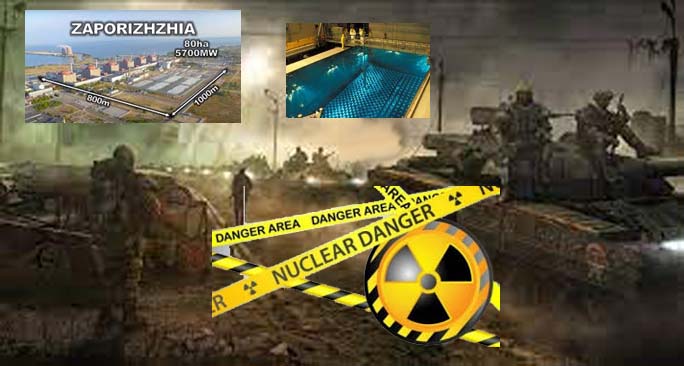
Zaporizhzhia nuclear plant loses all off-site power, risking safety
Xinhua 2025-09-24, https://global.chinadaily.com.cn/a/202509/24/WS68d35d8ba3108622abca294f.html
VIENNA – The Zaporizhzhia Nuclear Power Plant lost all off-site power on Tuesday, showcasing persistent risks to nuclear safety, according to a UN nuclear watchdog.
The power loss was the 10th time during the conflict between Russia and Ukraine, the International Atomic Energy Agency said Tuesday on social platform X, adding that its team is investigating the cause of the incident.
The agency’s Director General Rafael Grossi said later that day that emergency diesel generators had started operating to supply the plant with power, citing its team at Zaporizhzhia.
Zaporizhzhia’s six reactors have been in cold shutdown since 2024 but still require cooling water for their reactor cores and spent fuel pools. Before the conflict, it had 10 off-site power lines available.
1 This Month
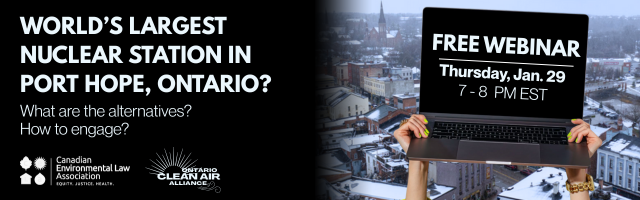
29 Jan. Thursday 7-8 p.m. Webinar – World’s Largest Nuclear Station in Port Hope, ON?
To see nuclear-related stories in greater depth and intensity – go to https://nuclearinformation.wordpress.com/
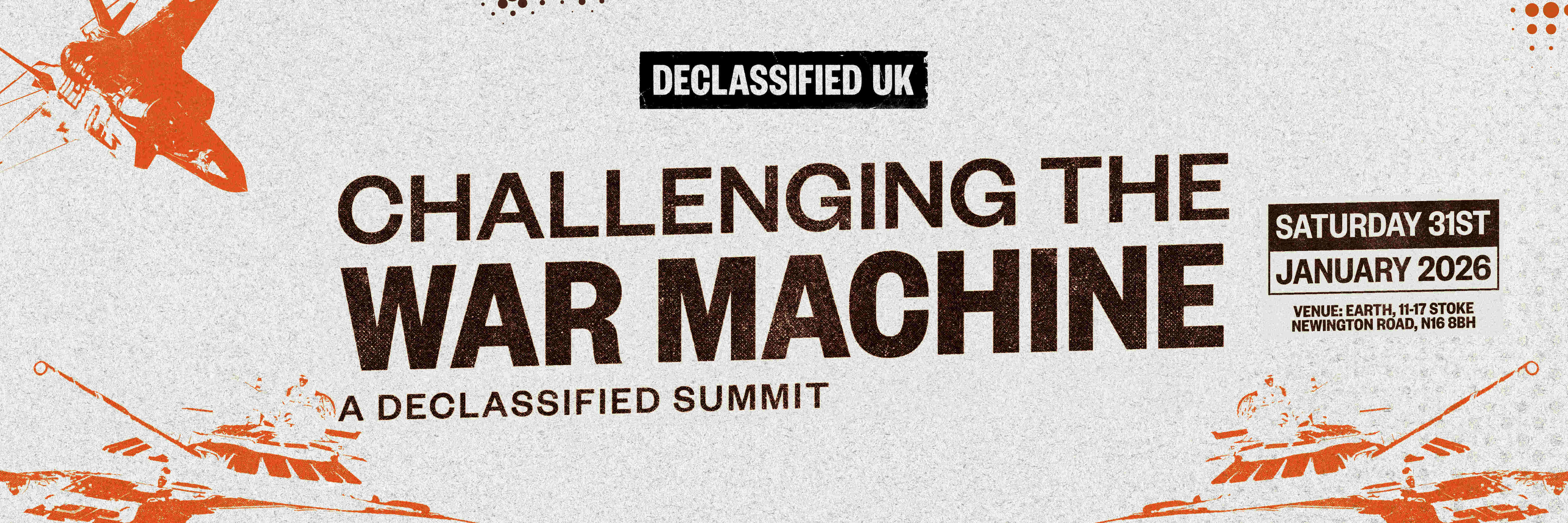
31st January – Challenging the War Machine – a DECLASSIFIED UK SUMMIT

Website of the Week
Now until to February 10, 2026 Radioactive waste storage in France: the debate is finally open! How to participate?
-
Archives
- January 2026 (288)
- December 2025 (358)
- November 2025 (359)
- October 2025 (376)
- September 2025 (258)
- August 2025 (319)
- July 2025 (230)
- June 2025 (348)
- May 2025 (261)
- April 2025 (305)
- March 2025 (319)
- February 2025 (234)
-
Categories
- 1
- 1 NUCLEAR ISSUES
- business and costs
- climate change
- culture and arts
- ENERGY
- environment
- health
- history
- indigenous issues
- Legal
- marketing of nuclear
- media
- opposition to nuclear
- PERSONAL STORIES
- politics
- politics international
- Religion and ethics
- safety
- secrets,lies and civil liberties
- spinbuster
- technology
- Uranium
- wastes
- weapons and war
- Women
- 2 WORLD
- ACTION
- AFRICA
- Atrocities
- AUSTRALIA
- Christina's notes
- Christina's themes
- culture and arts
- Events
- Fuk 2022
- Fuk 2023
- Fukushima 2017
- Fukushima 2018
- fukushima 2019
- Fukushima 2020
- Fukushima 2021
- general
- global warming
- Humour (God we need it)
- Nuclear
- RARE EARTHS
- Reference
- resources – print
- Resources -audiovicual
- Weekly Newsletter
- World
- World Nuclear
- YouTube
-
RSS
Entries RSS
Comments RSS
 nuclear-news